If you or a loved one suffered injuries, property damage, or other financial losses due to another party’s actions, you may be entitled to compensation for those losses.
Contact the experienced Chicago personal injury lawyers from TorHoerman Law for a free, no-obligation Chicago personal injury lawsuit case consultation today.
If you or a loved one suffered a personal injury or financial loss due to a car accident in Chicago, IL – you may be entitled to compensation for those damages.
Contact an experienced Chicago auto accident lawyer from TorHoerman Law today to see how our firm can serve you!
If you or a loved one have suffered injuries, property damage, or other financial losses due to a truck accident in Chicago, IL – you may qualify to take legal action to gain compensation for those injuries and losses.
If you or a loved one suffered an injury in a motorcycle accident in Chicago or the greater Chicagoland area – you may be eligible to file a Chicago motorcycle accident lawsuit.
If you have been involved in a bicycle accident in Chicago at no fault of your own and you suffered injuries as a result, you may qualify to file a Chicago bike accident lawsuit.
Chicago is one of the nation’s largest construction centers.
Thousands of men and women work on sites across the city and metropolitan area on tasks ranging from skilled trades to administrative operations.
Unfortunately, construction site accidents are fairly common.
Contact TorHoerman Law to discuss your legal options with an experienced Chicago construction accident lawyer, free of charge and no obligation required.
Nursing homes and nursing facilities should provide a safe, supportive environment for senior citizens, with qualified staff, nurses, and aids administering quality care.
Unfortunately, nursing home abuse and neglect can occur, leaving residents at risk and vulnerable.
Contact an experienced Chicago nursing home abuse lawyer from TorHoerman Law today for a free consultation to discuss your legal options.
If you are a resident of Chicago, or the greater Chicagoland area, and you have a loved one who suffered a fatal injury due to another party’s negligence or malpractice – you may qualify to file a wrongful death lawsuit on your loved one’s behalf.
When a child is injured at a daycare center, parents are left wondering who can be held liable, who to contact for legal help, and how a lawsuit may pan out for them.
If your child has suffered an injury at a daycare facility, you may be eligible to file a daycare injury lawsuit.
Contact a Chicago daycare injury lawyer from TorHoerman Law today for a free consultation to discuss your case and potential legal action!
If you or a loved one suffered injuries, property damage, or other financial losses due to another party’s actions, you may be entitled to compensation for those losses.
Contact the experienced Edwardsville personal injury lawyers from TorHoerman Law for a free, no-obligation Edwardsville personal injury lawsuit case consultation today.
If you or a loved one suffered a personal injury or financial loss due to a car accident in Edwardsville, IL – you may be entitled to compensation for those damages.
If you or a loved one have suffered injuries, property damage, or other financial losses due to a truck accident in Edwardsville, IL – you may qualify to take legal action to gain compensation for those injuries and losses.
If you or a loved one suffered an injury in a motorcycle accident in Edwardsville – you may be eligible to file an Edwardsville motorcycle accident lawsuit.
If you have been involved in a bicycle accident in Edwardsville at no fault of your own and you suffered injuries as a result, you may qualify to file an Edwardsville bike accident lawsuit.
Nursing homes and nursing facilities should provide a safe, supportive environment for senior citizens, with qualified staff, nurses, and aids administering quality care.
Unfortunately, nursing home abuse and neglect can occur, leaving residents at risk and vulnerable.
If you are a resident of Edwardsville and you have a loved one who suffered a fatal injury due to another party’s negligence or malpractice – you may qualify to file a wrongful death lawsuit on your loved one’s behalf.
When a child is injured at a daycare center, parents are left wondering who can be held liable, who to contact for legal help, and how a lawsuit may pan out for them.
If your child has suffered an injury at a daycare facility, you may be eligible to file a daycare injury lawsuit.
Contact an Edwardsville daycare injury lawyer from TorHoerman Law today for a free consultation to discuss your case and potential legal action!
If you or a loved one suffered injuries on someone else’s property in Edwardsville IL, you may be entitled to financial compensation.
If property owners fail to keep their premises safe, and their negligence leads to injuries, property damages or other losses as a result of an accident or incident, a premises liability lawsuit may be possible.
If you or a loved one suffered injuries, property damage, or other financial losses due to another party’s actions, you may be entitled to compensation for those losses.
Contact the experienced St. Louis personal injury lawyers from TorHoerman Law for a free, no-obligation St. Louis personal injury lawsuit case consultation today.
If you or a loved one suffered a personal injury or financial loss due to a car accident in St. Louis, IL – you may be entitled to compensation for those damages.
If you or a loved one have suffered injuries, property damage, or other financial losses due to a truck accident in St. Louis, IL – you may qualify to take legal action to gain compensation for those injuries and losses.
If you or a loved one suffered an injury in a motorcycle accident in St. Louis or the greater St. Louis area – you may be eligible to file a St. Louis motorcycle accident lawsuit.
If you have been involved in a bicycle accident in St. Louis at no fault of your own and you suffered injuries as a result, you may qualify to file a St. Louis bike accident lawsuit.
St. Louis is one of the nation’s largest construction centers.
Thousands of men and women work on sites across the city and metropolitan area on tasks ranging from skilled trades to administrative operations.
Unfortunately, construction site accidents are fairly common.
Contact TorHoerman Law to discuss your legal options with an experienced St. Louis construction accident lawyer, free of charge and no obligation required.
Nursing homes and nursing facilities should provide a safe, supportive environment for senior citizens, with qualified staff, nurses, and aids administering quality care.
Unfortunately, nursing home abuse and neglect can occur, leaving residents at risk and vulnerable.
If you are a resident of St. Louis, or the greater St. Louis area, and you have a loved one who suffered a fatal injury due to another party’s negligence or malpractice – you may qualify to file a wrongful death lawsuit on your loved one’s behalf.
When a child is injured at a daycare center, parents are left wondering who can be held liable, who to contact for legal help, and how a lawsuit may pan out for them.
If your child has suffered an injury at a daycare facility, you may be eligible to file a daycare injury lawsuit.
Contact a St. Louis daycare injury lawyer from TorHoerman Law today for a free consultation to discuss your case and potential legal action!
The Ozempic lawsuit centers on allegations that Novo Nordisk failed to adequately warn consumers about serious risks associated with Ozempic and other GLP-1 medications.
Plaintiffs allege the drug has been linked to severe gastrointestinal injuries, including gastroparesis, as well as vision loss and other complications that have disrupted patients’ health, nutrition, employment, and daily functioning.
If you or a loved one developed gastroparesis, bowel obstruction, severe vomiting, vision loss, or other serious complications after taking Ozempic or another GLP-1 medication, you may have legal options.
Dupixent lawsuits allege that patients treated with dupilumab therapy later developed cutaneous T-cell lymphoma (CTCL), a rare form of non-Hodgkin lymphoma that can closely resemble severe eczema.
Research and published case reports have raised questions about whether some patients with atopic dermatitis face a higher risk of developing CTCL compared to similar patients who did not receive the drug.
Plaintiffs contend that Sanofi and Regeneron failed to warn patients and physicians about the possibility that Dupixent could worsen, accelerate, or reveal previously undiagnosed cutaneous lymphoma.
If you or a loved one has suffered a severe reaction or blood cancer linked to Dupixent, you may be eligible to take action and file a Dupixent lawsuit.
Suboxone, a medication often used to treat opioid use disorder (OUD), has become a vital tool which offers a safer and more controlled approach to managing opioid addiction.
Despite its widespread use, Suboxone has been linked to severe tooth decay and dental injuries.
Suboxone Tooth Decay Lawsuits claim that the companies failed to warn about the risks of tooth decay and other dental injuries associated with Suboxone sublingual films.
The chemotherapy drug Taxotere, commonly used for breast cancer treatment, has been linked to severe eye injuries, permanent vision loss, and permanent hair loss.
Taxotere Lawsuits are being filed by breast cancer patients and others who have taken the chemotherapy drug and subsequently developed vision problems.
If you or a loved one used Taxotere and subsequently developed vision damage or other related medical problems, you may be eligible to file a Taxotere Lawsuit and seek financial compensation.
Tylenol (Acetaminophen), one of the most popular over the counter medications for pain relief and high fever, has been associated with an increased risk of Autism Spectrum Disorder (ASD), Attention Deficit Hyperactivity Disorder (ADHD), and other developmental disorders in children exposed to Acetaminophen during pregnancy.
Legal claims against manufacturers and distributors of generic Acetaminophen have been investigated on behalf of pregnant women who used Tylenol during pregnancy and children who developed disorders such as Autism Spectrum Disorder, ADHD, and more.
Spinal cord stimulator lawsuit claims allege that these devices are defectively designed and improperly marketed without adequate warnings, leading to severe injuries for patients.
TorHoerman Law is investigating claims involving spinal cord stimulators that allegedly caused serious injury instead of the relief patients were led to expect.
If you or a loved one experienced complications following spinal cord stimulator surgery, you may be eligible to pursue compensation through a spinal cord stimulator lawsuit.
Several studies have found a correlation between heavy social media use and mental health challenges, especially among younger users.
Social media harm lawsuits claim that social media companies are responsible for onsetting or heightening mental health problems, eating disorders, mood disorders, and other negative experiences of teens and children
You may be eligible to file a Social Media Mental Health Lawsuit if you are the parents of a teen, or teens, who attribute their use of social media platforms to their mental health problems.
Thousands of Uber sexual assault claims have been filed by passengers who suffered violence during rides arranged through the platform.
The ongoing Uber sexual assault litigation spans both federal law and California state court, with a consolidated Uber MDL (multi-district litigation) currently pending in the Northern District of California.
Uber sexual assault survivors across the country are coming forward to hold the company accountable for negligence in hiring, screening, and supervising drivers.
If you or a loved one were sexually assaulted, sexually battered, or faced any other form of sexual misconduct from an Uber driver, you may be eligible to file an Uber Sexual Assault Lawsuit.
Roblox lawsuit claims center on allegations that the platform allowed predators to groom, exploit, and abuse children through unsafe design and inadequate protections.
TorHoerman Law is dedicated to helping families who believe their child was harmed on Roblox pursue justice and financial recovery.
For many families, legal action represents both a path to compensation and a way to demand systemic change in how Roblox treats the safety of its youngest players.
If your child was sexually abused, exploited, or exposed to harmful content through Roblox, you may be eligible to take legal action by filing a lawsuit against Roblox Corporation.
Although pressure cookers were designed to be safe and easy to use, a number of these devices have been found to have a defect that can lead to excessive buildup of internal pressure.
The excessive pressure may result in an explosion that puts users at risk of serious injuries such as burns, lacerations, an even electrocution.
If your pressure cooker exploded and caused substantial burn injuries or other serious injuries, you may be eligible to file a Pressure Cooker Lawsuit and secure financial compensation for your injuries and damages.
Olympus Scope lawsuit claims center on allegations that certain reusable Olympus endoscopes and related accessories exposed patients to dangerous bacterial contamination after medical procedures.
These infections can lead to hospitalization, IV antibiotic treatment, sepsis, organ failure, and death, leaving many patients with serious medical complications and lasting physical harm.
You may qualify to file an Olympus scope lawsuit if you underwent an ERCP or another endoscopic procedure involving Olympus equipment and later developed a serious bacterial infection.
Families who lost a loved one after infection-related complications linked to an Olympus scope procedure may also be able to pursue a wrongful death claim.
Vaginal Mesh Lawsuits are being filed against manufacturers of transvaginal mesh products for injuries, pain and suffering, and financial costs related to complications and injuries of these medical devices.
Over 100,000 Transvaginal Mesh Lawsuits have been filed on behalf of women injured by vaginal mesh and pelvic mesh products.
If you or a loved one have suffered serious complications or injuries from vaginal mesh, you may be eligible to file a Vaginal Mesh Lawsuit.
Breast mesh lawsuits involve allegations that certain mesh products used during breast reconstruction, augmentation, and lift procedures contributed to postoperative complications and the need for revision surgeries.
Patients who experienced complications after mesh-assisted breast procedures have reported chronic pain, reconstruction problems, cosmetic deformities, and additional revision surgeries.
If you or a loved one experienced serious complications after breast surgery involving mesh or an internal bra technique, you may be eligible to pursue a breast mesh lawsuit claim for the harm caused.
Patients with the PowerPort devices may possibly be at a higher risk of serious complications or injury due to a catheter failure, according to lawsuits filed against the manufacturers of the Bard PowerPort Device.
If you or a loved one have been injured by a Bard PowerPort Device, you may be eligible to file a Bard PowerPort Lawsuit and seek financial compensation.
The AngioDynamics port catheter lawsuit claims that defective implantable ports have caused patients to suffer dangerous fractures, blood clots, and infections due to the breakdown of the catheter’s material inside the body.
These failures can lead to life-threatening complications such as embolism, sepsis, or the need for surgical removal of the device.
If you or a loved one experienced severe complications such as blood clots, infections, or catheter fractures requiring surgery due to a defective AngioDynamics port catheter, you may be eligible to file an AngioDynamics Port Catheter Lawsuit and seek compensation.
NEC Lawsuit claims allege that certain formulas given to infants in NICU settings increase the risk of necrotizing enterocolitis (NEC) – a severe intestinal condition in premature infants.
Parents and guardians are filing NEC Lawsuits against baby formula manufacturers, alleging that the formulas contain harmful ingredients leading to NEC.
Despite the claims, Abbott and Mead Johnson deny the allegations, arguing that their products are thoroughly researched and dismissing the scientific evidence linking their formulas to NEC, while the FDA issued a warning to Abbott regarding safety concerns of a formula product.
You may be eligible to file a Toxic Baby Formula NEC Lawsuit if your child received baby bovine-based (cow’s milk) baby formula in the maternity ward or NICU of a hospital and was subsequently diagnosed with Necrotizing Enterocolitis (NEC).
Paraquat, a widely-used herbicide, has been linked to Parkinson’s disease, leading to numerous Paraquat Parkinson’s Disease Lawsuits against its manufacturers for failing to warn about the risks of chronic exposure.
Due to its toxicity, the EPA has restricted the use of Paraquat and it is currently banned in over 30 countries.
You may be eligible to file a Paraquat Lawsuit if you or a loved one were exposed to Paraquat and subsequently diagnosed with Parkinson’s Disease or other related health conditions.
Ethylene Oxide Lawsuit claims center on allegations that Sterigenics U.S., LLC and other defendants negligently released hazardous levels of ethylene oxide (EtO), exposing nearby residents and workers to a known carcinogen linked to breast cancer, leukemia, lymphoma, and other serious illnesses.
If you or a loved one were diagnosed with cancer or other serious health problems associated with exposure to ethylene oxide and lived near a facility with known emissions, you may be eligible to file an Ethylene Oxide Lawsuit and seek financial compensation.
Nitrous oxide lawsuit claims center on manufacturers, distributors, and retailers who profit from selling canisters that are widely misused as a recreational drug.
Reports link this misuse to severe neurological injuries, psychiatric symptoms, hypoxia, and deaths caused by accidents or overdose.
These cases are rapidly expanding as more evidence emerges of the profound physical, psychological, and social toll caused by nitrous oxide misuse.
If you or a loved one has suffered brain injuries, spinal cord or nerve damage, psychiatric symptoms, or even death linked to misused nitrous oxide, you may be eligible to pursue a nitrous oxide lawsuit claim and seek compensation for the harm caused.
Diacetyl popcorn lung lawsuit claims center on allegations that repeated inhalation of butter-flavoring chemicals in certain workplaces, including diacetyl and related substitutes, caused permanent and preventable airway damage.
Popcorn lung, medically known as bronchiolitis obliterans or constrictive bronchiolitis, is a serious obstructive lung disease that scars and narrows the small airways, leaving many people with persistent shortness of breath, chronic cough, and reduced exercise tolerance.
TorHoerman Law has experience handling diacetyl popcorn lung cases and is currently reviewing claims from workers who believe occupational exposure to these flavoring chemicals contributed to their diagnosis.
If you or a loved one were diagnosed with diacetyl induced lung disease or bronchiolitis obliterans, you may have grounds to pursue a diacetyl popcorn lung lawsuit for the harm caused to your lung tissue and long-term lung function.
Our firm is about people. That is our motto and that will always be our reality.
We do our best to get to know our clients, understand their situations, and get them the compensation they deserve.
At TorHoerman Law, we believe that if we continue to focus on the people that we represent, and continue to be true to the people that we are – justice will always be served.
Without our team, we would’nt be able to provide our clients with anything close to the level of service they receive when they work with us.
The TorHoerman Law Team commits to the sincere belief that those injured by the misconduct of others, especially large corporate profit mongers, deserve justice for their injuries.
Our team is what has made TorHoerman Law a very special place since 2009.
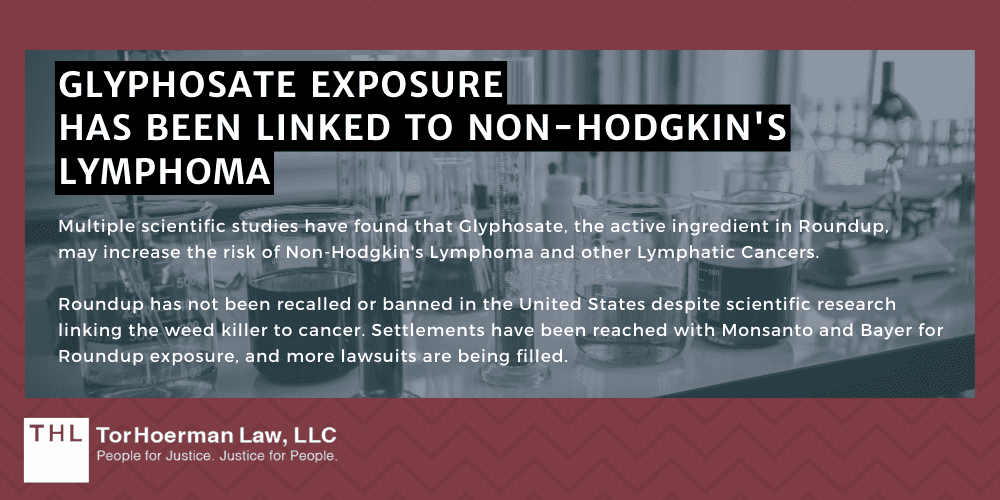
The Roundup lawsuit claims that Monsanto's popular weed killer, Roundup, causes cancer. The main ingredient, glyphosate, has been linked to Non-Hodgkin's Lymphoma.
Numerous studies and the International Agency for Research on Cancer (IARC) have classified glyphosate as a probable human carcinogen. Despite this, Monsanto continues to deny these claims.
Victims of Roundup exposure who developed cancer are filing lawsuits against Monsanto, seeking compensation for medical expenses, pain, and suffering.
No Longer Accepting Claims
Roundup Lawsuit Facts
TorHoerman Law is no longer accepting claims for the Roundup Lawsuit.
Intake Closed
Most Recent Updates
4,508 Roundup Lawsuits are consolidated in federal court, filed mainly by farm workers and landscapers claiming health issues like non-Hodgkin's lymphoma from glyphosate exposure.
Bayer is seeking state legislation to obtain legal immunity from cancer claims related to Roundup, arguing that compliance with EPA regulations should suffice.
Our Roundup Lawyers are reviewing potential claims from individuals diagnosed with non-hodgkin's lymphoma and other diseases potentially caused by Roundup exposure.
TorHoerman Law - The Premier Roundup Lawsuit Attorneys
The active ingredient in Roundup (Glyphosate) has been linked to an increased cancer risk, specifically Non Hodgkin’s Lymphoma.
Roundup Lawsuits are being filed against BayerAG and Monsanto for failing to warn consumers about the dangers of Roundup exposure.
Over 80% of Roundup Lawsuits, which amount to over 100,000 cases, have been settled.
The landmark $10 billion settlement agreement includes $1.25 billion for future Roundup claims.
If you or a loved one suffered injuries resulting from Roundup weed killer exposure, you may qualify to participate in a Roundup lawsuit.
Contact an experienced Roundup lawyer to discuss your legal options today, free of charge and no obligation required.
The decrease in the Roundup MDL, the docket falling from 4,511 in January to 3,902 in February, largely reflects the impact of large-scale settlements and case resolutions as Bayer/Monsanto has already settled or otherwise resolved tens of thousands of Roundup claims nationwide.
Bayer agreed to settle over 100,000 Roundup cases in a global settlement worth roughly $8.8–$10.9 billion, and many of those resolved claims are now being administratively removed from the federal MDL as part of settlement processing and docket clean-up.
This pattern, where resolved cases exit the MDL in bulk, explains why the total pending case count declined significantly in February.
If you or a loved one suffered injuries resulting from Roundup weed killer exposure, you may qualify to participate in a Roundup lawsuit.
Contact an experienced Roundup lawyer to discuss your legal options today, free of charge and no obligation required.
January 5th, 2026: Roundup Weed Killer Lawsuit January JPML Filing Update
The Roundup Weed Killer lawsuit recorded an increase in total multidistrict litigation (MDL) cases from December 2025 to January 2026.
According to the retraction notice and recent reports, Monsanto funded the article and helped draft it, even though the authors presented it as independent research.
The journal cited undisclosed conflicts of interest and ethical issues as the reason for the retraction.
Internal company documents released during Roundup litigation revealed that Monsanto scientists participated in outlining, editing, and shaping the manuscript, while outside academics were credited as the named authors.
The study has been used in regulatory submissions and court filings for years to support glyphosate’s safety profile.
Its retraction removes a key source that defendants relied on and adds to the evidence questioning the credibility of industry-backed science used to defend Roundup in cancer lawsuits.
December 2nd, 2025: Roundup Weed Killer Lawsuit December JPML Filing Update
The Roundup Weed Killer lawsuit experienced an increase in total multidistrict litigation (MDL) cases between November 2025 and December 2025.
The docket rose from 4,490 cases in November 2025 to 4,508 cases in December 2025, resulting in 18 new filings.
The Roundup Weed Killer lawsuit involves allegations that long-term exposure to glyphosate, the active ingredient in the Roundup herbicide, caused non-Hodgkin lymphoma and related cancers.
Plaintiffs assert that product labeling and safety disclosures did not adequately warn users about carcinogenic risks associated with glyphosate exposure.
If you or a loved one suffered injuries resulting from Roundup weed killer exposure, you may qualify to participate in a Roundup lawsuit.
Contact an experienced Roundup lawyer to discuss your legal options today, free of charge and no obligation required.
November 26th, 2025: November 2025 Roundup Lawsuit Update
A California appellate court has affirmed a $28 million verdict against Bayer in a Roundup cancer case, dealing another legal blow to the company amid its ongoing efforts to settle thousands of glyphosate-related lawsuits nationwide.
$28 Million Verdict Affirmed in California
Last week, the court upheld a $28 million judgment in favor of a plaintiff who alleged that Bayer’s Roundup weedkiller caused their cancer.
This comes as Bayer has been working to resolve a wave of large verdicts and appeals across the U.S., including recent settlements in Georgia, Philadelphia, and other jurisdictions.
Impact on Pending Litigation
The affirmed verdict is significant because it arrived just as Bayer has begun withdrawing appeals and entering settlements in several major cases.
Legal analysts suggest Bayer likely regrets not settling this California case before the appellate opinion was issued.
Outlook for Future Trials
No new Roundup trials are expected in the immediate future.
Attorneys anticipate that proceedings will remain paused while awaiting clarification on whether the U.S. Supreme Court will hear the key preemption issue, a legal argument that could affect Bayer’s liability under federal law.
Bayer’s Position Moving into 2026
After a difficult year in the courtroom, Bayer CEO Bill Anderson has committed to making progress in 2026 on resolving the remaining lawsuits.
The company continues to face pressure from plaintiffs and the public as Roundup litigation draws closer to a potential conclusion.
More updates are expected as the new year approaches and strategic decisions unfold regarding unresolved claims.
November 20th, 2025: Bayer Withdraws Appeals in Major Roundup Verdicts
Bayer has withdrawn several key appeals in high-profile Roundup cancer lawsuits, signaling a potential shift in strategy as litigation pressure builds.
The company notably dropped its appeal of the $2.1 billion Georgia verdict, one of the largest awards in the ongoing litigation.
In addition, Bayer has also abandoned its appeals of three plaintiff victories out of the Philadelphia Court of Common Pleas.
These moves may indicate Bayer’s intent to resolve remaining Roundup appeals rather than pursue further courtroom battles.
Legal observers suggest this could be part of a broader effort to stem escalating trial risks and jury awards.
If this strategy continues, it may mean fewer future Roundup cases go before a jury, and potentially signal the approaching resolution of the nationwide litigation.
Attorneys following the litigation are now watching closely to see whether Bayer will continue this pattern and begin settling more of the remaining cases.
November 14th, 2025: Georgia Plaintiff Reaches Settlement With Monsanto After $2.1 Billion Roundup Verdict Is Vacated
Bayer AG has reached a confidential settlement with plaintiff John Barnes in a Georgia Roundup Lawsuit after a Cobb County jury issued a $2.1 billion verdict earlier this year.
Court filings confirm that Barnes and Monsanto agreed to vacate the judgment in exchange for an undisclosed settlement amount.
The jury awarded Barnes $65 million in compensatory damages and $2 billion in punitive damages based on evidence alleging that Monsanto failed to disclose cancer risks associated with Roundup exposure.
Barnes attributed his cancer diagnosis to long-term Roundup use and argued that Monsanto engaged in a misinformation campaign to downplay carcinogenic risks identified in internal materials dating back to the 1980s.
According to Law360, Monsanto continues to deny liability but stated that it will consider settlements when doing so aligns with broader litigation strategy.
The settlement also resolves additional Roundup Lawsuits involving adverse verdicts covered under Bayer’s existing litigation provisions.
The statute takes effect in January and deems any federally approved warning label sufficient for liability purposes.
The law excludes pesticides for which the U.S. Environmental Protection Agency determines that a manufacturer withheld or misrepresented material safety information.
Legislative activity in Georgia reflects a broader nationwide trend in which state governments evaluate the interaction between federal pesticide regulation and product liability claims.
Roundup lawsuits continue to proceed nationwide.
Monsanto has faced more than 100,000 product liability claims alleging injuries linked to Roundup exposure.
Jury awards have varied significantly across jurisdictions, including Pennsylvania, Missouri, and other states.
November 4th, 2025: Bayer Finalizes $38 Million Settlement With Investors Over Monsanto Litigation Risks
The investors, including major pension funds, alleged Bayer downplayed the scope of Roundup-related cancer litigation, which inflated the stock prices of its American depositary receipts traded in the United States.
U.S. District Judge Richard Seeborg granted final approval to the agreement after years of litigation in which Bayer failed to dismiss the case or block class certification.
The court also awarded plaintiffs’ counsel at Cohen Milstein Sellers & Toll PLLC 9.3 million dollars in attorney fees and 3.2 million dollars in expenses.
Judge Seeborg described the case as “hard fought” and noted that settling spared investors from complex trial arguments about whether U.S. securities laws applied to transactions involving a foreign company’s ADRs.
Lead counsel Carol Gilden said the settlement confirms that foreign corporations can be held accountable under U.S. securities laws when they mislead domestic investors.
Bayer, which admitted no wrongdoing, stated it was pleased to resolve the matter and move forward.
The certified class includes investors who purchased Bayer ADRs between May 23, 2016, and July 6, 2020.
If you or a loved one suffered injuries resulting from Roundup weed killer exposure, you may qualify to participate in a Roundup lawsuit.
Contact an experienced Roundup lawyer to discuss your legal options today, free of charge and no obligation required.
This minor increase keeps the total just below the 4,500 mark.
Plaintiffs allege that exposure to glyphosate, the active ingredient in Roundup, caused non-Hodgkin’s lymphoma.
The MDL continues to move through pretrial litigation, with recent activity focused on expert testimony and case-specific discovery.
October 11th, 2025: Missouri Supreme Court Upholds $600 Million Judgment Against Bayer
The Missouri Supreme Court has declined to review a $600 million judgment against Bayer in a Roundup cancer lawsuit, affirming lower court rulings that found the herbicide causes non-Hodgkin lymphoma.
The decision concludes one of the few Roundup Lawsuits in Missouri to reach final judgment and adds to Bayer’s growing financial and legal challenges tied to glyphosate-based weed killers.
The case originated in Cole County, where a 2023 jury awarded four plaintiffs $1.56 billion in damages.
Circuit Judge Daniel Green later reduced the total to $611 million, a decision upheld by the Western District Court of Appeals in May. The Supreme Court’s refusal to hear Bayer’s appeal effectively ends the litigation at the state level.
The jury determined that Monsanto, and later Bayer, failed to warn consumers about cancer risks and that Roundup’s formulation was defective.
Punitive damages made up the majority of the award, which will continue to accrue 9% annual interest until paid, now exceeding $700 million.
Under Missouri law, half of the punitive damages will go to the state’s Tort Victims Compensation Fund, which assists individuals whose judgments exceed available insurance coverage. A portion of that fund also supports legal aid organizations across the state.
Bayer maintains that Roundup is safe and continues to argue that state-based failure-to-warn claims are preempted by federal law.
The company has paid roughly $11 billion to settle nearly 100,000 Roundup Lawsuits, with about 61,000 still pending nationwide.
Bayer discontinued production of glyphosate-based Roundup for consumer use and announced it is seeking regulatory approval for a new herbicide intended to replace Roundup in major markets, including the U.S., Europe, and Brazil.
October 10th, 2025: Two Missouri Men File New Cancer Claims Against Monsanto and Bayer
Two Kansas City-area residents have filed lawsuits against Monsanto and Bayer, alleging that long-term exposure to Roundup weed killer caused their non-Hodgkin lymphoma diagnoses.
The lawsuits, filed separately in Jackson and Platte counties, name plaintiffs Christopher McClure and Kenneth Payton. Both men claim decades of Roundup use and exposure at their residences.
The World Health Organization’s International Agency for Research on Cancer classified glyphosate as a “probable human carcinogen” in 2015, citing non-Hodgkin lymphoma as a primary cancer associated with exposure.
The lawsuits assert that Monsanto and Bayer knew of the dangers of glyphosate and other toxic components in Roundup, including arsenic, formaldehyde, ethylene oxide, and 1,4-dioxane, but failed to warn consumers.
The filings claim Monsanto misrepresented data, suppressed unfavorable research, and promoted Roundup as safe despite internal acknowledgment of potential cancer risks.
Monsanto’s chief toxicologist allegedly admitted that no carcinogenicity studies were ever conducted on the full Roundup formulation because such studies were not required by the Environmental Protection Agency (EPA).
Since Bayer’s acquisition of Monsanto in 2018, the company has assumed liability for Roundup-related claims.
To date, Bayer has paid approximately $11 billion to settle about 100,000 Roundup Lawsuits nationwide, but continues to maintain that the product is safe when used as directed.
October 9th, 2025: Roundup Editorial Sparks Scientific Pushback
A recent New York Times editorial argued that glyphosate, the active ingredient in Roundup, is “essentially harmless.” But leading independent research and regulatory reviews show the issue is far more complex than the piece suggests.
While the editorial highlights assessments by the EPA and EFSA, it downplays independent findings from the International Agency for Research on Cancer (IARC), which classified glyphosate as “probably carcinogenic to humans.”
This conclusion was based on strong evidence of DNA and chromosomal damage in human cells and increased tumor incidence in animal studies.
A 2019 meta-analysis published in Mutation Research further found that individuals with the highest exposures to glyphosate-based herbicides had a 41% higher risk of non-Hodgkin lymphoma compared to those with the lowest exposure.
The editorial also overlooks litigation outcomes that have drawn on weeks of expert testimony and scientific data.
Multiple U.S. juries have already linked glyphosate exposure to cancer in real people, awarding substantial verdicts based on evidence of inadequate warnings and corporate influence over “safety” literature.
Regulatory reviews are also divided.
While the EPA has maintained glyphosate is not likely to cause cancer when used as directed, agencies in France, Germany, and Canada have called for stricter restrictions or reassessments due to growing evidence of long-term risks.
Importantly, unlike regulatory bodies that balance safety against economic benefits, IARC’s sole mandate is to evaluate carcinogenic potential.
Finally, the editorial ignores dose–response complexities.
While glyphosate targets a plant enzyme absent in humans, exposure levels among agricultural workers and rural residents can be significantly higher than in the general population.
Peer-reviewed studies in Environmental Health and International Journal of Epidemiology have found measurable glyphosate in human urine samples, raising concerns about cumulative exposure and health outcomes.
In short, the weight of independent science indicates glyphosate is not benign.
Courts, scientists, and public health experts continue to warn that dismissing risks as “hysteria” ignores real evidence of carcinogenic potential and undermines trust in regulatory oversight.
This eight-case increase continues a trend of relatively steady filings in the ongoing litigation over allegations that glyphosate, the active ingredient in Roundup, causes non-Hodgkin’s lymphoma and other cancers.
The lawsuits claim that Monsanto (now owned by Bayer) failed to adequately warn consumers and regulators about the potential health risks of its widely used herbicide.
While many cases have resolved through settlements, including Bayer’s multi-billion-dollar agreements in past years, new claims are still being filed, and some continue to proceed toward trial.
Despite the small increase in total cases this month, the MDL remains one of the largest active mass torts in the country, with a strong focus on scientific evidence, expert testimony, and causation issues in upcoming proceedings.
If you or a loved one suffered injuries resulting from Roundup weed killer exposure, you may qualify to participate in a Roundup lawsuit.
Contact an experienced Roundup lawyer to discuss your legal options today, free of charge and no obligation required.
September 30th, 2025: Bayer and Monsanto Lawsuit Developments
Bayer has reached a proposed $38 million settlement with shareholders to resolve claims that it misled investors about litigation risks tied to Monsanto’s Roundup weedkiller.
Shareholders accused Bayer of downplaying the cancer-related liabilities it inherited with its 2018 acquisition of Monsanto, pointing to massive jury verdicts as evidence of undisclosed risks.
If approved, the settlement will end five years of litigation.
Meanwhile, Monsanto secured a major legal victory in Illinois, where the state’s appellate court affirmed a defense verdict in a Cook County Roundup case.
Plaintiffs had sought to overturn the September 2023 verdict, arguing juror bias, faulty jury instructions and the trial court’s refusal to grant a continuance after their lead lawyers contracted COVID-19.
The appellate panel rejected those arguments, finding the juror impartial and the short-form instructions sufficient given the single-defendant trial.
The court also upheld the denial of a mistrial, noting further delay would have burdened jurors in a nearly completed trial.
These developments underscore the ongoing legal challenges surrounding Monsanto’s Roundup liabilities even as Bayer works to resolve investor claims tied to the same issue.
September 30th, 2025: Bayer and Monsanto Lawsuit Developments
Bayer has reached a proposed $38 million settlement with shareholders to resolve claims that it misled investors about litigation risks tied to Monsanto’s Roundup weedkiller.
Shareholders accused Bayer of downplaying the cancer-related liabilities it inherited with its 2018 acquisition of Monsanto, pointing to massive jury verdicts as evidence of undisclosed risks.
If approved, the settlement will end five years of litigation.
Meanwhile, Monsanto secured a major legal victory in Illinois, where the state’s appellate court affirmed a defense verdict in a Cook County Roundup case.
Plaintiffs had sought to overturn the September 2023 verdict, arguing juror bias, faulty jury instructions and the trial court’s refusal to grant a continuance after their lead lawyers contracted COVID-19.
The appellate panel rejected those arguments, finding the juror impartial and the short-form instructions sufficient given the single-defendant trial.
The court also upheld the denial of a mistrial, noting further delay would have burdened jurors in a nearly completed trial.
These developments underscore the ongoing legal challenges surrounding Monsanto’s Roundup liabilities even as Bayer works to resolve investor claims tied to the same issue.
September 9th, 2025: Glyphosate in the Crosshairs: PMRA Remand, Class Action, and Forest Policy Pressure
Concerns over the use of glyphosate is not limited to the United States.
Health Canada’s last full re-evaluation (2017) maintained that labeled uses are acceptable.
This year’s legal and regulatory posture has shifted.
In February, the Federal Court set aside PMRA’s 2022 renewal of the glyphosate product Mad Dog Plus and directed a six-month reassessment that transparently addresses new evidence, an outcome that could ripple into labels and forestry practice.
Separately, the Canadian Roundup/NHL class action (DeBlock v. Monsanto Canada ULC et al.) remains active following certification in December 2023 and court-approved notices issued this spring, with common issues focused on causation and warnings.
Ontario-specific pressure is also building outside the courtroom.
A 2022 Treaty 9 First Nations suit (Chapleau Cree, Missanabie Cree, Brunswick House) challenges aerial spraying and consultation adequacy, while Nipissing First Nation and local municipalities have recently urged a moratorium ahead of late-summer spray windows, signals that injunction risk and policy oversight may rise in the near term.
September 5th, 2025: New Glyphosate Cancer Studies Add Pressure in Ongoing Roundup Litigation
Two new studies are raising concerns about glyphosate, the active ingredient in Roundup.
In one study, Italian researchers found that rats exposed to glyphosate developed significantly higher cancer rates, even at levels long considered safe.
A separate study from China suggested glyphosate may disrupt kidney function and nitrogen metabolism.
Together, these studies add to the growing evidence that glyphosate exposure may pose serious health risks.
These findings are critical as Bayer, the maker of Roundup, continues to face thousands of lawsuits claiming that glyphosate causes non-Hodgkin lymphoma and other cancers.
Juries across the country have already awarded massive verdicts against Bayer, including a recent $2.1 billion judgment in Georgia.
Plaintiffs argue that the company failed to warn consumers and sold a product with dangerous design flaws.
Bayer has paid billions in settlements but is still fighting in court, even appealing to the U.S. Supreme Court to limit claims by arguing that federal pesticide laws override state failure-to-warn suits.
The new studies, however, could strengthen plaintiffs’ cases by showing that glyphosate may be harmful even at lower exposures than previously believed.
For individuals and families pursuing Roundup claims, this research provides additional scientific support linking glyphosate exposure to cancer.
As litigation continues, the evidence may help juries and judges better understand the risks and hold Bayer accountable for the impact on victims.
September 2nd, 2025: September 2025 JPML Update
The number of Roundup lawsuits consolidated in the federal multidistrict litigation (MDL) increased slightly over the past month.
The Roundup MDL involves claims that exposure to glyphosate-based weed killers caused non-Hodgkin’s lymphoma and other cancers.
If you or a loved one suffered injuries resulting from Roundup weed killer exposure, you may qualify to participate in a Roundup lawsuit.
Contact an experienced Roundup lawyer to discuss your legal options today, free of charge and no obligation required.
August 27th, 2025: Study Links Glyphosate to Leukemia and Tumors
A new two-year animal study strengthens evidence that glyphosate and glyphosate-based herbicides might cause cancer.
Researchers at the Cesare Maltoni Cancer Research Center in Italy exposed rats to low daily doses of glyphosate and commercial formulations, including Roundup BioFlow and RangerPro, from conception through two years.
The study observed significant increases in both benign and malignant tumors across various organs, with leukemia exhibiting a clear dose-related trend.
Notably, approximately 40% of leukemia deaths in treated rats happened before age one, indicating an unusually early onset.
The findings support the 2015 conclusion by the International Agency for Research on Cancer that glyphosate is carcinogenic in animals and show differences between glyphosate alone and formulated herbicides, indicating that co-formulants may boost toxicity.
These outcomes could influence the Roundup litigation, where plaintiffs claim long-term glyphosate exposure causes cancers, including non-Hodgkin’s lymphoma.
Regulators remain divided: Europe renewed its use of glyphosate in 2023 despite data gaps, while the U.S. EPA was ordered to revisit its risk assessment after a federal appeals court vacated parts of its previous decision.
The new data increases pressure on regulators and could be referenced in lawsuits questioning the safety of glyphosate products.
August 8th, 2025: Courts Crack Down on Overlapping Roundup Lawsuits Filed in Multiple Venues
Some plaintiffs in Roundup litigation are filing overlapping lawsuits in multiple jurisdictions, seeking strategic advantages or quicker resolutions after years of delays.
This practice has led courts to impose stays or dismissals to address duplicative litigation and determine the appropriate venue.
Courts emphasize that plaintiffs cannot pursue nearly identical claims simultaneously in different forums to gain a faster or more favorable outcome.
When multiple cases involve the same parties, facts, and legal issues, courts often stay or dismiss the later-filed actions until earlier cases proceed.
This approach reinforces the judiciary’s commitment to preventing forum shopping and reducing unnecessary litigation burdens on defendants and courts.
August 4th, 2025: Bayer Sets Aside Another $1.37 Billion After Resolving 60,000 More Roundup Lawsuits
The company now reports resolving approximately 131,000 claims out of the 191,000 filed over allegations that Roundup exposure caused non-Hodgkin lymphoma and other cancers.
Approximately 60,000 claims are still active.
Bayer said it aims to “significantly contain” Roundup litigation by the end of 2026 but continues to face new filings as diagnoses emerge.
The announcement comes just before its second-quarter earnings report.
As it handles thousands of cases, Bayer is also pursuing legal immunity from future Roundup cancer claims.
The company has petitioned the U.S. Supreme Court—most recently challenging a $1.25 million Missouri verdict in October 2023—arguing that EPA-approved labeling preempts state failure-to-warn laws.
The Court has dismissed similar petitions twice previously.
While its federal immunity efforts have stalled, Bayer has gained some traction in state legislatures and a proposed 2026 House appropriations bill that could strengthen its preemption argument.
If legislative protections fail, Bayer might consider filing Monsanto for bankruptcy despite its ongoing ability to pay settlements.
The company previously committed to removing glyphosate from Roundup’s consumer formulations starting in 2021.
The Pesticide Injury Accountability Actwould amend the Federal Insecticide, Fungicide, and Rodenticide Act (FIFRA) to establish a federal right of action for people suffering from pesticide-related health conditions.
The legislation is a direct response to efforts by pesticide manufacturers to secure liability shields at both the federal and state levels—protections that would block lawsuits from farmworkers, families, and others harmed by exposure to products like Roundup and paraquat.
The bill comes as major companies like Syngenta and Monsanto (now owned by Bayer) face mounting legal pressure.
Supporters of the bill argue that corporate liability is essential for protecting Americans from proven pesticide-related risks such as cancer, infertility, endocrine disruption, and neurodegenerative diseases.
This proposed legislation could directly impact current and future pesticide injury lawsuits by preserving the public’s right to pursue claims, even as manufacturers lobby for immunity.
July 21st, 2025: Experts Warn of Health Risks from Diquat in Reformulated Roundup Products
Bayer’s recent reformulation of residential Roundup products to include diquat as a primary active ingredient is drawing scrutiny from health and environmental experts.
While glyphosate remains the focus of ongoing litigation involving over 170,000 lawsuits, attention is now shifting to diquat, a chemical some experts say may pose equal or greater health risks.
According to a Drugwatch report published July 18, 2025, recent scientific reviews have linked diquat exposure to significant health issues, including damage to the liver, kidneys, lungs, nervous system, and gastrointestinal lining.
Studies also suggest that diquat may disrupt gut microbiota and increase systemic inflammation.
Despite these findings, the U.S. Environmental Protection Agency has not yet taken regulatory action against diquat.
In contrast, the substance is banned in the European Union, United Kingdom, and China due to its toxicity.
Experts are warning that the substitution of diquat for glyphosate could be a “regrettable substitution,” a term used to describe replacing one harmful chemical with another without improving overall safety.
Labeling on Roundup products has reportedly remained similar despite the change in formulation, which could lead to consumer confusion.
The addition of diquat to Roundup has not been included in current litigation, but the emergence of new toxicological evidence could broaden the scope of future legal actions.
Health and environmental organizations continue to call for further regulatory review and consumer warnings regarding diquat-containing herbicides.
July 15th, 2025: Monsanto Wins Roundup Case After Plaintiff Misses Key Expert Deadline
The plaintiff had alleged that three decades of Roundup use led to his diagnosis of urothelial carcinoma, a form of bladder cancer.
But U.S. District Judge Thomas A. Varlan dismissed the $5 million case on July 15, 2025, after the plaintiff missed a court-mandated deadline to provide expert medical evidence linking his cancer to Roundup.
Under Tennessee law, such testimony is critical to establishing causation in toxic exposure claims.
The plaintiff did not file the required report by the February 27 deadline and also failed to respond to Monsanto’s motion for summary judgment.
Court records show the plaintiff had not actively litigated the case since May 2024.
The lawsuit is one of thousands filed over allegations that glyphosate, the key ingredient in Roundup, can cause cancer.
However, without expert support, this case will not move forward.
July 14th, 2025: Supreme Court Requests DOJ Guidance on Bayer’s Roundup Cancer Appeal
On June 30, 2025, the U.S. Supreme Court asked the Department of Justice to weigh in on whether it should accept Bayer AG’s appeal concerning its Roundup herbicide.
The appeal challenges a Missouri appellate court’s affirmation of a $1.25 million verdict awarded to a plaintiff who alleged his non-Hodgkin lymphoma was caused by long-term exposure to Roundup.
Bayer argues that federal pesticide regulations, enforced by the EPA, preempt state court claims alleging inadequate warnings on Roundup’s label.
The company seeks to curtail liability in the thousands of lawsuits pending nationwide that assert a link between Roundup and cancer.
Although the Supreme Court’s solicitation of the DOJ’s perspective indicates it is considering the case, it does not guarantee review.
The Court previously declined a similar petition from Bayer in 2022.
Following the announcement, Bayer’s stock fell 4.2%, reflecting investor unease about ongoing litigation risks.
The DOJ’s forthcoming recommendation is expected to play a critical role in the Supreme Court’s decision whether to take up the case, potentially affecting the future of Roundup litigation.
July 8th, 2025: Study Links Roundup to Cancer in Rats, Raising New Questions for Ongoing Litigation
The long-term animal study found statistically significant increases in multiple tumor types among rats exposed to glyphosate and two Roundup formulations, even at doses aligned with or below European Union “safe” exposure limits.
Researchers administered glyphosate and its commercial formulations to Sprague–Dawley rats at three exposure levels—0.5, 5, and 50 mg/kg/day—from prenatal stages through two years.
Results showed increased rates of leukemia, mammary tumors in males, and tumors in the liver, thyroid, skin, and nervous system.
Tumor development was dose-dependent and exceeded both concurrent and historical control rates.
Notably, the full glyphosate-based herbicide (GBH) formulations appeared to have stronger carcinogenic effects than glyphosate alone.
This study follows years of litigation over Roundup’s alleged health risks.
Plaintiffs in thousands of lawsuits have claimed that exposure to glyphosate caused non-Hodgkin lymphoma and other cancers.
Although Bayer, which acquired Roundup manufacturer Monsanto, has settled many claims for over $10 billion, litigation remains active.
The company continues to deny liability and is pursuing appeals that argue federal pesticide labeling laws should preempt state-based failure-to-warn claims.
The new findings may add weight to plaintiffs’ arguments as legal and scientific scrutiny around glyphosate continues.
Whether this emerging research could influence ongoing litigation or prompt regulatory reassessment remains to be seen.
July 3rd, 2025: Supreme Court Seeks Government’s Input on Roundup Lawsuit
On June 30, the U.S. Supreme Court asked the Solicitor General to weigh in on whether Bayer should be protected from liability in tens of thousands of Roundup cancer lawsuits.
The move follows Bayer’s most recent petition for certiorari, which contends that federal pesticide law overrides failure-to-warn claims regarding Roundup’s cancer risks.
Bayer is urging the Court to dismiss the lawsuits, arguing that the EPA would not have approved a warning label for glyphosate, the herbicide’s active ingredient.
The company has already paid over $10 billion to settle past claims but still faces thousands of active cases and continues to have new ones filed.
This is Bayer’s third effort to involve the Supreme Court in the Roundup litigation.
The request follows a February loss before the Missouri Supreme Court, which upheld a $1.25 million jury verdict for John Durnell, who was diagnosed with non-Hodgkin’s lymphoma after decades of Roundup use.
The Court previously chose not to review two other Roundup verdicts in 2019 and 2022.
While Bayer supports the federal government’s possible involvement, it is also advocating for state-level immunity.
Georgia and North Carolina have already enacted laws protecting the company, and similar initiatives are in progress in other states.
Reports also indicate Bayer might pursue bankruptcy protection for Monsanto if legislative and judicial actions fall through.
Litigation continues to focus on claims that glyphosate, the active ingredient in Roundup, causes non-Hodgkin’s lymphoma.
While the pace of new filings has slowed, ongoing trial activity and recent jury verdicts in state courts continue to influence settlement talks and litigation strategy.
The MDL remains active as plaintiffs press for additional transparency on Monsanto’s internal research and regulatory communications.
If you or a loved one suffered injuries resulting from Roundup weed killer exposure, you may qualify to participate in a Roundup lawsuit.
Contact an experienced Roundup lawyer to discuss your legal options today, free of charge and no obligation required.
June 27th, 2025: Pennsylvania Appeals Court Upholds $3.5 Million Verdict
The panel held that Kelly Martel’s state-law failure-to-warn claim is not pre-empted by the Federal Insecticide, Fungicide and Rodenticide Act and that sufficient scientific evidence linked her non-Hodgkin lymphoma to Roundup exposure.
Monsanto argued that EPA approval, industry-standard compliance, and prior punitive awards barred additional punitive damages, but the court ruled those factors did not shield the company from liability or limit a new award.
The judges also found no merit in Monsanto’s challenges to venue, causation testimony, or the size of the punitive damages, noting Pennsylvania law requires only that Roundup be a “substantial factor” in causing Martel’s cancer.
This decision strengthens plaintiffs’ positions in ongoing Roundup cancer litigation by reinforcing that federal pesticide labeling standards do not automatically pre-empt state warnings claims and that juries may impose punitive damages even when a product remains EPA-approved.
Monsanto has indicated it will seek further review, potentially elevating the pre-emption question to the U.S. Supreme Court.
June 24th, 2025: New Jersey Supreme Court Approves Multicounty Roundup Litigation
On June 24, 2025, the New Jersey Supreme Court approved a request to consolidate all current and future Roundup-related injury cases into a multicounty litigation (MCL) docket.
The court assigned the cases to Judge Gregg A. Padovano in Bergen County for coordinated pretrial proceedings.
Plaintiffs claim Monsanto’s weed killer caused non-Hodgkin lymphoma and other health issues.
The decision comes after a renewed motion in February, citing 36 active cases and projecting over 100 total filings.
In 2024, the court rejected a similar request due to a reduced case volume.
Plaintiffs argued that consolidation would eliminate redundant discovery and reduce inconsistent rulings.
Monsanto opposed the move, again asserting the case load did not justify MCL status.
The MCL order increases procedural demands on Bayer and may accelerate international settlement negotiations.
June 17th, 2025: Monsanto Settles Midtrial in Missouri Glyphosate Case
The settlement, finalized on June 16, 2025, brings an unexpected end to the case, which had been underway in St. Louis County Circuit Court since May 20.
Terms of the agreement were not disclosed.
The Plaintiff, 54, alleged that decades of exposure to Roundup while working in outdoor industries caused his non-Hodgkin lymphoma, diagnosed when he was 44.
The lawsuit is one of thousands asserting that glyphosate—the active ingredient in Roundup—is carcinogenic, and that Monsanto failed to warn users.
During the trial, jurors heard testimony regarding Monsanto’s behind-the-scenes influence over international safety reviews.
A key moment involved evidence showing that a Monsanto-funded researcher intervened during a 2015 International Agency for Research on Cancer (IARC) meeting, influencing the omission of multiple myeloma from the panel’s cancer risk assessment.
Monsanto has maintained its defense, with attorneys arguing that extensive scientific research over five decades shows no proven link between glyphosate and cancer.
Still, the company opted to settle, stating that while it is confident in its legal position, it will consider resolving cases when strategically advantageous.
The Grantges settlement follows a series of legal developments for Monsanto and its parent company Bayer.
Just days prior, Monsanto petitioned the U.S. Supreme Court to resolve a split among lower courts over whether federal pesticide laws preempt state failure-to-warn claims.
The move came after the Missouri Supreme Court upheld a $1.2 million verdict in another Roundup case.
As the Roundup litigation continues nationwide, this latest settlement highlights Monsanto’s evolving legal strategy amid ongoing scrutiny over its scientific influence and glyphosate’s health risks.
Plaintiffs continue to push for accountability, and new filings remain active across state and federal courts.
June 13th, 2025: Dutch Farmers Urge Review After New Cancer Study
The study, led by European and U.S. scientists, found that rats exposed to varying doses of glyphosate over several years developed leukemia and other cancers.
No cancers were observed in the unexposed control group.
Dutch scientists have described the results as “groundbreaking and alarming.”
In response, the Dutch farmers’ group LTO demanded that the European Food Safety Authority (EFSA) and national regulators urgently review the study and reconsider glyphosate’s approval.
Although the EU recently extended glyphosate’s authorization for another 10 years, LTO emphasized that continued approval should be withdrawn immediately if these findings are confirmed.
The Dutch regulatory agency CTGB stated it will review the study’s methodology and report to the agriculture ministry.
While CTGB acknowledged in May that earlier cancer risk assessments may have underestimated pesticide dangers, it has not yet committed to reassessing glyphosate’s overall approval status.
June 9th, 2025: Glyphosate Detected in UK Tampons at 40x Legal Water Limit, Raising Health Concerns
Glyphosate, a pesticide linked to cancer and classified as “probably carcinogenic to humans” by the WHO, was detected in tampons sold in the UK at levels 40 times higher than the legal limit for drinking water.
The discovery resulted from testing commissioned by PAN UK, the Women’s Environmental Network, and the Pesticide Collaboration, which analyzed 15 tampon brands from major retailers.
Researchers found 0.004 mg/kg of glyphosate in one sample, significantly exceeding the 0.0001 mg/kg limit allowed in water.
The tampon also contained aminomethylphosphonic acid (AMPA), which is a breakdown product of glyphosate.
Experts warn that vaginal absorption bypasses the body’s natural detox systems, increasing the risks even for low-dose exposures.
Advocacy groups are urging immediate regulatory oversight, which includes mandatory testing of pesticides in menstrual products.
Despite ongoing concerns regarding toxic exposure in personal care products, UK officials have yet to establish any action plans.
Glyphosate is commonly used in cotton farming, which may account for its presence in tampons.
June 6th, 2025: Bayer Considers Ending Glyphosate Production as Roundup Lawsuit Losses Mount
Bayer CEO Bill Anderson informed investors that the company is contemplating the complete cessation of glyphosate production, citing ongoing litigation risks and insufficient federal protections for pesticide manufacturers.
The company has already removed glyphosate from U.S. consumer products but warns that the ongoing lawsuits jeopardize its ability to supply farmers and professional users.
Bayer continues to advocate for a U.S. Supreme Court ruling that would override state failure-to-warn claims under federal pesticide law.
Past similar efforts have failed, including two Supreme Court denials in 2022.
Meanwhile, Bayer is advocating for state and federal legislation to restrict future lawsuits; so far, only Georgia and North Dakota have enacted such laws.
Roundup Lawyers continue to present internal Monsanto records that demonstrate efforts to manipulate the scientific narrative concerning glyphosate’s cancer risk.
The latest trial in Missouri is not unique in scope; however, it may have significant implications as Bayer indicates that it could exit the glyphosate market entirely.
June 5th, 2025: Missouri Glyphosate Shield Bill Fails
Missouri legislation that would have shielded Bayer and other chemical manufacturers from failure-to-warn lawsuits tied to EPA-approved pesticide labels failed to pass before the end of the 2025 legislative session.
Dane Diehl and Sen. Justin Brown would have barred plaintiffs from suing over inadequate warning labels if the EPA had previously approved the product’s labeling, effectively blocking many of the claims at the heart of Roundup litigation.
Although the bill narrowly passed the House, it stalled in the Senate after pressure from conservative Republicans who denounced it as a violation of the Seventh Amendment.
Sen. Nick Schroer and eight other Republicans publicly rejected Bayer’s lobbying, citing concerns about granting legal immunity to corporations.
Bayer, which has paid over $11 billion in judgments and settlements related to Roundup’s alleged link to cancer, continues to face litigation across the country.
The company argues that it complies with EPA labeling requirements and that the proposed legislation would not prevent suits based on negligence.
Similar laws have been passed in Georgia and North Dakota, and Bayer is expected to push for renewed efforts in Missouri in 2026.
June 4th, 2025: Missouri Appeals Court Upholds $611M Roundup Verdict Against Monsanto
The panel rejected Monsanto’s arguments related to federal preemption and evidentiary issues but lowered the original $1.5 billion punitive damages award to $549.9 million.
Including $61.1 million in compensatory damages, the total payout reaches $611 million.
The verdict arises from claims made by Valorie Gunther, Jimmy Draeger, and Daniel Anderson, who alleged that Monsanto did not warn about the cancer risks linked to glyphosate exposure.
It adds to the increasing litigation pressure on Bayer, which has already agreed to pay over $10 billion to settle Roundup-related claims but continues to face thousands of unresolved lawsuits.
Bayer is simultaneously pursuing legislative immunity in several states and seeking intervention from the U.S. Supreme Court, arguing that failure-to-warn claims should be preempted because of EPA approval of glyphosate.
The company’s third petition for certiorari follows unsuccessful appeals to both the Missouri Supreme Court and the U.S. Supreme Court.
Bankruptcy protection for Monsanto is reportedly being considered internally, but the details remain unconfirmed.
May 27th, 2025: Georgia Jury Awards $2.1 Billion to Roundup Plaintiff in Non-Hodgkin’s Lymphoma Case
A Georgia jury has ordered Bayer, the parent company of Monsanto, to pay nearly $2.1 billion to John Barnes, who alleged that exposure to Monsanto’s Roundup caused his non-Hodgkin lymphoma.
The award comprises $65 million in compensatory damages and $2 billion in punitive damages, making it one of the largest verdicts in Roundup litigation and one of the most significant single-plaintiff injury awards in Georgia’s history.
Barnes filed his lawsuit in 2021, claiming that extended exposure to Roundup resulted in his cancer diagnosis.
His legal team contended that Monsanto did not adequately inform consumers about the possible risks related to glyphosate, the active ingredient in Roundup.
Bayer, which acquired Monsanto in 2018, plans to appeal the verdict, arguing that it contradicts scientific evidence and regulatory assessments that assert the product’s safety.
The company has faced more than 177,000 lawsuits related to Roundup and has set aside $16 billion for settlements.
The company continues to defend the safety of Roundup but faces ongoing pressure from thousands of pending claims and recent state legislative efforts aimed at limiting future liability.
This verdict comes after a $2.25 billion judgment in a different Roundup case that was resolved earlier this year.
May 15th, 2025: Bayer Weighs Monsanto Bankruptcy as It Prepares Roundup Settlement Plan
Bayer is preparing a plan to settle a portion of the remaining Roundup lawsuits in Missouri, according to a May 15 report from the Wall Street Journal.
The Roundup lawsuit involves over 67,000 pending claims alleging that exposure to glyphosate, the active ingredient in Roundup, causes cancer.
Bayer has already paid approximately $10 billion to resolve earlier Roundup lawsuits and has reserved an additional $5.9 billion for unresolved claims.
A Chapter 11 filing by Monsanto would temporarily halt litigation and shift the resolution of Roundup lawsuit claims to bankruptcy court.
Bayer has retained Latham & Watkins and AlixPartners to advise on settlement and restructuring strategies related to Roundup cancer lawsuits.
In April 2025, Bayer petitioned the U.S. Supreme Court to limit future Roundup cancer claims, with a decision expected as early as next month.
The company acquired Monsanto in 2018 for $63 billion and has faced continued legal and financial challenges tied to Roundup glyphosate lawsuits.
Pressure from investors and internal performance concerns have further fueled speculation about strategic shifts, including potential divestitures.
May 12th, 2025: Georgia Becomes Second State to Shield Pesticide Makers From Liability Suits
The new law, signed by Governor Brian Kemp on May 10, 2025, provides legal immunity to companies that comply with federal pesticide labeling requirements—even if plaintiffs allege the labels failed to warn about cancer risks.
The measure mirrors a similar law enacted in North Dakota last month and is widely seen as a targeted response to the ongoing wave of litigation against Bayer over its Roundup weed killer.
The German-based company, which acquired Roundup as part of its 2018 purchase of Monsanto, is facing more than 67,000 unresolved claims alleging that glyphosate, the herbicide’s active ingredient, causes non-Hodgkin lymphoma.
Georgia’s legislation is written broadly, meaning its protections extend to any pesticide manufacturer in compliance with federal guidelines.
Bayer and its industry allies are supporting similar bills in at least nine other states this year, in what appears to be a coordinated effort to limit future liability through state-level reforms.
Critics argue the new law could undermine consumers’ ability to seek accountability through the courts, especially in cases where federal regulations lag behind emerging scientific concerns.
Still, the legislative trend signals that Bayer is gaining momentum in its strategy to shift the battleground from courtrooms to state legislatures.
May 8th, 2025: Pennsylvania Court Upholds $177 Million Roundup Verdict Against Bayer
Bayer has suffered another legal defeat in the ongoing Roundup litigation, as the Pennsylvania Superior Court upheld a $177 million jury verdict issued in March 2024 in favor of plaintiff Richard Caranci.
The case, originally tried in the Philadelphia Court of Common Pleas, centered on claims that Bayer’s glyphosate-based weedkiller caused Caranci’s cancer due to a lack of adequate warnings.
The appellate decision marks a significant setback for Bayer, which is already facing thousands of similar claims across the country and has been actively petitioning the U.S. Supreme Court to review key legal questions related to preemption and liability.
With the high court yet to weigh in, the affirmed Pennsylvania verdict increases pressure on Bayer to pursue settlement negotiations.
Legal analysts suggest the company is rapidly running out of viable legal avenues and may soon have little choice but to accelerate talks aimed at resolving the massive wave of Roundup lawsuits.
Bayer has long maintained that glyphosate is safe when used as directed, citing EPA guidance. However, juries across multiple jurisdictions have disagreed, handing down substantial verdicts over the past several years.
The $177 million award now upheld in Pennsylvania adds to mounting financial and legal strain for the German-based chemical giant.
May 2nd, 2025: Bayer Exits U.S. Seed Treatment Equipment Business to Cut Costs
The move, confirmed in an email to customers and later by a company spokesperson, includes the closure of its SeedGrowth Equipment Innovation Center in Shakopee, Minnesota—just nine years after the $12 million facility opened.
This decision comes amid ongoing financial strain at Bayer, which is facing declining earnings, a depressed share price, and mounting legal costs tied to Roundup litigation.
While Bayer is stepping back from equipment manufacturing, the company emphasized its continued commitment to seed treatment products themselves, including fungicides and insecticides used to protect crop yields.
CEO Bill Anderson has faced increasing pressure from investors to accelerate restructuring efforts.
The company is also lobbying states for regulatory reforms to help curb Roundup lawsuits but has acknowledged it may eventually exit the glyphosate herbicide market altogether.
The U.S. exit marks another major shift as Bayer reevaluates its agricultural strategy under growing scrutiny from both investors and courts.
May 1st, 2025: The Roundup Lawsuit is ongoing.
The Roundup lawsuit involves claims that exposure to the herbicide’s active ingredient, glyphosate, has caused users to develop non-Hodgkin’s lymphoma and other serious health conditions.
Plaintiffs argue that Monsanto failed to warn the public about the cancer risks associated with long-term use.
16 cases have been added to the Roundup MDL in the past month.
If you or a loved one suffered injuries resulting from Roundup weed killer exposure, you may qualify to participate in a Roundup lawsuit.
Contact an experienced Roundup lawyer to discuss your legal options today, free of charge and no obligation required.
Signed by Governor Kelly Armstrong, the law states that federally approved pesticide labels are sufficient to meet state-level warning requirements—an argument Bayer has used in court to dismiss thousands of lawsuits.
While the immediate impact in North Dakota may be limited due to the state’s population, Bayer hopes the law sets a precedent for other states.
Other bills, in Missouri and Iowa, have also been proposed and faced heavy scrutiny.
Bayer, facing around 181,000 claims linking Roundup to non-Hodgkin lymphoma, continues to deny the allegations and has support from agricultural groups that consider glyphosate essential for farming.
Critics argue the law sets a dangerous precedent that could prevent victims from holding pesticide manufacturers accountable.
The legislation in North Dakota will take effect August 1, 2025.
If you or a loved one suffered injuries resulting from Roundup weed killer exposure, you may qualify to participate in a Roundup lawsuit.
Contact an experienced Roundup lawyer to discuss your legal options today, free of charge and no obligation required.
This request follows a 2022 decision by the Court declining to hear a similar case.
However, Bayer contends the legal landscape has since shifted due to conflicting lower court rulings.
Meanwhile, the company is pursuing legislative efforts in multiple states to shield federally approved pesticide labels from state lawsuits.
Georgia recently passed such a bill, with similar measures advancing in Missouri, Iowa, Tennessee, and North Dakota.
Despite Bayer’s arguments, critics claim the company is trying to avoid warning consumers about the cancer risks of glyphosate, Roundup’s key ingredient. Plaintiffs’ lawyers argue the lawsuits should proceed to protect public health and preserve the right to a jury trial.
Bayer currently faces around 181,000 Roundup claims and has already set aside $16 billion for litigation and settlements.
The Supreme Court has not yet decided whether it will take up the case.
If you or a loved one suffered injuries resulting from Roundup weed killer exposure, you may qualify to participate in a Roundup lawsuit.
Contact an experienced Roundup lawyer to discuss your legal options today, free of charge and no obligation required.
April 6th, 2025: Many Consumer Roundup Products No Longer Contain Glyphosate
While professional and agricultural Roundup formulations still contain glyphosate, retail versions found in major garden centers now feature different active ingredients, such as fluazifop-p-butyl, triclopyr TEA salt, diquat dibromide, and imazapic ammonium.
These compounds serve as alternatives for weed control but come with different application risks and environmental behaviors than glyphosate.
The update cautions users to read ingredient labels carefully, as brand names no longer guarantee the same chemical composition.
Glyphosate’s historical appeal partly stemmed from its lack of soil activity, reducing the risk to surrounding plants.
Some of the new Roundup ingredients, particularly triclopyr and imazapic, may be more likely to affect non-target vegetation and are not labeled for use in vegetable gardens or around fruit-bearing trees.
This shift occurs amid ongoing legal battles over glyphosate’s alleged link to non-Hodgkin’s lymphoma.
While Bayer maintains glyphosate’s safety and continues to defend Roundup litigation in court, the move away from glyphosate in residential markets may signal a strategy to reduce future liability while offering consumers alternative herbicide options.
If you or a loved one suffered injuries resulting from Roundup weed killer exposure, you may qualify to participate in a Roundup lawsuit.
Contact an experienced Roundup lawyer to discuss your legal options today, free of charge and no obligation required.
April 1st, 2025: Roundup MDL Holds Steady at 4,415 Cases From March to April
The Roundup Lawsuit saw minimal movement in the number of filings between March and April 2025.
In March, the recorded number of Roundup Lawsuits in the MDL was at 4,414 cases.
This marginal change reflects the ongoing nature of the litigation, as more individuals who have suffered from cancer or other health issues due to Roundup exposure continue to come forward.
Roundup, a widely used herbicide, has been linked to various cancers, including non-Hodgkin lymphoma, prompting individuals to file lawsuits against its manufacturer, Monsanto.
If you or a loved one suffered injuries resulting from Roundup weed killer exposure, you may qualify to participate in a Roundup lawsuit.
Contact an experienced Roundup lawyer to discuss your legal options today, free of charge and no obligation required.
March 31st, 2025: Tennessee Advances Bill Shielding Pesticide Makers From Failure-to-Warn Suits
The bill, SB0527, would block failure-to-warn lawsuits against pesticide companies if their product labels were approved by the U.S. Environmental Protection Agency (EPA), unless plaintiffs can prove the company knowingly concealed or misrepresented health risks.
Critics say this would insulate manufacturers like Bayer, which acquired Monsanto, from responsibility even when evidence emerges that labels omitted critical safety information.
More than 300 Tennesseans have filed lawsuits alleging Roundup exposure caused their cancer, joining over 170,000 claims nationwide.
These lawsuits cite glyphosate—the herbicide’s active ingredient—as a carcinogen, particularly linked to non-Hodgkin lymphoma.
Although Bayer has denied liability, juries have returned billion-dollar verdicts against the company and forced major settlements, including a $10 billion payout in 2020.
Tennessee’s proposed law echoes similar efforts in 16 other states and has passed several committees.
If enacted, it could severely limit victims’ ability to hold chemical companies accountable, particularly in mass tort cases.
Critics argue the bill is based on a regulatory process that has been compromised by corporate influence.
Litigation documents have revealed that Monsanto ghostwrote studies, buried evidence, and worked closely with EPA officials to downplay glyphosate’s risks.
The EPA is now revisiting its cancer risk assessment of glyphosate under court order.
If you or a loved one suffered injuries resulting from Roundup weed killer exposure, you may qualify to participate in a Roundup lawsuit.
Contact an experienced Roundup lawyer to discuss your legal options today, free of charge and no obligation required.
March 22nd, 2025: Georgia Jury Awards Record $2.1 Billion Verdict Against Bayer in Roundup Case
In a significant development for Roundup lawsuits, a Georgia state court jury awarded $2.1 billion in damages against Bayer in the first Roundup case to reach a verdict in the state.
The jury’s decision included $65 million in compensatory damages and $2 billion in punitive damages, marking the largest Roundup verdict to date.
The verdict highlights ongoing concerns over Roundup’s alleged link to non-Hodgkin lymphoma and other health risks.
Plaintiffs have consistently argued that Bayer failed to adequately warn consumers about the potential dangers of glyphosate, Roundup’s active ingredient.
Despite mounting legal pressure, Bayer has maintained that Roundup is safe when used as directed.
Notably, Bayer has previously advocated for a federal pesticide immunity law, which would have shielded the company from liability claims tied to Roundup’s labeling.
The proposed legislation faced heavy criticism from consumer protection groups and environmental advocates, who argued it would limit victims’ ability to seek compensation.
If you or a loved one suffered injuries resulting from Roundup weed killer exposure, you may qualify to participate in a Roundup lawsuit.
Contact an experienced Roundup lawyer to discuss your legal options today, free of charge and no obligation required.
March 5th, 2025: Study Links Mixed Pesticide Exposure to Higher Pediatric Cancer Risk
The study, which looked at 2,500 pediatric cancer cases in Nebraska over 22 years, found that kids exposed to a mix of pesticides have a higher chance of developing cancers like brain cancer and leukemia.
For example, cancer rates went up by 36% for some types of cancers when kids were exposed to a mixture of chemicals.
This study is the first to look at the combined effects of common pesticides like glyphosate, dicamba, and paraquat.
Most previous research only looked at one pesticide at a time.
The study shows that children are at greater risk because they’re exposed to these chemicals in food, water, and air, especially in farming areas.
Glyphosate and other herbicides have been linked to cancer, but regulators haven’t banned them yet.
If you or a loved one suffered injuries resulting from Roundup weed killer exposure, you may qualify to participate in a Roundup lawsuit.
Contact an experienced Roundup lawyer to discuss your legal options today, free of charge and no obligation required.
March 4th, 2025: Attorneys Seek to Unseal Documents on Bayer's Alleged Propaganda Campaign
Bayer is under scrutiny as part of a legal case in Cole County, Missouri, where attorneys have filed an emergency motion to lift the confidentiality of 46 documents detailing the company’s alleged “propaganda” campaign.
These documents, included in the discovery phase of a Roundup Lawsuit, reportedly showcase Bayer’s use of media, advertising, and lobbying to sway public opinion and influence Missouri lawmakers.
Clement argues that Bayer has been improperly hiding these records, which shed light on its attempts to manipulate jurors and legislators regarding the safety of its Roundup weed killer.
Roundup, a widely used herbicide, has been linked to cancer, particularly non-Hodgkin lymphoma, and thousands of lawsuits have been filed against Bayer following its acquisition of Monsanto, the original maker of the product.
The lawsuits allege that Roundup’s label failed to warn users of the cancer risks associated with its main ingredient, glyphosate.
Bayer, in turn, has denied these claims and maintains that glyphosate is safe, despite glyphosate being classified by the World Health Organization as a probable carcinogen.
In the case at hand, the attorney represents a Wisconsin man diagnosed with non-Hodgkin’s lymphoma, which he attributes to using Roundup.
The ongoing lawsuit also challenges Bayer’s advertising practices, with allegations that the company has been involved in misleading messaging designed to convince the public and lawmakers that Roundup is safe and that the lawsuits are baseless.
The emergency motion follows significant political developments, with Missouri lawmakers considering a bill that would protect Bayer from lawsuits related to Roundup.
The bill suggests that an EPA-required pesticide label would suffice as a cancer warning, a measure which could shield Bayer from liability.
Advertising campaigns by groups such as the Modern Ag Alliance and the Protect America Initiative are also pushing for the legislation, further complicating the narrative surrounding Roundup’s safety.
If you or a loved one suffered injuries resulting from Roundup weed killer exposure, you may qualify to participate in a Roundup lawsuit.
Contact an experienced Roundup lawyer to discuss your legal options today, free of charge and no obligation required.
March 3rd, 2025: Roundup Lawsuit Filings Hold Steady at 4,414 Cases in March
In March 2025, the total number of new filings in the Roundup Lawsuit remained steady at 4,414 cases, showing no increase from the 4,414 filings recorded in February 2025.
The Roundup Lawsuits continue to be driven by claims of cancer risks associated with the herbicide, with plaintiffs seeking compensation for health issues allegedly caused by exposure to the product.
Despite the lack of change in new filings for March, our lawyers are closely monitoring the Roundup Lawsuits.
If you or a loved one suffered injuries resulting from Roundup weed killer exposure, you may qualify to participate in a Roundup lawsuit.
Contact an experienced Roundup lawyer to discuss your legal options today, free of charge and no obligation required.
February 20th, 2025: The Roundup Lawsuit is ongoing.
A new study from the University of Oregon has linked increased glyphosate herbicide exposure to lower birth weights and shorter pregnancies, raising further concerns about the health impact of widespread pesticide use.
The findings suggest that infants in rural areas—where glyphosate use has surged since GM crop adoption in the early 2000s—face previously undocumented health risks.
Key Findings:
Babies in areas with high glyphosate use weighed 29–30 grams less on average.
Pregnancies were shortened by 1 to 1.5 days in high-exposure regions.
Vulnerable groups—including Black mothers, female infants, and unmarried parents—faced greater developmental risks.
The study builds on existing research linking glyphosate to reproductive harm, endocrine disruption, and cancer.
The research follows decades of warnings from public health experts and scientists about the dangers of glyphosate-based herbicides, commonly used in Roundup and other weedkillers.
As concerns grow, advocates continue to push for stricter regulations and a transition toward organic, pesticide-free farming practices.
If you or a loved one suffered injuries resulting from Roundup weed killer exposure, you may qualify to participate in a Roundup lawsuit.
Contact an experienced Roundup lawyer to discuss your legal options today, free of charge and no obligation required.
February 11th, 2025: The Roundup Lawsuit is ongoing.
Bayer is expanding efforts to shield itself from lawsuits alleging that Roundup causes cancer.
The renewed push has sparked protests at the Iowa Capitol, where critics argue the bill would strip consumers of their right to hold corporations accountable. Protesters shared stories of cancer diagnoses linked to glyphosate exposure, challenging Bayer’s claim that Roundup is essential for agriculture.
Bayer faces 177,000 lawsuits and has set aside $16 billion for settlements. The company insists the litigation is “not sustainable” and warns that removing Roundup from the market could force farmers to rely on Chinese-made alternatives.
The Modern Ag Alliance and Protecting America Initiative, both tied to Trump-era officials, are funding ad campaigns urging lawmakers to support the bills. Meanwhile, experts warn that long-term chemical exposure risks take decades to confirm, with some studies already linking glyphosate to non-Hodgkin lymphoma.
As the debate intensifies, Bayer continues to deny wrongdoing while seeking legal protection at the state and federal levels.
If you or a loved one suffered injuries resulting from Roundup weed killer exposure, you may qualify to participate in a Roundup lawsuit.
Contact an experienced Roundup lawyer to discuss your legal options today, free of charge and no obligation required.
February 3rd, 2025: February 2025 JPML Update
In February 2025, the number of Roundup Weed Killer lawsuit cases increased to 4,414, reflecting a rise of 14 cases from January 2025, which had 4,400.
While the overall increase is modest, the decline in the rate of new filings compared to January’s 27 suggests a possible slowdown in litigation, possibly due to the progression of ongoing cases or changes in legal strategies.
Additionally, a recent study has explored the health implications of glyphosate exposure following the widespread adoption of genetically modified (GM) crops in the United States.
Since the introduction of GM seeds in 1996, glyphosate use surged, leading to significant increases in its application, especially in rural areas.
The study reveals that glyphosate exposure negatively impacted birth outcomes, with lower birthweights and shorter gestational lengths observed, especially in areas more suited to GM crops.
The research highlighted that glyphosate’s adverse effects were most pronounced in the most vulnerable groups, including infants with lower expected birthweight, for example, glyphosate’s impact on birthweight was up to 12 times greater for infants in the lowest decile of expected birthweights compared to those in the highest decile.
If you or a loved one suffered injuries resulting from Roundup weed killer exposure, you may qualify to participate in a Roundup lawsuit.
Contact an experienced Roundup lawyer to discuss your legal options today, free of charge and no obligation required.
January 10th, 2025: Iowa Legislators Revisit Bill That Could Shield Bayer From Roundup Lawsuits
Iowa legislators are expected to reconsider a bill that could shield Bayer, the manufacturer of Roundup, from lawsuits alleging failure to warn users of the herbicide’s cancer risks.
The bill, passed by the Iowa Senate in 2024 but not debated in the House, would block state-level lawsuits if Roundup’s labels comply with federal regulations.
Bayer has faced billions of dollars in settlements over claims that Roundup, containing glyphosate, causes non-Hodgkin lymphoma.
Proponents argue the legislation closes a legal loophole, ensuring companies can’t be sued when adhering to federal requirements.
Critics, including attorneys representing farmers and others exposed to Roundup, warn the bill would severely limit victims’ ability to seek compensation for cancer and other health conditions linked to glyphosate exposure.
The U.S. Environmental Protection Agency (EPA) has long maintained that glyphosate is unlikely to cause cancer, while the International Agency for Research on Cancer classifies it as “probably carcinogenic to humans.”
The discrepancy fuels ongoing debates over corporate liability and consumer safety.
The Iowa Senate passed the original bill with a 30-19 vote, with bipartisan opposition.
As Roundup remains widely used in agriculture due to its efficiency with resistant crops, lawmakers must balance protecting farmers’ access to glyphosate with addressing public health concerns and victims’ legal rights.
If you or a loved one suffered injuries resulting from Roundup weed killer exposure, you may qualify to participate in a Roundup lawsuit.
Contact an experienced Roundup lawyer to discuss your legal options today, free of charge and no obligation required.
January 2nd, 2025: January 2025 JPML Update
The number of Roundup Lawsuits pending in the MDL has increased from 4,373 in December to 4,400 in January, reflecting a rise of 27 new cases.
Roundup, a popular herbicide linked to non-Hodgkin’s lymphoma, remains a focal point in mass tort litigation as more individuals affected by the cancer seek compensation for their injuries.
The increase in case filings indicates continued awareness and legal action surrounding the alleged carcinogenic effects of glyphosate, the active ingredient in Roundup.
As more individuals diagnosed with non-Hodgkin’s lymphoma and other related health problems after using the herbicide pursue claims, the volume of lawsuits is expected to grow.
Legal action surrounding Roundup lawsuits continues to challenge the responsibility of Monsanto, now owned by Bayer, for the alleged harmful effects of its product.
If you or a loved one suffered injuries resulting from Roundup weed killer exposure, you may qualify to participate in a Roundup lawsuit.
Contact an experienced Roundup lawyer to discuss your legal options today, free of charge and no obligation required.
December 16th, 2024: The Roundup Lawsuit is ongoing.
Mice exposed to glyphosate showed persistent brain inflammation, anxiety-like behaviors, and worsened neurodegenerative markers, with effects lingering six months post-exposure.
The study also found glyphosate’s byproduct, aminomethylphosphonic acid, accumulates in brain tissue, raising serious concerns about its safety for humans.
These findings challenge current safety thresholds and underscore the herbicide’s potential long-term health risks, particularly for agricultural workers and communities with high glyphosate exposure.
As glyphosate use remains widespread, this research emphasizes the urgent need for stricter regulation and further investigation into its effects on human health.
If you or a loved one suffered injuries resulting from Roundup weed killer exposure, you may qualify to participate in a Roundup lawsuit.
Contact an experienced Roundup lawyer to discuss your legal options today, free of charge and no obligation required.
December 10th, 2024: The Roundup Lawsuit is ongoing.
New research highlights serious concerns about glyphosate, a widely used herbicide known for its role in agriculture and gardening.
A study from Arizona State University and the Translational Genomics Research Institute (TGen) found that even low doses of glyphosate caused persistent brain inflammation in mice, a condition associated with neurodegenerative diseases like Alzheimer’s.
Researchers also detected glyphosate byproducts accumulating in brain tissue, with effects such as anxiety-like behaviors and premature death persisting long after exposure ended.
These findings raise alarm for rural and agricultural communities where glyphosate exposure is more common, as well as for the general population through food and environmental residues.
While the EPA considers glyphosate safe, the International Agency for Research on Cancer classifies it as “possibly carcinogenic to humans,” furthering the debate on its long-term safety.
If you or a loved one suffered injuries resulting from Roundup weed killer exposure, you may qualify to participate in a Roundup lawsuit.
Contact an experienced Roundup lawyer to discuss your legal options today, free of charge and no obligation required.
December 6th, 2024: The Roundup Lawsuit is ongoing.
On December 6, 2024, a Cook County Circuit Court judge declared a mistrial in the Antonou v. Monsanto Roundup trial in Chicago.
The mistrial occurred during the fourth week of proceedings after the defense improperly referenced a past criminal charge against the plaintiff during cross-examination.
The judge condemned this line of questioning as “serious misconduct,” noting its irrelevance to the case and potential to unfairly prejudice the jury.
This case is among numerous lawsuits alleging that Monsanto’s herbicide, Roundup, causes non-Hodgkin’s lymphoma due to its active ingredient, glyphosate.
Plaintiffs claim that Monsanto failed to warn users about the carcinogenic risks associated with glyphosate exposure.
Monsanto, acquired by Bayer AG in 2018, maintains that Roundup is safe for use, citing regulatory approvals and scientific studies supporting its position.
The mistrial in Chicago adds to the complex legal landscape Bayer faces concerning Roundup.
In recent developments, a Philadelphia jury found in favor of Monsanto in the Womack trial, while another Philadelphia jury awarded $78 million to the plaintiff in the Melissen trial.
These mixed outcomes reflect the ongoing challenges in resolving these cases.
If you or a loved one suffered injuries resulting from Roundup weed killer exposure, you may qualify to participate in a Roundup lawsuit.
Contact an experienced Roundup lawyer to discuss your legal options today, free of charge and no obligation required.
December 2nd, 2024: The Roundup Lawsuit is ongoing.
The Judicial Panel on Multidistrict Litigation (JPML) reported 4,355 case filings for the Roundup lawsuit in November.
The Roundup lawsuit involves allegations that exposure to the glyphosate-based herbicide has caused non-Hodgkin’s lymphoma and other cancers.
The increase in filings may stem from heightened public awareness, additional medical evidence linking Roundup to health risks, or law firms identifying new claimants eligible to participate in the litigation.
The Roundup multidistrict litigation remains one of the most significant mass torts, with ongoing legal developments as more individuals pursue claims against the manufacturer.
If you or a loved one suffered injuries resulting from Roundup weed killer exposure, you may qualify to participate in a Roundup lawsuit.
Contact an experienced Roundup lawyer to discuss your legal options today, free of charge and no obligation required.
November 12th, 2024: The Roundup Lawsuit is ongoing.
Monsanto, a subsidiary of Bayer AG, secured another courtroom victory in Philadelphia as a jury ruled in its favor in a lawsuit alleging its weedkiller, Roundup, caused cancer.
This marks Monsanto’s third win in Philadelphia court and its 15th favorable verdict out of 22 trials nationwide.
The case claimed that Roundup exposure caused the plaintiff to develop non-Hodgkin lymphoma after using the product more than ten times since 2015.
However, after over two weeks of trial and six hours of deliberation, the jury rejected the plaintiff’s claims, siding with Monsanto.
Monsanto has faced mixed outcomes in Philadelphia courts.
However, recent verdicts in July and September also found Monsanto not liable.
The case was heard in the Philadelphia County Court of Common Pleas, presided over by Judge Michael Erdos.
If you or a loved one suffered injuries resulting from Roundup weed killer exposure, you may qualify to participate in a Roundup lawsuit.
Contact an experienced Roundup lawyer to discuss your legal options today, free of charge and no obligation required.
November 1st, 2024: The Roundup Lawsuit is ongoing.
The Roundup Lawsuit involves claims that the popular weed killer contains glyphosate, a chemical linked to non-Hodgkin’s lymphoma and other cancers.
Plaintiffs argue that Monsanto, the manufacturer, failed to adequately warn users of the cancer risks associated with prolonged exposure to Roundup.
In October, the Roundup lawsuit had 4,349 cases filed, which increased slightly to 4,355 in November, adding six new cases.
This steady increase reflects ongoing concerns among users regarding the health risks associated with glyphosate exposure.
Roundup exposure has been linked to non-Hodgkin’s lymphoma, causing serious health challenges for those affected, including high medical costs and long-term treatment needs.
If you or a loved one suffered injuries resulting from Roundup weed killer exposure, you may qualify to participate in a Roundup lawsuit.
Contact an experienced Roundup lawyer to discuss your legal options today, free of charge and no obligation required.
October 10th, 2024: The Roundup litigation is ongoing.
A Philadelphia state court jury awarded the plaintiff $3 million in compensatory damages and $75 million in punitive damages.
This marks a setback for Bayer, which had won 14 of the previous 20 Roundup trials.
The Plaintiff, who used Roundup both at home and work from 1992 to 2020, was diagnosed with cancer, which he alleges was caused by glyphosate and another chemical in the product.
Bayer, which acquired Roundup through its $63 billion purchase of Monsanto, maintains that glyphosate does not cause cancer and disagreed with the verdict, citing scientific evidence and regulatory assessments that support its stance.
Although Bayer settled the majority of Roundup claims in 2020 for $10.9 billion, the company still faces 58,000lawsuits.
It recently scored a legal victory in August when a 3rd U.S. Circuit Court of Appeals ruling shielded it from state law claims.
Bayer plans to seek further clarity from the U.S. Supreme Court, which could potentially end the ongoing litigation.
If you or a loved one suffered injuries resulting from Roundup weed killer exposure, you may qualify to participate in a Roundup lawsuit.
Contact an experienced Roundup lawyer to discuss your legal options today, free of charge and no obligation required.
October 1st, 2024: October 2024 JPML Update
The Roundup litigation, centered around claims that exposure to the herbicide’s active ingredient, glyphosate, causes non-Hodgkin’s lymphoma, continues to grow.
Roundup lawsuits allege that the manufacturers of the product failed to adequately warn users of the cancer risks associated with glyphosate.
In September, the Judicial Panel on Multidistrict Litigation (JPML) reported 4,337 active Roundup lawsuits.
By October, this number had increased to 4,349, reflecting a slight rise of 12 cases.
Although the increase is minimal, it shows the ongoing concerns over glyphosate exposure and its impact on public health.
If you or a loved one developed non-Hodgkin’s lymphoma or another type of cancer due to Roundup weed killer exposure, you may qualify to participate in a Roundup Lawsuit.
Contact an experienced Roundup lawyer to discuss your legal options today, free of charge and no obligation required.
September 24th, 2024: Monsanto Has Settled Nearly 100,000 Roundup Lawsuits for About $11 Billion
Monsanto, the maker of Roundup weed killer, has settled nearly 100,000 lawsuits, paying approximately $11 billion to resolve claims alleging that Roundup causes cancer.
Despite these settlements, around 54,000 lawsuits remain active, with over 4,000 cases still pending in the MDL (Multidistrict Litigation) in California.
In Philadelphia, the Melissen v. Monsanto trial has officially begun, with plaintiffs holding high expectations.
However, recent outcomes show that not all cases result in victories for plaintiffs.
In the Young v. Monsanto case, a Philadelphia jury ruled in favor of Monsanto, finding insufficient evidence to link Roundup to the plaintiff’s cancer.
Despite this loss, plaintiffs have won three of the five Philadelphia Roundup trials, with verdicts as high as $404 million.
The average verdict in these cases, factoring in both wins and losses, stands at approximately $194.17 million.
If you or a loved one developed non-Hodgkin’s lymphoma or another type of cancer due to Roundup weed killer exposure, you may qualify to participate in a Roundup Lawsuit.
Contact an experienced Roundup lawyer to discuss your legal options today, free of charge and no obligation required.
September 12th, 2024: Philadelphia Jury Hands Bayer Second Defense Win in Five Roundup Trials
A Philadelphia jury ruled that Bayer, the manufacturer of Roundup, is not liable for causing a plaintiff’s cancer in the most recent trial, marking the second defense victory in five trials in Philadelphia related to Roundup lawsuits.
Plaintiffs have won three of these cases, resulting in significant compensation, with two of the last three trials decided in favor of the defense.
The recent verdict comes after a 3rd Circuit ruling that favored Bayer, further strengthening the company’s defense in ongoing litigation.
However, another Roundup trial is expected to begin in Philadelphia soon, with a verdict anticipated by the end of the year.
If the plaintiffs secure a victory in this upcoming trial, it may reignite discussions about a potential settlement.
Roundup Lawsuits claim that exposure to glyphosate, the primary ingredient in Roundup, leads to the development of cancer.
Thousands of plaintiffs across the country have filed lawsuits against Bayer, following the company’s acquisition of Monsanto, the original manufacturer of Roundup.
If you or a loved one developed non-Hodgkin’s lymphoma or another type of cancer due to Roundup weed killer exposure, you may qualify to participate in a Roundup Lawsuit.
Contact an experienced Roundup lawyer to discuss your legal options today, free of charge and no obligation required.
September 1st, 2024: Roundup Lawsuit Filings Rise From 4,311 to 4,337 Active Cases
The Roundup Lawsuit, which claims that exposure to the herbicide Roundup has led to the development of non-Hodgkin lymphoma and other serious health conditions, continues to see an increase in filings.
In August 2024, there were 4,311 active cases within the Roundup lawsuit.
As of September 2024, this number has risen to 4,337, reflecting a slight but notable increase in new filings.
The gradual increase in filings reflect the growing concerns about the potential health risks associated with glyphosate, the active ingredient in Roundup.
Glyphosate has been linked to non-Hodgkin lymphoma, with research suggesting that prolonged exposure to the chemical may significantly elevate the risk of developing this type of cancer.
Victims allege that Monsanto, the manufacturer of Roundup, failed to adequately warn consumers about these risks.
If you or a loved one developed non-Hodgkin’s lymphoma or another type of cancer due to Roundup weed killer exposure, you may qualify to participate in a Roundup Lawsuit.
Contact an experienced Roundup lawyer to discuss your legal options today, free of charge and no obligation required.
August 21st, 2024: Fifth Philadelphia Roundup Trial Begins as Plaintiffs Seek Fourth Win
A new Roundup trial commenced this week in Philadelphia, marking the fifth Roundup case to be heard in the Philadelphia Court of Common Pleas.
Plaintiffs are aiming to secure their fourth victory out of five trials in this venue.
The trial is particularly significant as it follows a previous loss in Philadelphia, which plaintiffs attribute to an evidentiary ruling that excluded key evidence, including a study from the International Agency for Research on Cancer (IARC) linking glyphosate, the active ingredient in Roundup, to cancer.
Judge Roberts, who is presiding over the current trial, has reconsidered his earlier decision and will now allow the plaintiffs to present the IARC study as evidence.
This ruling is expected to play a pivotal role in the trial, potentially influencing the outcome in favor of the plaintiffs.
The trial’s proceedings are being closely watched, given the broader implications for ongoing and future Roundup lawsuits, where the admissibility of scientific evidence remains a contentious issue.
The trial is expected to conclude in the coming weeks.
If you or a loved one developed non-Hodgkin’s lymphoma or another type of cancer due to Roundup weed killer exposure, you may qualify to participate in a Roundup Lawsuit.
Contact an experienced Roundup lawyer to discuss your legal options today, free of charge and no obligation required.
August 15th, 2024: Third Circuit Rules Federal Pesticide Labeling Law Preempts State Claims
Bayer recently won a significant legal decision in the Third Circuit Court, which ruled that federal regulations on pesticide labeling take precedence over state laws.
Pesticide labeling refers to the information provided on the packaging of pesticide products, which includes instructions on how to use the product safely and effectively.
The label typically includes details like the ingredients, health and environmental warnings, proper application methods, storage and disposal instructions, and first aid measures.
This decision is particularly important because it involves the widely used herbicide Roundup, which has been the subject of numerous lawsuits claiming it causes cancer.
The case arose in Pennsylvania, where state laws could have required cancer warnings on Roundup labels.
However, the Environmental Protection Agency (EPA) had already reviewed the scientific evidence and decided not to include a cancer warning on the Roundup label.
The court ruled that because the EPA had approved the label without a cancer warning, state laws demanding such warnings are overridden by federal law.
This ruling strengthens Bayer’s legal position in defending Roundup against similar claims.
Although there are differing opinions in other federal courts about whether state or federal regulations should be the final authority.
The ruling has caused Bayer’s stock to rise by 10%, reflecting investor confidence in the outcome.
However, this issue might not be settled entirely, as the disagreement among courts increases the chance that it could eventually be reviewed by the U.S. Supreme Court.
For now, though, Bayer has won a crucial battle in its ongoing legal challenges related to Roundup.
Despite this, lawsuits are still being filed against Monsanto (Bayer) by individuals who claim that exposure to Roundup caused their cancer.
If you or a loved one developed non-Hodgkin’s lymphoma or another type of cancer due to Roundup weed killer exposure, you may qualify to participate in a Roundup Lawsuit.
Contact an experienced Roundup lawyer to discuss your legal options today, free of charge and no obligation required.
This push comes amid ongoing litigation and controversy surrounding the safety of glyphosate, the active ingredient in Roundup, a widely used herbicide.
Kevin Ross, a former president of the National Corn Growers Association, supports the call for a national standard, arguing that it would eliminate misleading labels and create uniformity across states.
He pointed out that California, in particular, has implemented laws that impact agriculture in other states, creating a patchwork of regulations that complicate compliance for farmers and producers.
In addition to Iowa and Nebraska, nine other states have joined the petition, including Alabama, Arkansas, Georgia, Indiana, Louisiana, Montana, North Dakota, South Carolina, and South Dakota.
The ongoing debate over glyphosate’s safety has led to numerous lawsuits against Bayer, the manufacturer of Roundup, with plaintiffs claiming that exposure to the herbicide caused cancer.
If you or a loved one suffered health problems resulting from Roundup weed killer exposure, you may qualify to participate in a Roundup Lawsuit.
Contact TorHoerman Law for a free consultation.
You can also use the chatbot on this page to find out if you qualify for the Roundup Lawsuit instantly.
August 1st, 2024: The Roundup Lawsuit is ongoing.
The Roundup Lawsuit focuses on claims against Monsanto regarding the herbicide Roundup, which contains glyphosate.
Plaintiffs allege that glyphosate exposure leads to serious health conditions, including non-Hodgkin lymphoma.
In July, there were 4,305 filings in the Roundup lawsuit.
The study used county-level data to analyze pesticide usage patterns and their correlation with cancer incidence.
The study found strong associations between pesticide exposure and cancers such as leukemia, non-Hodgkin’s lymphoma, bladder, colon, lung, and pancreatic cancers.
Glyphosate, commonly known as Roundup, was frequently identified as a significant contributor to increased cancer risks, including non-Hodgkin’s lymphoma.
Other pesticides like Atrazine, Boscalid, and Dicamba were also linked to higher incidences of various cancers.
Glyphosate, the active ingredient in Roundup, has been classified as a probable carcinogen by the International Agency for Research on Cancer.
The study emphasizes the need for more stringent regulations and policies to manage pesticide use to mitigate cancer risks.
It also calls for greater public awareness and healthcare initiatives to address the risks associated with pesticide exposure, particularly in heavily agricultural regions.
If you or a loved one suffered injuries resulting from Roundup weed killer exposure, you may qualify to participate in a Roundup lawsuit.
Contact an experienced Roundup lawyer to discuss your legal options today, free of charge and no obligation required.
July 22nd, 2024: French Study Finds Glyphosate in Over Half of Human Sperm Samples
A newly published study reveals that glyphosate, the active ingredient in Monsanto’s Roundup, is present in human sperm.
Conducted at a French infertility clinic, the study found that over 55 percent of sperm samples contained high levels of glyphosate.
The recent study, published in Ecotoxicology and Environmental Safety, examined 128 men from an area in France known for heavy Roundup use, particularly in grain and wine production.
Researchers warn that this could contribute to infertility, damage DNA in sperm, and cause health issues in offspring.
The study aligns with broader concerns about declining global fertility rates.
A 2020 Lancet analysis highlighted that exposure to toxic chemicals like glyphosate may significantly drive this decline.
Researchers tested blood and semen samples, finding glyphosate in the seminal plasma of 73 men.
Levels in semen were nearly four times higher than in blood.
The study indicated a positive correlation between glyphosate and oxidative stress, which damages cells and can lead to infertility.
Glyphosate appears to disrupt the Blood-Testis Barrier, leading to increased production of anti-sperm antibodies and autoimmune responses, further contributing to male infertility.
The study’s lead researcher, Claudine Vasseur, suggested that glyphosate negatively impacts human reproductive health and could affect progeny.
Despite the EPA’s stance that glyphosate does not cause cancer, thousands of lawsuits and settlements are still being actively filed.
If you or a loved one suffered injuries resulting from Roundup weed killer exposure, you may qualify to participate in a Roundup Lawsuit.
Contact an experienced Roundup lawyer to discuss your legal options today, free of charge and no obligation required.
You can also use the chatbot on this page to find out if you qualify to file a Roundup Lawsuit instantly.
July 17th, 2024: Parties Request Wind-Down Process for Roundup MDL
In a recent multidistrict litigation (MDL) filing, parties requested the court to initiate the wind-down process for the Roundup MDL.
The proposal includes advancing the final wave of cases, designated as wave 9, with no additional waves for case workup and expert reports.
While defendants support continuing the mediation, plaintiffs advocate for a new process, citing inadequate settlement offers.
Currently, less than 2% of cases remain in the MDL, with litigation predominantly transitioning to state courts in Missouri, Pennsylvania, and other jurisdictions.
Despite low new MDL filings, approximately 40,000 cases are pending in Missouri courts.
The MDL court is expected to begin winding down the main Roundup litigation, potentially closing it by 2025.
The overall impact of these efforts on Roundup litigation is minimal, as plaintiffs have identified jurisdictions such as California, Missouri, and Pennsylvania, which allow for mass consolidated actions.
Cases are progressing towards trial in these venues, with several jury verdicts anticipated before the end of 2024.
If you or a loved one suffered injuries resulting from Roundup weed killer exposure, you may qualify to participate in a Roundup lawsuit.
Contact an experienced Roundup lawyer to discuss your legal options today, free of charge and no obligation required.
July 12th, 2024: The Roundup lawsuit is ongoing and our Roundup lawyers are accepting new cases.
The court found the trial judge improperly barred key evidence about the EPA, which could have swayed the jury in favor of the plaintiff, Larry Johnson, who claims long-term Roundup use caused his non-Hodgkin lymphoma (NHL).
The court rejected Monsanto’s argument that EPA approval preempts state law claims.
This decision aligns with other courts’ rejections of Monsanto’s “preemption” defense.
Excluding testimony from Charles Benbrook, a critic of the EPA’s handling of glyphosate herbicides, was deemed a significant error.
His testimony would have clarified the regulatory framework and EPA oversight.
The ruling means Monsanto may face a new trial with the previously excluded evidence.
This could affect the outcomes of over 100,000 similar lawsuits alleging Roundup causes cancer.
Bayer AG can request reconsideration by the appellate court or seek review by the Oregon Supreme Court.
If unsuccessful, the case will proceed to a new trial.
If you or a loved one suffered injuries resulting from Roundup weed killer exposure, you may qualify to participate in a Roundup lawsuit.
Contact an experienced Roundup lawyer to discuss your legal options today, free of charge and no obligation required.
July 1st, 2024: The Roundup lawsuit is ongoing and our lawyers are continuing to accept cases.
The Roundup lawsuit involves claims related to the herbicide Roundup, which contains the toxic chemical glyphosate linked to non-Hodgkin lymphoma.
In June, there were 4,285 Roundup lawsuit filings.
By July, this number increased to 4,305, reflecting ongoing concerns about glyphosate.
Glyphosate in Roundup causes lymphoma by disrupting cellular processes.
Many exposed individuals have developed non-Hodgkin lymphoma, leading to more Roundup lawsuit filings.
The Roundup lawsuit seeks to hold the manufacturer accountable for glyphosate-related harm.
Affected individuals should consult a Roundup lawsuit lawyer.
If you or a loved one suffered injuries resulting from Roundup weed killer exposure, you may qualify to participate in a Roundup lawsuit.
Contact an experienced Roundup lawyer to discuss your legal options today, free of charge and no obligation required.
June 20th, 2024: Bayer Intensifies Congressional Lobbying to Shield Itself From Roundup Suits
Bayer has intensified its lobbying efforts in Congress to introduce legislation that could shield the company from thousands of lawsuits which claim that Roundup causes cancer.
This initiative aims to mitigate Bayer’s financial exposure and prevent substantial payouts to plaintiffs.
Central to this campaign is the Roundup’s primary ingredient, glyphosate, which several health authorities classify as a carcinogen.
Bayer’s lobbying targets the upcoming farm bill, a comprehensive piece of legislation essential for federal agriculture and nutrition programs.
If Bayer’s efforts are successful, lawsuits alleging Roundup’s health risks could be prevented, protecting Bayer from future liabilities.
The Roundup Lawsuits claim that users were not adequately warned about the potential health risks linked to Roundup exposure, including non-Hodgkin’s lymphoma.
Bayer maintains the safety of Roundup, but the company already settled thousands of cases for around $10 billion in 2020 and is facing thousands more cases yet to be resolved.
Bayer’s acquisition of Monsanto in 2018 for $63 billion included inheriting Roundup Lawsuits, significantly impacting its finances.
The company has faced approximately 170,000 claims, some with substantial settlement awards.
The outcome of these legislative efforts holds significant implications for future claims and regulatory practices concerning pesticide safety.
Our law firm is still accepting new clients for the Roundup Lawsuit.
Contact us today for a free consultation, or use the chatbot on this page to find out if you qualify for the Roundup Lawsuit instantly.
June 18th, 2024: The Roundup Lawsuit is ongoing.
A study published in Ecotoxicology and Environmental Safety revealed glyphosate, the active ingredient in Roundup, is present in human sperm at levels higher than typically found in blood.
French researchers warn that glyphosate could damage the blood test barrier, leading to infertility and DNA damage that might affect future generations.
This finding raises concerns about the widespread use of Roundup in agriculture and residential settings.
The CDC found that 80% of Americans tested positive for glyphosate.
Glyphosate has faced scrutiny since the World Health Organization’s International Agency for Research on Cancer classified it as a probable carcinogen in 2015.
This classification led to numerous global restrictions on Roundup, driven by concerns over increased risks of non-Hodgkin’s lymphoma and other cancers.
These findings suggest glyphosate could have long-term effects on human reproductive health, necessitating a precautionary approach to its use.
Bayer and its subsidiary Monsanto have faced over 100,000 lawsuits from users claiming exposure to Roundup caused their cancer.
Despite paying over $10 billion in settlements, Bayer continues to face thousands more Roundup Lawsuits in the U.S. court system.
In 2023, Bayer committed to replacing glyphosate-based products in the U.S. residential market with formulations using alternative ingredients.
Our law firm is still accepting new clients for the Roundup Lawsuit.
Contact us today for a free consultation, or use the chatbot on this page to find out if you qualify for the Roundup Lawsuit instantly.
June 17th, 2024: The Roundup Lawsuit is ongoing.
Bayer AG is intensifying its efforts to establish a legal safeguard against ongoing lawsuits that allege its Roundup weedkiller causes cancer and other serious health effects.
Roundup is used widely by farmers to manage weeds, reduce tilling, and prevent soil erosion.
Despite disputing claims that glyphosate causes cancer, Bayer has faced approximately 170,000 lawsuits and has allocated $16 billion for settlements.
The company asserts that continuing the legal battle is unsustainable and is seeking legislative relief.
The legislation Bayer supports would shield pesticide manufacturers from cancer-related claims if their product labeling complies with EPA standards.
This move has sparked debate among lawmakers, with some expressing concerns about the implications for farmer alternatives and Bayer’s potential withdrawal from the U.S. market.
Bayer has pushed for laws in Missouri, Iowa, and Idaho that would prevent plaintiffs from claiming that the company failed to warn about cancer risks associated with Roundup.
Although legislation progressed in Iowa and Missouri, it ultimately did not pass in any of the states.
Our law firm is still accepting new clients for the Roundup Lawsuit.
Contact us today for a free consultation, or use the chatbot on this page to find out if you qualify for the Roundup Lawsuit instantly.
June 5th, 2024: Philadelphia Court Slashes Roundup Verdict From $2.25 Billion to $400 Million
A Philadelphia court has reduced the payout that Monsanto, now owned by Bayer, must provide in damages related to a lawsuit from $2.25 billion to $400 million.
This decision decreases the company’s financial burden by approximately 82%, or nearly $1.9 billion.
The court ruled that Monsanto is now ordered to pay $350 million in punitive damages and a little over $50 million in compensatory damages, although the original ruling earlier this year had mandated a considerably higher sum.
The decision for reduction comes amidst Monsanto’s plans to appeal the liability verdict in the Superior Court of Pennsylvania.
The case centers around claims from a plaintiff who alleges that his cancer was caused by exposure to Roundup, a herbicide that contains glyphosate.
Glyphosate has been reported to increase the risk of cancer and other serious health issues.
Glyphosate was reclassified in 2015 as ‘probably carcinogenic’ by the International Agency for Cancer Research (IARC).
Our law firm is still accepting new clients for the Roundup Lawsuit.
Contact us today for a free consultation, or use the chatbot on this page to find out if you qualify for the Roundup Lawsuit instantly.
June 3rd, 2024: The Roundup Lawsuit is ongoing.
The multidistrict litigation concerning Roundup, Monsanto’s widely used herbicide, has grown from 4,279 to 4,285 pending cases in the past month, according to the latest JPML filings.
Plaintiffs, predominantly farm workers, landscapers, and gardeners, allege that prolonged exposure to glyphosate, Roundup’s active ingredient, has led to serious health issues, including non-Hodgkin’s lymphoma.
Monsanto, a subsidiary of Bayer AG, faces increasing scrutiny as these legal challenges escalate.
Plaintiffs are urged to seek legal advice to understand their options and possibly hold responsible parties accountable.
Our law firm is still accepting new clients for the Roundup Lawsuit.
Contact us today for a free consultation, or use the chatbot on this page to find out if you qualify for the Roundup Lawsuit instantly.
May 24th, 2024: The Roundup Lawsuit is ongoing.
Bayer AG is escalating its legal defense as it faces a mounting number of lawsuits alleging that its Roundup weedkiller causes cancer.
The chemical giant, which firmly disputes these cancer claims, has encountered approximately 170,000 legal actions related to Roundup and has allocated $16 billion to settle these cases.
The CEO reported that the chemical conglomerate is spending more on lawsuits than the $2.6 billion annually allocated to R&D, stating that continuing the legal battle in its current form is unsustainable.
In an effort to establish a legal buffer, Bayer lobbied for legislation this year in Missouri, Iowa, and Idaho that would prevent claims that the company failed to warn about cancer risks if their products adhere to existing EPA regulations.
Bayer’s plan includes a renewed push in upcoming legislative sessions and potentially expanding efforts to other states.
The company faces significant internal changes as well, having reduced its global workforce by over 1,500 employees, with additional layoffs forthcoming at its Iowa facility, which Bayer attributes to broader restructuring rather than the legislative setbacks alone.
Additionally, Bayer is reinforcing its stance by supporting legislation aimed at protection, especially in Missouri—the location of the original manufacturer of Roundup, Monsanto, which Bayer acquired in 2018.
Legal experts indicate that while new legislation may not affect existing lawsuits, it could curtail future claims.
Our law firm is still accepting new clients for the Roundup Lawsuit.
Contact us today for a free consultation, or use the chatbot on this page to find out if you qualify for the Roundup Lawsuit instantly.
May 15th, 2024: Missouri Senate Debates Bill Protecting Pesticide Makers From Cancer Suits
The Missouri Senate faces significant contention over proposed legislation designed to protect pesticide manufacturers from litigation alleging their products cause cancer.
Specifically targeting Roundup’s active ingredient, glyphosate, the bill would shield Bayer, Roundup’s manufacturer, from failure to warn lawsuits if their products carry labels approved by the Environmental Protection Agency (EPA).
Despite clearance in the House, the bill’s progress in the Senate remains uncertain due to a deadlock particularly caused by a filibuster.
The legislation asserts that adherence to EPA’s labeling guidelines fulfills Bayer’s duty to warn consumers, providing substantial legal protection against claims.
Conversely, opposition from a team including the Missouri Association of Trial Attorneys and the Missouri Freedom Caucus GOP members highlight concerns over prioritizing corporate interests above public health.
Critics argue that the bill would restrict Missourians’ rights to pursue legal action for health damages such as non-Hodgkin’s lymphoma, which some attribute exposure to glyphosate-based pesticides like Roundup.
The financial stakes for Bayer are high, having already moved approximately $16 billion towards handling Roundup Lawsuits, including over $10 billion paid out in settlements and jury verdicts.
The proposed legislation follows several legal defeats for Bayer, with recent jury awards reaching billions in favor of plaintiffs.
The legislative outcome could dramatically influence both future litigation and the availability of Roundup nationwide.
Missouri farm groups have backed the pesticide labeling legislation, saying farmers need assurance Roundup will be available for the long term.
Our law firm is still accepting new clients for the Roundup Lawsuit.
Contact us today for a free consultation, or use the chatbot on this page to find out if you qualify for the Roundup Lawsuit instantly.
May 1st, 2024: The Roundup Lawsuit is ongoing.
A total of 4,279 lawsuits are pending in the multidistrict litigation established for plaintiffs claiming that exposure to Roundup’s active ingredient, glyphosate, caused them to develop non-hodgkin’s lymphoma and other health problems.
Roundup Lawsuit plaintiffs are commonly individuals such as farm workers, landscapers, and gardeners, who claim that long-term exposure to glyphosate has adversely affected their health.
This move has sparked controversy, with opponents arguing it could shield companies from accountability for not fully informing consumers about potential risks.
If you or a loved one were exposed to Roundup and subsequently developed non-Hodgkin’s lymphoma or other related cancers, you may be eligible to file a Roundup Lawsuit.
Contact us for a free consultation, or use the chatbot on this page to find out if you qualify for the Roundup Lawsuit instantly.
April 16th, 2024: Bayer Lobbies Iowa, Missouri, and Idaho for Roundup Lawsuit Protections
The proposed bills, which have been influenced directly by Bayer, aim to grant pesticide companies immunity from claims if their product labels comply with U.S. Environmental Protection Agency (EPA) standards, despite ongoing disputes about the safety of these products.
The concern is that this could set a precedent that potentially could be adopted by other states.
Critics of the legislation argue that it undermines government accountability and consumer safety.
Bayer defends the legislative push as a necessity to manage the defense of a product they assert is safe when used as directed.
The company has faced about 167,000 legal claims tying Roundup to non-Hodgkin’s lymphoma, a type of cancer, resulting in substantial financial settlements and several court losses.
Bayer contends that the EPA has consistently found glyphosate, Roundup’s active ingredient, unlikely to cause cancer, a stance supported by many global regulatory bodies.
The debate over glyphosate escalated when a 2015 report by the International Agency for Research on Cancer, part of the World Health Organization, said it’s “probably carcinogenic to humans” based on “limited” evidence of cancer in people and “sufficient” evidence in study animals.
The legislative outcomes vary: it has passed the Iowa Senate, is pending in the Missouri House, and was defeated in Idaho.
The defeat in Idaho reflects broader concerns about over-reliance on federal safety standards and restricting individuals’ rights to seek compensation through legal action.
This legislative effort by Bayer raises critical questions about the balance between protecting business interests and ensuring consumer safety, especially given precedents where substances initially deemed safe are later proved harmful.
Our law firm is still accepting clients for the Roundup Lawsuit.
Contact us for a free consultation, or use the chatbot on this page to find out if you qualify for a Roundup Lawsuit instantly.
April 16th, 2024: Bayer Seeks State Legal Protections From Future Roundup Cancer Claims
Experts and critics of the legislation express concerns about its implications for consumer safety and legal rights.
The legislation’s potential to prevent lawsuits beyond product liability is highlighted by experts who warn of its extensive reach, potentially impacting various types of legal claims.
This legislative push by Bayer underscores the company’s ongoing battle over the safety and labeling of Roundup.
The outcome of these legislative efforts could significantly influence future litigation and regulatory approaches to product safety and corporate liability.
April 5th, 2024: Missouri Judge Reduces $1.56 Billion Roundup Verdict to $611 Million
The jury awarded $61.1 million in compensatory damages and $1.5 billion in punitive damages, the latter divided equally among the plaintiffs.
On March 15, the Judge adjusted the punitive damages to $549.9 million, in line with the U.S. Supreme Court’s guidance.
Bayer contests the revised verdict, planning to appeal both the damages and the initial liability ruling.
The company maintains that extensive scientific studies demonstrate the safety of Roundup and its active ingredient, glyphosate.
The plaintiff’s lawyers supported the court’s adjustment, labeling it “unassailably constitutional” and reflective of Monsanto’s “willful, malicious, and reckless disregard” for consumer safety.
This ruling is part of a broader legal battle Bayer has been waging since it acquired Monsanto in 2018 for $63 billion.
Despite agreeing to a $10.9 billion settlement for a large portion of the claims in 2020, about 113,000 of the 167,000 cases have been resolved, with the rest continuing to press forward.
Bayer has achieved more successes in recent trials, but the plaintiffs have secured over $4 billion in verdicts, including a $2.25 billion verdict in January, which Bayer is also appealing.
Our law firm is still accepting new clients for the Roundup Lawsuit.
Reach out to us today for a free consultation.
Use the chatbot on this page to find out if you qualify for a Roundup Lawsuit instantly.
April 1st, 2024: The Roundup litigation continues to unfold, with the number of lawsuits steadily increasing.
According to the latest JPML filings, there are currently 4,281 Roundup Lawsuits consolidated into the multidistrict litigation.
An increase in the number of cases filed can be attributed to growing awareness among individuals who have been exposed to Roundup and are now experiencing health concerns.
Apart from consolidated litigation, other Roundup Lawsuits are ongoing across the country.
New Jersey is considering the establishment of a multi-county litigation (MCL) for Roundup cancer claims in the state, and other individual lawsuits filed in state courts have resulted in significant verdicts.
Produced by Monsanto, a subsidiary of Bayer AG, Roundup has been widely used by farm workers, landscapers, and gardeners.
These individuals, who have been exposed to the herbicide over extended periods, have been at the forefront of raising concerns regarding the potential health risks associated with glyphosate.
For those who have been exposed to Roundup and are now facing health issues, it’s crucial to understand the legal options available.
Seek legal advice and hold these companies accountable today.
If you or someone you know is in this situation, reach out to TorHoerman law for a free consultation.
You can also use the chatbot on this page for a free case evaluation and to find out if you qualify for a Roundup Lawsuit instantly.
March 26th, 2024: Appeals Court Rules Federal Law Does Not Shield Bayer From Roundup Claims
Bayer AG and Monsanto face continued legal challenges despite having settled billions in claims related to Roundup exposure.
The U.S. Court of Appeals ruled in February 2024 that federal insecticide laws do not exempt the companies from lawsuits alleging failures to warn about Roundup’s risks.
The roundup herbicide have been linked to the following risks in individuals:
Cancer, specifically Non-Hodgkin’s Lymphoma
Liver Damage
Kidney Damage
Reproductive Issues
Developmental issues
The Court of Appeals decision comes amid Bayer’s consideration of employing the “Texas Two-Step,” a legal strategy aimed at channeling current and future claims through the U.S. bankruptcy system.
Bayer’s exploration of the Texas Two-Step follows a series of jury verdicts awarding approximately $4 billion to plaintiffs alleging harm from Roundup exposure.
The company, in light of these costly judgments, is reportedly seeking advice on how to convince a bankruptcy judge to halt upcoming trials within the year, aiming to settle over 50,000 pending cases.
The Texas Two-Step involves a company dividing itself to isolate liabilities in one entity while maintaining assets in another.
Essentially, Bayer is trying to establish another company to force into bankruptcy in order to release the liability from themselves.
This tactic has been scrutinized and previously attempted by other corporations, such as Johnson & Johnson and 3M Company, with varying degrees of success.
Legal experts, including former federal bankruptcy judge Bruce Markell, view Bayer’s consideration of this strategy as a desperate measure given recent judicial skepticism towards the Texas Two-Step in bankruptcy cases.
Bayer’s attempt to consolidate and settle the litigation through a settlement program in 2021 was thwarted when a federal judge dismissed the company’s proposal.
Since acquiring Monsanto in 2018 for $63 billion and inheriting the Roundup lawsuits, Bayer has experienced a significant decline in market value, losing approximately 70 percent.
March 15th, 2024: The Roundup litigation is ongoing and our lawyers are still accepting more cases.
A request has been submitted for the centralization of ten Roundup cases, previously filed across four New Jersey counties, to be managed collectively in The Superior Court of New Jersey, the Atlantic County Vicinage.
The request is for Multicounty Litigation (MCL) Designation of Roundup cases in New Jersey.
The Atlantic County Vicinage refers to the administrative division of the New Jersey Superior Court that has jurisdiction over Atlantic County, which provides a structured system for the resolution of legal disputes.
A group of ten plaintiffs is seeking centralized management of their Roundup cases, with expectations to encompass over a hundred related lawsuits.
Plaintiffs argue that centralization will save judicial resources and prevent inconsistent rulings, given the cases share common legal and factual issues related to Roundup’s alleged harmful effects.
The request is made under New Jersey Rule 4:38A and the Multicounty Litigation Guidelines, allowing for the central management of cases that share common factual and legal issues.
The allegations against Monsanto, the manufacturer of Roundup, center on claims of negligence due to the company’s failure to warn users about the potential carcinogenic effects of glyphosate, the active ingredient in roundup.
Plaintiffs in numerous lawsuits argue that exposure to glyphosate has contributed to the development of Non-Hodgkin’s Lymphoma (NHL) and other health issues, asserting that Monsanto had knowledge of the risks associated with its product but did not provide adequate warnings or safety instructions.
If you or a loved one has been exposed to Roundup and are experiencing health complications as a result, contact us today to explore your legal options for free.
You can also use the free chatbot on this page to find out if you qualify for the Roundup Lawsuit.
March 1st, 2024: The Roundup litigation is ongoing
Currently, a total of 4,253 Roundup lawsuits are pending consolidation according to the most recent JPML filings.
The increase from 4,203 Roundup lawsuits reported on February 1st to 4,253 lawsuits this past month can be attributed to more individuals coming forward to seek action against the makers of Roundup, due to health concerns surrounding the product.
Roundup is produced by Monsanto, which is now a subsidiary of Bayer AG.
The lawsuits claim that exposure to glyphosate, the active ingredient in Roundup, has caused or contributed to the development of cancer.
Individuals who have been exposed to Roundup over extended periods, such as farm workers, landscapers, and gardeners, have raised issues about a potential link between glyphosate exposure and roundup.
If you or a loved one has been exposed to Roundup and are experiencing health issues, it may be important to seek legal advice.
Contact us today for a free consultation or use the chatbot on this page for immediate feedback.
February 20th, 2024: The Roundup litigation is still ongoing and our lawyers are accepting more cases.
A Philadelphia jury imposed a hefty penalty of $2.25 billion on Bayer this year, in a case that implicated the popular Monsanto weed killer, Roundup, as cause for a cable technician’s blood cancer.
This is the largest verdict to date in the ongoing legal feud regarding Roundup.
The litigation started in 2020 when Bayer allocated over $10 billion to settle approximately 125,000 cases.
The controversy around Roundup is its link to non-Hodgkin lymphoma.
Plaintiffs have started winning large verdicts from juries since last year and thousands of Roundup cases still remain with more being filed.
The attorneys argued Bayer failed to warn consumers about glyphosate, a known pesticide in Roundup.
Despite these settlements, Bayer, the parent company of Monsanto, continues to assert the safety of Roundup.
They have, however, reformulated the consumer version to exclude glyphosate.
Bayer has plans to contest the cases, relying on extensive scientific findings and endorsements from leading health and scientific regulators globally that validate the safety and non-carcinogenic nature of Roundup.
John McKivison, a plaintiff in a recent Roundup case, testified that he used Roundup for 20 years which led to it frequently making contact with his skin.
He has been diagnosed with remission cancer but constantly worries about a recurrence.
The jury ruled in favor of McKivison, awarding him $250 million in actual damages and an added $2 billion for punitive damages.
Bayer filed a post-trial motion against the verdict, they claim the award and the grounds of the Philadelphia courts are unfair.
The company believes there isn’t evidence of McKivison incurring hundreds of millions of dollars in actual losses.
Bayer disputes the claim that glyphosate contributes to non-Hodgkin lymphoma, referring to studies that report incidents of the cancer at similar rates in Roundup users and the general population.
Roundup exposure legal proceedings began after the World Health Organization (WHO) voiced concerns about glyphosate in 2015.
The International Agency for Research on Cancer (IARC), a division of WHO, classified glyphosate as “probably carcinogenic to humans.”
This was based on evidence from studies that pointed to an increased risk of cancer among glyphosate-exposed agricultural workers.
The IARC also cited strong evidence that glyphosate caused genetic and cellular damage in laboratory studies, all of which suggested potential cancer risks for people.
If you believe you may be impacted by exposure to Roundup, we recommend contacting TorHoerman Law for a complimentary consultation.
You can also use the chatbot on this page to learn if you qualify for a Roundup lawsuit.
February 8th, 2024: The Roundup Litigation is ongoing and our lawyers are still accepting more cases.
The court rejected Bayer’s argument that federal approval shielded it from state lawsuits over the product’s risks.
Bayer intends to continue defending its product despite investor pressure for settlements.
The ruling reduces the likelihood of the U.S. Supreme Court intervening.
Bayer had hoped for a favorable Supreme Court ruling to limit its liability.
The company faces over 50,000 claims related to Roundup despite settling most pending claims in 2020.
The plaintiff in this particular case, David Carson, alleges he developed cancer after using Roundup for years.
The appeals court revived Carson’s case, rejecting Bayer’s defense.
Bayer has experienced mixed success in previous trials but has also substantial verdicts, including a $2.25 billion verdict handed down in Philadelphia court last month.
If you or a loved one were exposed to Roundup weed killer and subsequently were diagnosed with related health problems, you may be eligible to file a Roundup Lawsuit.
Contact TorHoerman Law for a free consultation.
Use the chatbot on this page for an instant case evaluation.
February 5th, 2024: The Roundup Litigation is ongoing and our lawyers are still accepting more cases.
As of February 2024, there are a total of 4,203 Roundup Lawsuits pending in the Roundup MDL according to the most recent JPML filings.
Many Roundup Lawsuits have already been settled, and there have been recent and major jury verdicts awarded to victims who have filed individual Roundup Lawsuits.
Last month, Bayer was ordered to pay $2.25 billion to a Pennsylvania man who developed cancer after being exposed to Roundup.
If you or a loved one were exposed to Roundup weed killer and subsequently were diagnosed with related health problems, you may be eligible to file a Roundup Lawsuit.
Contact TorHoerman Law for a free consultation.
Use the chatbot on this page for an instant case evaluation.
January 31st, 2024: The Roundup Lawsuit is ongoing, and the Roundup Lawyers at TorHoerman Law are still speaking to potential clients about their circumstances.
Bayer has been ordered to pay $2.25 billion to a Pennsylvania man who claimed he developed cancer from using the company’s Roundup weedkiller.
The verdict includes $250 million in compensatory damages and $2 billion in punitive damages.
Bayer disputes the verdict and plans to appeal, arguing that it conflicts with scientific evidence and regulatory assessments.
This decision follows several other wins by plaintiffs suing Bayer over Roundup, but the company has also won some recent trials.
Around 165,000 claims have been filed against Bayer in the U.S. related to Roundup, most alleging a link to non-Hodgkins lymphoma.
Bayer acquired Roundup as part of its purchase of Monsanto in 2018.
The company had previously settled most cases for up to $9.6 billion but failed to secure a settlement for future cases, with over 50,000 claims remaining pending.
Despite significant losses in court, Bayer has insisted on fighting the cases rather than settling.
The company had considered breaking off its crop science business due to concerns about Roundup liability but recently decided to focus on internal reorganization instead.
If you or a loved one were exposed to Roundup weed killer and subsequently were diagnosed with related health problems, you may be eligible to file a Roundup Lawsuit.
Contact TorHoerman Law for a free consultation.
Use the chatbot on this page for an instant case evaluation.
January 26th, 2024: The Roundup Lawsuit is ongoing, and the Roundup Lawyers at TorHoerman Law are still speaking to potential clients about their circumstances.
In the most recent Roundup Trial located in Philadelphia, the trial judge granted Nouryon Chemicals’ motion to dismiss, making Monsanto the sole defendant in the case.
This marks the beginning of Monsanto’s defense, and a verdict is expected late next week.
In an attempt to improve their chances after a series of losses, Monsanto introduced a new toxicologist in the trial.
This move did not work in their favor, as they tried to turn a fact witness into an expert witness, combining opinions in his testimony.
Plaintiff’s attorneys and the trial judge were not pleased with this tactic and moved to stop the testimony.
If you or a loved one were exposed to Roundup weed killer and subsequently were diagnosed with related health problems, you may be eligible to file a Roundup Lawsuit.
Contact TorHoerman Law for a free consultation.
Use the chatbot on this page for an instant case evaluation.
December 19th, 2023: The Roundup Lawsuit is ongoing, and the Roundup Lawyers at TorHoerman Law are still speaking to potential clients about their circumstances.
A coalition of environmental and farmworkers groups, citing research from the U.S. National Institutes of Health (NIH), has accused the U.S. Environmental Protection Agency (EPA) of allowing the continued use of the herbicide glyphosate, despite evidence linking it to cancer.
The Center for Food Safety (CFS) filed a petition on behalf of several groups, challenging the legality of glyphosate’s registration in the U.S.
The petition comes after an NIH study found genotoxic markers in male farmers exposed to high levels of glyphosate.
Glyphosate is the active ingredient in the widely used weedkiller Roundup, and the World Health Organization warned it is “probably carcinogenic to humans” in 2015.
Despite mounting evidence, the EPA has not taken action, lacking a legal human health assessment of glyphosate.
The coalition calls for the suspension of glyphosate use until it meets required safety standards or is canceled under federal law.
Glyphosate is banned for household use in some countries and for public use in others.
Critics argue that the EPA ignored glyphosate’s adverse effects in the past, facilitating its widespread use.
If you or a loved one were exposed to Roundup weed killer and subsequently were diagnosed with related health problems, you may be eligible to file a Roundup Lawsuit.
Contact TorHoerman Law for a free consultation.
Use the chatbot on this page for an instant case evaluation.
December 12th, 2023: Study Finds Higher Glyphosate Levels in Pregnant Women Near Farm Fields
The Roundup Lawsuit is ongoing, and the Roundup Lawyers at TorHoerman Law are still speaking to potential clients about their circumstances.
A new scientific paper reveals that pregnant women residing near farm fields have significantly higher levels of glyphosate weedkiller in their urine when farmers are spraying their fields with the herbicide.
This finding is concerning, given previous research linking gestational exposure to glyphosate with reduced fetal growth and other fetal issues.
Glyphosate has also been associated with cancer and other health problems.
The study, conducted by researchers from the University of California, Berkeley; the University of Washington; Boise State University; and the US Centers for Disease Control and Prevention (CDC), is surprising because none of the women studied worked with glyphosate or herbicides, and none had household members using weedkillers.
The research collected 453 urine samples biweekly from 40 pregnant women in southern Idaho throughout 2021.
Glyphosate was detected more frequently and at higher concentrations in the urine of women living near fields during the months of glyphosate spraying.
Those living farther away still had glyphosate in their urine, but the levels remained relatively consistent throughout the year.
The study raises questions about how glyphosate exposure occurs, such as through drifting, adhering to soil particles, or entering drinking water.
Further research will aim to identify the sources of exposure by collecting household dust and water samples.
Glyphosate, the world’s most widely used herbicide, is the active ingredient in products like Roundup, originally developed by Monsanto and now owned by Bayer.
Researchers have only recently begun to document the extent of human exposure to glyphosate, with previous studies showing detectable traces of glyphosate in urine samples from a significant percentage of participants.
If you or a loved one were exposed to Roundup weed killer and subsequently were diagnosed with related health problems, you may be eligible to file a Roundup Lawsuit.
Contact TorHoerman Law for a free consultation.
Use the chatbot on this page for an instant case evaluation.
November 18th, 2023: Missouri Jury Orders Monsanto to Pay $1.56 Billion in Roundup Verdict
The Roundup Lawsuit is ongoing, and the Roundup Lawyers at TorHoerman Law are still speaking to potential clients about their circumstances.
The jury found Bayer’s Monsanto business liable for negligence, design defects, and failing to warn about Roundup’s potential dangers.
Three plaintiffs received $61.1 million in compensatory damages and $500 million each in punitive damages for non-Hodgkin lymphoma linked to Roundup exposure.
This verdict marks Bayer’s fourth consecutive court loss, and a top Bayer shareholder suggested the company should consider settling more cases.
If you or a loved one were exposed to Roundup weed killer and subsequently were diagnosed with related health problems, you may be eligible to file a Roundup Lawsuit.
Contact TorHoerman Law for a free consultation.
Use the chatbot on this page for an instant case evaluation.
November 3rd, 2023: The Roundup Lawsuit is ongoing, and the Roundup Lawyers at TorHoerman Law are still speaking to potential clients about their circumstances.
Diagnosed with non-Hodgkin’s lymphoma in 2020, Dennis linked his illness to Roundup’s active ingredient, glyphosate.
Although in remission, his condition is incurable.
The jury held Monsanto responsible for failing to warn about Roundup’s risks but ruled partially in Bayer’s favor, Monsanto’s parent company, stating the product design wasn’t defective, and the company wasn’t negligent.
Dennis was granted $7 million in compensatory damages and $325 million in punitive damages.
Bayer intends to appeal, citing legal errors and an excessive damage award.
If you or a loved one were exposed to Roundup weed killer and subsequently were diagnosed with related health problems, you may be eligible to file a Roundup Lawsuit.
Contact TorHoerman Law for a free consultation.
Use the chatbot on this page for an instant case evaluation.
October 30th, 2023: The Roundup Lawsuit is ongoing, and the Roundup Lawyers at TorHoerman Law are still speaking to potential clients about their circumstances.
In a significant legal outcome, a St. Louis jury granted a plaintiff $1.25 million in a case where he alleged that Monsanto’s Roundup was responsible for his non-Hodgkin lymphoma.
The jury’s decision was based on the finding that Monsanto failed to provide sufficient warnings about the potential risks associated with Roundup and its key component, glyphosate.
Furthermore, a separate Philadelphia jury recently handed Monsanto a substantial $175 million verdict in a lawsuit brought by a cancer patient who argued that the company inadequately informed consumers about the presence of carcinogenic substances in the weed killer Roundup.
This verdict concludes the first trial in Philadelphia involving tort claims related to Bayer’s flagship product.
If you or a loved one were exposed to Roundup weed killer and subsequently were diagnosed with related health problems, you may be eligible to file a Roundup Lawsuit.
Contact TorHoerman Law for a free consultation.
Use the chatbot on this page for an instant case evaluation.
October 2nd, 2023: The Roundup Lawsuit is ongoing, and the Roundup Lawyers at TorHoerman Law are still speaking to potential clients about their circumstances.
Glyphosate, the main ingredient in Roundup, interferes with amino acid production in plants and was patented by Monsanto in the 1970s.
Legal challenges arose in 2015 after the World Health Organization’s IARC classified glyphosate as “probably carcinogenic to humans.”
This classification was based on evidence of cancer in animal experiments and limited evidence from human exposure.
Bayer, which owns Monsanto, has faced numerous lawsuits, paying billions in settlements.
An Australian court case features expert testimonies on epidemiological studies, mechanistic evidence, and animal experiments to determine glyphosate’s carcinogenicity and whether it can be absorbed in quantities through herbicide use to cause cancer.
Monsanto argues that glyphosate is safe when used as directed and that other factors may cause non-Hodgkin lymphoma.
If you or a loved one were exposed to Roundup weed killer and subsequently were diagnosed with related health problems, you may be eligible to file a Roundup Lawsuit.
Contact TorHoerman Law for a free consultation.
Use the chatbot on this page for an instant case evaluation.
September 25th, 2023: The Roundup Lawsuit is ongoing, and our Roundup Lawyers are still speaking to new potential clients and assessing their eligibility for legal action.
The McCostlin Roundup trial is ongoing in St. Louis County.
Because of the significant connections Monsanto has in St. Louis, a ruling in favor of the plaintiff could potentially promote favorable rulings across many other parts of the country.
One of the biggest challenges and disputes in this specific case regards whether the plaintiff’s suit was brought within the statute of limitations.
In many states, the timeline to file suit starts when an injured individual becomes aware that their injury resulted from another’s mistake or negligence.
The plaintiff argues that they realized their non-Hodgkin’s lymphoma could be from Roundup in 2019, but the defendants argue that the plaintiff learned about this connection in 2017 after viewing a commercial about the ties between non-Hodgkin’s lymphoma and Roundup.
The determination of whether this suit is within the statute of limitations is up to the jury, but it is unclear when this decision will be made.
If you or a loved one were exposed to Roundup weed killer and subsequently were diagnosed with related health problems, you may be eligible to file a Roundup Lawsuit.
Contact TorHoerman Law for a free consultation.
Use the chatbot on this page for an instant case evaluation.
September 18th, 2023: The Roundup lawsuit is ongoing and TorHoerman Law’s team of Roundup lawyers are still accepting clients.
Two Roundup Lawsuit trials in St. Louis county are set to begin within the next few months, and it appears they both involve plaintiffs who used Roundup for more than 10 years and were subsequently diagnosed with non-hodgkin’s lymphoma.
If you or a loved one suffered injuries resulting from Roundup weed killer exposure, you may qualify to participate in a Roundup lawsuit.
Contact an experienced Roundup lawyer to discuss your legal options today, free of charge and no obligation required.
September 2nd, 2023: Missouri Supreme Court Blocks St. Louis Trial for Out-of-State Roundup Plaintiffs
The Missouri Supreme Court rejected plaintiffs’ attempt to have a trial held in the City of St. Louis for cases alleging cancer caused by Roundup exposure.
Although none of the plaintiffs reside in Missouri, the trial court had consolidated their cases into a single trial in the City of St. Louis.
BCLP, serving as legal and appellate counsel, successfully halted this move by recommending an emergency writ petition that the Supreme Court ultimately granted.
If you or a loved one suffered injuries resulting from Roundup weed killer exposure, you may qualify to participate in a Roundup lawsuit.
Contact an experienced Roundup lawyer to discuss your legal options today, free of charge and no obligation required.
August 28th, 2023: As of August 2023, Monsanto has settled over 100,000 Roundup lawsuits, paying out approximately $11 billion.
This represents about 80% of all filed Roundup claims.
There are still 30,000 lawsuits pending, and this number continues to rise.
In the $11 billion settlement for all past cases, $2 billion was set aside for all future cases.
Roundup lawyers are still accepting clients every day.
If you or a loved one suffered injuries resulting from Roundup weed killer exposure, you may qualify to participate in a Roundup lawsuit.
Contact an experienced Roundup lawyer to discuss your legal options today, free of charge and no obligation required.
July 19th, 2023: Monsanto Moves to Exclude Expert Witness Testimony in Roundup Case
Monsanto has recently filed a motion seeking to exclude the viewpoints of Dr. Ron Schiff, an expert witness representing one of the plaintiffs in the Roundup case.
Dr. Schiff has played a substantial role by offering his expert medical opinion regarding the link between glyphosate exposure and lymphoma in the Roundup litigation.
However, Monsanto is currently asserting that Dr. Schiff’s opinions should be considered unreliable and excluded due to flawed methodology.
It’s worth noting that Monsanto’s prior endeavors to exclude expert witness testimonies have achieved limited success.
If you or a loved one suffered injuries resulting from Roundup weed killer exposure, you may qualify to participate in a Roundup lawsuit.
Contact an experienced Roundup lawyer to discuss your legal options today, free of charge and no obligation required.
June 20th, 2023: Bayer Pays $6.9 Million to Settle New York Roundup Advertising Claims
Bayer AG has agreed to pay $6.9 million to settle claims made by New York Attorney General Letitia James, who accused the company of misleading consumers with its advertising of Roundup weedkiller.
The settlement resolves allegations that Bayer and its Monsanto unit failed to provide evidence for their claims that Roundup, which contains the active ingredient glyphosate, was environmentally safe.
The advertising statements that were deemed misleading included assertions that Roundup only harmed weeds and not animal wildlife, as well as suggestions that Roundup was safer than detergent and soap.
The settlement requires Bayer to stop advertising Roundup as a safe and non-toxic product.
The $6.9 million will be used to mitigate the impact of pesticides on pollinators and aquatic species.
Bayer did not admit or deny wrongdoing but expressed satisfaction with the settlement.
The attorney general’s investigation did not draw scientific conclusions about Roundup’s safety.
Bayer has faced extensive litigation over the alleged cancer-causing effects of Roundup since its acquisition of Monsanto in 2018, settling a significant portion of the claims for $10.9 billion in 2020.
If you or a loved one suffered injuries resulting from Roundup weed killer exposure, you may qualify to participate in a Roundup lawsuit.
Contact an experienced Roundup lawyer to discuss your legal options today, free of charge and no obligation required.
May 24th, 2023: Monsanto Wins Seventh Straight Roundup Trial in St. Louis County
Monsanto has won the past seven Roundup trials, including the most recent trial in St. Louis County, but our lawyers are still accepting cases and speaking to clients daily about their situations.
The defendants’ victories in recent Roundup trials might dissuade those diagnosed with Non-Hodgkin’s Lymphoma from seeking legal action, but it is imperative that you consult with an experienced Roundup Lawyer who can assess your eligibility and provide you with options for your Roundup Lawsuit.
It is also to be considered that the defendants’ recent victories are a part of their overall legal strategy regarding the Roundup Lawsuit:
They will only take certain cases they are confident in winning to trial.
Other cases that defendants are not confident they will win in a trial setting are better poised to be settled.
There are three additional Roundup trials scheduled for next month.
Visit this page for more updates.
If you or a loved one suffered injuries resulting from Roundup weed killer exposure, you may qualify to participate in a Roundup lawsuit.
Contact an experienced Roundup lawyer to discuss your legal options today, free of charge and no obligation required.
May 4th, 2023: The Roundup Lawsuit is ongoing.
Our Roundup Lawyers are speaking to potential clients and assessing their eligibility to file a Roundup Lawsuit.
Several Roundup Lawsuits have gone to trial in front of a jury, with the most recent Roundup trial beginning on April 26th in St. Louis court.
Successful Roundup Lawsuits may be entitled to monetary compensation for the damages incurred by Roundup exposure.
Damages in a Roundup Lawsuit for Non-Hodgkin’s Lymphoma may include demands of payment for the following:
Medical bills
Future medical expenses
Lost wages or earning ability
Lost quality of life
Permanent disability
Other compensatory and punitive damages
Visit this page for more updates on the Roundup Lawsuit, and contact our law firm to speak to one of our Roundup Lawyers today.
If you or a loved one were exposed to Roundup and subsequently developed Non-Hodgkin’s Lymphoma or another related health problem, you may be eligible to file a Roundup Lawsuit.
Contact TorHoerman Law for a free consultation.
You can also use the chatbot on this page to find out if you qualify for a Roundup Lawsuit instantly.
April 1st, 2023: Settlement Fund Remains Available for Future Roundup Claims
The Roundup Litigation is ongoing, and our Roundup Lawyers are still accepting new clients. Although there was a settlement reached and most claims have been paid, there is a fund available for future lawsuits.
If you were exposed to Roundup at work or while using it at home, it’s important that you retain evidence such as the following:
Receipts of purchase
Medical records
Employment records
Personal testimony documenting Roundup use and its effects
If you or a loved one used Roundup and subsequently developed medical conditions related to exposure, you may be eligible to file a Roundup Lawsuit.
Contact TorHoerman Law for a free consultation. You can also use the chatbot on this page to find out if you qualify for a Roundup Lawsuit instantly.
March 1st, 2023: Courts Halt Monsanto and Bayer Efforts to Dismiss Roundup Cases
Roundup Lawsuits continue to be filed in courts across the country, and lawyers are still accepting clients.
Monsanto and Bayer have been on the offensive and are attempting to have cases dismissed, but many of their actions have been halted by state and federal courts.
If you or a loved one were exposed to Roundup and subsequently developed cancer or another related illness, you may be eligible for legal action.
Contact TorHoerman Law for a free, no-obligation consultation. You can also use the chatbot on this page to find out if you qualify for a Roundup Lawsuit instantly.
February 1st, 2023: The Roundup Lawsuit is ongoing and lawyers are accepting clients from across the country.
The pace of lawsuits being added to the multidistrict litigation has slowed in the past year, but there are more people out there that do qualify for compensation and should contact an attorney as soon as possible.
TorHoerman Law is accepting new clients for the Roundup MDL.
If you or a loved one have been exposed to Roundup and subsequently suffered related health problems, you may be eligible for a lawsuit.
Contact us for a free consultation.
You can also use the chatbot on this page for an instant case evaluation.
January 1st, 2023: 11th Circuit to Review Federal Preemption Ruling in Roundup Litigation
Bayer is still attempting to have Roundup Lawsuits dismissed, despite the Supreme Court refusing to hear its appeal to dismiss legal action surrounding the weed killer in June 2022.
The 11th Circuit Court of Appeals will review its previous ruling that deals with the issue of whether federal pesticide law takes precedence over state failure-to-warn claims.
Though this is a win for Bayer, it does not guarantee by any means that Roundup Lawsuits will be dismissed any time soon.
Visit this page for more updates on the Roundup litigation as they become available.
Contact TorHoerman Law for a free consultation, or use the chatbot on this page to see if you qualify for a Roundup lawsuit instantly.
December 1st, 2022: Roundup Settlements and Trials Continue as MDL Consolidation Proceeds
Attorneys are still accepting clients and filing claims for Roundup Lawsuits. Recently, several lawsuits have settled for plaintiffs, and others have gone to trial.
Cases are still being consolidated into multidistrict litigation.
Visit this page for more updates on the Roundup litigation as they become available.
Contact TorHoerman Law for a free consultation, or use the chatbot on this page to see if you qualify for a Roundup lawsuit instantly.
November 1st, 2022: Roundup Litigation Continues as Attorneys File New Claims
The Roundup litigation is ongoing and lawyers across the country are still accepting new clients and filing claims on their behalf.
Visit this page for more updates on the Roundup litigation as they become available.
Contact TorHoerman Law for a free consultation, or use the chatbot on this page to see if you qualify for a Roundup lawsuit instantly.
October 1st, 2022: New Scientific Evidence Emerges on Glyphosate's Harmful Effects
The Roundup Lawsuit is ongoing and lawyers across the country are still accepting clients and filing cases.
More and more scientific evidence has come out as of late on the harmful effects of glyphosate, the toxic ingredient in Roundup:
If you or a loved one were exposed to Roundup in a work or home gardening setting, and subsequently developed cancer, you may qualify for a lawsuit.
Contact us for a free consultation or use the chatbot on this page to see if you qualify for legal action instantly.
Visit this page for more updates on Roundup Lawsuits as they become available.
August 1st, 2022: CDC Study Finds Widespread Glyphosate Exposure in Americans
The Roundup Lawsuit is ongoing and lawyers across the country are still accepting cases.
Last month, news came out that spoke to how widespread Roundup contamination may be in the United States.
A CDC study, the National Health and Nutrition Examination Survey, found that Glyphosate, the chemical in Roundup linked to cancer, was present in 80% (1,885 of 2,310) of urine samples from test subjects.
The study included participants representative of the U.S. population, with around one third of participants being children aged 6 and older.
Cases are continually being added to the Roundup multidistrict litigation (MDL 2741).
Visit this page for more updates as they become available.
July 7th, 2022: Supreme Court Rejects Bayer's Appeal in Roundup Bellwether Case
The Supreme Court rejected an appeal from Bayer in the most recent Roundup Bellwether Trial, a move that may have major implications on the remaining Roundup lawsuits that have yet to be tried.
Bayer’s appeal argued that an EPA filing that declared Roundup safe to use superseded California’s failure-to-warn law, where the lawsuits are consolidated.
If the appeal was accepted, thousands of Roundup lawsuits would have likely been thrown out.
The Supreme Court decision means that Bayer/Monsanto is liable to pay the $25 million settlement decided in the bellwether and preemption cannot be used as an argument by the defense.
June 1st, 2022: Supreme Court Takes No Action on Bayer's Bid to Dismiss Roundup Claims
The Roundup litigation is ongoing, and lawyers are still accepting cases across the country.
On June 13, 2022, the Supreme Court took no action on Bayer’s bid to dismiss Roundup legal claims.
It was expected that the Supreme Court would dismiss Bayer’s appeal, but it instead took no action.
It’s difficult to tell what may happen next with the Roundup Litigation.
The Supreme Court may even decide to rule on the case.
Visit this page for further updates as they come available.
May 1st, 2022: Monsanto Asks Supreme Court to Dismiss Roundup Suits on Preemption Grounds
Most recently, Monsanto appealed to the U.S. Supreme Court to dismiss Roundup Lawsuits based on the argument that legal action for injuries caused by Roundup are preempted by the Federal Insecticide, Fungicide, and Rodenticide Act.
An Ex-Monsanto CEO has been ordered to testify in the trial of a suit filed in Missouri State Court by a former Roundup user.
The suit alleges that the herbicide is responsible for his Non-Hodgkin Lymphoma diagnosis.
Many cases have been consolidated into MDL 2741 in the US District Court: Northern District of California, which is still in progress.
April 7th, 2022: Bayer Faces Tens of Thousands of Roundup Cancer Lawsuits
Bayer is still dealing with tens of thousands of lawsuits filed in both state and federal courts over claims that Roundup, the discontinued weed killer, is linked to cancer.
In 2018 Bayer acquired Monsanto, which developed and patented Roundup, and has assumed the legal responsibilities tied to the weed killer.
On April 7th, Bayer reached a settlement with a number of claims that were scheduled to go to trial in front of a St. Louis court.
The cases, filed in 2017, join the nearly 100,000 others settled by Bayer.
There has been a push by plaintiffs’ attorneys to file Roundup cases in state court, as many people have been waiting far too long for a trial or settlement.
Roundup Lawsuits concern the links between chronic exposure to the weed killer and cancer, specifically Non-Hodgkin’s Lymphoma.
Roundup Lawsuit Filed on Behalf of Cancer Patients
As research on the effects of glyphosate continues to indicate that the chemical is a carcinogen, more product liability Roundup lawsuit cases will be filed across federal and state courts.
Federal multidistrict litigation is proceeding under the direction of U.S. District Court Judge Vince Chhabria.
During the first bellwether trial, Judge Chhabria made the following comment relating to Monsanto’s carelessness.
Judge Chhabria said:
“Although the evidence that Roundup causes cancer is quite equivocal, there is strong evidence from which a jury could conclude that Monsanto does not particularly care whether its product is, in fact, giving people cancer, focusing instead on manipulating public opinion and undermining anyone who raises genuine and legitimate concerns about the issue.”
How Many Roundup Lawsuits Have Been Filed? Current Status of the Roundup Weed Killer MDL
The Roundup MDL continues to grow, with nearly 4,500 pending Roundup Weed Killer Lawsuits filed as of January 2025.
New Roundup Lawsuits are currently being filed by lawyers across the country.
If you have been exposed to Roundup weed killers and have developed Non-Hodgkin’s Lymphoma, contact a knowledgeable Roundup injury lawyer to explore your options.
TorHoerman Law offers free, no-obligation case consultations for any potential Roundup lawsuit case.
Any individual who has been consistently exposed to Roundup weed killer may be eligible to participate in a Roundup lawsuit.
If you have been exposed to Roundup weed killers and have developed Non-Hodgkin’s Lymphoma, contact a knowledgeable Roundup injury lawyer to explore your options.
TorHoerman Law offers free, no-obligation case consultations for any potential Roundup lawsuit case.
Call today to speak to an experienced Roundup injury lawyer from our law firm.
Though there have been several Roundup verdicts and settlements in the past, the average Roundup settlement is not consistent across every lawsuit.
Average Roundup settlement amounts for the June 2020 $11 billion settlement were over $150,000 each. This landmark settlement included $1.25 for future Roundup claims.
Our Roundup lawyers estimate that average Roundup settlement amounts fall between $5,000 to $200,000+.
As mentioned previously, the Roundup settlement amounts will depend on a variety of factors, including the strength of the plaintiff’s case, quality of evidence, severity of the injury or illness, extent of medical treatment, and amount of damages sought.
A 2015 report from the World Health Organization’s International Agency for Research on Cancer (IARC) bridged the potential link between the chemical component, glyphosate, and cancer.
The report referenced studies that showed that there was “sufficient evidence” glyphosate causes cancer in animals as well as damaging effects on human cells.
Recent studies suggest that the popular Roundup weedkiller could be deadly to more than just unwanted plants.
In relation to these studies and IARC’s findings, lawsuits were filed against Roundup manufacturer, Monsanto.
The Roundup lawsuit claims that exposure to a chemical component of the herbicide, glyphosate, causes Non-Hodgkin’s Lymphoma.
Glyphosate, a common agent in herbicides, targets specific enzymes in weeds to eradicate them without damaging other plants.
Glyphosate is the active ingredient in Monsanto Co.’s Roundup weed killer.
On a yearly average, American farmers spray nearly a pound of glyphosate on every acre of cropland.
Farmers and landscapers who use Roundup regularly are often exposed to high levels of glyphosate.
Because of the herbicide’s popularity in the agricultural industry, trace amounts of glyphosate have been found in corn, soy, and wheat-based products.
Alarmingly, the chemical has also been detected in human urine samples and women’s breast milk.
Monsanto claims that the chemical is completely harmless to humans, citing years of in-house studies conducted on glyphosate.
The Environmental Protection Agency (EPA) has backed up Monsanto’s claim, citing their own findings which show no link between glyphosate and increased risk of cancer for humans.
Why Isn't Glyphosate Considered Dangerous by the EPA?
The Environmental Protection Agency’s long-standing position is that glyphosate exposure and low-level consumption does not pose any risk to humans.
According to their website, Monsanto supports these claims with their own in-house studies, which have found glyphosate to be “more than 10 times less toxic than caffeine.”
Despite Monsanto’s statements, a number of U.S. agricultural workers and landscapers are currently suing Monsanto, claiming that by using Roundup they were exposed to high levels of glyphosate which caused them to develop Non-Hodgkins Lymphoma.
Monsanto stands by their safety claims, stating “in more than 700 studies, no one has associated cancer with the use of glyphosate.”
However, information obtained through the first cases against Monsanto shows that the EPA reports are likely compromised.
Within the documents lies a chain of Monsanto internal emails, and email communications between the company and EPA staff, suggesting that the EPA research had been ghostwritten by Monsanto, and later signed off by EPA academics.
In one such email, Monsanto executive William F. Heydens wrote:
“We would be keeping the cost down by us doing the writing and they [EPA] would just edit & sign their names so to speak.”
There is also evidence that one EPA senior official had worked directly with Monsanto directors to put a halt to further investigations by other federal health agencies into the potential adverse effects of glyphosate.
Other documents indicate that an EPA senior officials had worked with Monsanto to hide a U.S. Department of Health and Human Services study reviewing glyphosate, which suggested the herbicide could be a carcinogen.
A series of EPA internal emails revealed a great level of dispute among employees about the safety of glyphosate.
Even within the EPA, there seems to be a polarizing disagreement of whether glyphosate is hazardous for humans.
The agency is currently conducting a scheduled evaluation of the chemical though there is no indication of when the results of the evaluation will be published.
Roundup weed killers have been banned in:
The Netherlands
France
Bermuda
Columbia
Sri Lanka
And recently, in Vietnam
On April 11, 2019, Vietnam removed herbicides containing glyphosate from the market because of the damaging effects it has on the environment and severe health consequences for the population.
“The decision to remove herbicides containing glyphosate from the list of plant protection chemicals permitted for use in Vietnam is in accordance with the current law, international regulations and in line with Vietnam’s socio-economic conditions,” Hoang Trung, head of the Plant Protection Department under Vietnam’s Ministry of Agriculture and Rural Development said in the statement.
The herbicide is Monsanto’s flagship product.
Being sold internationally for both mass agricultural purposes and as an at-home gardening applicant, it is the most widely used herbicide in the world.
There are currently more than 700 roundup cancer lawsuits filed against Monsanto related to Roundup weedkillers.
The people claiming injuries are made up of agricultural labourers, lawn care workers, and gardeners who have developed Non-Hodgkin’s Lymphoma because of their high levels of exposure to glyphosate.
Monsanto continues to assert that Roundoff is safe for consumers.
In December 2016, the EPA constructed a panel to review the possible health effects of glyphosate.
The panel consisted of 15 outside experts, composed of:
Academics
Federal law scientists
Chemical industry consultants
The review was not a consequence of the lawsuits, but rather the EPA is required to review health-effects for every pesticide once every 15 years.
Glyphosate had not been reviewed since 1991.
At that time, the EPA determined that the herbicide did not pose a threat to consumers.
In a puzzling move, the December conference began with the Chief of the Office of Pesticides Programs, Jack Housenger, laying out an array of evidence – in the form of a 227-page issue paper –explaining why glyphosate is an unlikely carcinogen.
Housenger then requested the panel review the analysis.
More than half of the expert panelists were concerned with the EPA’s findings.
During the conference, panelist Eric Johnson, an epidemiologist at the University of Arkansas, expressed his concerns.
Johnson said that if any study suggested a positive connection between glyphosate and Non-Hodgkins Lymphoma, the EPA would quickly minimize the findings, citing alleged flaws in the study.
Panelist Lianne Sheppard, a biostatistician at the University of Washington-Seattle, explained that there was a “consensus” on the panel that “the available evidence did not fit with the conclusions drawn in the issue paper, particularly when put in the context of guidelines.”
Three of the experts even expressed concern regarding the Office of Pesticides Programs’ integrity and ability to conduct unbiased studies.
In 2016, approximately 30% of the Office of Pesticides Programs operating budget was funded by the pesticide manufacturing industry.
The office relies on studies and tests conducted by the pesticide manufacturers for much of their data.
After the conference, the EPA publicly released the issue paper.
By law, the EPA had to include any concerns expressed by the panelists.
Using ambiguous language and vague information, the EPA downplayed the severity of the panel’s concerns.
When a majority of the panelists disagreed with the EPA’s findings, the release paper would simply state “some panelists expressed doubt.”
If the panelists denied the data, the release would only explain that “panelists had some concerns.”
The issue paper did not distinguish how many or which panelists were concerned with which specific data sets.
Following the conference, a group of environmental health scientists came together to voice their concerns in the Journal of Epidemiology and Community Health.
The researchers argued that more unbiased safety reviews of glyphosate are needed for market approval.
The study’s authors write that:
“It is incongruous that safety assessments of the most widely used herbicide on the planet rely largely on fewer than 300 unpublished, non-peer-reviewed studies while excluding the vast modern literature on glyphosate effects.”
On July 7, California was the first state to list glyphosate as a known carcinogen, contrasting the EPA’s federal approval of the herbicide.
The 2016 election cycle brought a change in bureaucratic leadership, including a new EPA administrator, Scott Pruitt.
Pruitt previously served as Oklahoma’s Attorney General.
During his tenure as Attorney General, Pruitt sued the EPA on 13 separate occasions, all of which were attempts to end federal regulations on behalf of corporations.
Since taking over the EPA, Pruitt has already reversed a ban on chlorpyrifos, a pesticide similar to glyphosate, which is believed to cause brain damage in agricultural workers and children.
A national group of pediatricians said that they were “deeply alarmed by EPA’s decision not to finalize the proposed rule to end chlorpyrifos uses on food,” saying it puts children at significant risk.
Despite this, Pruitt took the side of chlorpyrifos manufacturer, DOW Chemical, arguing that the data did not directly link chlorpyrifos exposure to brain damage.
Pruitt is in a position now to decide whether to increase regulations on or completely ban glyphosate.
Based on Pruitt’s past history and aggressive attitude towards deregulation, it is unlikely that the new EPA administrator will go against corporate interest.
A lot rides on the EPA’s market approval of glyphosate.
Last September, Bayer AG agreed to buy Monsanto for $66 billion, pending regulatory approvals.
Since 2015, Monsanto has spent more than $10.3 million in lobbying, developing advantageous relationships with political heads and bureaucrats that control agricultural policies and regulations.
With political influence and financial power, as well as a new EPA head administrator favoring environmental deregulation, there is little to hinder Monsanto’s merger with Bayer AG.
The corporate giant will see to it that Roundup stays on the market, even if it is at the expense of the thousands of agricultural workers who are exposed to its dangerous product every day.
If you or a loved one was exposed to Roundup regularly and subsequently was diagnosed with non-Hodgkin’s lymphoma or another form of cancer – you may qualify to file a Roundup lawsuit.
The best way to determine if you qualify is to speak with an experienced Roundup lawyer.
The average payout for an individual who has been diagnosed with non-Hodgkin’s lymphoma or other cancers is between $5,000 to $250,000 in compensation.
One report stated that the average amount per client suffering from cancer is $160,000.
There have been a number of people who have been diagnosed with cancer after being exposed to Roundup.
These individuals have filed lawsuits against Monsanto/Bayer, the manufacturer of Roundup.
The Roundup lawsuits claim that Bayer knew or should have known that Roundup was dangerous and failed to warn consumers of the risks associated with its use.
Bayer denies these claims and is currently appealing a number of Roundup verdicts.
The Roundup litigation is currently in the appeals process.
It is unclear how long the appeals will take or what the final outcome will be.
Tor Hoerman has represented injured individuals for more than 30 years, with experience spanning individual personal injury cases and nationwide mass tort litigation. His work includes car accidents, catastrophic injuries, product liability claims, and other serious injury cases. Tor has served in court-appointed leadership roles in national litigation and tried cases involving major corporate defendants.
Legally Reviewed
TorHoerman Law’s legal content is researched and written by our editorial team and attorneys for legal accuracy, clarity, and relevance. We rely on statutes, court records, government publications, medical research, and other authoritative sources when applicable. This page provides general legal information and does not constitute legal advice.
Fact-Checked
TorHoerman Law reviews its legal content for factual accuracy, current information, and relevant legal context before publication and as material developments occur. This article is provided for general informational purposes and does not constitute legal advice. For guidance about a specific case, contact TorHoerman Law.
TorHoerman Law represents people whose lives have been disrupted by serious injuries, unsafe products, and negligence. Our attorneys handle individual personal injury cases as well as national mass tort lawsuits involving major corporations.
Founded in 2009, our legal team brings more than 100 years of combined experience handling serious injury and complex civil litigation.
Do you believe you’re entitled to compensation?
Use our Instant Case Evaluator to find out in as little as 60 seconds!
In this case, we obtained a verdict of $495 Million for our client’s child who was diagnosed with Necrotizing Enterocolitis after consuming baby formula manufactured by Abbott Laboratories.