If you or a loved one suffered injuries, property damage, or other financial losses due to another party’s actions, you may be entitled to compensation for those losses.
Contact the experienced Chicago personal injury lawyers from TorHoerman Law for a free, no-obligation Chicago personal injury lawsuit case consultation today.
If you or a loved one suffered a personal injury or financial loss due to a car accident in Chicago, IL – you may be entitled to compensation for those damages.
Contact an experienced Chicago auto accident lawyer from TorHoerman Law today to see how our firm can serve you!
If you or a loved one have suffered injuries, property damage, or other financial losses due to a truck accident in Chicago, IL – you may qualify to take legal action to gain compensation for those injuries and losses.
If you or a loved one suffered an injury in a motorcycle accident in Chicago or the greater Chicagoland area – you may be eligible to file a Chicago motorcycle accident lawsuit.
If you have been involved in a bicycle accident in Chicago at no fault of your own and you suffered injuries as a result, you may qualify to file a Chicago bike accident lawsuit.
Chicago is one of the nation’s largest construction centers.
Thousands of men and women work on sites across the city and metropolitan area on tasks ranging from skilled trades to administrative operations.
Unfortunately, construction site accidents are fairly common.
Contact TorHoerman Law to discuss your legal options with an experienced Chicago construction accident lawyer, free of charge and no obligation required.
Nursing homes and nursing facilities should provide a safe, supportive environment for senior citizens, with qualified staff, nurses, and aids administering quality care.
Unfortunately, nursing home abuse and neglect can occur, leaving residents at risk and vulnerable.
Contact an experienced Chicago nursing home abuse lawyer from TorHoerman Law today for a free consultation to discuss your legal options.
If you are a resident of Chicago, or the greater Chicagoland area, and you have a loved one who suffered a fatal injury due to another party’s negligence or malpractice – you may qualify to file a wrongful death lawsuit on your loved one’s behalf.
When a child is injured at a daycare center, parents are left wondering who can be held liable, who to contact for legal help, and how a lawsuit may pan out for them.
If your child has suffered an injury at a daycare facility, you may be eligible to file a daycare injury lawsuit.
Contact a Chicago daycare injury lawyer from TorHoerman Law today for a free consultation to discuss your case and potential legal action!
If you or a loved one suffered injuries, property damage, or other financial losses due to another party’s actions, you may be entitled to compensation for those losses.
Contact the experienced Edwardsville personal injury lawyers from TorHoerman Law for a free, no-obligation Edwardsville personal injury lawsuit case consultation today.
If you or a loved one suffered a personal injury or financial loss due to a car accident in Edwardsville, IL – you may be entitled to compensation for those damages.
If you or a loved one have suffered injuries, property damage, or other financial losses due to a truck accident in Edwardsville, IL – you may qualify to take legal action to gain compensation for those injuries and losses.
If you or a loved one suffered an injury in a motorcycle accident in Edwardsville – you may be eligible to file an Edwardsville motorcycle accident lawsuit.
If you have been involved in a bicycle accident in Edwardsville at no fault of your own and you suffered injuries as a result, you may qualify to file an Edwardsville bike accident lawsuit.
Nursing homes and nursing facilities should provide a safe, supportive environment for senior citizens, with qualified staff, nurses, and aids administering quality care.
Unfortunately, nursing home abuse and neglect can occur, leaving residents at risk and vulnerable.
If you are a resident of Edwardsville and you have a loved one who suffered a fatal injury due to another party’s negligence or malpractice – you may qualify to file a wrongful death lawsuit on your loved one’s behalf.
When a child is injured at a daycare center, parents are left wondering who can be held liable, who to contact for legal help, and how a lawsuit may pan out for them.
If your child has suffered an injury at a daycare facility, you may be eligible to file a daycare injury lawsuit.
Contact an Edwardsville daycare injury lawyer from TorHoerman Law today for a free consultation to discuss your case and potential legal action!
If you or a loved one suffered injuries on someone else’s property in Edwardsville IL, you may be entitled to financial compensation.
If property owners fail to keep their premises safe, and their negligence leads to injuries, property damages or other losses as a result of an accident or incident, a premises liability lawsuit may be possible.
If you or a loved one suffered injuries, property damage, or other financial losses due to another party’s actions, you may be entitled to compensation for those losses.
Contact the experienced St. Louis personal injury lawyers from TorHoerman Law for a free, no-obligation St. Louis personal injury lawsuit case consultation today.
If you or a loved one suffered a personal injury or financial loss due to a car accident in St. Louis, IL – you may be entitled to compensation for those damages.
If you or a loved one have suffered injuries, property damage, or other financial losses due to a truck accident in St. Louis, IL – you may qualify to take legal action to gain compensation for those injuries and losses.
If you or a loved one suffered an injury in a motorcycle accident in St. Louis or the greater St. Louis area – you may be eligible to file a St. Louis motorcycle accident lawsuit.
If you have been involved in a bicycle accident in St. Louis at no fault of your own and you suffered injuries as a result, you may qualify to file a St. Louis bike accident lawsuit.
St. Louis is one of the nation’s largest construction centers.
Thousands of men and women work on sites across the city and metropolitan area on tasks ranging from skilled trades to administrative operations.
Unfortunately, construction site accidents are fairly common.
Contact TorHoerman Law to discuss your legal options with an experienced St. Louis construction accident lawyer, free of charge and no obligation required.
Nursing homes and nursing facilities should provide a safe, supportive environment for senior citizens, with qualified staff, nurses, and aids administering quality care.
Unfortunately, nursing home abuse and neglect can occur, leaving residents at risk and vulnerable.
If you are a resident of St. Louis, or the greater St. Louis area, and you have a loved one who suffered a fatal injury due to another party’s negligence or malpractice – you may qualify to file a wrongful death lawsuit on your loved one’s behalf.
When a child is injured at a daycare center, parents are left wondering who can be held liable, who to contact for legal help, and how a lawsuit may pan out for them.
If your child has suffered an injury at a daycare facility, you may be eligible to file a daycare injury lawsuit.
Contact a St. Louis daycare injury lawyer from TorHoerman Law today for a free consultation to discuss your case and potential legal action!
Depo-Provera, a contraceptive injection, has been linked to an increased risk of developing brain tumors (including glioblastoma and meningioma).
Women who have used Depo-Provera and subsequently been diagnosed with brain tumors are filing lawsuits against Pfizer (the manufacturer), alleging that the company failed to adequately warn about the risks associated with the drug.
Despite the claims, Pfizer maintains that Depo-Provera is safe and effective, citing FDA approval and arguing that the scientific evidence does not support a causal link between the drug and brain tumors.
You may be eligible to file a Depo Provera Lawsuit if you used Depo-Provera and were diagnosed with a brain tumor.
Suboxone, a medication often used to treat opioid use disorder (OUD), has become a vital tool which offers a safer and more controlled approach to managing opioid addiction.
Despite its widespread use, Suboxone has been linked to severe tooth decay and dental injuries.
Suboxone Tooth Decay Lawsuits claim that the companies failed to warn about the risks of tooth decay and other dental injuries associated with Suboxone sublingual films.
Tepezza, approved by the FDA in 2020, is used to treat Thyroid Eye Disease (TED), but some patients have reported hearing issues after its use.
The Tepezza lawsuit claims that Horizon Therapeutics failed to warn patients about the potential risks and side effects of the drug, leading to hearing loss and other problems, such as tinnitus.
You may be eligible to file a Tepezza Lawsuit if you or a loved one took Tepezza and subsequently suffered permanent hearing loss or tinnitus.
Elmiron, a drug prescribed for interstitial cystitis, has been linked to serious eye damage and vision problems in scientific studies.
Thousands of Elmiron Lawsuits have been filed against Janssen Pharmaceuticals, the manufacturer, alleging that the company failed to warn patients about the potential risks.
You may be eligible to file an Elmiron Lawsuit if you or a loved one took Elmiron and subsequently suffered vision loss, blindness, or any other eye injury linked to the prescription drug.
The chemotherapy drug Taxotere, commonly used for breast cancer treatment, has been linked to severe eye injuries, permanent vision loss, and permanent hair loss.
Taxotere Lawsuits are being filed by breast cancer patients and others who have taken the chemotherapy drug and subsequently developed vision problems.
If you or a loved one used Taxotere and subsequently developed vision damage or other related medical problems, you may be eligible to file a Taxotere Lawsuit and seek financial compensation.
Parents and guardians are filing lawsuits against major video game companies (including Epic Games, Activision Blizzard, and Microsoft), alleging that they intentionally designed their games to be addictive — leading to severe mental and physical health issues in minors.
The lawsuits claim that these companies used psychological tactics and manipulative game designs to keep players engaged for extended periods — causing problems such as anxiety, depression, and social withdrawal.
You may be eligible to file a Video Game Addiction Lawsuit if your child has been diagnosed with gaming addiction or has experienced negative effects from excessive gaming.
Thousands of Uber sexual assault claims have been filed by passengers who suffered violence during rides arranged through the platform.
The ongoing Uber sexual assault litigation spans both federal law and California state court, with a consolidated Uber MDL (multi-district litigation) currently pending in the Northern District of California.
Uber sexual assault survivors across the country are coming forward to hold the company accountable for negligence in hiring, screening, and supervising drivers.
If you or a loved one were sexually assaulted, sexually battered, or faced any other form of sexual misconduct from an Uber driver, you may be eligible to file an Uber Sexual Assault Lawsuit.
Although pressure cookers were designed to be safe and easy to use, a number of these devices have been found to have a defect that can lead to excessive buildup of internal pressure.
The excessive pressure may result in an explosion that puts users at risk of serious injuries such as burns, lacerations, an even electrocution.
If your pressure cooker exploded and caused substantial burn injuries or other serious injuries, you may be eligible to file a Pressure Cooker Lawsuit and secure financial compensation for your injuries and damages.
Several studies have found a correlation between heavy social media use and mental health challenges, especially among younger users.
Social media harm lawsuits claim that social media companies are responsible for onsetting or heightening mental health problems, eating disorders, mood disorders, and other negative experiences of teens and children
You may be eligible to file a Social Media Mental Health Lawsuit if you are the parents of a teen, or teens, who attribute their use of social media platforms to their mental health problems.
The Paragard IUD, a non-hormonal birth control device, has been linked to serious complications, including device breakage during removal.
Numerous lawsuits have been filed against Teva Pharmaceuticals, the manufacturer of Paragard, alleging that the company failed to warn about the potential risks.
If you or a loved one used a Paragard IUD and subsequently suffered complications and/or injuries, you may qualify for a Paragard Lawsuit.
Patients with the PowerPort devices may possibly be at a higher risk of serious complications or injury due to a catheter failure, according to lawsuits filed against the manufacturers of the Bard PowerPort Device.
If you or a loved one have been injured by a Bard PowerPort Device, you may be eligible to file a Bard PowerPort Lawsuit and seek financial compensation.
Vaginal Mesh Lawsuits are being filed against manufacturers of transvaginal mesh products for injuries, pain and suffering, and financial costs related to complications and injuries of these medical devices.
Over 100,000 Transvaginal Mesh Lawsuits have been filed on behalf of women injured by vaginal mesh and pelvic mesh products.
If you or a loved one have suffered serious complications or injuries from vaginal mesh, you may be eligible to file a Vaginal Mesh Lawsuit.
Above ground pool accidents have led to lawsuits against manufacturers due to defective restraining belts that pose serious safety risks to children.
These belts, designed to provide structural stability, can inadvertently act as footholds, allowing children to climb into the pool unsupervised, increasing the risk of drownings and injuries.
Parents and guardians are filing lawsuits against pool manufacturers, alleging that the defective design has caused severe injuries and deaths.
If your child was injured or drowned in an above ground pool accident involving a defective restraining belt, you may be eligible to file a lawsuit.
Recent scientific studies have found that the use of chemical hair straightening products, hair relaxers, and other hair products present an increased risk of uterine cancer, endometrial cancer, breast cancer, and other health problems.
Legal action is being taken against manufacturers and producers of these hair products for their failure to properly warn consumers of potential health risks.
You may be eligible to file a Hair Straightener Cancer Lawsuit if you or a loved one used chemical hair straighteners, hair relaxers, or other similar hair products, and subsequently were diagnosed with:
NEC Lawsuit claims allege that certain formulas given to infants in NICU settings increase the risk of necrotizing enterocolitis (NEC) – a severe intestinal condition in premature infants.
Parents and guardians are filing NEC Lawsuits against baby formula manufacturers, alleging that the formulas contain harmful ingredients leading to NEC.
Despite the claims, Abbott and Mead Johnson deny the allegations, arguing that their products are thoroughly researched and dismissing the scientific evidence linking their formulas to NEC, while the FDA issued a warning to Abbott regarding safety concerns of a formula product.
You may be eligible to file a Toxic Baby Formula NEC Lawsuit if your child received baby bovine-based (cow’s milk) baby formula in the maternity ward or NICU of a hospital and was subsequently diagnosed with Necrotizing Enterocolitis (NEC).
Paraquat, a widely-used herbicide, has been linked to Parkinson’s disease, leading to numerous Paraquat Parkinson’s Disease Lawsuits against its manufacturers for failing to warn about the risks of chronic exposure.
Due to its toxicity, the EPA has restricted the use of Paraquat and it is currently banned in over 30 countries.
You may be eligible to file a Paraquat Lawsuit if you or a loved one were exposed to Paraquat and subsequently diagnosed with Parkinson’s Disease or other related health conditions.
AFFF (Aqueous Film Forming Foam) is a firefighting foam that has been linked to various health issues, including cancer, due to its PFAS (per- and polyfluoroalkyl substances) content.
Numerous AFFF Lawsuits have been filed against AFFF manufacturers, alleging that they knew about the health risks but failed to warn the public.
PFAS contamination lawsuits are being filed against manufacturers and suppliers of PFAS chemicals, alleging that these substances have contaminated water sources and products, leading to severe health issues.
Plaintiffs claim that prolonged exposure to PFAS through contaminated drinking water and products has caused cancers, thyroid disease, and other health problems.
The lawsuits target companies like 3M, DuPont, and Chemours, accusing them of knowingly contaminating the environment with PFAS and failing to warn about the risks.
If you or a loved one has been exposed to PFAS-contaminated water or products and has developed health issues, you may be eligible to file a PFAS lawsuit.
The Roundup Lawsuit claims that Monsanto’s popular weed killer, Roundup, causes cancer.
Numerous studies have linked the main ingredient, glyphosate, to Non-Hodgkin’s Lymphoma, Leukemia, and other Lymphatic cancers.
Despite this, Monsanto continues to deny these claims.
Victims of Roundup exposure who developed cancer are filing Roundup Lawsuits against Monsanto, seeking compensation for medical expenses, pain, and suffering.
Our firm is about people. That is our motto and that will always be our reality.
We do our best to get to know our clients, understand their situations, and get them the compensation they deserve.
At TorHoerman Law, we believe that if we continue to focus on the people that we represent, and continue to be true to the people that we are – justice will always be served.
Without our team, we would’nt be able to provide our clients with anything close to the level of service they receive when they work with us.
The TorHoerman Law Team commits to the sincere belief that those injured by the misconduct of others, especially large corporate profit mongers, deserve justice for their injuries.
Our team is what has made TorHoerman Law a very special place since 2009.
Were You Injured at No Fault of Your Own? Contact our Motorcycle Accident Lawyers Today
Looking for an experienced Edwardsville motorcycle accident lawyer who gets results?
Our team of Edwardsville motorcycle accident lawyers at TorHoerman Law has secured significant compensation for people harmed in motor vehicle accidents.
We provide expert counsel and legal representation for people involved in motorcycle accidents throughout Edwardsville and the surrounding area.
Hire an Edwardsville, Illinois Motorcycle Accident Attorney Today
A serious motorcycle crash can change your life in seconds, leaving you with painful injuries, mounting medical bills, missed work, and ongoing uncertainty.
Working with an Edwardsville motorcycle accident lawyer can help you protect your claim early, preserve key evidence, and pursue accountability based on the facts.
TorHoerman Law represents injured riders across Madison County and Southern Illinois, and our team builds each case around documentation, liability proof, and damages support from the start.
If you need a motorcycle accident lawyer Edwardsville residents can reach for clear, direct guidance, our attorneys can evaluate what happened, explain next steps, and manage insurer communications.
In an Edwardsville motorcycle accident, liability often turns on scene evidence, witness accounts, and medical records, and early preservation can matter if the insurer disputes fault.
Whether your crash happened in motorcycle accident Edwardsville IL traffic or on a higher-speed roadway, we focus on pursuing compensation for medical expenses, lost wages, and other documented losses, without promising outcomes.
To speak with an Edwardsville motorcycle accident lawyer, call (618) 278-2536 for a free, no-obligation consultation.
You can also use the chat feature on this page for an instant case evaluation to see whether you may qualify for a claim and to connect with our team.
Meet Our Edwardsville IL Motorcycle Accident Lawyers
TorHoerman Law represents motorcycle accident victims in Edwardsville and across Madison County with an evidence-driven approach focused on liability and documented damages.
An Edwardsville motorcycle accident lawyer from our team evaluates how the motorcycle crash happened, identifies the responsible parties, and preserves key records that may be disputed later.
If you need an Edwardsville motorcycle accident attorney or an Illinois motorcycle accident attorney who can explain the process clearly and move quickly on evidence, our legal team can review the facts and outline next steps based on the record.
Motorcycle riders often face unfair assumptions after a crash, and building the case around objective proof can be critical in personal injury cases.
In many cases, the most important work happens early.
That can include securing witness contact information, requesting video before it is overwritten, and confirming what the police report does and does not say about the collision.
Our lawyers also focus on documenting the injury timeline from the start so medical records and bills support the full scope of harm.
If you want an initial review, you can request a free case evaluation to discuss the basic facts and what evidence should be preserved.
How Much Does it Cost to Hire a Motorcycle Accident Lawyer?
Most IL motorcycle accident lawyers, including TorHoerman Law, handle cases on a contingency fee basis.
That typically means you do not pay attorney fees up front, and the lawyer is paid only if there is a recovery through settlement or verdict.
The fee percentage and how case costs are handled should be stated in a written agreement so you understand how litigation expenses, expert fees, and record retrieval costs are treated.
A contingency arrangement can make representation accessible even when medical bills and time off work are already creating financial strain.
Cost questions should also include timing and communication.
Ask whether the fee changes if the case becomes a motorcycle accident lawsuit, whether costs are deducted before or after the fee calculation, and how often you will receive updates.
A motorcycle accident lawyer should be able to explain these terms in plain language so you can make an informed decision.
If you want to discuss the structure in your specific situation, a free case evaluation can clarify the expected fee model and what steps would happen next.
What to Do Immediately After a Motorcycle Accident in Edwardsville
After a motorcycle accident, prioritize safety and medical care first.
Call 911, request police response, and seek prompt medical evaluation, even if symptoms seem mild, because injuries can worsen after adrenaline fades.
If you are able, document the accident scene with photos of vehicle positions, skid marks, debris, road conditions, and damage to the motorcycle and other vehicles.
Avoid discussing fault with the other driver or insurers at the scene, and do not provide a recorded statement until you understand what is being requested and why.
If you can do so safely, exchange identifying and insurance information and confirm the correct spelling of names and contact details.
Keep your helmet, gear, and damaged items in the condition they were in after the crash, because they can become evidence of impact mechanics and injury causation.
Follow through with medical appointments and save discharge paperwork, prescriptions, and referrals, because consistent documentation can support a later motorcycle accident claim.
If you are dealing with pain, dizziness, or any signs of head injury, treat it as urgent and do not delay evaluation.
Gathering Evidence for Motorcycle Accident Claims
A strong motorcycle accident claim is built on documentation that shows how the crash occurred and what harm resulted.
Evidence should be collected early because witness memories fade and video footage can be overwritten.
A motorcycle accident lawyer may also send preservation requests for traffic camera footage, business surveillance video, dashcam video, and phone records when distraction is disputed.
In some cases, scene measurements and vehicle damage patterns are reviewed alongside witness statements to test competing versions of events.
Common evidence includes:
Police reports and incident numbers, including any diagrams or supplemental narratives
Photos and video from the accident scene and surrounding area, including signage and lighting conditions
Witness names, contact information, and statements collected as early as possible
Medical records documenting injuries, treatment, and prognosis
Medical bills and records of out-of-pocket medical expenses
Documentation of lost wages and time missed from work
Repair estimates and receipts for motorcycle damage and related property loss
Helmet and gear condition documentation, including photos and preserved physical items
Communications with insurers, including requests for recorded statements or broad authorizations
Damages in Motorcycle Accident Cases
Damages are the documented losses tied to the motorcycle crash.
In many motorcycle accident lawsuits, the damages evaluation depends on the severity of injuries, the length of treatment, and whether there are permanent limitations.
The goal is to pursue fair compensation based on medical documentation and verified financial losses, not generalized estimates.
Medical expenses and lost wages are usually the starting point, but long-term restrictions, ongoing pain, and functional limitations can also drive value when supported by records.
Damages commonly claimed include:
Medical expenses, including emergency care, surgery, follow-up visits, and rehabilitation
Future medical care needs when supported by treating providers and the medical record
Lost wages and reduced earning capacity when injuries affect work long term
Property damage to the motorcycle and other personal property
Physical pain and suffering and loss of normal activities, where permitted by law
Other related costs tied to recovery, such as transportation to care and medical devices
The Legal Process for Edwardsville Motorcycle Accident Claims
Motorcycle accident claims in Edwardsville often involve unique challenges, particularly when determining how the crash occurred and who is responsible.
Investigations frequently examine factors such as driver error, distracted driving, brake failure, or other forms of equipment failure that may have caused a rider to lose control.
Reports from the Illinois State Police, along with local law enforcement, often provide the initial framework for understanding the events leading to the collision.
Motorcycle safety considerations, including whether riders obey speed limits and roadway conditions, can also influence how fault is evaluated in a claim.
Steps in the legal process for a motorcycle accident claim:
Seek medical attention immediately and document all injuries and treatment
Obtain crash reports and supporting documentation from the Illinois State Police or responding agencies
Consult an attorney to evaluate liability and identify factors such as driver error or equipment failure
Conduct a full investigation, including witness statements, accident reconstruction, and evidence review
File insurance claims and assess available coverage, including uninsured or underinsured policies
Negotiate with insurers or proceed with litigation if liability or damages are disputed
Resolve the case through settlement or trial, depending on the strength of the evidence
Motorcycle accidents often involve a higher fatality rate than other types of motor vehicle collisions, which can increase the complexity of damages and long-term care considerations.
Building a strong case requires detailed evidence that connects the cause of the crash to the injuries sustained.
Claims may also involve disputes over visibility, rider conduct, and roadway conditions, all of which must be addressed through documentation and expert analysis.
Each step in the process contributes to establishing liability and pursuing appropriate compensation under Illinois law.
How Long Do You Have to File a Motorcycle Accident Lawsuit in Illinois?
In Illinois, the deadline to file a motorcycle accident lawsuit is often controlled by the state’s statute of limitations for personal injury claims.
The statute of limitations for personal injury claims in Illinois is two years.
Missing the deadline can end the right to pursue the case in court, even if police reports, medical records, and surveillance footage strongly support liability and damages.
Wrongful death claims typically have their own filing rules and deadlines, and the applicable date can be tied to the death rather than the date of the accident.
Even when the filing window is measured in years, the practical timeline is often much shorter for evidence purposes.
Video may be overwritten, witnesses may become harder to locate, and scene details can change quickly, which affects gathering evidence.
If you are dealing with severe injuries, ongoing treatment, or emotional distress, early documentation also helps preserve a clear connection between the crash and the medical course.
An accident lawyer can confirm the controlling deadline based on where the crash occurred and what claim type applies, then prioritize preservation steps while the case is evaluated.
Motorcycle Laws and Insurance Requirements in Illinois Explained
Illinois applies the same core traffic laws to motorcycles as it does to passenger vehicles, including compliance with speed limits and the duty to operate with reasonable care under existing road conditions.
These rules often become central in a claim, particularly when insurers evaluate visibility, lane positioning, and whether a driver failed to detect a motorcycle before impact.
Insurance coverage also plays a defining role, as Illinois follows an at-fault system, meaning the responsible party’s insurance is expected to cover damages, though disputes over fault and valuation are common.
When coverage is limited or unavailable, uninsured and underinsured motorist provisions may affect recovery, and claims frequently depend on documentation such as police reports, medical records, and objective evidence showing how the crash occurred.
Motorcycle crashes often involve more severe injuries, which can increase the complexity of both liability analysis and damages calculations, particularly in cases involving long-term care or wrongful death.
Illinois motorcycle laws and regulations include:
No universal helmet law: Illinois does not require helmets for riders or passengers, though protective gear may still factor into injury claims
Eye protection requirement: Riders must use eye protection unless the motorcycle has a windshield
No lane splitting: Riding between lanes of traffic is not permitted under Illinois law
Handlebar height limits: Handlebars cannot be higher than shoulder level when seated
Passenger rules: Passengers are allowed only if the motorcycle is designed to carry more than one person
Insurance requirements: Minimum liability coverage includes $25,000 per person, $50,000 per accident, and $20,000 for property damage
Comparative fault rule: Riders can recover damages if they are less than 50% at fault, though compensation is reduced by their percentage of fault
These laws shape how motorcycle accident claims are evaluated, particularly when disputes arise over fault, rider conduct, and the sequence of events leading to the crash.
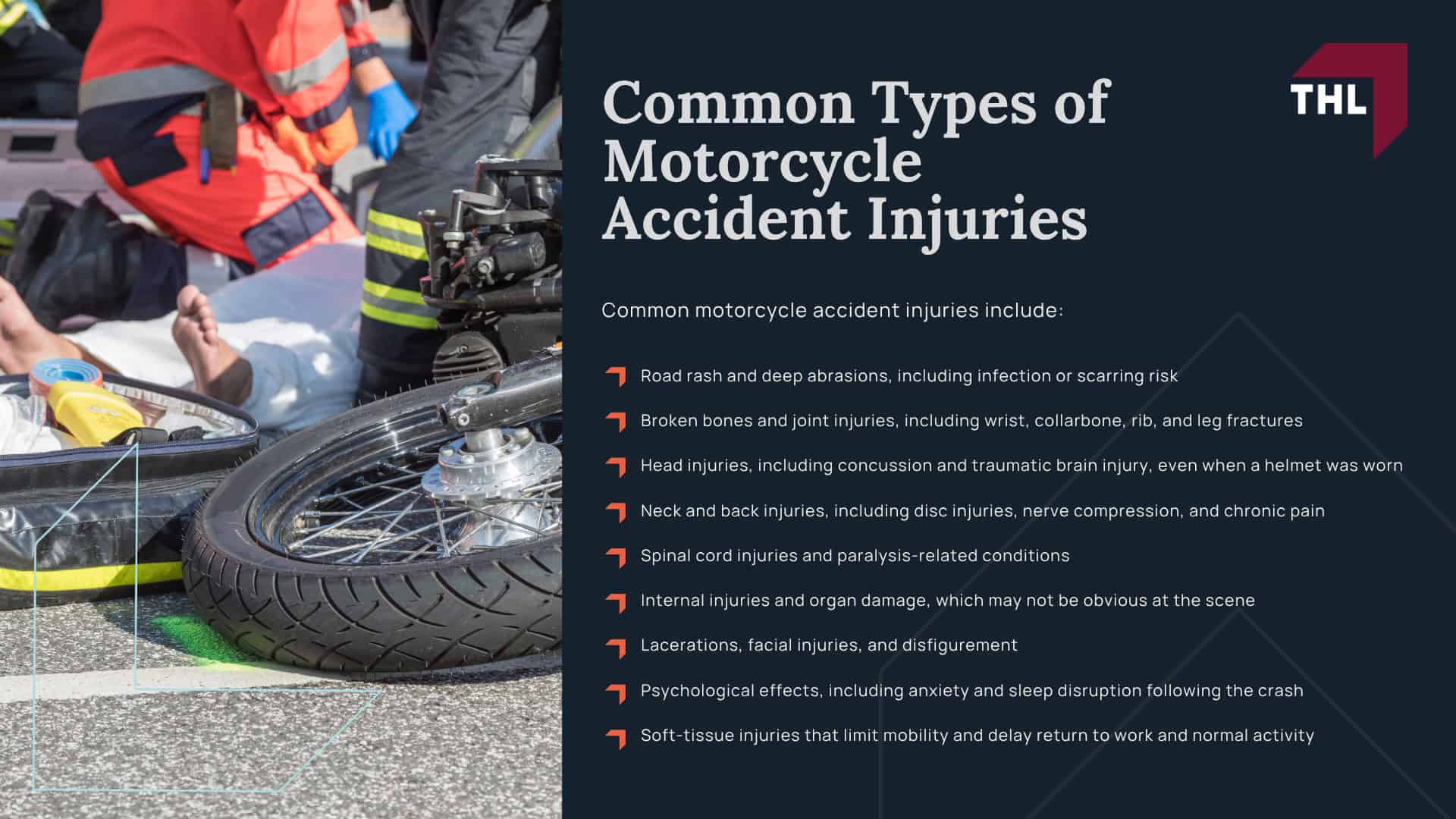
A motorcycle crash can cause serious harm because motorcyclists have limited physical protection compared to occupants of a car.
Some injuries are immediately apparent at the scene, while others worsen over the next several days, especially head trauma, internal injuries, and soft-tissue damage.
In Illinois, medical documentation is often the foundation of a claim because it shows what treatment was required and how symptoms progressed after the incident.
If you were injured in a motorcycle accident in Edwardsville, seek medical care promptly and follow through with appointments so the record reflects the full scope of suffering, pain, and functional limits.
Motorcycle accidents often happen because another driver misjudges the speed of the motorcycle, fails to yield, or is not paying close attention in traffic.
Speeding is a common factor, and it can involve either the motorcycle or the other vehicles involved, particularly when drivers rush through intersections or tailgate in congestion.
Many crashes occur when a car turns left in front of motorcyclists or changes lanes into a rider’s path, and blind spots can play a major role when drivers do not check mirrors or signal.
Road conditions also matter because hazards that are minor for larger vehicles can be dangerous for motorcycles, including gravel, potholes, uneven pavement, and debris.
A strong liability case usually depends on early investigation and objective proof.
Police reports, witness accounts, and photos of the scene can clarify lane positions, sight lines, and timing, and they can help address disputes about fault.
In some incidents, helmet damage patterns, motorcycle damage, and skid marks can also support reconstruction of what happened.
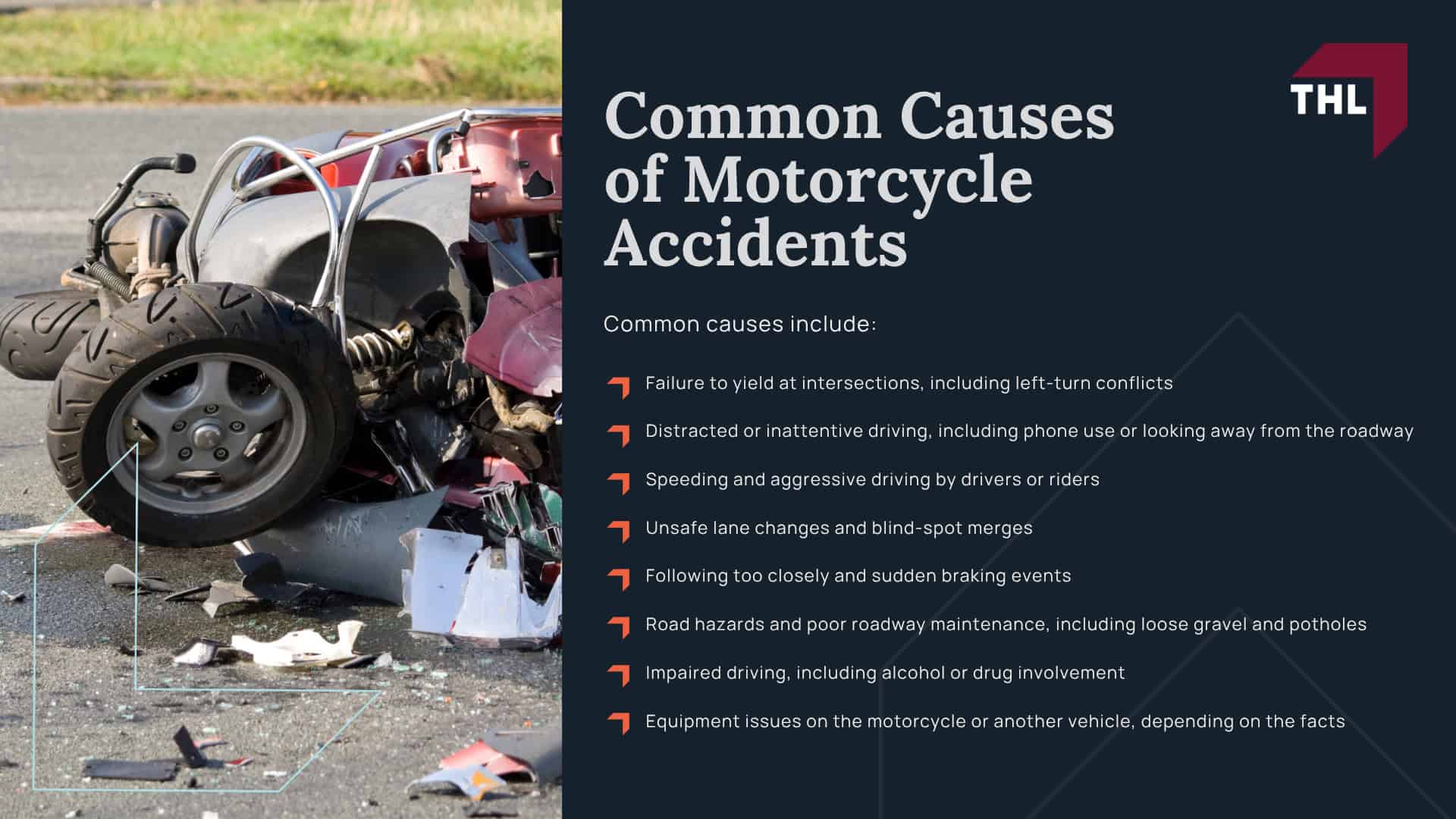
Common causes include:
Failure to yield at intersections, including left-turn conflicts
Distracted or inattentive driving, including phone use or looking away from the roadway
Speeding and aggressive driving by drivers or riders
Unsafe lane changes and blind-spot merges
Following too closely and sudden braking events
Road hazards and poor roadway maintenance, including loose gravel and potholes
Impaired driving, including alcohol or drug involvement
Equipment issues on the motorcycle or another vehicle, depending on the facts
TorHoerman Law: Hire an Experienced Edwardsville Motorcycle Accident Attorney
After a motorcycle accident in Edwardsville, injured riders and their family often have to manage medical care, missed work, and immediate financial pressure at the same time.
TorHoerman Law helps clients by focusing on investigation, documentation, and a clear liability narrative supported by evidence.
An experienced motorcycle accident attorney can request police records, locate witnesses, preserve any available video, and organize medical documentation so damages are tied to the crash and treatment timeline.
The firm also handles communications with insurers so clients are not pushed into recorded statements or early settlement offers before the injury picture is clear.
If you were injured in a motorcycle accident in Edwardsville and want to understand your options, contact TorHoerman Law.
You can also use the chatbot on this page.
An attorney can explain what information matters most, what deadlines may apply in Illinois, and what steps can help strengthen your case early.
Most motorcycle accident lawyers handle cases on a contingency fee basis, which usually means you pay no attorney fee up front and the fee is a percentage of any recovery.
The exact percentage and how case expenses are handled should be stated in a written agreement, because costs like records requests or expert fees may be treated separately.
A consultation is often free, which lets you understand the fee structure and what work the lawyer expects to do before you decide.
In many cases, yes, but wrongful death rights depend on state law and who has legal standing to file.
Some states allow certain family members to pursue the claim directly, while others require the personal representative of the estate to file on behalf of eligible survivors.
A lawyer can confirm who can file, what deadlines apply, and what documentation is needed to prove fault and losses tied to the death.
A personal injury lawyer can investigate the crash, preserve evidence, and build a record that supports liability and damages.
That work often includes obtaining police reports, locating witnesses, requesting available video, and organizing medical records to connect the injuries to the collision.
A lawyer can also handle insurer communications and negotiations, and can file a lawsuit if a fair resolution is not offered.
Compensation typically includes economic damages such as medical expenses, future care costs, lost wages, reduced earning capacity, and property damage to the motorcycle and gear.
Depending on state law, it may also include non-economic damages like pain, emotional distress, and loss of normal activities when supported by medical documentation.
In rare cases where the evidence supports extreme misconduct, punitive damages may be available, but that depends on the jurisdiction and the facts proven.
Compensation typically includes economic damages such as medical expenses, future care costs, lost wages, reduced earning capacity, and property damage to the motorcycle and gear.
Depending on state law, it may also include non-economic damages like pain, emotional distress, and loss of normal activities when supported by medical documentation.
In rare cases where the evidence supports extreme misconduct, punitive damages may be available, but that depends on the jurisdiction and the facts proven.
Attorney Tor Hoerman, admitted to the Illinois State Bar Association since 1995 and The Missouri Bar since 2009, specializes nationally in mass tort litigations. Locally, Tor specializes in auto accidents and a wide variety of personal injury incidents occuring in Illinois and Missouri.
Legally Reviewed
This article has been written and reviewed for legal accuracy and clarity by the team of writers and attorneys at TorHoerman Law and is as accurate as possible. This content should not be taken as legal advice from an attorney. If you would like to learn more about our owner and experienced injury lawyer, Tor Hoerman, you can do so here.
Fact-Checked
TorHoerman Law does everything possible to make sure the information in this article is up to date and accurate. If you need specific legal advice about your case, contact us. This article should not be taken as advice from an attorney.
Were you or a loved one injured in
Edwardsville, Illinois?
A serious injury can have life-altering results.
Don’t settle for less than you deserve. Speak with an award-winning Edwardsville personal injury lawyer today.
At TorHoerman Law, we believe that if we continue to focus on the people that we represent, and continue to be true to the people that we are – justice will always be served.
Do you believe you’re entitled to compensation?
Use our Instant Case Evaluator to find out in as little as 60 seconds!
In this case, we obtained a verdict of $495 Million for our client’s child who was diagnosed with Necrotizing Enterocolitis after consuming baby formula manufactured by Abbott Laboratories.
They helped my elderly uncle receive compensation for the loss of his wife who was administered a dangerous drug. He consulted with this firm because of my personal recommendation and was very pleased with the compassion, attention to detail and response he received. Definitely recommend this firm for their 5 star service.
★★★★★Rated 5 out of 5
Philip Storey
When I wanted to join the Xarelto class action lawsuit, I chose TorrHoerman Law from a search of a dozen or so law firm websites. I was impressed with the clarity of the information they presented. I gave them a call, and was again impressed, this time with the quality of our interactions.
★★★★★Rated 5 out of 5
Krista Miller
TorHoerman Law is an awesome firm to represent anyone that has been involved in a case that someone has stated that it's too difficult to win. The entire firm makes you feel like you’re part of the family, Tor, Eric, Jake, Kristie, Chad, Tyler, Kathy and Steven are the best at what they do.
★★★★★Rated 5 out of 5
Joe Smith
TorHorman Law is awesome
★★★★★Rated 5 out of 5
Karen Levy
I can’t say enough how grateful I was to have TorHoerman Law help with my case. Jacob Plattenberger is very knowledgeable and an amazing lawyer. Jillian Pileczka was so patient and kind, helping me with questions that would come up. Even making sure my special needs were taken care of for meetings.
★★★★★Rated 5 out of 5
Lauren B
TorHoerman Law fights for justice with their hardworking and dedicated staff. Not only do they help their clients achieve positive outcomes, but they are also generous and important pillars of the community with their outreach and local support. Thank you THL!
★★★★★Rated 5 out of 5
Joey
Hands down one of the greatest group of people I had the pleasure of dealing with!
★★★★★Rated 5 out of 5
Nickie Shewmake
A very kind and professional staff.
★★★★★Rated 5 out of 5
Jeannette Johnson
Very positive experience. Would recommend them to anyone.