If you or a loved one suffered injuries, property damage, or other financial losses due to another party’s actions, you may be entitled to compensation for those losses.
Contact the experienced Chicago personal injury lawyers from TorHoerman Law for a free, no-obligation Chicago personal injury lawsuit case consultation today.
If you or a loved one suffered a personal injury or financial loss due to a car accident in Chicago, IL – you may be entitled to compensation for those damages.
Contact an experienced Chicago auto accident lawyer from TorHoerman Law today to see how our firm can serve you!
If you or a loved one have suffered injuries, property damage, or other financial losses due to a truck accident in Chicago, IL – you may qualify to take legal action to gain compensation for those injuries and losses.
If you or a loved one suffered an injury in a motorcycle accident in Chicago or the greater Chicagoland area – you may be eligible to file a Chicago motorcycle accident lawsuit.
If you have been involved in a bicycle accident in Chicago at no fault of your own and you suffered injuries as a result, you may qualify to file a Chicago bike accident lawsuit.
Chicago is one of the nation’s largest construction centers.
Thousands of men and women work on sites across the city and metropolitan area on tasks ranging from skilled trades to administrative operations.
Unfortunately, construction site accidents are fairly common.
Contact TorHoerman Law to discuss your legal options with an experienced Chicago construction accident lawyer, free of charge and no obligation required.
Nursing homes and nursing facilities should provide a safe, supportive environment for senior citizens, with qualified staff, nurses, and aids administering quality care.
Unfortunately, nursing home abuse and neglect can occur, leaving residents at risk and vulnerable.
Contact an experienced Chicago nursing home abuse lawyer from TorHoerman Law today for a free consultation to discuss your legal options.
If you are a resident of Chicago, or the greater Chicagoland area, and you have a loved one who suffered a fatal injury due to another party’s negligence or malpractice – you may qualify to file a wrongful death lawsuit on your loved one’s behalf.
When a child is injured at a daycare center, parents are left wondering who can be held liable, who to contact for legal help, and how a lawsuit may pan out for them.
If your child has suffered an injury at a daycare facility, you may be eligible to file a daycare injury lawsuit.
Contact a Chicago daycare injury lawyer from TorHoerman Law today for a free consultation to discuss your case and potential legal action!
If you or a loved one suffered injuries, property damage, or other financial losses due to another party’s actions, you may be entitled to compensation for those losses.
Contact the experienced Edwardsville personal injury lawyers from TorHoerman Law for a free, no-obligation Edwardsville personal injury lawsuit case consultation today.
If you or a loved one suffered a personal injury or financial loss due to a car accident in Edwardsville, IL – you may be entitled to compensation for those damages.
If you or a loved one have suffered injuries, property damage, or other financial losses due to a truck accident in Edwardsville, IL – you may qualify to take legal action to gain compensation for those injuries and losses.
If you or a loved one suffered an injury in a motorcycle accident in Edwardsville – you may be eligible to file an Edwardsville motorcycle accident lawsuit.
If you have been involved in a bicycle accident in Edwardsville at no fault of your own and you suffered injuries as a result, you may qualify to file an Edwardsville bike accident lawsuit.
Nursing homes and nursing facilities should provide a safe, supportive environment for senior citizens, with qualified staff, nurses, and aids administering quality care.
Unfortunately, nursing home abuse and neglect can occur, leaving residents at risk and vulnerable.
If you are a resident of Edwardsville and you have a loved one who suffered a fatal injury due to another party’s negligence or malpractice – you may qualify to file a wrongful death lawsuit on your loved one’s behalf.
When a child is injured at a daycare center, parents are left wondering who can be held liable, who to contact for legal help, and how a lawsuit may pan out for them.
If your child has suffered an injury at a daycare facility, you may be eligible to file a daycare injury lawsuit.
Contact an Edwardsville daycare injury lawyer from TorHoerman Law today for a free consultation to discuss your case and potential legal action!
If you or a loved one suffered injuries on someone else’s property in Edwardsville IL, you may be entitled to financial compensation.
If property owners fail to keep their premises safe, and their negligence leads to injuries, property damages or other losses as a result of an accident or incident, a premises liability lawsuit may be possible.
If you or a loved one suffered injuries, property damage, or other financial losses due to another party’s actions, you may be entitled to compensation for those losses.
Contact the experienced St. Louis personal injury lawyers from TorHoerman Law for a free, no-obligation St. Louis personal injury lawsuit case consultation today.
If you or a loved one suffered a personal injury or financial loss due to a car accident in St. Louis, IL – you may be entitled to compensation for those damages.
If you or a loved one have suffered injuries, property damage, or other financial losses due to a truck accident in St. Louis, IL – you may qualify to take legal action to gain compensation for those injuries and losses.
If you or a loved one suffered an injury in a motorcycle accident in St. Louis or the greater St. Louis area – you may be eligible to file a St. Louis motorcycle accident lawsuit.
If you have been involved in a bicycle accident in St. Louis at no fault of your own and you suffered injuries as a result, you may qualify to file a St. Louis bike accident lawsuit.
St. Louis is one of the nation’s largest construction centers.
Thousands of men and women work on sites across the city and metropolitan area on tasks ranging from skilled trades to administrative operations.
Unfortunately, construction site accidents are fairly common.
Contact TorHoerman Law to discuss your legal options with an experienced St. Louis construction accident lawyer, free of charge and no obligation required.
Nursing homes and nursing facilities should provide a safe, supportive environment for senior citizens, with qualified staff, nurses, and aids administering quality care.
Unfortunately, nursing home abuse and neglect can occur, leaving residents at risk and vulnerable.
If you are a resident of St. Louis, or the greater St. Louis area, and you have a loved one who suffered a fatal injury due to another party’s negligence or malpractice – you may qualify to file a wrongful death lawsuit on your loved one’s behalf.
When a child is injured at a daycare center, parents are left wondering who can be held liable, who to contact for legal help, and how a lawsuit may pan out for them.
If your child has suffered an injury at a daycare facility, you may be eligible to file a daycare injury lawsuit.
Contact a St. Louis daycare injury lawyer from TorHoerman Law today for a free consultation to discuss your case and potential legal action!
The Ozempic lawsuit centers on allegations that Novo Nordisk failed to adequately warn consumers about serious risks associated with Ozempic and other GLP-1 medications.
Plaintiffs allege the drug has been linked to severe gastrointestinal injuries, including gastroparesis, as well as vision loss and other complications that have disrupted patients’ health, nutrition, employment, and daily functioning.
If you or a loved one developed gastroparesis, bowel obstruction, severe vomiting, vision loss, or other serious complications after taking Ozempic or another GLP-1 medication, you may have legal options.
Dupixent lawsuits allege that patients treated with dupilumab therapy later developed cutaneous T-cell lymphoma (CTCL), a rare form of non-Hodgkin lymphoma that can closely resemble severe eczema.
Research and published case reports have raised questions about whether some patients with atopic dermatitis face a higher risk of developing CTCL compared to similar patients who did not receive the drug.
Plaintiffs contend that Sanofi and Regeneron failed to warn patients and physicians about the possibility that Dupixent could worsen, accelerate, or reveal previously undiagnosed cutaneous lymphoma.
If you or a loved one has suffered a severe reaction or blood cancer linked to Dupixent, you may be eligible to take action and file a Dupixent lawsuit.
Suboxone, a medication often used to treat opioid use disorder (OUD), has become a vital tool which offers a safer and more controlled approach to managing opioid addiction.
Despite its widespread use, Suboxone has been linked to severe tooth decay and dental injuries.
Suboxone Tooth Decay Lawsuits claim that the companies failed to warn about the risks of tooth decay and other dental injuries associated with Suboxone sublingual films.
The chemotherapy drug Taxotere, commonly used for breast cancer treatment, has been linked to severe eye injuries, permanent vision loss, and permanent hair loss.
Taxotere Lawsuits are being filed by breast cancer patients and others who have taken the chemotherapy drug and subsequently developed vision problems.
If you or a loved one used Taxotere and subsequently developed vision damage or other related medical problems, you may be eligible to file a Taxotere Lawsuit and seek financial compensation.
Tylenol (Acetaminophen), one of the most popular over the counter medications for pain relief and high fever, has been associated with an increased risk of Autism Spectrum Disorder (ASD), Attention Deficit Hyperactivity Disorder (ADHD), and other developmental disorders in children exposed to Acetaminophen during pregnancy.
Legal claims against manufacturers and distributors of generic Acetaminophen have been investigated on behalf of pregnant women who used Tylenol during pregnancy and children who developed disorders such as Autism Spectrum Disorder, ADHD, and more.
Spinal cord stimulator lawsuit claims allege that these devices are defectively designed and improperly marketed without adequate warnings, leading to severe injuries for patients.
TorHoerman Law is investigating claims involving spinal cord stimulators that allegedly caused serious injury instead of the relief patients were led to expect.
If you or a loved one experienced complications following spinal cord stimulator surgery, you may be eligible to pursue compensation through a spinal cord stimulator lawsuit.
Several studies have found a correlation between heavy social media use and mental health challenges, especially among younger users.
Social media harm lawsuits claim that social media companies are responsible for onsetting or heightening mental health problems, eating disorders, mood disorders, and other negative experiences of teens and children
You may be eligible to file a Social Media Mental Health Lawsuit if you are the parents of a teen, or teens, who attribute their use of social media platforms to their mental health problems.
Thousands of Uber sexual assault claims have been filed by passengers who suffered violence during rides arranged through the platform.
The ongoing Uber sexual assault litigation spans both federal law and California state court, with a consolidated Uber MDL (multi-district litigation) currently pending in the Northern District of California.
Uber sexual assault survivors across the country are coming forward to hold the company accountable for negligence in hiring, screening, and supervising drivers.
If you or a loved one were sexually assaulted, sexually battered, or faced any other form of sexual misconduct from an Uber driver, you may be eligible to file an Uber Sexual Assault Lawsuit.
Roblox lawsuit claims center on allegations that the platform allowed predators to groom, exploit, and abuse children through unsafe design and inadequate protections.
TorHoerman Law is dedicated to helping families who believe their child was harmed on Roblox pursue justice and financial recovery.
For many families, legal action represents both a path to compensation and a way to demand systemic change in how Roblox treats the safety of its youngest players.
If your child was sexually abused, exploited, or exposed to harmful content through Roblox, you may be eligible to take legal action by filing a lawsuit against Roblox Corporation.
Although pressure cookers were designed to be safe and easy to use, a number of these devices have been found to have a defect that can lead to excessive buildup of internal pressure.
The excessive pressure may result in an explosion that puts users at risk of serious injuries such as burns, lacerations, an even electrocution.
If your pressure cooker exploded and caused substantial burn injuries or other serious injuries, you may be eligible to file a Pressure Cooker Lawsuit and secure financial compensation for your injuries and damages.
Olympus Scope lawsuit claims center on allegations that certain reusable Olympus endoscopes and related accessories exposed patients to dangerous bacterial contamination after medical procedures.
These infections can lead to hospitalization, IV antibiotic treatment, sepsis, organ failure, and death, leaving many patients with serious medical complications and lasting physical harm.
You may qualify to file an Olympus scope lawsuit if you underwent an ERCP or another endoscopic procedure involving Olympus equipment and later developed a serious bacterial infection.
Families who lost a loved one after infection-related complications linked to an Olympus scope procedure may also be able to pursue a wrongful death claim.
Vaginal Mesh Lawsuits are being filed against manufacturers of transvaginal mesh products for injuries, pain and suffering, and financial costs related to complications and injuries of these medical devices.
Over 100,000 Transvaginal Mesh Lawsuits have been filed on behalf of women injured by vaginal mesh and pelvic mesh products.
If you or a loved one have suffered serious complications or injuries from vaginal mesh, you may be eligible to file a Vaginal Mesh Lawsuit.
Breast mesh lawsuits involve allegations that certain mesh products used during breast reconstruction, augmentation, and lift procedures contributed to postoperative complications and the need for revision surgeries.
Patients who experienced complications after mesh-assisted breast procedures have reported chronic pain, reconstruction problems, cosmetic deformities, and additional revision surgeries.
If you or a loved one experienced serious complications after breast surgery involving mesh or an internal bra technique, you may be eligible to pursue a breast mesh lawsuit claim for the harm caused.
Patients with the PowerPort devices may possibly be at a higher risk of serious complications or injury due to a catheter failure, according to lawsuits filed against the manufacturers of the Bard PowerPort Device.
If you or a loved one have been injured by a Bard PowerPort Device, you may be eligible to file a Bard PowerPort Lawsuit and seek financial compensation.
The AngioDynamics port catheter lawsuit claims that defective implantable ports have caused patients to suffer dangerous fractures, blood clots, and infections due to the breakdown of the catheter’s material inside the body.
These failures can lead to life-threatening complications such as embolism, sepsis, or the need for surgical removal of the device.
If you or a loved one experienced severe complications such as blood clots, infections, or catheter fractures requiring surgery due to a defective AngioDynamics port catheter, you may be eligible to file an AngioDynamics Port Catheter Lawsuit and seek compensation.
NEC Lawsuit claims allege that certain formulas given to infants in NICU settings increase the risk of necrotizing enterocolitis (NEC) – a severe intestinal condition in premature infants.
Parents and guardians are filing NEC Lawsuits against baby formula manufacturers, alleging that the formulas contain harmful ingredients leading to NEC.
Despite the claims, Abbott and Mead Johnson deny the allegations, arguing that their products are thoroughly researched and dismissing the scientific evidence linking their formulas to NEC, while the FDA issued a warning to Abbott regarding safety concerns of a formula product.
You may be eligible to file a Toxic Baby Formula NEC Lawsuit if your child received baby bovine-based (cow’s milk) baby formula in the maternity ward or NICU of a hospital and was subsequently diagnosed with Necrotizing Enterocolitis (NEC).
Paraquat, a widely-used herbicide, has been linked to Parkinson’s disease, leading to numerous Paraquat Parkinson’s Disease Lawsuits against its manufacturers for failing to warn about the risks of chronic exposure.
Due to its toxicity, the EPA has restricted the use of Paraquat and it is currently banned in over 30 countries.
You may be eligible to file a Paraquat Lawsuit if you or a loved one were exposed to Paraquat and subsequently diagnosed with Parkinson’s Disease or other related health conditions.
Ethylene Oxide Lawsuit claims center on allegations that Sterigenics U.S., LLC and other defendants negligently released hazardous levels of ethylene oxide (EtO), exposing nearby residents and workers to a known carcinogen linked to breast cancer, leukemia, lymphoma, and other serious illnesses.
If you or a loved one were diagnosed with cancer or other serious health problems associated with exposure to ethylene oxide and lived near a facility with known emissions, you may be eligible to file an Ethylene Oxide Lawsuit and seek financial compensation.
Nitrous oxide lawsuit claims center on manufacturers, distributors, and retailers who profit from selling canisters that are widely misused as a recreational drug.
Reports link this misuse to severe neurological injuries, psychiatric symptoms, hypoxia, and deaths caused by accidents or overdose.
These cases are rapidly expanding as more evidence emerges of the profound physical, psychological, and social toll caused by nitrous oxide misuse.
If you or a loved one has suffered brain injuries, spinal cord or nerve damage, psychiatric symptoms, or even death linked to misused nitrous oxide, you may be eligible to pursue a nitrous oxide lawsuit claim and seek compensation for the harm caused.
Diacetyl popcorn lung lawsuit claims center on allegations that repeated inhalation of butter-flavoring chemicals in certain workplaces, including diacetyl and related substitutes, caused permanent and preventable airway damage.
Popcorn lung, medically known as bronchiolitis obliterans or constrictive bronchiolitis, is a serious obstructive lung disease that scars and narrows the small airways, leaving many people with persistent shortness of breath, chronic cough, and reduced exercise tolerance.
TorHoerman Law has experience handling diacetyl popcorn lung cases and is currently reviewing claims from workers who believe occupational exposure to these flavoring chemicals contributed to their diagnosis.
If you or a loved one were diagnosed with diacetyl induced lung disease or bronchiolitis obliterans, you may have grounds to pursue a diacetyl popcorn lung lawsuit for the harm caused to your lung tissue and long-term lung function.
Our firm is about people. That is our motto and that will always be our reality.
We do our best to get to know our clients, understand their situations, and get them the compensation they deserve.
At TorHoerman Law, we believe that if we continue to focus on the people that we represent, and continue to be true to the people that we are – justice will always be served.
Without our team, we would’nt be able to provide our clients with anything close to the level of service they receive when they work with us.
The TorHoerman Law Team commits to the sincere belief that those injured by the misconduct of others, especially large corporate profit mongers, deserve justice for their injuries.
Our team is what has made TorHoerman Law a very special place since 2009.
Snapchat Lawsuit for Mental Health Issues and Addiction [2026 Update]
Use the chatbot on this page to find out if you qualify for the Snapchat Lawsuit/Social Media Mental Health Lawsuit. Contact TorHoerman Law for a free consultation.
TorHoerman Law is actively accepting claims for the Social Media Mental Health Lawsuit.
Defendants
Meta Platforms, Inc. (Facebook & Instagram)
ByteDance Ltd. / TikTok
Snap Inc. (Snapchat)
Google LLC / YouTube
Injuries named in lawsuit
Depression
Anxiety disorders
Eating disorders
Body dysmorphia
Self-harm
Suicidal ideation or suicide attempts
Suicide / wrongful death
You may qualify to file a claim if...
You or your child frequently used Facebook, Instagram, TikTok, Snapchat, YouTube, or another major social media platform while under 18.
You or your child developed depression, anxiety, an eating disorder, body dysmorphia, self-harm behaviors, suicidal thoughts or attempts, or another serious mental health condition after prolonged or compulsive social media use.
The mental health problems resulted in professional treatment, such as therapy, counseling, psychiatric care, medication, hospitalization, or inpatient treatment.
Most Recent Updates
Social media addiction lawsuits remain consolidated in federal MDL 3047, with parallel cases proceeding in California state court through JCCP 5255.
In March 2026, a California jury found Meta and YouTube liable in the first social media addiction personal injury case to reach a verdict, awarding the plaintiff $6 million in damages.
In August 2026, the Ninth Circuit dismissed appeals by Meta and TikTok seeking immediate review of key Section 230 rulings, allowing the underlying social media addiction litigation to continue.
Overview of Snapchat Lawsuit for Mental Health
Snapchat lawsuit claims center on the platform’s addictive design, exposure to harmful content, and the growing mental health crisis among young users.
TorHoerman Law represents victims and families who believe their children suffered psychological or physical harm as a result of Snapchat’s unsafe features and lack of accountability.
Our law firm investigates individual claims, gathers critical evidence, and helps families pursue justice and compensation through ongoing social media addiction litigation.
Our Social Media Lawyers Represent Victims Potentially Harmed by Snapchat
The Snapchat lawsuit for mental health problems and addiction addresses growing concerns over how the app’s design and features affect teen mental health and behavior.
What began as a platform for social connection has evolved into an environment that many experts argue contributes to widespread psychological harm among young users.
Families across the country are taking legal action, claiming that underage users addicted to Snapchat suffer from the platform’s addictive nature, which promotes compulsive use through streaks, disappearing messages, and constant notifications.
The lawsuits allege that Snapchat exposes minors to inappropriate material and real-world dangers, including sexual predators, drug sales, and sexual content that often bypasses parental oversight.
These risks have been compounded by the app’s promotion of unrealistic beauty standards, giving rise to what clinicians now call Snapchat dysmorphia, a condition linked to distorted self-image and body dissatisfaction.
Plaintiffs argue that children and teens harmed by these design choices experience heightened anxiety, depression, and disordered eating tied to excessive engagement and filtered self-representation.
Studies show that prolonged exposure to filtered images and curated lifestyles can worsen negative effects on self-esteem and identity formation.
The suits claim Snapchat failed to warn users and parents about these risks or to meaningfully curb predatory behavior and exposure to harmful content.
By targeting the company’s role in creating and sustaining harmful online habits, this litigation seeks accountability for the damage caused by the platform’s design and the broader impact on youth mental health.
If you or a loved one’s children have suffered from mental health problems due to excessive social media use or social media addiction, you may be eligible to file a Social Media Harm Lawsuit or Snapchat Lawsuit.
Contact TorHoerman Law for a free consultation.
You can also use the chatbot on this page to find out if you qualify for the Snapchat social media lawsuit instantly.
Our attorneys understand what you and your family are going through, and we are here to help you seek justice.
Reach out to our law firm today for a free case review.
The Social Media Addiction Lawsuit is a mass litigation effort addressing the harmful mental health effects associated with excessive social media use, particularly among children and teens.
Plaintiffs argue that social media companies like Meta, TikTok, Snapchat, and others have designed platforms that promote addictive behaviors through algorithms, resulting in severe mental health disorders such as depression, anxiety, body image issues, and social media addiction.
The lawsuit has been consolidated into a multidistrict litigation (MDL) to streamline the growing number of cases across the country.
The Judicial Panel on Multidistrict Litigation (JPML) determined that because many lawsuits share common factual issues, such as the role of social media algorithms in promoting addiction, consolidation would allow for more efficient pretrial proceedings.
The MDL is being heard in federal court and involves claims that these companies not only failed to protect users but also prioritized profit over user safety.
Plaintiffs, represented by social media addiction lawyers, are seeking compensation for the emotional, psychological, and even physical harm suffered as a result of prolonged exposure to harmful content.
The rapid rise of social media has led to mounting evidence that the app known as Snapchat can have significant consequences for mental health issues among young users.
Research shows that when children and teens engage in repeated daily use, the online environment may begin to distort their perceptions of their own lives and offline life.
Features designed to encourage users to stay engaged (such as streaks, Snap Map surveillance, and “Best Friends” lists) can create a constant need for validation and social reward, making it easier to addict children to the platform.
The app’s reliance on snap scores and disappearing messages fosters compulsive checking, and the desire for instant feedback may elevate anxiety and peer-comparison rather than positive emotions.
For particularly teenagers and children, Snapchat’s visual focus (especially with Snapchat filters and beauty filters) can push unrealistic standards of beauty, a phenomenon sometimes called Snapchat dysmorphia, which ties into body-image dissatisfaction and disordered eating.
The presence of explicit content, online predators, and online predators seeking youth on the platform further adds to the risk of exposure to harmful interactions that can degrade mental health.
Research shows that social surveillance on Snapchat (such as being “left on read”) is linked with greater loneliness and depressive symptoms.
Because Snapchat shares many other platforms features (algorithmic rewards, disappearing content, incentive loops), it blurs boundaries between safe social connection and harmful compulsion.
Ultimately, while Snapchat may offer a space for peer connection, its addictive nature, dangerous features, and pressure to present a filtered version of oneself create a landscape where children and teens harmed by overuse face increased risk of anxiety, depression, and distorted self-image.
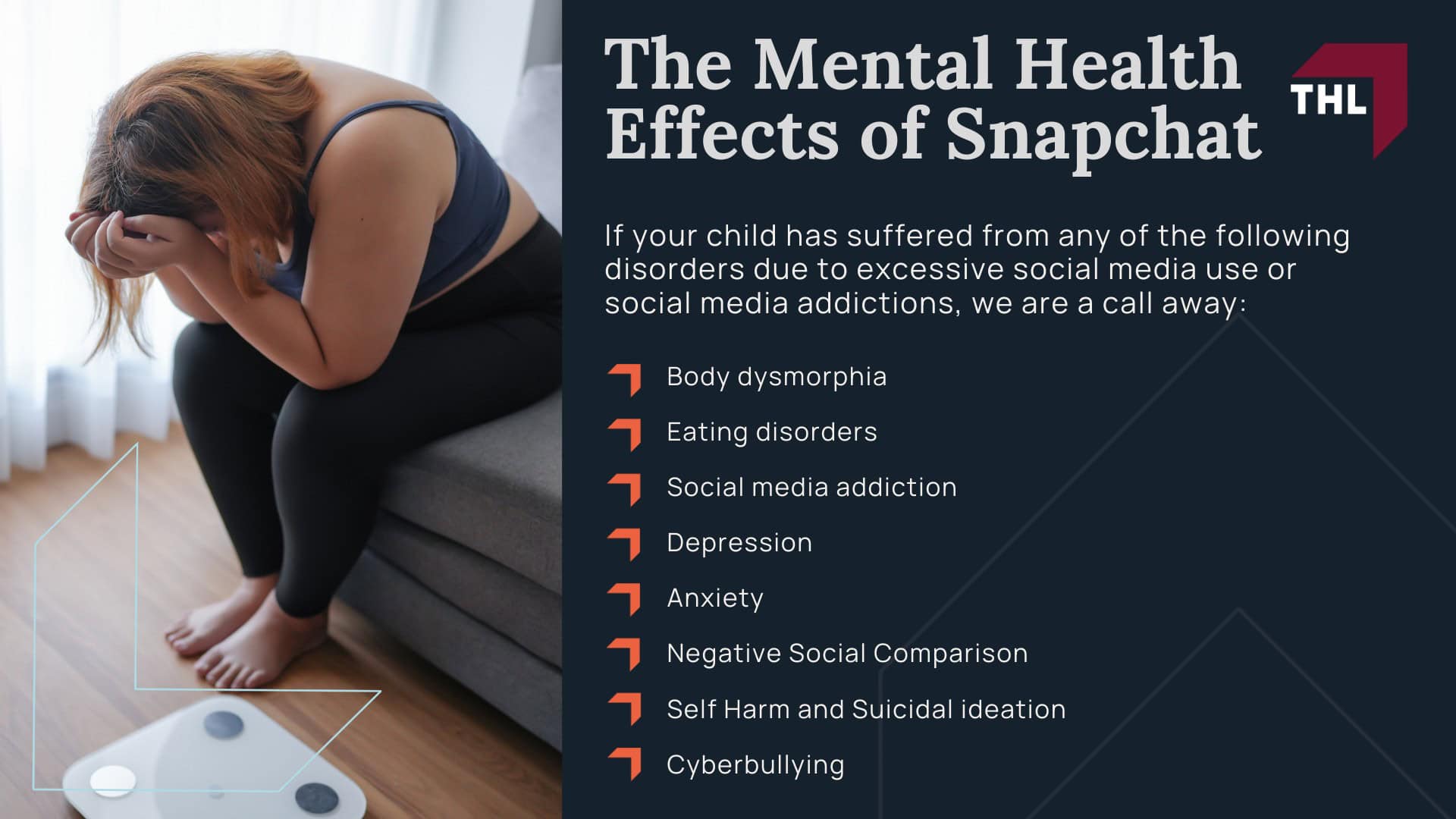
If your child has suffered from any of the following disorders due to excessive social media use or social media addictions, we are a call away:
Body dysmorphia
Eating disorders
Social media addiction
Depression
Anxiety
Negative Social Comparison
Self Harm and Suicidal ideation
Cyberbullying
Reach out to our attorneys to see if you’re eligible for a claim.
You can also use the chatbot on this page to instantly determine whether you qualify to file a social media lawsuit.
This can cause users to view their bodies inaccurately, and this is even more prevalent among young women.
Snapchat was originally a photo and video-sharing chat application.
Now, it has become a social media platform that gives users access to filters, group messaging, news stories, and more.
Filters in particular enhance and alter the visual appearance of the user whenever the user takes selfies or videos.
While visual filters are meant to add a layer of aesthetics to interactions and content sharing, they may come at the expense of a user’s mental health.
The gap between enhanced and un-enhanced images might become so pronounced that users develop body image issues, otherwise called body dysmorphia.
In a published peer-reviewed 2018 study, researchers at the Boston Medical Center found body dysmorphia to be present in more than 55% of people who sought plastic surgery.
According to these individuals, they opted for surgery to appear more like the digitally-enhanced version of themselves.
Eating Disorders
When a young user develops body dysmorphia, it can lead to preoccupations with food and healthy eating.
When the preoccupation becomes obsessive, it becomes an eating disorder.
Besides eating disorders and body image issues, Snapchat may also contribute to social media addiction.
Social media addiction is characterized by the obsessive use of social media platforms.
Addiction occurs due to new stimuli in the form of constantly changing content and a stream of social interaction.
The novelty of content causes a dopamine rush that keeps users hooked.
Platforms like Snapchat make their content both novel and addicting by catering to the preferences of their users and pushing copious amounts of notifications to the user.
Through notifications and the presence of “streaks”, where users are encouraged to use Snapchat daily to keep a “streak” of how many days they’ve messaged another user, social media addiction is also fostered.
These platforms may be fostering addiction through social media algorithms that track what content users interact with the most.
Addiction isn’t just a blow to a person’s productivity and functionality.
Because Snapchat users are usually young adults and teens, the addiction deals a more severe blow that affects emotional and mental health.
These are formative years in a person’s habit-forming and social development.
When exposed to social media, young users develop the habit of constantly checking their Snapchat apps for new interactions, notifications, and how many people have viewed their “story”.
This habit can be difficult to correct, especially if it has been formed at a young age.
Also, Snapchat usage can make isolation and impersonal communication the norm for social interactions.
This sets young users up for developing feelings of isolation and loneliness.
When a user sees popular influencers on their feeds, they feel unable to keep up, experiencing feelings of inferiority and hopelessness — two signs of depression.
Users can also be exposed to the “fear of missing out” through their peers using social media and posting.
Besides social comparison, the isolating feeling of interacting via a screen contributes to feelings of depression.
When the bulk of a young user’s interactions are online, the user develops a feeling of social isolation.
Anxiety
Snap Inc and other social media companies may also be potentially liable for causing anxiety to young users.
There are many ways the platforms of these companies contribute to adolescent and teen anxiety.
One way is by leveraging the FOMO (fear of missing out) phenomenon.
The FOMO phenomenon is a tendency for users to compulsively check for the latest content on their feeds.
Using algorithms, social media apps present the newest content at various times of the day to keep users coming back for more.
Another way social media platforms contribute to anxiety is by presenting potentially negative content.
Users may be constantly bombarded with news and information that can be upsetting or anxiety-provoking, such as images of violence, natural disasters, or political unrest.
This can lead to feelings of fear, helplessness, and dread, which can contribute to anxiety disorders.
The time spent on social media seems to be a predictor of anxiety.
According to a 2020 study, adolescents who spent more than two hours on social media daily were more likely to develop anxiety compared to users who spent less time online daily.
Low Self-Esteem Due to Negative Social Comparison
Social media also has the potential to negatively affect a person’s self-esteem.
The frequent display of images featuring models and celebrities with idealized physiques can trigger feelings of dissatisfaction with one’s own body.
These feelings can prompt engagement in unhealthy behaviors, such as disordered eating.
The resulting cycle can further compromise an individual’s self-esteem.
Self-Harm and Suicidal Ideation
Harmful social media content can be triggering to the point where it causes suicidal ideation and self-harm.
Social media can expose users to harmful content, such as images of self-harm or suicide.
This can be triggering for people who are already struggling with mental health problems.
Another way social media triggers self-harm and suicidal thoughts is by bombarding users with content that prompts social comparison and by becoming a breeding ground for cyberbullying.
Cyberbullying and harmful content can overwhelm young users and drive them to self-harm, especially if they are already suffering from anxiety or depression.
Cyberbullying
Cyberbullying is another issue arising from social media use.
It can occur across any social media platform, making it tough to evade.
Through social media, cyberbullies can spread rumors, post embarrassing photos or videos, and send hurtful or threatening messages.
As a result, those targeted often grapple with feelings of isolation, fear, and depression.
In tragic instances, victims even contemplate suicide as the bullying begins to take a toll on their mental well-being.
Who Are the Defendants in the Social Media Mental Health Lawsuits?
The social media mental health lawsuits name several major tech companies as defendants, each accused of designing products that exploit psychological vulnerabilities in young people and teen users.
Plaintiffs claim these companies created features that deceive users into believing they are gaining social connection and validation, while actually promoting addiction, anxiety, and distorted perceptions of real life.
These lawsuits argue that the platforms failed to provide users with adequate mental health resources or warnings about the potential risks associated with their apps.
Instead, their algorithms allegedly offer a false sense of belonging while exposing minors to harmful other forms of influence, including drug use, explicit content, and pressure to alter appearance.
Some experts, including plastic surgeons, have linked the use of filters and beauty-enhancement features to rising rates of body dysmorphia among young people.
Attorneys argue that app’s safety promises were misleading and that the companies prioritized engagement and profit over the well-being of children.
Although not everyone experiences harm from social media, the lawsuits contend that the risks for minors far outweigh the benefits when these products are intentionally designed to promote dependency.
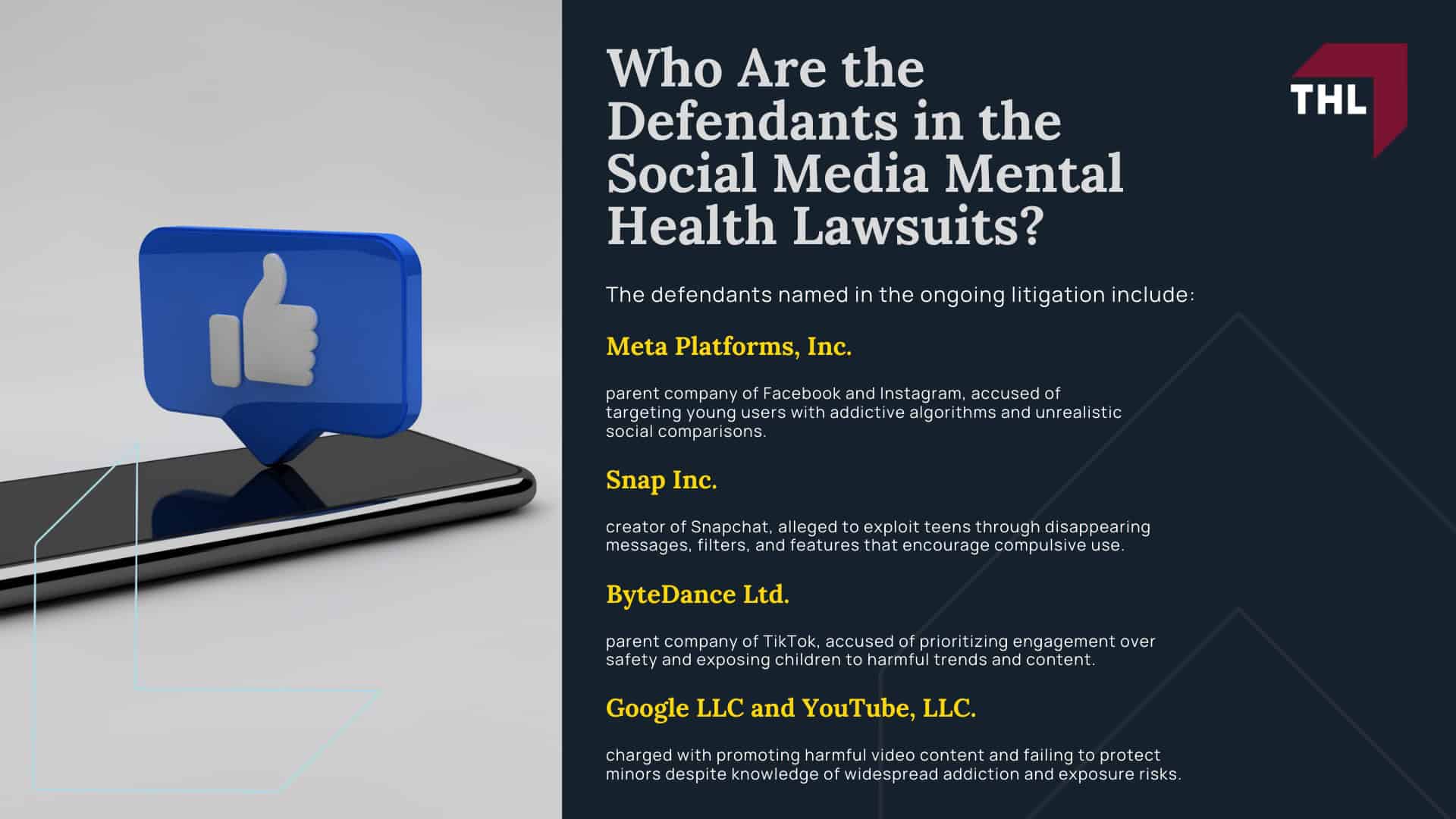
The defendants named in the ongoing litigation include:
Meta Platforms, Inc. — parent company of Facebook and Instagram, accused of targeting young users with addictive algorithms and unrealistic social comparisons.
Snap Inc. — creator of Snapchat, alleged to exploit teens through disappearing messages, filters, and features that encourage compulsive use.
ByteDance Ltd. — parent company of TikTok, accused of prioritizing engagement over safety and exposing children to harmful trends and content.
Google LLC and YouTube, LLC. — charged with promoting harmful video content and failing to protect minors despite knowledge of widespread addiction and exposure risks.
We are here to help victims attempt to recover compensation for the negative impact these companies have had on your child.
Contact us at TorHoerman Law now to find out if you qualify for a claim.
You can also use the chatbot on this page to determine your eligibility instantly.
TorHoerman Law: Your Social Media Addiction Lawyers
Our attorneys are speaking to potential new clients daily and accepting claims for social media lawsuits in all 50 states.
We recognize the devastating impact social media addiction and related mental health problems can have on children and their family members, and we are here to help you take action and make sure these companies are held accountable.
If your child has experienced issues like social media addiction or other mental health concerns stemming from their use of Snapchat and other social media platforms, you may be eligible to file a social media mental health lawsuit.
Contact TorHoerman Law for a free consultation.
You can also use the chatbot on this page to find out if you qualify for the Snapchat social media lawsuit instantly.
At TorHoerman Law, our legal team is actively examining litigation options against social media platforms such as Snapchat, Instagram, and Facebook.
Yes, you may be eligible to file a social media lawsuit if you or your child has suffered from conditions associated with social media addiction.
You may be eligible to file a social media lawsuit if you or your child suffered from:
Depression
Anxiety
Body dysmorphia and eating disorders
Suicidal ideation and self-harm
Social media addiction
If you believe social media platforms have negatively impacted your mental health or that of a family member, you should reach out to a social media addiction lawyer to explore your legal options.
Contact TorHoerman Law today, our attorneys are accepting social media addiction claims and offer a free consultation to help determine if you qualify.
You can also use the chatbot on this page for an instant evaluation of your eligibility for the social media mental health lawsuit.
States and school districts are filing lawsuits against social-media apps because they claim the platforms contribute significantly to the rising youth mental-health crisis by failing to protect minors from harmful content and addictive design.
In Utah Social Media Regulation Act and other state-level efforts, for example, Utah officials assert that major apps mislead users and parents about their safety measures, exploit minors through algorithmic engagement features, and expose children to online predators and illegal activities such as drug dealers targeting kids.
In Utah’s case, the state’s Utah Consumer Privacy Act and related statutes form part of the legal foundation: the lawsuit alleges that platforms did not obtain proper parental consent, violated privacy/data laws, and failed to put robust parental controls in place for teen users.
The complaint points to features that allegedly give minors a false sense of safety and allow easy access to illicit behavior or explicit content, with the state arguing that the companies “addicted children” and left them vulnerable.
Utah’s Derek Brown (Attorney General) and the state’s consumer-protection division specifically say major platforms designed their services to maximize engagement from minors, even when two users or more might suffer serious offline harms.
By holding these companies accountable under state consumer-protection and privacy laws, Utah and other jurisdictions hope to force changes in how apps treat young people and ensure that companies actually provide users and their families with meaningful protections.
Many of the suits seek both injunctive relief (to change platform practices) and monetary compensation for the costs borne by schools, families and public-health systems.
In short, the reason states and school districts are acting isn’t simply frustration with social media, it’s a legal theory that the companies’ business models impose real, measurable harm on children that the entities are now legally claiming must be remedied.
Snapchat stands out from other platforms because of how it structures communication and engagement among other users, particularly teenagers.
Instead of focusing on public posts or likes, Snapchat encourages users to send photos and short videos that disappear after viewing, creating an illusion of privacy and exclusivity.
This design makes users feel more comfortable sharing impulsive or personal content, but it also fosters compulsive behavior as they try to maintain streaks and continuous interactions.
Unlike platforms that emphasize curated profiles, Snapchat’s real-time messaging and ephemeral nature keep users checking the app throughout the day to avoid missing messages that vanish.
The constant pressure to respond and stay active creates a feedback loop that can be more addictive for teens than traditional social media feeds, reinforcing the emotional dependency that the lawsuits allege contributes to rising mental health concerns.
There is no single nationwide class action lawsuit for social media–related mental health injuries, but thousands of cases have been combined into a federal MDL (multidistrict litigation).
An MDL differs from a class action because each plaintiff maintains an individual claim, while pretrial proceedings and discovery are consolidated under one federal judge.
In contrast, a class action treats all plaintiffs as a single group with a shared outcome.
The current MDL, centered in the Northern District of California, involves claims against major social media companies for allegedly causing psychological harm to minors through addictive design and unsafe features.
Separate cases are also being heard in state court, where local governments and school districts have filed lawsuits seeking damages and policy reforms.
Tor Hoerman has represented injured individuals for more than 30 years, with experience spanning individual personal injury cases and nationwide mass tort litigation. His work includes car accidents, catastrophic injuries, product liability claims, and other serious injury cases. Tor has served in court-appointed leadership roles in national litigation and tried cases involving major corporate defendants.
Legally Reviewed
TorHoerman Law’s legal content is researched and written by our editorial team and attorneys for legal accuracy, clarity, and relevance. We rely on statutes, court records, government publications, medical research, and other authoritative sources when applicable. This page provides general legal information and does not constitute legal advice.
Fact-Checked
TorHoerman Law reviews its legal content for factual accuracy, current information, and relevant legal context before publication and as material developments occur. This article is provided for general informational purposes and does not constitute legal advice. For guidance about a specific case, contact TorHoerman Law.
Additional Social Media Mental Health Lawsuit resources on our website:
You or your child frequently used Facebook, Instagram, TikTok, Snapchat, YouTube, or another major social media platform while under 18.
You or your child developed depression, anxiety, an eating disorder, body dysmorphia, self-harm behaviors, suicidal thoughts or attempts, or another serious mental health condition after prolonged or compulsive social media use.
The mental health problems resulted in professional treatment, such as therapy, counseling, psychiatric care, medication, hospitalization, or inpatient treatment.
Most Recent Updates
Social media addiction lawsuits remain consolidated in federal MDL 3047, with parallel cases proceeding in California state court through JCCP 5255.
In March 2026, a California jury found Meta and YouTube liable in the first social media addiction personal injury case to reach a verdict, awarding the plaintiff $6 million in damages.
In August 2026, the Ninth Circuit dismissed appeals by Meta and TikTok seeking immediate review of key Section 230 rulings, allowing the underlying social media addiction litigation to continue.
TorHoerman Law represents people whose lives have been disrupted by serious injuries, unsafe products, and negligence. Our attorneys handle individual personal injury cases as well as national mass tort lawsuits involving major corporations.
Founded in 2009, our legal team brings more than 100 years of combined experience handling serious injury and complex civil litigation.
Do you believe you’re entitled to compensation?
Use our Instant Case Evaluator to find out in as little as 60 seconds!
In this case, we obtained a verdict of $495 Million for our client’s child who was diagnosed with Necrotizing Enterocolitis after consuming baby formula manufactured by Abbott Laboratories.