No Longer Accepting Claims
Roundup Lawsuit Facts
TorHoerman Law is no longer accepting claims for the Roundup Lawsuit.
Intake Closed

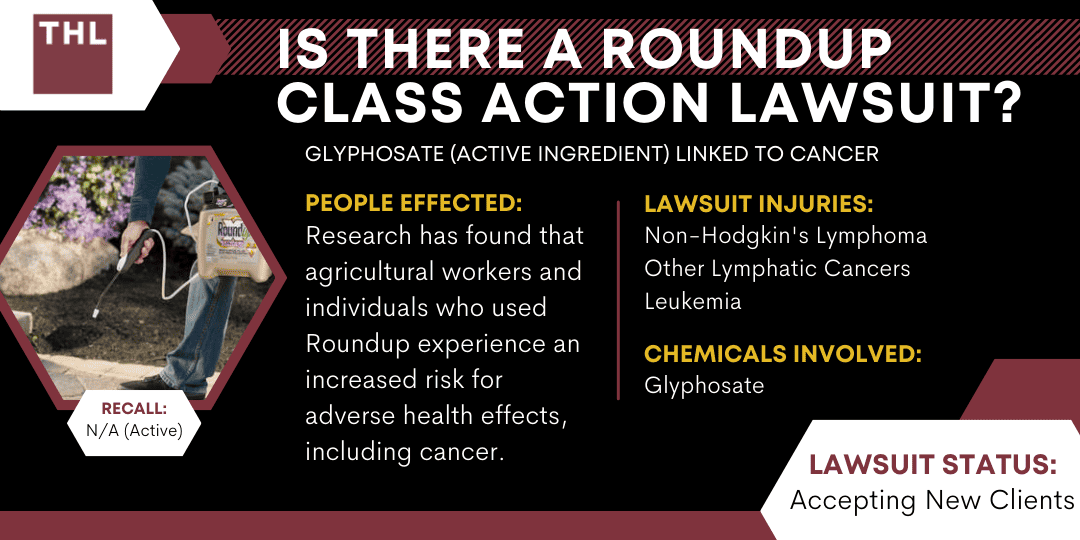
Monsanto first introduced Roundup in 1976.
The company marketed it as a safe and effective herbicide, whether used at home or in commercial agriculture.
This quality made it a go-to solution for weed control among farmers, landscapers, and homeowners.
Monsanto’s Roundup became the most popular weed killer globally, generating billions of dollars in sales for the company.
National Geographic reported in 2015 that Roundup was a top-selling product in more than 160 countries worldwide, primarily the U.S., Australia, Canada, and the United Kingdom.
This massive success came despite the company’s knowledge of potential health risks associated with the active ingredient in Roundup — glyphosate.
Glyphosate is a synthetic herbicide that targets and kills weeds by inhibiting an enzyme called EPSP synthase.
This attribute leads to the death of plant cells, ultimately causing the plant to wither and die.
In the 1970s, Monsanto developed the glyphosate molecule and patented it as a broad-spectrum herbicide.
Monsanto started marketing the weed killer under the Roundup brand name in 1973.

Monsanto had exclusive rights to synthesize glyphosate until 2000 when its U.S. patent expired.
Patents in other countries expired earlier.
This expiration allowed other companies to produce their own glyphosate-based herbicides, leading to a surge in the product’s use.
Still, Monsanto’s Roundup arguably remains to be the most popular brand even after the patent expiration.
Glyphosate, the active ingredient in Roundup, effectively kills weeds and other unwanted vegetation.
This quality made it an essential product for anyone who works with plants, whether commercially or in their garden.
However, as its use increased, so did concerns about its safety.
In 2015, the International Agency for Research on Cancer (IARC), a specialized cancer agency of the World Health Organization (WHO), classified the chemical as “probably carcinogenic to humans.”
Its Group 2A classification was based on sufficient evidence from animal studies and limited evidence from human studies linking glyphosate exposure to cancer, particularly non-Hodgkin’s lymphoma.

The IARC also discovered that glyphosate exposure can lead to DNA and chromosomal damage in human cells.
More studies have since emerged, further strengthening the link between Roundup exposure and cancer.
In contrast, the Environmental Protection Agency (EPA) and other regulatory agencies have maintained that glyphosate, the primary ingredient in Roundup linked to cancer, is, in fact, safe and not likely to cause cancer in humans.
Monsanto has faced numerous Roundup lawsuits since the IARC classified glyphosate as a probable carcinogen.
Since Bayer AG acquired Monsanto in 2018, Bayer has also faced similar claims.
Plaintiffs allege that extended exposure to glyphosate-containing Roundup products led to their cancer diagnosis, particularly non-Hodgkin’s lymphoma.
Monsanto and Bayer AG have settled thousands Roundup lawsuits, with a total payout reaching into the tens of billions of dollars.
However, the manufacturers maintain that glyphosate is safe and not linked to cancer.
The companies’ legal team employs various legal strategies to fight these claims, including ignoring scientific evidence and discrediting expert witnesses who link glyphosate exposure to cancer.
Monsanto and Bayer AG have already resolved thousands of cases, but how many Roundup lawsuits are still pending?

Bayer AG faces over 40,000 unresolved Roundup lawsuits.
Case are often filed individually by Roundup victims in their respective state courts.
Over 4,000 lawsuits consolidated in the Roundup MDL 2741 are pending in the Northern District of California.
When the number of lawsuits involving a similar issue is too high, the judicial system resorts to two legal frameworks: class actions and multidistrict litigation (MDL).
Many people confuse these two terms, but they are different legal processes.
Multi-District Litigation (MDL) and class action lawsuits are both methods for handling large numbers of related legal cases, but they differ in key ways.
In an MDL, individual lawsuits with common factual issues are consolidated for pre-trial proceedings, such as discovery and motions, but each case remains separate and may return to its original court for trial.
In contrast, a class action lawsuit combines all claims into a single lawsuit, where a few plaintiffs represent the interests of the entire group, and the outcome of the case applies to all members of the class.

A class action lawsuit is a legal procedure that allows a large group of people, collectively known as a ‘class,’ to file and prosecute a lawsuit collectively.
This type of lawsuit is typically used when the grievances shared by the class members are so similar that it makes sense to handle them together rather than individually.
In a class action, a few individuals, known as class representatives or lead plaintiffs, sue on behalf of the entire class.
The outcome of the case, including any settlement or judgment, applies to all class members, unless they choose to opt out.
Class actions are efficient for handling a high volume of similar claims, ensuring a uniform resolution for all members while reducing the burden on the court system.
In the context of Roundup, there is no class action lawsuit.
Instead, the cases were consolidated into an MDL or are presently handled individually in relevant courts.
MDL, on the other hand, is a different legal process that consolidates cases with similar facts but does not create a class.
In an MDL, individual lawsuits retain their unique identities, but the presiding court manages common pretrial processes collectively.
This approach helps avoid duplication of efforts, ensures consistency in legal rulings, and expedites the legal process.
Compensation-wise, MDL lawsuits are different from class actions.
In an MDL, each plaintiff receives compensation based on their unique damages and injuries.
The amount of payment may vary significantly depending on the strength of evidence presented by the plaintiffs’ lawyers and other factors such as economic losses, emotional distress, and pain and suffering.
The Roundup MDL is a centralization point for all pending and some future Roundup lawsuits across the United States.
The MDL court handles pretrial proceedings, such as discovery and motion practice, to determine if there is enough evidence to proceed with trials or settlement negotiations.
If the parties involved do not reach a fair settlement, the court sends back the cases to their respective courts for individual trials.
In the context of Roundup, an MDL is more appropriate than a class action lawsuit because each plaintiff’s experience with the product is different.
Factors such as exposure levels and length may vary, making it difficult to prove causation on a large scale.
Consolidating the cases in an MDL often allows for more individualized consideration of each plaintiff’s claim.
The Roundup MDL was established to address the growing number of lawsuits against Monsanto.
The U.S. Judicial Panel on Multidistrict Litigation (JPML) consolidated these cases under Judge Vince Chhabria in the Northern District of California.
This consolidation aimed to streamline proceedings and promote efficiency in handling the increasing caseload.
The Roundup MDL was a significant development in the Roundup litigation.
It centralized pretrial proceedings, such as discovery and motion practice, to streamline the litigation process, reduce costs, and prevent duplicative efforts across individual cases.
Having one judge oversee common legal issues also helps ensure consistency in rulings.
In 2020, Bayer AG, the parent company of Monsanto, agreed to a $10 billion settlement to resolve existing and future litigation claims against Roundup.

The Roundup MDL and individual lawsuits have seen significant developments since their formation.
In the first bellwether trials, the plaintiffs won substantial sums in compensation, with juries awarding damages ranging from $80 million to $2 billion.
After three major losses in court, Monsanto and Bayer AG decided to target cases with weaker claims, earning them several consecutive defense wins.
The Monsanto Papers, a collection of internal company documents, revealed several questionable practices by the companies, including:
Monsanto and Bayer attempted to discredit scientists, researchers, and expert witnesses when their findings and professional opinions were unfavorable to their defense.
These tactics revealed the company’s efforts to suppress scientific research and manipulate public opinion about glyphosate safety.
Recent Roundup lawsuits have resulted in verdicts favoring the plaintiffs, with juries awarding millions in damages.
These developments have raised hopes for thousands of plaintiffs still awaiting their day in court.
Here are some key milestones in the Roundup litigation:
The Roundup litigation is still ongoing, with more plaintiffs coming forward and seeking justice for their alleged injuries.
Monsanto/Bayer AG have an experienced legal team and ample resources to defend their product.
That is why Roundup plaintiffs must seek the help of competent lawyers who can effectively present their case in court.
Roundup lawsuit lawyers are crucial in providing legal representation and support to plaintiffs seeking compensation for their alleged injuries.
Roundup attorneys handle all aspects of the case, from filing the lawsuit to representing the plaintiff in court.
They also negotiate settlements on behalf of their clients, ensuring they receive fair compensation for their damages.
Roundup cancer lawyers have extensive knowledge and experience in complex litigation involving product liability and personal injury claims.
They understand the legal nuances of the Roundup litigation and individual cases, allowing them to provide effective representation for their clients.

Some of the key responsibilities of Roundup lawyers include:
With the help of Roundup lawyers, plaintiffs have a better chance of obtaining justice and holding Monsanto and Bayer accountable for their actions.
They can also have peace of mind knowing they have a knowledgeable and dedicated legal advocate.
The Roundup litigation has shed light on the potential dangers of using the famous weed killer.
The numerous lawsuits filed against Monsanto/Bayer AG demonstrate that individuals have suffered or are currently suffering from severe health issues due to Roundup exposure.
The absence of a Roundup class action lawsuit does not diminish the legal avenues available for individuals seeking justice.
The Roundup MDL has played a vital role in efficiently managing many cases, culminating in a substantial settlement.
However, individual lawsuits against Monsanto/Bayer AG have also resulted in significant jury awards.
If you believe Roundup has adversely affected your health, it is crucial to consult with legal professionals who can guide you through the process of pursuing your legal rights.
A Roundup lawyer will advise you on the best course of action for your claim and work tirelessly to ensure you receive the compensation you deserve.
Despite the challenges, justice is attainable for those seeking compensation for the alleged harms of Roundup exposure.
If you or a loved one has developed cancer after using Roundup regularly, TorHoerman Law is here to help.
Our experienced Roundup attorneys have a deep understanding of the legal complexities involved in these cases.
We are committed to holding Monsanto and Bayer accountable for their actions and fighting for the rights of those affected by Roundup exposure.
Contact us to schedule a free consultation.
You can also use the chatbot on this page to find out if you qualify for the Roundup cancer lawsuit instantly.


