Do You Need Help After an Assault or Battery in St. Louis?
A St. Louis assault and battery lawyer can help people injured by intentional violence determine whether they have a civil claim for physical harm, medical bills, lost income, emotional distress, and other documented losses.
A civil claim may still be available even when a criminal case is pending, dismissed, reduced, or never filed.
Criminal proceedings focus on punishment, while the civil process focuses on compensation for the victim’s injuries and losses.
TorHoerman Law can review the facts, identify potential defendants, evaluate available evidence, and explain how the criminal case may affect timing, recovery options, and the civil claim.
Injured in an Assault Because of Negligent Security or Unsafe Property Conditions?
Assault and battery claims often involve two separate paths: the criminal case against the attacker and the civil claim for the victim’s injuries and losses.
Conduct that may be considered assault can include threats, attempted harmful contact, or physical violence, while criminal charges may range from simple assault to aggravated battery depending on the facts and jurisdiction.
In a civil case, the central question is not only who committed the attack, but whether another party may have failed to prevent a foreseeable risk.
Bars, apartment complexes, hotels, event venues, parking lots, and other commercial properties may be reviewed when negligent security, poor lighting, broken locks, or ignored prior incidents contributed to the assault.
If you were injured, the legal process begins with immediate medical attention because treatment records can document physical harm, emotional trauma, and the connection between the incident and your injuries.
Filing a police report is also important because it creates an official timeline that may support criminal charges and a later civil lawsuit.
TorHoerman Law’s assault and battery attorneys can review the facts, identify potential defendants, evaluate evidence, and explain how the civil legal system may provide a path to compensation.
The law firm can also determine whether a negligent business, property owner, security company, or other third party may share responsibility for the harm.
If you or a loved one was injured in an assault and battery in St Louis, MO, you may be eligible for a claim.
Contact TorHoerman Law today for a free case evaluation.
You can also use the chatbot on this page to see if you qualify.
An assault and battery lawyer can help clients understand whether they have a civil claim against the attacker, a negligent property owner, a business, or another party whose conduct contributed to the incident.
These cases often require fast evidence collection, witness interviews, surveillance review, medical record analysis, and a clear separation between the civil claim and any related assault and battery charges.
A criminal case focuses on punishment, while the civil case focuses on compensation for medical bills, lost income, emotional distress, physical injuries, and other documented losses.
Missouri law generally gives victims two years to file civil assault and battery claims, so early review can matter.
An attorney can also identify the resources needed to investigate third-party liability.
In negligent security cases, that may include reviewing prior incidents at the property, police calls, broken locks, poor lighting, security staffing, surveillance retention, and whether the owner had notice of a foreseeable risk.
Missouri negligent security claims generally focus on whether a property owner or party in control of the premises owed a duty, failed to provide reasonable security, and caused injury through that failure.
TorHoerman Law can evaluate liability, preserve evidence, communicate with insurers, and pursue damages supported by the facts.
You may have a civil assault claim if another person intentionally threatened or attempted harmful contact in a way that caused reasonable fear of immediate harm.
You may have a civil battery claim if another person intentionally caused harmful or offensive physical contact, such as a strike, shove, restraint, or other unwanted contact that resulted in injury.
In either case, the focus is on whether the defendant’s conduct caused measurable losses, including medical treatment, lost income, physical pain, emotional distress, or other documented damages.
Civil liability may also extend beyond the attacker if the incident occurred in circumstances where another party failed to address a foreseeable risk.
You may have a case if:
You suffered a physical injury and required medical treatment
You missed work or experienced lost income
The incident caused ongoing pain, scarring, or permanent disfigurement
You experienced psychological trauma, fear, or emotional distress
The assault occurred at a location where a business, landlord, or other party may have contributed through negligence
A civil claim does not require the same level of proof as a criminal prosecution.
In a criminal case, the government must prove guilt beyond a reasonable doubt, while civil claims are evaluated under a lower standard based on the weight of the evidence.
This distinction allows victims to pursue compensation even when criminal charges are reduced, dismissed, or never filed.
Who Can Be Held Liable in an Assault and Battery Claim?
Civil assault and battery claims are not always limited to the person who committed the attack.
While an individual attacker may be legally responsible, many cases are evaluated based on whether another party had a duty to prevent a foreseeable risk of harm and failed to take reasonable steps to do so.
This distinction matters because a viable claim often depends on identifying parties with control over the location and access to insurance coverage.
In many cases, liability centers on whether a business, landlord, or property operator failed to address known safety risks.
Assaults that occur at bars, apartment complexes, hotels, parking garages, event venues, or other commercial properties may involve questions about prior incidents, security measures, and whether the risk of violence was foreseeable.
These claims are commonly referred to as negligent security or premises liability cases.
Potentially liable parties may include:
A bar, nightclub, or restaurant operator
A landlord, apartment complex owner, or property manager
A hotel or event venue operator
A security company or contractor
An employer, in limited circumstances
A retail business or commercial property owner
Another entity responsible for safety, supervision, or access control
Liability in these cases often depends on three core issues: control, notice, and foreseeability.
A property owner or business may be responsible if it controlled the premises, knew or should have known about prior incidents or dangerous conditions, and failed to take reasonable steps such as providing security staff, maintaining lighting, repairing locks, monitoring access, or responding to escalating threats.
A full liability analysis requires reviewing where the incident occurred, what safety measures were in place, whether similar incidents had been reported, and how the conditions may have contributed to the attack.
Identifying the correct parties early is important because it affects both the legal strategy and the availability of insurance coverage that may support a claim.
What Is the Difference Between Assault and Battery?
People often use “assault and battery” together, but the terms can mean different things in a civil injury claim.
In legal terms, assault can occur even if no physical contact is made, while battery occurs only when there is actual harmful or offensive physical contact.
A civil assault claim generally involves an intentional threat or attempt to cause harm that creates a reasonable fear of immediate physical contact.
A civil battery claim generally involves unwanted physical contact, such as a strike, shove, restraint, or other harmful or offensive touching.
Missouri criminal law generally classifies violent conduct through assault offenses divided by degree. For example, a person commits first-degree assault if they attempt to kill another person or knowingly cause or attempt to cause serious physical injury.
Missouri also separately addresses armed criminal action when a felony is committed with a dangerous instrument or deadly weapon.
The distinction matters because the criminal charge may not use the same wording as the civil claim, and a victim may still have a civil claim based on threats, physical contact, negligent security, or related injury-producing conduct depending on the facts.
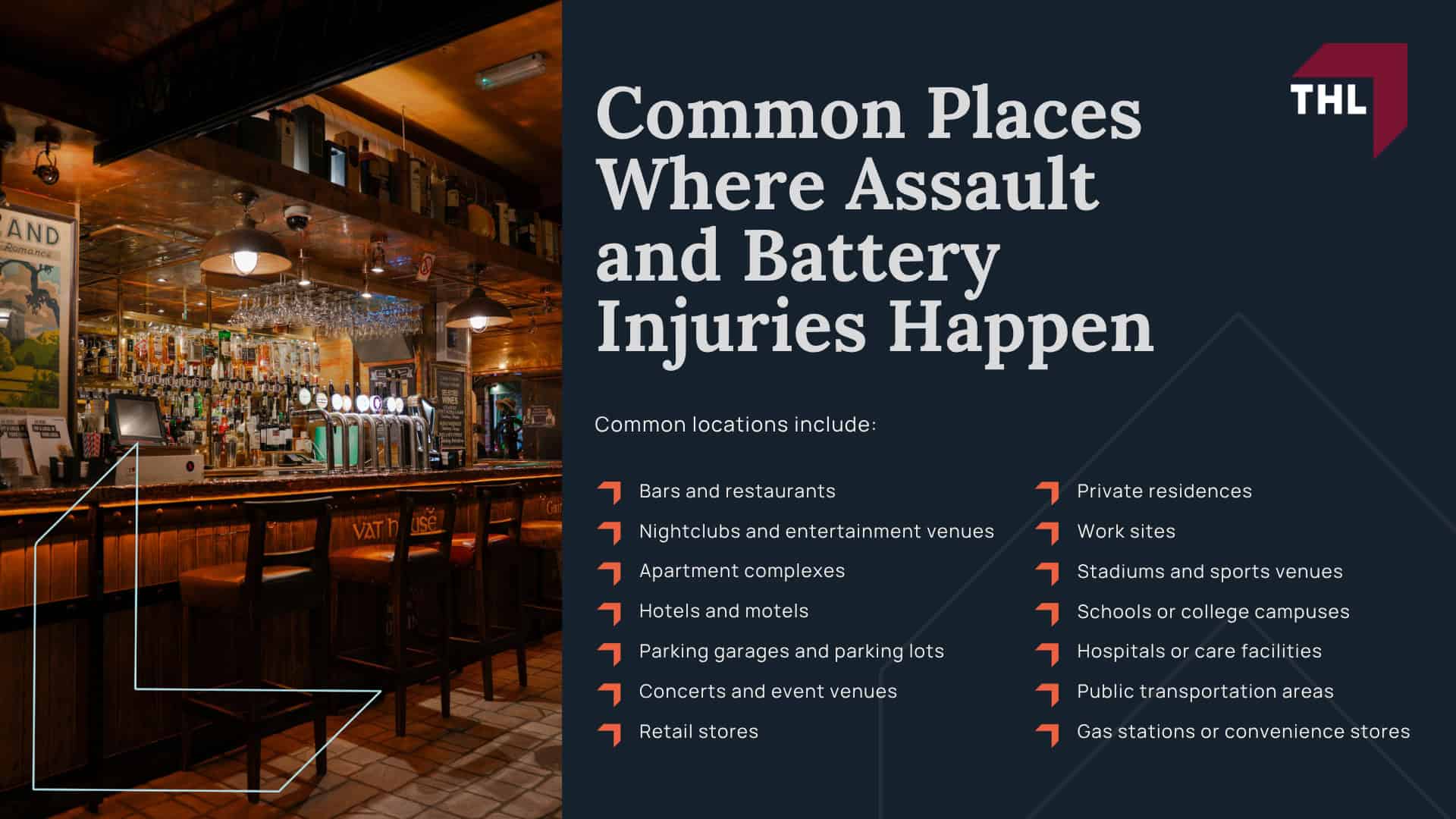
Common Places Where Assault and Battery Injuries Happen
Assault and battery injuries can happen almost anywhere, but certain locations appear more often in civil claims because they involve crowds, alcohol service, limited supervision, weak security, prior incidents, or poor control over access to the property.
The location matters because it can affect whether a business, landlord, property manager, or security company had a duty to take reasonable steps to reduce a foreseeable risk of harm.
Common locations include:
Bars and restaurants
Nightclubs and entertainment venues
Apartment complexes
Hotels and motels
Parking garages and parking lots
Concerts and event venues
Retail stores
Private residences
Work sites
Stadiums and sports venues
Schools or college campuses
Hospitals or care facilities
Public transportation areas
Gas stations or convenience stores
These cases often require a closer review of prior incidents, lighting, locks, security staffing, surveillance footage, crowd control, and whether the property owner or operator responded reasonably to known safety risks.
Injuries Caused by Assault and Battery Incidents
An assault or battery can cause injuries ranging from bruising and fractures to head trauma, internal injuries, and permanent complications.
Some injuries are obvious immediately after the attack, while others may develop or worsen over time, including concussion symptoms, nerve pain, anxiety, sleep disruption, and post-traumatic stress.
Serious incidents may cause disfigurement, neurological problems, mobility loss, psychological trauma, or long-term work restrictions.
Medical documentation is critical because civil claims depend on proving how the incident caused the injury and how the injury affected the victim’s health, income, and daily life.
Common injuries may include:
Broken bones
Facial trauma
Cuts and lacerations
Concussions and traumatic brain injuries
Neck and back injuries
Dental injuries
Nerve damage
Permanent disfigurement or scarring
Post-traumatic emotional harm
Eye injuries
Internal injuries
Gunshot or stab wounds, when relevant
Anxiety symptoms, sleep disruption, or PTSD symptoms
Loss of mobility or work restrictions
More serious injuries usually require closer documentation of emergency treatment, specialist care, future medical needs, counseling, work restrictions, scarring, emotional effects, and long-term limitations.
A strong civil claim should account for both visible injuries and less visible harm that affects daily functioning, employment, relationships, and personal safety.
Negligent Security and Third-Party Liability Claims
As we’ve established, not every assault case is only about the attacker.
Some claims involve negligent security, meaning the incident may have been preventable if a property owner or business had taken reasonable steps to protect lawful visitors.
These cases often arise after repeated violence at the same location, poor lighting, broken locks, lack of security staff, or ignored warnings.
A third-party claim may be worth investigating if:
The location had a history of similar violent incidents
Security was missing or inadequate
Staff failed to respond to escalating threats
Entry controls were broken or ignored
The property owner knew of the danger and failed to act
These cases can be fact-intensive, but they are important because they may identify insurance coverage or additional sources of recovery
That can matter when the attacker has limited assets and the victim needs a realistic path to compensation.
Damages in Assault and Battery Lawsuits
Civil damages in assault and battery cases are meant to compensate the victim for real losses caused by the incident.
Depending on the facts, recoverable damages may include medical bills, lost wages, pain and suffering, future care costs, and other financial losses tied to the injury.
A civil case may also seek monetary damages for emotional harm and, in some cases, punitive damages in limited cases involving especially egregious or intentional conduct, when supported by Missouri law and the evidence.
Punitive damages are not automatic in assault and battery cases.
They depend on the facts, pleadings, and proof of the defendant’s conduct.
Damages may include:
Medical expenses
Future medical care
Lost wages
Reduced earning ability
Pain and suffering
Emotional distress
Scarring or disfigurement
Punitive damages
A criminal prosecution may result in fines, probation, jail, prison, or other penalties, but it does not automatically make the victim whole.
That is why civil lawsuits matter even when the attacker has already been arrested or is facing criminal proceedings.
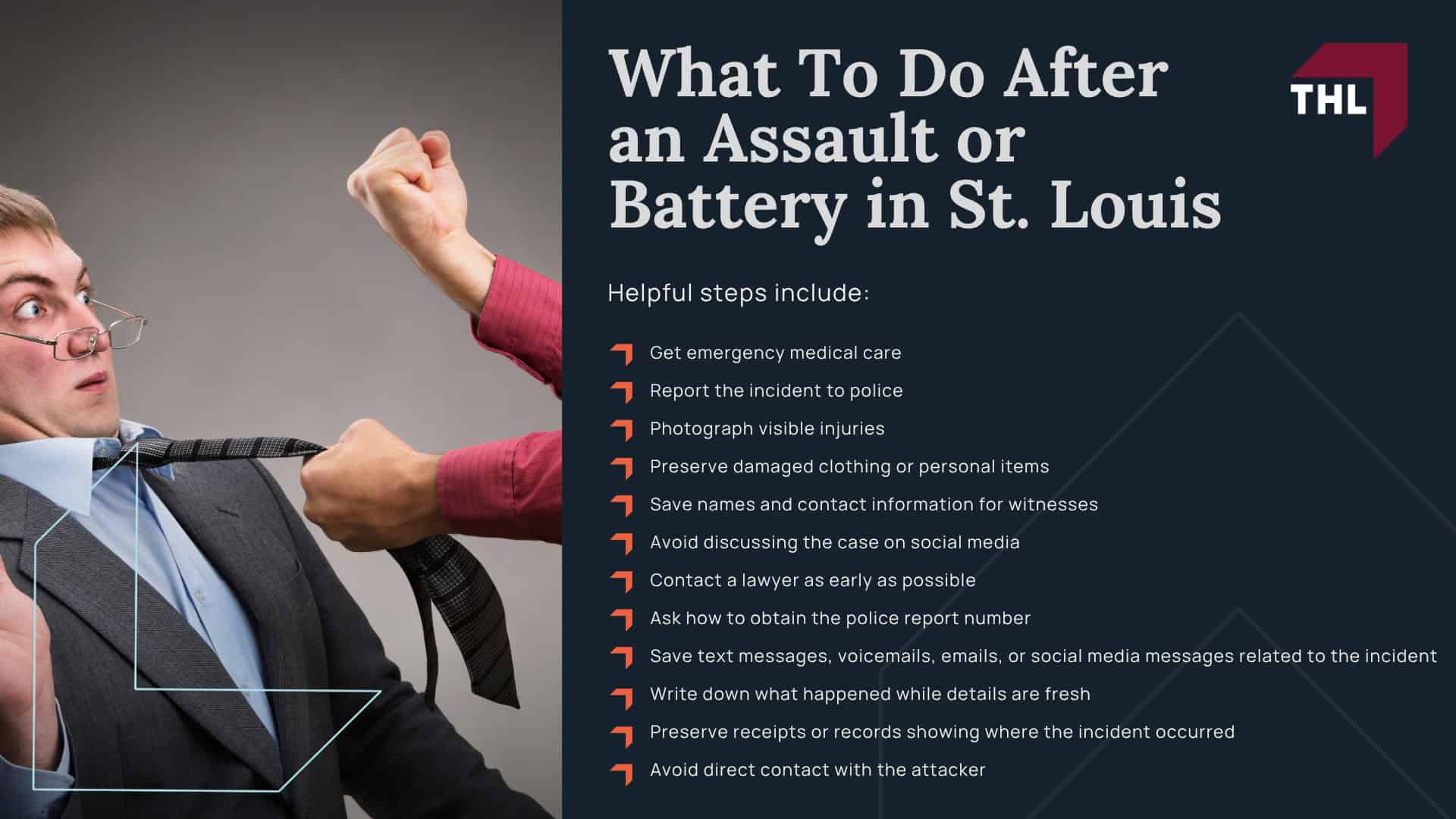
In many battery cases, the most important proof includes surveillance footage, medical records, police reports, photographs, and statements from people who saw what happened.
A lawyer may also focus on interviewing witnesses, identifying prior incidents at the location, and preserving digital evidence before it is lost.
Useful evidence may include:
Medical records and treatment bills
Police reports
Surveillance video
Photos of injuries and the scene
Witness statements
Employment records showing lost income
Communications before or after the incident
911 records
Bodycam or dashcam footage, if available
Protective order paperwork
Prior incident records at the location
Security staffing records
Photos of damaged property
Screenshots of threats or communications
A strong civil case often depends on what can be gathered early.
The evidence should connect the conduct to the injury, the injury to documented losses, and any third-party negligence to a foreseeable risk that should have been addressed.
How to Prove Liability in an Assault and Battery Case
To win a civil claim, the victim must show that the defendant’s conduct caused the injury and resulting losses.
In direct assault and battery claims, that usually means proving intentional conduct, harmful or offensive contact, or an immediate threat of harm.
In a direct claim against the attacker, liability often focuses on intent, contact, threats, self-defense arguments, and causation.
In a negligent security claim, liability usually focuses on whether the property owner or business had notice of a foreseeable risk and failed to use reasonable security measures.
The evidence should answer questions such as:
Who committed the act?
What exactly happened?
What injuries resulted?
Were there witnesses or video?
Did the location have prior safety problems?
Did another party fail to act reasonably?
Because these cases may involve both intentional tort and negligence theories, the evidence should be organized around the specific claim being pursued.
A lawyer can help organize the facts, present evidence effectively, and prepare the case for negotiation, filing, or trial if needed.
Missouri Laws That Can Affect Your Claim
Missouri law can affect both the criminal and civil sides of an assault and battery matter.
Missouri criminal assault charges and civil assault or battery claims serve different purposes.
A criminal conviction may help support a civil case, but it is not always required. Likewise, a dismissed or reduced criminal charge does not automatically prevent a civil claim.
On the criminal side, Missouri classifies assault offenses by degree, with first-degree assault covering attempts to kill or knowingly causing or attempting to cause serious physical injury.
Missouri also recognizes lower-degree assault offenses and armed criminal action involving a dangerous instrument or deadly weapon, which can increase the seriousness of the case.
On the civil side, timing matters. Missouri’s statute of limitations for civil actions for assault and battery is generally two years, which is shorter than the deadline for many other personal injury claims.
That means victims should not wait too long to speak with counsel about their options.
Claims involving negligent security, wrongful death, minors, or government property may involve different deadlines or additional legal issues, so the specific facts should be reviewed promptly.
Do You Qualify for a St. Louis Assault and Battery Lawsuit?
You may have a civil claim if you were injured by intentional violent conduct and suffered actual losses as a result.
A claim may also be possible if a business, landlord, event operator, employer, or security company failed to take reasonable steps to address a foreseeable risk.
The main questions are whether the conduct caused injury, whether damages can be documented, whether any third party may share liability, and whether the claim is filed within the applicable Missouri deadline.
You may have a case if:
You suffered physical injury
You needed medical treatment
You missed work or lost income
You experienced emotional distress
The incident caused lasting complications
Another party may have contributed through negligence
A civil claim may still be possible even if the accused is never convicted, or if the prosecution later drops or reduces the criminal charges.
The standards are different, and the victim’s right to seek compensation may still exist.
TorHoerman Law: St. Louis Assault and Battery Lawyers
TorHoerman Law represents injured people in serious personal injury matters, including assault and battery claims.
Our lawyers understand how these incidents can disrupt a victim’s health, work, finances, and peace of mind.
If you are searching for a St Louis assault and battery lawyer, our team can explain your rights, review the facts, and help you decide whether to pursue a civil claim.
We offer an initial consultation and confidential consultation so you can ask questions and learn more about your legal options.
If you need an experienced attorney and a legal team prepared to fight for justice, contact TorHoerman Law today for a free consultation.
You can also use the chatbot on this page.
Our firm is ready to review your case, discuss next steps, and help you pursue the best possible outcome.
A civil assault and battery claim is separate from the criminal prosecution.
The prosecutor is trying to prove a crime and seek a criminal sentence, while the civil case focuses on compensation for the victim’s injuries, losses, and other harm.
Self defense is a common argument in both criminal and civil cases.
Whether that defense applies depends on the facts, including who started the confrontation, what force was used, and whether the response was reasonable under the circumstances.
A civil claim may still succeed if the evidence shows the force used was unjustified or excessive.
Serious conduct can lead to aggravated assault charges, felony assault, or other major criminal filings depending on how the event happened and whether a weapon was involved.
For example, Missouri law treats first-degree assault as a felony and separately criminalizes armed criminal action when a felony is committed with a dangerous instrument or deadly weapon.
Those criminal classifications can matter in the civil case because they often reflect the seriousness of the conduct and resulting injuries.
A civil claim does not require a criminal conviction.
The burden of proof in criminal court is reasonable doubt, while civil cases use a lower standard, which means a victim may still recover compensation even if the prosecution does not obtain a conviction.
Tor Hoerman has represented injured individuals for more than 30 years, with experience spanning individual personal injury cases and nationwide mass tort litigation. His work includes car accidents, catastrophic injuries, product liability claims, and other serious injury cases. Tor has served in court-appointed leadership roles in national litigation and tried cases involving major corporate defendants.
Legally Reviewed
TorHoerman Law’s legal content is researched and written by our editorial team and attorneys for legal accuracy, clarity, and relevance. We rely on statutes, court records, government publications, medical research, and other authoritative sources when applicable. This page provides general legal information and does not constitute legal advice.
Fact-Checked
TorHoerman Law reviews its legal content for factual accuracy, current information, and relevant legal context before publication and as material developments occur. This article is provided for general informational purposes and does not constitute legal advice. For guidance about a specific case, contact TorHoerman Law.
Have you or a loved one been injured in
St Louis, Missouri?
A serious injury can change your life.
Speak with an experienced St Louis personal injury lawyer about your rights, your case, and the legal options available to you.
TorHoerman Law represents people whose lives have been disrupted by serious injuries, unsafe products, and negligence. Our attorneys handle individual personal injury cases as well as national mass tort lawsuits involving major corporations.
Founded in 2009, our legal team brings more than 100 years of combined experience handling serious injury and complex civil litigation.
Do you believe you’re entitled to compensation?
Use our Instant Case Evaluator to find out in as little as 60 seconds!
In this case, we obtained a verdict of $495 Million for our client’s child who was diagnosed with Necrotizing Enterocolitis after consuming baby formula manufactured by Abbott Laboratories.
They helped my elderly uncle receive compensation for the loss of his wife who was administered a dangerous drug. He consulted with this firm because of my personal recommendation and was very pleased with the compassion, attention to detail and response he received. Definitely recommend this firm for their 5 star service.
★★★★★Rated 5 out of 5
Philip Storey
When I wanted to join the Xarelto class action lawsuit, I chose TorrHoerman Law from a search of a dozen or so law firm websites. I was impressed with the clarity of the information they presented. I gave them a call, and was again impressed, this time with the quality of our interactions.
★★★★★Rated 5 out of 5
Krista Miller
TorHoerman Law is an awesome firm to represent anyone that has been involved in a case that someone has stated that it's too difficult to win. The entire firm makes you feel like you’re part of the family, Tor, Eric, Jake, Kristie, Chad, Tyler, Kathy and Steven are the best at what they do.
★★★★★Rated 5 out of 5
Joe Smith
TorHorman Law is awesome
★★★★★Rated 5 out of 5
Karen Levy
I can’t say enough how grateful I was to have TorHoerman Law help with my case. Jacob Plattenberger is very knowledgeable and an amazing lawyer. Jillian Pileczka was so patient and kind, helping me with questions that would come up. Even making sure my special needs were taken care of for meetings.
★★★★★Rated 5 out of 5
Lauren B
TorHoerman Law fights for justice with their hardworking and dedicated staff. Not only do they help their clients achieve positive outcomes, but they are also generous and important pillars of the community with their outreach and local support. Thank you THL!
★★★★★Rated 5 out of 5
Joey
Hands down one of the greatest group of people I had the pleasure of dealing with!
★★★★★Rated 5 out of 5
Nickie Shewmake
A very kind and professional staff.
★★★★★Rated 5 out of 5
Jeannette Johnson
Very positive experience. Would recommend them to anyone.