Chicago
Case Types We Handle
Personal Injuries
Car Accidents
Truck Accidents
Motorcycle Accidents
Bicycle Accidents
Construction Accidents
Nursing Home Abuse
Wrongful Death
Slip and Fall Accidents
Daycare Injury & Abuse
Edwardsville
Case Types We Handle
Personal Injuries
Car Accidents
Truck Accidents
Motorcycle Accidents
Bicycle Accidents
Nursing Home Abuse
Wrongful Death
Slip and Fall Accidents
Daycare Injury & Abuse
Premises Liability
St. Louis
Case Types We Handle
Personal Injuries
Car Accidents
Truck Accidents
Motorcycle Accidents
Bicycle Accidents
Construction Accidents
Nursing Home Abuse
Wrongful Death
Slip and Fall Accidents
Daycare Injury & Abuse
Dangerous Drugs
Defective Products
Chemical Exposure

Edwardsville Negligent Security Lawyer

4.9
206 reviews

Need Help After a Negligent Security Incident in Edwardsville? Contact TorHoerman Law

An Edwardsville negligent security lawyer from TorHoerman Law helps people pursue premises liability claims after assaults, shootings, robberies, sexual violence, and other violent crimes that occur on property with inadequate safety measures.

Negligent security incidents often involve preventable attacks at apartment complexes, hotels, parking lots, bars, shopping centers, and other locations where owners may have failed to address foreseeable risks through reasonable security precautions.

TorHoerman Law is actively reviewing negligent security claims from individuals injured in these incidents and from family members of those who have tragically passed away.

Edwardsville Negligent Security Lawyer

Our Personal Injury Lawyers Help Crime Victims Hurt in Preventable Attacks

Negligent security claims in Illinois arise when people are harmed by violence on commercial property or private property and the danger was foreseeable, yet property owners failed to take reasonable steps to reduce the risk.

In plain terms, these cases focus on whether a responsible party ignored known security threats and failed to implement reasonable security measures that could have helped prevent an attack.

For victims hurt due to negligent security, the consequences are often severe, ranging from a serious injury and long-term disability to lasting psychological trauma.

Many people are left shaken after realizing that a place they trusted (an apartment complex, hotel, parking lot, or business) was not treated as a safe environment.

Families facing wrongful death loss often have the same questions: whether the warning signs were there, and whether the property had opportunities to intervene before the violence occurred.

A negligent security claim can allow victims and families to pursue financial compensation for immediate medical care, medical costs tied to ongoing recovery, and the future costs of treatment that may follow for years.

These cases also look closely at evidence such as prior incidents, security complaints, and physical failures like broken locks, poor lighting, or missing surveillance.

TorHoerman Law is available to review what happened, explain your options, and determine whether a property’s security failures may support a claim for compensation under Illinois law.

If you or a loved one were harmed in a negligent security incident in Edwardsville, you may be eligible to take legal action and seek compensation.

Contact TorHoerman Law today for a free consultation.

You can also use the chat feature on this page for a free case evaluation and find out if you qualify for a negligent security claim.

What Is Negligent Security in Illinois?

Negligent security is a type of claim brought under Illinois premises liability law when someone is harmed by violence or other foreseeable criminal acts on a property that lacked appropriate safeguards.

In plain terms, a negligent security case arises when a person is attacked on someone else’s property and there are signs the danger was predictable, yet the owner failed to respond with adequate security measures.

These cases can involve apartment buildings, hotels, parking lots, bars, shopping centers, and other properties where people have a right to expect the environment will be kept reasonably safe.

The legal question is not whether a property can prevent every crime, but whether the business owner or other responsible party failed to act reasonably once warning signs existed.

When negligent security occurs, the focus is on what the property knew or should have known about the risk, what security steps were missing, and whether those gaps contributed to the attack.

In Illinois, property owners generally have a legal duty to act with reasonable care for lawful visitors, which can include taking steps to keep a property safe when violence is foreseeable under the circumstances.

That standard becomes a security issue when the property has a history of criminal incidents, repeated complaints, or obvious security vulnerabilities that create a predictable risk of harm.

In that situation, the property owner’s responsibility may include basic protections like functional locks and gates, controlled access, lighting that reduces hiding places, and security policies that respond to repeated threats.

Whether those steps were required depends on the setting and risk level, but the general principle is that the law expects owners to take reasonable safety measures that match what they know about the danger.
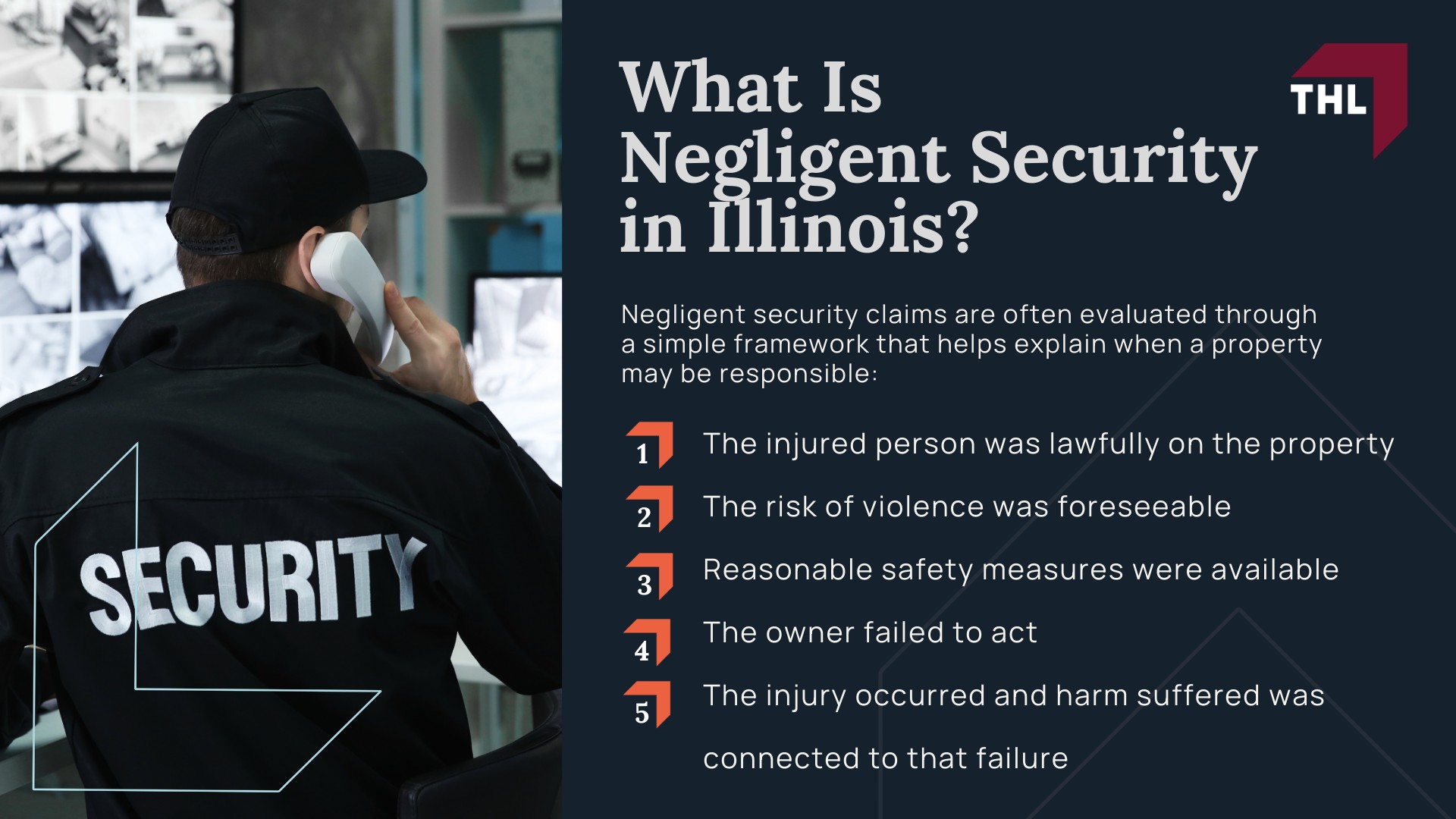
Negligent security claims are often evaluated through a simple framework that helps explain when a property may be responsible:

  1. The injured person was lawfully on the property, meaning the owner owed them a duty of reasonable care.
  2. The risk of violence was foreseeable, based on prior incidents, complaints, police activity, or other warning signs.
  3. Reasonable safety measures were available, including improvements that could have reduced the likelihood of an attack.
  4. The owner failed to act, meaning safeguards were missing, ignored, or not maintained.
  5. The injury occurred and harm suffered was connected to that failure, showing the security gaps contributed to the attack in a meaningful way.

Ultimately, these cases are about accountability for preventable risk.

If the evidence shows the property had repeated warning signs and still failed to take steps that a reasonable owner would have taken, Illinois law may allow victims and families to pursue compensation for the physical, emotional, and financial consequences of the harm.

Negligent Security vs. Premises Liability for Unsafe Conditions

Negligent security is a form of premises liability, but it focuses specifically on injuries caused by violent or criminal acts rather than hazards like broken stairs, wet floors, or structural defects.

In these cases, the claim is that the property had warning signs of danger and failed to take reasonable steps to prevent foreseeable crimes.

A traditional premises liability claim usually involves a dangerous condition created by poor maintenance, while negligent security claims often involve failures in access control, lighting, surveillance, staffing, or emergency response planning.

The difference matters because negligent security cases often require proof of foreseeability: showing the property knew or should have known that criminal harm was likely.
When a person is attacked due to a property owner’s failure to address known security risks, the case becomes less about the criminal act itself and more about whether the property’s safety decisions contributed to the harm.

Both types of claims can help victims recover compensation, but negligent security cases typically involve deeper investigation into crime history, complaints, and security practices to prove the attack was preventable.
What Types of Incidents Lead to Negligent Security Claims in Edwardsville?

Negligent security claims in Edwardsville often involve violent crimes that occur on property where owners or managers failed to treat known risks seriously.

Many negligent security cases arise in places where people reasonably expect the premises safe, such as apartment complexes, hotels, shopping areas, and public-facing businesses.

These incidents frequently happen when access control is weak, lighting is poor, or there is little deterrence, especially at night or in isolated areas.

The legal focus is whether the property had warning signs of danger (such as prior incidents, repeated disturbances, or police calls) and failed to respond with proper security measures.

Security gaps can include broken locks, unsecured entrances, unmonitored common areas, or a lack of on-site staff when the risk was obvious.

In some cases, properties hire security guards but fail to staff them adequately, train them properly, or deploy them in areas where violence is most likely.

Claims often involve locations where visibility and response time are limited, including parking garages, stairwells, entryways, and exterior walkways.

When a violent crime follows a recognizable risk pattern and the property failed to take reasonable precautions, the case may center on whether the harm could have been prevented or reduced.

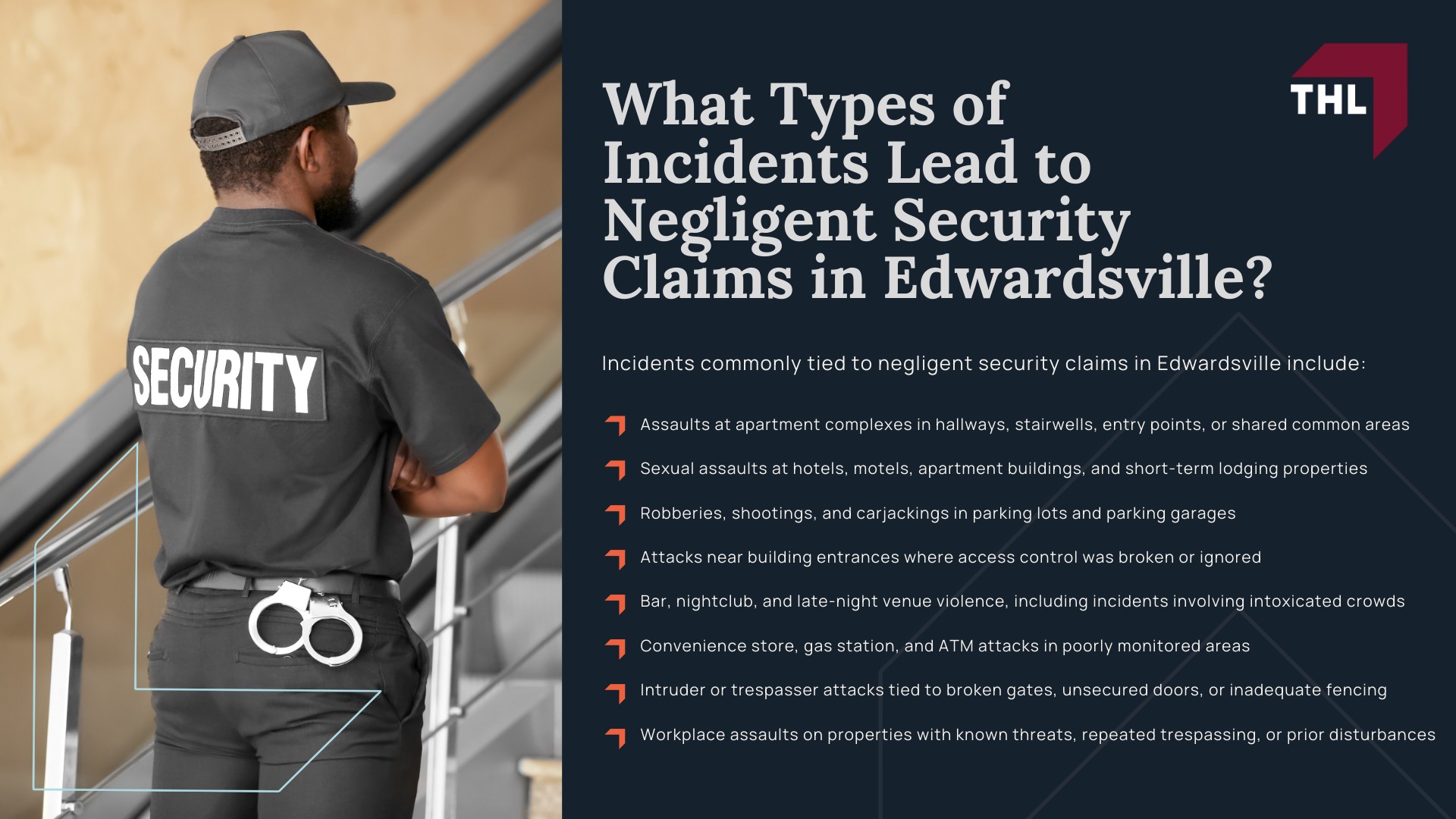
Incidents commonly tied to negligent security claims in Edwardsville include:

  • Assaults at apartment complexes in hallways, stairwells, entry points, or shared common areas
  • Sexual assaults at hotels, motels, apartment buildings, and short-term lodging properties
  • Robberies, shootings, and carjackings in parking lots and parking garages
  • Attacks near building entrances where access control was broken or ignored
  • Bar, nightclub, and late-night venue violence, including incidents involving intoxicated crowds
  • Convenience store, gas station, and ATM attacks in poorly monitored areas
  • Intruder or trespasser attacks tied to broken gates, unsecured doors, or inadequate fencing
  • Workplace assaults on properties with known threats, repeated trespassing, or prior disturbances

Common Negligent Security Injuries

Negligent security incidents often cause severe injuries because the underlying event usually involves intentional violence, weapons, or sudden physical force.

Many victims require emergency treatment, surgery, and long-term rehabilitation, and some injuries leave lasting disability.

Even when physical wounds heal, many people experience psychological symptoms that affect sleep, work, relationships, and daily functioning.

Because these cases frequently involve traumatic events, the injuries often include both physical harm and serious emotional or mental health consequences.

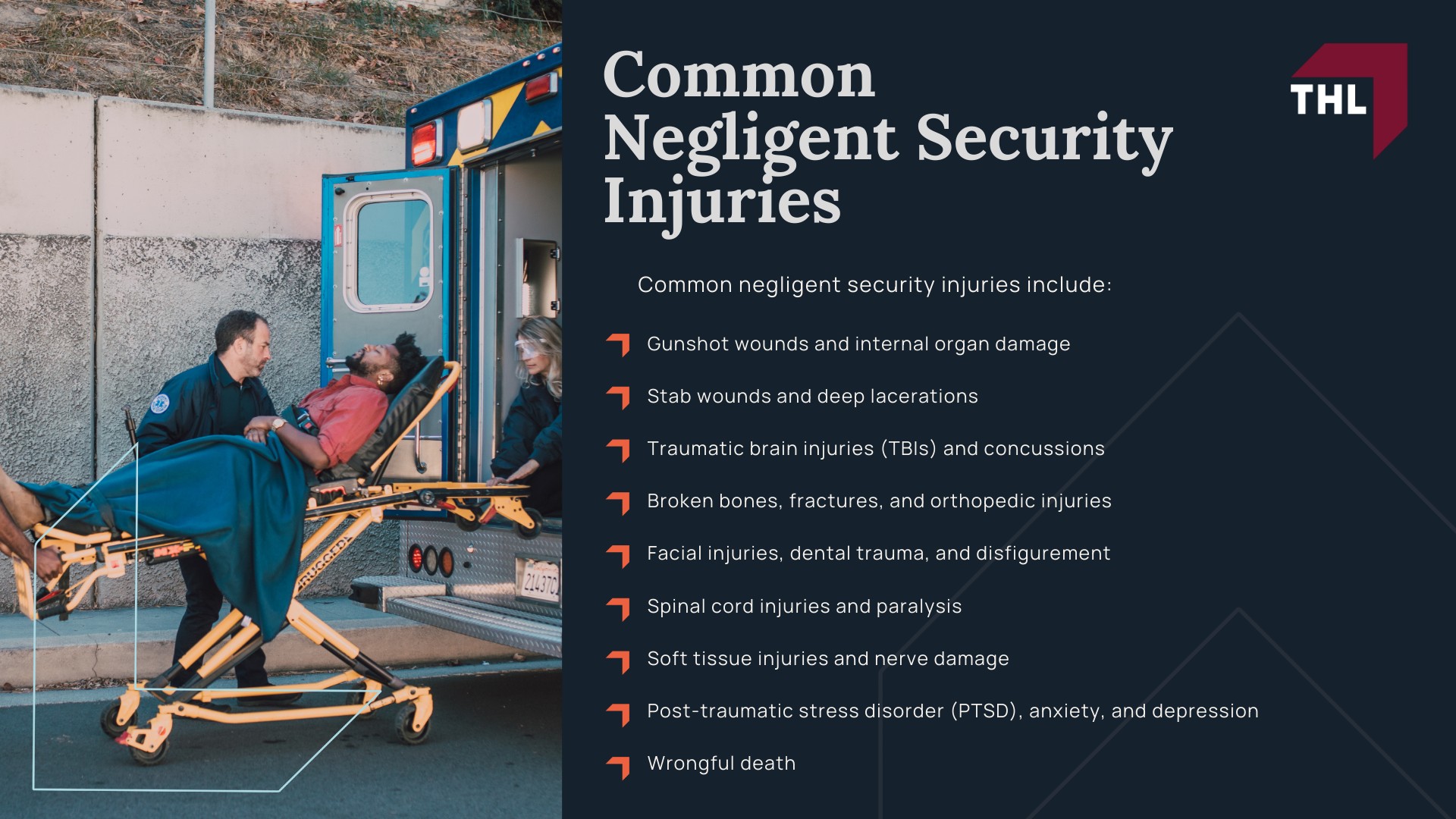
Common negligent security injuries include:

  • Gunshot wounds and internal injuries
  • Stab wounds and deep lacerations
  • Traumatic brain injuries (TBIs) and concussions
  • Broken bones and fractures
  • Spinal cord injuries and paralysis
  • Facial injuries, dental trauma, and disfigurement
  • Soft tissue injuries and nerve damage
  • Post-traumatic stress disorder (PTSD), anxiety, and depression
  • Wrongful death

What Is Considered Inadequate Security?

Inadequate security refers to security conditions or practices that fail to match the risk level on a property, especially when the owner or manager had warning signs of criminal activity.

These cases often involve properties that did not take basic steps to reduce predictable danger, even after prior incidents, repeated complaints, or obvious security vulnerabilities.

In many negligent security claims, the issue is not that a crime happened, but that the property created an easier environment for violence by leaving key safeguards broken, missing, or ignored.

When an attack occurs, evidence like surveillance footage, maintenance logs, and staffing records can help show what protections were missing and whether the property failed to respond to known risks.

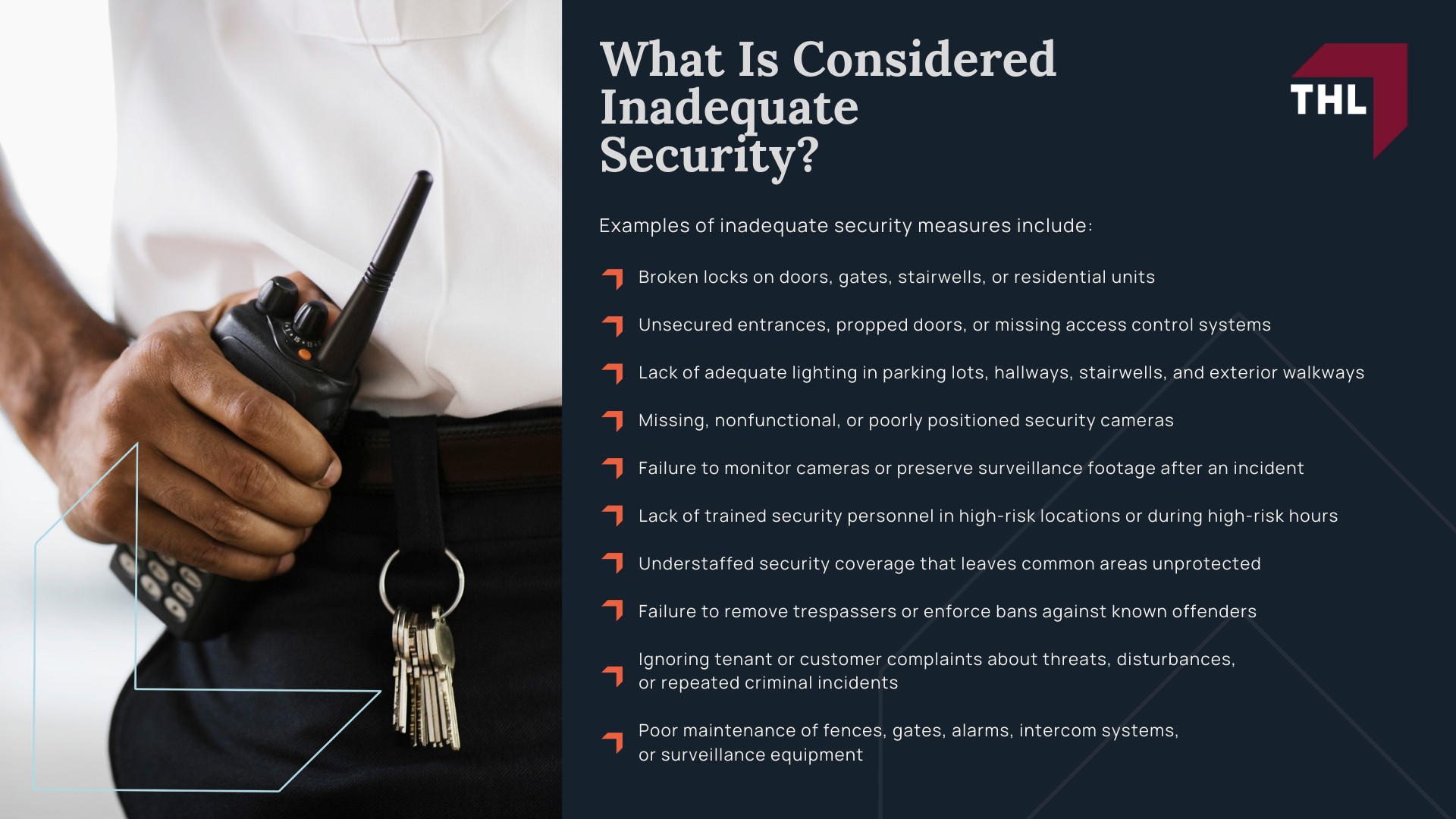
Examples of inadequate security measures include:

  • Broken locks on doors, gates, stairwells, or residential units
  • Unsecured entrances, propped doors, or missing access control systems
  • Lack of adequate lighting in parking lots, hallways, stairwells, and exterior walkways
  • Missing, nonfunctional, or poorly positioned security cameras
  • Failure to monitor cameras or preserve surveillance footage after an incident
  • Lack of trained security personnel in high-risk locations or during high-risk hours
  • Understaffed security coverage that leaves common areas unprotected
  • Failure to remove trespassers or enforce bans against known offenders
  • Ignoring tenant or customer complaints about threats, disturbances, or repeated criminal incidents
  • Poor maintenance of fences, gates, alarms, intercom systems, or surveillance equipment

What To Do After an Assault or Attack on Someone Else’s Property

After an assault or attack, many people feel overwhelmed, physically shaken, and unsure of what steps to take while they are trying to recover from trauma.

That reaction is normal, especially when the incident happened in a place that should have felt safe, such as an apartment complex, hotel, parking lot, or business open to the public.

If you believe the property may have failed to provide adequate security measures, the facts and documentation gathered early can have a major impact on your ability to pursue accountability later.

Surveillance footage can be overwritten within days, and properties may quickly repair locks, lighting, gates, or access points after an incident, making it harder to prove what conditions were like at the time of the attack.

You may also be contacted by insurance representatives or property managers asking for statements or signatures that can limit your claim.

Taking careful steps early protects your health and preserves evidence that may be critical when filing negligent security claims.

The goal is not to handle everything alone.

It is to document what happened while you focus on safety and medical care.

A qualified law firm can step in early to preserve evidence and help you understand your options before important details are lost.

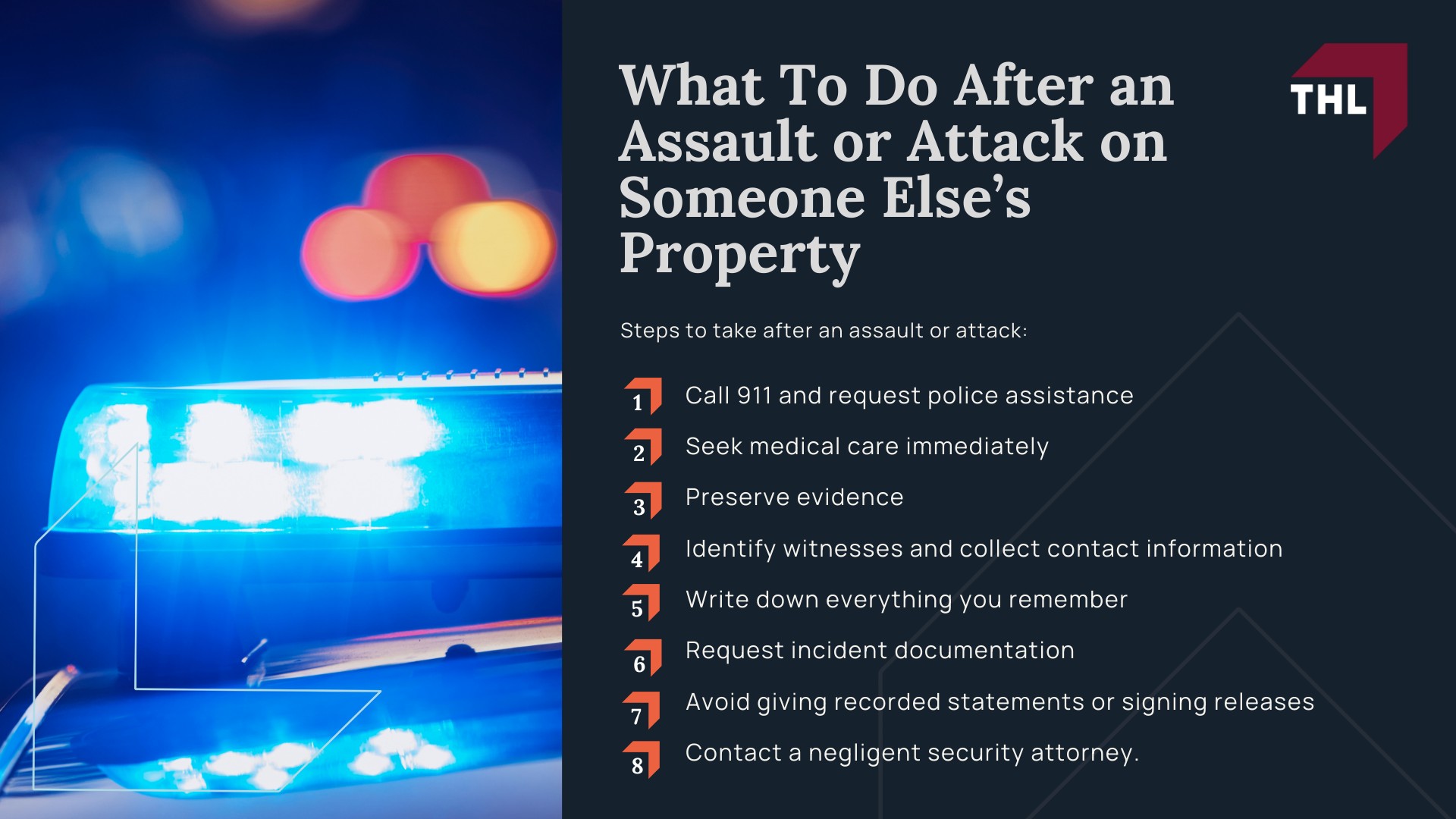
Steps to take after an assault or attack:

  1. Call 911 and request police assistance so the incident is officially documented and the scene is addressed.
  2. Seek medical care immediately, even if injuries seem minor, and follow treatment recommendations.
  3. Preserve evidence by taking photos of the scene, your injuries, damaged clothing, and any visible security failures like broken locks or poor lighting.
  4. Identify witnesses and collect contact information, including residents, employees, or bystanders who saw the incident or unsafe conditions.
  5. Write down what you remember as soon as possible, including the timeline, location, and anything that seemed unsafe or suspicious before the attack.
  6. Request incident documentation from the property if available, including incident reports, manager notes, or communications related to the event.
  7. Avoid giving recorded statements or signing releases for insurers or property owners before you understand how they may be used.
  8. Contact a negligent security attorney to discuss evidence preservation and your legal options.

These cases often depend on records controlled by the property, including surveillance footage, maintenance history, and security staffing documents.

An attorney can send preservation letters to request that evidence and help prevent it from being deleted or altered.

A law firm can also begin investigating whether prior incidents or repeated complaints made the risk foreseeable before the attack occurred.

Even if you are unsure whether you want to pursue a claim, early legal review can help you protect evidence and avoid mistakes that could weaken the case later.

The sooner the facts are documented, the easier it becomes to evaluate whether the harm may be tied to inadequate security rather than being treated as unavoidable.

Do You Qualify for a Negligent Security Lawsuit?

A negligent security lawsuit may be an option if you were injured during a violent crime on someone else’s property and the evidence suggests the risk was foreseeable.

These cases often involve properties with a history of criminal activity, repeated disturbances, or security complaints that should have prompted stronger safety measures.

You may qualify if you were lawfully on the premises and the property failed to take reasonable steps to reduce predictable danger, such as repairing locks, improving lighting, monitoring cameras, or providing security staffing.

The claim also needs a clear connection between the security failures and the harm, showing the attack was made more likely or more severe because safeguards were missing or ignored.

Your injuries and losses matter as well, including medical care, lost income, emotional trauma, and long-term treatment needs.

Because negligent security litigation often depends on evidence controlled by the property, acting quickly to preserve footage, incident logs, and maintenance records can strengthen the case.

A successful negligent security lawsuit is built on proof of foreseeability, a breach of duty, and documented damages that show the full impact of the attack.

TorHoerman Law can review what happened and explain whether the facts support pursuing adequate compensation under Illinois law.

Gathering Evidence for a Negligent Security Claim

Evidence is often the foundation of a negligent security claim because it helps show what the property knew about safety risks, what protections were missing, and whether the attack was foreseeable.

These cases frequently come down to whether the property failed to provide reasonable security measures despite warning signs such as prior incidents, repeated disturbances, or documented complaints.

Acting quickly matters because surveillance footage can be overwritten, witnesses can disappear, and property conditions (like locks, gates, or lighting) may be repaired soon after the incident.

Strong evidence can also clarify the role of third parties, including security companies, when a property outsourced security duties but failed to staff, supervise, or enforce safety protocols.

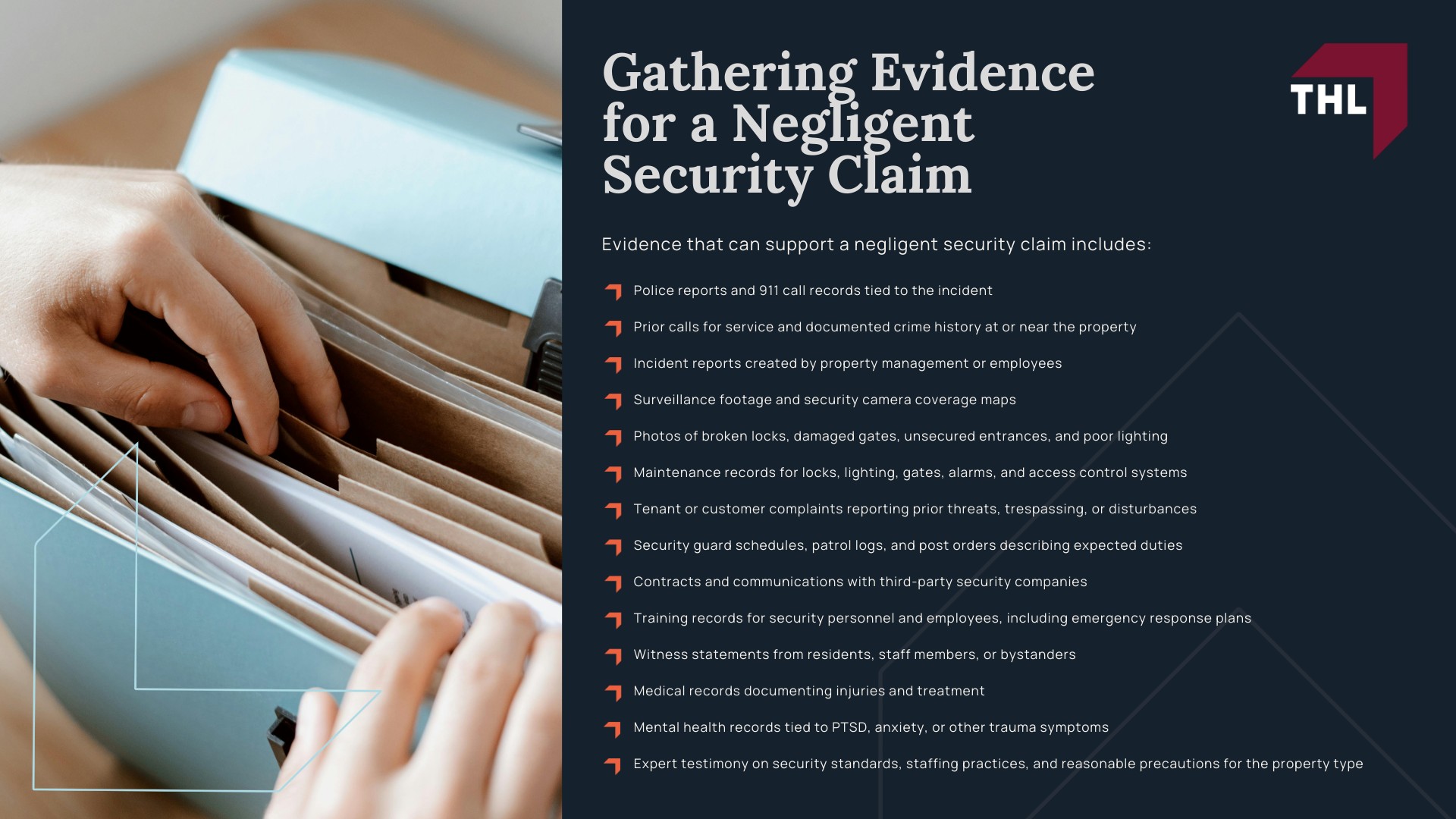
Evidence that can support a negligent security claim includes:

  • Police reports and 911 call records tied to the incident
  • Prior calls for service and documented crime history at or near the property
  • Incident reports created by property management or employees
  • Surveillance footage and security camera coverage maps
  • Photos of broken locks, damaged gates, unsecured entrances, and poor lighting
  • Maintenance records for locks, lighting, gates, alarms, and access control systems
  • Tenant or customer complaints reporting prior threats, trespassing, or disturbances
  • Security guard schedules, patrol logs, and post orders describing expected duties
  • Contracts and communications with third-party security companies
  • Training records for security personnel and employees, including emergency response plans
  • Witness statements from residents, staff members, or bystanders
  • Medical records documenting injuries and treatment
  • Mental health records tied to PTSD, anxiety, or other trauma symptoms
  • Expert testimony on security standards, staffing practices, and reasonable precautions for the property type

Damages in Negligent Security Claims

Damages are the losses a victim suffers after a violent incident, and they form the basis of the compensation requested in a negligent security claim.

Lawyers evaluate damages by reviewing medical bills, treatment records, and the expected long-term impact of the injuries, including ongoing care and future limitations.

They also calculate economic losses like lost wages and reduced earning capacity by documenting missed work, disability restrictions, and career disruption caused by the attack.

Because many negligent security incidents involve lasting psychological harm, attorneys also assess non-economic damages such as pain and suffering and emotional trauma using medical documentation, mental health treatment records, and evidence of daily-life disruption.

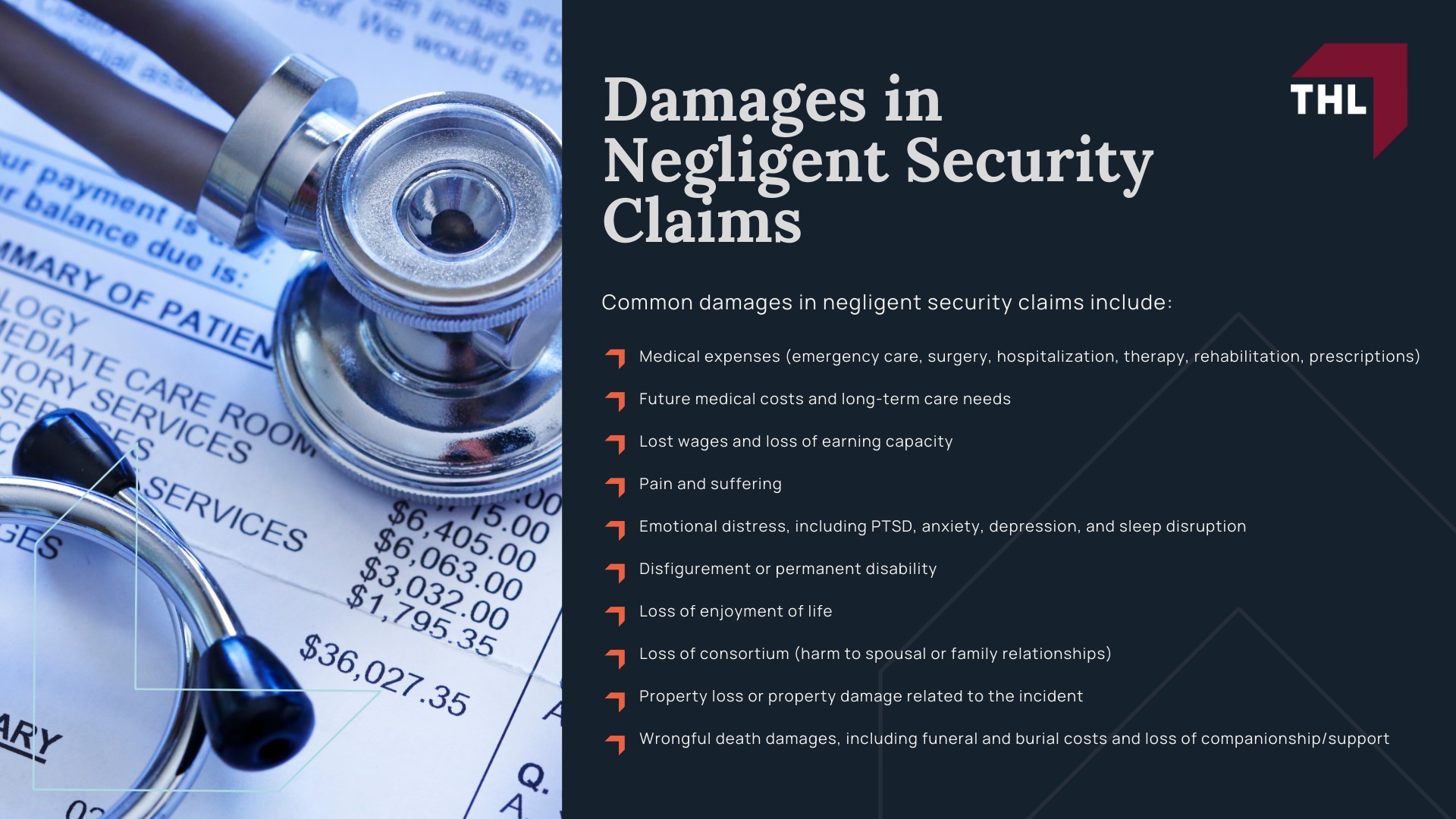
Common damages in negligent security claims include:

  • Medical bills and out-of-pocket expenses related to emergency care and treatment
  • Ongoing medical expenses, including rehabilitation, therapy, prescriptions, and future medical care
  • Lost wages and loss of future earning capacity
  • Pain and suffering
  • Emotional trauma, including PTSD, anxiety, depression, and sleep disruption
  • Disfigurement, scarring, and permanent disability
  • Loss of enjoyment of life
  • Loss of consortium (impact on close family relationships)
  • Property loss or damage connected to the incident
  • Wrongful death damages, including funeral expenses and loss of companionship/support

Who Can Be Held Liable for a Negligent Security Incident?

Liability in a negligent security case depends on who controlled the property, who made the safety decisions, and who had the ability to fix security problems before the attack occurred.

Many cases involve multiple defendants because ownership, management, and security operations are often divided between different companies and contractors.

Identifying every responsible party is a key part of the investigation, especially when third-party security vendors or corporate entities played a role in the conditions that contributed to the harm.

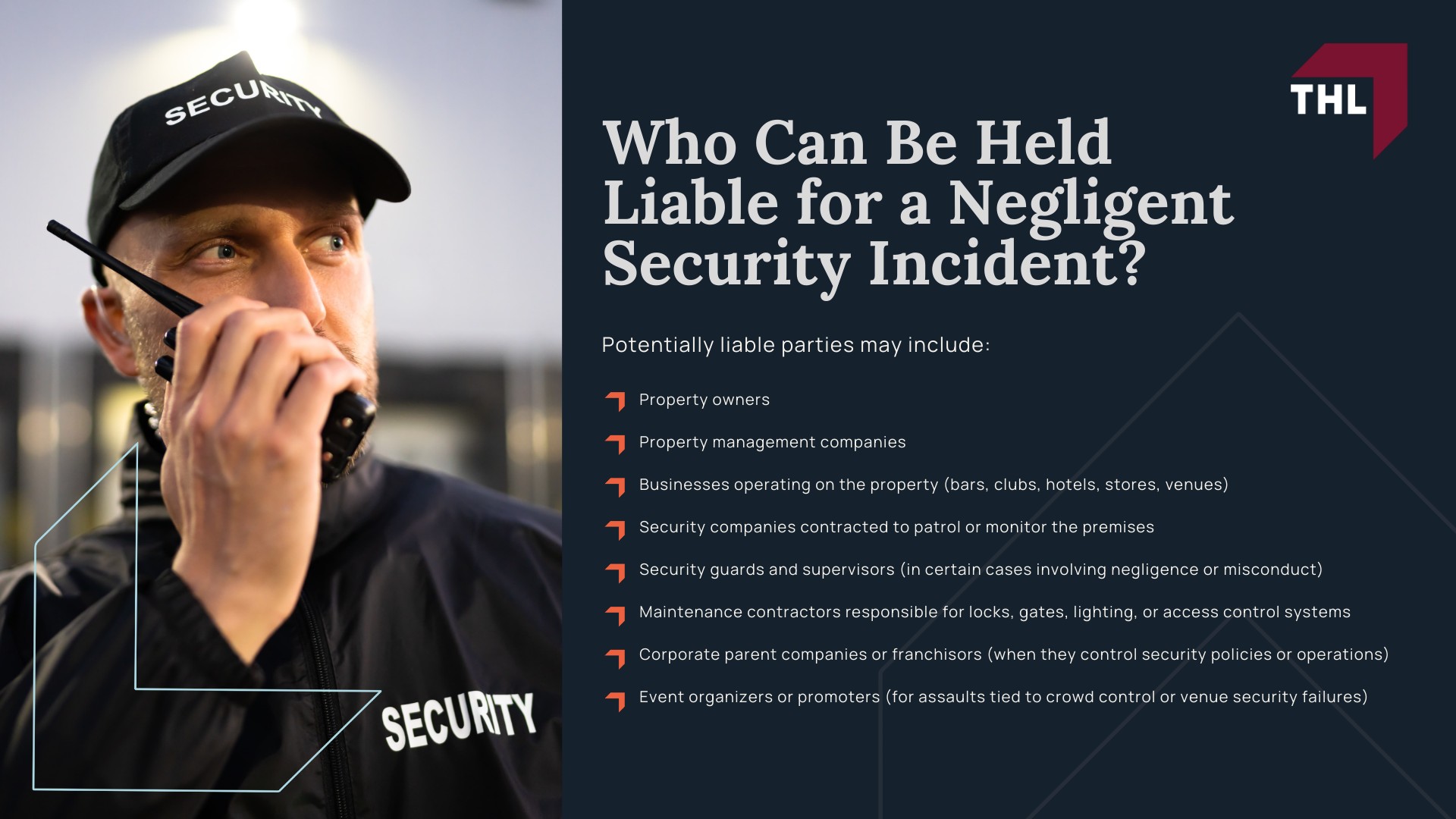
Potentially liable parties may include:

  • Property owners
  • Landlords and apartment complex owners/operators
  • Property management companies
  • Businesses operating on the property (hotels, bars, restaurants, stores, venues)
  • Security companies and private security contractors
  • Security guards and supervisors (in certain cases involving negligence or misconduct)
  • Maintenance contractors responsible for locks, gates, lighting, alarms, or access control systems
  • Corporate parent companies or franchisors (when they control security policies or operational decisions)
  • Event organizers or promoters (when violence is tied to crowd control or venue security failures)

TorHoerman Law: Edwardsville Negligent Security Attorneys

TorHoerman Law has a proven track record representing people harmed in serious injury cases involving preventable dangers and corporate negligence.

Negligent security claims often involve life-changing trauma, and property owners and insurers rarely admit fault without a thorough investigation and a strong liability argument.

Our law firm moves quickly to preserve evidence, review the property’s history, identify security failures, and build a case focused on foreseeability, duty, and damages under Illinois law.

If you or a loved one was injured in an Edwardsville negligent security incident or if your family is grieving a wrongful death, TorHoerman Law is available to review your case and explain your legal options.

Call today for a free, confidential consultation.

You can also use the chat feature on this page to find out if you qualify for a negligent security lawsuit.

Frequently Asked Questions

Other Edwardsville personal injury cases we handle
All
Auto Accidents
Car Accidents
Motorcycle Accidents
Other Accidents & Injuries
Truck Accidents
You can learn more about other Edwardsville personal injury cases we handle below:
Edwardsville ATV Accident Lawyer
Edwardsville Drowning Accident Lawyer
Edwardsville 18 Wheeler Accident Lawyer
Edwardsville Insurance Claim Lawyer
Edwardsville Spinal Cord Injury Lawyer
Edwardsville Fatal Car Accident Lawyer
Edwardsville Brain Injury Lawyer
Edwardsville Drunk Driving Accident Lawyer
Edwardsville Catastrophic Injury Lawyer
Edwardsville Construction Accident Lawyer
Edwardsville Uber Accident Lawyer
Edwardsville Public Transportation Accident Lawyer
Edwardsville Car Accident Lawyer
Edwardsville Slip and Fall Lawyer
Edwardsville Wrongful Death Lawyer
Edwardsville Truck Accident Lawyer
Edwardsville Premises Liability Lawyer
Edwardsville Nursing Home Abuse Lawyer
Edwardsville Motorcycle Accident Lawyer
Edwardsville Daycare Injury Lawyer
Edwardsville Medical Malpractice Lawyer
Edwardsville Workers Compensation Lawyer
Edwardsville Chemical Exposure Lawyer
Edwardsville Bicycle Accident Lawyer
Edwardsville Assault Lawyer
Edwardsville Personal Injury Lawyer
Edwardsville Dog Bite Lawyer
Published by:
Share
Picture of Tor Hoerman
Tor Hoerman

Attorney Tor Hoerman, admitted to the Illinois State Bar Association since 1995 and The Missouri Bar since 2009, specializes nationally in mass tort litigations. Locally, Tor specializes in auto accidents and a wide variety of personal injury incidents occuring in Illinois and Missouri.

This article has been written and reviewed for legal accuracy and clarity by the team of writers and attorneys at TorHoerman Law and is as accurate as possible. This content should not be taken as legal advice from an attorney. If you would like to learn more about our owner and experienced injury lawyer, Tor Hoerman, you can do so here.

TorHoerman Law does everything possible to make sure the information in this article is up to date and accurate. If you need specific legal advice about your case, contact us. This article should not be taken as advice from an attorney.

Were you or a loved one injured in Edwardsville, Illinois?

A serious injury can have life-altering results.

Don’t settle for less than you deserve. Speak with an award-winning Edwardsville personal injury lawyer today.
206 reviews
4.9
★★★★★
Recovered damages
$4 Billion+

Table of Contents

About TorHoerman Law

At TorHoerman Law, we believe that if we continue to focus on the people that we represent, and continue to be true to the people that we are – justice will always be served.

Do you believe you’re entitled to compensation?

Use our Instant Case Evaluator to find out in as little as 60 seconds!

$495 Million
Baby Formula NEC Lawsuit

In this case, we obtained a verdict of $495 Million for our client’s child who was diagnosed with Necrotizing Enterocolitis after consuming baby formula manufactured by Abbott Laboratories.

$20 Million
Toxic Tort Injury

In this case, we were able to successfully recover $20 Million for our client after they suffered a Toxic Tort Injury due to chemical exposure.

$103.8 Million
COX-2 Inhibitors Injury

In this case, we were able to successfully recover $103.8 Million for our client after they suffered a COX-2 Inhibitors Injury.

$4 Million
Traumatic Brain Injury

In this case, we were able to successfully recover $4 Million for our client after they suffered a Traumatic Brain Injury while at daycare.

$2.8 Million
Defective Heart Device

In this case, we were able to successfully recover $2.8 Million for our client after they suffered an injury due to a Defective Heart Device.

Guides & Resources

Share

Other Edwardsville Personal Injury Cases

All
Auto Accidents
Car Accidents
Motorcycle Accidents
Other Accidents & Injuries
Truck Accidents

St. Louis Auto Accident News

TorHoerman Law: Injury & Car Accident Lawyers in Edwardsville, IL
Local Edwardsville Resources
Education
Emergency Services
Courthouses
Department of Motor Vehicles
Sights to See
Counties We Serve
Cities We Serve

What Our Clients Have To Say