Active Litigation
Gambling Addiction Lawsuit Facts
TorHoerman Law is actively accepting claims for the Gambling Addiction Lawsuit.

Active Litigation
TorHoerman Law is actively accepting claims for the Gambling Addiction Lawsuit.
Gambling addiction lawsuit claims center on the argument that online platforms like DraftKings and FanDuel were deliberately designed to foster compulsive betting and exploit vulnerable users.
Victims report devastating financial losses, mental health struggles, and family disruption tied to apps that marketed “risk-free” bets and encouraged constant play.
TorHoerman Law is helping victims seek accountability from operators that prioritized profit while leaving individuals and their loved ones to bear the consequences.
Online gambling platforms have transformed how people place bets, offering constant access that has intensified the risks of gambling disorder.
For many sports bettors and young people, the convenience of mobile wagering has blurred the line between entertainment and compulsive gambling.
Problem gambling is no longer confined to casinos; it is now embedded in daily routines, available with a swipe or tap.
The brain’s reward system is especially vulnerable to the instant feedback of wins and losses, which can push individuals toward chasing losses and betting increasing amounts over time.
What may begin as casual play and interaction with online casino games can spiral into a lack of control, where gambling affects not only finances but also mental health.
Depression, anxiety, and strained relationships with loved ones and family members are common consequences of this hidden addiction.
Risk factors such as youth, financial stress, and exposure to aggressive promotions compound the dangers of online access.
For those struggling, the cycle of compulsive gambling often leaves behind deep emotional scars for both the individual and their family members.
Lawsuits are now being filed and further legal action is under investigation on behalf of individuals who have suffered significant losses because these apps and platforms were deliberately engineered to keep users betting.
If you or a loved one has suffered significant financial losses, been diagnosed with gambling disorder or related mental health conditions, or began betting on apps like DraftKings or FanDuel at a young age, you may be eligible to take legal action against the companies that engineered these platforms to encourage compulsive play.
Contact TorHoerman Law today for a free case review.
You can also use the chat feature on this page to find out if you qualify for a gambling addiction lawsuit.
The Seminole Tribe of Florida has sued DraftKings, CEO Jason Robins and DraftKings Predictions, asking a Florida court to shut down what the Tribe calls an illegal sportsbook operating in the state.
The 72 page complaint, filed Thursday in Broward County Circuit Court, also names GUS III LLC, which does business as DraftKings Predictions.
At the center of the case is Florida’s 2021 gaming compact, which the Tribe says gives it exclusive rights to operate sports betting in the state through Hard Rock Bet.
The Tribe alleges that DraftKings is using its new “Super App” and prediction market products to offer sports betting without a Florida license, and that those products function like a traditional sportsbook despite being structured as a prediction market.
To support that claim, the complaint cites statements from Robins that most customers do not really understand the difference between the two products and that the company offers its predictions product only in states where it lacks legal sports betting, a group that includes Florida.
The Tribe also alleges that DraftKings operates a market making division that trades against customers, which it says makes the company look more like a sportsbook than a neutral exchange.
The suit raises consumer protection concerns as well, noting that the compact requires bettors to be at least 21 and that state safeguards exist to verify age and address problem gambling.
It points to DraftKings advertising in Florida that promotes customer bonuses alongside a problem gambling hotline warning.
The Tribe asks the court to declare DraftKings’ Florida offerings illegal, order the company to stop operating and advertising them in the state, and require it to give up profits from the alleged illegal activity, adding that it would prioritize any money recovered for consumer protection and problem gambling programs.
DraftKings disputes the allegations, saying its prediction markets product operates within the federal regulatory framework established under the Commodity Exchange Act and that its Pick6 game is a peer to peer fantasy sports variant rather than sports betting.
The company said it does not offer sports contracts on Seminole tribal land in Florida and noted that other companies operate prediction market platforms in the state, adding that it respects the Tribe’s sovereignty but remains confident in its legal position.
A West Virginia man has filed a proposed class action alleging that DraftKings used artificial intelligence to identify customers showing signs of problem gambling and then targeted them with tailored promotions.
The complaint, filed September 30 in the District of Massachusetts, seeks to represent consumers who received targeted emails, push notifications and other personalized promotions from DraftKings.
The plaintiff alleges that DraftKings’ AI system identifies addictive gambling patterns and uses that information to encourage larger and more frequent wagers.
He claims that during one 30-day period before September 25, he received about 70 emails, texts and in-app notifications urging him to continue spending.
The lawsuit also alleges that DraftKings failed to disclose that it was using artificial intelligence, machine learning and customer information in this way.
The claims include breach of contract, breach of implied contract and money had and received.
The plaintiff is seeking damages and a court order barring DraftKings from using its AI model to encourage gambling.
The lawsuit follows a New York Times report in which current and former employees said DraftKings’ system offered free bets and other promotions to customers considered likely to continue losing.
They also alleged that the company could identify and warn customers showing signs of gambling addiction but had not done so.
DraftKings has denied using artificial intelligence to target customers based on losses or signs of problem gambling.
Massachusetts regulators have also said they plan to examine how sportsbooks use AI, beginning with DraftKings.
A Philadelphia Inquirer investigation reports that sportsbook addiction lawsuits are spreading across several states.
One plaintiff’s lawyer told the paper her firm has retained about 15,000 clients with similar claims.
Her firm has sued sportsbook operators in Delaware, Massachusetts, New Jersey, and Pennsylvania.
About a half dozen former FanDuel and DraftKings customers have recently sued in Philadelphia Common Pleas Court, alleging the apps use highly personalized algorithms and loyalty programs to target the most addicted users.
The companies deny that and point to their responsible gaming tools and have asked judges to dismiss other cases, arguing they offer a free app rather than a product.
Governmental pressure is building too.
On September 23, the Public Health Advocacy Institute and a nonprofit called Families and Friends of Gamblers launched a gambling reform campaign in Washington, with Senator Richard Blumenthal and Representative Paul Tonko joining the launch.
The institute’s lawyers filed a March lawsuit against FanDuel, DraftKings and the NFL.
The SAFE Bet Act would set federal standards for state licensed sportsbooks covering advertising, affordability checks and the use of AI.
A proposed Massachusetts class action alleges DraftKings used artificial intelligence to identify customers most likely to respond to gambling promotions, including people showing signs of problem gambling.
A West Virginia man filed the lawsuit in federal court in Boston, claiming he lost thousands of dollars gambling with DraftKings over several years.
He alleges the company sent him at least 70 promotional emails, texts, and other messages in a single month urging him to keep betting.
He’s seeking to represent other DraftKings customers he says the company’s AI systems identified as likely to respond to incentives and promotions designed to keep them gambling.
The complaint also alleges DraftKings violated Massachusetts law by failing to disclose that it was using AI this way.
DraftKings has publicly denied the allegations, stating it doesn’t use AI to target customers based on losses or signs of problem gambling.
The case stems directly from a New York Times investigation published last month, in which former DraftKings employees described systems built to identify losing gamblers likely to respond positively to promotional offers.
The report also found DraftKings explored, then abandoned, technology to identify customers prone to gambling problems.
Massachusetts Attorney General Andrea Campbell’s office said the allegations raise serious concerns, and the state auditor said the accusations would be unacceptable if proven true.
This isn’t the first such case against DraftKings.
A Chicago-area customer filed a similar suit in June, alleging the company deliberately targeted him with personalized offers despite signs of a gambling disorder, and that case remains ongoing.
A New York Times investigation reports DraftKings built machine-learning models capable of identifying gamblers who consistently lose more than they win, then used that data to target them with “free bet” promotions and other incentives designed to keep them wagering.
Former and current employees told the Times the same models could detect signs of problem gambling and warn those users but say DraftKings has resisted using the technology that way for years.
According to the report, DraftKings built the model in 2023 after spending millions on promotions without knowing whether they worked.
A data analyst brought in to test its effectiveness said the goal was to find patterns showing what made people spend and who was most likely to fall for the tactics, meaning the model was built to find people who gamble more and lose more.
Those same traits closely overlap with signs of addiction, including “chasing the dragon,” a pattern where a losing gambler keeps betting trying to win the money back.
Employees say they pushed the company to use the same technology to flag and warn at-risk users, but DraftKings shelved the idea, calling it unproven.
Following the report, the Massachusetts Gaming Commission announced it will investigate how licensed sportsbooks in the state use AI, starting with DraftKings.
The announcement came alongside state data showing online sportsbooks generated $47 million in Massachusetts in August alone.
DraftKings has disputed the allegations.
The report adds to a growing number of lawsuits against the company alleging its promotional tactics and personalized incentives contributed to gambling addiction and serious financial harm among users.
A Pennsylvania man has sued DraftKings, alleging the company deliberately used targeted promotions, “free” bets, push notifications, and personal VIP managers to drive him into gambling addiction.
He filed the complaint in the Philadelphia Court of Common Pleas this summer, with the case later removed to federal court on September 16.
He began using the DraftKings app in 2017, and alleges the platform’s tracking algorithms analyzed his gambling patterns and exploited them, resulting in more than $2.1 million in total wagers and roughly $81,000 in losses.
He alleges his addiction grew alongside worsening depression and anxiety, eventually leading him to stop leaving the house, fall behind on work, accrue debt, have his vehicle repossessed, and separate from his wife.
His suit alleges DraftKings knew its design was addictive and used behavioral data to push consumers toward larger, more frequent wagers instead of warning them to seek help.
He brings claims including defective design, failure to warn, negligence, intentional misrepresentation, and violations of Pennsylvania consumer protection law.
Fifteen lawsuits were filed against FanDuel and DraftKings by Florida attorney Jennifer Hoekstra, alleging the sports betting apps were designed to addict users.
The cases follow a legal theory Hoekstra’s firm previously used in a social media addiction case against Meta and YouTube.
That earlier case, decided by a California jury in March, found Meta and YouTube negligent and ordered them to pay $4.2 million and $1.8 million in damages.
Hoekstra said the argument in that case, that platform design itself caused harm, is now being applied to gambling apps using similar mechanics.
The lawsuits allege push notifications and bonus alerts create a persistent presence in users’ lives, encouraging repeated engagement during moments of stress, boredom, or financial anxiety.
Plaintiffs in the cases include individuals who say they lost significant sums of money, along with their homes and relationships, due to their gambling activity.
Online sports betting reached $167 billion in wagers last year, according to the American Gaming Association.
A UCLA study published this year found bankruptcies and credit card delinquencies rose about 25% in states that legalized online sports betting.
FanDuel disputed the claims, stating it invested $158 million in responsible gaming measures last year and removed 5,700 users from its platform for gambling-related concerns.
DraftKings declined to comment on the pending litigation but said all employees receive annual training on responsible engagement.
He filed the complaint in the U.S. District Court for the Eastern District of Pennsylvania on September 16, naming DraftKings, FanDuel, and several related entities as defendants.
He began using both platforms after Pennsylvania legalized sports betting in 2020, starting with casino-style games that led to addiction.
He alleges he wagered more than $1.6 million on DraftKings, losing roughly $97,000, and placed another $841,000 on FanDuel, losing about $40,000, all by April 2026.
He says he was repeatedly targeted with promotions and free credits, and was assigned a VIP Manager who offered special perks designed to keep him betting larger and more frequent amounts.
He alleges he tried to quit by placing himself on a self-exclusion list, but couldn’t withstand the platforms’ continued outreach and returned to gambling.
His suit brings claims including defective design, failure to warn, negligence, and violations of Pennsylvania consumer protection law, seeking damages for his financial losses and resulting mental health harm.
Philadelphia has fired back at DraftKings in the company’s federal lawsuit trying to stop a city investigation into its business practices.
In its reply, the city called the lawsuit’s biggest problem the fact that it’s premature, arguing DraftKings rushed to court instead of simply responding to a subpoena or negotiating in good faith over its objections.
The dispute centers on Philadelphia’s Consumer Protection Ordinance, which the city says operates separately from the state law authorizing DraftKings to run online gambling in Pennsylvania.
Philadelphia argues state gaming law covers things like slot machine certification, where a single statewide standard makes sense, but doesn’t reach how a licensee markets and advertises to local consumers.
The city says there’s no ripe controversy for a federal court to even weigh in on yet, since DraftKings sued before any specific advertisement or promotion was formally at issue.
This adds another layer to the growing friction between sportsbooks and local governments over who gets to police marketing and consumer protection concerns, on top of the individual and class action suits already piling up against DraftKings and FanDuel nationwide.
A South Carolina man has sued DraftKings, DraftKings Predictions, Railbird Exchange, and several other prediction market operators, alleging they’re offering illegal sports betting through financial “event contracts” in a state where sports betting has been prohibited for over a century.
He filed the complaint in South Carolina state court on July 29th; the case was later removed to federal court on September 2nd.
The plaintiff alleges DraftKings Predictions is overwhelmingly sports-focused despite the company’s argument that the contracts are federally regulated financial products, not gambling.
He points to promotional offers targeting South Carolina users, including bonus “Prediction Dollars” tied to sports trades, and notes DraftKings has called the 2026 FIFA World Cup a “key demand driver” for the product.
DraftKings maintains federal commodities law preempts South Carolina’s gambling statute.
Notably, the plaintiff isn’t seeking recovery for his own losses; he’s never personally used the platforms.
Instead, he’s suing under South Carolina’s Statute of Anne, an old law allowing any resident to recover gambling losses on behalf of others if the original bettor doesn’t file within three months, entitling him to four times the amount collected plus litigation costs.
He’s seeking an accounting of all South Carolina losses and an injunction barring the defendants from continuing to operate in the state.
Connecticut has sued the prediction market Kalshi, alleging it operates an illegal, unlicensed sports betting platform.
The complaint was filed in Connecticut Superior Court on August 26 against KalshiEX LLC.
The state alleges Kalshi has offered sports wagers to Connecticut residents since January 2025 without the license required under state law.
Kalshi describes its offerings as “event contracts” regulated as financial derivatives under federal law, arguing state gambling laws cannot reach them.
A federal judge denied Kalshi’s request to block Connecticut’s enforcement efforts on August 7, and courts in other states have rejected similar arguments from the company.
The complaint alleges Kalshi allows users as young as 18 to wager, below Connecticut’s minimum betting age of 21.
It also alleges Kalshi paid a 15-year-old to promote the platform and ran a campus ambassador program targeting college students.
The state further claims Kalshi deceptively advertised itself as a legal nationwide sports betting platform and used investment language to obscure the risks of wagering.
The lawsuit raises allegations of unfair trade practices, illegal wagering, underage gambling and deceptive advertising.
Connecticut seeks injunctive relief, restitution for consumers, civil penalties and disgorgement of Kalshi’s revenue from the state.
A California man has filed a class action against DraftKings, alleging its Predictions platform offers sports betting in states where the company lacks a licensed sportsbook.
He filed the complaint in the Central District of California on August 13.
He seeks to represent California residents who purchased sports event contracts through the platform and lost money.
He alleges DraftKings markets Predictions using terms like “event contracts” and “trading” to disguise what is functionally sports betting.
He claims the company leverages its existing sportsbook reputation to promote Predictions through in-app ads, while allowing DraftKings or its affiliates to profit regardless of outcome.
He also alleges the platform lacks responsible-gaming safeguards available on DraftKings’ traditional sportsbook and permits users as young as 18 to participate.
He argues DraftKings structured Predictions specifically to bypass state betting restrictions rather than obtain proper licensing.
His suit seeks restitution, damages, and injunctive relief under California’s Unfair Competition and False Advertising laws, with aggregate class claims potentially exceeding $5 million.
Addiction psychologist Dr. Nicholas Kardaras warns that widespread access to mobile sports betting is contributing to gambling addiction, particularly among young men.
Kardaras told Yahoo that gambling disorder can be especially difficult to treat because betting apps provide constant access to wagers and allow users to bet repeatedly throughout a single sporting event.
Kardaras also points to the financial consequences of compulsive betting, noting that some people do not seek treatment until they have exhausted their credit and other financial resources.
Gambling disorder is recognized as a behavioral addiction, and Kardaras says the combination of easy mobile access, frequent betting opportunities, and the psychological reward associated with winning can make sports betting difficult to stop.
A Pennsylvania man filed suit claiming FanDuel’s aggressive, exploitative design led to his gambling addiction.
He filed the complaint August 12th in the Court of Common Pleas of Allegheny County, naming Flutter Entertainment and several FanDuel entities as defendants.
He alleges the app tracks users’ every interaction to foster addiction and mental health problems, and claims the platform financially drains users instead of warning them of danger signs.
He began wagering on FanDuel in 2021 through the mobile app.
Over five years, he placed nearly $1 million in bets, with net losses around $75,000.
He says he was bombarded with targeted ads and notifications pushing riskier, more expensive wagers.
He estimates he now spends eight to ten hours a day on the app, maxing out credit cards, taking out loans, and falling behind on payments.
He says he now faces constant harassment from debt collectors.
He reports suffering from gambling addiction, depression, anxiety, and PTSD as a result.
His suit brings claims including defective design, failure to warn, and violations of Pennsylvania consumer protection law.
A Pennsylvania man filed suit against FanDuel in Allegheny County court, alleging the app’s design intentionally fuels compulsive gambling.
He claims features like microbets on minor in-game events, push notifications, and VIP programs combined to trap him in addiction, leading to significant economic losses and mental anguish.
The complaint cites a Connecticut study finding problem gamblers make up just 2% of users but generate more than half of all bets.
It alleges FanDuel can predict when users are escalating into dangerous addiction and specifically targets them with personalized bonuses during those moments.
The suit also notes FanDuel’s UK parent company implemented betting limits and VIP restrictions after a 2018 regulatory fine there, but never extended similar protections to US users.
He is seeking $75,000 in gambling losses after placing roughly $970,000 in total bets, plus damages for physical and emotional harm.
The suit brings claims including defective design, failure to warn, and violations of Pennsylvania consumer protection law.
Three consumers filed a class action against DraftKings over its Predictions platform on August 3.
The suit was filed in the U.S. District Court for the District of Massachusetts.
Plaintiffs allege DraftKings disguised traditional sports betting as “event contracts.”
They claim this let the company operate in states where it lacks a sportsbook license.
The complaint raises claims under Massachusetts, Texas, and California law, seeking refunds of consumers’ gambling losses, plus attorneys’ fees and costs.
This is the first of three separate DraftKings Predictions suits filed within a single week.
Similar suits are already pending against Kalshi, Robinhood, and Polymarket over the same “event contract” legal theory.
Congressional Democrats are demanding FanDuel shut down its VIP program following revelations a VIP host sent a personalized Bryce Harper Cameo video to a bettor with a documented gambling addiction.
The bettor had lost more than $2 million and later expressed suicidal thoughts to his therapist.
Lawmakers argue the program specifically targets vulnerable high-value bettors with personalized incentives to keep them gambling.
The controversy adds pressure to FanDuel’s ongoing defense in the related Sage and Thompson lawsuit, where the company is fighting to dismiss claims it has no duty of care toward Pennsylvania bettors.
FanDuel and DraftKings have moved to dismiss a Pennsylvania lawsuit accusing them of designing products to maximize gambling addiction, arguing state law imposes no general duty on sportsbooks to protect adults from their own lawful wagering.
The suit, filed by the Public Health Advocacy Institute on behalf of Christopher Sage and Terry Thompson, alleges VIP hosts cultivated personal relationships with high-value bettors using gifts and celebrity messages to keep them gambling even after showing signs of addiction.
Thompson lost more than $2 million across both platforms, including his final $10,000 on a DraftKings parlay in February, and later texted his therapist about suicidal thoughts, prompting police intervention.
The case drew wider attention after it surfaced that a FanDuel VIP host arranged a personalized Cameo video from Phillies star Bryce Harper, sent to Thompson in November 2024, wishing him an “extra-special Thanksgiving” while he was in the grip of his gambling addiction.
Harper said publicly he never consented to the video being used this way and had no affiliation with FanDuel.
The outcome of the motion could determine whether sportsbooks owe any duty of care to vulnerable customers, a question likely to shape gambling addiction litigation well beyond this case
A former FanDuel employee has sued FanDuel and DraftKings in New Jersey Superior Court, alleging both platforms’ design and marketing fueled a compulsive gambling addiction that caused significant financial losses.
The plaintiff filed the complaint on July 20, alleging the companies used personalized promotions, bonus bets, and behavioral tracking to keep him wagering despite obvious signs of a gambling problem.
His insider perspective as a former FanDuel employee is a notable element of the case, as he alleges firsthand knowledge of how the company’s engagement systems are designed to maximize user activity regardless of the financial harm to bettors.
The suit adds to a growing wave of individual and municipal actions against DraftKings and FanDuel, including Philadelphia’s ongoing dispute with DraftKings over a city investigation into its wagering practices and a separate Pennsylvania suit challenging the applicability of state consumer protection law to sportsbook operators.
DraftKings and FanDuel have filed objections seeking to dismiss a lawsuit brought by Christopher Sage and Terry Thompson, arguing Pennsylvania’s consumer protection statute doesn’t apply to their apps.
Both companies filed 106-page briefs contending they operate free applications rather than sell a “product” and that the state legislature gave the Pennsylvania Gaming Control Board exclusive authority over how sportsbooks are regulated.
DraftKings also argues the suit is time-barred, saying both plaintiffs knew about their gambling problems well before filing in March 2026. FanDuel has separately asked to move the case to arbitration, citing its terms of service.
The suit centers on microbetting, alleging DraftKings and FanDuel used mobile technology and AI to turn in-game wagers into a compulsive product.
Thompson placed roughly $23 million in NFL microbets and lost nearly $1.9 million; Sage’s losses across both platforms topped $170,000.
Co-defendants the NFL and Genius Sports have also moved to be dismissed, arguing their role supplying game data is too remote from the plaintiffs’ losses to support liability.
Attorneys for Sage and Thompson have until August 5 to respond to all four defendants’ motions.
DraftKings has filed suit against the City of Philadelphia in federal court, seeking to halt a city investigation into its sports betting practices and block enforcement of a local consumer protection ordinance.
The suit follows an April 24 subpoena from Philadelphia’s Law Department requesting information on DraftKings’ wagering operations, promotional credits, VIP programs, and problem gambling policies.
DraftKings argues the Pennsylvania Gaming Control Board holds exclusive authority over its licensed activities and that the city’s 2024 consumer protection ordinance is preempted by state law.
The filing comes as DraftKings separately defends a proposed class action alleging its promotions were deceptive and encouraged customers to gamble longer and wager more, a portion of which a federal judge has allowed to proceed.
It also follows Baltimore’s pending suit against DraftKings and FanDuel over similar consumer protection allegations, signaling a broader pattern of municipalities pursuing sportsbooks directly over problem gambling concerns.
Matthew Mazza has filed a proposed class action against Robinhood Markets and its subsidiary Robinhood Derivatives in the U.S. District Court for the Northern District of California, alleging the company’s sports event contracts function as unlicensed sports betting disguised as financial trading.
Mazza claims he lost roughly $400,000 wagering on sports contracts through Robinhood’s Prediction Markets Hub between 2025 and 2026 and that the platform reached users in states including his home state of Georgia, where sports gambling is illegal.
The suit alleges violations of California’s Unfair Competition Law and Georgia’s gambling and consumer protection statutes, along with unjust enrichment, and seeks class certification, restitution, disgorgement of Robinhood’s profits, and an injunction stopping the contracts.
It follows a similar suit against prediction market operator Polymarket and comes as the CFTC weighs formal rules for the sector, with the American Gaming Association arguing these platforms should not be allowed to operate outside state gambling regulation.
A class action lawsuit has been filed against VGW Holdings Pty Ltd. and related entities, alleging that ChumbaCasino.com, LuckyLandCasino.com and GlobalPoker.com operate as real-money gambling platforms despite being marketed as free-to-play “social casinos.”
The plaintiff filed the complaint in the District of Minnesota on July 3, arguing the sites let users convert purchasable in-game currency into real money, making them illegal gambling operations in a state where online casino gambling has not been legalized.
The complaint alleges the plaintiff began gambling on Chumba Casino around 2020, using its Sweep Coins to play slot-style games and its “Auto Spin” feature to run up to 100 consecutive spins at a time, allowing him to gamble throughout the day.
He claims he lost $50,000 on Chumba and another $25,000 on a similar site, Funzpoints, and that these losses left him homeless at points between 2020 and 2025.
He seeks class certification on behalf of other Minnesota users and brings claims under the state’s Prevention of Consumer Fraud Act and Deceptive Trade Practices Act, along with unjust enrichment.
An Illinois man has filed a lawsuit accusing DraftKings of designing its online sportsbook to encourage compulsive gambling and targeting vulnerable users through personalized promotions, VIP programs, and data-driven engagement.
The complaint alleges the company continued to reward his betting activity even as he lost more than $2 million, including his wedding savings, and later developed severe gambling disorder, anxiety, and depression.
The case adds to a growing number of lawsuits challenging whether online sportsbooks can be held liable for using platform features and marketing practices that allegedly encourage excessive gambling.
If the claims move forward, the litigation could shape how courts evaluate allegations that sportsbooks prioritized user retention and revenue over consumer safeguards.
Pennsylvania gaming regulators are reviewing a personalized Bryce Harper video that FanDuel sent to a VIP customer who claims the sportsbook continued encouraging his gambling despite signs of addiction.
The review follows a lawsuit alleging FanDuel rewarded the bettor with perks, including Super Bowl tickets, free betting credits, and the Harper video, while he continued losing large sums of money.
The lawsuit does not name Harper as a defendant, and reports indicate the video was obtained through Cameo rather than a direct partnership between the player and FanDuel.
The Pennsylvania Gaming Control Board has not announced whether it will take enforcement action.
However, the review adds additional regulatory scrutiny to allegations that sportsbooks used VIP programs to retain customers experiencing gambling-related harm.
A new study found that university students who gamble experience significantly higher levels of stress, anxiety and depression than students who do not gamble.
Sports betting was the most common form of gambling reported, adding to concerns about the effect of increasingly accessible wagering platforms on young adults.
Researchers at the University of Benin in Nigeria surveyed third year education students during the 2025 to 2026 academic year.
Although 150 students were initially selected, the study reported that only 100 submitted usable responses.
The researchers calculated an overall gambling prevalence of 39.33 percent and found a statistically significant difference in mental health outcomes between gambling and nongambling students.
The findings arrive as sports betting companies face lawsuits alleging that their platforms use targeted promotions, behavioral data and engagement features to encourage repeated wagering, including among college students and young adults.
Plaintiffs claim these practices can contribute to gambling addiction, severe financial losses and related psychological harm.
The study does not establish that any particular sportsbook caused an individual injury, but it may contribute to the growing body of research examining the relationship between gambling behavior and mental health.
An Illinois man has filed a lawsuit against DraftKings, alleging the company intentionally used data-driven algorithms, personalized promotions, and VIP marketing tactics to encourage his gambling activity.
The complaint claims DraftKings continued targeting him after identifying signs of compulsive betting instead of taking steps to intervene or limit his gambling.
According to the complaint, the plaintiff began using DraftKings in 2020 and ultimately wagered more than $2 million through the platform.
He alleges the company tracked his gambling habits in real time and responded with customized bonuses, deposit incentives, free bets, and direct outreach from VIP hosts designed to keep him placing wagers.
The lawsuit claims these engagement tools became more aggressive as his losses mounted, contributing to the loss of his life savings, significant debt, and the end of his employment.
Rather than implementing responsible gambling safeguards, the lawsuit claims the company used behavioral insights to encourage continued betting despite clear indicators of gambling-related harm.
Plaintiffs have increasingly alleged that sportsbooks identify vulnerable customers, assign dedicated VIP representatives, and offer targeted incentives that encourage continued gambling even after warning signs of addiction become apparent.
A new report from the Ethics and Public Policy Center concludes that the rapid expansion of legalized online sports betting has contributed to rising rates of gambling addiction across the United States.
The report also links the industry’s growth to increasing financial hardship, mental health disorders, and suicide.
The report states that Americans wagered approximately $160 billion on sports in 2025, a dramatic increase from $4.9 billion in 2017.
Researchers attribute much of that growth to mobile betting platforms, which allow users to place wagers at any time through smartphone apps.
The findings come as lawsuits against major online sportsbooks continue to allege that betting companies use targeted promotions, personalized bonuses, and other engagement tools to keep users betting.
The report also cites studies linking expanded online sports betting to increased personal debt, bankruptcies, domestic violence, alcohol-related problems, and property crime.
It warns that the widespread availability of mobile wagering has made gambling more accessible and more difficult for at-risk individuals to control.
The report is not tied to any specific lawsuit, but its findings may become relevant in ongoing litigation involving online sportsbooks.
As lawsuits and regulatory scrutiny continue, the report adds to a growing body of research examining the public health consequences of the rapidly expanding online sports betting industry.
Multiple lawsuits accusing Polymarket of operating an illegal online gambling platform have been consolidated before a single federal judge in the Southern District of New York.
The cases were filed by consumers who allege the company unlawfully offered sports betting and other wagering products while marketing the platform as a legal prediction market.
Plaintiffs contend that the platform’s event contracts function as traditional sports bets and should be subject to state gambling laws.
The consolidation is expected to streamline pretrial proceedings, coordinate discovery, and avoid conflicting rulings as plaintiffs pursue claims seeking recovery of alleged gambling losses.
The court will address common legal and factual issues in a single proceeding, including whether Polymarket’s offerings violated applicable gambling restrictions and consumer protection laws.
The move comes as Polymarket faces growing scrutiny from regulators and courts over whether its products constitute lawful prediction markets or unlicensed gambling operations.
Several states have recently challenged similar event-contract platforms, arguing that contracts tied to sporting events amount to prohibited sports wagering.
The outcome of the consolidated proceedings could influence future litigation involving prediction market platforms and how courts distinguish those products from traditional online sports betting.
A new report from the Ethics and Public Policy Center (EPPC) examines the rapid growth of online sports betting since the Supreme Court’s 2018 Murphy v. NCAA decision and argues that the expansion has contributed to increased gambling addiction, financial hardship, mental health problems, and crime.
According to the report, Americans wagered approximately $160 billion on sports in 2025, up from $4.9 billion in 2017, with 94% of bets now being placed online or through smartphones.
The report highlights concerns about the impact on young men and adolescents, citing research that shows higher rates of problem gambling among sports bettors and increased exposure to gambling content through mobile apps and social media.
It also points to studies linking legalized online sports betting to higher rates of bankruptcy, debt delinquency, depression, anxiety, suicide attempts, and certain types of crime.
The report urges policymakers to consider stronger regulations on betting apps and advertising, expand funding for gambling addiction treatment and public education, and evaluate broader restrictions on online sports betting.
It also calls on schools, parents, and community organizations to address the growing prevalence of sports gambling among younger populations.
Two Massachusetts sports betting addiction lawsuits against DraftKings and FanDuel have been amended to add claims under the state’s consumer protection law, increasing the potential financial exposure for both companies.
The updated complaints allege the sportsbooks continued targeting users who showed signs of problem gambling through promotions, betting credits, VIP programs, and personalized outreach designed to encourage additional wagering.
According to the amended filings, the plaintiffs claim the companies used customer data and algorithms to identify at-risk gamblers and then directed marketing efforts toward those users rather than limiting their activity.
The new consumer protection claims allow the plaintiffs to seek double or treble damages, along with attorneys’ fees and litigation costs, based on allegations that the companies failed to make reasonable settlement offers after receiving pre-suit demand letters.
The amendments expand on allegations that have appeared in other recent lawsuits against major sportsbooks, including claims that operators use behavioral data, VIP programs, and targeted incentives to retain high-risk users despite signs of compulsive gambling.
A recent ADDitude Magazine report highlights growing concerns that individuals with ADHD may face elevated risks of developing behavioral addictions involving online gaming and sports betting due to underlying differences in dopamine regulation, impulsivity, reward-seeking behavior, and difficulty with delayed gratification.
Experts cited in the article note that the rapid expansion of mobile sports betting and highly engaging digital platforms has created unprecedented access to activities that provide immediate rewards and dopamine stimulation.
Sports betting apps, online gaming platforms, and social media systems are specifically designed to maximize engagement, making them particularly attractive to individuals who struggle with impulsivity and sensation-seeking behaviors.
The article points to research showing that individuals with ADHD who develop gambling disorders often experience more severe addiction symptoms than those without ADHD.
Studies have also found significant overlap between ADHD and behavioral addictions, including gambling, gaming, internet use, and compulsive online activities.
The growing wave of sports gambling addiction lawsuits gained new momentum in May after a U.S. Senate subcommittee convened a hearing examining what some advocates describe as a nationwide gambling-related mental health crisis.
The hearing came as Americans wagered a record $165 billion on sports during 2025, while nearly 20 million people reported experiencing problematic gambling behavior.
Among those scheduled to testify was gambling policy advocate Harry Levant, whose organization recently filed lawsuits against major sportsbooks DraftKings and FanDuel.
Those complaints allege that modern betting platforms are designed to maximize user engagement through features like in-game “microbets,” which allow gamblers to place wagers on nearly every play of a sporting event.
The Senate hearing also highlighted growing concerns about the relationship between professional sports leagues and gambling companies, as well as the role of targeted advertising, personalized promotions, and real-time betting opportunities.
Lawmakers have increasingly questioned whether sportsbook operators are using customer data and behavioral tracking tools in ways that may encourage excessive gambling among vulnerable users.
The hearing reflects a broader shift toward regulatory oversight.
Federal lawmakers have proposed restrictions on sportsbook advertising and limitations on rapid account funding, while several companies have been asked to disclose how much of their revenue comes from users who exhibit signs of problem gambling.
For plaintiffs pursuing sports betting addiction lawsuits, the increased attention from Congress may support allegations that gambling operators knew or should have known that certain platform features could contribute to compulsive betting behaviors.
As investigations and legislative efforts continue, the debate over whether sportsbooks prioritized growth and profits over consumer protection is expected to remain a central issue in the litigation.
Multiple states are advancing legislation and regulatory proposals that would prohibit sports bettors from using credit cards to fund sportsbook accounts, reflecting growing concerns over gambling addiction and consumer debt.
Ohio is among the latest states considering a formal ban, joining a broader national movement targeting “borrowed money” gambling.
Supporters of the restrictions argue that allowing wagers through credit increases the risk of compulsive gambling, financial instability, and delinquency, particularly among younger users.
Regulators and addiction advocates have pointed to studies linking legalized mobile sports betting to increased credit card debt and rising default rates.
Several states, including Illinois, Maine, Iowa, Massachusetts, New Hampshire, Rhode Island, Tennessee, Vermont, and Virginia, have already enacted or maintained restrictions on credit card betting deposits, while additional states are considering similar measures.
The regulatory trend directly aligns with allegations in ongoing gambling addiction litigation, where plaintiffs claim sportsbooks used frictionless deposit systems, instant funding methods, and high-frequency betting features to encourage compulsive wagering despite foreseeable addiction risks.
Proposed credit card bans focus on limiting access to borrowed funds and reducing the financial harms central to many of those lawsuits.
Federal lawmakers have introduced new legislation aimed at curbing sports betting addiction, directly targeting many of the same practices now being challenged in sports gambling lawsuits filed across the country.
The proposed SAFE Bet Act would establish national standards for online sportsbooks like DraftKings and FanDuel, focusing heavily on the use of artificial intelligence, aggressive promotions and high-frequency wagering tactics that critics say are fueling compulsive gambling behavior.
Among other restrictions, the bill would ban sportsbooks from using AI to track gambling habits and send personalized promotions to users identified as likely to continue betting.
Lawmakers also want to prohibit “no sweat” bets, odds boosts and certain live-event advertisements that plaintiffs in recent lawsuits describe as manipulative and psychologically engineered to keep users gambling.
The legislation would further require affordability checks for users wagering more than $1,000 per day or $10,000 per month, while also banning the use of credit cards for sportsbook deposits and limiting customers to five deposits within a 24-hour period.
The proposal comes as lawsuits nationwide increasingly accuse sportsbooks of using data-driven algorithms and behavioral analytics to target vulnerable users, particularly younger gamblers and individuals showing signs of addictive behavior.
Critics argue the platforms are designed to maximize engagement and losses through constant notifications, personalized offers and microbetting systems that encourage rapid-fire wagering.
Lawmakers backing the bill warned that sports betting is evolving into a major public health issue, especially after the rapid expansion of mobile sportsbooks following the Supreme Court’s 2018 decision allowing states to legalize sports gambling.
Colorado lawmakers are advancing legislation aimed at limiting high-risk sports betting practices, including restrictions on deposits, advertising, and certain betting features linked to problem gambling and financial harm.
The bill would cap the number of deposits a user can make within a 24-hour period, prohibit the use of credit cards for betting, and restrict push notifications and promotional advertising that encourage continued wagering.
It also targets specific betting formats such as proposition bets, which allow rapid, repeated wagers on in-game events and have been associated with higher addiction risk.
Lawmakers have framed the proposal as a response to growing concerns about compulsive gambling behavior and financial losses tied to mobile betting platforms, particularly as the industry has expanded rapidly in recent years.
An appeal has been filed challenging the dismissal of a lawsuit against DraftKings that alleges the company contributed to gambling addiction through its sports betting platform.
The appeal asks a higher court to review whether the lower court erred in dismissing the claims, which center on allegations that the platform’s design and marketing practices encouraged compulsive gambling behavior.
The underlying case was brought by plaintiffs who claim they suffered significant financial losses and addiction-related harm after using DraftKings’ services.
The lawsuit alleged that the company employed misleading promotions and product features that incentivize repeated betting, including offers described as risk free and in app engagement tools designed to increase user activity.
A lower court previously dismissed the case, finding that the claims were not legally sufficient to proceed.
The plaintiffs now argue on appeal that the court improperly evaluated the allegations and failed to recognize viable claims under applicable consumer protection and public nuisance laws.
The appeal also raises broader questions about how courts should evaluate claims involving digital betting platforms and alleged addictive design.
Plaintiffs contend that modern sports betting applications function differently from traditional gambling environments and require updated legal scrutiny, particularly where features are designed to maximize user engagement.
DraftKings has denied the allegations and maintains that its platform operates in compliance with applicable laws and regulations.
The company is expected to argue that users voluntarily participate in betting activities and that existing safeguards are in place to promote responsible gaming.
A Tennessee man has filed a lawsuit against BetMGM LLC, alleging that the sportsbook failed to enforce required self-exclusion protections and allowed continued gambling activity despite his enrollment in a state program designed to prevent wagering.
The lawsuit states that the plaintiff enrolled in the Tennessee Voluntary Sports Wagering Self-Exclusion List in June 2021, with restrictions set to remain in place through June 2026.
Self-exclusion programs are regulatory tools that allow individuals to block access to licensed gambling platforms and opt out of marketing communications.
The BetMGM Lawsuit alleges that the platform failed to honor the self-exclusion status when the plaintiff resumed wagering in May 2023.
The filing claims BetMGM allowed account access, accepted wagers, and provided guidance on how to remove his name from the exclusion list before the expiration date.
The complaint states that the plaintiff continued gambling until May 2025 and incurred losses of approximately $300,000.
The lawsuit also alleges that BetMGM continued to send promotional offers during the exclusion period, including incentives such as travel, accommodations, and financial credits.
The complaint claims such conduct violated both company policies and Tennessee regulatory requirements.
Ohio lawmakers are considering new legislation that would impose broad restrictions on sports betting, including limits on certain wager types, advertising practices, and platform features linked to increased gambling activity.
The proposal reflects growing concern among policymakers about the accessibility and intensity of online betting since legalization in 2023.
The bill targets high-risk betting formats such as proposition bets and microbetting, which allow users to place rapid, repeated wagers during live events.
Lawmakers have raised concerns that these features can accelerate gambling behavior and increase the risk of addiction by enabling constant engagement.
Regulators are also focused on the role of aggressive advertising and mobile access, which have made betting more immediate and widespread.
State officials have acknowledged that the scale of marketing and ease of access contributed to higher participation and problem gambling rates.
These proposed restrictions align with allegations in ongoing litigation against sports betting platforms, where plaintiffs claim companies designed apps and features to encourage continuous wagering while failing to implement adequate safeguards.
Central issues in those cases include whether platform design, targeted promotions, and rapid betting mechanisms contributed to addictive behavior and financial harm.
A recent report from the New York Federal Reserve finds that legalized sports betting is associated with deteriorating consumer credit outcomes, particularly among active bettors.
In states where sports betting is legal, overall credit delinquency rates rose by about 0.3%, while those who started betting after legalization experienced a more than 10% increase in delinquency.
Additional research shows that in states permitting online betting, bankruptcy risk increased by 10% and debt sent to collections rose by 8%, with these effects appearing within two years of legalization.
The data indicates that mobile betting access is a key driver.
Since 2019, the average quarterly betting spend has more than doubled, driven by widespread app availability and ongoing marketing campaigns.
Studies also show measurable declines in credit scores and increased dependence on debt consolidation among bettors, reinforcing concerns that easy access is directly impacting financial stability.
These findings are likely to attract more scrutiny in ongoing and future litigation involving gambling platforms, especially cases related to addiction, consumer protection, and financial harm.
The concentration of industry profits among a small percentage of users, along with increasing evidence of debt-related consequences, may influence claims that operators did not implement adequate safeguards as access expanded.
New reporting is shedding light on the inner workings of legalized sports betting platforms – and the details are becoming central to emerging addiction-based lawsuits against companies like DraftKings and FanDuel.
At the center of these claims is how sportsbooks treat their most active users.
So-called “VIP programs” are designed to keep high-volume bettors gambling at extreme levels.
These users are offered perks like exclusive experiences, personal hosts, and even access to major sporting events.
But critics, and now plaintiffs, argue these programs are not rewards for skill, but incentives aimed at users who are consistently losing large sums of money.
At the same time, lawsuits are increasingly focusing on a conflicting practice: limiting or restricting the winnings of bettors.
Reports show that sportsbooks can quickly identify profitable users and drastically reduce their betting limits, sometimes to just a few dollars, while continuing to encourage heavy losses from other users.
This creates what plaintiffs describe as a “rigged ecosystem,” where losing is incentivized and winning is restricted.
The impact goes beyond financial harm.
Addiction-based claims argue that these platforms are engineered to exploit behavioral patterns – using constant notifications, real-time betting opportunities, and personalized promotions to keep users engaged during losing streaks.
Plaintiffs allege this design contributes directly to compulsive gambling behavior.
The broader consequences are also drawing attention.
Athletes have reported harassment and even death threats tied to betting outcomes, and concerns are growing about the pressure that gambling places on players and the integrity of games themselves.
As lawsuits move forward, courts are expected to examine whether sportsbooks’ business models, particularly VIP targeting and betting restrictions, cross the line from entertainment into exploitative conduct, and whether companies failed to adequately protect users from the known risks of gambling addiction.
DraftKings and FanDuel have been sued in Massachusetts state court by a consumer alleging their sports betting platforms are intentionally designed to promote gambling addiction.
The complaint claims the companies use user data such as betting history and time spent wagering to create personalized algorithms that drive targeted notifications and advertisements encouraging continued betting.
The plaintiff alleges he placed more than 8,000 bets on FanDuel, lost approximately $160,000, and developed a gambling disorder that led to job loss and ongoing therapy.
According to the suit, despite signs of problematic behavior, the platform continued to promote betting activity rather than intervening or limiting access.
The lawsuit also challenges specific platform features, including microbetting, which allows users to place rapid, repeated wagers on small in-game events.
The complaint alleges these features create a continuous cycle of betting that increases compulsive use.
It further claims that safeguards implemented in other jurisdictions, such as wagering limits and restrictions for younger users, have not been adopted in the U.S.
Kentucky lawmakers are advancing legislation that would significantly tighten the state’s sports betting framework, including raising the legal betting age from 18 to 21 and restricting certain types of wagers. The bill, House Bill 904, recently passed the state House with strong support and now moves to the Senate for consideration.
The legislation would ban “prop bets” on individual college athletes, which lawmakers say raise concerns about player harassment and integrity of collegiate sports.
It also includes provisions to regulate fantasy sports and impose stricter rules on operators participating in the state’s gambling market.
A key component of the bill targets prediction markets, prohibiting sportsbooks and related companies from affiliating with platforms that allow users to wager on future events outside traditional regulatory structures.
Lawmakers cited uncertainty around how these markets should be governed and whether they fall under existing gambling laws.
The proposal reflects growing legislative scrutiny of the expansion of sports betting, particularly as participation increases and concerns rise about consumer protections and problem gambling.
The bill must still pass the Kentucky Senate before becoming law.
The bill would prohibit companies regulated by the Commodity Futures Trading Commission from offering event contracts tied to sporting outcomes or casino-style games, which lawmakers argue function as gambling rather than legitimate financial products.
Supporters of the bill contend that these platforms operate as a workaround to state-regulated sports betting systems, allowing users to place wagers without complying with state licensing, consumer protection, or taxation requirements.
The legislation is intended to close what lawmakers view as a regulatory gap between federally overseen prediction markets and traditional state-regulated sportsbooks.
Platforms like Kalshi and Polymarket have pushed back, maintaining that their offerings are financial prediction contracts rather than gambling.
The bill comes amid increasing scrutiny and legal challenges from multiple states, with regulators arguing that these markets resemble unlicensed betting operations.
Officials and counselors in Arkansas are reporting increased concerns about problem gambling as March Madness drives a surge in sports betting activity.
Experts say the NCAA tournament, combined with the accessibility of mobile betting apps, has led more individuals to wager more frequently, sometimes resulting in financial stress and compulsive behavior.
Counselors noted that the ease of placing bets through smartphones has made gambling more constant and harder to control, with some individuals reporting difficulty stopping despite losses.
Increased advertising and promotions tied to sports betting platforms have also contributed to higher participation during the tournament period.
Support organizations in the state have indicated that periods like March Madness tend to correlate with spikes in help-seeking behavior, including calls related to financial hardship, anxiety, and loss of control over gambling.
Arkansas has already seen rising demand for gambling support services in recent years, including a documented increase in hotline calls following the expansion of mobile sports betting.
New reports and recent studies indicate a sharp increase in adolescent sports betting, with experts noting that teenage boys are a growing portion of those developing gambling issues.
Clinicians and researchers cite increased access through mobile apps, heavy advertising, and new betting formats, such as micro-betting, as key drivers.
One Canadian study found a more than 300% rise in young men reaching out to a mental health helpline for gambling-related issues after the expansion of private online gambling.
Doctors and treatment providers report that more families are seeking help for minors, some as young as 12, who have lost significant amounts of money.
Researchers warn that micro-betting, which allows wagers on in-game events, can increase harmful behavior by promoting repeated betting and loss-chasing.
The findings raise concerns that current regulations and advertising practices are exposing minors to high-risk gambling environments, while access to treatment remains limited.
A new scorecard from the Center for Addiction Science, Policy, and Research ranks Oregon near the bottom nationwide for protections against gambling addiction, giving the state an F and placing it 42nd out of 50 states.
The report highlights Oregon’s legalization of 24/7 sports betting apps, limited addiction prevention efforts, and the state’s ongoing promotion of online gambling through its lottery system.
Researchers assessed states based on policies like restrictions on credit card use for online betting, limits on advertising, whether spousal consent is needed for wagers from joint accounts, and the availability of high-risk platforms such as iCasino apps.
The report also states that operators in Oregon can keep offering bets to individuals displaying signs of compulsive gambling behavior.
The findings emerge as worries increase about the growing involvement in sports betting among young people.
A 2023 NCAA survey revealed that 67% of college students living on campus reported placing sports bets, prompting the Oregon Health Authority to advise parents to talk with their children about the risks of online gambling.
A recent report indicates that platforms operating prediction markets, including Kalshi, may attract younger users who fall below the legal gambling age in many states.
The development raises legal questions related to sports gambling lawsuits and regulatory oversight of digital betting platforms.
Analysts at Truist have identified a pattern in which individuals between 18 and 20 years old use prediction market platforms to place wagers on sporting events and other outcomes.
U.S. gambling laws often restrict traditional sports betting to individuals aged 21 or older in many states.
Prediction markets operate under a different regulatory framework, which allows participation in many jurisdictions where traditional sportsbooks face stricter age limits.
Prediction markets function through contract trading rather than traditional sportsbook odds. Participants purchase contracts that pay a fixed amount if a specific event occurs.
Professor Joshua Shuart of Sacred Heart University explained that prediction markets rely on collective market belief about the probability of an outcome rather than bookmaker-set odds.
Contracts often pay one dollar if the event occurs and zero if the event does not occur.
The contract price reflects the market’s estimated probability of the event.
Data cited in the report suggests younger bettors actively use prediction markets to wager on sports events, including college athletics.
Analysts note that betting activity on prediction platforms exceeds wagering on professional sports in some datasets.
A study conducted by Fairleigh Dickinson University found that 25 percent of men under age 30 report placing sports wagers, with 10 percent reporting gambling problems.
The Michigan Attorney General has filed a lawsuit against prediction market platform Kalshi, alleging the company operated unauthorized sports betting services in violation of state gambling laws.
Michigan Attorney General Dana Nessel filed the complaint in the 30th Judicial Circuit Court.
The lawsuit alleges that Kalshi violated the Michigan Lawful Sports Betting Act by allowing Michigan residents to place wagers on sporting events through financial products described as “event contracts.”
State regulators claim that Kalshi structured its platform to resemble a financial trading market while allowing users to speculate on the outcomes of sporting events.
The Michigan Attorney General’s office alleges that Kalshi’s platform created the impression that its betting activity was legal within the state.
Court filings state that Kalshi did not obtain authorization from the Michigan Gaming Control Board, the regulatory body responsible for overseeing licensed online sports betting operators.
The lawsuit also alleges that Kalshi operated without responsible gambling safeguards required under Michigan law.
Licensed sports betting platforms in Michigan must implement consumer protections such as self-exclusion programs, deposit limits, and regulatory oversight designed to reduce gambling addiction risks.
The Michigan Attorney General is seeking a permanent injunction that would prohibit Kalshi from advertising or operating its alleged sports betting platform in Michigan.
The complaint also argues that companies cannot bypass state gambling regulations by labeling wagering products as financial trading instruments.
The City of Baltimore is asking a federal appeals court to allow a lawsuit against major sports betting platforms to proceed in Maryland state court.
The Mayor and City Council of Baltimore originally filed the lawsuit in April in the Circuit Court for Baltimore City against DraftKings and FanDuel.
The complaint alleges that the online sportsbooks used tracking algorithms, targeted promotions, and aggressive marketing campaigns designed to encourage excessive gambling.
Baltimore officials claim the companies violated the city’s Consumer Protection Ordinance by targeting users who showed signs of gambling addiction.
The companies argued that the lawsuit should be handled as a consumer protection case in federal court due to the interstate nature of the businesses.
A federal judge rejected the removal request and returned the lawsuit to Maryland state court. DraftKings and FanDuel appealed the decision to the U.S. Court of Appeals for the Fourth Circuit.
In a response brief filed by Baltimore officials, the city argues that the lawsuit involves issues tied to Maryland public policy and gambling regulation, which traditionally fall under state authority.
Court filings also cite the rapid expansion of online sports betting in Maryland following legalization in 2021.
A federal judge has ruled that a class action lawsuit against DraftKings over the design and marketing of its sports betting platform may proceed, rejecting the company’s attempt to immediately appeal an earlier decision allowing the claims to move forward.
The DraftKings class action lawsuit was originally filed in January 2025.
The complaint alleges that DraftKings used misleading promotions, including “risk free bets” and “No Sweat First Bets,” which allegedly failed to disclose important restrictions.
Plaintiffs claim users often discovered the limitations only after depositing funds into the sportsbook platform.
The case was initially filed in the Illinois state court and later removed to the U.S. District Court for the Northern District of Illinois.
U.S. District Judge Robert W. Gentleman is presiding over the litigation.
DraftKings sought early dismissal of the lawsuit, arguing that a mobile sportsbook platform does not qualify as a “product” under Illinois product liability law.
The court rejected that argument, allowing the plaintiffs to pursue product liability claims related to the sportsbook app’s design and operation.
Following the denial of the motion to dismiss, DraftKings filed a request for an interlocutory appeal.
An interlocutory appeal is a request for a higher court to review a legal ruling before the case reaches final judgment.
The request sought to pause the litigation while DraftKings challenged the court’s interpretation of Illinois product liability law.
In a February 26 order, Judge Gentleman denied the request for the interlocutory appeal.
The order explained that such appeals are permitted only when a ruling involves a controlling legal question and when early review could significantly advance the resolution of the case.
Data from Florida’s problem gambling hotline show a significant surge in calls following the state’s rollout of legalized sports betting, with operators and public health officials warning that expanded wagering access may be contributing to increased gambling-related harm.
The increase in contacts includes a notable rise in individuals seeking support for financial stress, anxiety, and compulsive betting behavior since statewide sports wagering became widely available.
According to reports, the hotline experienced higher-than-normal call volumes shortly after sports betting went live, with many callers indicating that online and retail wagering opportunities made it harder to control gambling habits.
Counselors and advocates have emphasized that easily accessible mobile sports betting can intensify habitual patterns and trigger or worsen problem gambling symptoms, especially among vulnerable populations such as young adults and those with prior gambling issues.
The uptick in hotline utilization has drawn attention from lawmakers, consumer protection groups, and public health professionals, who argue that enhanced responsible gaming safeguards and support resources are necessary to mitigate foreseeable negative effects associated with expanded betting markets.
Critics of the state’s sports wagering regime contend that the legislation and regulatory framework did not adequately address the potential for increased gambling addiction and related social costs.
Data from Florida’s problem gambling hotline show a significant surge in calls following the state’s rollout of legalized sports betting, with operators and public health officials warning that expanded wagering access may be contributing to increased gambling-related harm.
The increase in contacts includes a notable rise in individuals seeking support for financial stress, anxiety, and compulsive betting behavior since statewide sports wagering became widely available.
According to reports, the hotline experienced higher-than-normal call volumes shortly after sports betting went live, with many callers indicating that online and retail wagering opportunities made it harder to control gambling habits.
Counselors and advocates have emphasized that easily accessible mobile sports betting can intensify habitual patterns and trigger or worsen problem gambling symptoms, especially among vulnerable populations such as young adults and those with prior gambling issues.
The uptick in hotline utilization has drawn attention from lawmakers, consumer protection groups, and public health professionals, who argue that enhanced responsible gaming safeguards and support resources are necessary to mitigate foreseeable negative effects associated with expanded betting markets.
Critics of the state’s sports wagering regime contend that the legislation and regulatory framework did not adequately address the potential for increased gambling addiction and related social costs.
Researchers in Great Britain have published a new report introducing the Gambling Harms Severity Index (GHSI), a tool designed to measure the full extent of harm caused by gambling addiction.
The study, drawing on data from 4,519 individuals, found a clear connection between the severity of gambling behavior and measurable decreases in mental health, financial stability, and overall quality of life.
Individuals with the highest GHSI scores experienced harm levels similar to those linked with cocaine addiction and depression.
The analysis shows that, while alcohol addiction generally causes more physical health damage, gambling addiction results in particularly high financial and mental health issues.
Researchers also found that much of the overall public health burden comes from individuals classified as low- to moderate-risk gamblers, not just those in the most severe category.
These findings emerge as gambling addiction lawsuits keep being filed across the United States against major sports betting platforms.
Plaintiffs claim that companies employed aggressive marketing, high-frequency betting features, and targeted campaigns that led to compulsive gambling and major financial losses.
The new data contributes to the expanding research on the real-world effects of online sports betting and the harms associated with its design.
A Massachusetts Superior Court judge has allowed a class action lawsuit against DraftKings to proceed, rejecting the company’s request for summary judgment in litigation alleging deceptive advertising practices tied to a $1,000 bonus bet promotion.
Massachusetts Superior Court Justice Debra A. Squires-Lee ruled on February 17 that DraftKings failed to establish that plaintiffs received reasonable notice of the promotion’s full terms and conditions.
The DraftKings lawsuit was filed in April 2024 by Melissa Scanlon and Sean Harris, who allege that they opened new sportsbook accounts in Massachusetts after seeing advertisements for a $1,000 bonus offer.
The complaint alleges that the promotion required users to deposit at least $5,000 and place $25,000 in bets within 90 days to qualify for the full bonus.
Plaintiffs claim DraftKings obscured the wagering and deposit requirements within hyperlinks and fine print.
The promotion applied only to new DK Sportsbook users and excluded Daily Fantasy Sports accounts.
DraftKings argued that the terms and conditions were accessible through links and promotional materials.
The court found that DraftKings did not produce direct evidence demonstrating that plaintiffs viewed or assented to the specific terms presented.
The judge stated that the record did not establish, as a matter of law, that the terms were sufficiently prominent to provide reasonable notice.
The court dismissed certain claims, including allegations of misuse of personal identification information.
The core consumer protection claims tied to the bonus promotion remain pending.
A recent review published by The Washington Post examines the legal and societal consequences of the rapid expansion of legalized sports betting in the United States, spotlighting concerns that increasingly mirror issues raised in ongoing gambling related litigation.
The review analyzes Everybody Loses: The Tumultuous Rise of American Sports Gambling by Danny Funt*, which details the industry’s growth following the Supreme Court’s 2018 decision that allowed states to legalize sports wagering.
According to the review, the book documents how major platforms such as FanDuel and DraftKings have embedded betting into professional sports broadcasts, mobile apps, and media partnerships.
The expansion has generated billions in revenue for operators and states, but critics argue that it has also contributed to rising addiction rates, financial harm to consumers, and increased harassment of athletes tied to wagering losses.
The review notes that the industry’s growth has triggered regulatory scrutiny at both state and federal levels.
Policymakers continue to evaluate advertising practices, consumer protections, and safeguards aimed at preventing underage and compulsive gambling.
Plaintiffs in civil actions nationwide have alleged deceptive marketing tactics, failure to implement adequate protections, and harm stemming from aggressive promotional incentives.
The book further highlights how sports leagues and media companies have entered revenue sharing and advertising agreements with betting operators, raising questions about conflicts of interest and oversight.
As gambling becomes more integrated into mainstream sports culture, lawmakers and regulators face mounting pressure to address potential consumer protection gaps.
The Washington Post review underscores a broader shift in public and legal discourse surrounding legalized sports gambling, with growing attention on accountability, regulation, and the long term impact on consumers.
South Carolina legislators are debating proposals to legalize online sports betting in the state, marking a notable shift in policy discussions even as concerns about gambling-related harms persist.
The proposed legislation would establish a framework for regulated mobile wagering, including licensing requirements, oversight mechanisms, and consumer protections designed to govern how residents place bets on sporting events through digital platforms.
Supporters of legalization argue that a regulated market would generate new tax revenue for the state, redirect consumer activity away from unregulated offshore operators, and provide structured safeguards for bettors.
They contend that clear statutory standards and regulatory oversight can help mitigate some risks associated with sports wagering by incorporating responsible gaming measures and funding support services.
Opposition remains among some lawmakers and public health advocates who caution that expanding legal access to sports betting could exacerbate problem gambling and related social costs, especially if robust protections are not built into the system.
These stakeholders have called for careful consideration of measures such as self-exclusion programs, betting limits, and mandatory addiction resources to address foreseeable harms and reduce the likelihood of addiction, financial distress, and other negative outcomes tied to increased betting access.
Hawaii lawmakers have taken a modest step toward legalizing sports betting, advancing a proposal that would authorize regulated wagering in the state despite continued opposition from some community leaders and advocacy groups.
The initiative seeks to establish a legal framework for sports gambling that includes licensing, oversight, and revenue channels while addressing concerns about consumer protection and potential social harms.
Supporters of the measure argue that a regulated sports betting market could generate new tax revenues for public services without exposing residents to unregulated offshore operators.
The proposal aims to balance economic development with safeguards such as age restrictions and responsible gambling resources, though specific regulatory structures remain under discussion.
Opposition has come from lawmakers and public interest groups who warn that introducing legal sports betting could lead to increased problem gambling, financial hardship for vulnerable populations, and other social costs.
These stakeholders have urged caution and called for robust consumer protections and funding for addiction support services if the state moves forward with legalization.
A new federal lawsuit involving prediction market platform Polymarket adds another development to ongoing sports gambling addiction litigation and regulatory disputes over sports-related betting products.
Polymarket filed a complaint in Massachusetts federal court seeking to block the state from enforcing its sports gambling laws against its platform.
Polymarket argues that its products qualify as event contracts regulated by the U.S. Commodity Futures Trading Commission.
Event contracts are financial instruments that allow users to trade on the outcome of future events.
Federal regulation of event contracts creates a jurisdictional dispute when states attempt to classify similar activity as gambling.
Polymarket requests a preemptive ruling declaring that federal law overrides Massachusetts gambling enforcement in this context.
The complaint follows a recent ruling against competitor Kalshi.
A Massachusetts Superior Court judge denied Kalshi’s request to pause a preliminary injunction that bars Kalshi from offering new sports-related event contracts in the state.
Kalshi is appealing that decision. Polymarket cites the Kalshi injunction as evidence that Massachusetts may take similar action against other platforms.
Polymarket states that enforcement would expose the company to civil penalties, potential criminal liability, and forced cessation of operations within Massachusetts.
The complaint names the Massachusetts attorney general and members of the Massachusetts Gaming Commission as defendants.
As Super Bowl betting reaches record levels, with an estimated 67 million Americans expected to wager on the game, public health professionals and consumer advocates are raising concerns about the growing risk of gambling addiction.
The continued expansion and normalization of sports betting, particularly through widely accessible online platforms, has increased exposure for casual bettors while heightening risks for individuals vulnerable to compulsive gambling behaviors.
Mental health experts note that major sporting events often drive spikes in betting activity, which can worsen addiction-related harms such as financial strain, damaged personal relationships, and efforts to conceal losses.
Increased advertising and promotion of sports wagering during high-profile events has also drawn scrutiny, as it may undermine recovery efforts for individuals struggling with gambling addiction.
These developments contribute to ongoing discussions within legal, regulatory, and public health communities regarding the broader societal impacts of legalized sports betting.
As participation continues to grow, attention remains focused on potential regulatory responses, consumer protection measures, and the implications for future addiction-related litigation and policy initiatives.
A doctoral thesis published on January 16 by University of Turku researcher Albert Bellmunt Gil reports measurable brain abnormalities in people with gambling disorder, especially in regions responsible for self-control and reward processing.
Using MRI and PET imaging, the research identified disrupted connections between the frontal cortex and subcortical brain regions, along with increased brain responses to gambling cues, patterns that closely resemble those seen in drug addiction.
The study examined brain scans from various groups of individuals with gambling disorder in comparison to matched control groups.
Gil concluded that gambling disorder is linked to structural and functional changes in the fronto-striatal-thalamic circuit, a network essential for decision-making and impulse control.
While the research could not establish whether these abnormalities are a cause or effect of gambling, it adds to the growing scientific evidence that compulsive gambling is rooted in altered brain function, not just poor judgment.
These findings come as sports betting addiction lawsuits keep emphasizing whether sportsbooks intentionally encourage high-frequency betting and personalized incentives that weaken users’ self-control.
Plaintiffs argue that app design and marketing tactics exploit the brain’s reward system, especially among younger users, a claim increasingly backed by emerging neuroscience research like Gil’s.
In a New York federal court decision, a proposed class action alleging that online sports gambling through DraftKings is inherently addictive and violates consumer protection laws was dismissed for failure to state viable legal claims.
The Southern District of New York granted DraftKings’ motion to dismiss putative class claims that sought to characterize online sports gambling as a defective product and pursue negligence, consumer fraud and product liability theories.
The plaintiffs had described severe losses, addiction-like behavior and related distress tied to their DraftKings accounts, asserting that the platform’s design and promotional practices contributed to compulsive wagering.
The court, however, concluded that online sports betting is legal in New York and that such behavioral and financial harms do not support product liability claims absent physical injury under New York law.
It also found that DraftKings did not make actionable misrepresentations or engage in deceptive practices, noting disclaimers and terms were accurately disclosed and accessible to users.
The court’s reasoning underscores the challenge plaintiffs face when trying to extend traditional tort concepts to behaviors linked to regulated commercial activities that do not involve tangible products or physical harm.
Because DraftKings complied with applicable disclosures and the underlying conduct was lawful, the decision held that no cognizable legal injury supported the claims.
A new study finds that teenage boys who engage in gambling are significantly more likely to show behaviors associated with problem gambling, including financial loss, emotional distress, and loss of control.
Researchers point to frequent wagering, risk-seeking play, and exposure to online betting features as key drivers, patterns that closely resemble those seen in adults with sports betting addiction.
The findings are especially relevant to the rapidly expanding sports betting market, where mobile apps, live betting, and constant promotions create continuous opportunities to wager.
Although most sportsbooks prohibit underage users, the study raises concerns that existing age verification and monitoring tools may be insufficient to prevent teen exposure, particularly when betting content is heavily promoted through sports media and social platforms popular with adolescents.
The research adds weight to arguments that sports betting operators may face increased scrutiny over whether their products and marketing practices adequately account for foreseeable risks to minors.
Early data from Vermont’s newly launched legal sports betting market shows a sharp rise in wagering activity, alongside patterns that regulators say may signal increased risk of problem gambling.
Officials report spikes in betting frequency and rapid engagement by new users, prompting closer scrutiny of whether existing consumer protections are sufficient.
While increased participation is expected in a new market, some of the observed behaviors mirror risk indicators seen in other states, including heavy mobile betting, high turnover, and concentrated use among younger adults.
Regulators are monitoring whether tools such as spending limits, self-exclusion options, and responsible gambling alerts are effectively slowing harmful behavior.
As Vermont continues to collect data, lawmakers and regulators may face pressure to strengthen safeguards if risk indicators persist.
The early experience highlights the ongoing challenge of balancing legalized sports betting revenue with public health and consumer protection concerns.
On January 22, 2026, Representative Marc Malon of Biddeford introduced LD 2080 before the Maine Legislature’s Veterans and Legal Affairs Committee.
The bill seeks to prohibit the use of credit cards for online sports wagering, aiming to curb gambling-related debt and addiction among Maine residents.
Currently, two companies operate online sports betting in the state.
Caesars Palace already bars credit card funding, while DraftKings allows its branded credit card and “reward points” to be used for wagering.
Malon stated the measure balances the economic benefits of sports betting and iGaming with protections against compulsive gambling.
Research cited in the bill links credit card access to higher wagering amounts and increased rates of compulsive gambling.
Neighboring states, including New Hampshire and Massachusetts, have similar prohibitions.
The committee plans a work session in the coming weeks to discuss the bill and consider amendments to include Maine’s recently implemented iGaming platforms.
A Massachusetts state court has moved to block Kalshi from offering sports-related prediction markets to residents, a ruling that carries implications for ongoing and potential Sports Gambling Addiction Lawsuits tied to unregulated online betting products.
On January 20, 2026, Suffolk County Superior Court Judge Christopher Barry-Smith ruled that Kalshi may not allow Massachusetts residents to place financial bets on sporting event outcomes through its online platform without proper licensure.
The decision followed a lawsuit filed by Massachusetts Attorney General Andrea Joy Campbell, who alleged that Kalshi operated in violation of state sports wagering laws by offering betting products without approval from the Massachusetts Gaming Commission.
Judge Barry-Smith stated that state licensing and regulatory oversight of sports wagering serves public health and safety interests, as well as the Commonwealth’s financial interests.
The court indicated that a preliminary injunction would be issued, formally prohibiting Kalshi from operating sports prediction markets in Massachusetts.
A subsequent hearing is scheduled to determine whether the injunction should be paused to allow an appeal.
The lawsuit alleged that Kalshi offered sports wagering products under the structure of “event contracts,” which the company claimed fall under federal oversight by the U.S. Commodity Futures Trading Commission (CFTC).
Although Kalshi has yet to be named in the Sports Gambling Addiction Lawsuits, the attorney general’s office also raised concerns.
Court filings alleged that Kalshi made sports betting available to users as young as 18, despite Massachusetts law restricting licensed sports wagering to individuals aged 21 and older.
Online sports betting operators, including DraftKings and PointsBet, are under increasing scrutiny for practices critics say contribute to gambling addiction.
Recent reporting highlights internal operations that may prioritize revenue over consumer protection, raising potential liability concerns.
The reports detail aggressive engagement strategies, including rapid-deposit features, personalized VIP programs, and continuous marketing, which can exacerbate problem gambling.
Former employees indicate that responsible-gaming departments are often understaffed, limiting their ability to identify and intervene with at-risk bettors.
Cases of substantial personal losses, sometimes exceeding six figures, illustrate the human impact.
Experts note a lack of robust federal research and minimal state funding for treatment and prevention, leaving affected individuals with limited support.
The policy directs higher-education institutions to implement programs that raise awareness of the signs of gambling addiction, the risks associated with sports betting and online wagering, and resources for students struggling with compulsive gambling behavior.
Administrators say the initiative responds to data showing that young adults are particularly vulnerable to gambling-related harm, including financial distress, academic disruption, and mental health strain.
The required education may include workshops, digital campaigns, counseling referrals, and partnerships with campus health services to connect students with support.
A newly filed class action lawsuit alleges that Stake.us operates as an illegal online gambling platform while marketing itself as a lawful “social casino,” with claims extending to celebrity promoters Drake and Adin Ross.
The complaint asserts violations of federal law and Virginia law, focusing on allegations that Stake.us misleads consumers into participating in real-money gambling through a dual-currency system disguised as free-to-play gaming.
According to the complaint, Stake.us uses a sweepstakes-style model that allows users to purchase virtual “Gold Coins,” which are marketed as entertainment-only credits.
The purchase of Gold Coins allegedly includes “Stake Cash,” a secondary virtual currency that plaintiffs claim can be redeemed for cryptocurrency or digital gift cards at a one-to-one rate with the U.S. dollar.
Plaintiffs allege that this structure allows users to wager and cash out real money, placing Stake.us outside the scope of lawful social casino operations and within the definition of illegal online gambling.
The lawsuit alleges that Stake.us intentionally bypasses state gambling regulations by bundling non-redeemable Gold Coins with redeemable Stake Cash.
Plaintiffs claim this model creates the functional equivalent of a real-money casino without required state licenses or regulatory oversight.
The complaint also alleges that Drake and Adin Ross’s marketing campaigns portrayed Stake.us as legal, safe, and risk-free, while encouraging repeated wagering through live-streamed gambling sessions and social media promotions.
Plaintiffs allege consumer harm that includes financial losses and an increased risk of gambling addiction.
The lawsuit asserts that the “social casino” label obscures the true nature of the platform and reduces consumer awareness of gambling risks, particularly among younger users and residents in states where online gambling remains illegal.
A new University of Maryland survey reports that severe gambling disorders have nearly doubled in the state since 2010, with the sharpest increases happening after the expansion of legalized sports betting.
The study found that disordered gambling increased from 3.4% in 2010 to 5.7% in 2024, while probable pathological gambling more than doubled.
Researchers found higher rates among single men, especially African American and Hispanic men, and those with a high school education or less.
The findings seem to support claims in ongoing sports betting addiction lawsuits accusing major sportsbook operators, including DraftKings, FanDuel, and BetMGM, of using app design and targeted promotions that promote compulsive betting.
Plaintiffs claim these platforms use data analytics, in-game betting features, and “risk-free” offers to extend betting sessions and cause repeated losses, even when users show signs of addiction or ask for account restrictions.
Pennsylvania’s problem gambling hotline is reporting a significant increase in call volume in 2025, reflecting growing concerns tied to the expansion of online sports betting and digital casino gambling across the state.
Hotline administrators say calls and texts have reached their highest levels on record, with many individuals seeking help for compulsive gambling behaviors, financial distress, and related mental health challenges.
Officials attribute the surge largely to the accessibility of mobile betting platforms and the normalization of gambling through constant advertising and in-app promotions.
Callers frequently describe rapid losses, difficulty stopping online wagering, and spillover effects on relationships and employment.
The hotline, which operates 24/7, provides confidential support, crisis intervention, and referrals to counseling and treatment resources for both individuals and families affected by problem gambling.
Advocates view the increased demand for help as a signal that gambling-related harms are becoming a broader public health issue.
They argue the trend underscores the need for stronger consumer protections, improved awareness of gambling risks, and expanded access to prevention and treatment services as legal gambling continues to grow in Pennsylvania.
A recent Maryland survey of college students and young adults shows that easier access to sports betting—especially mobile wagering—is associated with higher rates of gambling problems and related harms.
Many respondents reported frequent betting, adverse impacts on finances and academics, and feelings of loss of control, highlighting the social costs that can accompany the rapid expansion of legalized gambling.
From a litigation perspective, these findings may bolster claims that sportsbook operators and regulators have failed to provide adequate warnings, safeguards, or age-appropriate protections.
As legal challenges mount in various states over gambling addiction and negligent promotion practices, empirical evidence of harm among young adults can support arguments that operators knew or should have known their platforms pose foreseeable risks without stronger controls.
The Maryland data reflects a broader national trend: as sports betting becomes more accessible, courts and policymakers are increasingly confronting how to deal with documented increases in gambling-related harm.
Missouri officially launched legal sports betting on December 1, offering both mobile wagering and in-person betting at casinos and sports venues across the state.
Major operators have entered the market with extensive promotions and sign-up bonuses, rapidly expanding access to high-volume, app-based gambling for Missouri residents.
The rollout places Missouri among the growing number of states where concerns over gambling addiction, marketing tactics, and inadequate consumer safeguards are likely to surface.
Expanded mobile access has historically been followed by increases in problem gambling and financial harm.
As regulators monitor the early impacts of legalized betting, Missouri’s launch may become another point in the broader landscape surrounding sports gambling and its associated public-health risks.
An Illinois federal judge has allowed most claims in a proposed class action against DraftKings to move forward, finding that allegations the company used “risk-free” and similar promotions to fuel gambling addiction were sufficiently pleaded.
While the court trimmed a few counts for plaintiffs who failed to specify when they saw certain ads, it rejected DraftKings’ broader attempt to dismiss the case, ruling that consumers cannot reasonably be expected to identify precise digital ad variants served to them in the past.
The plaintiffs allege DraftKings’ marketing (particularly “risk-free,” “no sweat,” and deposit-match promotions) misled users into taking bets that accelerated financial and psychological harm.
The court agreed that even literally true statements can be deceptive under Illinois law if they mislead a reasonable consumer, noting that some ads lacked disclosures altogether.
The judge also upheld claims that DraftKings unfairly targeted underage users and allowed several common-law misrepresentation counts to proceed.
In a notable ruling for emerging gambling-addiction litigation, the court determined that the DraftKings app interface may be treated as a “product” under Illinois product liability law, given its design features and the public-health implications of gambling addiction.
The judge emphasized that, at this stage, plaintiffs have adequately alleged physical harm stemming from addiction and that the claims will be allowed to advance to discovery.
Record-high gambling revenues in 2024 are drawing renewed attention to the extent of gambling addiction in the United States, a key issue in the gambling addiction litigation.
New industry data shows that U.S. casinos, online gambling platforms, and sports betting apps brought in nearly $72 billion in gross revenue last year, marking a fourth straight annual record.
Attorneys point out that these same platforms are contributing to the increase in compulsive gambling cases now appearing in lawsuits against major operators.
Experts interviewed this week identify aggressive marketing as a key factor behind the surge. Gambling journalist Danny Funt said companies have spent billions to turn casual sports fans into regular bettors, expanding the pool of vulnerable users.
A recent study by the National Council on Problem Gambling estimates that as many as 10 million Americans are experiencing signs of gambling addiction or serious related harm.
These figures reflect the experiences described by the plaintiffs, including young adults who encountered sports-betting promotions while still in high school.
North Carolina reported a record $811 million in sports bets in October 2025, highlighting how quickly mobile wagering continues to grow statewide.
The surge raises legal and regulatory concerns, especially as higher betting volume often correlates with increased addiction risks, financial harm, and inadequate platform safeguards.
These numbers reinforce arguments that operators and regulators should have anticipated escalating harms and implemented stronger protections for vulnerable users, including age checks, spending limits, and meaningful responsible-gaming tools.
A recent report from the New York Times highlights why gambling-related litigation is expected to grow as online sports betting continues to drive addiction nationwide.
Clinicians and recovery specialists are seeing a rise in severe gambling disorders, especially among young men, tied to platforms that use constant promotions, push notifications, and rapid-fire betting options.
Individuals described financial collapse, emotional distress, and compulsive behavior that escalated quickly due to design features meant to maximize engagement.
For plaintiff firms, the growing body of evidence connecting app-based betting to mental health harms strengthens arguments that operators failed to implement reasonable safeguards despite knowing their products could cause addiction.
Advocates note that treatment resources remain underdeveloped, while the industry expands aggressively, creating a widening gap between public health risks and corporate responsibility.
As states grapple with oversight and families confront the fallout of gambling-related harm, litigation over deceptive marketing, inadequate protections, and negligent product design is likely to intensify.
ESPN and Penn Entertainment have agreed to end their $1.5 billion sportsbook partnership early, announcing that the ESPN Bet app will shut down on December 1, 2025.
The move follows a federal investigation into illegal sports betting involving current and former NBA players, placing ESPN in a conflicted position as both a league broadcaster and sports betting operator.
Penn plans to rebrand the platform as theScore Bet, integrating it with its existing Ontario operations and scheduling a relaunch in Missouri once regulatory approval is secured.
CEO Jay Snowden stated the company will shift its focus to its iCasino business and omnichannel strategy through the Hollywood Casino brand.
The initial 10-year ESPN–Penn deal, signed in 2023, included performance-based termination clauses and paid ESPN $150 million each year in cash and stock warrants.
After the exit, ESPN formed a new media and marketing partnership with DraftKings, which will power the betting section within the redesigned ESPN app starting December 1.
The shakeup highlights the ongoing tension between major sports media networks and their ties to the rapidly evolving and more closely scrutinized online gambling industry.
A recent Pew Research Center survey indicates that public approval of legal sports betting is declining as gambling addiction increases across the United States.
Nearly half of U.S. adults now view sports betting as a negative influence on society, with fewer than 10% describing it as beneficial.
The nationwide expansion of online gambling followed the U.S. Supreme Court’s 2018 decision in Murphy v. National Collegiate Athletic Association, which allowed states to legalize sports betting.
Since then, 39 states, the District of Columbia, and Puerto Rico have enacted legalization measures, leading to widespread advertising from platforms such as FanDuel, DraftKings, BetMGM, and Caesars.
Health professionals have warned that the rapid proliferation of online sportsbooks has outpaced regulatory oversight.
Clinics across the country have reported a substantial increase in patients seeking treatment for sports-betting addiction, a behavioral condition that experts compare to substance use disorders due to similar neurochemical effects and relapse risks.
These platforms reportedly utilize design features—such as rapid betting cycles and variable rewards—that promote compulsive engagement and risk-taking behaviors.
Industry data shows that the U.S. sports betting sector generated nearly $14 billion in revenue last year, with the majority derived from online gambling platforms.
An Allentown title agent has been sentenced to four and a half years in prison after stealing more than $6 million in client funds to fuel a severe gambling addiction.
Prosecutors say Louis Belletieri diverted escrow and business money from his title company between 2020 and 2023, using the stolen funds to place sports bets and finance personal expenses. He also admitted to submitting a fraudulent federal loan application.
Belletieri pleaded guilty to wire fraud and was ordered to pay $6.1 million in restitution.
Investigators said his gambling began years earlier but escalated with the expansion of online and mobile sports betting in Pennsylvania.
The case underscores how digital gambling accessibility can intensify addiction, leading to serious financial crimes.
The sentencing also raises broader concerns about the responsibility of gambling operators and regulators to identify high-risk behavior and prevent addiction-driven misconduct.
As sports betting grows nationwide, such cases highlight the urgent need for stronger safeguards to prevent financial ruin linked to compulsive gambling.
A growing number of teenagers, particularly boys,are becoming addicted to sports betting, according to a recent New York Post report.
Many are using parents’ or friends’ accounts to place wagers online, with some starting as young as 11.
One New York high school senior estimated that nearly 80 percent of boys in his class have bet on sports, and roughly half do so regularly.
Experts warn that youth gambling rates have quadrupled in just two years, with an estimated five percent of kids aged 12 to 17 already showing signs of addiction.
The findings highlight serious public health and legal implications.
As sports betting becomes more accessible through mobile apps, critics argue that operators have failed to implement effective age verification systems or safeguards to prevent underage use.
Some experts suggest that the design of these platforms (featuring instant payouts and continuous engagement) may be intentionally addictive, raising potential product liability and negligence concerns.
With betting advertisements saturating social media and major sports broadcasts, lawmakers and regulators are facing renewed pressure to examine how the industry targets young audiences.
If gambling companies continue to overlook youth risks, they could face litigation over negligent marketing and failure to protect minors, similar to ongoing lawsuits against social media and gaming platforms.
In North Carolina’s Triangle and Sandhills regions, advocacy groups are calling for increased funding and infrastructure to support problem gambling services as sports betting gains traction.
They emphasize that expanded access to gambling without parallel investment in prevention and treatment could amplify public health risks.
Supporters argue that as more residents begin wagering (with easier mobile and online options) state and local systems must scale up mental health services, hotlines, and educational outreach.
The push is emblematic of a broader nationwide tension: when states legalize or promote sports gambling, where does responsibility lie for mitigating addiction-related harm?
For litigation and regulatory observers, these developments spotlight potential liability exposure for operators and policymakers.
If jurisdictions allow betting infrastructure to advance without commensurate consumer protections, future claims could target gaps in duty of care, failure to warn, or defective system design.
The North Carolina advocates’ call underscores that as sports gambling proliferates, the legal stakes extend well beyond mere revenue.
A recent U.S. News survey of 1,200 Americans who placed sports bets in the prior six months reveals troubling financial impacts associated with gambling.
One in four bettors says they have missed a bill payment due to wagering.
Almost 30 percent attribute existing debt to betting, and over 50 percent of those say their gambling-related debt exceeds $500.
To bankroll wagers, many respondents reported risky borrowing behaviors: 15 percent took personal loans, 12 percent used payday loans, and about 24 percent tapped credit card advances.
Meanwhile, more than half say they carry a credit-card balance month to month, and 45 percent admit they lack emergency savings covering three to six months.
Beyond the financial stress, behavioral red flags abound.
Twenty-five percent of bettors worry they lack control over their gambling.
Around one-third have concealed their losses from loved ones, and nearly half say they’ve placed at least one bet they deeply regret.
From a liability and regulatory perspective, the survey underscores how rapidly accessible sports wagering can magnify consumer risk.
Platforms and regulators may face increasing scrutiny over duty of care, disclosures about addiction risk, and the adequacy of internal safeguards for vulnerable users.
Legal and public health observers are increasingly scrutinizing the rapid spread of sports betting across more than 30 U.S. states, noting that the shift to mobile and online platforms may be changing not just how people gamble, but how readily problem gambling can develop.
A recent Lee Health article highlights that in 2023, an estimated 60 percent of U.S. adults placed a bet, and industry revenue again broke records, underscoring how deeply sports wagering has penetrated mainstream culture.
Psychiatrist Dr. Rolando Gonzalez warns that the always-available nature of digital gambling can amplify risks for vulnerable individuals: dopamine responses triggered by both wins and losses may reinforce repeated bets, driving addictive behavior.
The article emphasizes that even infrequent “check-ins” with gambling apps can correlate with higher loneliness, stress, and impulsivity, particularly among high-risk groups like males aged 18–35.
Warning signs the piece lists, such as chasing losses, lying about gambling, or using it to escape emotional distress, mirror criteria for recognized gambling disorder.
From a regulatory and litigation perspective, this trend raises multiple points of exposure.
Platforms offering betting services may face challenges around duty of care, disclosure of addiction risks, and the adequacy of internal safeguards or warnings.
Enforcement actions or private suits could target failures in algorithmic design, user segmentation, or promotional practices that target vulnerable populations.
As states continue to legalize and monetarily benefit from sports gambling, balancing market interests with consumer protections will likely become a flashpoint for legislative reform and liability claims.
A report from the American Psychological Association highlights how sports gambling, particularly online and app-based betting, can trigger powerful changes in the brain’s reward circuitry, mirroring those seen in substance addictions.
Researchers note that sports betting’s fast-paced odds, real-time wagers, and near-constant game schedules create an ideal environment for compulsive reinforcement.
Each near-win or in-game “boost” releases dopamine, training the brain to crave the next bet.
Young men, the demographic most engaged with online sportsbooks, appear especially vulnerable.
Psychologists explain that repeated exposure to instant feedback loops (checking odds, placing parlays, and watching outcomes unfold live) strengthens neural pathways that associate gambling with excitement and control, even when losses dominate.
Over time, this cycle blunts the brain’s response to everyday rewards, increasing risk-taking and emotional volatility.
The APA review further warns that the illusion of skill in sports wagering may intensify risk, as bettors believe knowledge or intuition can overcome chance.
Combined with financial stress and social competition, this can accelerate the slide from entertainment to addiction.
Experts call for increased education, mental health screening, and responsible gambling tools to counteract these brain-level effects and protect frequent bettors from long-term harm.
Sports gambling is no longer confined to casinos or betting shops.
Online gambling platforms now allow people to place bets from their phones at any hour.
While this accessibility was marketed as safe and regulated, lawsuits and gambling studies show that it has fueled problem gambling and compulsive behaviors for thousands of users.
Many gamblers describe starting with small wagers but quickly chasing losses, spending increasing amounts of money, and falling into patterns of addictive behavior that they could not stop on their own.
These gambling behaviors often lead to debt, financial instability, and long-term effects on mental health, including depression and anxiety.
If you or a loved one tried to stop gambling but felt powerless against the design of the apps, with constant push notifications, risk-free promotions, or VIP perks, you may have grounds for a lawsuit.
Legal actions now allege that operators like DraftKings and FanDuel engineered their apps to exploit the brain’s reward system, encouraging compulsive gambling that stripped players of control.
Family members are often the first to notice when gamblers can’t stop spending, and many are left managing the fallout of drained savings, escalating debt, or emotional crises tied to online betting.
Evidence from gambling studies, regulatory fines, and consumer complaints suggests that the harm is not isolated, but systemic.
Courts are beginning to recognize that the long-term effects of addictive behavior linked to these apps cannot be dismissed as personal responsibility alone.
By taking legal action, individuals harmed by online sports gambling can seek accountability from the platforms that profited while ignoring the dangers.
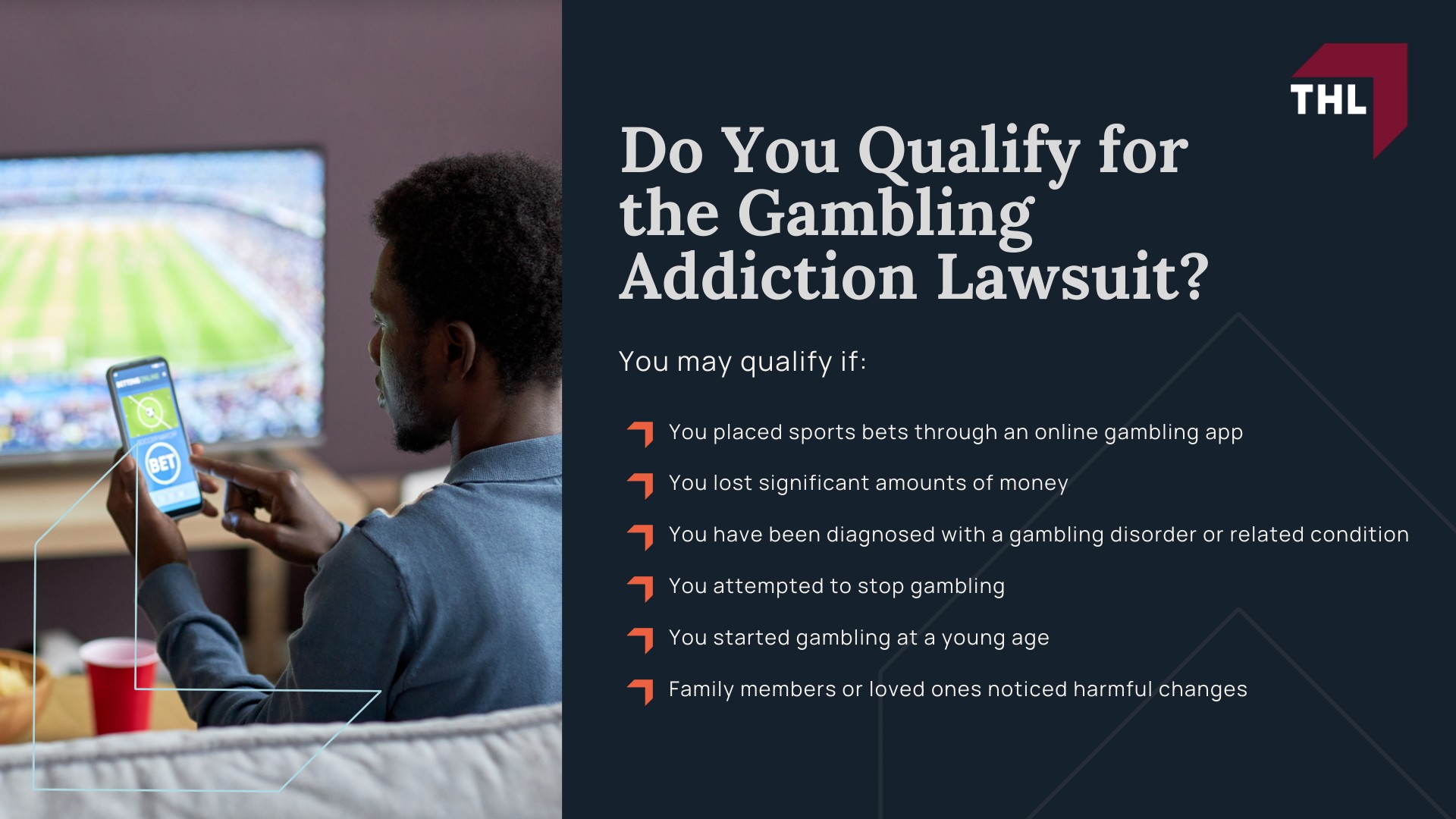
You may qualify if:
A growing number of lawsuits and regulatory actions are targeting major online gambling platforms for the way they encourage compulsive gambling and exploit vulnerable users.
FanDuel and DraftKings are at the center of many claims, with allegations that their apps use deceptive promotions, VIP inducements, and aggressive marketing that make it difficult for gamblers to stop gambling.
Other operators have also drawn scrutiny from regulators and consumer advocates for similar addictive behavior models and failure to protect at-risk users.
Investigations focus on whether these companies profited while ignoring the long-term effects on gamblers, families, and communities.
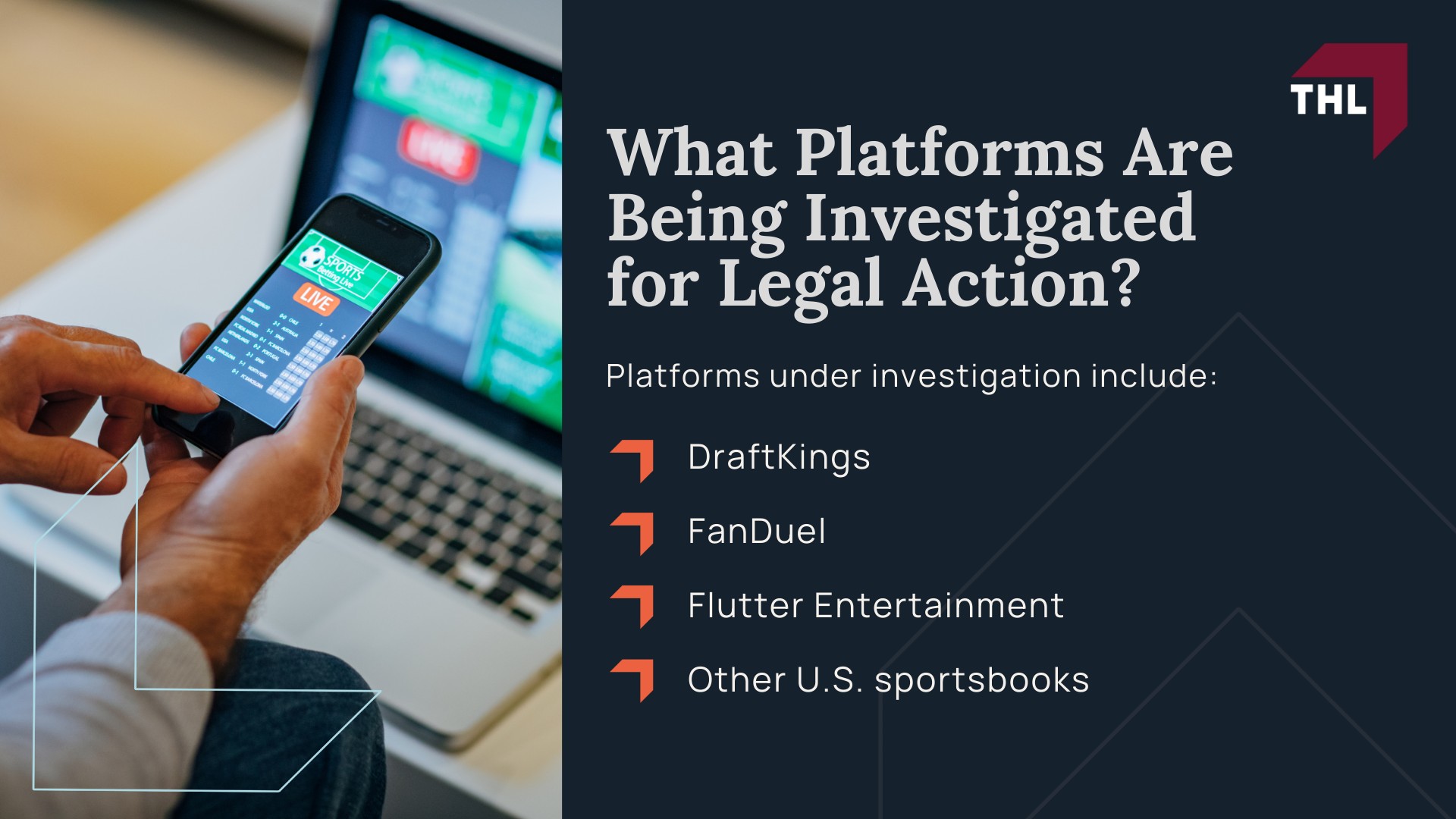
Platforms under investigation include:
Building a strong case against an online gambling platform requires more than showing financial losses.
It also involves documenting the broader impact on your health and daily life.
Courts and attorneys often look for evidence that gambling behavior caused or worsened mental disorders, including depression, anxiety, or other behavioral addictions.
Support groups such as Gamblers Anonymous and treatment records from therapy or rehabilitation can strengthen claims by demonstrating the seriousness of the disorder.
Loved ones and family members may also provide statements that show how gambling disrupted relationships, finances, and overall well-being.
Gathering this documentation not only supports your lawsuit but can also connect you with strategies and treatment resources that help in recovery.
Helpful forms of evidence may include:
The legal response to online gambling addiction is expanding quickly, and cases against DraftKings, FanDuel, and other platforms are building momentum.
Cities, private individuals, and regulators are filing actions that argue these companies designed their apps to foster compulsive gambling, targeted vulnerable users, and failed to implement meaningful safeguards.
Courts are now being asked to decide whether deceptive promotions, self-exclusion failures, and VIP inducements amount to unfair and deceptive practices under consumer protection laws.
Regulators at the state level are also imposing fines for compliance failures ranging from improper funding methods to violations of responsible gaming rules.
At the federal level, new legislation has been introduced that would ban VIP programs, tighten advertising rules, and create a national self-exclusion system.
Meanwhile, precedent from daily fantasy sports and “social casino” litigation shows courts are willing to treat addictive design as a basis for liability, even when companies point to arbitration clauses or argue they owe no duty to problem gamblers.
Together, these developments reveal a landscape where the gap between industry promises and lived harms is under sharper legal scrutiny.
For potential claimants, the important point is clear: legal avenues are opening, but documenting harms and evidence remains crucial to pursuing a case.
Significant legal actions include:
The American Psychiatric Association classifies gambling disorder in the Diagnostic and Statistical Manual of Mental Disorders (DSM-5/DSM-5-TR) as the only non-substance addictive disorder, grouped with “Substance-Related and Addictive Disorders” because it engages the brain’s reward circuitry in ways comparable to drugs of abuse.
DSM criteria describe a persistent, recurrent pattern marked by tolerance (needing increasing amounts of money), irritability when trying to stop, chasing losses, and significant life impairment, features clinicians use to diagnose the condition.
Recent research links online sports wagering to elevated mental-health harms: in a New Jersey study cited by the American Psychological Association, about 14% of sports bettors reported thoughts of suicide and 10% reported a suicide attempt.
Broader epidemiology shows people with gambling disorder face increased risk of depression, anxiety, substance use, and suicidality; one study found anxiety (44%), depression (38%), and substance use (33%) among diagnosed patients.
Sports betting carries distinct risks tied to rapid, continual markets and perceived “skill,” while electronic gaming machines (slot machines) are high-risk for different structural reasons (continuous play, rapid event frequency); both are riskier than many other forms such as lotteries.
Young men are disproportionately affected in today’s mobile era, with surveys and academic reviews flagging higher problem rates among this group as online access expands.
Since widespread legalization, signals of harm (including help-seeking and search interest for gambling addiction) have climbed alongside the growth of online sportsbooks.
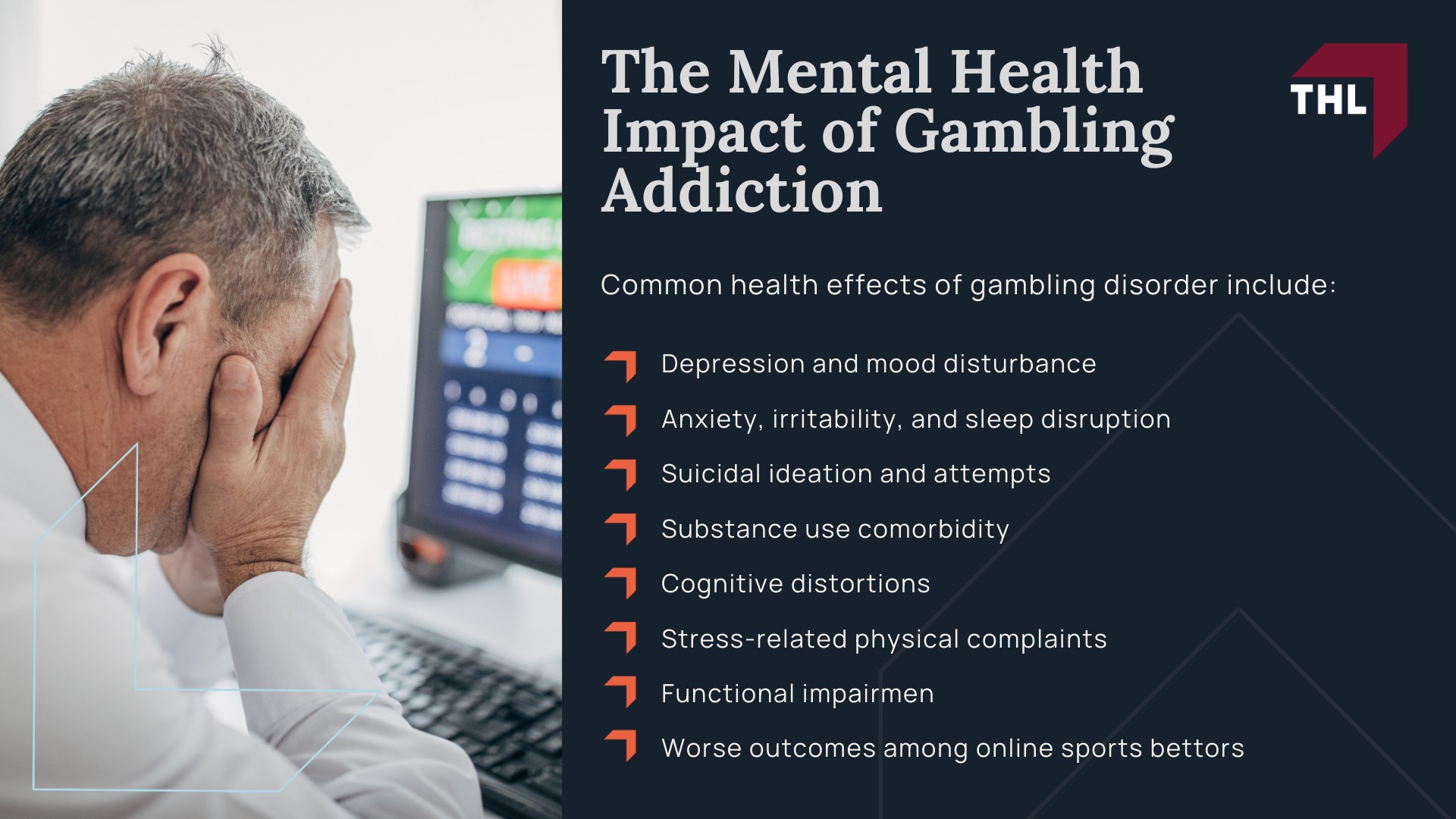
Common health effects of gambling disorder include:
Gambling disorder is an addictive disorder recognized by the DSM.
Today’s online sports bettors face unique pressures (live markets, push alerts, “skill” illusions) that heighten risk and intensify harms relative to many other forms of gambling.
Treatment for gambling addiction combines medical, psychological, and community-based support to address both the behavior and its underlying causes.
Cognitive-behavioral therapy (CBT) is one of the most effective approaches, helping individuals challenge distorted beliefs about gambling and build healthier coping strategies.
Medications such as SSRIs, mood stabilizers, or opioid antagonists are sometimes prescribed to reduce urges or treat co-occurring mental health conditions.
Many people benefit from peer-based programs like Gamblers Anonymous, which provide ongoing accountability and a supportive environment.
Specialized treatment centers for behavioral addictions may also offer group therapy, family counseling, and financial planning services to repair the damage caused by compulsive betting.
Recovery is rarely a single step.
It often requires a long-term combination of therapy, treatment, and support groups to help individuals regain control of their lives.
If you have experienced major financial harm or mental health struggles because of compulsive gambling on platforms like DraftKings or FanDuel, you may qualify to take legal action.
Many individuals who believed they could stop gambling instead found themselves spending increasing amounts of money and falling deeper into debt.
Lawsuits argue that these apps were engineered to encourage addictive behavior, leaving players unable to recover losses while operators profited.
Mental health consequences are also a critical factor, with gambling disorder linked to depression, anxiety, and other conditions that disrupt daily life.
Family members and loved ones often see the emotional toll firsthand, as relationships and finances strain under the weight of gambling addiction.
Courts are now reviewing whether victims should have the right to seek compensation for money lost and the long-term harm caused by these platforms.
If you have tried to stop but felt trapped by promotions, VIP perks, or constant app notifications, you may fit the profile of claimants already coming forward.
Speaking with a lawyer can help you determine whether you have a case and what steps are available to pursue justice and potentially recover losses.
In gambling addiction lawsuits, damages represent the financial and personal losses that victims may be able to claim through legal action.
Because these cases are still developing, the types and amounts of damages available may vary widely depending on how courts view the conduct of operators and the direction of ongoing litigation.
Some claims may emphasize the recovery of direct financial losses, while others highlight medical treatment, therapy, or long-term mental health support tied to gambling disorder.
Ultimately, damages may be designed to account for both the economic costs and the personal toll that compulsive gambling has inflicted on individuals and their families.
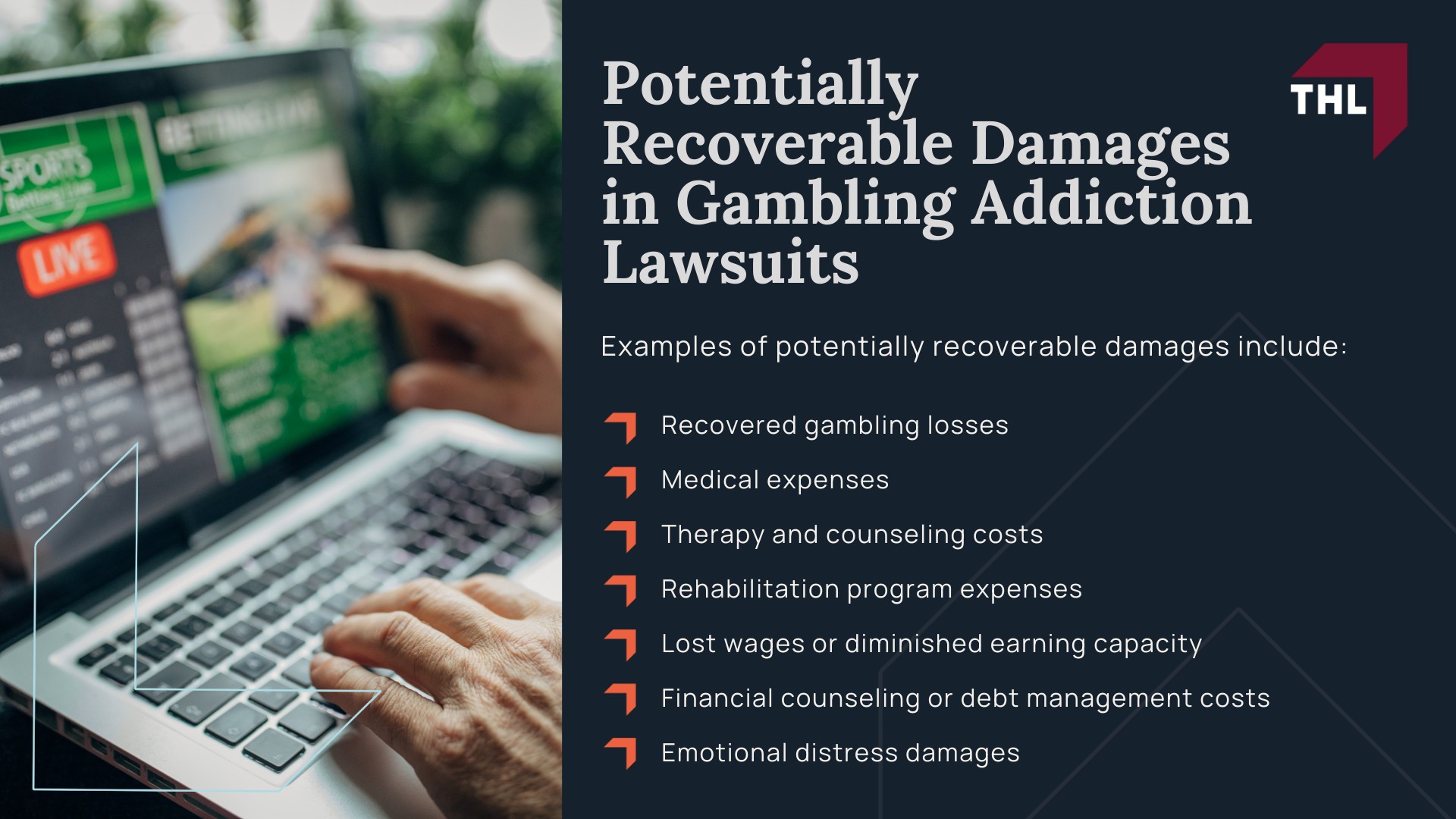
Examples of potentially recoverable damages include:
The rise of lawsuits against DraftKings, FanDuel, and other online gambling platforms reflects a growing recognition that these companies may have prioritized profit over consumer protection.
Victims of gambling disorder are coming forward with stories of significant financial losses, mental health struggles, and families torn apart by compulsive gambling behaviors fueled by manipulative app design.
TorHoerman Law is actively investigating claims on behalf of individuals who suffered harm, with a focus on recovering losses and securing compensation for medical treatment, therapy, and related damages.
Our law firm is committed to holding powerful operators accountable and giving a voice to those who were left vulnerable by platforms engineered to encourage addictive play.
If you or a loved one developed a gambling addiction, lost significant money, or faced mental health consequences tied to online sports betting apps, you may have legal options.
Contact TorHoerman Law today to learn whether you qualify for the gambling addiction lawsuit and take the first step toward recovery and justice.
You can also use the chat feature on this page to find out if you qualify for the gambling addiction lawsuit.
Yes, in certain circumstances you can sue for gambling addiction if an online platform’s conduct contributed to your harm.
Current lawsuits allege that companies like DraftKings and FanDuel designed their apps to encourage compulsive play, ignored self-exclusion requests, and used deceptive promotions that trapped users in cycles of loss.
These claims are framed more like personal injury lawsuits, focusing on financial losses, emotional harm, and mental health problems caused by addictive design.
Some cases are filed individually, while others are pursued as class actions or through state enforcement.
If you or a loved one suffered significant losses or health impacts from gambling apps, you may be eligible to seek compensation through legal action.
Gambling addiction is not only a financial problem.
It is also recognized as a serious mental health condition.
American Psychiatric publishing has listed gambling disorder in the fifth edition of the Diagnostic and Statistical Manual of Mental Disorders (DSM-5) as the first behavioral addiction, placing it alongside substance use disorders.
Research shows that compulsive gambling can trigger or worsen existing mental health struggles, leaving both gamblers and their loved ones coping with long-term consequences.
Common mental health impacts of gambling addiction include:
Addressing these mental health effects often requires therapy, treatment, and ongoing support from both professionals and peer groups such as Gamblers Anonymous.
Legal action against online gambling platforms is taking several forms across the United States.
Some cases are individual lawsuits (similar to personal injury claims) brought by people who suffered significant financial losses and mental health harms linked to compulsive gambling.
Others are being pursued as class action lawsuits, where groups of consumers allege deceptive promotions, failures around self-exclusion, or manipulative design across a wide pool of users.
In addition, state actions have been filed, such as Baltimore’s lawsuit against DraftKings and FanDuel, and regulators in many states have fined operators for advertising violations or failures to comply with responsible gaming rules.
At the same time, federal lawmakers are considering whether new federal law should set national standards, including bans on certain types of promotions and VIP programs.
Together, these overlapping approaches reflect the growing recognition that gambling platforms may bear responsibility for the harms caused by their products.
For many people, what begins as excitement over the possibility of a big win quickly turns into a pattern of losses, secrecy, and shame.
Gamblers often hide their behavior until debt and mental health problems like depression or anxiety become impossible to ignore.
The effects are rarely confined to the individual: family members may struggle with financial instability, strained relationships, or the emotional toll of watching a loved one lose control.
In some cases, a trusted friend or relative is the first to notice the changes, encouraging the person to seek help or consider legal action.
These personal stories underscore why lawsuits are being filed: the harm of compulsive gambling extends beyond money, touching every aspect of a person’s life and the lives of those closest to them.
Online gambling addiction differs from traditional gambling addictions because access is constant and mobile, making it easier to place bets anytime and anywhere.
Unlike going to a casino to play poker or sit at a slot machine, online platforms deliver instant opportunities through apps, often with push notifications and live odds.
Sports bettors can wager on nearly every play of a game, from routine matchups to massive events like the Super Bowl, creating more frequent triggers and faster cycles of loss.
The illusion of skill, especially in sports betting and online poker, can intensify compulsive behavior compared to more static forms of gambling.
These differences make online gambling addiction uniquely pervasive and harder to control, often escalating more quickly than traditional gambling addictions.

Tor Hoerman has represented injured individuals for more than 30 years, with experience spanning individual personal injury cases and nationwide mass tort litigation. His work includes car accidents, catastrophic injuries, product liability claims, and other serious injury cases. Tor has served in court-appointed leadership roles in national litigation and tried cases involving major corporate defendants.
TorHoerman Law’s legal content is researched and written by our editorial team and attorneys for legal accuracy, clarity, and relevance. We rely on statutes, court records, government publications, medical research, and other authoritative sources when applicable. This page provides general legal information and does not constitute legal advice.
TorHoerman Law reviews its legal content for factual accuracy, current information, and relevant legal context before publication and as material developments occur. This article is provided for general informational purposes and does not constitute legal advice. For guidance about a specific case, contact TorHoerman Law.
You can learn more about this topic by visiting any of our Gambling Addiction Lawsuit pages listed below:
A serious injury can change your life.

TorHoerman Law represents people whose lives have been disrupted by serious injuries, unsafe products, and negligence. Our attorneys handle individual personal injury cases as well as national mass tort lawsuits involving major corporations.
Founded in 2009, our legal team brings more than 100 years of combined experience handling serious injury and complex civil litigation.
Do you believe you’re entitled to compensation?
Use our Instant Case Evaluator to find out in as little as 60 seconds!

In this case, we obtained a verdict of $495 Million for our client’s child who was diagnosed with Necrotizing Enterocolitis after consuming baby formula manufactured by Abbott Laboratories.

In this case, we were able to successfully recover $20 Million for our client after they suffered a Toxic Tort Injury due to chemical exposure.

In this case, we were able to successfully recover $103.8 Million for our client after they suffered a COX-2 Inhibitors Injury.

In this case, we were able to successfully recover $4 Million for our client after they suffered a Traumatic Brain Injury while at daycare.

In this case, we were able to successfully recover $2.8 Million for our client after they suffered an injury due to a Defective Heart Device.
A serious injury can change your life.