If you or a loved one suffered injuries, property damage, or other financial losses due to another party’s actions, you may be entitled to compensation for those losses.
Contact the experienced Chicago personal injury lawyers from TorHoerman Law for a free, no-obligation Chicago personal injury lawsuit case consultation today.
If you or a loved one suffered a personal injury or financial loss due to a car accident in Chicago, IL – you may be entitled to compensation for those damages.
Contact an experienced Chicago auto accident lawyer from TorHoerman Law today to see how our firm can serve you!
If you or a loved one have suffered injuries, property damage, or other financial losses due to a truck accident in Chicago, IL – you may qualify to take legal action to gain compensation for those injuries and losses.
Contact TorHoerman Law today for a free, no-obligation consultation with our Chicago truck accident lawyers!
If you or a loved one suffered an injury in a motorcycle accident in Chicago or the greater Chicagoland area – you may be eligible to file a Chicago motorcycle accident lawsuit.
Contact an experienced Chicago motorcycle accident lawyer at TorHoerman Law today to find out how we can help.
If you have been involved in a bicycle accident in Chicago at no fault of your own and you suffered injuries as a result, you may qualify to file a Chicago bike accident lawsuit.
Contact a Chicago bike accident lawyer from TorHoerman Law to discuss your legal options today!
Chicago is one of the nation’s largest construction centers.
Thousands of men and women work on sites across the city and metropolitan area on tasks ranging from skilled trades to administrative operations.
Unfortunately, construction site accidents are fairly common.
Contact TorHoerman Law to discuss your legal options with an experienced Chicago construction accident lawyer, free of charge and no obligation required.
Nursing homes and nursing facilities should provide a safe, supportive environment for senior citizens, with qualified staff, nurses, and aids administering quality care.
Unfortunately, nursing home abuse and neglect can occur, leaving residents at risk and vulnerable.
Contact an experienced Chicago nursing home abuse lawyer from TorHoerman Law today for a free consultation to discuss your legal options.
If you are a resident of Chicago, or the greater Chicagoland area, and you have a loved one who suffered a fatal injury due to another party’s negligence or malpractice – you may qualify to file a wrongful death lawsuit on your loved one’s behalf.
Contact a Chicago wrongful death lawyer from TorHoerman Law to discuss your legal options today!
If you have suffered a slip and fall injury in Chicago you may be eligible for compensation through legal action.
Contact a Chicago slip and fall lawyer at TorHoerman Law today!
TorHoerman Law offers free, no-obligation case consultations for all potential clients.
When a child is injured at a daycare center, parents are left wondering who can be held liable, who to contact for legal help, and how a lawsuit may pan out for them.
If your child has suffered an injury at a daycare facility, you may be eligible to file a daycare injury lawsuit.
Contact a Chicago daycare injury lawyer from TorHoerman Law today for a free consultation to discuss your case and potential legal action!
If you or a loved one suffered injuries, property damage, or other financial losses due to another party’s actions, you may be entitled to compensation for those losses.
Contact the experienced Edwardsville personal injury lawyers from TorHoerman Law for a free, no-obligation Edwardsville personal injury lawsuit case consultation today.
If you or a loved one suffered a personal injury or financial loss due to a car accident in Edwardsville, IL – you may be entitled to compensation for those damages.
Contact an experienced Edwardsville car accident lawyer from TorHoerman Law today to see how our firm can serve you!
If you or a loved one have suffered injuries, property damage, or other financial losses due to a truck accident in Edwardsville, IL – you may qualify to take legal action to gain compensation for those injuries and losses.
Contact TorHoerman Law today for a free, no-obligation consultation with our Edwardsville truck accident lawyers!
If you or a loved one suffered an injury in a motorcycle accident in Edwardsville – you may be eligible to file an Edwardsville motorcycle accident lawsuit.
Contact an experienced Edwardsville motorcycle accident lawyer at TorHoerman Law today to find out how we can help.
If you have been involved in a bicycle accident in Edwardsville at no fault of your own and you suffered injuries as a result, you may qualify to file an Edwardsville bike accident lawsuit.
Contact an Edwardsville bicycle accident lawyer from TorHoerman Law to discuss your legal options today!
Nursing homes and nursing facilities should provide a safe, supportive environment for senior citizens, with qualified staff, nurses, and aids administering quality care.
Unfortunately, nursing home abuse and neglect can occur, leaving residents at risk and vulnerable.
Contact an experienced Edwardsville nursing home abuse attorney from TorHoerman Law today for a free consultation to discuss your legal options.
If you are a resident of Edwardsville and you have a loved one who suffered a fatal injury due to another party’s negligence or malpractice – you may qualify to file a wrongful death lawsuit on your loved one’s behalf.
Contact an Edwardsville wrongful death lawyer from TorHoerman Law to discuss your legal options today!
If you have suffered a slip and fall injury in Edwardsville you may be eligible for compensation through legal action.
Contact an Edwardsville slip and fall lawyer at TorHoerman Law today!
TorHoerman Law offers free, no-obligation case consultations for all potential clients.
When a child is injured at a daycare center, parents are left wondering who can be held liable, who to contact for legal help, and how a lawsuit may pan out for them.
If your child has suffered an injury at a daycare facility, you may be eligible to file a daycare injury lawsuit.
Contact an Edwardsville daycare injury lawyer from TorHoerman Law today for a free consultation to discuss your case and potential legal action!
If you or a loved one suffered injuries on someone else’s property in Edwardsville IL, you may be entitled to financial compensation.
If property owners fail to keep their premises safe, and their negligence leads to injuries, property damages or other losses as a result of an accident or incident, a premises liability lawsuit may be possible.
Contact an Edwardsville premises liability lawyer from TorHoerman Law today for a free, no-obligation case consultation.
If you or a loved one suffered injuries, property damage, or other financial losses due to another party’s actions, you may be entitled to compensation for those losses.
Contact the experienced St. Louis personal injury lawyers from TorHoerman Law for a free, no-obligation St. Louis personal injury lawsuit case consultation today.
If you or a loved one suffered a personal injury or financial loss due to a car accident in St. Louis, IL – you may be entitled to compensation for those damages.
Contact an experienced St. Louis car accident lawyer from TorHoerman Law today to see how our firm can serve you!
If you or a loved one have suffered injuries, property damage, or other financial losses due to a truck accident in St. Louis, IL – you may qualify to take legal action to gain compensation for those injuries and losses.
Contact TorHoerman Law today for a free, no-obligation consultation with our St. Louis truck accident lawyers!
If you or a loved one suffered an injury in a motorcycle accident in St. Louis or the greater St. Louis area – you may be eligible to file a St. Louis motorcycle accident lawsuit.
Contact an experienced St. Louis motorcycle accident lawyer at TorHoerman Law today to find out how we can help.
If you have been involved in a bicycle accident in St. Louis at no fault of your own and you suffered injuries as a result, you may qualify to file a St. Louis bike accident lawsuit.
Contact a St. Louis bicycle accident lawyer from TorHoerman Law to discuss your legal options today!
St. Louis is one of the nation’s largest construction centers.
Thousands of men and women work on sites across the city and metropolitan area on tasks ranging from skilled trades to administrative operations.
Unfortunately, construction site accidents are fairly common.
Contact TorHoerman Law to discuss your legal options with an experienced St. Louis construction accident lawyer, free of charge and no obligation required.
Nursing homes and nursing facilities should provide a safe, supportive environment for senior citizens, with qualified staff, nurses, and aids administering quality care.
Unfortunately, nursing home abuse and neglect can occur, leaving residents at risk and vulnerable.
Contact an experienced St. Louis nursing home abuse attorney from TorHoerman Law today for a free consultation to discuss your legal options.
If you are a resident of St. Louis, or the greater St. Louis area, and you have a loved one who suffered a fatal injury due to another party’s negligence or malpractice – you may qualify to file a wrongful death lawsuit on your loved one’s behalf.
Contact a St. Louis wrongful death lawyer from TorHoerman Law to discuss your legal options today!
If you have suffered a slip and fall injury in St. Louis you may be eligible for compensation through legal action.
Contact a St. Louis slip and fall lawyer at TorHoerman Law today!
TorHoerman Law offers free, no-obligation case consultations for all potential clients.
When a child is injured at a daycare center, parents are left wondering who can be held liable, who to contact for legal help, and how a lawsuit may pan out for them.
If your child has suffered an injury at a daycare facility, you may be eligible to file a daycare injury lawsuit.
Contact a St. Louis daycare injury lawyer from TorHoerman Law today for a free consultation to discuss your case and potential legal action!
Depo-Provera, a contraceptive injection, has been linked to an increased risk of developing brain tumors (including glioblastoma and meningioma).
Women who have used Depo-Provera and subsequently been diagnosed with brain tumors are filing lawsuits against Pfizer (the manufacturer), alleging that the company failed to adequately warn about the risks associated with the drug.
Despite the claims, Pfizer maintains that Depo-Provera is safe and effective, citing FDA approval and arguing that the scientific evidence does not support a causal link between the drug and brain tumors.
You may be eligible to file a Depo Provera Lawsuit if you used Depo-Provera and were diagnosed with a brain tumor.
Suboxone, a medication often used to treat opioid use disorder (OUD), has become a vital tool which offers a safer and more controlled approach to managing opioid addiction.
Despite its widespread use, Suboxone has been linked to severe tooth decay and dental injuries.
Suboxone Tooth Decay Lawsuits claim that the companies failed to warn about the risks of tooth decay and other dental injuries associated with Suboxone sublingual films.
Tepezza, approved by the FDA in 2020, is used to treat Thyroid Eye Disease (TED), but some patients have reported hearing issues after its use.
The Tepezza lawsuit claims that Horizon Therapeutics failed to warn patients about the potential risks and side effects of the drug, leading to hearing loss and other problems, such as tinnitus.
You may be eligible to file a Tepezza Lawsuit if you or a loved one took Tepezza and subsequently suffered permanent hearing loss or tinnitus.
Elmiron, a drug prescribed for interstitial cystitis, has been linked to serious eye damage and vision problems in scientific studies.
Thousands of Elmiron Lawsuits have been filed against Janssen Pharmaceuticals, the manufacturer, alleging that the company failed to warn patients about the potential risks.
You may be eligible to file an Elmiron Lawsuit if you or a loved one took Elmiron and subsequently suffered vision loss, blindness, or any other eye injury linked to the prescription drug.
The chemotherapy drug Taxotere, commonly used for breast cancer treatment, has been linked to severe eye injuries, permanent vision loss, and permanent hair loss.
Taxotere Lawsuits are being filed by breast cancer patients and others who have taken the chemotherapy drug and subsequently developed vision problems.
If you or a loved one used Taxotere and subsequently developed vision damage or other related medical problems, you may be eligible to file a Taxotere Lawsuit and seek financial compensation.
Parents and guardians are filing lawsuits against major video game companies (including Epic Games, Activision Blizzard, and Microsoft), alleging that they intentionally designed their games to be addictive — leading to severe mental and physical health issues in minors.
The lawsuits claim that these companies used psychological tactics and manipulative game designs to keep players engaged for extended periods — causing problems such as anxiety, depression, and social withdrawal.
You may be eligible to file a Video Game Addiction Lawsuit if your child has been diagnosed with gaming addiction or has experienced negative effects from excessive gaming.
Thousands of Uber sexual assault claims have been filed by passengers who suffered violence during rides arranged through the platform.
The ongoing Uber sexual assault litigation spans both federal law and California state court, with a consolidated Uber MDL (multi-district litigation) currently pending in the Northern District of California.
Uber sexual assault survivors across the country are coming forward to hold the company accountable for negligence in hiring, screening, and supervising drivers.
If you or a loved one were sexually assaulted, sexually battered, or faced any other form of sexual misconduct from an Uber driver, you may be eligible to file an Uber Sexual Assault Lawsuit.
Although pressure cookers were designed to be safe and easy to use, a number of these devices have been found to have a defect that can lead to excessive buildup of internal pressure.
The excessive pressure may result in an explosion that puts users at risk of serious injuries such as burns, lacerations, an even electrocution.
If your pressure cooker exploded and caused substantial burn injuries or other serious injuries, you may be eligible to file a Pressure Cooker Lawsuit and secure financial compensation for your injuries and damages.
Several studies have found a correlation between heavy social media use and mental health challenges, especially among younger users.
Social media harm lawsuits claim that social media companies are responsible for onsetting or heightening mental health problems, eating disorders, mood disorders, and other negative experiences of teens and children
You may be eligible to file a Social Media Mental Health Lawsuit if you are the parents of a teen, or teens, who attribute their use of social media platforms to their mental health problems.
The Paragard IUD, a non-hormonal birth control device, has been linked to serious complications, including device breakage during removal.
Numerous lawsuits have been filed against Teva Pharmaceuticals, the manufacturer of Paragard, alleging that the company failed to warn about the potential risks.
If you or a loved one used a Paragard IUD and subsequently suffered complications and/or injuries, you may qualify for a Paragard Lawsuit.
Patients with the PowerPort devices may possibly be at a higher risk of serious complications or injury due to a catheter failure, according to lawsuits filed against the manufacturers of the Bard PowerPort Device.
If you or a loved one have been injured by a Bard PowerPort Device, you may be eligible to file a Bard PowerPort Lawsuit and seek financial compensation.
Vaginal Mesh Lawsuits are being filed against manufacturers of transvaginal mesh products for injuries, pain and suffering, and financial costs related to complications and injuries of these medical devices.
Over 100,000 Transvaginal Mesh Lawsuits have been filed on behalf of women injured by vaginal mesh and pelvic mesh products.
If you or a loved one have suffered serious complications or injuries from vaginal mesh, you may be eligible to file a Vaginal Mesh Lawsuit.
Above ground pool accidents have led to lawsuits against manufacturers due to defective restraining belts that pose serious safety risks to children.
These belts, designed to provide structural stability, can inadvertently act as footholds, allowing children to climb into the pool unsupervised, increasing the risk of drownings and injuries.
Parents and guardians are filing lawsuits against pool manufacturers, alleging that the defective design has caused severe injuries and deaths.
If your child was injured or drowned in an above ground pool accident involving a defective restraining belt, you may be eligible to file a lawsuit.
Recent scientific studies have found that the use of chemical hair straightening products, hair relaxers, and other hair products present an increased risk of uterine cancer, endometrial cancer, breast cancer, and other health problems.
Legal action is being taken against manufacturers and producers of these hair products for their failure to properly warn consumers of potential health risks.
You may be eligible to file a Hair Straightener Cancer Lawsuit if you or a loved one used chemical hair straighteners, hair relaxers, or other similar hair products, and subsequently were diagnosed with:
NEC Lawsuit claims allege that certain formulas given to infants in NICU settings increase the risk of necrotizing enterocolitis (NEC) – a severe intestinal condition in premature infants.
Parents and guardians are filing NEC Lawsuits against baby formula manufacturers, alleging that the formulas contain harmful ingredients leading to NEC.
Despite the claims, Abbott and Mead Johnson deny the allegations, arguing that their products are thoroughly researched and dismissing the scientific evidence linking their formulas to NEC, while the FDA issued a warning to Abbott regarding safety concerns of a formula product.
You may be eligible to file a Toxic Baby Formula NEC Lawsuit if your child received baby bovine-based (cow’s milk) baby formula in the maternity ward or NICU of a hospital and was subsequently diagnosed with Necrotizing Enterocolitis (NEC).
Paraquat, a widely-used herbicide, has been linked to Parkinson’s disease, leading to numerous Paraquat Parkinson’s Disease Lawsuits against its manufacturers for failing to warn about the risks of chronic exposure.
Due to its toxicity, the EPA has restricted the use of Paraquat and it is currently banned in over 30 countries.
You may be eligible to file a Paraquat Lawsuit if you or a loved one were exposed to Paraquat and subsequently diagnosed with Parkinson’s Disease or other related health conditions.
Mesothelioma is an aggressive form of cancer primarily caused by exposure to asbestos.
Asbestos trust funds were established in the 1970s to compensate workers harmed by asbestos-containing products.
These funds are designed to pay out claims to those who developed mesothelioma or other asbestos-related diseases due to exposure.
Those exposed to asbestos and diagnosed with mesothelioma may be eligible to file a Mesothelioma Lawsuit.
AFFF (Aqueous Film Forming Foam) is a firefighting foam that has been linked to various health issues, including cancer, due to its PFAS (per- and polyfluoroalkyl substances) content.
Numerous AFFF Lawsuits have been filed against AFFF manufacturers, alleging that they knew about the health risks but failed to warn the public.
AFFF Firefighting Foam lawsuits aim to hold manufacturers accountable for putting peoples’ health at risk.
You may be eligible to file an AFFF Lawsuit if you or a loved one was exposed to firefighting foam and subsequently developed cancer.
PFAS contamination lawsuits are being filed against manufacturers and suppliers of PFAS chemicals, alleging that these substances have contaminated water sources and products, leading to severe health issues.
Plaintiffs claim that prolonged exposure to PFAS through contaminated drinking water and products has caused cancers, thyroid disease, and other health problems.
The lawsuits target companies like 3M, DuPont, and Chemours, accusing them of knowingly contaminating the environment with PFAS and failing to warn about the risks.
If you or a loved one has been exposed to PFAS-contaminated water or products and has developed health issues, you may be eligible to file a PFAS lawsuit.
The Roundup Lawsuit claims that Monsanto’s popular weed killer, Roundup, causes cancer.
Numerous studies have linked the main ingredient, glyphosate, to Non-Hodgkin’s Lymphoma, Leukemia, and other Lymphatic cancers.
Despite this, Monsanto continues to deny these claims.
Victims of Roundup exposure who developed cancer are filing Roundup Lawsuits against Monsanto, seeking compensation for medical expenses, pain, and suffering.
Our firm is about people. That is our motto and that will always be our reality.
We do our best to get to know our clients, understand their situations, and get them the compensation they deserve.
At TorHoerman Law, we believe that if we continue to focus on the people that we represent, and continue to be true to the people that we are – justice will always be served.
Without our team, we would’nt be able to provide our clients with anything close to the level of service they receive when they work with us.
The TorHoerman Law Team commits to the sincere belief that those injured by the misconduct of others, especially large corporate profit mongers, deserve justice for their injuries.
Our team is what has made TorHoerman Law a very special place since 2009.
Suing for sexual abuse in the Catholic Church involves pursuing civil accountability for abuse allegations against clergy and church institutions tied to widespread abuse across dioceses across the nation.
Decades of reports and investigations have shown that countless individuals were sexually abused by known abusers within the Church, with lasting emotional, psychological, and physical consequences that often affect survivors throughout their lives.
TorHoerman Law is reviewing claims from individuals who suffered abuse to determine whether legal action may be available based on the specific facts of their experience.
Abuse within the Roman Catholic Church has been found to be an ongoing problem nationwide, with investigations showing that child abuse by Roman Catholic clergy was often addressed by quietly moving offending priests to new parishes rather than removing them from ministry.
These practices allowed abusive priests accused of sexual misconduct to continue having access to minors, including boys and other vulnerable children, sometimes across multiple dioceses and over decades.
One of the most significant revelations came after the Boston Globe published its landmark investigation into the Archdiocese of Boston, exposing predator priests and the role of bishops in concealing abuse, which sparked public outrage and led to similar investigations across the United States.
Subsequent inquiries revealed that the Church’s failings were not isolated to one region, but reflected a systemic problem affecting victims nationwide.
Comparable investigations in other countries have also documented widespread abuse involving Roman Catholic clergy, reinforcing the global extent of the crisis.
In Illinois, these issues came into sharper focus after the Illinois Attorney General released a comprehensive report detailing sexual abuse allegations involving Catholic clergy across multiple dioceses in the state.
That investigation examined how abuse of minors and adults was handled internally, including whether church officials took steps to report abuse or protect victims.
TorHoerman Law is investigating civil lawsuits on behalf of victims who allege they were sexually abused by Catholic clergy and may have legal options to pursue accountability for the harm they suffered.
If you or a loved one experienced sexual abuse in an Illinois parish of the Catholic Church, you may be eligible to file a lawsuit and seek compensation.
Contact TorHoerman Law today for a free consultation.
Use the chat feature on this page to find out if you qualify for the Catholic Church abuse lawsuit.
Suing the Catholic Church for sexual abuse means pursuing a civil claim against institutions whose actions or inaction allegedly allowed abuse to occur.
These cases often involve claims against an Archdiocese, a diocese, or other religious institutes responsible for supervising clergy and managing internal responses to allegations.
Lawsuits may name individual priests who were later convicted, as well as Catholic bishops and church officials accused of ignoring, concealing, or mishandling reports of assault.
Many claims arise from abuse that occurred in the past, sometimes decades earlier, when survivors were children or otherwise vulnerable.
Civil litigation focuses on whether church leadership took reasonable efforts to protect people from harm or instead prioritized institutional reputation.
In some cases, courts examine patterns showing that abusive clergy were transferred to new parishes rather than removed from ministry.
These lawsuits are not limited to churches alone and may involve other institutions connected to Catholic schools, seminaries, or youth programs.
Survivors may pursue claims even when criminal prosecution is no longer possible, as civil standards differ from criminal law.
Ultimately, suing the Catholic Church for sexual abuse seeks accountability for institutional decisions that allegedly allowed assault to continue and caused lasting harm.
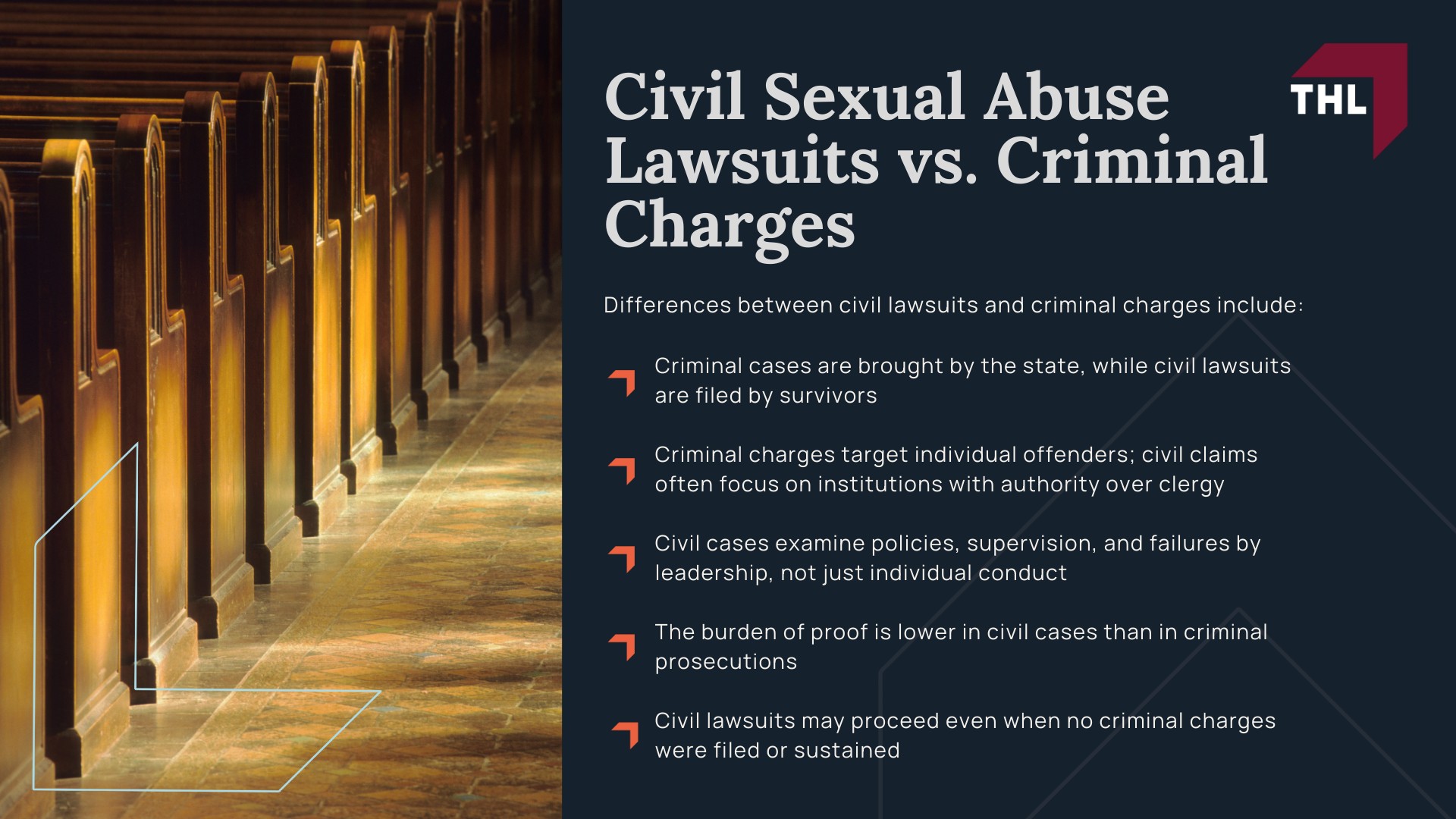
Civil sexual abuse lawsuits and criminal charges serve different purposes within the legal system.
Criminal cases focus on whether an individual abuser committed a crime and may result in incarceration, while civil lawsuits address harm suffered and responsibility for allowing abuse to occur.
Civil claims typically name the organization or institution that exercised authority over members of the clergy, including dioceses, archdioceses, or other entities responsible for oversight.
This structure reflects how decisions were made at an institutional level, particularly when leadership controlled assignments, supervision, and responses to complaints.
Many survivors pursue civil claims because criminal prosecution may no longer be possible, or because broader accountability remains a concern.
Civil litigation also allows survivors to address the misuse of faith and institutional power that contributed to the harm.
Differences between civil lawsuits and criminal charges include:
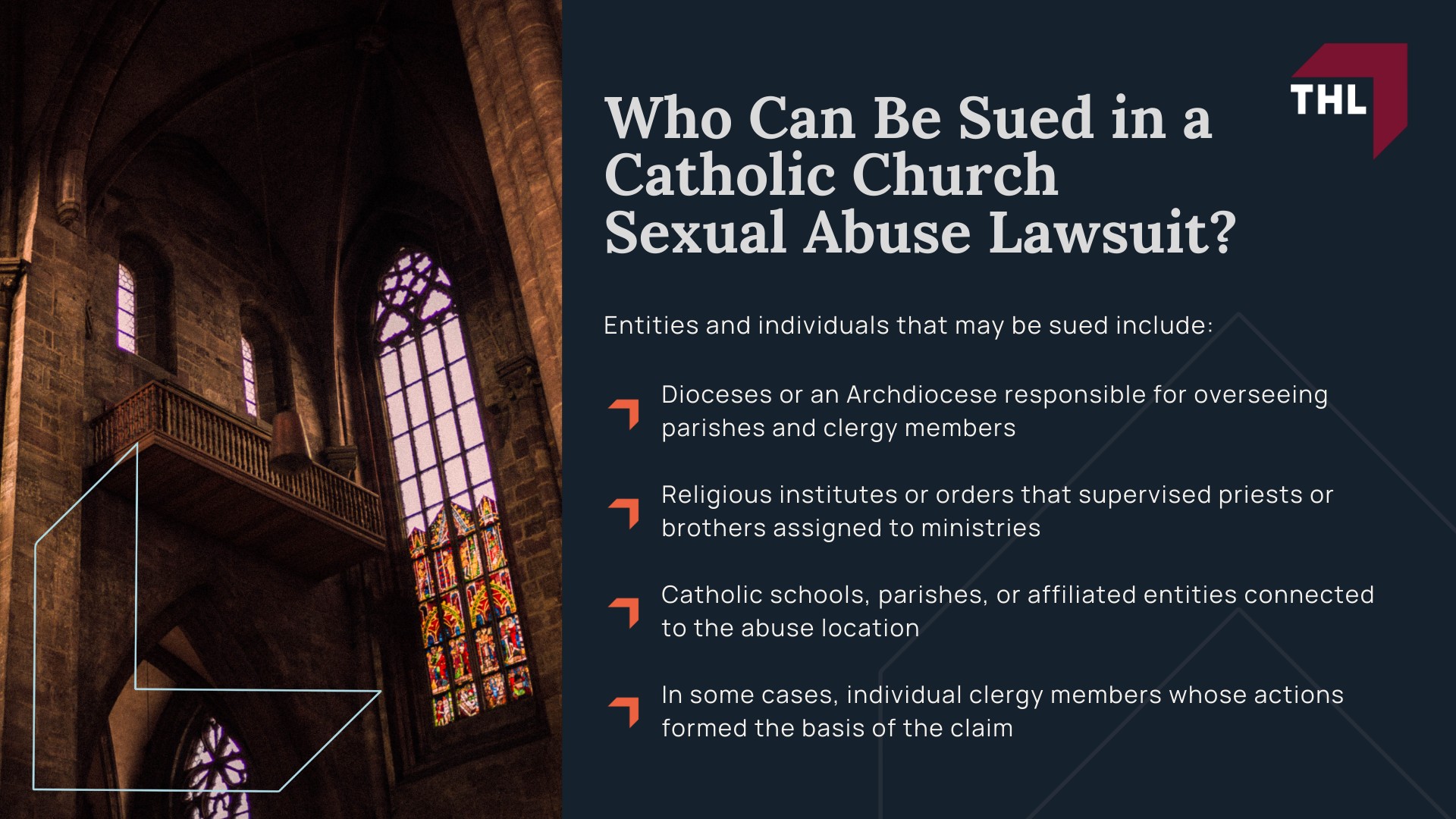
A Catholic Church sexual abuse lawsuit may name individuals and institutions that had authority over the setting where abuse occurred.
Civil claims often focus on organizations that controlled supervision, assignments, and internal discipline rather than only the person who committed the abuse.
This approach reflects how decisions were made at higher levels and how failures in oversight may have contributed to harm.
Identifying proper defendants is a critical step in determining accountability.
Entities and individuals that may be sued include:
Survivors of sexual abuse may be able to recover compensation through civil litigation, which operates apart from criminal justice proceedings.
Civil lawsuits focus on the harm caused and the Church’s response to abuse allegations, including how complaints were handled and whether leadership acted to protect others.
These cases allow courts to examine institutional decisions that may have contributed to continued abuse.
Compensation may address both tangible losses and long-term personal harm tied to the abuse.
For many survivors, civil litigation provides a way to pursue accountability even when criminal charges are unavailable or were never filed.
This process offers a legal avenue to confront institutional failures and seek redress outside the criminal system.
Many survivors question whether what they experienced is enough to support a civil claim, especially when the abuse occurred long ago or was never formally reported.
Civil cases do not require perfect recall or official documentation at the time of abuse, and many viable claims involve circumstances that were hidden, minimized, or unknown to parents and other adults.
Abuse often occurred within environments where clergy members cultivated trust, authority, or a close relationship with children or families, making disclosure difficult or unsafe.
These dynamics are well-documented in civil litigation and investigative reports examining institutional abuse.
A civil claim may be supported when the surrounding facts show that abuse was enabled by access, authority, or institutional inaction rather than isolated misconduct alone.
Survivors frequently describe patterns that only later became clear, including behaviors that seemed normal at the time or were framed as part of religious instruction, mentorship, or spiritual guidance.
The absence of immediate reporting does not undermine credibility, particularly when fear, confusion, or loyalty to the Church played a role.
What matters is whether the experience fits known patterns of abuse and whether institutional oversight failures may have contributed.
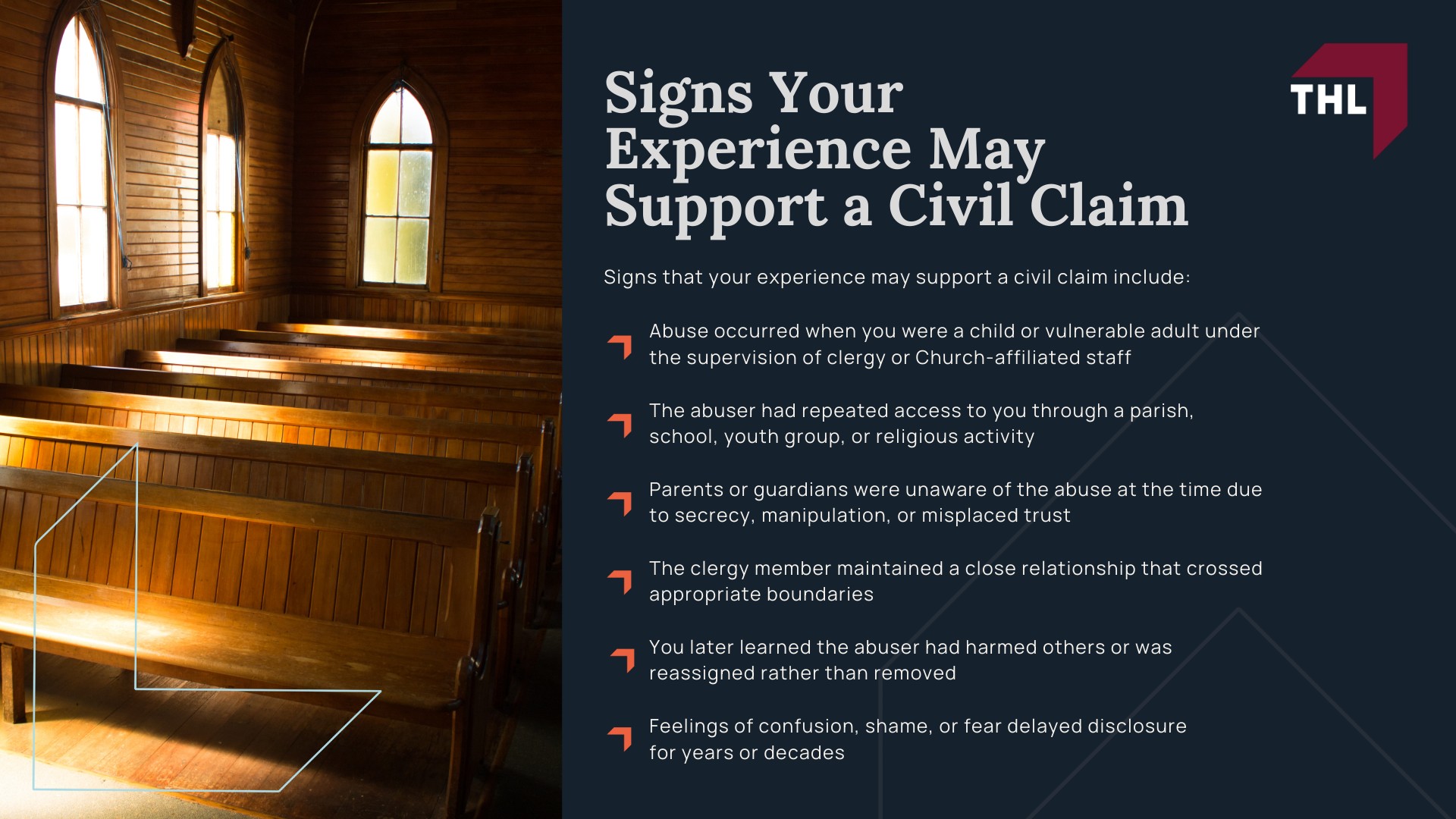
Signs that your experience may support a civil claim include:
Every survivor’s experience is different, and civil claims are evaluated based on the full context of what occurred.
A legal review can help determine whether your experience aligns with recognized abuse patterns and whether the institutions involved may bear civil responsibility.
Clergy sexual abuse has been alleged in a wide range of settings connected to Church life and religious education.
These environments often involved regular, unsupervised access to children or vulnerable individuals under the authority of clergy members.
Abuse was not limited to one type of location and frequently occurred in places viewed as safe or spiritually guided.
Identifying the setting can help establish how access and oversight failures contributed to the abuse.
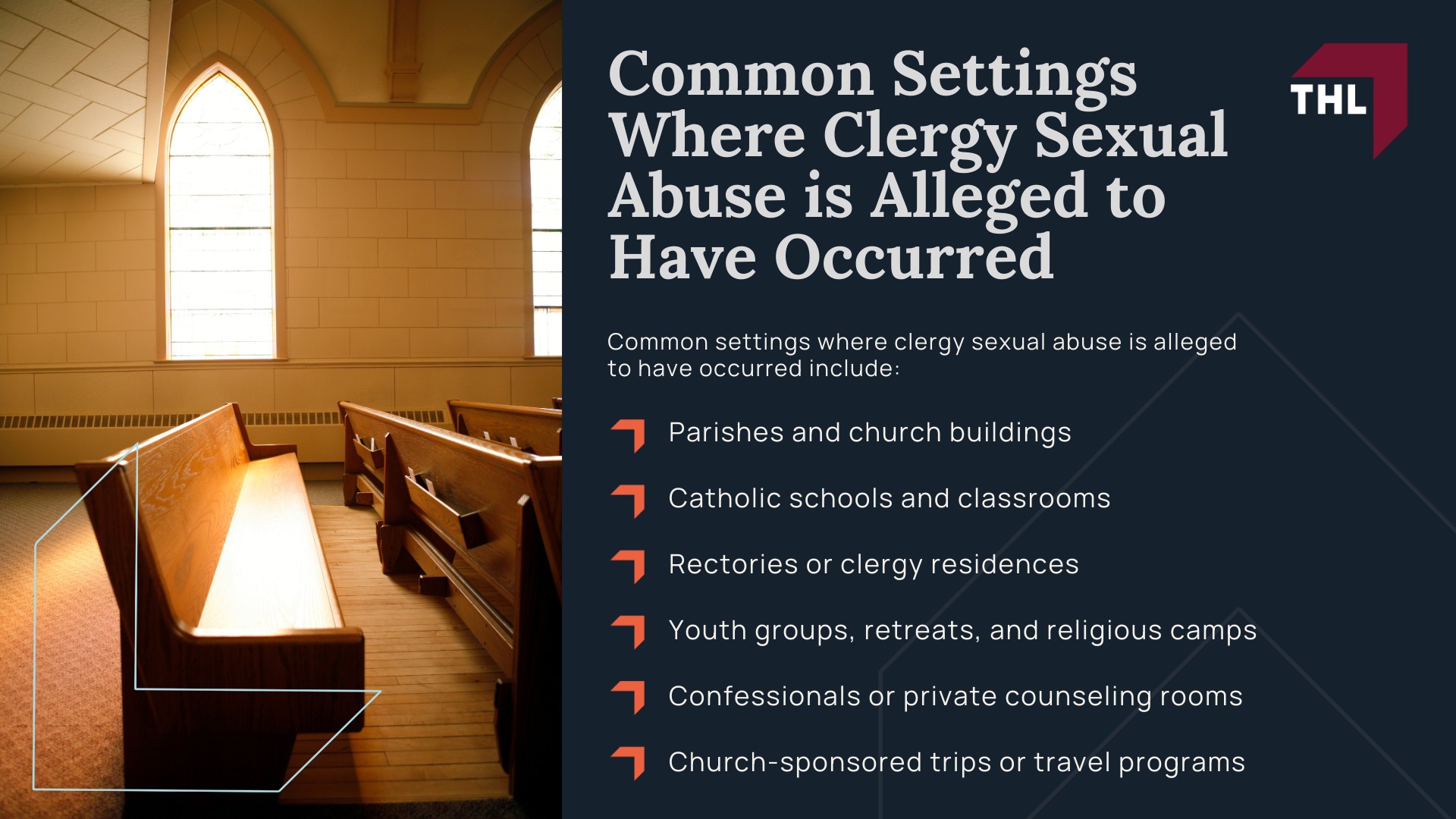
Common settings where clergy sexual abuse is alleged to have occurred include:
Investigations into clergy sexual abuse have consistently shown that church records often contained early warning signs long before abuse became public.
The Pennsylvania Grand Jury found that internal diocesan files documented allegations, concerns, and disciplinary discussions that were never disclosed to parish communities or law enforcement.
Similar findings have been referenced in reports reviewed by the United States Conference of Catholic Bishops and discussed in proceedings involving the Vatican’s pontifical commission on the protection of minors.
In civil litigation and trial proceedings, these records have played a central role in demonstrating what church officials knew and how they responded.
Courts and investigators rely on these documents to assess whether institutional decisions allowed abuse to continue despite documented risks.
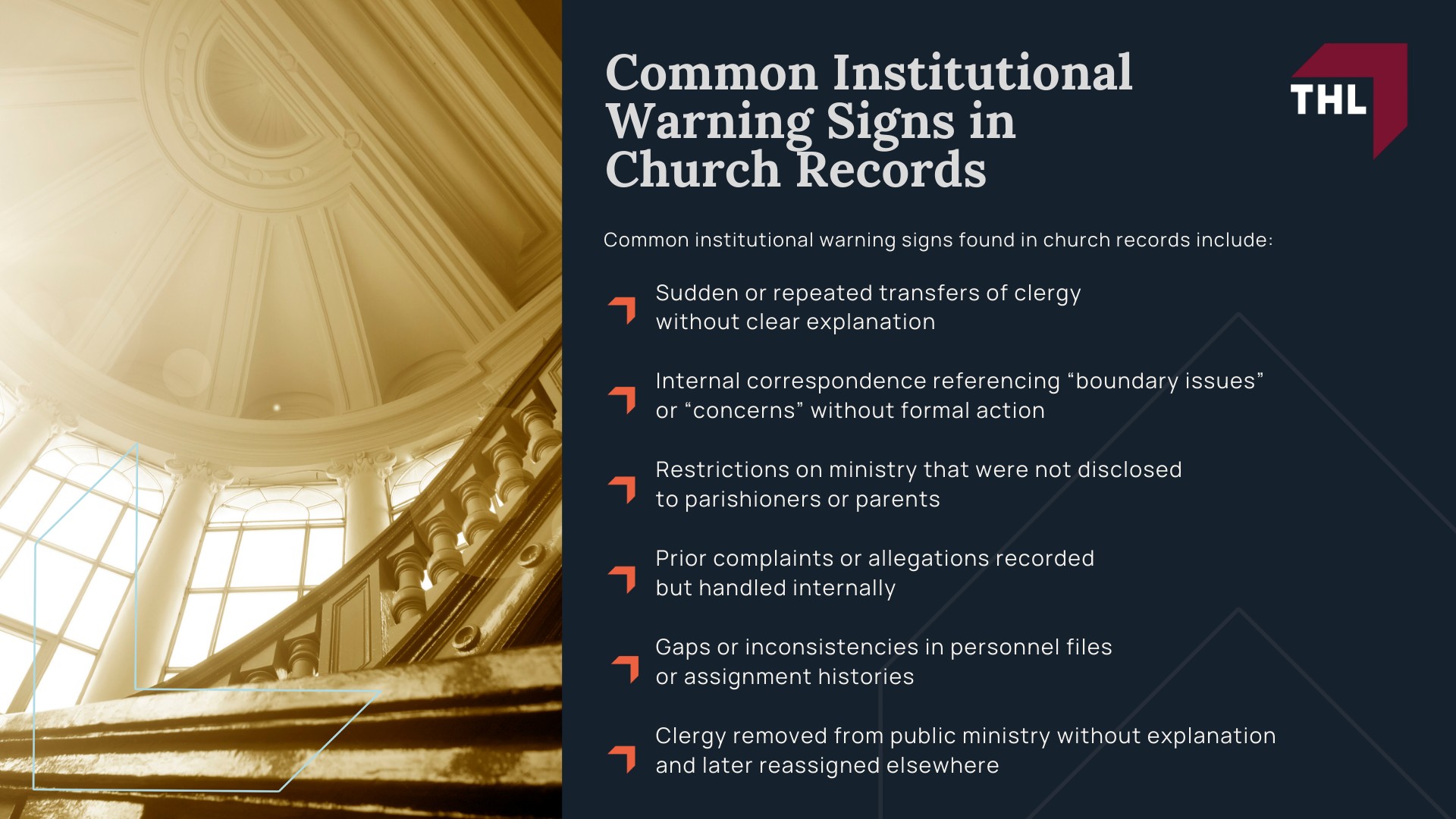
Common institutional warning signs found in church records include:
Many survivors never reported abuse at the time it occurred, and that fact alone does not prevent a civil claim.
Sexual abuse by clergy often involved fear, confusion, manipulation, or misplaced trust that made disclosure feel impossible, especially for children.
In other cases, survivors believed reporting would lead to punishment, disbelief, or harm to their family or faith community.
Courts recognize that delayed disclosure is common in cases involving authority figures and institutional power.
Civil law focuses on what occurred and how institutions responded, not on whether a report was made decades earlier.
You may still have a Catholic Church sexual abuse claim even if you never reported the abuse, particularly when evidence shows institutional failures or patterns of misconduct.
For decades, the Roman Catholic Church has been at the center of sexual abuse accusations in the United States and around the world, with recurring allegations that church officials covered up abuse by priests and protected institutional reputations over child safety.
Public inquiries and investigative commissions have repeatedly described patterns in which accused clergy remained in ministry, were reassigned, or were handled through internal processes that kept survivors out of view and delayed public accountability.
In many jurisdictions, the crisis has been characterized not only by abuse itself, but by the Church’s response: particularly a failure to support victims and survivors in ways that were timely, transparent, and survivor-centered.
These criticisms continue into the present, including recent Vatican-commission reporting that acknowledged ongoing shortcomings and called out how mishandling and secrecy can compound harm.
While abuse occurred long before it was widely discussed, the first significant U.S. media coverage of Catholic Church sexual abuse emerged in the 1980s, including early reporting and the notoriety surrounding the Louisiana priest Gilbert Gauthe case.
That early coverage did not immediately produce a sustained national reckoning, but it set the stage for later public reporting and litigation.
The issue exploded into mainstream national attention in 2002, when the Boston Globe published its Spotlight investigation documenting widespread abuse and institutional concealment in the Boston area.
This reporting helped trigger broader reporting, additional lawsuits, and major criminal investigations nationwide.
Many later government-led investigations explicitly built on the same core questions Spotlight forced into the open: what was known internally, who made decisions, and why the institution kept putting children at risk.
Investigations and commission reports have exposed thousands of victims in multiple countries, including France, Spain, Germany, and Australia, each with its own inquiry mechanisms and findings but overlapping themes of delayed reporting, institutional secrecy, and survivor harm.
In England and Wales, the Independent Inquiry into Child Sexual Abuse (IICSA) reported that the Roman Catholic Church received more than 900 complaints involving over 3,000 instances of child sexual abuse between 1970 and 2015, involving hundreds of connected individuals.
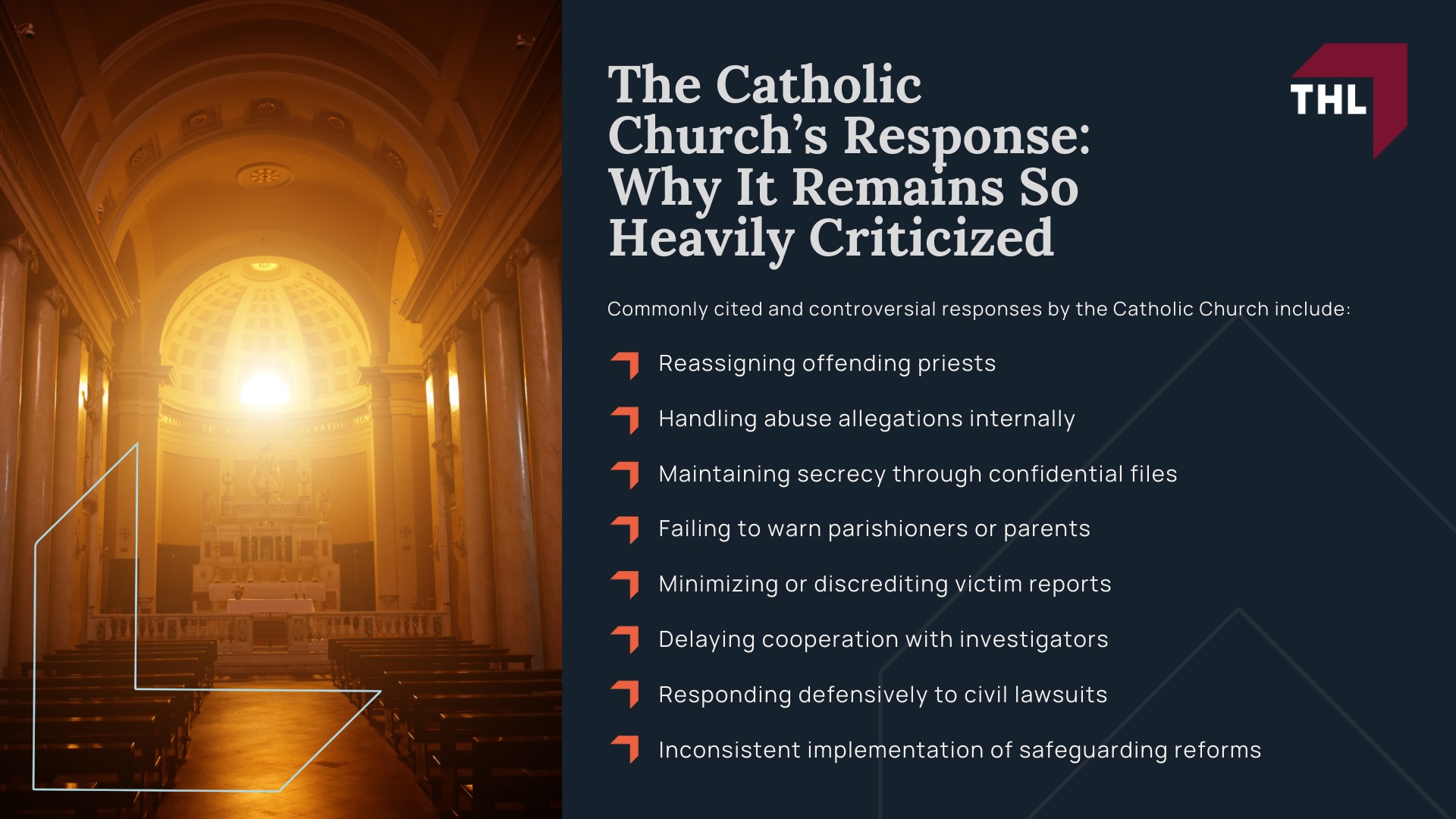
The Catholic Church’s response to sexual abuse allegations has been widely criticized for prioritizing institutional protection over survivor safety and accountability.
Investigations, court records, and public inquiries across multiple countries have repeatedly found that Church leadership often treated abuse as an internal disciplinary matter rather than a serious crime requiring outside intervention.
These responses did not occur in isolation but followed consistent patterns across dioceses, countries, and decades.
As abuse scandals became public, many survivors and advocates argued that the Church’s actions compounded the original harm by silencing victims and delaying justice.
Even where reforms were later announced, critics have questioned whether those measures meaningfully addressed past failures or prevented future abuse.
This sustained criticism reflects not only what was done, but how long it took for meaningful acknowledgment to occur.
Commonly cited and controversial responses by the Catholic Church include:
These responses have drawn criticism from survivors, advocacy groups, governments, and even internal Church commissions tasked with reform.
Many observers argue that accountability efforts came only after public exposure, litigation pressure, or widespread outrage forced institutional change.
As a result, civil lawsuits continue to play a central role in examining how abuse was handled and whether Church leadership acted responsibly when allegations arose.
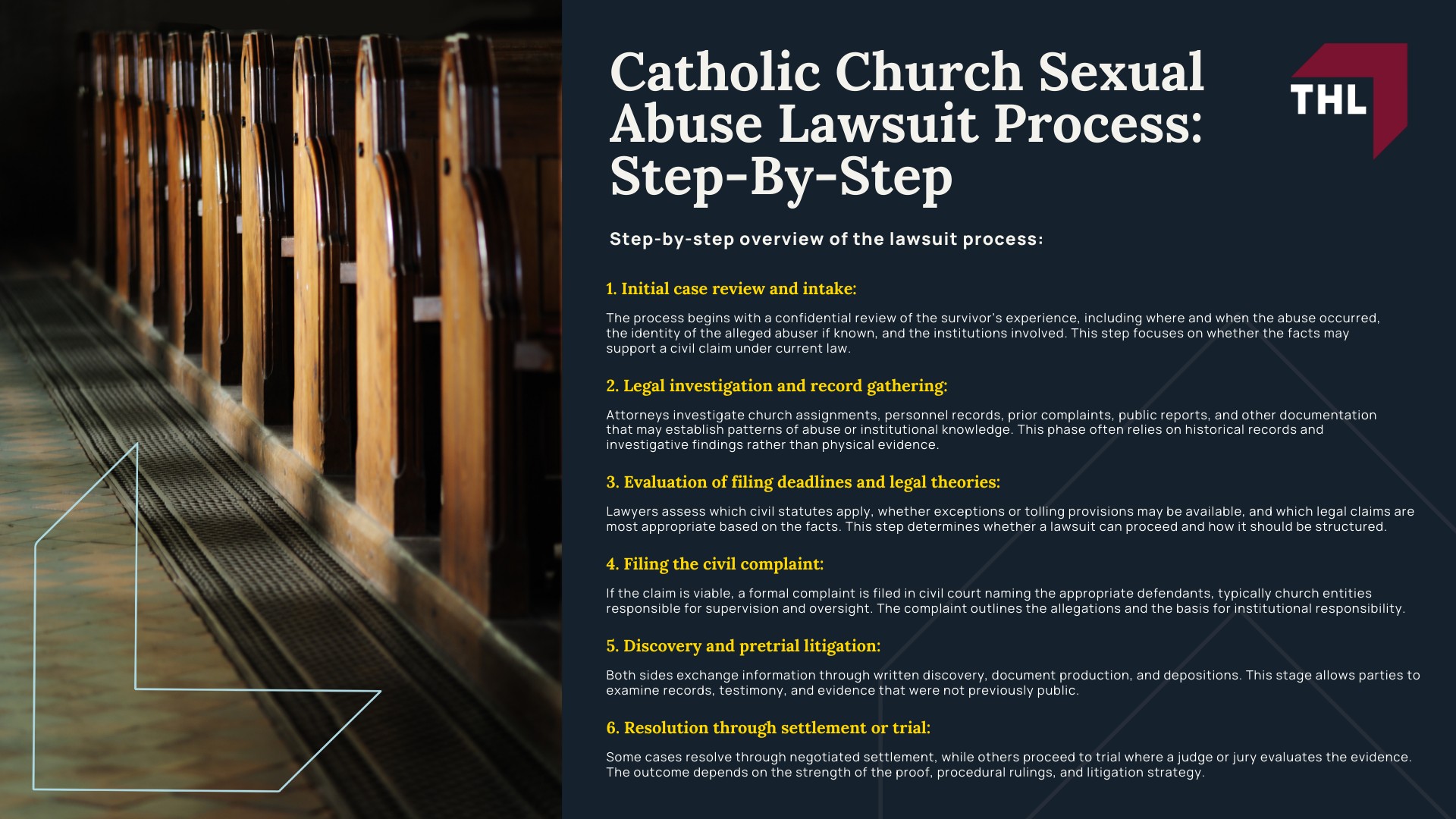
The Catholic Church sexual abuse lawsuit process is a civil legal path designed to examine institutional conduct and determine whether survivors may pursue accountability through the courts.
These cases often involve abuse that occurred years or decades ago, which means the process focuses heavily on records, patterns, and institutional decision-making rather than immediate reporting.
Civil litigation differs from criminal proceedings and follows a structured sequence governed by procedural rules and filing requirements.
Survivors are not required to understand this process before coming forward, as attorneys handle the legal and investigative work.
Each case develops based on its own facts, available evidence, and applicable law.
While the process can take time, it is structured to allow claims to be reviewed, tested, and resolved through the judicial system.
Step-by-step overview of the lawsuit process:
After these steps, a case may conclude with a court judgment, settlement agreement, or dismissal depending on the circumstances.
Throughout the process, survivors are not required to confront the accused directly unless necessary for testimony.
Civil litigation places responsibility on institutions to answer for their actions and decisions, not on survivors to relive trauma unnecessarily.
The timeline varies widely, with some cases resolving sooner and others requiring extended litigation.
Ultimately, the process is designed to provide a lawful means to assess claims, test evidence, and pursue accountability through the civil justice system.
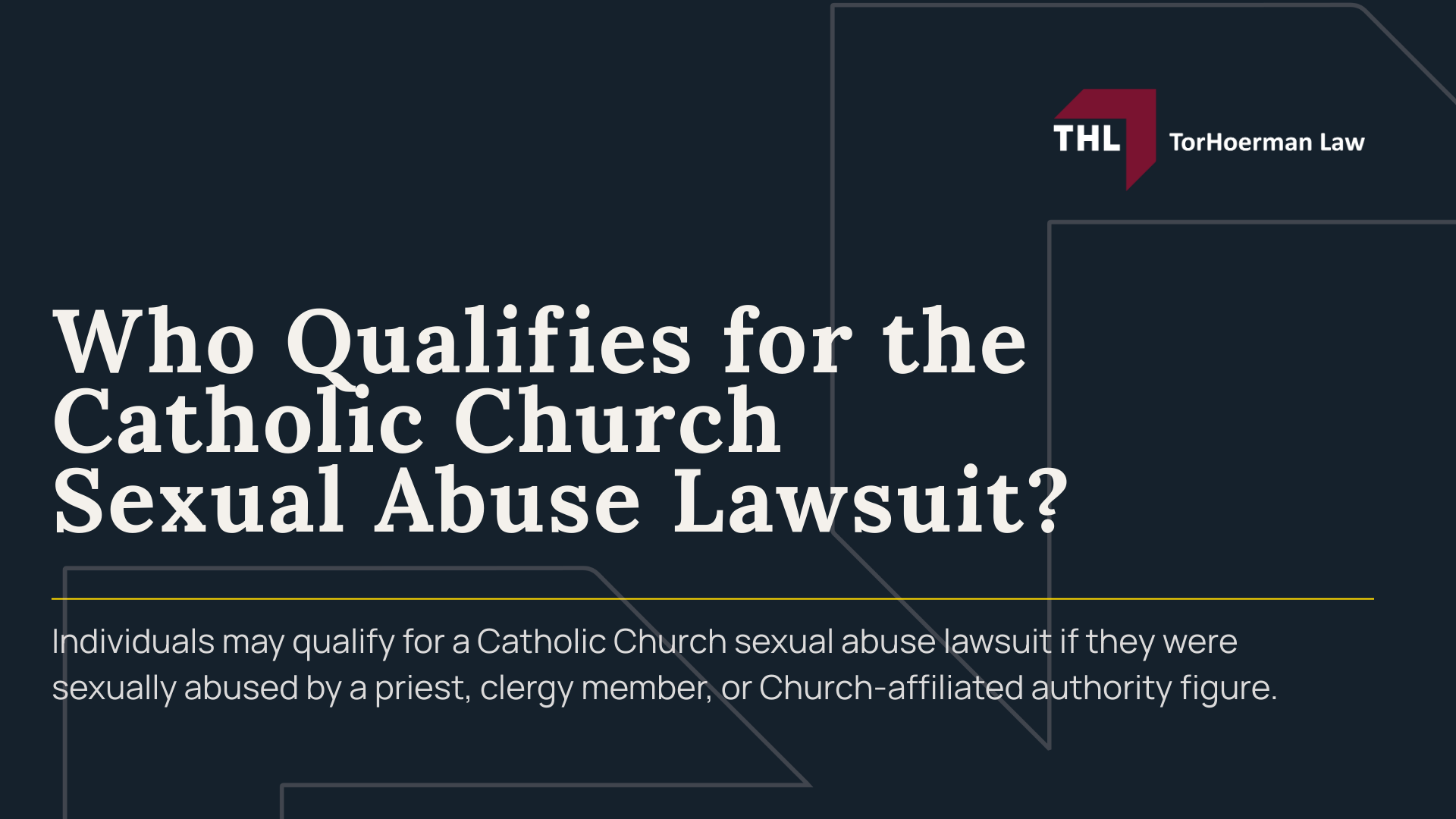
Individuals may qualify for a Catholic Church sexual abuse lawsuit if they were sexually abused by a priest, clergy member, or Church-affiliated authority figure.
Eligibility often includes survivors who were abused as children, but adults may also qualify depending on the circumstances and the nature of the abuse.
Claims may involve conduct that occurred in parishes, schools, youth programs, or other Church-related settings.
Many lawsuits are based on abuse that occurred years or decades ago, particularly where institutional concealment delayed disclosure.
Qualification does not depend on whether the abuse was reported to law enforcement at the time it occurred.
Survivors may still qualify even if the accused clergy member has since died or left the Church.
Legal eligibility depends on applicable civil laws, filing deadlines, and the ability to identify responsible institutions.
A case review can help determine whether an individual’s experience meets the criteria for pursuing a civil claim.
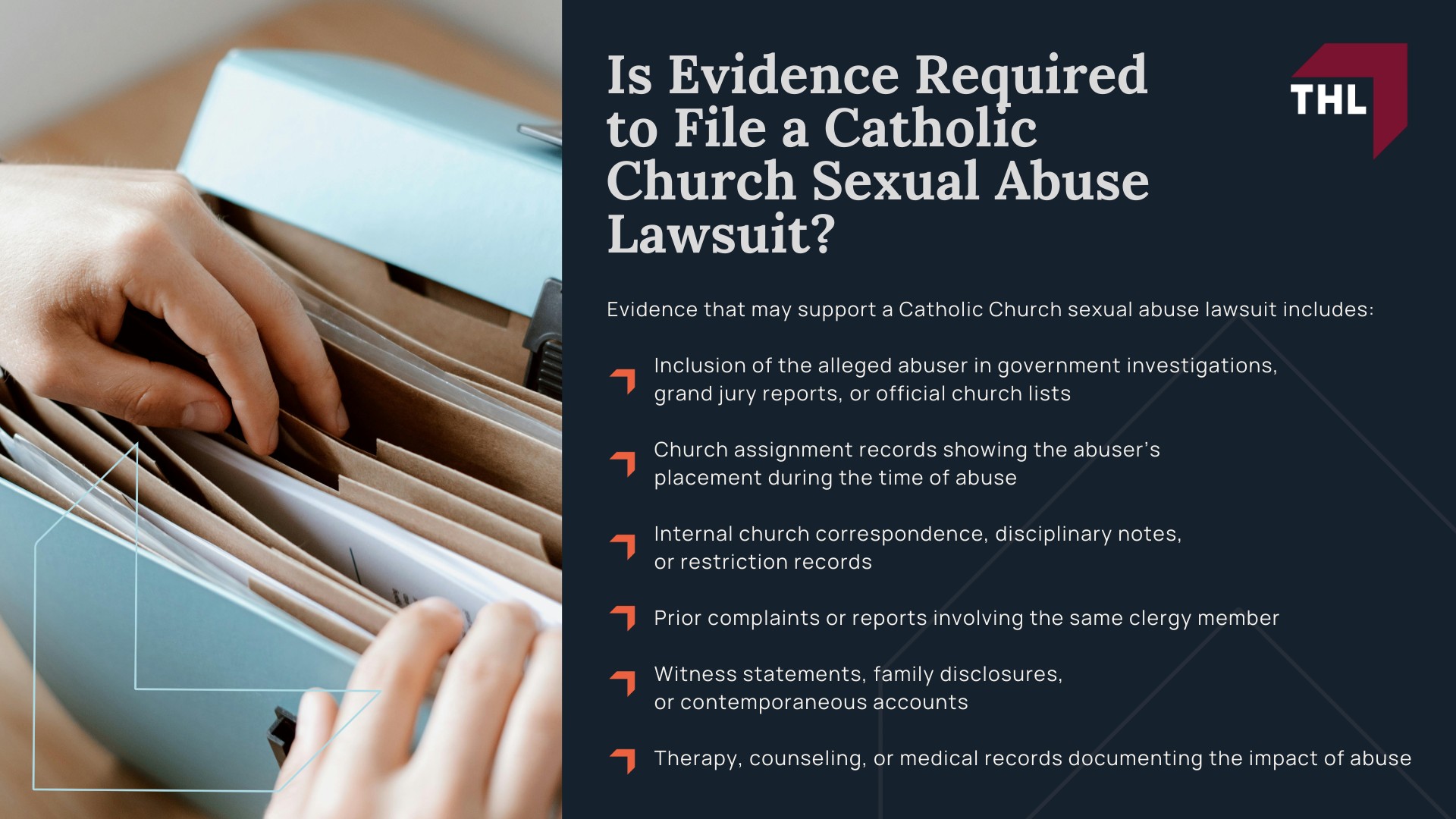
Evidence is required to file a Catholic Church sexual abuse lawsuit, but the standard differs from criminal cases and does not require physical proof.
Civil claims often rely on records, corroboration, and documented patterns rather than contemporaneous reports or forensic evidence.
Courts recognize that abuse frequently went unreported due to fear, manipulation, or institutional pressure.
Evidence may come from third-party investigations, church files, or testimony that supports the survivor’s account.
The focus is on whether abuse occurred and whether institutional failures allowed it to continue.
Evidence that may support a Catholic Church sexual abuse lawsuit includes:
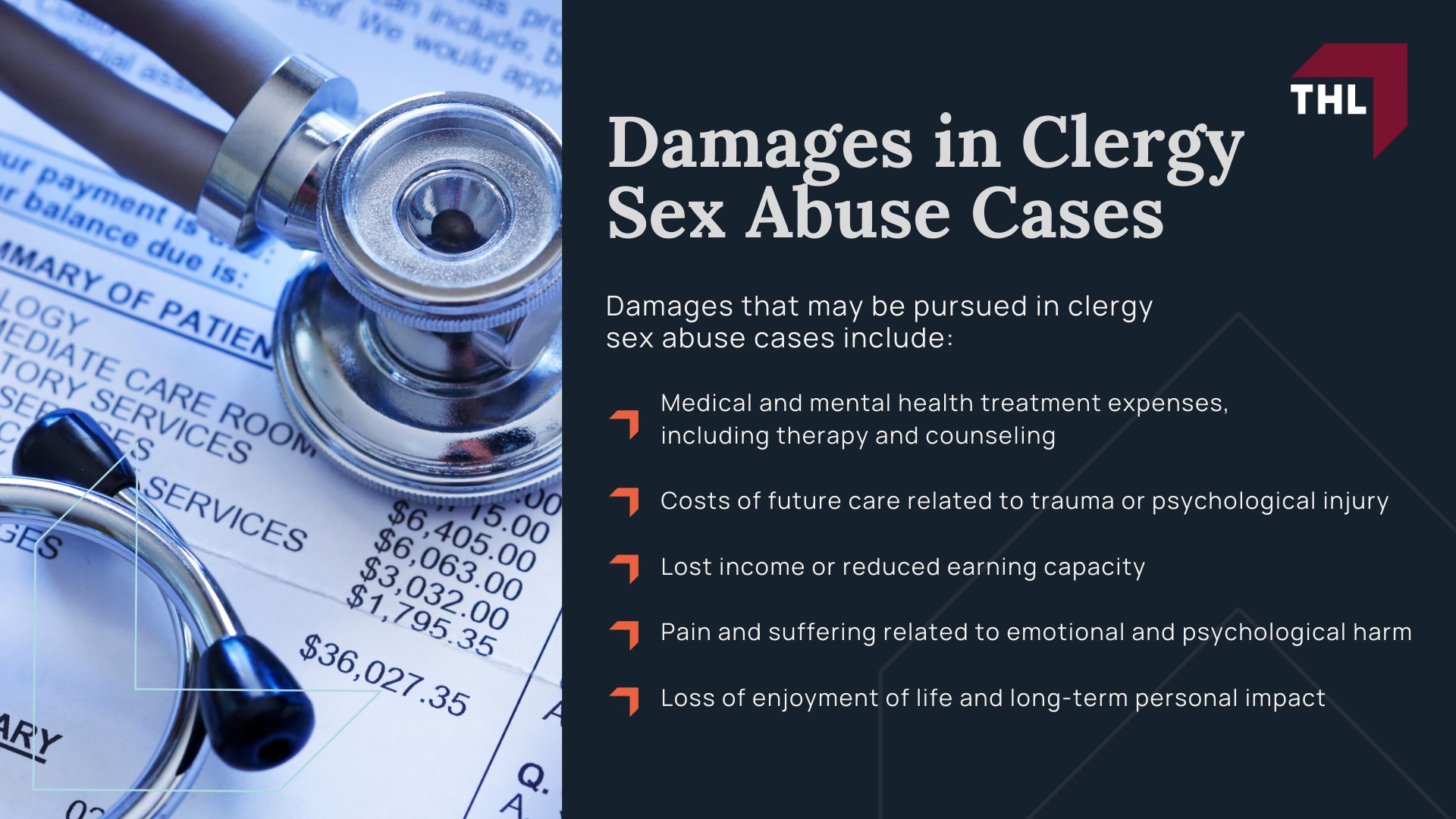
Damages in clergy sex abuse cases represent the measurable and non-measurable harm a survivor has suffered as a result of abuse and institutional failures.
These damages are evaluated through a careful review of medical history, psychological treatment, employment impact, and the long-term effects of trauma.
Lawyers assess damages by analyzing records, expert opinions, and comparable cases to present a complete picture of how abuse altered a survivor’s life.
This process helps determine the full scope of losses that may be pursued through civil litigation.
A thorough assessment is critical when seeking accountability and financial recovery through the courts.
Damages that may be pursued in clergy sex abuse cases include:
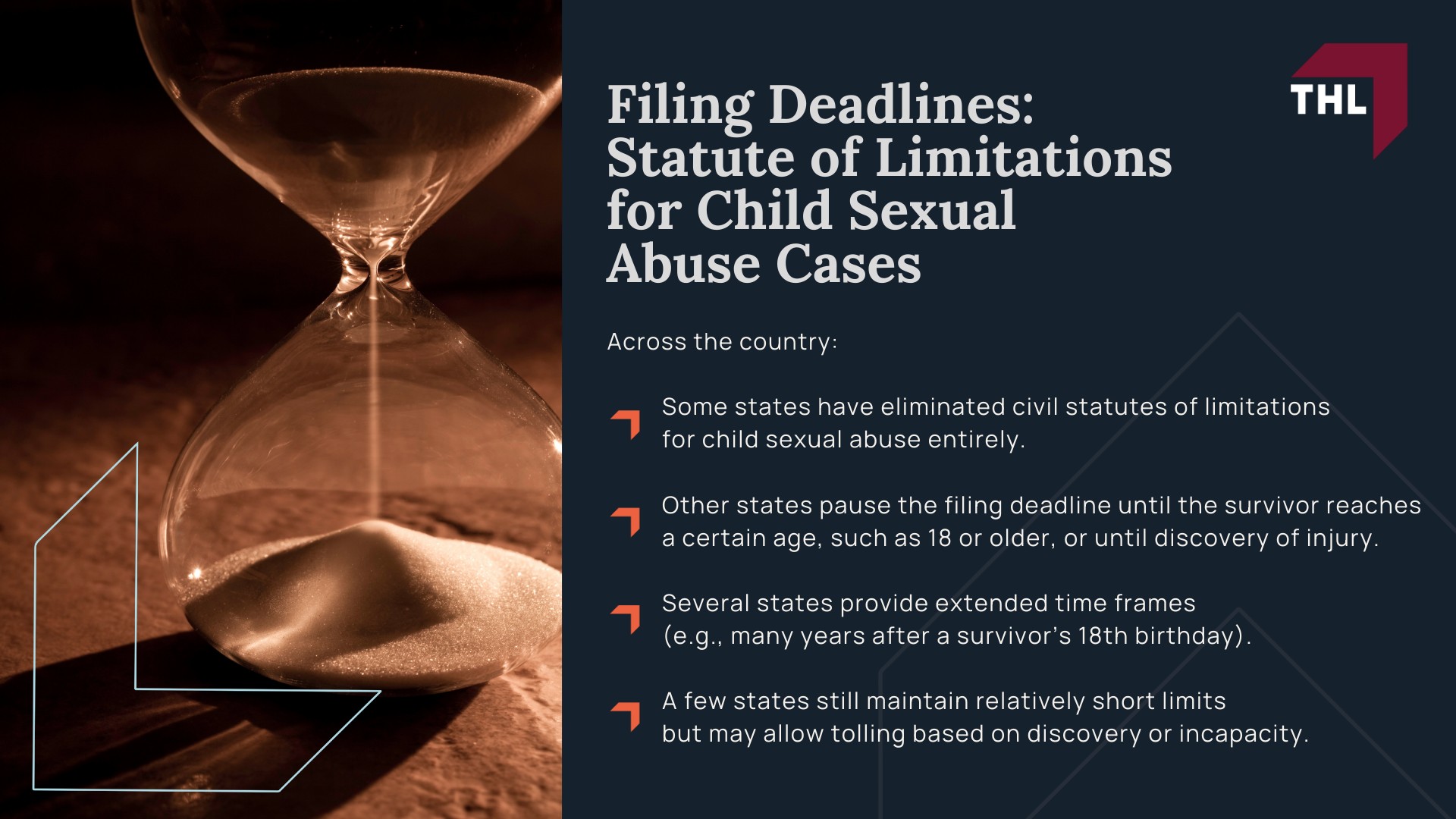
The statute of limitations sets a legal deadline for when a survivor must file a civil lawsuit alleging sexual abuse, including cases involving clergy or other authority figures.
These laws vary widely across the United States, and recent reforms have extended or, in some states, eliminated filing deadlines entirely for childhood sexual abuse to account for the fact that many survivors do not disclose or fully understand the harm until much later in life.
In many states, the statute of limitations for civil claims involving child sexual abuse is suspended until the survivor reaches a certain age, such as 18 or older, or is extended further based on when the survivor discovered or reasonably should have discovered the injury.
Other states have no statute of limitations for child sexual abuse claims at all, meaning survivors can file civil lawsuits at any time.
Even in states that still impose deadlines, laws often include tolling provisions that pause the filing period while the claimant is a minor or until later discovery of harm.
Because these deadlines directly affect a survivor’s ability to seek legal remedies, it’s critical to understand the specific rules in your state and how exceptions may apply.
Across the country:
Because these deadlines can be complicated and change with new legislation, consulting an attorney promptly can help ensure that important filing windows are not missed, preserve critical evidence, and give survivors the best opportunity to pursue justice and recover compensation under the law.
Sexual abuse by clergy leaves lasting harm, and for many survivors, the most difficult part has been how institutions responded or failed to respond when abuse came to light.
Civil litigation offers a way to examine those failures, demand accountability, and place survivor experiences on the public record.
TorHoerman Law investigates Catholic clergy sexual abuse cases with a focus on institutional conduct, historical patterns, and the legal options available under current law.
Each case is reviewed on its own facts, with care given to privacy, dignity, and the long-term impact of abuse.
If you were abused by a member of the Catholic clergy and have questions about whether a civil claim may be possible, TorHoerman Law can review your situation confidentially.
There is no obligation to move forward, and speaking with a legal team does not require public disclosure.
A case review can help clarify timelines, evidence considerations, and potential next steps.
Contact TorHoerman Law to discuss your experience and learn whether legal action may be available to you.
Yes, the Catholic Church can be sued for sexual abuse through civil litigation, but these cases are typically brought against church entities rather than solely against individual abusers.
Civil lawsuits often name dioceses, archdioceses, or religious orders that had authority over clergy and responsibility for supervision, assignment, and discipline.
The legal theory usually focuses on institutional conduct, including whether church leaders knew or should have known about abuse risks and failed to act.
Courts examine whether policies, decisions, or omissions by church officials contributed to the harm.
These cases are separate from criminal proceedings and may proceed even when no criminal charges were filed or when prosecutions are no longer possible.
Whether a lawsuit can move forward depends on applicable civil laws, filing deadlines, and the specific facts of the case.
A legal review is necessary to determine if the Catholic Church may be held civilly responsible under the circumstances involved.
TorHoerman Law handles Catholic Church sexual abuse cases on a contingency fee basis, meaning clients do not pay upfront legal fees.
Our firm’s fees are tied to the outcome of the case and are paid only if compensation is recovered through settlement or judgment.
This structure allows survivors to pursue legal action without taking on immediate financial risk or added stress.
Litigation costs are typically advanced by the firm during the case. If no recovery is obtained, clients generally do not owe attorney’s fees.
This approach helps make legal representation accessible to individuals who may otherwise be unable to afford to pursue a civil claim.
The Catholic Church has paid billions of dollars in settlements and payouts to survivors of clergy sexual abuse, especially in the United States.
Catholic dioceses and related entities in the U.S. have paid more than $3 billion in total settlements to survivors of clergy abuse over several decades.
More recent reporting based on an independent study from the Center for Applied Research in the Apostolate (CARA) shows that between 2004 and 2023, the U.S. Catholic Church spent over $5 billion on victim compensation and attorney fees related to clergy sexual abuse allegations.
Individual dioceses have agreed to very large payouts in notable cases, such as the Archdiocese of Los Angeles (which has paid or agreed to pay in the hundreds of millions), and other dioceses with settlements ranging from tens of millions to hundreds of millions of dollars for groups of survivors.
Diocesan settlements often arise from large groups of survivors and can involve compensation funds or bankruptcy resolutions.
Settlement amounts vary significantly based on the number of claimants, severity of abuse, and legal issues in each case.
Some dioceses have paid compensation as part of bankruptcy proceedings to address large volumes of lawsuits.
These figures reflect civil compensation through lawsuits and settlements; they do not include broader financial impacts such as counseling costs, institutional reforms, or costs incurred by public systems.
Because reporting practices and legal frameworks vary by jurisdiction, total global payouts are difficult to quantify precisely, but U.S. figures alone demonstrate the substantial financial consequences tied to clergy abuse claims.
Reports of widespread sexual abuse linked to the Catholic Church are often traced to a combination of institutional structure, authority dynamics, and historical practices rather than to any single cause.
Clergy members historically held significant moral authority and trust within communities, which created conditions where abuse could occur with limited scrutiny.
The Church’s hierarchical structure concentrated decision-making power in bishops and senior officials, reducing external oversight and accountability.
For decades, allegations were frequently handled internally, allowing abusive behavior to continue without intervention from law enforcement.
Cultural deference to religious authority discouraged victims, families, and parishioners from questioning clergy or reporting abuse.
Mandatory celibacy, isolation, and inadequate screening or supervision have also been cited by researchers as contributing risk factors.
Investigations have shown that patterns of transferring accused priests rather than removing them enabled repeat abuse across multiple locations.
These combined factors allowed abuse to persist over long periods before public reporting, litigation, and government investigations forced systemic scrutiny.
The Catholic Church has been accused, in investigations and court records, of using institutional practices that concealed sexual abuse rather than addressing it transparently.
These practices often delayed public awareness and prevented timely intervention by civil authorities.
Multiple government inquiries and civil cases have examined how internal decision-making limited accountability and prolonged harm.
Survivors and investigators have described patterns that prioritized institutional reputation over child safety.
These findings form the basis of many civil lawsuits examining institutional responsibility.
Tactics that have been cited in investigations and litigation include:
Yes, it may still be possible to file a lawsuit even if the abuse occurred decades ago.
Many states have changed their civil laws to account for delayed reporting in child sexual abuse cases.
These reforms recognize that survivors often need years or decades to process abuse or feel safe coming forward.
Some states have extended filing deadlines, created “lookback windows,” or removed time limits entirely for certain claims.
Whether a case can proceed depends on the law in the state where the abuse occurred and the specific facts involved.
Courts also consider whether institutional concealment delayed discovery of the harm.
A legal review is necessary to determine whether a decades-old claim may still be viable under current law.
When discussing how many Catholic leaders, priests, and others have been accused of sexual abuse, the numbers are significant but vary by source and reporting method.
In the United States, an official survey (called the John Jay College report) commissioned by the U.S. Conference of Catholic Bishops found that dioceses identified about 4,392 clergy (including priests and deacons) with credible accusations of child sexual abuse from 1950 to 2002.
Other compilations based on diocesan disclosures suggest that thousands of Catholic priests have been named in abuse allegations over the years; one publicly available list catalogues over 4,800 priests accused of abuse in the United States alone.
Independent watchdog data also shows that thousands of abuse allegations have been reported nationwide, with one report indicating more than 16,000 credible allegations of sexual abuse of minors by priests, deacons, or religious brothers over a 20-year period.
At the episcopal level, global accounting by BishopAccountability.org has identified 110 Catholic bishops accused of sexual crimes against children and 54 accused of wrongdoing against adults.
Numbers vary internationally and are difficult to pin down precisely due to differences in disclosure, reporting practices, and recordkeeping across regions.
However, massive investigations in countries such as the United States, Australia, and Europe confirm that abuse allegations have involved clergy and Church leaders in many nations.
Additionally, reports from specific dioceses, such as a recent Michigan investigation identifying 51 priests accused of sexual misconduct in one diocese alone, show that abuse allegations continue to surface in local contexts.
Owner & Attorney - TorHoerman Law
Here, at TorHoerman Law, we’re committed to helping victims get the justice they deserve.
Since 2009, we have successfully collected over $4 Billion in verdicts and settlements on behalf of injured individuals.
Would you like our help?
At TorHoerman Law, we believe that if we continue to focus on the people that we represent, and continue to be true to the people that we are – justice will always be served.
Do you believe you’re entitled to compensation?
Use our Instant Case Evaluator to find out in as little as 60 seconds!
In this case, we obtained a verdict of $495 Million for our client’s child who was diagnosed with Necrotizing Enterocolitis after consuming baby formula manufactured by Abbott Laboratories.
In this case, we were able to successfully recover $20 Million for our client after they suffered a Toxic Tort Injury due to chemical exposure.
In this case, we were able to successfully recover $103.8 Million for our client after they suffered a COX-2 Inhibitors Injury.
In this case, we were able to successfully recover $4 Million for our client after they suffered a Traumatic Brain Injury while at daycare.
In this case, we were able to successfully recover $2.8 Million for our client after they suffered an injury due to a Defective Heart Device.
Here, at TorHoerman Law, we’re committed to helping victims get the justice they deserve.
Since 2009, we have successfully collected over $4 Billion in verdicts and settlements on behalf of injured individuals.
Would you like our help?
They helped my elderly uncle receive compensation for the loss of his wife who was administered a dangerous drug. He consulted with this firm because of my personal recommendation and was very pleased with the compassion, attention to detail and response he received. Definitely recommend this firm for their 5 star service.
When I wanted to join the Xarelto class action lawsuit, I chose TorrHoerman Law from a search of a dozen or so law firm websites. I was impressed with the clarity of the information they presented. I gave them a call, and was again impressed, this time with the quality of our interactions.
TorHoerman Law is an awesome firm to represent anyone that has been involved in a case that someone has stated that it's too difficult to win. The entire firm makes you feel like you’re part of the family, Tor, Eric, Jake, Kristie, Chad, Tyler, Kathy and Steven are the best at what they do.
TorHorman Law is awesome
I can’t say enough how grateful I was to have TorHoerman Law help with my case. Jacob Plattenberger is very knowledgeable and an amazing lawyer. Jillian Pileczka was so patient and kind, helping me with questions that would come up. Even making sure my special needs were taken care of for meetings.
TorHoerman Law fights for justice with their hardworking and dedicated staff. Not only do they help their clients achieve positive outcomes, but they are also generous and important pillars of the community with their outreach and local support. Thank you THL!
Hands down one of the greatest group of people I had the pleasure of dealing with!
A very kind and professional staff.
Very positive experience. Would recommend them to anyone.
A very respectful firm.