The Edwardsville wrongful death lawyers at TorHoerman Law have recovered significant compensation for families and loved ones of individuals who have tragically passed away due to negligence.
Our wrongful death lawyers handle claims involving car accidents, premises liability, negligent security, daycare and nursing home abuse, and other serious accidents.
Under Illinois law, family members and loved ones may be able to seek compensation medical expenses, funeral costs, lost income, loss of companionship, emotional distress, and other damages.
Do You Qualify to File a Wrongful Death Claim? Contact TorHoerman Law
Looking for an experienced Edwardsville wrongful death lawyer who gets results?
Our team of Edwardsville wrongful death lawyers at TorHoerman Law has been awarded over $4 billion in verdicts and negotiated settlements for clients across all practice areas since 2009, including multiple high-profile wrongful death cases.
We provide expert counsel and legal representation for people involved in wrongful deaths throughout Edwardsville and the surrounding area.
Our Attorneys Can Help You File a Wrongful Death Lawsuit in Illinois
A wrongful death can leave families facing sudden loss, unanswered questions, and immediate financial pressure.
Working with an Edwardsville wrongful death lawyer can help you protect the record early, preserve key evidence, and pursue accountability from the parties responsible when the facts support a claim.
TorHoerman Law represents families across Madison County and Southern Illinois, and our team builds wrongful death cases around documentation, liability proof, and damages support from the start.
If you need a wrongful death lawyer Edwardsville families can reach for clear, direct guidance, our attorneys can evaluate what happened, explain next steps, and handle communications with insurers.
A wrongful death attorney can also identify all potential defendants and insurance coverage issues, including employer liability and other responsible parties, depending on the evidence.
In an Illinois wrongful death case, the path forward is shaped by the Illinois wrongful death statute and related probate requirements, including who has standing to file and what damages may be recoverable under the wrongful death statute Illinois law.
These rules are specific, and filing a wrongful death lawsuiton time and in the correct legal capacity matters.
To speak with an Edwardsville wrongful death lawyer, call (618) 278-2536 for a free, no-obligation consultation.
You can also use the chat feature on this page for an instant case evaluation to see whether you may qualify and to connect with our team.
TorHoerman Law’s attorneys handle wrongful death in Illinois matters across Madison County and Southern Illinois, with our main office based in downtown Edwardsville.
Meet Our Team of Edwardsville Wrongful Death Lawyers
TorHoerman Law represents families in wrongful death cases arising in Edwardsville and throughout Madison County.
An Edwardsville wrongful death lawyer from our team builds each case around documentation, admissible evidence, and a clear plan for proving how a wrongful act caused the death of a deceased person.
Under the Illinois Wrongful Death Act, a wrongful death claim is intended to address losses suffered by surviving family members, and the process is guided by strict standing and filing rules.
In many cases, the claim focuses on the harm to the family, including the surviving spouse and other eligible next of kin, and it may also involve proof of mental suffering and related losses recognized by law.
Wrongful death cases can involve complex liability questions and significant insurer resistance, especially when defendants dispute fault or attempt to narrow damages.
A wrongful death lawyer can evaluate who may be named, what evidence is needed, and what steps are required to file a wrongful death case in the proper legal capacity.
While some people search for a “death lawyer” after a sudden loss, the more important question is whether the legal elements can be proven under the Illinois statute and whether the claim is filed correctly from the start.
Depending on the facts, a wrongful death lawsuit may also involve allegations of reckless conduct, and in rare situations it may involve violent intentional conduct, which can affect the theories asserted and the evidence required.
How Much Does it Cost to Hire a Wrongful Death Attorney?
Most wrongful death attorneys handle cases on a contingency fee basis, which generally means you pay no attorney fees up front and the fee is collected only if there is a recovery through settlement or verdict.
The specific percentage and how case expenses are handled should be stated in a written agreement, so you understand how costs such as records retrieval, expert work, and filing fees are treated.
Because a wrongful death lawsuit often requires extensive evidence development, including proof of damages like funeral expenses and other losses, families should also ask how litigation costs are advanced and whether they are deducted from any recovery.
Cost questions should also include communication and expectations.
A wrongful death lawyer should be able to explain the process under the Illinois Wrongful Death Act and the broader wrongful death act framework in plain language, including who has standing and what the timeline looks like.
A clear fee agreement and a clear plan for evidence collection can reduce uncertainty while the family focuses on immediate needs after the loss.
The Legal Process for a Wrongful Death Lawsuit in Illinois
A wrongful death lawsuit is a civil case brought after a death occurred because of another party’s negligence or misconduct.
In Illinois wrongful death matters, the claim is typically filed by the personal representative of the deceased person’s estate, and the case seeks to recover damages for losses suffered by the surviving relatives.
The process usually begins with an investigation, collection of medical bills and records, and confirmation of who has standing before a formal complaint is filed in court.
After filing, the case moves through discovery, where both sides exchange documents and take testimony, and many cases resolve through negotiated settlement rather than trial.
Wrongful death cases can arise from a motor vehicle accident, workplace accidents, or medical malpractice, and each setting affects what evidence is required to prove liability.
Insurance and defense counsel often raise disputes about causation, comparative or contributory negligence, and the scope of wrongful death damages, which is why documentation and expert review can be central.
A wrongful death attorney can also help families understand what attorney fees and case costs may look like under a contingency arrangement, and how those terms are handled in a written agreement.
The overall timeline varies, but wrongful death litigation often takes months to a year or more depending on complexity, number of defendants, and the level of dispute.
Typical steps in an Illinois wrongful death case include:
Confirm standing and estate authority: determine the next of kin and appoint a personal representative through probate if needed.
Initial investigation and preservation: gather incident reports, witness information, and any available video or third-party records before they are lost.
Medical and financial documentation: collect medical records, medical expenses, and proof of financial support and other losses tied to the death.
Liability analysis: identify responsible parties and evaluate negligence, causation, and any contributory negligence arguments raised by the defense.
File the lawsuit: submit a complaint in civil court within the statute of limitations.
Discovery: exchange documents, take depositions, and retain experts when necessary to prove liability and damages.
Settlement negotiations or mediation: pursue resolution once evidence is developed and damages are supported.
Trial, if necessary: present the case to a judge or jury if no fair settlement is reached.
Distribution of recovery: allocate proceeds through the estate to eligible surviving relatives under Illinois law.
It allows a case to be brought when a wrongful death occurs due to a wrongful act, neglect, or default that would have supported a personal injury claim if the person had lived.
The purpose of the Act is to allow eligible survivors to seek financial compensation for the losses they suffer because of the loved one’s death.
Those losses can include loss of financial support, loss of companionship and society, and other harms recognized by Illinois law.
Wrongful death damages are distinct from the losses the deceased person could have pursued during life.
For that reason, many cases also involve survival claims under the Illinois Survival Act, which can address losses tied to the decedent’s own injury period, such as medical expenses, medical bills, and other damages incurred before death.
A wrongful death attorney will typically evaluate whether both a wrongful death claim and an Illinois Survival Act claim should be pursued based on the facts, medical records, and the timeline of treatment.
Who is Eligible to File a Wrongful Death Claim in Illinois?
In Illinois, the wrongful death lawsuit is generally filed by the personal representative of the deceased person’s estate, not by each family member individually.
The recovery is then distributed to the next of kin (surviving relatives) under Illinois law, which often includes a surviving spouse and other surviving family member relationships depending on the family structure.
The identity of next of kin can be straightforward in some families and disputed in others, and estate administration issues may affect who is appointed as personal representative and how settlement proceeds are allocated.
An Edwardsville wrongful death claim often requires early confirmation of standing and estate authority, especially if there is no prior estate administration in place.
If multiple family members disagree about representation or distribution, the probate process can affect the timeline even when liability is clear.
The Statute of Limitations for an Edwardsville Wrongful Death Claim
The statute of limitations is the filing deadline for a wrongful death lawsuit, and missing it can eliminate the right to recover financial compensation regardless of how strong the evidence is.
In many Illinois wrongful death cases, the deadline is generally two years from the date the death occurred, but exceptions and special rules can apply depending on the cause of death and the defendant.
Claims involving medical malpractice, workplace accidents, or government entities can involve different timing rules or notice requirements, so the applicable deadline should be confirmed early.
Even when the statute of limitations has time remaining, evidence can degrade quickly.
Medical records, billing documentation, incident reports, and witness information should be preserved early to support recovery of damages, including wrongful death damages and any survival claims under the Illinois Survival Act.
A wrongful death attorney can evaluate deadlines, preserve key records, and help the family pursue financial compensation through the correct legal process.
You may qualify to file a wrongful death lawsuit if the decedent died because of else’s negligence or another act neglect or default that would have supported a personal injury claim if the deceased individual had lived.
Under Illinois law, the core issue is whether the negligent person or entity owed a legal obligation, breached that obligation, and caused the decedent’s death, resulting in losses recognized by statute.
Wrongful death claims are governed by the Illinois Wrongful Death Act (740 ILCS 180), which sets who has the legal right to bring the case and how recovery is handled.
Standing is a key threshold issue.
In Illinois, individual family members do not usually file the lawsuit in their own names; instead, the claim is typically brought by the representative of the decedent’s estate appointed through probate court, for the benefit of eligible next of kin.
This structure matters in fatal accidents involving car accidents, medical events, or other incidents where liability may be disputed and damages are significant.
Because some losses are not immediately apparent in the early aftermath of death, early legal review helps families dealing with paperwork, insurance contact, and evidence preservation.
Evidence in Wrongful Death Cases
Wrongful death cases are evidence-driven, and the strength of the claim often turns on whether the proof establishes party’s negligence and causation.
Depending on how the death occurred, evidence may involve crash documentation (in car accidents), professional standards (for medical professionals), or other records tied to the incident.
Evidence is also used to show damages, including financial losses and the impact on the family.
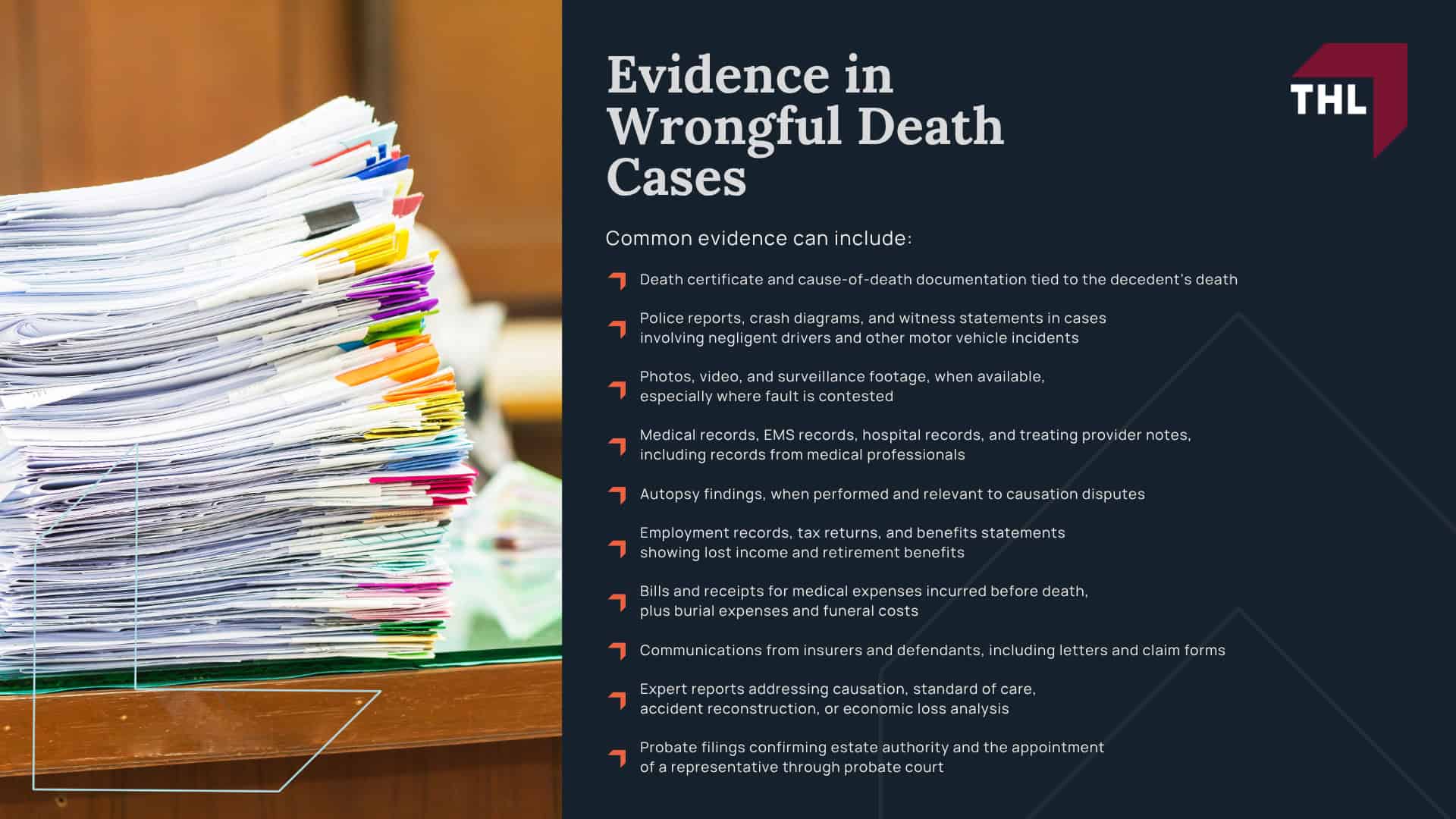
Common evidence can include:
Death certificate and cause-of-death documentation tied to the decedent’s death
Police reports, crash diagrams, and witness statements in cases involving negligent drivers and other motor vehicle incidents
Photos, video, and surveillance footage, when available, especially where fault is contested
Medical records, EMS records, hospital records, and treating provider notes, including records from medical professionals
Autopsy findings, when performed and relevant to causation disputes
Employment records, tax returns, and benefits statements showing lost income and retirement benefits
Bills and receipts for medical expenses incurred before death, plus burial expenses and funeral costs
Communications from insurers and defendants, including letters and claim forms
Expert reports addressing causation, standard of care, accident reconstruction, or economic loss analysis
Probate filings confirming estate authority and the appointment of a representative through probate court
Potential Compensation in Wrongful Death Cases
Compensation in a wrongful death lawsuit is intended to address the harms suffered by surviving family members as recognized by Illinois statutes.
Economic damages often include measurable financial losses, while non-economic damages can address the family’s loss of companionship and related harms.
In many cases, a separate claim under the Survival Act may also apply, which can allow recovery for losses the decedent could have claimed if they had lived, depending on the evidence and the timeline of suffering and treatment.
Potential damages may include:
Lost income and loss of expected future financial support
Loss of retirement benefits and other employment-related benefits
Medical expenses incurred before death, supported by records and billing
Burial expenses and funeral-related costs verified by invoices
Loss of companionship, guidance, and support recognized under Illinois wrongful death law
In some cases, damages addressed through the Survival Act, which may include the decedent’s pre-death losses, including pain and suffering when supported by proof
Because damages can be complex and disputed, families often need documentation and, in some cases, expert analysis to present a defensible valuation.
The goal is to seek compensation supported by records, not assumptions.
TorHoerman Law: Hire an Experienced Wrongful Death Lawyer Today
TorHoerman Law helps families dealing with a sudden death evaluate whether legal action is appropriate and whether the evidence supports a wrongful death claim under 740 ILCS 180.
Our team focuses on identifying liable parties, preserving key records, and building a case that connects the death to a specific negligent act, whether the claim involves negligent drivers, a workplace incident, or alleged errors by medical professionals.
We also guide families through estate and probate court requirements so the claim is filed in the proper capacity and on time.
If you want to discuss your options, TorHoerman Law offers a free consultation to review what happened and explain next steps toward seeking maximum compensation supported by the record.
Contact us today for a free consultation.
Use the chat feature on this page for a free case evaluation and to get in touch with our Edwardsville wrongful death lawyers.
In Illinois, a wrongful death lawsuit is typically filed by the personal representative of the deceased person’s estate, not by individual family members in their own names.
The recovery is then distributed to the decedent’s next of kin as determined by Illinois law, which often includes a surviving spouse and children, and may include other relatives depending on the family structure.
Because the personal representative is usually appointed through probate court, standing and estate authority should be confirmed early so the case is filed correctly and within the deadline.
The Illinois Survival Act is a statute that allows certain claims the decedent could have brought if they had lived to continue after death through the estate.
These “survival” claims are distinct from the wrongful death claim, which focuses on losses suffered by surviving family members.
In practice, a case may include both a wrongful death claim and a Survival Act claim, depending on the timeline of injury, treatment, and the damages supported by records.
Proving negligence generally requires showing a duty of care, a breach of that duty, causation, and damages.
The evidence must connect the breach to the death, which often involves incident reports, medical records, witness statements, and expert analysis depending on the facts.
Defendants may dispute fault or argue comparative negligence, so the strongest cases are built around objective documentation and a clear timeline of events.
Common causes include motor vehicle crashes, unsafe property conditions, workplace incidents, and medical malpractice, although the specific pattern varies by location and industry.
Fatal claims involving vehicles often center on speeding, impairment, distraction, and failure to yield, while workplace cases may involve safety violations or equipment hazards.
Medical malpractice claims often focus on whether the standard of care was breached and whether that breach caused the death, which typically requires expert review and detailed medical documentation.
Tor Hoerman has represented injured individuals for more than 30 years, with experience spanning individual personal injury cases and nationwide mass tort litigation. His work includes car accidents, catastrophic injuries, product liability claims, and other serious injury cases. Tor has served in court-appointed leadership roles in national litigation and tried cases involving major corporate defendants.
Legally Reviewed
TorHoerman Law’s legal content is researched and written by our editorial team and attorneys for legal accuracy, clarity, and relevance. We rely on statutes, court records, government publications, medical research, and other authoritative sources when applicable. This page provides general legal information and does not constitute legal advice.
Fact-Checked
TorHoerman Law reviews its legal content for factual accuracy, current information, and relevant legal context before publication and as material developments occur. This article is provided for general informational purposes and does not constitute legal advice. For guidance about a specific case, contact TorHoerman Law.
Have you or a loved one been injured in
Edwardsville, Illinois?
A serious injury can change your life.
Speak with an experienced Edwardsville personal injury lawyer about your rights, your case, and the legal options available to you.
TorHoerman Law represents people whose lives have been disrupted by serious injuries, unsafe products, and negligence. Our attorneys handle individual personal injury cases as well as national mass tort lawsuits involving major corporations.
Founded in 2009, our legal team brings more than 100 years of combined experience handling serious injury and complex civil litigation.
Do you believe you’re entitled to compensation?
Use our Instant Case Evaluator to find out in as little as 60 seconds!
In this case, we obtained a verdict of $495 Million for our client’s child who was diagnosed with Necrotizing Enterocolitis after consuming baby formula manufactured by Abbott Laboratories.
They helped my elderly uncle receive compensation for the loss of his wife who was administered a dangerous drug. He consulted with this firm because of my personal recommendation and was very pleased with the compassion, attention to detail and response he received. Definitely recommend this firm for their 5 star service.
★★★★★Rated 5 out of 5
Philip Storey
When I wanted to join the Xarelto class action lawsuit, I chose TorrHoerman Law from a search of a dozen or so law firm websites. I was impressed with the clarity of the information they presented. I gave them a call, and was again impressed, this time with the quality of our interactions.
★★★★★Rated 5 out of 5
Krista Miller
TorHoerman Law is an awesome firm to represent anyone that has been involved in a case that someone has stated that it's too difficult to win. The entire firm makes you feel like you’re part of the family, Tor, Eric, Jake, Kristie, Chad, Tyler, Kathy and Steven are the best at what they do.
★★★★★Rated 5 out of 5
Joe Smith
TorHorman Law is awesome
★★★★★Rated 5 out of 5
Karen Levy
I can’t say enough how grateful I was to have TorHoerman Law help with my case. Jacob Plattenberger is very knowledgeable and an amazing lawyer. Jillian Pileczka was so patient and kind, helping me with questions that would come up. Even making sure my special needs were taken care of for meetings.
★★★★★Rated 5 out of 5
Lauren B
TorHoerman Law fights for justice with their hardworking and dedicated staff. Not only do they help their clients achieve positive outcomes, but they are also generous and important pillars of the community with their outreach and local support. Thank you THL!
★★★★★Rated 5 out of 5
Joey
Hands down one of the greatest group of people I had the pleasure of dealing with!
★★★★★Rated 5 out of 5
Nickie Shewmake
A very kind and professional staff.
★★★★★Rated 5 out of 5
Jeannette Johnson
Very positive experience. Would recommend them to anyone.