Chicago
Case Types We Handle
Personal Injuries
Car Accidents
Truck Accidents
Motorcycle Accidents
Bicycle Accidents
Construction Accidents
Nursing Home Abuse
Wrongful Death
Slip and Fall Accidents
Daycare Injury & Abuse
Edwardsville
Case Types We Handle
Personal Injuries
Car Accidents
Truck Accidents
Motorcycle Accidents
Bicycle Accidents
Nursing Home Abuse
Wrongful Death
Slip and Fall Accidents
Daycare Injury & Abuse
Premises Liability
St. Louis
Case Types We Handle
Personal Injuries
Car Accidents
Truck Accidents
Motorcycle Accidents
Bicycle Accidents
Construction Accidents
Nursing Home Abuse
Wrongful Death
Slip and Fall Accidents
Daycare Injury & Abuse
Dangerous Drugs
Defective Products
Chemical Exposure

Paraquat Lawsuit Settlement Amounts [2026 Estimates]

Settlement Estimates for Paraquat Parkinson's Disease Lawsuits

Current estimates for Paraquat lawsuit settlement amounts range between $20,000 to over $1,000,000 depending on the severity and progression of Parkinson’s disease, the duration and intensity of paraquat exposure, the quality of medical and occupational documentation, and the ability to establish a clear causal link between the herbicide and the diagnosed condition.

Paraquat exposure has been linked to developing Parkinson’s disease, and thousands of individuals are now taking legal action to seek financial compensation for their illness.

TorHoerman Law is actively reviewing claims from people who’ve developed Parkinson’s disease after prolonged paraquat exposure.

Paraquat Lawsuit Settlement Amounts

Do You Qualify to File a Paraquat Lawsuit? Contact TorHoerman Law

Thousands of paraquat Parkinson’s lawsuits have been filed against Syngenta and Chevron, with claimants alleging that use of the herbicide Paraquat contributed to the development of Parkinson’s disease.

Paraquat lawsuits allege that people who were exposed to paraquat through agricultural work, mixing and spraying, or drift exposure were not adequately warned about the risk of neurological injury.

A growing body of scientific evidence is frequently cited in these claims, including research examining whether paraquat exposure is associated with a higher Parkinson’s risk in certain populations.

Parkinson’s disease often requires long-term medical treatment and can lead to mounting medical expenses, work limitations, and major changes to day-to-day life.

Through the Paraquat MDL and related state court litigation, paraquat lawsuits are seeking compensation for losses such as medical expenses, lost income, reduced future earnings, and pain and suffering.

Paraquat attorneys commonly estimate that paraquat settlement amounts could range from roughly $20,000 to over $1,000,000 depending on the severity of the illness, the length of exposure, and the strength of supporting documentation.

These figures are estimates, not guarantees, and outcomes can vary widely based on the facts and evidence in an individual case.

If you were exposed to paraquat and later diagnosed with Parkinson’s disease, it is worth speaking with a lawyer to understand your legal options and what compensation may be realistic for your specific claim.

Contact TorHoerman Law today for a free consultation with our paraquat lawyers.

You can also use the chat feature on this page to find out if you’re eligible to file a Paraquat lawsuit instantly.

Table of Contents

Paraquat Lawsuit Settlement Amounts Estimates and Projections

Settlement projections in paraquat cases vary because paraquat claims are evaluated individually, even when they are coordinated in a single federal proceeding.

The paraquat multidistrict litigation was created to consolidate paraquat lawsuits filed across the country so the court could manage common discovery, expert issues, and pretrial rulings in one forum while preserving each plaintiff’s right to prove their own damages.

Over the life of the MDL, the parties have moved through core stages that typically drive valuation in mass torts, including coordinated discovery, expert challenges, and bellwether preparation, with scheduling shifts and stays that reflect ongoing negotiations.

Those developments matter because settlement discussions often intensify when both sides can better predict how key evidence will perform at trial and how the court will rule on disputed scientific questions.

As a result, the average paraquat settlement number discussed online is best treated as a rough midpoint in a wide band, not a single figure that applies to most claims.

Projections are usually based on patterns from prior toxic exposure MDLs, public reporting about bellwether posture, and how settlement programs in comparable litigation scale awards by disease severity and proof strength.

This section sets up the tiered ranges below by explaining why estimates span from lower-value cases with limited documentation to higher-value claims supported by detailed exposure histories, medical records, and substantial damages.
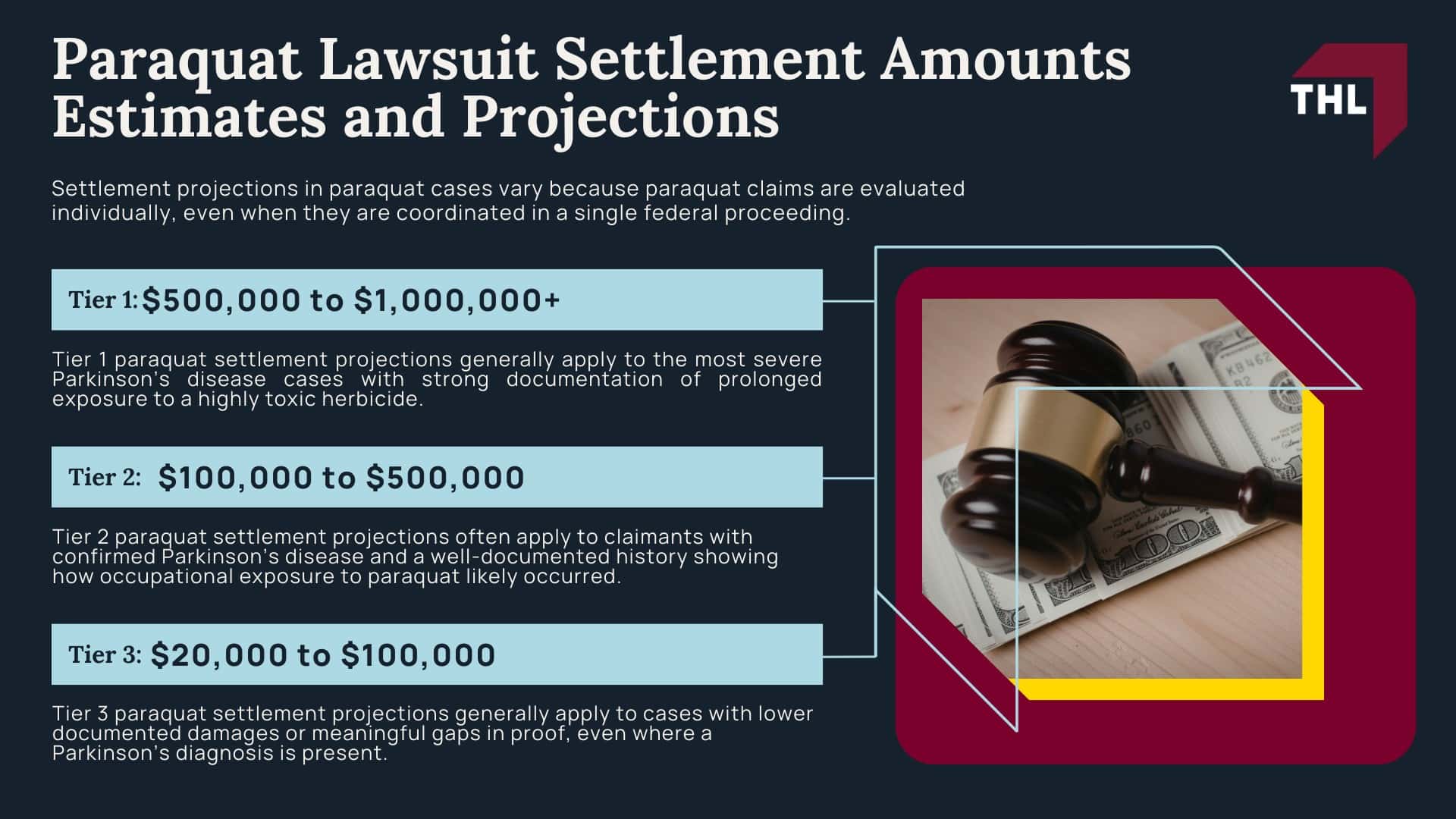
Tier 1 Paraquat Settlement Projections: $500,000 to $1,000,000+

Tier 1 paraquat settlement projections generally apply to the most severe Parkinson’s disease cases with strong documentation of prolonged exposure to a highly toxic herbicide.

These are often claims where paraquat victims can show years of direct handling and repeated contact, including circumstances where they sprayed paraquat as part of regular job duties.

The highest-value cases tend to involve substantial functional decline, intensive treatment needs, and clear economic loss tied to work disruption or disability.

In this tier, projected outcomes commonly fall between $500,000 and $1,000,000+, reflecting both injury severity and the strength of proof.

Cases that may fall within this highest settlement tier often share several common characteristics, including the following:

  • Advanced Parkinson’s symptoms that significantly impair daily functioning, mobility, or independence
  • Extensive medical documentation, including diagnosis confirmation, treatment history, and progression notes
  • A well-supported exposure narrative showing repeated use, mixing, loading, or application over multiple seasons
  • Occupational histories common to agricultural workers, applicators, or crews working around paraquat use and drift
  • Meaningful damages such as long-term medical care needs, lost wages, diminished future earnings, and caregiving costs

Tier 1 projections also tend to assume the file is trial-ready, with cohesive records that support the timeline from exposure to diagnosis.

Cases with extensive work history evidence and credible corroboration often sit at the top of this tier, especially where prolonged exposure is difficult to dispute.

Even within this bracket, outcomes can vary based on proof strength, jurisdictional posture, and how the broader litigation develops.

Tier 2 Paraquat Settlement Projections: $100,000 to $500,000

Tier 2 paraquat settlement projections often apply to claimants with confirmed Parkinson’s disease and a well-documented history showing how occupational exposure to paraquat likely occurred.

These cases can involve meaningful symptoms and ongoing treatment needs, but typically with less severe impairment or fewer long-term care demands than Tier 1 claims.

In this tier, compensation estimates commonly range from $100,000 to $500,000, depending on disease progression, economic loss, and the strength of the evidentiary record.

Cases in this tier often share the following fact patterns and proof markers:

  • Medical records confirming diagnosis, treatment history, and documented symptom progression
  • Work history evidence showing when and where exposure occurred, including job duties tied to mixing, loading, applying, or working near application sites
  • Occupational roles such as farm labor, landscaping, groundskeeping, pesticide application, or equipment operation in treated areas
  • Moderate economic damages, including time off work, reduced capacity, or job changes tied to symptoms
  • Supporting documentation or witness information that helps establish repeated exposure without the extensive multi-decade record seen in Tier 1 cases

Tier 2 valuations rise when the exposure narrative is consistent, records are complete, and damages are clearly traceable to the diagnosis.

They tend to fall when exposure documentation is thin, symptoms are early-stage, or economic losses are limited.

Tier 3 Paraquat Settlement Projections: $20,000 to $100,000

Tier 3 paraquat settlement projections generally apply to cases with lower documented damages or meaningful gaps in proof, even where a Parkinson’s diagnosis is present.

These claims often involve shorter or less clearly documented exposure to the herbicide, which can make the case harder to value within a settlement program.

In many Tier 3 files, the central issue is whether the claimant can prove paraquat exposure with enough detail to support a consistent timeline and causation theory.

Economic losses may be limited, and the medical record may reflect earlier-stage symptoms or less intensive treatment needs.

For these reasons, projected outcomes in this tier often fall between $20,000 and $100,000, depending on the completeness of the evidence and the level of damages.

Even in Tier 3, stronger corroboration, cleaner records, and a clear exposure narrative can push valuation toward the top of the range.

Paraquat Lawsuit Overview and Updates

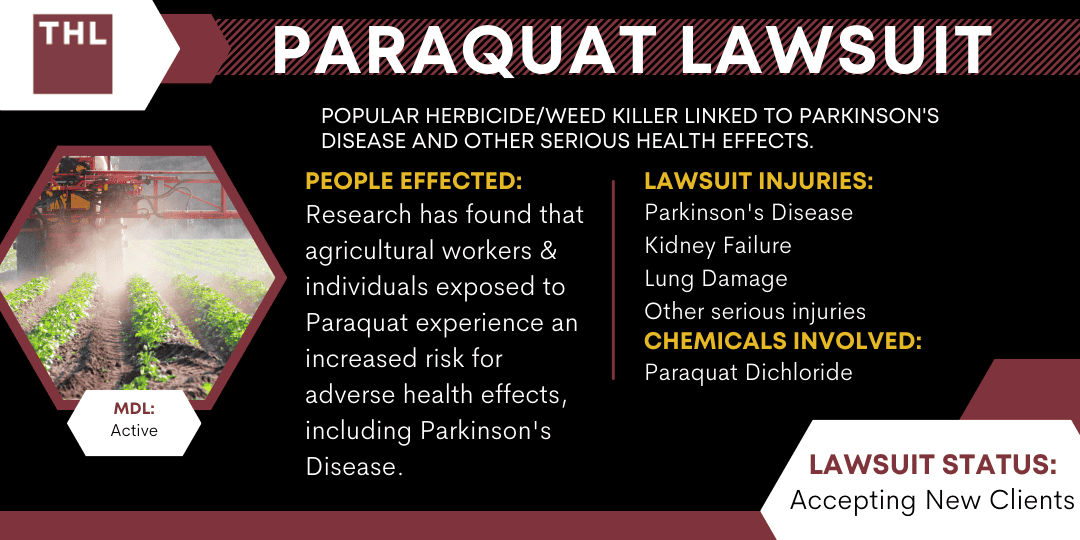
Paraquat dichloride is a widely used agricultural herbicide that has been the subject of growing legal scrutiny due to concerns about its toxicity and long-term neurological effects.

Although the Environmental Protection Agency (EPA) continues to allow restricted use of paraquat in the United States, it is classified as a highly toxic chemical and is banned in dozens of other countries because of documented health risks.

Central to the litigation are claims linking paraquat and Parkinson’s disease, with scientific research cited by plaintiffs to support an alleged increased risk among individuals with repeated exposure.

Thousands of people have begun filing paraquat lawsuits after being diagnosed with Parkinson’s disease, often years after occupational or environmental exposure.

These cases have been consolidated in federal court as part of the paraquat Products Liability Litigation, a coordinated mass tort litigation proceeding.

The MDL is pending in the Southern District of Illinois, where a single judge oversees shared discovery, expert challenges, and pretrial rulings.

This structure allows the court to manage complex scientific and procedural issues while preserving the individualized nature of each claim.

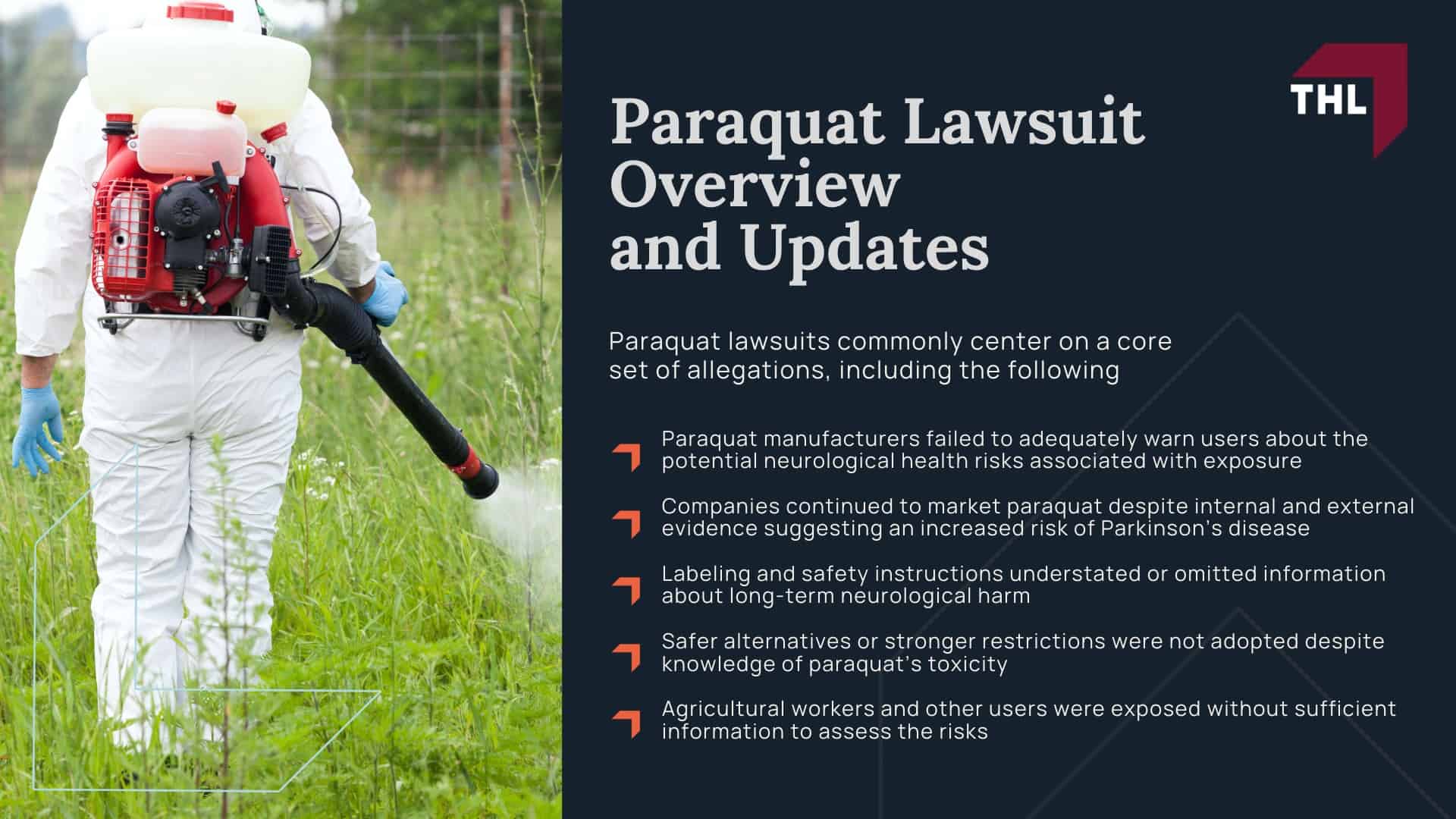
Paraquat lawsuits commonly center on a core set of allegations, including the following:

  • Paraquat manufacturers failed to adequately warn users about the potential neurological health risks associated with exposure
  • Companies continued to market paraquat despite internal and external evidence suggesting an increased risk of Parkinson’s disease
  • Labeling and safety instructions understated or omitted information about long-term neurological harm
  • Safer alternatives or stronger restrictions were not adopted despite knowledge of paraquat’s toxicity
  • Agricultural workers and other users were exposed without sufficient information to assess the risks

As the litigation has progressed, the federal court has addressed expert evidence, exposure proof requirements, and case management issues that directly affect how claims are evaluated.

Plaintiffs argue that these developments reinforce the need for a coordinated resolution rather than piecemeal litigation across jurisdictions.

Settlement discussions have occurred alongside these procedural milestones, though outcomes remain dependent on individual proof and broader litigation posture.

Ongoing updates in both the MDL and related state court proceedings continue to shape expectations for how paraquat cases may ultimately be resolved.

What Paraquat Manufacturers are Named in the Lawsuit?

Syngenta and Chevron are the primary paraquat manufacturers most commonly named in paraquat Parkinson’s lawsuits, based on allegations tied to paraquat-based products sold and distributed in the United States.

Many complaints also name Growmark, Inc. and related entities in cases where plaintiffs allege distribution or sale of paraquat products through agricultural supply channels.

Historically, paraquat’s commercial use traces back to Imperial Chemical Industries (ICI), which began manufacturing and selling paraquat in the early 1960s under the Gramoxone brand, a product line now associated with Syngenta.

In practice, the lawsuits focus on paraquat as a widely used herbicide in U.S. agriculture, which the EPA describes as one of the most widely used herbicides registered in the United States and often referred to as Gramoxone.

Plaintiffs typically allege that entities involved in manufacturing, marketing, and distribution bear responsibility for warnings and risk communications connected to long-term exposure claims, even when the product moved through multiple corporate predecessors over decades.

Paraquat Lawsuit Timeline and Updates

The federal Paraquat multidistrict litigation (MDL) was created in 2021 to coordinate hundreds, and now thousands, of ongoing paraquat lawsuits pending across state and federal courts, so that common issues could be addressed in one forum.

As the case developed, the court moved the litigation into the typical MDL phases, including coordinated discovery and selection of cases for workup toward bellwether trials, which are designed to test evidence and valuation pressures across the docket.

The first federal Paraquat bellwether trial was scheduled for October 2025 as part of the MDL’s trial track, but later court orders extended stays tied to settlement work and vacated that setting, effectively pushing the first federal paraquat trial timeline further out.

One key turning point was the court’s April 2024 dismissal order, which followed the exclusion of plaintiffs’ sole general causation expert for the initial trial pool, a ruling that influences how parties evaluate proof and risk across pending paraquat cases.

As the MDL continues, settlement discussions and case-vetting orders operate alongside the normal litigation path that can include dispositive motions such as summary judgement in individual cases, particularly where exposure proof or causation evidence is disputed.

Milestones in the multidistrict litigation (MDL) from formation to the present include the following:

  • June 7, 2021: JPML creates MDL No. 3004 and transfers cases to the Southern District of Illinois.
  • April 13, 2022: Court selects cases for early case-specific discovery to build a bellwether workup track.
  • April 17, 2024: Court dismisses the initial bellwether trial-selection cases after excluding plaintiffs’ sole general causation expert for that trial pool.
  • January 2025: Court issues an order selecting plaintiffs for further case-specific discovery as part of the next trial track.
  • May 9, 2025: Court notes a tentative settlement posture and stays certain case-specific deadlines to allow settlement work to proceed.
  • Sept. 29, 2025: Court extends the stay and vacates the October 2025 federal trial date.
  • Dec. 30, 2025: Court extends the stay again through March 6, 2026, while keeping certain plaintiff obligations active.
  • Late January 2026: A Philadelphia bellwether Paraquat case scheduled to begin trial resolved in a confidential, pre-trial settlement immediately before opening statements, an outcome closely watched because state-court bellwethers can influence negotiating posture across parallel state and federal inventories.
  • Ongoing: JPML monthly reporting shows the docket remains in the thousands of pending actions (for example, 6,433 pending actions were reported in early November 2025).

Do You Qualify for the Paraquat Lawsuit?

Qualifying for a Paraquat lawsuit depends on both exposure history and a confirmed medical diagnosis.

People who worked in agriculture, landscaping, pest control, or related fields may be eligible to file a paraquat lawsuit if they handled, mixed, applied, or worked around paraquat products over time.

Many pending cases involve individuals who were repeatedly exposed through occupational use rather than a single incident.

A key requirement is a Parkinson’s disease diagnosis supported by medical records, often made years after the exposure occurred.

Claims generally allege that paraquat exposure leads to Parkinson’s disease or materially increased the risk of developing it.

Documentation showing where and how exposure occurred, such as employment records or job descriptions, can play an important role in evaluating eligibility.

Because the litigation continues to evolve, a case review can help determine whether your circumstances align with the criteria being applied in pending cases.

Gathering Evidence for the Paraquat Litigation

Strong evidence often determines whether a paraquat claim can move forward and how it may be valued within the litigation.

Because Parkinson’s disease can develop years after exposure, cases frequently depend on clear documentation that connects a claimant’s work and exposure timeline to the eventual diagnosis.

Medical records and employment history are often the starting point, but many claims also benefit from corroborating records that show what products were used and how exposure occurred.

The goal is to build a consistent narrative that can be tested against the proof standards applied in mass tort litigation.

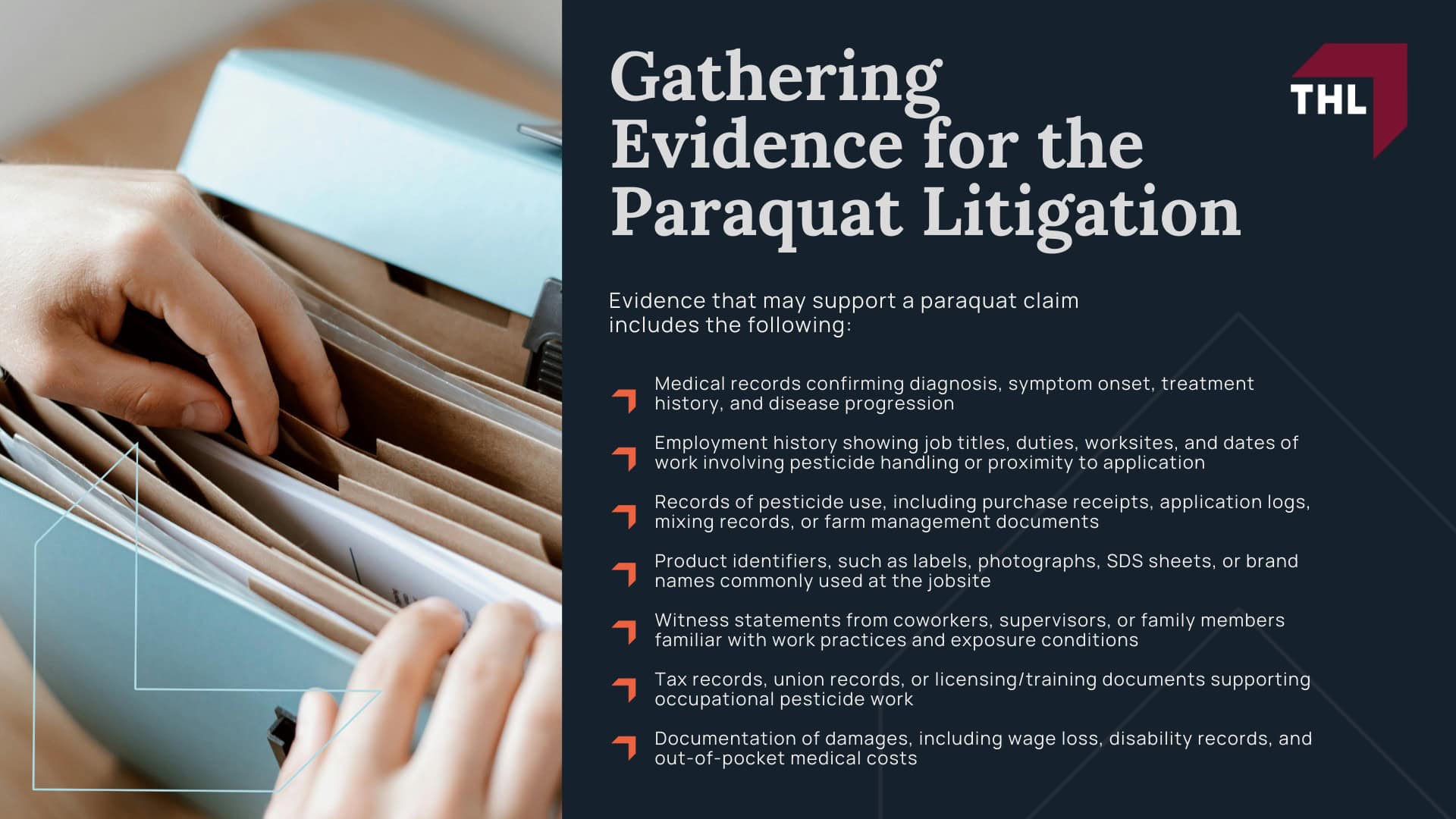
Evidence that may support a paraquat claim includes the following:

  • Medical records confirming diagnosis, symptom onset, treatment history, and disease progression
  • Employment history showing job titles, duties, worksites, and dates of work involving pesticide handling or proximity to application
  • Records of pesticide use, including purchase receipts, application logs, mixing records, or farm management documents
  • Product identifiers, such as labels, photographs, SDS sheets, or brand names commonly used at the jobsite
  • Witness statements from coworkers, supervisors, or family members familiar with work practices and exposure conditions
  • Tax records, union records, or licensing/training documents supporting occupational pesticide work
  • Documentation of damages, including wage loss, disability records, and out-of-pocket medical costs

Potential Damages in Paraquat Lawsuits

Damages are the losses a person claims resulted from an injury, and in Paraquat cases they are tied to how pesticide exposure has affected health, work, and daily life.

Because Parkinson’s disease can progress over time, damages often include both current costs and projected future needs based on medical records and functional limitations.

An experienced paraquat lawyer can review treatment history, work disruption, and care needs to assess what categories of damages may apply and how they should be supported with documentation.

That analysis typically includes gathering records, consulting appropriate experts when needed, and translating a diagnosis into a clear, defensible damages presentation.

The goal is to advocate for compensation that reflects the real financial and personal impact of the condition, not a generic estimate.

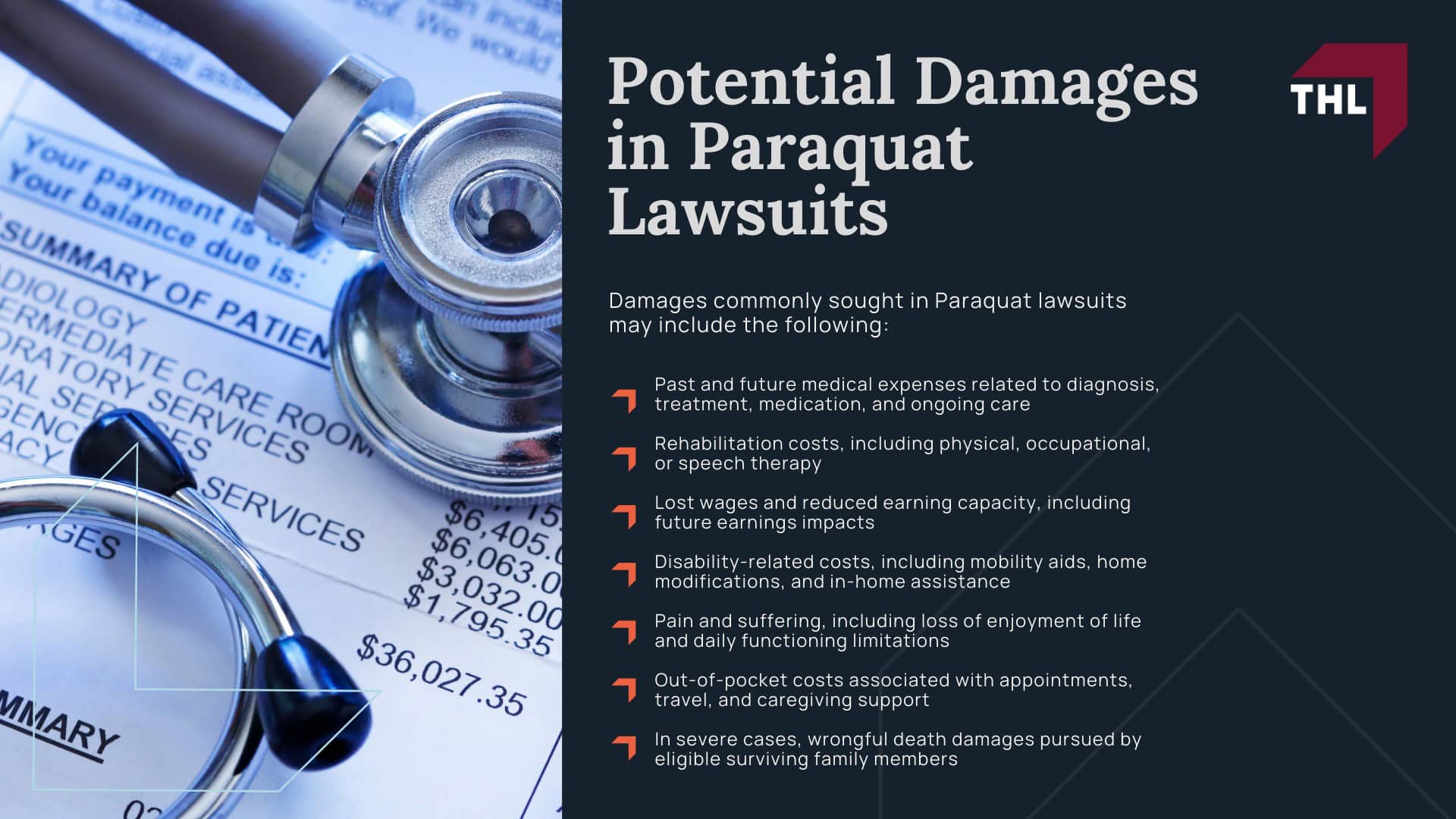
Damages commonly sought in Paraquat lawsuits may include the following:

  • Past and future medical expenses related to diagnosis, treatment, medication, and ongoing care
  • Rehabilitation costs, including physical, occupational, or speech therapy
  • Lost wages and reduced earning capacity, including future earnings impacts
  • Disability-related costs, including mobility aids, home modifications, and in-home assistance
  • Pain and suffering, including loss of enjoyment of life and daily functioning limitations
  • Out-of-pocket costs associated with appointments, travel, and caregiving support
  • In severe cases, wrongful death damages pursued by eligible surviving family members

TorHoerman Law: Contact a Paraquat Lawsuit Attorney Today

Paraquat lawsuits raise serious questions about how pesticide paraquat has been handled, marketed, and used despite concerns about human health.

For many people, paraquat poisoning and long-term exposure are not abstract risks but lived experiences that have led to permanent neurological injury and lasting financial strain.

Understanding whether those harms may be addressed through litigation requires a careful review of medical records, work history, and exposure circumstances.

TorHoerman Law focuses on evaluating these claims with attention to detail, scientific context, and the procedural realities of the Paraquat litigation.

If you believe paraquat exposure contributed to a Parkinson’s disease diagnosis, speaking with a Paraquat lawsuit attorney can help clarify your legal options and next steps.

A consultation can determine whether your situation aligns with the criteria being applied in current cases and what information may be needed to move forward.

Contact TorHoerman Law to discuss your circumstances and learn whether a Paraquat lawsuit may be appropriate in your case.

You can also use the chat feature on this page to find out if you’re eligible to file a Paraquat lawsuit instantly.

Frequently Asked Questions

Published By:
Picture of Tor Hoerman

Tor Hoerman

Owner & Attorney - TorHoerman Law

Do You
Have A Case?

Here, at TorHoerman Law, we’re committed to helping victims get the justice they deserve.

Since 2009, we have successfully collected over $4 Billion in verdicts and settlements on behalf of injured individuals.

Would you like our help?

About TorHoerman Law

At TorHoerman Law, we believe that if we continue to focus on the people that we represent, and continue to be true to the people that we are – justice will always be served.

Do you believe you’re entitled to compensation?

Use our Instant Case Evaluator to find out in as little as 60 seconds!

$495 Million
Baby Formula NEC Lawsuit

In this case, we obtained a verdict of $495 Million for our client’s child who was diagnosed with Necrotizing Enterocolitis after consuming baby formula manufactured by Abbott Laboratories.

$20 Million
Toxic Tort Injury

In this case, we were able to successfully recover $20 Million for our client after they suffered a Toxic Tort Injury due to chemical exposure.

$103.8 Million
COX-2 Inhibitors Injury

In this case, we were able to successfully recover $103.8 Million for our client after they suffered a COX-2 Inhibitors Injury.

$4 Million
Traumatic Brain Injury

In this case, we were able to successfully recover $4 Million for our client after they suffered a Traumatic Brain Injury while at daycare.

$2.8 Million
Defective Heart Device

In this case, we were able to successfully recover $2.8 Million for our client after they suffered an injury due to a Defective Heart Device.

Guides & Resources
Do You
Have A Case?

Here, at TorHoerman Law, we’re committed to helping victims get the justice they deserve.

Since 2009, we have successfully collected over $4 Billion in verdicts and settlements on behalf of injured individuals.

Would you like our help?

Additional Paraquat Lawsuit resources on our website:
All
FAQs
Injuries & Conditions
Legal Help
News
Other Resources
Settlements & Compensation
You can learn more about the Paraquat Lawsuit by visiting any of our pages listed below:
Paraquat Lawsuit
Paraquat Parkinson's Lawsuit: Statute of Limitations [By State]
What Is The Paraquat MDL?

Share

Other Paraquat Lawsuit Resources

All
FAQs
Injuries & Conditions
Legal Help
News
Other Resources
Settlements & Compensation

What Our Clients Have To Say