

Scientifically positive evidence has linked Topamax to certain birth defects.
If you took Topamax while pregnant, and your child suffered birth defects, you may qualify for a Topamax Lawsuit.
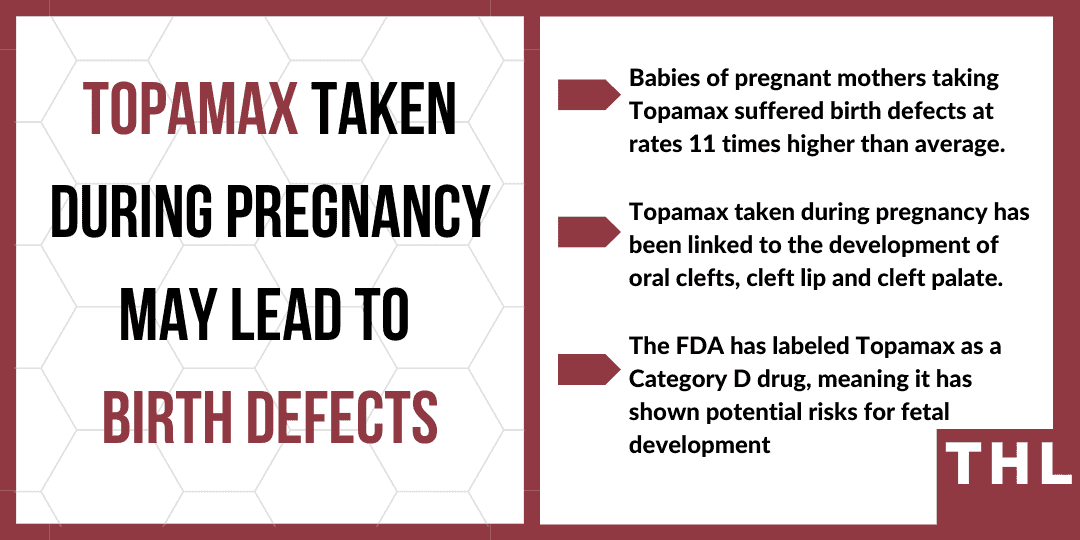
According to a 2008 study published in Neurology, babies of pregnant mothers taking Topamax suffered birth defects at rates 11 times higher than average.
Topamax Birth Defects: Risk of Oral Clefts in Infants Exposed to Topiramate Drugs
Infants exposed to Topiramate in utero experience an increased risk of developing Oral Clefts (also known as a Cleft Lip or Cleft Palate).
Oral clefts, cleft palate or cleft lip are birth defects that occur when a baby’s lip and mouth do not form correctly during pregnancy.
Oral clefts occur early on in pregnancy, even before a woman discovers that she is pregnant.
Cleft palate refers to a split in the roof of the mouth and is sometimes not forwardly visible.
Cleft lip refers to a split in the top lip.
In 2011, the U.S. Food and Drug Administration released a warning on Topamax and the risk of cleft palate in developing babies.
The FDA originally labeled Topamax as a pregnancy category C drug, meaning that clinical trials on animals indicated potential risks for fetal injury, but they were not yet known for humans.
Now, Topiramate is labeled as a pregnancy category D drug, as new data shows risks for development of cleft lip, cleft palate and oral clefts generally.
The following guidance was released alongside the FDA Drug Safety Communication on cleft palate risks:
- Women of childbearing age who do decide to take topiramate and are not planning a pregnancy should use effective birth control (contraception) while taking topiramate. Women should talk to their healthcare professionals about the best kind of birth control to use while taking topiramate.
- Before you start topiramate, you should tell your healthcare professional if you are pregnant or are planning to become pregnant. Healthcare professionals may discuss other treatment options with you.
- You should tell your healthcare professional right away if you become pregnant while taking topiramate. You and your healthcare provider should decide if you will continue to take topiramate while you are pregnant.
- Topiramate should not be stopped without talking to a healthcare professional, even in pregnant women. Stopping topiramate suddenly can cause serious problems. Not treating epilepsy during pregnancy can be harmful to women and their developing babies.
- If you become pregnant while taking topiramate, you should talk to your healthcare professional about registering with the North American Antiepileptic Drug Pregnancy Registry. You can enroll in this registry by calling 1-888-233-2334. The purpose of this registry is to collect additional information about the safety of antiepileptic drugs during pregnancy.
Other Topamax Birth Defects
Taking Topamax during pregnancy may be associated with birth defects other than oral clefts and cleft lip/palate.
A study published in the National Library of Medicine found that Topiramate and other antiepileptic drugs such as Zonisamide can lead to low birth weight and small for gestational age (SGA), which is defined as weight below the 10th percentile for gestational age.
Do Seizure Medications or Other Antiepileptic Drugs Pose a Human Fetal Risk?
Seizure medications have been linked to congenital heart defects, urinary tract defects and neural tube defects in babies of mothers who took them while pregnant.
Research on the association between birth defects and seizure medications include the following:
- National Library of Medicine: Epilepsy drugs and effects on fetal development: Potential mechanisms
- Neurology: Risks of 23 specific malformations associated with prenatal exposure to 10 antiepileptic drugs
- National Library of Medicine: Influencing clinical practice regarding the use of antiepileptic medications during pregnancy: modeling the potential impact on the prevalences of spina bifida and cleft palate in the United States


