If you or a loved one suffered injuries, property damage, or other financial losses due to another party’s actions, you may be entitled to compensation for those losses.
Contact the experienced Chicago personal injury lawyers from TorHoerman Law for a free, no-obligation Chicago personal injury lawsuit case consultation today.
If you or a loved one suffered a personal injury or financial loss due to a car accident in Chicago, IL – you may be entitled to compensation for those damages.
Contact an experienced Chicago auto accident lawyer from TorHoerman Law today to see how our firm can serve you!
If you or a loved one have suffered injuries, property damage, or other financial losses due to a truck accident in Chicago, IL – you may qualify to take legal action to gain compensation for those injuries and losses.
If you or a loved one suffered an injury in a motorcycle accident in Chicago or the greater Chicagoland area – you may be eligible to file a Chicago motorcycle accident lawsuit.
If you have been involved in a bicycle accident in Chicago at no fault of your own and you suffered injuries as a result, you may qualify to file a Chicago bike accident lawsuit.
Chicago is one of the nation’s largest construction centers.
Thousands of men and women work on sites across the city and metropolitan area on tasks ranging from skilled trades to administrative operations.
Unfortunately, construction site accidents are fairly common.
Contact TorHoerman Law to discuss your legal options with an experienced Chicago construction accident lawyer, free of charge and no obligation required.
Nursing homes and nursing facilities should provide a safe, supportive environment for senior citizens, with qualified staff, nurses, and aids administering quality care.
Unfortunately, nursing home abuse and neglect can occur, leaving residents at risk and vulnerable.
Contact an experienced Chicago nursing home abuse lawyer from TorHoerman Law today for a free consultation to discuss your legal options.
If you are a resident of Chicago, or the greater Chicagoland area, and you have a loved one who suffered a fatal injury due to another party’s negligence or malpractice – you may qualify to file a wrongful death lawsuit on your loved one’s behalf.
When a child is injured at a daycare center, parents are left wondering who can be held liable, who to contact for legal help, and how a lawsuit may pan out for them.
If your child has suffered an injury at a daycare facility, you may be eligible to file a daycare injury lawsuit.
Contact a Chicago daycare injury lawyer from TorHoerman Law today for a free consultation to discuss your case and potential legal action!
If you or a loved one suffered injuries, property damage, or other financial losses due to another party’s actions, you may be entitled to compensation for those losses.
Contact the experienced Edwardsville personal injury lawyers from TorHoerman Law for a free, no-obligation Edwardsville personal injury lawsuit case consultation today.
If you or a loved one suffered a personal injury or financial loss due to a car accident in Edwardsville, IL – you may be entitled to compensation for those damages.
If you or a loved one have suffered injuries, property damage, or other financial losses due to a truck accident in Edwardsville, IL – you may qualify to take legal action to gain compensation for those injuries and losses.
If you or a loved one suffered an injury in a motorcycle accident in Edwardsville – you may be eligible to file an Edwardsville motorcycle accident lawsuit.
If you have been involved in a bicycle accident in Edwardsville at no fault of your own and you suffered injuries as a result, you may qualify to file an Edwardsville bike accident lawsuit.
Nursing homes and nursing facilities should provide a safe, supportive environment for senior citizens, with qualified staff, nurses, and aids administering quality care.
Unfortunately, nursing home abuse and neglect can occur, leaving residents at risk and vulnerable.
If you are a resident of Edwardsville and you have a loved one who suffered a fatal injury due to another party’s negligence or malpractice – you may qualify to file a wrongful death lawsuit on your loved one’s behalf.
When a child is injured at a daycare center, parents are left wondering who can be held liable, who to contact for legal help, and how a lawsuit may pan out for them.
If your child has suffered an injury at a daycare facility, you may be eligible to file a daycare injury lawsuit.
Contact an Edwardsville daycare injury lawyer from TorHoerman Law today for a free consultation to discuss your case and potential legal action!
If you or a loved one suffered injuries on someone else’s property in Edwardsville IL, you may be entitled to financial compensation.
If property owners fail to keep their premises safe, and their negligence leads to injuries, property damages or other losses as a result of an accident or incident, a premises liability lawsuit may be possible.
If you or a loved one suffered injuries, property damage, or other financial losses due to another party’s actions, you may be entitled to compensation for those losses.
Contact the experienced St. Louis personal injury lawyers from TorHoerman Law for a free, no-obligation St. Louis personal injury lawsuit case consultation today.
If you or a loved one suffered a personal injury or financial loss due to a car accident in St. Louis, IL – you may be entitled to compensation for those damages.
If you or a loved one have suffered injuries, property damage, or other financial losses due to a truck accident in St. Louis, IL – you may qualify to take legal action to gain compensation for those injuries and losses.
If you or a loved one suffered an injury in a motorcycle accident in St. Louis or the greater St. Louis area – you may be eligible to file a St. Louis motorcycle accident lawsuit.
If you have been involved in a bicycle accident in St. Louis at no fault of your own and you suffered injuries as a result, you may qualify to file a St. Louis bike accident lawsuit.
St. Louis is one of the nation’s largest construction centers.
Thousands of men and women work on sites across the city and metropolitan area on tasks ranging from skilled trades to administrative operations.
Unfortunately, construction site accidents are fairly common.
Contact TorHoerman Law to discuss your legal options with an experienced St. Louis construction accident lawyer, free of charge and no obligation required.
Nursing homes and nursing facilities should provide a safe, supportive environment for senior citizens, with qualified staff, nurses, and aids administering quality care.
Unfortunately, nursing home abuse and neglect can occur, leaving residents at risk and vulnerable.
If you are a resident of St. Louis, or the greater St. Louis area, and you have a loved one who suffered a fatal injury due to another party’s negligence or malpractice – you may qualify to file a wrongful death lawsuit on your loved one’s behalf.
When a child is injured at a daycare center, parents are left wondering who can be held liable, who to contact for legal help, and how a lawsuit may pan out for them.
If your child has suffered an injury at a daycare facility, you may be eligible to file a daycare injury lawsuit.
Contact a St. Louis daycare injury lawyer from TorHoerman Law today for a free consultation to discuss your case and potential legal action!
The Ozempic lawsuit centers on allegations that Novo Nordisk failed to adequately warn consumers about serious risks associated with Ozempic and other GLP-1 medications.
Plaintiffs allege the drug has been linked to severe gastrointestinal injuries, including gastroparesis, as well as vision loss and other complications that have disrupted patients’ health, nutrition, employment, and daily functioning.
If you or a loved one developed gastroparesis, bowel obstruction, severe vomiting, vision loss, or other serious complications after taking Ozempic or another GLP-1 medication, you may have legal options.
Dupixent lawsuits allege that patients treated with dupilumab therapy later developed cutaneous T-cell lymphoma (CTCL), a rare form of non-Hodgkin lymphoma that can closely resemble severe eczema.
Research and published case reports have raised questions about whether some patients with atopic dermatitis face a higher risk of developing CTCL compared to similar patients who did not receive the drug.
Plaintiffs contend that Sanofi and Regeneron failed to warn patients and physicians about the possibility that Dupixent could worsen, accelerate, or reveal previously undiagnosed cutaneous lymphoma.
If you or a loved one has suffered a severe reaction or blood cancer linked to Dupixent, you may be eligible to take action and file a Dupixent lawsuit.
Suboxone, a medication often used to treat opioid use disorder (OUD), has become a vital tool which offers a safer and more controlled approach to managing opioid addiction.
Despite its widespread use, Suboxone has been linked to severe tooth decay and dental injuries.
Suboxone Tooth Decay Lawsuits claim that the companies failed to warn about the risks of tooth decay and other dental injuries associated with Suboxone sublingual films.
The chemotherapy drug Taxotere, commonly used for breast cancer treatment, has been linked to severe eye injuries, permanent vision loss, and permanent hair loss.
Taxotere Lawsuits are being filed by breast cancer patients and others who have taken the chemotherapy drug and subsequently developed vision problems.
If you or a loved one used Taxotere and subsequently developed vision damage or other related medical problems, you may be eligible to file a Taxotere Lawsuit and seek financial compensation.
Tylenol (Acetaminophen), one of the most popular over the counter medications for pain relief and high fever, has been associated with an increased risk of Autism Spectrum Disorder (ASD), Attention Deficit Hyperactivity Disorder (ADHD), and other developmental disorders in children exposed to Acetaminophen during pregnancy.
Legal claims against manufacturers and distributors of generic Acetaminophen have been investigated on behalf of pregnant women who used Tylenol during pregnancy and children who developed disorders such as Autism Spectrum Disorder, ADHD, and more.
Spinal cord stimulator lawsuit claims allege that these devices are defectively designed and improperly marketed without adequate warnings, leading to severe injuries for patients.
TorHoerman Law is investigating claims involving spinal cord stimulators that allegedly caused serious injury instead of the relief patients were led to expect.
If you or a loved one experienced complications following spinal cord stimulator surgery, you may be eligible to pursue compensation through a spinal cord stimulator lawsuit.
Several studies have found a correlation between heavy social media use and mental health challenges, especially among younger users.
Social media harm lawsuits claim that social media companies are responsible for onsetting or heightening mental health problems, eating disorders, mood disorders, and other negative experiences of teens and children
You may be eligible to file a Social Media Mental Health Lawsuit if you are the parents of a teen, or teens, who attribute their use of social media platforms to their mental health problems.
Thousands of Uber sexual assault claims have been filed by passengers who suffered violence during rides arranged through the platform.
The ongoing Uber sexual assault litigation spans both federal law and California state court, with a consolidated Uber MDL (multi-district litigation) currently pending in the Northern District of California.
Uber sexual assault survivors across the country are coming forward to hold the company accountable for negligence in hiring, screening, and supervising drivers.
If you or a loved one were sexually assaulted, sexually battered, or faced any other form of sexual misconduct from an Uber driver, you may be eligible to file an Uber Sexual Assault Lawsuit.
Roblox lawsuit claims center on allegations that the platform allowed predators to groom, exploit, and abuse children through unsafe design and inadequate protections.
TorHoerman Law is dedicated to helping families who believe their child was harmed on Roblox pursue justice and financial recovery.
For many families, legal action represents both a path to compensation and a way to demand systemic change in how Roblox treats the safety of its youngest players.
If your child was sexually abused, exploited, or exposed to harmful content through Roblox, you may be eligible to take legal action by filing a lawsuit against Roblox Corporation.
Although pressure cookers were designed to be safe and easy to use, a number of these devices have been found to have a defect that can lead to excessive buildup of internal pressure.
The excessive pressure may result in an explosion that puts users at risk of serious injuries such as burns, lacerations, an even electrocution.
If your pressure cooker exploded and caused substantial burn injuries or other serious injuries, you may be eligible to file a Pressure Cooker Lawsuit and secure financial compensation for your injuries and damages.
Olympus Scope lawsuit claims center on allegations that certain reusable Olympus endoscopes and related accessories exposed patients to dangerous bacterial contamination after medical procedures.
These infections can lead to hospitalization, IV antibiotic treatment, sepsis, organ failure, and death, leaving many patients with serious medical complications and lasting physical harm.
You may qualify to file an Olympus scope lawsuit if you underwent an ERCP or another endoscopic procedure involving Olympus equipment and later developed a serious bacterial infection.
Families who lost a loved one after infection-related complications linked to an Olympus scope procedure may also be able to pursue a wrongful death claim.
Vaginal Mesh Lawsuits are being filed against manufacturers of transvaginal mesh products for injuries, pain and suffering, and financial costs related to complications and injuries of these medical devices.
Over 100,000 Transvaginal Mesh Lawsuits have been filed on behalf of women injured by vaginal mesh and pelvic mesh products.
If you or a loved one have suffered serious complications or injuries from vaginal mesh, you may be eligible to file a Vaginal Mesh Lawsuit.
Breast mesh lawsuits involve allegations that certain mesh products used during breast reconstruction, augmentation, and lift procedures contributed to postoperative complications and the need for revision surgeries.
Patients who experienced complications after mesh-assisted breast procedures have reported chronic pain, reconstruction problems, cosmetic deformities, and additional revision surgeries.
If you or a loved one experienced serious complications after breast surgery involving mesh or an internal bra technique, you may be eligible to pursue a breast mesh lawsuit claim for the harm caused.
Patients with the PowerPort devices may possibly be at a higher risk of serious complications or injury due to a catheter failure, according to lawsuits filed against the manufacturers of the Bard PowerPort Device.
If you or a loved one have been injured by a Bard PowerPort Device, you may be eligible to file a Bard PowerPort Lawsuit and seek financial compensation.
The AngioDynamics port catheter lawsuit claims that defective implantable ports have caused patients to suffer dangerous fractures, blood clots, and infections due to the breakdown of the catheter’s material inside the body.
These failures can lead to life-threatening complications such as embolism, sepsis, or the need for surgical removal of the device.
If you or a loved one experienced severe complications such as blood clots, infections, or catheter fractures requiring surgery due to a defective AngioDynamics port catheter, you may be eligible to file an AngioDynamics Port Catheter Lawsuit and seek compensation.
NEC Lawsuit claims allege that certain formulas given to infants in NICU settings increase the risk of necrotizing enterocolitis (NEC) – a severe intestinal condition in premature infants.
Parents and guardians are filing NEC Lawsuits against baby formula manufacturers, alleging that the formulas contain harmful ingredients leading to NEC.
Despite the claims, Abbott and Mead Johnson deny the allegations, arguing that their products are thoroughly researched and dismissing the scientific evidence linking their formulas to NEC, while the FDA issued a warning to Abbott regarding safety concerns of a formula product.
You may be eligible to file a Toxic Baby Formula NEC Lawsuit if your child received baby bovine-based (cow’s milk) baby formula in the maternity ward or NICU of a hospital and was subsequently diagnosed with Necrotizing Enterocolitis (NEC).
Paraquat, a widely-used herbicide, has been linked to Parkinson’s disease, leading to numerous Paraquat Parkinson’s Disease Lawsuits against its manufacturers for failing to warn about the risks of chronic exposure.
Due to its toxicity, the EPA has restricted the use of Paraquat and it is currently banned in over 30 countries.
You may be eligible to file a Paraquat Lawsuit if you or a loved one were exposed to Paraquat and subsequently diagnosed with Parkinson’s Disease or other related health conditions.
Ethylene Oxide Lawsuit claims center on allegations that Sterigenics U.S., LLC and other defendants negligently released hazardous levels of ethylene oxide (EtO), exposing nearby residents and workers to a known carcinogen linked to breast cancer, leukemia, lymphoma, and other serious illnesses.
If you or a loved one were diagnosed with cancer or other serious health problems associated with exposure to ethylene oxide and lived near a facility with known emissions, you may be eligible to file an Ethylene Oxide Lawsuit and seek financial compensation.
Nitrous oxide lawsuit claims center on manufacturers, distributors, and retailers who profit from selling canisters that are widely misused as a recreational drug.
Reports link this misuse to severe neurological injuries, psychiatric symptoms, hypoxia, and deaths caused by accidents or overdose.
These cases are rapidly expanding as more evidence emerges of the profound physical, psychological, and social toll caused by nitrous oxide misuse.
If you or a loved one has suffered brain injuries, spinal cord or nerve damage, psychiatric symptoms, or even death linked to misused nitrous oxide, you may be eligible to pursue a nitrous oxide lawsuit claim and seek compensation for the harm caused.
Diacetyl popcorn lung lawsuit claims center on allegations that repeated inhalation of butter-flavoring chemicals in certain workplaces, including diacetyl and related substitutes, caused permanent and preventable airway damage.
Popcorn lung, medically known as bronchiolitis obliterans or constrictive bronchiolitis, is a serious obstructive lung disease that scars and narrows the small airways, leaving many people with persistent shortness of breath, chronic cough, and reduced exercise tolerance.
TorHoerman Law has experience handling diacetyl popcorn lung cases and is currently reviewing claims from workers who believe occupational exposure to these flavoring chemicals contributed to their diagnosis.
If you or a loved one were diagnosed with diacetyl induced lung disease or bronchiolitis obliterans, you may have grounds to pursue a diacetyl popcorn lung lawsuit for the harm caused to your lung tissue and long-term lung function.
Our firm is about people. That is our motto and that will always be our reality.
We do our best to get to know our clients, understand their situations, and get them the compensation they deserve.
At TorHoerman Law, we believe that if we continue to focus on the people that we represent, and continue to be true to the people that we are – justice will always be served.
Without our team, we would’nt be able to provide our clients with anything close to the level of service they receive when they work with us.
The TorHoerman Law Team commits to the sincere belief that those injured by the misconduct of others, especially large corporate profit mongers, deserve justice for their injuries.
Our team is what has made TorHoerman Law a very special place since 2009.
Do You Need Help After a Pedestrian Accident in Edwardsville?
An Edwardsville pedestrian accident lawyer can help injured people evaluate whether a driver, vehicle owner, employer, or other responsible party may be liable after a collision involving a motor vehicle.
Pedestrian accident claims often turn on disputed facts: where the person was walking, whether the driver had time to stop, whether traffic signals or crosswalk rules applied, and whether speed, distraction, or poor visibility contributed to the crash.
Experienced pedestrian accident lawyers can investigate the scene, preserve video footage, review the police report, identify insurance coverage, and respond when insurers try to shift blame onto the injured pedestrian.
TorHoerman Law can guide you through the legal process, explain your rights under Illinois law, and build a claim around the full impact of your injuries, medical treatment, lost income, and long-term losses.
Hit by a Car While Walking in Edwardsville?
If you were hurt in a pedestrian accident, the impact may be only the beginning of the medical, financial, and legal problems that follow.
Pedestrian accident victims often face emergency treatment, follow-up care, missed work, and pressure from insurance adjusters before the full extent of the injuries is known.
Serious injuries can worsen over time, especially when the crash causes a brain injury, internal trauma, fractures, spinal damage, or lasting soft-tissue complications.
Being hit by a car is different from being inside one.
Pedestrians have no seatbelt, airbag, or vehicle frame to absorb the force of impact, which means even a lower-speed collision can cause significant harm. Higher-speed crashes may result in catastrophic injury, permanent impairment, or fatal injuries.
The insurance claim process can become difficult quickly when the driver or insurer argues that the pedestrian crossed outside a marked crosswalk, entered traffic unexpectedly, wore dark clothing, or otherwise shared fault for the crash.
Illinois uses modified comparative negligence, which bars recovery if the injured person is more than 50% at fault and reduces any allowed recovery by that person’s percentage of fault.
An experienced pedestrian accident attorney can preserve evidence, identify available insurance coverage, communicate with insurers, and build the claim around documented injuries and losses.
If you or a loved one has been injured in a pedestrian accident in Edwardsville, you may be eligible to file a pedestrian accident claim and seek compensation.
Why Hire an Edwardsville Pedestrian Accident Lawyer
A pedestrian claim often looks simple until liability is disputed.
An experienced pedestrian accident lawyer can investigate the crash, obtain the police report, collect medical records, secure witness contact information, and determine whether the case involves only driver negligence or additional issues as well.
A lawyer may also look for nearby surveillance footage, traffic-camera footage, dashcam video, 911 records, vehicle damage photos, cell-phone evidence, driver statements, intersection design issues, and insurance policies that may apply.
That work matters because the insurer may argue the pedestrian stepped into traffic, crossed outside a marked crosswalk, or otherwise caused the crash.
A lawyer also helps calculate damages beyond the first hospital bill.
A strong claim should account for medical expenses, future medical costs, lost wages, pain, mobility limitations, and the long-term impact of the injuries suffered.
If you are searching for the right pedestrian accident attorney, early investigation can affect whether key evidence is preserved before video is overwritten, vehicles are repaired, or witness memories fade.
You may have a case if the crash happened because another person failed to use reasonable care and that failure caused injury.
In many pedestrian accident cases, the issue is whether the driver involved was speeding, distracted, failed to yield, ignored traffic conditions, or otherwise caused the collision through driver negligence.
A valid pedestrian injury claim also requires proof that the collision caused actual losses, such as treatment costs, lost income, pain, or lasting impairment.
A case may also turn on whether the pedestrian was in a marked or unmarked crosswalk, whether traffic signals applied, whether the driver was turning, whether visibility was limited, and whether the driver failed to keep a proper lookout.
A claim may be supported when:
You were lawfully walking when a vehicle struck you
The driver failed to yield or was otherwise negligent
You needed medical treatment after the crash
The crash caused bodily injury, missed work, or long-term limitations
The evidence supports a direct connection between the crash and the losses
A claim can still be worth reviewing even if the driver says the pedestrian was partly responsible.
Illinois comparative-fault rules do not automatically bar every case.
Who Can Be Held Liable in a Pedestrian Accident Claim?
The driver who struck the pedestrian is often the first defendant, but not always the only one.
Depending on the facts, a pedestrian claim may also involve an employer, vehicle owner, commercial carrier, rideshare company, or another party connected to the trip.
Some cases overlap with truck accidents or delivery-vehicle collisions, where liability may extend beyond the individual driver.
If the driver was working at the time, liability may depend on employment status, trip purpose, vehicle ownership, insurance coverage, and whether the driver was acting within the scope of work.
Potentially liable parties may include:
The at-fault driver
An employer if the driver was working at the time
A company that owned or controlled the vehicle
A commercial motor carrier
A rideshare company or delivery platform, depending on the driver’s status and available coverage
Another negligent third party connected to the crash
In some situations, the facts may also raise related issues outside ordinary traffic negligence, including roadway design or even premises liability if a parking-lot or private-property condition contributed to the incident.
Liability depends on who caused or materially contributed to the crash.
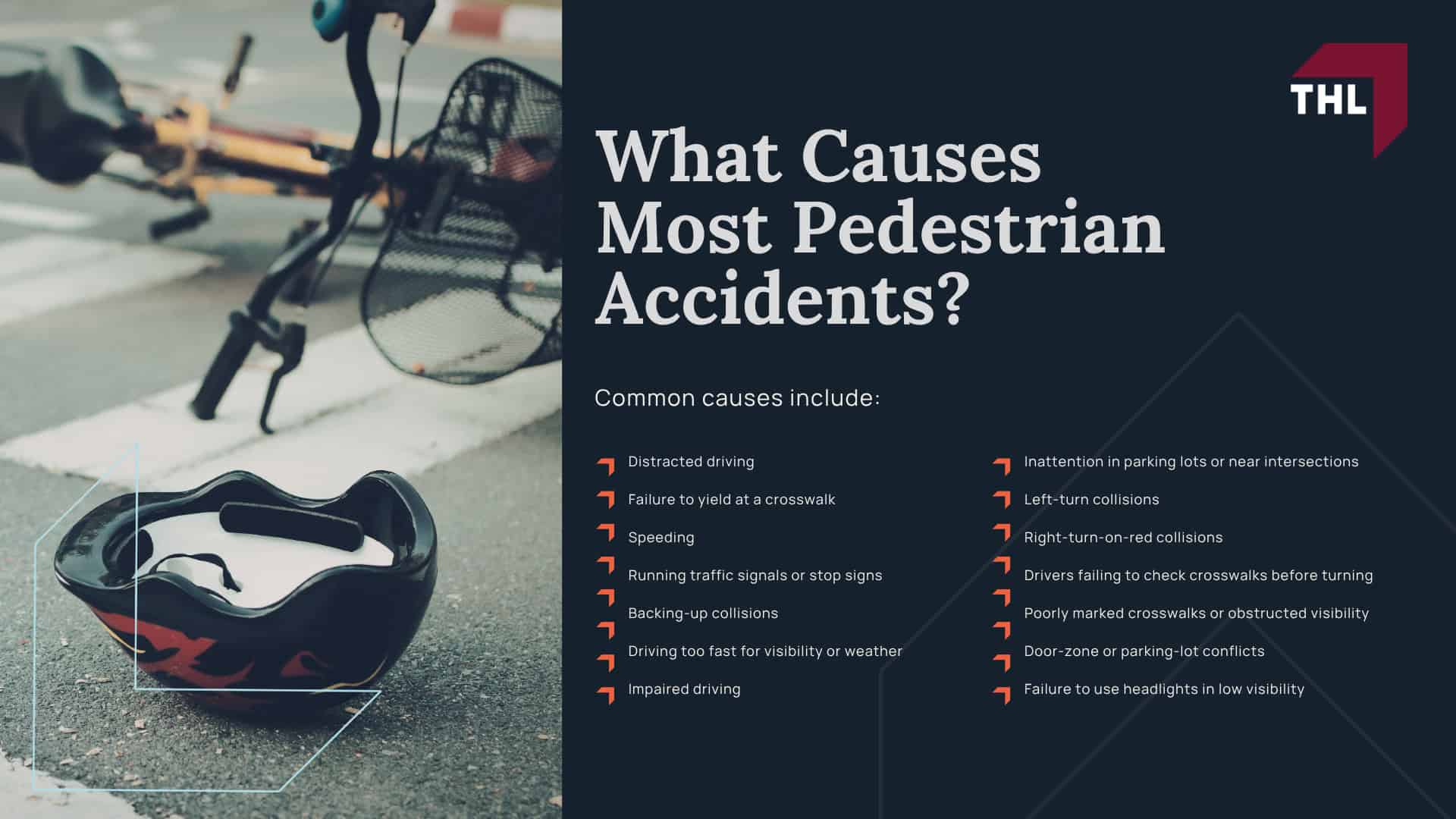
What Causes Most Pedestrian Accidents?
The causes of pedestrian accidents vary, but many involve preventable driver behavior.
Some of the most common causes include distracted driving, speeding, failure to yield, turning without checking for pedestrians, backing up without looking, and poor visibility conditions.
A crash can also happen when a driver is focused on other traffic and never sees the person in the roadway until it is too late.
Common causes include:
Distracted driving
Failure to yield at a crosswalk
Speeding
Running traffic signals or stop signs
Backing-up collisions
Driving too fast for visibility or weather
Impaired driving
Inattention in parking lots or near intersections
Left-turn collisions
Right-turn-on-red collisions
Drivers failing to check crosswalks before turning
Poorly marked crosswalks or obstructed visibility
Door-zone or parking-lot conflicts
Failure to use headlights in low visibility
Illinois law specifically addresses pedestrians’ right-of-way at crosswalks, which can be a central issue in these cases.
In Edwardsville pedestrian cases, liability often turns on whether the driver should have anticipated foot traffic near crosswalks, intersections, school zones, parking lots, or commercial entrances.
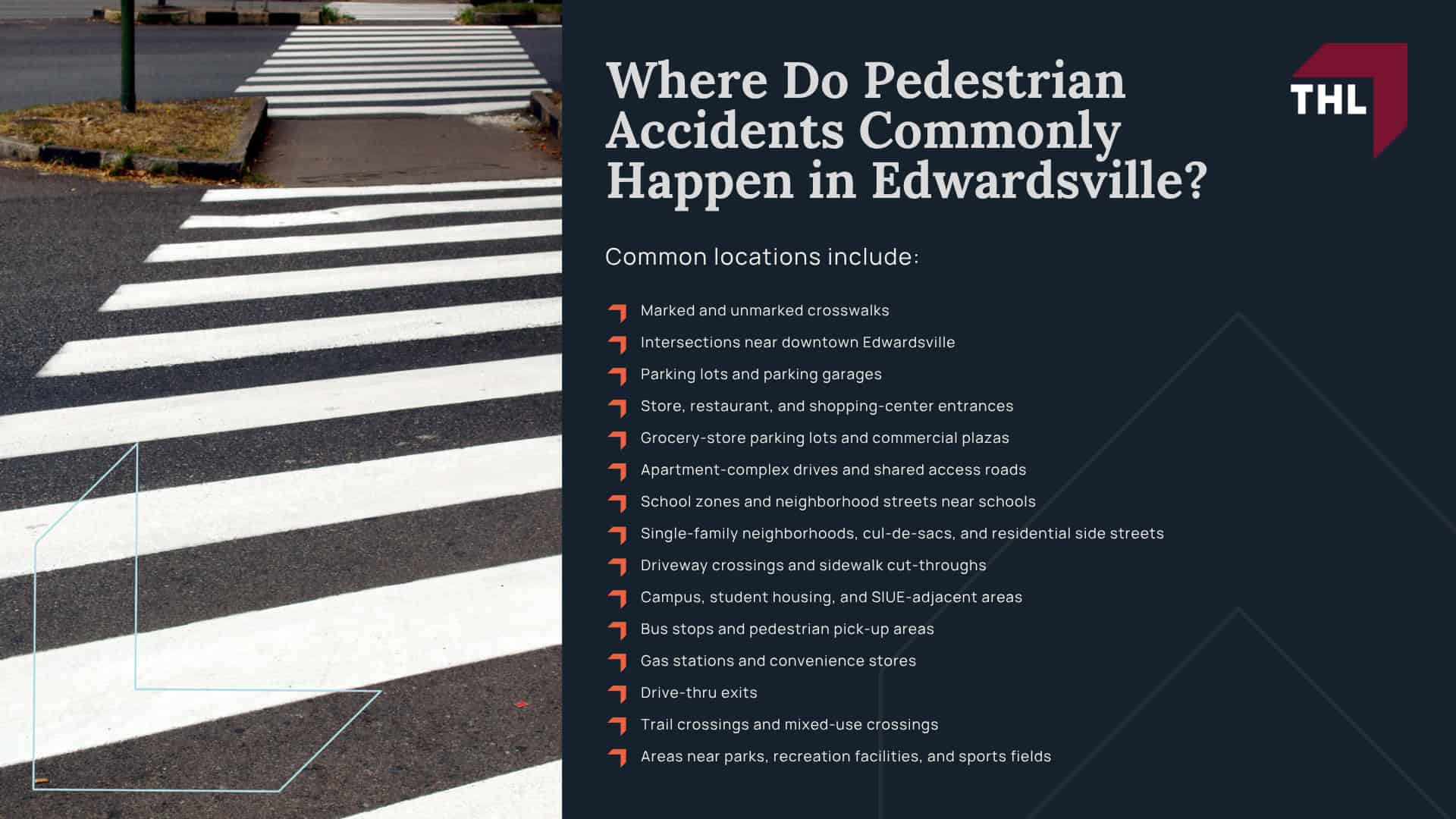
Where Do Pedestrian Accidents Commonly Happen in Edwardsville?
Pedestrian crashes in Edwardsville can happen anywhere people and vehicles share space, including intersections, commercial areas, school zones, parking lots, and residential neighborhoods.
The city has a mix of downtown walkability, SIUE-related traffic, shopping areas, apartment complexes, trail access points, and single-family subdivisions with cul-de-sacs where drivers may not expect pedestrians, children, runners, or dog walkers near the roadway.
In many cases, the crash happens in a place where the driver should have anticipated foot traffic and slowed down, checked for pedestrians, or used greater caution.
Common locations include:
Marked and unmarked crosswalks
Intersections near downtown Edwardsville
Parking lots and parking garages
Store, restaurant, and shopping-center entrances
Grocery-store parking lots and commercial plazas
Apartment-complex drives and shared access roads
School zones and neighborhood streets near schools
Single-family neighborhoods, cul-de-sacs, and residential side streets
Driveway crossings and sidewalk cut-throughs
Campus, student housing, and SIUE-adjacent areas
Bus stops and pedestrian pick-up areas
Gas stations and convenience stores
Drive-thru exits
Trail crossings and mixed-use crossings
Areas near parks, recreation facilities, and sports fields
The location of the crash can affect what evidence is available, including surveillance footage, traffic-signal timing, nearby witnesses, property records, lighting conditions, roadway design, and whether the driver should have expected pedestrians in the area.
In residential neighborhoods, evidence may come from doorbell cameras, nearby homeowners, parked vehicles, school-zone signage, or witness accounts from neighbors.
In commercial or campus-adjacent areas, a lawyer may review business security footage, parking-lot design, traffic flow, lighting, and whether drivers were entering or exiting private property without yielding to pedestrians.
Pedestrian accident injuries are often more severe than injuries in a standard car accident because the pedestrian absorbs the impact directly.
Some people suffer only minor injuries, but many others face severe injuries that require hospitalization, surgery, rehabilitation, or long-term care.
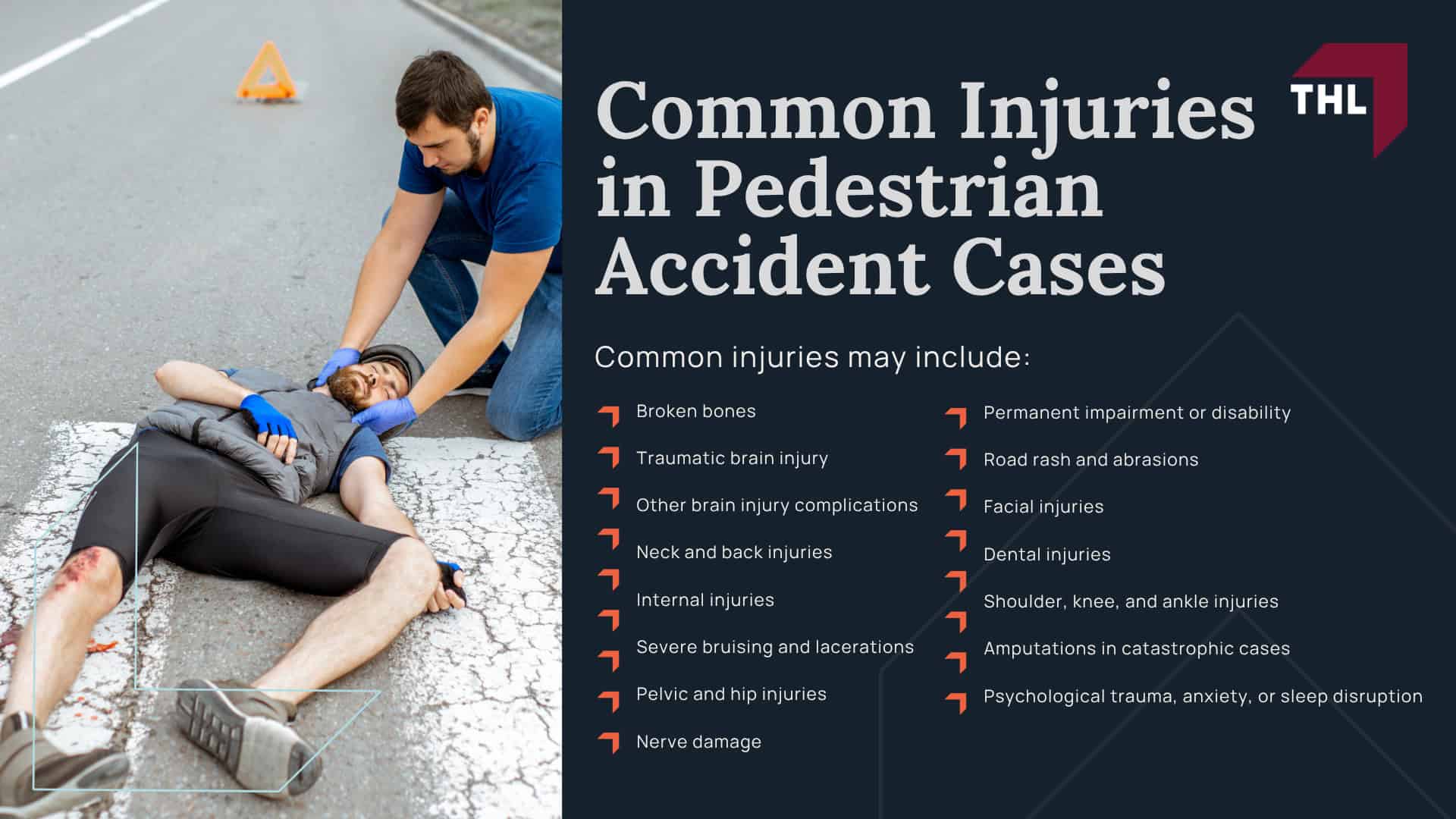
Common pedestrian accident injuries include fractures, head trauma, spinal injuries, internal organ damage, and soft-tissue trauma.
Common injuries may include:
Broken bones
Traumatic brain injury
Other brain injury complications
Neck and back injuries
Internal injuries
Severe bruising and lacerations
Pelvic and hip injuries
Nerve damage
Permanent impairment or disability
Road rash and abrasions
Facial injuries
Dental injuries
Shoulder, knee, and ankle injuries
Amputations in catastrophic cases
Psychological trauma, anxiety, or sleep disruption
Severe pedestrian injuries may require surgery, rehabilitation, future medical care, mobility aids, work restrictions, and long-term support.
Pedestrian crashes are a recognized part of broader traffic-safety efforts in Illinois because they can produce life-altering harm.
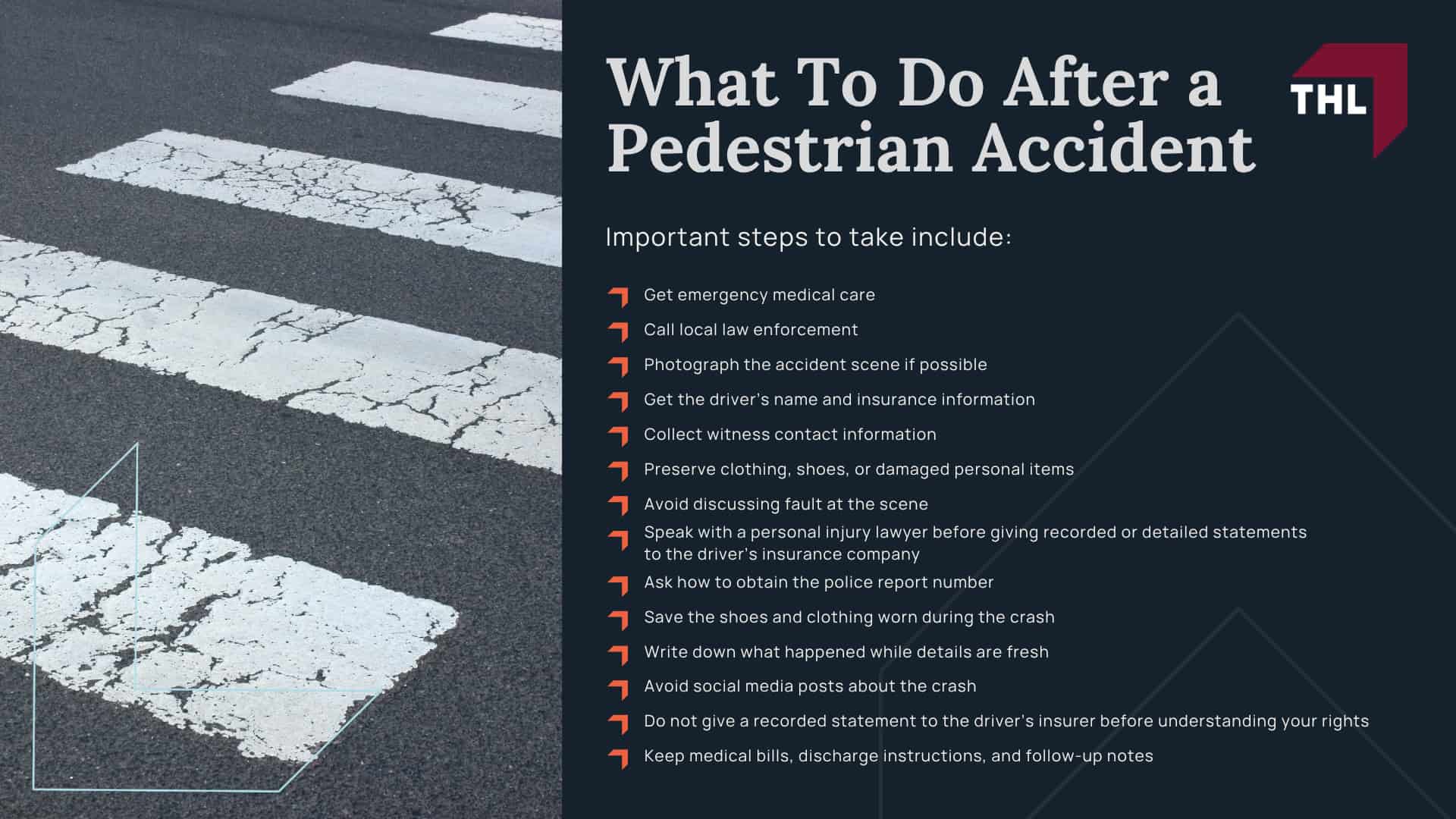
What To Do After a Pedestrian Accident
The first priority after a pedestrian crash is medical care.
Even if the symptoms do not seem severe at first, prompt medical treatment protects both your health and the claim.
You should also call local law enforcement so that an officer can respond and create a police report, which may later become an important piece of evidence.
Important steps to take include:
Get emergency medical care
Call local law enforcement
Photograph the accident scene if possible
Get the driver’s name and insurance information
Collect witness contact information
Preserve clothing, shoes, or damaged personal items
Avoid discussing fault at the scene
Speak with a personal injury lawyer before giving recorded or detailed statements to the driver’s insurance company
Ask how to obtain the police report number
Save the shoes and clothing worn during the crash
Write down what happened while details are fresh
Avoid social media posts about the crash
Do not give a recorded statement to the driver’s insurer before understanding your rights
Keep medical bills, discharge instructions, and follow-up notes
These steps can help protect your legal rights and strengthen the case before the evidence changes or disappears.
Gathering Evidence for Your Pedestrian Accident Claim
Evidence is critical in pedestrian accident cases.
To prove a pedestrian accident claim, you usually need to show how the crash happened, who had the right-of-way, what injuries resulted, and how those injuries affected your finances and daily life.
A lawyer can gather and preserve proof before it is lost.
Helpful evidence may include:
The police report
Photographs or video from the accident scene
Surveillance footage
Witness names and contact information
Medical records and bills
Proof of lost income
Vehicle-damage photos
Cell-phone or distraction-related evidence in some cases
Traffic-signal timing records
Intersection diagrams
911 recordings
Dashcam or bodycam footage
Driver cell-phone records, when legally obtainable
Skid marks or debris photos
Clothing, shoes, and damaged personal items
Health insurance lien or payment records
Employment records showing lost income
Strong documentation can make it harder for the defense to dispute right-of-way, injury causation, medical treatment, or the value of documented losses.
To win a pedestrian case, you generally must prove negligence, causation, and damages.
In practical terms, that means showing the driver failed to act with reasonable care, that the failure caused the crash, and that the injured person suffered compensable losses.
Evidence of driver negligence may include a failure to yield, distraction, excessive speed, poor lookout, or violating traffic rules.
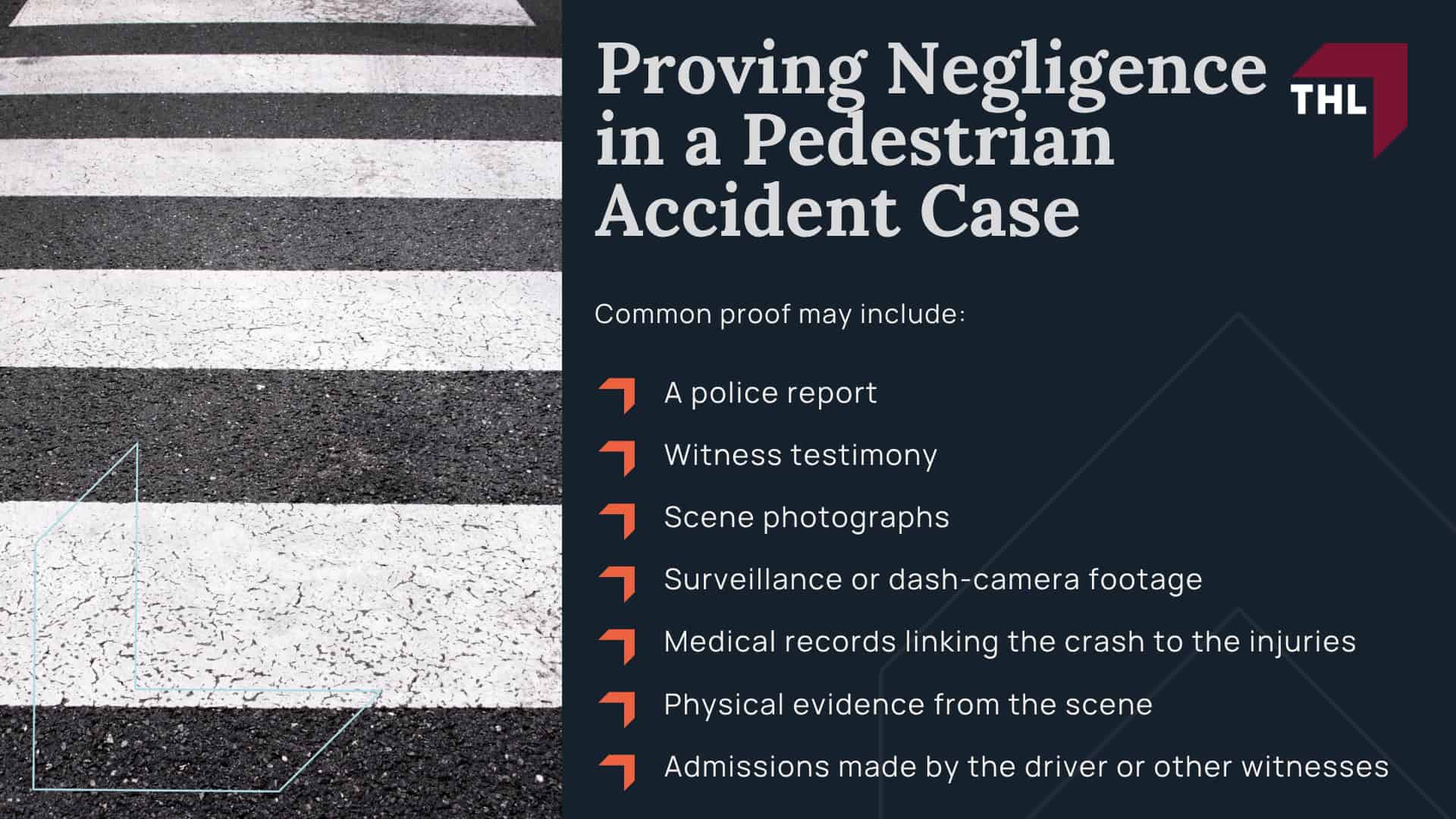
Common proof may include:
A police report
Witness testimony
Scene photographs
Surveillance or dash-camera footage
Medical records linking the crash to the injuries
Physical evidence from the scene
Admissions made by the driver or other witnesses
In a crosswalk case, the evidence may focus on whether the driver had a duty to stop and yield, whether the pedestrian was within the crosswalk, whether signals were present or operating, and whether the driver’s movement created danger.
Illinois law requires drivers to stop and yield to pedestrians in certain crosswalk situations.
The claim should be built around evidence showing fault, causation, damages, and responses to any comparative-fault arguments.
A strong file helps show that the driver, not the pedestrian, was primarily at fault.
Damages in Edwardsville Pedestrian Accident Lawsuits
A pedestrian case is meant to help the injured person recover compensation for the losses caused by the crash.
Depending on the facts, recoverable damages may include medical bills, future medical expenses, rehabilitation, lost wages, pain and suffering, and other harm tied to the collision.
These damages usually need to be supported by medical records, bills, treatment plans, wage records, work restrictions, expert opinions, and evidence of daily limitations.
In Illinois negligence cases, defendants found liable are jointly and severally liable for the plaintiff’s past and future medical and medically related expenses, subject to statutory rules.
This can matter when more than one defendant contributed to the crash.
Illinois Laws That Can Affect Your Pedestrian Accident Claim
Illinois law can affect both fault and timing in a pedestrian accident claim.
Important rules may include:
Crosswalk right-of-way: Drivers must stop and yield to pedestrians in certain crosswalk situations when traffic signals are not in place or not operating.
Traffic-control devices: Pedestrians and drivers must follow applicable signals and traffic-control devices.
Modified comparative negligence: A plaintiff is barred from recovery if they are more than 50% at fault, and any allowed recovery is reduced by the plaintiff’s percentage of fault.
Two-year filing deadline: Illinois personal injury lawsuits generally must be filed within two years.
Multi-defendant cases: Illinois joint liability rules may affect medical-expense recovery when more than one defendant is found liable.
These rules can affect how fault is argued, how damages are evaluated, and whether the claim can be filed in court.
Do You Qualify for an Edwardsville Pedestrian Accident Lawsuit?
You may qualify if you were struck by a vehicle and suffered losses as a result.
The strongest claims usually involve clear evidence that the driver failed to yield, drove inattentively, or otherwise caused the crash through negligence.
That said, a case may still exist even if the pedestrian is accused of sharing some fault for the accident, depending on the facts.
You may have a case if:
A vehicle struck you while you were walking
You needed medical treatment
You missed work or incurred significant costs
The injuries caused long-term limitations
The evidence supports a negligence claim against the driver or another party
A lawyer can evaluate whether the facts support seeking compensation and what insurance coverage may be available and whether the evidence supports a claim for documented losses.
TorHoerman Law represents injured people in serious personal injury cases, including pedestrian collisions.
Our law firm understands how pedestrian claims are defended, how insurers value them, and what evidence matters most when the injuries are serious.
If you need legal representation from a personal injury attorney, our team can review the facts and explain your options.
If you are looking for the right pedestrian accident attorney to review your claim, contact TorHoerman Law for a free consultation and free case evaluation.
You can also use the chatbot on this page to see if you qualify today.
Our team can explain your rights, review your injuries, and help you decide how to move forward after a serious pedestrian crash.
An injured pedestrian should get medical care right away, even if the symptoms do not seem severe at first.
Prompt treatment helps protect your health, supports pedestrian safety, and creates records that may later become important in a legal claim.
After that, it is important to report the crash, preserve evidence, and speak with a lawyer who understands personal injury law before giving detailed statements to insurers.
Yes, in many cases you may still be able to pursue compensation even if the driver’s insurance company argues that you share some responsibility for the crash.
Illinois follows comparative-fault rules, which means the outcome can depend on how much fault is assigned to each side and how the evidence is developed.
A lawyer can review the facts, deal with the insurance company, and work to pursue fair compensation based on the actual circumstances of the accident.
Injury victims in pedestrian accident cases may be able to recover damages for medical bills, lost income, pain and suffering, and other losses caused by the crash.
Depending on the circumstances, the claim may also involve future treatment costs, rehabilitation, disability-related losses, and the financial effect of long-term impairment.
Available recovery can also depend on insurance policy limits, whether other insurance coverage exists, and whether health insurance initially paid for some of the treatment.
In cases involving pedestrian deaths or pedestrian fatalities, Illinois law does not allow every family member to file a lawsuit individually.
Instead, a wrongful death claim must be filed by the personal representative of the deceased person’s estate, who acts on behalf of the surviving family.
That personal representative is often a spouse, adult child, or parent, but if no one has been named, the court can appoint someone to serve in that role.
The lawsuit is brought for the benefit of the deceased person’s surviving spouse and next of kin, who may receive compensation for financial losses, emotional harm, and loss of companionship.
This structure is important because it creates a single legal claim rather than multiple competing lawsuits.
Even though one person files the case, the recovery is intended to support the family members affected by the loss.
In fatal pedestrian accident cases, identifying the proper representative early is a key step in preserving the claim and complying with Illinois law.
Limited insurance does not always end the case, but it can affect how compensation is pursued.
A lawyer can investigate all available sources of coverage, including other policies that may apply, and determine whether additional claims or avenues of recovery exist beyond the driver’s basic liability coverage.
In some situations, personal injury protection-type benefits, health insurance, or other insurance arrangements may help address medical costs while the legal claim moves forward.
A lawyer can gather key evidence such as police reports, witness statements, surveillance footage, and, when necessary, work with experts to reconstruct how the accident occurred.
An attorney also handles communication with insurance companies and uses negotiation strategies to pursue compensation based on documented injuries and losses.
Local legal knowledge can matter, as attorneys familiar with Edwardsville traffic patterns, courts, and judges may be better positioned to evaluate how a case may develop.
Most personal injury law firms, including TorHoerman Law, work on a contingency fee basis, meaning there are no upfront costs and fees are only paid if compensation is recovered.
Initial consultations are typically free and allow a legal team to review liability, damages, and available insurance coverage.
For clients recovering from serious injuries, clear and consistent communication from a legal team can help reduce stress while the claim moves through the legal process.
Pedestrian accidents often happen when drivers fail to follow traffic laws, overlook people near crosswalks or bus stops, or fail to adjust for poor nighttime visibility.
These crashes can cause serious or fatal injuries because pedestrians have no physical protection from vehicle impact.
Continuity of medical treatment is important after a pedestrian crash because gaps in care may be used by insurance companies to dispute the severity of the injuries or argue that the crash did not cause them.
Common pedestrian accident risks and injuries include:
Poor nighttime visibility
Drivers violating traffic laws
Collisions near bus stops or pedestrian gathering areas
Fractures and broken bones
Spinal cord damage
Traumatic brain injuries
Soft-tissue injuries
Fatal injuries in severe crashes
Anyone injured in a pedestrian accident should seek immediate medical attention and follow all recommended treatment.
Filing an insurance claim after a pedestrian accident usually begins with reporting the crash to the police, seeking medical care, and gathering evidence from the scene.
Strong documentation is essential because the insurance company will review fault, injuries, medical treatment, and damages before deciding whether to pay the claim.
Police reports, medical records, photos, witness information, and insurance correspondence can help prove liability and show the extent of the injuries.
A lawyer can organize the evidence, communicate with the insurer, and evaluate whether any settlement offer reflects the full losses caused by the crash.
Tor Hoerman has represented injured individuals for more than 30 years, with experience spanning individual personal injury cases and nationwide mass tort litigation. His work includes car accidents, catastrophic injuries, product liability claims, and other serious injury cases. Tor has served in court-appointed leadership roles in national litigation and tried cases involving major corporate defendants.
Legally Reviewed
TorHoerman Law’s legal content is researched and written by our editorial team and attorneys for legal accuracy, clarity, and relevance. We rely on statutes, court records, government publications, medical research, and other authoritative sources when applicable. This page provides general legal information and does not constitute legal advice.
Fact-Checked
TorHoerman Law reviews its legal content for factual accuracy, current information, and relevant legal context before publication and as material developments occur. This article is provided for general informational purposes and does not constitute legal advice. For guidance about a specific case, contact TorHoerman Law.
Have you or a loved one been injured in
Edwardsville, Illinois?
A serious injury can change your life.
Speak with an experienced Edwardsville personal injury lawyer about your rights, your case, and the legal options available to you.
TorHoerman Law represents people whose lives have been disrupted by serious injuries, unsafe products, and negligence. Our attorneys handle individual personal injury cases as well as national mass tort lawsuits involving major corporations.
Founded in 2009, our legal team brings more than 100 years of combined experience handling serious injury and complex civil litigation.
Do you believe you’re entitled to compensation?
Use our Instant Case Evaluator to find out in as little as 60 seconds!
In this case, we obtained a verdict of $495 Million for our client’s child who was diagnosed with Necrotizing Enterocolitis after consuming baby formula manufactured by Abbott Laboratories.
They helped my elderly uncle receive compensation for the loss of his wife who was administered a dangerous drug. He consulted with this firm because of my personal recommendation and was very pleased with the compassion, attention to detail and response he received. Definitely recommend this firm for their 5 star service.
★★★★★Rated 5 out of 5
Philip Storey
When I wanted to join the Xarelto class action lawsuit, I chose TorrHoerman Law from a search of a dozen or so law firm websites. I was impressed with the clarity of the information they presented. I gave them a call, and was again impressed, this time with the quality of our interactions.
★★★★★Rated 5 out of 5
Krista Miller
TorHoerman Law is an awesome firm to represent anyone that has been involved in a case that someone has stated that it's too difficult to win. The entire firm makes you feel like you’re part of the family, Tor, Eric, Jake, Kristie, Chad, Tyler, Kathy and Steven are the best at what they do.
★★★★★Rated 5 out of 5
Joe Smith
TorHorman Law is awesome
★★★★★Rated 5 out of 5
Karen Levy
I can’t say enough how grateful I was to have TorHoerman Law help with my case. Jacob Plattenberger is very knowledgeable and an amazing lawyer. Jillian Pileczka was so patient and kind, helping me with questions that would come up. Even making sure my special needs were taken care of for meetings.
★★★★★Rated 5 out of 5
Lauren B
TorHoerman Law fights for justice with their hardworking and dedicated staff. Not only do they help their clients achieve positive outcomes, but they are also generous and important pillars of the community with their outreach and local support. Thank you THL!
★★★★★Rated 5 out of 5
Joey
Hands down one of the greatest group of people I had the pleasure of dealing with!
★★★★★Rated 5 out of 5
Nickie Shewmake
A very kind and professional staff.
★★★★★Rated 5 out of 5
Jeannette Johnson
Very positive experience. Would recommend them to anyone.