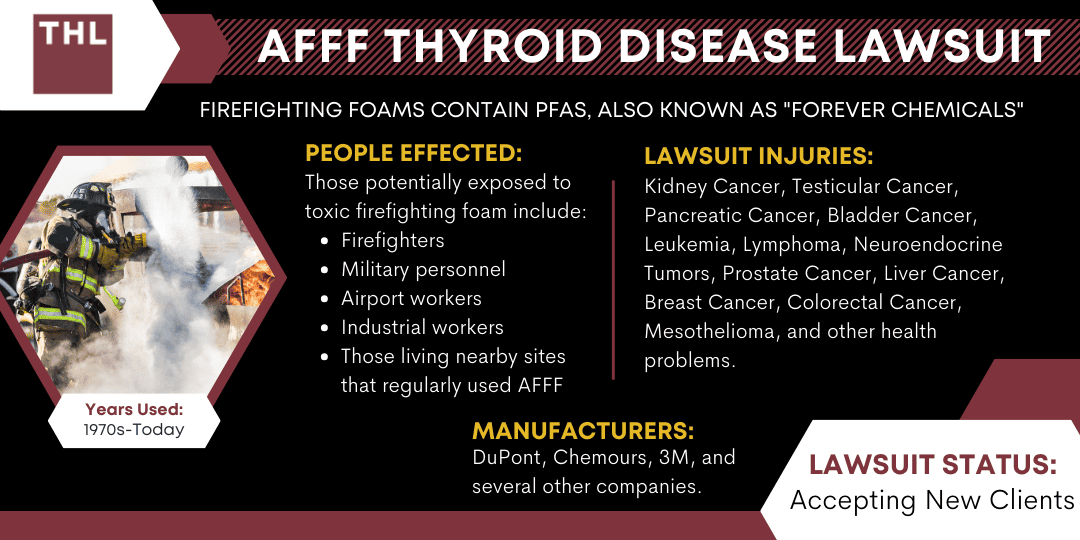
AFFF foam was long used by civilian and military firefighters to extinguish highly flammable liquid fires, including jet fuel fires.
Despite its effectiveness against chemical fires and its long shelf life, AFFF firefighting foam contains per- and polyfluoroalkyl substances (PFAS) that lead to health risks like thyroid disease.
AFFF firefighting foam and the increased risk of developing thyroid disease are well-documented.
Various studies and other scientific evidence corroborate the link between thyroid disease and chronic exposure to PFAS chemicals in AFFF foam.
For example, a 2018 meta-analysis looked into the correlation between exposure to PFAS chemicals and the development of thyroid disease and cancer.
Based on its findings, various studies had consistent data revealing a decrease in thyroid hormones in individuals exposed to PFAS chemicals.
Also, based on a 2020 review of old and new-generation PFAS chemicals, PFAS chemicals have thyroid-disrupting effects.
The study stated that pregnant women and developing children are the most at risk.
The thyroid-related health risks posed by toxic firefighting foam are hard to ignore, so agencies have looked into other at-risk populations.
In a report on PFAS and PFAS exposure, the Environmental Protection Agency identifies children and industrial workers to be the most at-risk populations.
Military firefighters were particularly in harm’s way due to their consistent exposure to PFAS chemicals in AFFF firefighting foam.
Understanding Thyroid Disease and Its Link to AFFF Firefighting Foam
Thyroid disease involves a range of disorders affecting thyroid function, leading to hormonal imbalances that impact various bodily processes.
AFFF firefighting foam, widely used to fight liquid fuel fires, contains PFAS chemicals increasingly associated with thyroid dysfunction and disease.
Studies have demonstrated that long-term exposure to PFAS chemicals, especially those found in AFFF, may disrupt thyroid function and contribute to thyroid-related diseases.
Symptoms of Thyroid Disease
Symptoms of thyroid disease can vary depending on whether it results in hyperthyroidism (overactive thyroid) or hypothyroidism (underactive thyroid).
Common symptoms include:
- Fatigue
- Unexplained weight gain or loss
- Sensitivity to temperature
Complications Associated with Thyroid Disease from PFAS Exposure
Long-term thyroid disease can lead to various complications that severely impact an individual’s quality of life.
Complications from thyroid dysfunction may include heart problems, such as arrhythmias or heart failure, due to fluctuating thyroid hormone levels.
Chronic thyroid disease can also contribute to mental health issues, like depression and cognitive decline, and increase the risk of osteoporosis due to imbalanced calcium regulation in the body.
For those exposed to PFAS chemicals, these risks are particularly concerning as PFAS compounds may exacerbate the severity of these health conditions over time.
Studies Linking PFAS Chemicals in AFFF to Thyroid Disease
Numerous studies have explored the relationship between PFAS exposure and thyroid disease, reinforcing the risks faced by those exposed to AFFF firefighting foam.
Research, such as a 2018 meta-analysis, has shown consistent data connecting PFAS exposure to thyroid hormone disruption, which may lead to the development of thyroid disease.
Another study in 2020 revealed that PFAS chemicals, both old and new-generation, disrupt thyroid function and pose health risks, especially for pregnant women and children.
The accumulating evidence from these studies strengthens the case for those pursuing legal recourse through AFFF litigation to address health issues related to thyroid disease from PFAS exposure.