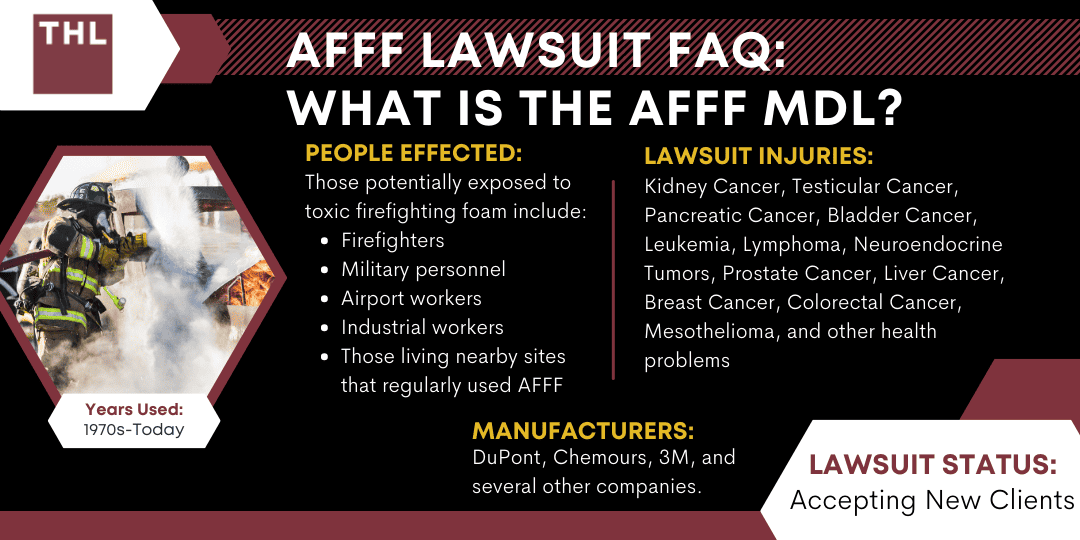
Multidistrict litigation (MDL) emerges as the legal recourse to address the multifaceted concerns surrounding AFFF.
MDL is a legal procedure that consolidates the litigation process for multiple related cases into a single court.
This mechanism allows for the efficient handling of complex and widespread legal disputes while maintaining consistency and avoiding duplication of efforts across various courts.
How Do MDLs Operate?
The AFFF firefighting foam MDL process encompasses several stages designed to ensure a fair and effective resolution for all parties involved.
Determining if an MDL Is Needed
Before the MDL process can be initiated, a critical threshold must be met: the cases at hand must share common issues of fact.
In the context of AFFF firefighting foam lawsuits, the common thread is the presence of per- and polyfluoroalkyl substances (PFAS) in firefighting foam, the alleged health effects associated with these toxic chemicals, and the potential responsibility of manufacturers and distributors in producing and supplying AFFF.
These shared elements provide the foundation for consolidating lawsuits into a single court, where the complexities of the cases can be streamlined, and justice can be pursued collectively.
By consolidating these cases, the legal system aims to prevent duplicative efforts, facilitate efficient discovery processes, and promote consistent rulings.
JPML Consolidates All Qualified Lawsuits Into a Single Court
Once the need for an MDL is established, the Judicial Panel on Multidistrict Litigation (JPML) comes into play.
Comprising federal judges from various districts, the JPML evaluates the eligible cases and determines the most appropriate federal district court for the MDL.
This pivotal decision ensures that the MDL court possesses the necessary jurisdiction and expertise to handle the complexities of the AFFF firefighting foam lawsuit.
The JPML’s decision to consolidate the AFFF lawsuits serves to centralize the AFFF litigation, preventing fragmentation across multiple jurisdictions and enhancing the efficiency of the legal process.
By uniting these cases under a single court’s purview, the JPML facilitates cohesive management and coordination.
Establishing the Steering Committee
One of the cornerstones of the MDL process is the formation of the Steering Committee.
This committee comprises experienced attorneys representing various parties, including plaintiffs, defendants, and other stakeholders.
The Steering Committee plays a vital role in guiding the litigation, streamlining communication, and managing the logistics of the consolidated cases.
The Steering Committee collaborates to develop strategies, coordinate discovery efforts, and present arguments before the MDL court.
This collective approach ensures that all parties’ diverse perspectives are considered, promoting a balanced and comprehensive resolution process.
The Bellwether Trial
The bellwether trial is one of the most significant milestones within the MDL process.
This trial involves selecting a representative case from the consolidated lawsuits to proceed to trial.
The bellwether trial serves as a litmus test, offering insights into the strengths and weaknesses of the arguments presented by both sides.
The outcome of the bellwether trial has far-reaching implications.
It can provide a basis for evaluating potential settlements, encouraging parties to negotiate to reach a mutually acceptable resolution.
Additionally, the insights gleaned from the bellwether trial can influence the trajectory of the remaining cases within the MDL, potentially prompting parties to reassess their positions or approaches.
Recovering MDL Settlements
As the MDL process advances, parties may opt for settlements to expedite the resolution of the cases.
Settlements can take various forms, including monetary compensation for affected individuals, changes in practices or procedures to prevent future harm, and commitments to environmental remediation.
The MDL process provides a framework for negotiating and implementing settlements addressing the multifaceted concerns of AFFF foam lawsuits.
These settlements deliver redress to affected individuals while prompting industry actors to acknowledge their responsibilities and take corrective actions.
How MDL Differs From Class Action Lawsuits
In MDL, individual lawsuits remain distinct and retain their unique identities.
Unlike a class action lawsuit, where plaintiffs are represented collectively by a class representative, MDL plaintiffs maintain their representation.
MDL cases, such as discovery and motion practice, are consolidated for pretrial purposes to avoid redundant efforts and conflicting rulings across multiple jurisdictions.
The ultimate goal of an MDL is to promote efficiency in pretrial proceedings and facilitate consistent rulings.
However, after pretrial proceedings, cases may return to their original jurisdictions for trial or may be settled individually.
The MDL process primarily serves as a mechanism for managing the complexities of discovery and pretrial motions.
Class action lawsuits often seek a global resolution for all class members.
If the case succeeds, damages or compensation are distributed among the class according to a predetermined formula.
However, if the case is unsuccessful, all class members are bound by the unfavorable outcome, even if they would have fared better pursuing an individual lawsuit.