This page discusses the link between toxic baby formula and risk of Necrotizing Enterocolitis (NEC), a severe intestinal condition in premature infants.
Abbott Laboratories and Mead Johnson face individual lawsuits in state courts and consolidated federal claims involving children diagnosed with NEC after receiving preterm infant formula or fortifier products.
TorHoerman Law is no longer accepting new clients for claims against Abbott.
We are actively accepting new clients for claims against Mead, maker of Enfamil, Pregestimil, Enfacare, and Nutramigen.
Active Litigation·MDL 3026
Toxic Baby Formula NEC Lawsuit Facts
TorHoerman Law is actively accepting claims for the Toxic Baby Formula NEC Lawsuit.
Defendants
Mead Johnson & Company
Abbott Laboratories (TorHoerman Law is NO LONGER accepting cases involving Abbott Laboratories)
Injuries named in lawsuit
Necrotizing Enterocolitis (NEC)
Intestinal damage
Surgical intervention
Long-term gastrointestinal issues
Systemic complications
Developmental impacts
You may qualify to file a claim if...
Your premature infant was fed cow's milk based formula in the NICU.
Your baby was later diagnosed with necrotizing enterocolitis (NEC).
NEC caused serious complications such as intestinal damage, long-term health problems, or death.
Most Recent Updates
A Missouri state court has overturned a defense verdict that favored baby formula manufacturers Abbott and Mead Johnson, ordering a new trial.
This ruling is a significant step forward for plaintiffs, especially following two previous victories in NEC trials.
In a past NEC Infant Formula Trial in the same court, the jury awarded $495 million. This case was tried by Jake Plattenberger of TorHoerman Law.
Key Takeaways
This page discusses the link between toxic baby formula and risk of Necrotizing Enterocolitis (NEC), a severe intestinal condition in premature infants.
Abbott Laboratories and Mead Johnson face individual lawsuits in state courts and consolidated federal claims involving children diagnosed with NEC after receiving preterm infant formula or fortifier products.
TorHoerman Law is no longer accepting new clients for claims against Abbott.
We are actively accepting new clients for claims against Mead, maker of Enfamil, Pregestimil, Enfacare, and Nutramigen.
Toxic Baby Formula NEC Lawsuit Overview
Toxic Baby Formula NEC Lawsuit claims allege cow’s milk-based formulas increase NEC risk in premature infants.
Abbott and Mead Johnson face baby formula NEC lawsuits for failing to warn about dangers of Similac and Enfamil.
On this page, we’ll discuss the Toxic Baby Formula NEC Lawsuit, recent developments in the Infant Formula NEC Lawsuits filed against baby formula makers, the increased risk of NEC and severe health complications potentially linked to toxic baby formula, hiring a NEC Baby Formula Lawyer, and much more.
TorHoerman Law: NEC Baby Formula Lawyers
Major infant formula companies are facing lawsuits from parents who claim that cow’s milk based formulas increase the risk of necrotizing enterocolitis (NEC), a devastating gastrointestinal disease that primarily affects premature and low birth weight infants.
The NEC Lawsuits target Abbott Laboratories and Mead Johnson & Company, the manufacturers of Similac Infant Formula and Enfamil Infant Formula respectively.
Lawsuits against formula manufacturers are being filed in both state and federal courts, with the NEC Formula MDL centralized in the U.S. District Court for the Northern District of Illinois.
Recent NEC Lawsuit trials have made national news, with baby formula manufacturers being ordered to pay hundreds of millions of dollars.
In this case, our NEC Lawyers represented the mother of a young girl who developed necrotizing enterocolitis (NEC) after being fed cow’s milk based formula.
Our NEC Baby Formula Lawyers continue to lead the fight for justice on behalf of families affected by toxic infant formula products.
If your child developed necrotizing enterocolitis (NEC) after being fed Enfamil cow’s milk-based formula in the maternity ward or NICU of a hospital, you may be eligible to file an NEC Baby Formula Lawsuit.
Contact the experienced NEC Baby Formula Lawyers from TorHoerman Law today for a free consultation.
You can also use the chatbot on this page to find out if you qualify for the NEC Baby Formula Lawsuit instantly.
NEC is a life-threatening gastrointestinal disease that can lead to lifelong medical complications, including short bowel syndrome, developmental delays, and the need for specialized care.
This disease is potentially fatal, and severe cases often lead to life-threatening health complications.
For families, the consequences of NEC extend far beyond the NICU—many face long-term emotional trauma and financial strain due to the cost of treatment, therapies, and future medical needs.
We understand the weight of what you’re going through, and our legal team is committed to holding manufacturers accountable.
Please reach out to us with any questions you may have about the NEC Lawsuit. We’re here to help you.
NEC baby formula lawsuits allege that cow’s milk-based products such as Similac formula and Mead Johnson’s Enfamil formula increase the risk of necrotizing enterocolitis in premature and low-birth-weight infants.
Abbott Laboratories and Mead Johnson face claims that they failed to adequately warn parents and healthcare providers about the risks associated with their preterm formula and fortifier products.
Many baby formula lawsuits filed against the manufacturers involve a child born premature who developed NEC after receiving Similac or Enfamil formula products in a hospital neonatal intensive care unit.
Some affected infants received formula exclusively, while others were fed breast milk or donor milk along with cow’s milk-based products during their NICU care.
NEC is a potentially fatal intestinal disease that primarily affects babies born prematurely.
The condition can cause intestinal tissue death, bowel perforation, sepsis, and permanent complications such as short bowel syndrome, developmental impairment, and long-term feeding difficulties.
Scientific evidence has found higher rates of NEC among premature infants who receive cow’s milk-based formula compared with infants fed maternal or donor milk.
Plaintiffs argue that Abbott and Mead Johnson continued marketing their products for vulnerable premature infants without adequately disclosing this comparative risk.
Each NEC formula lawsuit remains an individual claim based on the child’s feeding history, diagnosis, injuries, and resulting damages.
Cases are proceeding in state courts and in federal multidistrict litigation centralized in the Northern District of Illinois rather than as a class action.
Results have varied between proceedings.
The first three scheduled federal bellwether cases involving Abbott ended on summary judgment before trial, while state cases have produced plaintiff verdicts, including a preterm infant formula trial in which TorHoerman Law secured a $495 million award and an April 2026 decision in which an Illinois jury awarded $70 million to four families.
TorHoerman Law is continuing to investigate potential claims involving premature infants who developed NEC after receiving Enfamil products manufactured by Mead Johnson.
A family may qualify for a free case review if their child was born prematurely, received an Enfamil cow’s milk-based formula or fortifier in a hospital or NICU, and was later diagnosed with NEC.
TorHoerman Law is no longer accepting NEC clients with claims against Similac. We are still accepting clients with claims against Enfamil.
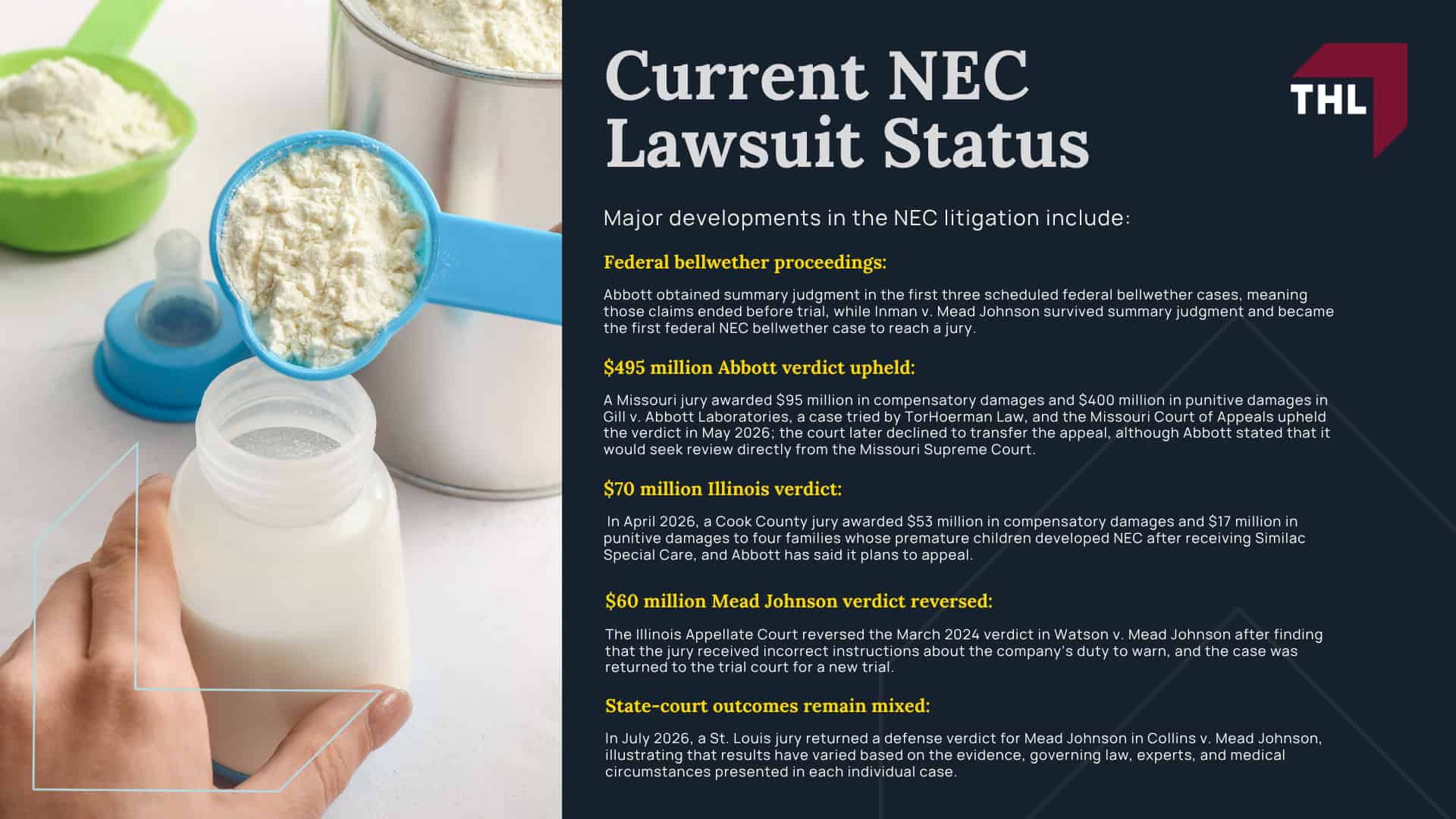
Current NEC Lawsuit Status
NEC baby formula lawsuits remain active against Abbott Laboratories and Mead Johnson in federal and state courts.
The federal cases are centralized in MDL No. 3026 before Judge Rebecca R. Pallmeyer in the U.S. District Court for the Northern District of Illinois, with more than 800 lawsuits pending.
No global settlement program has been established, and each family’s case remains an individual claim based on the child’s feeding history, NEC diagnosis, injuries, and applicable state law.
Major developments in the NEC litigation include:
Federal bellwether proceedings: Abbott obtained summary judgment in the first three scheduled federal bellwether cases, meaning those claims ended before trial, while Inman v. Mead Johnson survived summary judgment and became the first federal NEC bellwether case to reach a jury.
$495 million Abbott verdict upheld: A Missouri jury awarded $95 million in compensatory damages and $400 million in punitive damages in Gill v. Abbott Laboratories, a case tried by TorHoerman Law, and the Missouri Court of Appeals upheld the verdict in May 2026; the court later declined to transfer the appeal, although Abbott stated that it would seek review directly from the Missouri Supreme Court.
$60 million Mead Johnson verdict reversed: The Illinois Appellate Court reversed the March 2024 verdict in Watson v. Mead Johnson after finding that the jury received incorrect instructions about the company’s duty to warn, and the case was returned to the trial court for a new trial.
The NEC Infant Formula MDL (multidistrict litigation) consolidates numerous lawsuits filed against Abbott Laboratories and Mead Johnson & Company, the manufacturers of Similac and Enfamil premature infant formulas respectively.
These cases are centralized in the U.S. District Court for the Northern District of Illinois under Judge Rebecca R. Pallmeyer.
The MDL seeks to streamline pretrial proceedings for claims that these companies’ cow’s milk-based formulas caused necrotizing enterocolitis (NEC) in premature infants.
Plaintiffs allege that the manufacturers failed to warn about the risks of NEC associated with their products.
This consolidation aims to improve efficiency and consistency in handling the numerous similar cases.
In addition to the MDL, similar NEC Lawsuits have been filed in state courts across the country.
These state trials (in Illinois and Missouri) have also resulted in significant verdicts.
In Whitfield v. Abbott Laboratories and Mead Johnson, a Missouri trial court vacated an October 2024 defense verdict and ordered a new trial after finding that prejudicial conduct by defense counsel deprived the plaintiff of a fair trial; the defendants appealed that ruling.
How Many Toxic Baby Formula NEC Lawsuits Have Been Filed? Current Status of the Baby Formula NEC MDL
The Toxic Baby Formula NEC MDL continues to grow, with over 800 pending NEC Lawsuits filed.
The case, Margo Gill vs. Abbott Laboratories, centered on claims that Abbott’s formula increased the risk for NEC.
Margo is the mother of Robynn, a young girl who tragically developed necrotizing enterocolitis (NEC) after being given Abbott’s baby formula as a premature infant.
Internal documents from Abbott, revealed in the trial, showed the company knew as early as 2009 that NEC has a significant formula feeding component.
Despite having knowledge that premature babies are at an increased risk of developing NEC when given cow’s milk formula, Abbott did not provide parents of NICU babies any information regarding the risk, incidence, or severity of NEC for babies on formula versus human milk.
Robynn had approximately 75% of her intestines removed following her NEC diagnosis, and also suffered permanent brain damage.
She will need intensive care for the rest of her life, and this verdict is intended to account for Robynn’s extensive lifelong medical and care needs.
TorHoerman Law is honored to have represented the Gill family and achieved a landmark verdict on their behalf.
TorHoerman Law’s NEC Verdict in the News
THL’s landmark verdict against Abbott Laboratories is drawing national attention.
Several major news outlets are covering the case.
This case emphasizes the risks associated with certain infant formulas and is a key moment in the ongoing fight for the protection of premature infants.
News outlets that have covered TorHoerman Law’s NEC verdict include:
Wall Street Journal: Abbott Ordered to Pay $495 Million in Baby-Formula Verdict
Reuters: Abbott must pay $495 million in premature infant formula trial, jury finds
Chicago Tribune: Abbott Laboratories must pay $495M in case over formula for premature infants, jury decides
CNBC: Abbott must pay $95 million in premature infant formula trial, jury finds
New York Post: Abbott must pay $495M in damages after girl develops dangerous disease from premature infant formula
The Guardian: Reckitt Benckiser’s shares slump after Abbott baby formula ruling over bowel disease link
Yahoo: Abbott Laboratories must pay $495 million in case over formula for premature infants, jury decides
At TorHoerman Law, our efforts in the NEC Litigation are led by a team of attorneys with distinct experience in product liability, trial advocacy, and neonatal injury cases.
Each attorney plays a defined role in strategizing, building, and litigating these cases.
Our collaborative approach to Infant Formula NEC Lawsuits allows us to handle high-stakes litigation while providing each client with focused, consistent support.
Below is an overview of our dedicated attorneys and their contributions to NEC litigation:
Jake Plattenberger: As a lead attorney, Jake helped present the case that resulted in TorHoerman Law’s $495 million NEC verdict.
Tor Hoerman: Tor Hoerman is the founder of the firm and our senior litigation strategist. Tor directed the legal approach behind the landmark verdict and manages client communications, public response, and long-term case development.
Alan Holcomb: A recent addition to our leadership team, Alan Holcomb focuses on case valuation, trial preparation, and identifying high-impact legal strategies to maximize compensation for affected families. He brings extensive experience in complex product liability trials and plays a key role in shaping our approach to NEC cases.
Steve Davis: Partner at TorHoerman Law, Steve Davis aids in the interpretation of corporate documents related to formula marketing, internal safety reviews, and product disclosures. He also works closely with our litigation team to connect internal communications and marketing strategies to the core legal claims in each case.
Tyler Schneider: As the managing partner of TorHoerman Law, Tyler Schneider oversees interdepartmental coordination and case resource allocation. Tyler helps streamline attorney collaboration and firm operations to keep NEC cases moving efficiently.
Chad Finley: Partner at TorHoerman Law, Chad Finley oversees expert witness development and manages the scientific and medical framework of each case. Chad works closely with neonatal and gastroenterology experts, reviews scientific studies and supporting arguments, and helps build the foundation of NEC Lawsuits.
Alexis Robinson: A rising star at TorHoerman Law, Alexis Robinson chairs the NEC trial coordination team. Alexis facilitates pretrial case selection, expert witness scheduling, and trial logistics across jurisdictions.
Necrotizing enterocolitis (NEC) is a serious gastrointestinal disease that primarily affects premature infants and low birth weight babies, often those receiving care in a neonatal intensive care unit (NICU).
The condition involves inflammation of the intestinal lining, leading to tissue death and potential perforations in the bowel wall.
These perforations can allow bacteria to leak into the abdominal cavity, causing widespread infection and increasing the risk of sepsis, a life-threatening response to infection.
Prematurity is the primary risk factor for NEC because premature infants have underdeveloped intestinal and immune systems.
Feeding practices may also affect NEC risk, and human milk has a documented protective effect.
The disease can escalate rapidly, leading to sepsis, organ failure, and in severe cases, death.
Early detection of NEC is crucial for effective management.
NEC symptoms typically appear within the first two to six weeks of life and may include feeding intolerance, abdominal distension, bloody stools, vomiting bile-stained fluid, lethargy, and temperature instability.
Prompt medical intervention is essential to prevent rapid progression of the disease.
The condition’s danger can range from mild to fatal, and you must recognize the following symptoms if you believe your child is at risk:
Abdominal pain and swelling
Changes in heart rate and blood pressure
Changes in body temperature and breathing
Diarrhea with bloody stool
Green or yellow vomit
Lethargy
Refusal to eat, feeding intolerance, and lack of weight gain
Healthcare providers can diagnose NEC through tests checking for a swollen belly, blood tests, fecal tests, and x-rays.
If your infant exhibits any of these symptoms, seek immediate medical attention to ensure proper diagnosis and treatment.
Initial approaches include discontinuing oral feedings, providing intravenous nutrition, administering broad-spectrum antibiotics to combat infection, and decompressing the stomach with a nasogastric tube.
In severe cases where intestinal perforation or necrosis occurs, surgical intervention may be necessary to remove the damaged sections of the intestine.
Common NEC treatment measures may include:
Discontinuation of oral feedings to rest the bowels and reduce further irritation.
Nasogastric decompression to relieve abdominal pressure and remove air or fluid from the stomach.
Intravenous (IV) nutrition to support growth and development while the intestines heal.
Broad-spectrum antibiotics to treat or prevent bacterial infection.
Frequent monitoring of vital signs and abdominal imaging to track disease progression.
Blood transfusions if the infant develops anemia or low blood pressure.
Surgical removal of necrotic bowel if the disease has progressed to perforation or if the infant does not improve with medical management.
Placement of a peritoneal drain in select cases where surgery is too risky due to the infant’s condition.
Each treatment plan is tailored to the baby’s condition and the severity of the disease, often requiring coordinated care from neonatologists, pediatric surgeons, and other specialists.
How Dangerous Is NEC?
Necrotizing enterocolitis is a disease that can have fatal consequences if left untreated.
NEC primarily affects premature and very low birth weight infants, causing the death of intestinal tissue, inflammation, and perforation of the intestines.
NEC mortality varies according to the infant’s gestational age, birth weight, disease severity, and need for surgery, and can approach 50% in the most severe cases.
There is no guaranteed way to prevent necrotizing enterocolitis, and parents should make feeding decisions with their child’s neonatologist and NICU care team.
NEC is a complex disease that can develop even when recommended feeding practices are followed.
When maternal milk is unavailable or insufficient, the American Academy of Pediatrics recommends pasteurized donor milk for very-low-birth-weight infants during the period when their NEC risk is highest.
An NIH-funded study also found that extremely premature infants receiving donor milk developed NEC at approximately half the rate of infants receiving preterm formula.
Premature infants have specialized nutritional needs and may require additional calories, protein, or fortification to support growth.
Depending on the infant’s condition and the availability of human milk, a care team may recommend fortified maternal milk, fortified donor milk, or premature baby formula Enfamil or Similac.
The benefits and risks of each option should be evaluated individually rather than assuming that one feeding plan is appropriate for every premature infant.
Parents can support their child’s health by asking the NICU team:
Whether maternal or pasteurized donor milk is available.
Why a particular formula or fortifier is being recommended.
How the feeding plan accounts for the child’s gestational age, birth weight, growth, and NEC risk.
What symptoms of feeding intolerance or NEC the medical team is monitoring.
Parents should not stop or change a premature infant’s prescribed feeding plan without medical guidance, as adequate nutrition and growth are also essential to the child’s health.
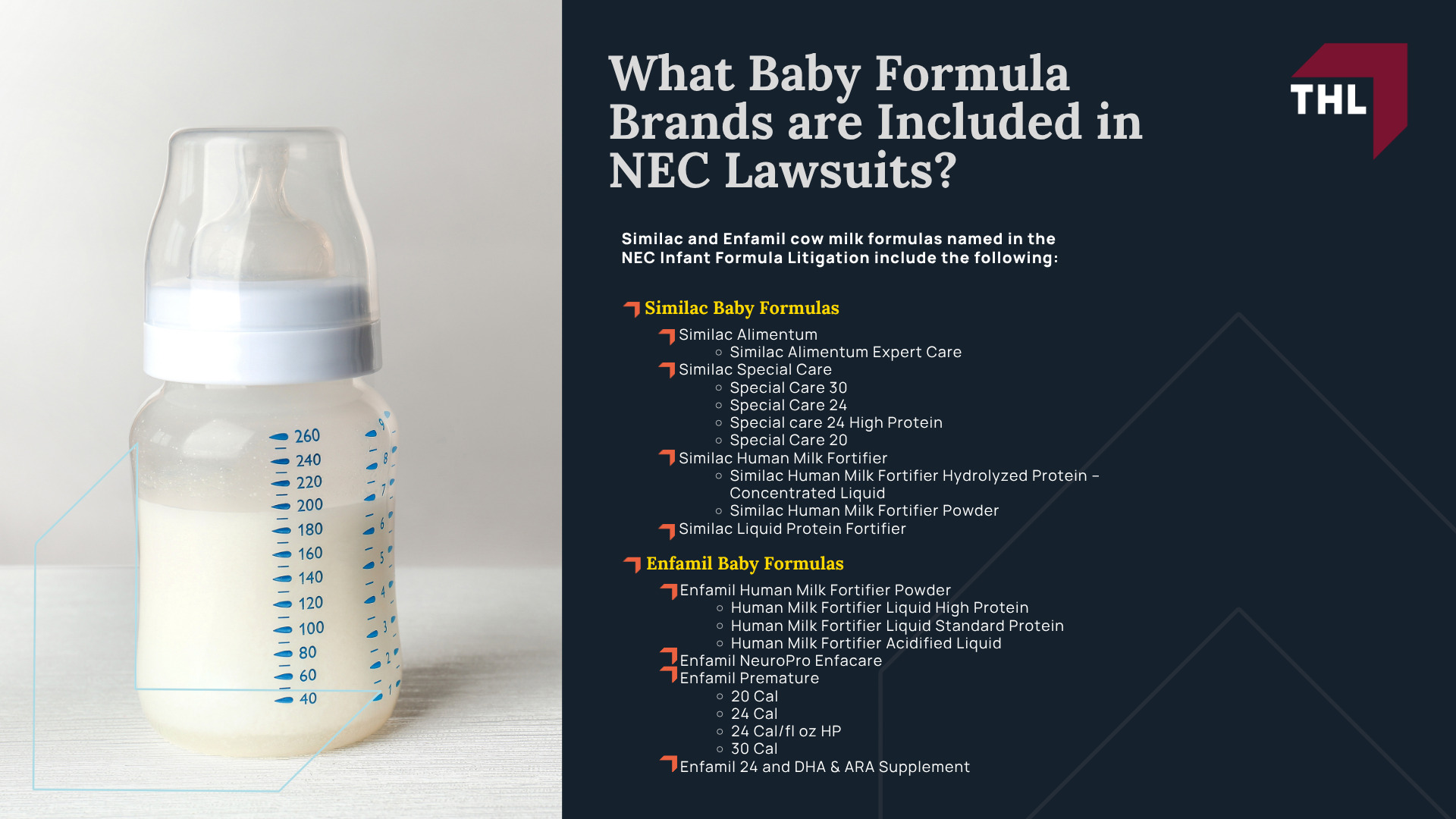
Similac, Enfamil, Other Baby Formulas Allegedly Linked To NEC Risk
Similac (manufactured by Abbott) and Enfamil (manufactured by Mead Johnson) are two common bovine milk-based formulas that have been linked to an increased risk of NEC.
Similac and Enfamil formula are comprised of several product lines that feature different supplements and caloric levels for the specific needs of premature babies.
Both manufacturers are named in lawsuits, with parents alleging that these products increased the risk for their premature babies to develop the gastrointestinal disease and the risk was not presented on warning labels.
Many NEC lawsuits involve specialized preterm formulas and fortifiers administered in hospitals or NICUs, although certain products within the broader Similac and Enfamil lines are also available through retail channels.
Learn more about the Similac Baby Formula Lawsuits here.
Learn more about the Enfamil Formula Lawsuit here.
If your child was fed an Enfamil cow’s milk-based infant formula and later developed necrotizing enterocolitis (NEC), you may be eligible to file an NEC lawsuit.
TorHoerman Law is no longer accepting NEC clients with claims against Similac.
We are still accepting clients with claims against Enfamil.
Contact TorHoerman Law for a free consultation about a potential Enfamil NEC claim.
Cow Milk Based Formula and Risk for Necrotizing Enterocolitis (NEC)
The infant formulas involved in the NEC Lawsuits are not the typical products found on store shelves for general use.
These formulas, such as Similac Special Care and Enfamil NeuroPro EnfaCare, are specifically designed for and administered to premature or low birth weight infants in hospital settings.
Hospitals use these specialized formulas to meet the higher nutritional needs of vulnerable infants who require enhanced calories and protein for growth and development.
Premature infants often lack the ability to digest and process cow’s milk proteins effectively, which is a key concern highlighted in these lawsuits.
While these formulas are vital in providing necessary nutrients, the lawsuits claim that the manufacturers failed to adequately warn about the potential risks associated with their use in premature infants.
Parents of affected infants argue that they were not properly informed about safer alternatives, such as human milk fortifiers or donor breast milk.
What Did the Manufacturers of Cow’s Milk Based Formula Know About the Risk of NEC?
Internal documents and trial evidence suggest that the manufacturers of cow’s milk-based baby formulas (Abbott Laboratories (maker of Similac) and Mead Johnson (maker of Enfamil)) were aware of the increased risk of necrotizing enterocolitis (NEC) in premature infants for years before parents and healthcare providers were adequately warned.
Despite a growing body of scientific literature dating back over two decades, these companies continued to promote their products for use in neonatal intensive care units (NICUs), even for the most vulnerable preterm infants.
In a July 2024 trial led by TorHoerman Law, a Missouri jury awarded $495 million against Abbott Laboratories after concluding that the company failed to warn about the NEC risks linked to its Similac products.
Evidence revealed that Abbott had documentation as early as 2009 suggesting an increased risk of NEC, but chose not to update product warnings or educate physicians.
This failure to act has become a key component of NEC Baby Formula Lawsuits.
Evidence presented in NEC lawsuits shows manufacturers may have:
Possessed internal studies and communications indicating a higher incidence of NEC in preterm infants fed with cow’s milk-based formulas.
Failed to revise warning labels or include NEC risks in product inserts for hospitals and healthcare providers.
Continued aggressive marketing to NICUs, promoting their formulas as safe and essential for growth, even as studies showed better outcomes with human milk-based feeding.
Neglected to issue timely public advisories or inform neonatal care professionals despite mounting evidence and calls for safer feeding alternatives.
Targeted their products for premature infants without conducting adequate long-term safety evaluations specific to NEC risk.
Ignored clinical guidelines from groups such as the American Academy of Pediatrics recommending human milk as the preferred nutrition for premature babies.
The revelation of this knowledge gap between what manufacturers knew and what they disclosed is central to the legal arguments in the ongoing NEC Baby Formula Lawsuits.
TorHoerman Law continues to pursue accountability on behalf of affected families.
What Can I Do If My Child Has Been Affected By NEC?
If your child was fed Enfamil cow’s milk-based infant formula and subsequently developed Necrotizing Enterocolitis (NEC), you may be eligible to file an NEC Baby Formula Lawsuit and secure compensation for your child’s injuries and damages.
To learn more about the NEC Infant Formula Lawsuits and to get a free consultation, contact TorHoerman Law today.
Who is Liable For My Child’s Injuries?
In the NEC Baby Formula Lawsuits, liability is primarily focused on the manufacturers of cow’s milk-based formulas, such as Abbott Laboratories (Similac) and Mead Johnson (Enfamil).
These companies are accused of failing to warn parents and healthcare providers about the increased risk of necrotizing enterocolitis (NEC) in preterm infants fed their products.
Product liability claims argue that these manufacturers knew—or should have known—about the dangers and marketed the formulas as safe alternatives to breast milk without adequate warnings or risk disclosures.
These NEC Lawsuits contend that the lack of transparency contributed directly to severe and sometimes fatal outcomes for premature babies.
Some families have asked about the possibility of pursuing medical malpractice claims against hospitals or physicians.
These cases would only be viable under specific circumstances—namely, if there is clear evidence that a healthcare provider knew about the heightened risk of NEC and failed to act appropriately, such as by continuing formula use without informing the parents of safer alternatives.
At this time, TorHoerman Law is not pursuing medical malpractice claims related to NEC.
Our focus remains on holding formula manufacturers accountable for their failure to disclose known risks and protect vulnerable infants.
You may be eligible for an NEC Baby Formula Lawsuit if your child was diagnosed with necrotizing enterocolitis after being administered an Enfamil cow’s milk-based formula or fortifier.
Experienced infant formula lawyers will help assess and build your case, litigate your lawsuit, and get rightful compensation for your injuries.
In a personal injury case, such as a NEC infant formula lawsuit, you might be wondering how much it costs to hire an experienced lawyer.
Contingency fees can be utilized in the instance where you cannot pay for an attorney, but are in need of one.
TorHoerman Law operates on a contingency fee basis, which means you do not pay for legal representation unless you receive financial compensation for your case.
Contingency fee agreements can be incredibly helpful in ensuring that you get proper representation regardless of your current financial situation.
Strong evidence can greatly increase your chances of reaching an adequate resolution.
Our attorneys will help you gather and retain crucial evidence for your NEC Lawsuit.
Possible evidence for NEC Infant Formula Lawsuits can include:
Medical and feeding records
Photos and videos
Witness statements
Incident reports
Expert testimony on the risks of cow’s milk-based formulas
Marketing materials from formula manufacturers
Communications between healthcare providers and parents
Hospital protocols and guidelines regarding infant feeding practices
Any other evidence regarding the feeding of cow milk based formula and NEC diagnosis
Your attorney will also help in the process of gathering evidence to build your potential baby formula lawsuit.
Assessing Damages in NEC Baby Formula Lawsuits
Preterm infants diagnosed with necrotizing enterocolitis (NEC) often require extensive and long-term medical care, including surgeries, intensive care stays, and ongoing treatment for serious complications.
These medical interventions can result in overwhelming expenses for families, both immediately after diagnosis and for years to come.
In addition to the financial toll, families face emotional distress, disruption to daily life, and in some cases, lifelong disabilities that impact the child’s quality of life.
Damages are the total amount of losses, economic and non-economic, incurred as a result of an NEC diagnosis.
In NEC Baby Formula Lawsuits, the defendant may be liable to pay for:
For toxic baby formula lawsuits, types of damages you may look for are medical expenses, pain and suffering, permanent disability, and future medical expenses.
Your NEC Baby Formula Lawyers will help you through this step in the process of filing a lawsuit.
If your child developed NEC after receiving an Enfamil cow’s milk-based formula or fortifier, contact TorHoerman Law for a free, no-obligation consultation.
TorHoerman Law is no longer accepting NEC clients with claims against Similac. We are still accepting clients with claims against Enfamil.
TorHoerman Law is a personal injury law firm dedicated to fighting for individuals injured through no fault of their own.
We’ve secured over $4 billion for our clients, and our lawyers are ready to help you.
We operate on a contingency fee basis as an assurance to our clients that we are as dedicated to getting the absolute best result for them.
This means you pay nothing unless we win your case.
Let us focus on fighting for you in court so that you can dedicate your full attention to what truly matters – the health and well-being of your child.
Necrotizing enterocolitis is a gastrointestinal disease that almost exclusively affects infants born before the 37th week of pregnancy (premature babies).
It causes inflammation and bacterial infection in the intestines, leading to the death of intestinal tissue and potential perforation of the bowel.
The exact cause of NEC is not fully understood, but factors such as prematurity, formula feeding, and an underdeveloped immune system contribute to its development.
Symptoms of NEC include abdominal swelling, feeding intolerance, bloody stools, and lethargy.
Immediate medical treatment is crucial, as the condition can rapidly progress to sepsis and other life-threatening complications.
Studies have reported higher NEC rates among premature infants fed formula compared with infants receiving maternal or donor human milk.
However, NEC is a complex, multifactorial disease, and federal health agencies state that current evidence does not conclusively establish that preterm formula causes NEC.
Human milk has a documented protective effect, while prematurity remains the primary underlying risk factor.
NEC lawsuits allege that manufacturers should have warned parents and healthcare providers about the comparative risks observed in feeding studies.
No, there is not a Baby Formula NEC Class Action Lawsuit.
Instead, NEC Lawsuits are being handled as multidistrict litigation (MDL) or are filed individually in state courts.
The key difference between the MDL and class action lawsuits is that a class action involves a single lawsuit with many plaintiffs who share the same legal issue, and any settlement or judgment is divided among all class members.
In contrast, an MDL consolidates individual lawsuits that share common factual issues to streamline pretrial proceedings, but each case remains separate and is judged on its own merits.
You may qualify for a baby formula NEC lawsuit if your child was born prematurely, was fed an Enfamil cow’s milk-based formula or fortifier, and subsequently developed necrotizing enterocolitis (NEC).
Medical and hospital feeding records may help document the formula product your child received and the timing of the NEC diagnosis.
TorHoerman Law is no longer accepting NEC clients with claims against Similac. We are still accepting clients with claims against Enfamil.
Contact our law firm for a free consultation to discuss a potential Enfamil NEC claim.
Yes, necrotizing enterocolitis (NEC) can result in long-term health complications, especially for premature and low birth weight infants who survive the initial infection.
Surgical removal of damaged intestines can lead to short bowel syndrome, a chronic condition that impairs the body’s ability to absorb nutrients.
Children with this condition often require lifelong parenteral nutrition, feeding tubes, and ongoing gastrointestinal care.
NEC survivors may also suffer from growth delays, developmental disabilities, and a higher risk of neurological complications due to prolonged hospital stays and systemic infections.
These long-term effects not only impact the child’s quality of life, but also place emotional and financial strain on families.
For these reasons, NEC Baby Formula Lawsuits seek compensation that accounts for both the immediate and lasting consequences of the disease.
TorHoerman Law works with medical and economic experts to document these complications thoroughly and pursue full compensation on behalf of affected families.
NEC Baby Formula Lawsuits are filed against manufacturers like Abbott Laboratories and Mead Johnson for allegedly failing to warn parents and medical providers about the increased risk of NEC in preterm infants fed cow’s milk baby formula.
NEC Baby Formula Lawsuits argue that the companies marketed their products—such as Similac and Enfamil—for use in neonatal intensive care units (NICUs) despite studies linking them to a heightened risk of NEC.
Plaintiffs claim that internal documents, marketing materials, and medical literature demonstrate that these manufacturers were aware of the potential dangers but continued to promote the formulas for vulnerable infants.
By pursuing these lawsuits, families are seeking compensation for the harm caused and pushing for greater transparency in how infant nutrition products are tested, labeled, and sold.
Successful cases also send a clear message to the industry that profit cannot come at the expense of infant health and safety.
TorHoerman Law has been at the forefront of this litigation, including securing a $495 million verdict in one of the most significant NEC-related trials to date.
Tor Hoerman has represented injured individuals for more than 30 years, with experience spanning individual personal injury cases and nationwide mass tort litigation. His work includes car accidents, catastrophic injuries, product liability claims, and other serious injury cases. Tor has served in court-appointed leadership roles in national litigation and tried cases involving major corporate defendants.
Legally Reviewed
TorHoerman Law’s legal content is researched and written by our editorial team and attorneys for legal accuracy, clarity, and relevance. We rely on statutes, court records, government publications, medical research, and other authoritative sources when applicable. This page provides general legal information and does not constitute legal advice.
Fact-Checked
TorHoerman Law reviews its legal content for factual accuracy, current information, and relevant legal context before publication and as material developments occur. This article is provided for general informational purposes and does not constitute legal advice. For guidance about a specific case, contact TorHoerman Law.
Additional Toxic Baby Formula NEC Lawsuit resources on our website:
TorHoerman Law represents people whose lives have been disrupted by serious injuries, unsafe products, and negligence. Our attorneys handle individual personal injury cases as well as national mass tort lawsuits involving major corporations.
Founded in 2009, our legal team brings more than 100 years of combined experience handling serious injury and complex civil litigation.
Do you believe you’re entitled to compensation?
Use our Instant Case Evaluator to find out in as little as 60 seconds!
In this case, we obtained a verdict of $495 Million for our client’s child who was diagnosed with Necrotizing Enterocolitis after consuming baby formula manufactured by Abbott Laboratories.