
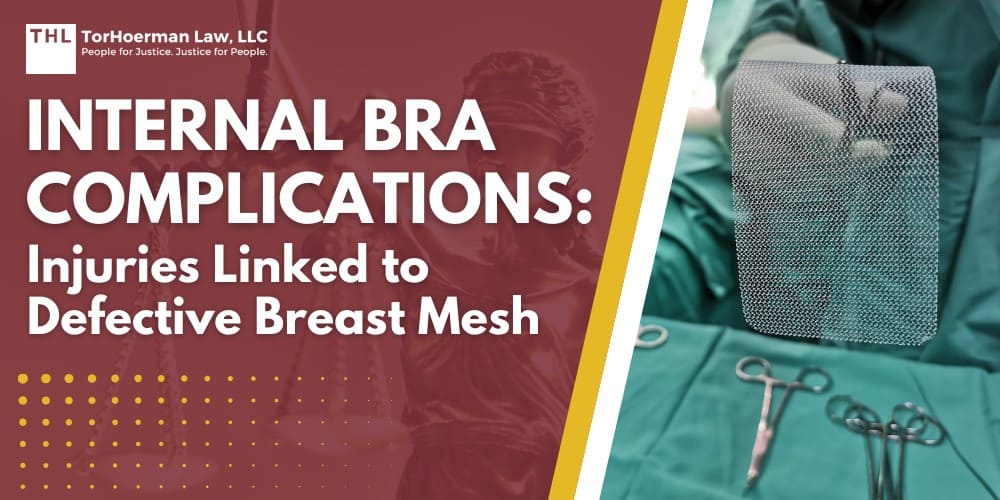
An “internal bra” in breast surgery is a technique where a surgeon adds internal support to help stabilize the lower portion of the breast or the implant pocket using a mesh or scaffold.
Plastic surgery organizations describe it as a soft-tissue scaffold intended to resist downward stretch and help hold shape during healing.
In implant based breast reconstruction, surgeons may use a mesh-like material to help cover or support the implant’s lower pole, a concept that has been described in the medical literature as creating an “internal bra.”
The same general approach is also used in cosmetic breast surgery, including lifts and augmentation-lift combinations, and sometimes in other breast surgeries such as reductions when surgeons believe added reinforcement is needed.
The intended goal is support and shape control during healing, but outcomes can differ based on patient factors, technique, and how the body responds to an implanted material.
Importantly, the FDA has stated that the safety and effectiveness of surgical mesh in breast surgery has not been determined by the FDA and that no surgical mesh products are cleared or approved specifically for breast surgery such as augmentation or reconstruction.
For patients, this means the use of mesh in breast procedures can involve added considerations around informed consent, complication risk, and the possibility of additional treatment if recovery does not follow the expected course.
Internal Bra Techniques Explained
Internal bra procedures are used across a range of breast surgeries when surgeons believe added internal support may help control shape, position, or healing.
In reconstructive surgery, internal support is often added after mastectomy to help stabilize an implant against the chest wall and define the breast pocket during recovery.
Similar techniques may be used in cosmetic procedures, including breast reduction or lift surgeries, when tissue quality is thin or stretched and long-term support is a concern.
Surgeons may select different approaches depending on anatomy, implant size, and the desired aesthetic outcomes.
While the goals vary, all internal bra techniques involve placing material inside the body to influence how the breast heals and holds shape over time.
Common internal bra techniques include:
- Securing mesh or scaffold material to the chest wall to reinforce the lower pole of the breast
- Creating an internal sling beneath the breast pocket to support an implant or reposition tissue
- Reinforcing weakened or stretched tissue during revision or reconstructive surgery
- Supporting the breast pocket to limit downward movement or implant displacement
- Adding internal reinforcement during breast reduction or lift procedures when tissue support is limited
Types of Materials Used for Internal Support
Internal bra support can be created using several different types of surgical mesh materials, each with distinct properties and risk profiles.
Some products are designed to remain in the body long term, while others are intended to gradually absorb as healing progresses and the surrounding tissue provides support.
The choice between biologic and synthetic meshes often depends on surgeon preference, patient anatomy, and the specific goals of the procedure.
Regardless of material, any type of surgical mesh introduces foreign material into the body, which can affect healing and inflammatory response.
Differences in mesh materials and mesh brands are one reason outcomes and complication rates can vary from patient to patient.
Common types of materials used for internal support include:
- Synthetic mesh, typically made from polymer-based materials designed to provide structural reinforcement
- Acellular dermal matrix (ADM), derived from processed human or animal tissue with cells removed
- Biologic meshes, which use donated tissue to act as a scaffold for tissue integration
- Biosynthetic meshes, which combine synthetic structure with absorbable properties
- Permanent mesh materials, intended to remain in place long term
- Resorbable scaffolds, designed to degrade over time as the surrounding tissue heals


