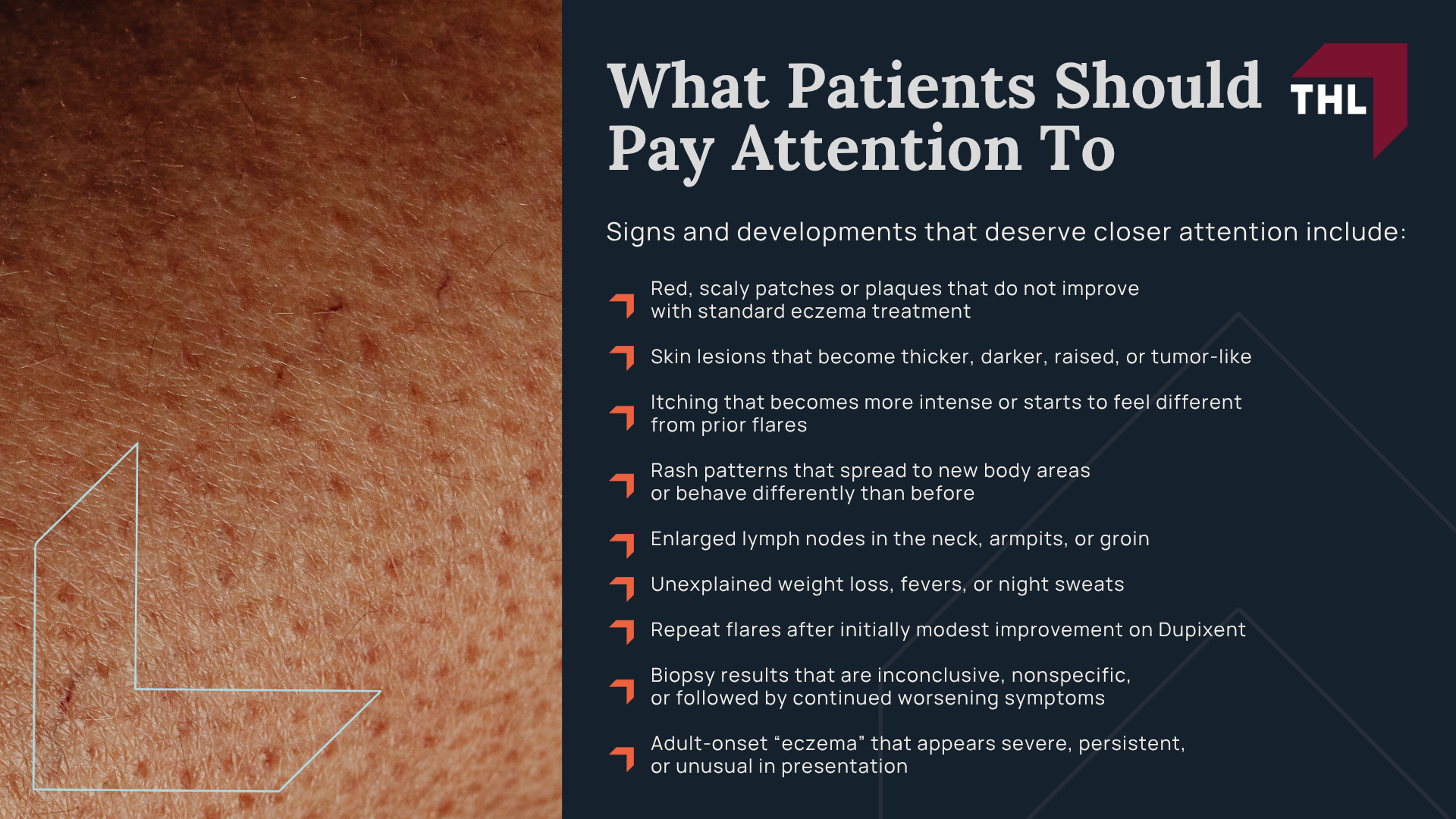
Cutaneous T-cell lymphoma, or CTCL, is a rare non-Hodgkin lymphoma that begins in abnormal T cells and usually shows up first in the skin, most often as persistent patches, plaques, or other rash-like lesions rather than as an obvious internal cancer.
Early CTCL can look very similar to severe eczema or dermatitis, which is one reason the Dupixent debate has focused so heavily on whether some patients already had undiagnosed lymphoma before treatment started.
Major medical sources note that CTCL often develops slowly, but some cases progress from flat, itchy, scaly patches to thicker plaques, tumors, blood involvement, swollen lymph nodes, or spread beyond the skin.
That clinical overlap is what drives the three main theories linking the drug to an increased risk of lymphoma.
One theory is that Dupixent increased lymphoma risk by helping some patients develop CTCL or another T-cell lymphoma after treatment began.

Another is that Dupixent did not create a new cancer at all, but instead changed the inflammatory picture enough to reveal CTCL that had been mistaken for severe eczema.
A third theory focuses on delayed diagnosis, arguing that when suspicious skin disease was treated as refractory dermatitis for too long, the cancer had more time to progress before doctors recognized what it was.
At this stage, the evidence supports careful scrutiny and further research, but not a settled conclusion that Dupixent directly causes lymphoma in every patient who later receives that diagnosis.
Did Dupixent Cause New Lymphoma?
The strongest evidence used to argue that Dupixent may have caused new lymphoma comes from observational studies and post-marketing reports, not from the original clinical trials that led to approval.
In those early trials, no lymphoma or cutaneous lymphoma cases were reported, which means the concern surfaced later as doctors began seeing lymphoma diagnoses in real-world patients after dupilumab exposure.
Some of the most cited studies have found a measurable association between dupilumab use and later CTCL diagnosis, while others argue the signal may reflect misdiagnosed eczema rather than cancer newly created by the drug.
A 2025 population-based asthma cohort also found more new-onset lymphoma in dupilumab users than in matched patients on standard inhaled therapy, which is one reason the “new lymphoma” theory remains part of the scientific debate.
At the same time, none of these studies proves direct causation, and each leaves open the possibility that Dupixent revealed or accelerated disease that was already present at a microscopic or misdiagnosed stage.
Studies and reports most often cited on the “new lymphoma” question include:
- European Respiratory Journal asthma cohort (2025): This population based cohort study found that asthma patients who initiated dupilumab had a higher incidence of new-onset lymphoma than matched patients on inhaled corticosteroid/LABA therapy, with the signal strongest for T-cell and natural killer cell lymphomas. The same study also found lower all-cause mortality in the dupilumab group, which makes the safety picture more complicated rather than one-directional.
- Dermatologic Therapy / Jefferson TriNetX study (2024): In a matched atopic dermatitis retrospective cohort study, patients treated with dupilumab had a reported 4.59-fold relative risk of later CTCL diagnosis compared with non-users. Most CTCL diagnoses after dupilumab occurred within the first year, and a substantial share involved older adults, which is why this study is repeatedly cited in Dupixent litigation.
- JID real-world pharmacovigilance analysis (2024/2025): This work drew attention to biopsy-proven CTCL occurring after dupilumab use in real-world settings and helped move the issue beyond scattered anecdotes into a more structured safety discussion. It supports the existence of a signal, but it does not resolve whether dupilumab caused a truly new cancer or exposed one that was already present.
- JAAD case series of 18 patients (2024): This series documented patients diagnosed with CTCL after dupilumab treatment for presumed atopic dermatitis, with a median time to diagnosis of about 10 months. The short interval is important because it can be read two different ways: either as evidence of rapid emergence after drug exposure or as evidence that CTCL was present but not correctly identified before treatment.
- JACI integrative epidemiology and immunotranscriptomics paper (2024): This study explored biologic mechanisms that might connect IL-4/IL-13 blockade with CTCL risk and progression. It offers a plausible mechanistic framework for why dupilumab could contribute to lymphoma biology, but it remains hypothesis-generating rather than definitive proof.
Several authors point out that observational studies can be affected by background lymphoma risk in severe inflammatory disease, case selection, and the possibility that CTCL was already present before dupilumab exposure.
The short interval between treatment and diagnosis in many reported cases cuts both ways: some readers see rapid emergence after drug exposure, while others see previously missed disease becoming easier to detect.
Did Dupixent Unmask Cancer That Was Already There?
The strongest alternative to the “new lymphoma” theory is that some patients already had early cutaneous T-cell lymphoma before Dupixent was prescribed, but the disease was mistaken for severe eczema or another inflammatory skin disorder. CTCL is well known to mimic dermatitis in its early stages, and that overlap matters most in atopic dermatitis receiving dupilumab, where the starting diagnosis is often a chronic pruritic rash rather than a suspected malignancy.
A growing set of dermatology publications describes dupilumab associated lymphoma as being more complex and not a simple drug-causes-cancer narrative, because the same pattern can reflect misdiagnosis, disease evolution, immune effects, or some combination of those explanations.
The unmasking theory gains force from the fact that CTCL reports are concentrated in dermatology patients, while research in asthma receiving dupilumab raises a different set of questions because those patients are less likely to have preexisting CTCL hidden inside an eczema diagnosis.
Publications most often cited in support of the unmasking theory include:
- “Decoupling the association of dupilumab with cutaneous T-cell lymphoma” (JAAD, 2024): This letter argues that the association seen in TriNetX data may be explained by CTCL patients initially misdiagnosed with atopic dermatitis, then “unmasked” when they failed to improve on dupilumab and underwent more definitive evaluation.
- “Unmasking a masquerader: Mycosis fungoides unveiled after dupilumab” (JAAD, 2023): This report emphasizes that mycosis fungoides can masquerade as eczema and presents dupilumab as a clinical moment when previously smoldering CTCL may become easier to recognize.
- “Did dupilumab unmask smoldering mycosis fungoides?” (JAAD Case Reports, 2023): This case-based discussion explicitly frames dupilumab as a possible trigger for recognition of previously unrecognized mycosis fungoides rather than proof of a newly created cancer.
- “Cutaneous T-Cell Lymphoma and Dupilumab Use: A Multifactorial and Complex Association” (JID, 2024): This commentary states that the relationship is not one-dimensional and suggests the observed signal may arise from several mechanisms, including baseline disease confusion, selective recognition, and biologic effects.
- American Journal of Clinical Dermatology review, “Dupilumab and Cutaneous T-Cell Lymphoma: A Call for Vigilance, Not Alarm” (2025): This review treats unmasking as a serious and plausible explanation for many dermatology cases while also noting that it may not explain every lymphoma signal seen outside eczema populations.
Did Dupixent Contribute To Delayed Diagnosis?
In some patients, the central problem may not be that Dupixent created a new cancer, but that cutaneous T-cell lymphoma continued to be treated as severe eczema after warning signs were already present.
A 2024 JAAD retrospective study on delays in CTCL diagnosis explains that these cancers often mimic benign inflammatory skin disease, which can lead to years of ineffective treatment before the correct diagnosis is made.What Larger Studies Have Found
Another JAAD update on primary cutaneous lymphomas states that persistent patches or plaques that do not respond to usual therapy, expanding tumors, or erythroderma should keep lymphoma in the differential diagnosis and warrant a low threshold for biopsy.
Several reports describe patients whose presumed atopic dermatitis did not improve, changed pattern, or worsened before repeat biopsies finally identified CTCL.
Publications that support the delayed-diagnosis theory include:
- “Delays in diagnosis in cutaneous T-cell lymphoma: A retrospective study” (JAAD, 2024): This study focuses directly on diagnostic lag in CTCL and explains that the disease often resembles benign inflammatory dermatoses, leading to delayed recognition and ineffective or even harmful treatment.
- “Bridging the specialty gap: Update on primary cutaneous lymphomas” (JAAD, 2023): This review states that persistent plaques, tumors, erythroderma, or disease unresponsive to usual therapies should keep primary cutaneous lymphoma on the differential diagnosis and justify prompt biopsy.
- “Progression of cutaneous T-cell lymphoma after dupilumab: Case review” (JAAD, 2020): This report describes patients initially treated as atopic dermatitis who were later diagnosed with CTCL, along with progression in some patients during treatment.
- “Diagnosis of cutaneous T-cell lymphoma following exposure to biologic agents for atopic dermatitis” (JAAD, 2025): This publication discusses several explanations for the pattern seen after biologic exposure, including delayed recognition of CTCL in patients first labeled as having advanced atopic dermatitis.