Understanding the risk profile for communities near the Willowbrook plant requires looking at both distance (how close someone lived, worked, or attended school) and duration (how long or how often exposure to the sterilizing agent occurred).
In its risk assessment, the Environmental Protection Agency (EPA) estimated lifetime cancer risks for individuals exposed to ambient air from the facility.
The agency assumed a scenario of continuous inhalation exposure for 70 years in residential settings to approximate worst-case cumulative effects.
Because the facility handled large volumes of ethylene oxide (EtO), a chemically reactive gas used to sterilize medical devices and now classified as a human carcinogen, communities and workers exposed nearby face significant health risks.
Many studies have found that long-term inhalation of EtO is linked to cancers of the white blood cells, such as non-Hodgkin lymphoma and lymphocytic leukemia, as well as breast cancer and other lymphohematopoietic cancers.
Ethylene oxide exposure risks are not uniformly distributed.
Factors like prevailing wind direction, emission points (e.g., chamber vents, back-vents, aeration rooms), and topography can concentrate toxic air in certain downwind neighbourhoods.
In addition to cancer risks, non-cancer health effects such as peripheral neuropathy, memory loss, impaired coordination, and respiratory irritation have been observed or flagged in health agency reviews, especially among residents and workers with higher exposures.
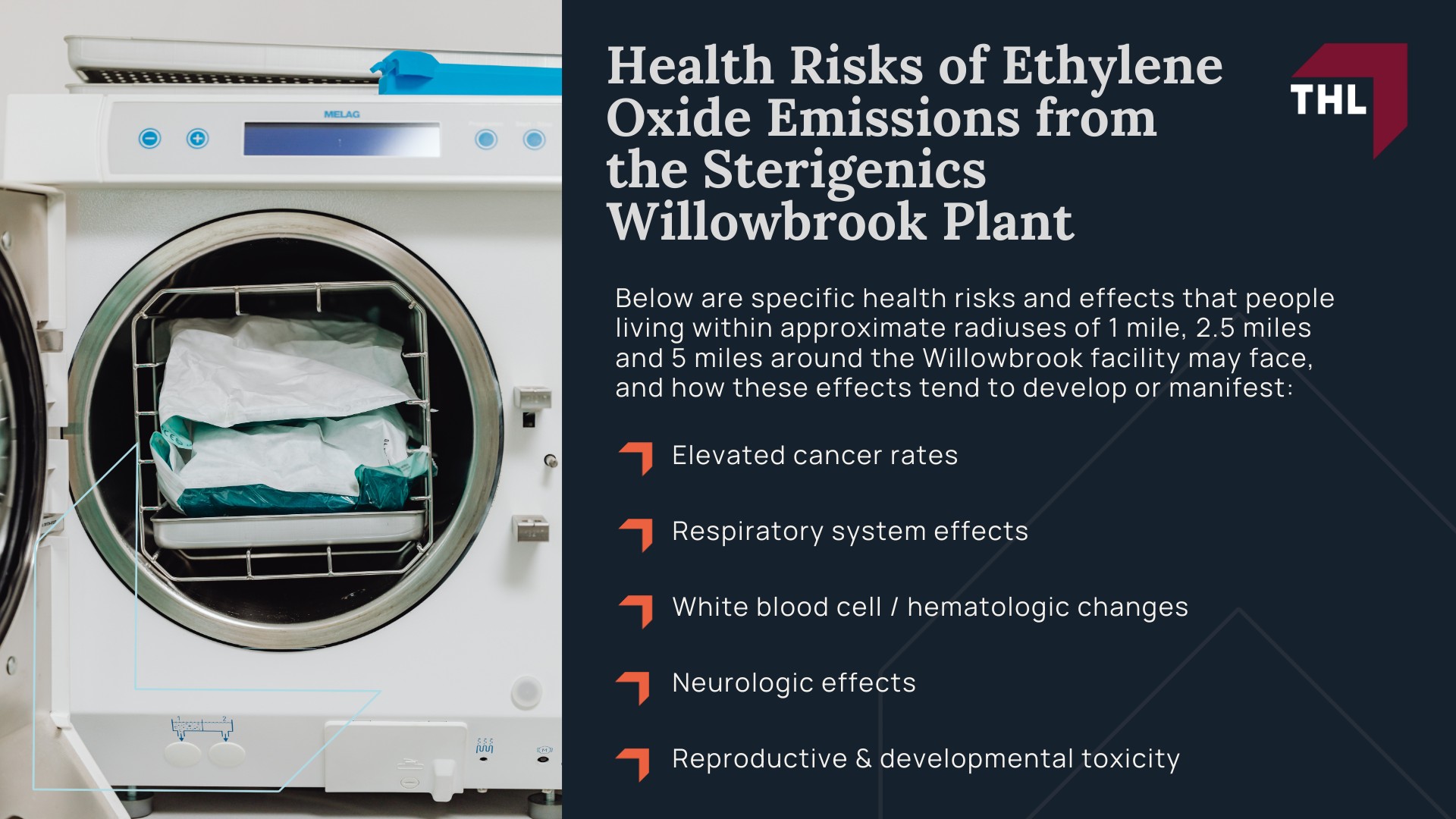
Below are specific health risks and effects that people living within approximate radiuses of 1 mile, 2.5 miles and 5 miles around the Willowbrook facility may face, and how these effects tend to develop or manifest:
- Elevated cancer rates: Long-term exposure to ambient EtO in downwind zones is linked to breast cancer, chronic lymphocytic leukemia, non-Hodgkin lymphoma, multiple myeloma and other lymphohematopoietic cancers.
- Respiratory system effects: Chronic inhalation of low-level EtO can lead to throat and lung irritation, coughing, and in high-exposure scenarios pulmonary edema or more serious lung damage.
- White blood cell / hematologic changes: Studies in occupational settings show EtO can alter white blood cell counts, affecting immune response and increasing mutation risk in hematologic tissues.
- Neurologic effects: Residents and workers exposed to higher concentrations of EtO may experience symptoms such as memory loss, impaired hand-eye coordination, neuropathy, numbness or tingling in the extremities.
- Reproductive & developmental toxicity: Animal and worker studies suggest EtO exposure can affect reproductive organs, fetal development and cause genetic changes that precede major disease onset.
Residents within the first one-mile radius of the sterilization plant typically faced the highest average exposure levels and therefore the greatest likelihood of elevated health risks.
From 1 to 2.5 miles, risk decays but remains elevated depending on direction and meteorological conditions; by 5 miles, risk is reduced but not negligible, especially in areas under consistent downwind conditions and weaker emission controls.
This detailed risk profile shows how toxic substances from commercial sterilization facilities like the Sterigenics Willowbrook plant can cause real and measurable harm in ambient air for neighbouring communities and exposed workers.
Environmental Factors That Influence Ethylene Oxide Exposure Risks
Environmental factors play a critical role in determining how far released ethylene oxide (EtO) travels and where it accumulates, turning a chemical leak into a potential public health hazard for nearby communities.
The Environmental Protection Agency has classified ethylene oxide as a cancer-causing chemical, meaning that even low concentrations of this colorless gas can contribute to elevated cancer risk and other serious health effects.
At the Sterigenics Willowbrook plant, for example, persistent hazardous emissions from sterilizing equipment and associated aeration chambers created conditions that public health advocates say amplified exposure in downwind neighborhoods.
Terrain, prevailing wind patterns, atmospheric stability (such as inversion layers), and proximity to emission points interact in unpredictable ways, so two homes at the same distance from the facility may face vastly different risks.
Some areas ended up with significantly higher ambient air concentrations of EtO than model averages, particularly when the sterilizing agent was vented without enhanced emission controls.
Beyond cancer, subsidiary risks such as peripheral neuropathy, respiratory irritation, and reproductive toxicity arise more frequently in zones where emission mitigation was weak or delayed.
Federal and state agencies now recognize that communities and workers exposed within a 1- to 5-mile radius of commercial sterilization facilities are among the most vulnerable to both cancer-linked and non-cancer health conditions.
The effectiveness of emission control upgrades (testing filters, installing scrubbers, monitoring fence-lines) can dramatically alter the exposure profile, yet gaps in implementation mean many affected neighborhoods still face higher levels of risk.