If you or a loved one suffered injuries, property damage, or other financial losses due to another party’s actions, you may be entitled to compensation for those losses.
Contact the experienced Chicago personal injury lawyers from TorHoerman Law for a free, no-obligation Chicago personal injury lawsuit case consultation today.
If you or a loved one suffered a personal injury or financial loss due to a car accident in Chicago, IL – you may be entitled to compensation for those damages.
Contact an experienced Chicago auto accident lawyer from TorHoerman Law today to see how our firm can serve you!
If you or a loved one have suffered injuries, property damage, or other financial losses due to a truck accident in Chicago, IL – you may qualify to take legal action to gain compensation for those injuries and losses.
If you or a loved one suffered an injury in a motorcycle accident in Chicago or the greater Chicagoland area – you may be eligible to file a Chicago motorcycle accident lawsuit.
If you have been involved in a bicycle accident in Chicago at no fault of your own and you suffered injuries as a result, you may qualify to file a Chicago bike accident lawsuit.
Chicago is one of the nation’s largest construction centers.
Thousands of men and women work on sites across the city and metropolitan area on tasks ranging from skilled trades to administrative operations.
Unfortunately, construction site accidents are fairly common.
Contact TorHoerman Law to discuss your legal options with an experienced Chicago construction accident lawyer, free of charge and no obligation required.
Nursing homes and nursing facilities should provide a safe, supportive environment for senior citizens, with qualified staff, nurses, and aids administering quality care.
Unfortunately, nursing home abuse and neglect can occur, leaving residents at risk and vulnerable.
Contact an experienced Chicago nursing home abuse lawyer from TorHoerman Law today for a free consultation to discuss your legal options.
If you are a resident of Chicago, or the greater Chicagoland area, and you have a loved one who suffered a fatal injury due to another party’s negligence or malpractice – you may qualify to file a wrongful death lawsuit on your loved one’s behalf.
When a child is injured at a daycare center, parents are left wondering who can be held liable, who to contact for legal help, and how a lawsuit may pan out for them.
If your child has suffered an injury at a daycare facility, you may be eligible to file a daycare injury lawsuit.
Contact a Chicago daycare injury lawyer from TorHoerman Law today for a free consultation to discuss your case and potential legal action!
If you or a loved one suffered injuries, property damage, or other financial losses due to another party’s actions, you may be entitled to compensation for those losses.
Contact the experienced Edwardsville personal injury lawyers from TorHoerman Law for a free, no-obligation Edwardsville personal injury lawsuit case consultation today.
If you or a loved one suffered a personal injury or financial loss due to a car accident in Edwardsville, IL – you may be entitled to compensation for those damages.
If you or a loved one have suffered injuries, property damage, or other financial losses due to a truck accident in Edwardsville, IL – you may qualify to take legal action to gain compensation for those injuries and losses.
If you or a loved one suffered an injury in a motorcycle accident in Edwardsville – you may be eligible to file an Edwardsville motorcycle accident lawsuit.
If you have been involved in a bicycle accident in Edwardsville at no fault of your own and you suffered injuries as a result, you may qualify to file an Edwardsville bike accident lawsuit.
Nursing homes and nursing facilities should provide a safe, supportive environment for senior citizens, with qualified staff, nurses, and aids administering quality care.
Unfortunately, nursing home abuse and neglect can occur, leaving residents at risk and vulnerable.
If you are a resident of Edwardsville and you have a loved one who suffered a fatal injury due to another party’s negligence or malpractice – you may qualify to file a wrongful death lawsuit on your loved one’s behalf.
When a child is injured at a daycare center, parents are left wondering who can be held liable, who to contact for legal help, and how a lawsuit may pan out for them.
If your child has suffered an injury at a daycare facility, you may be eligible to file a daycare injury lawsuit.
Contact an Edwardsville daycare injury lawyer from TorHoerman Law today for a free consultation to discuss your case and potential legal action!
If you or a loved one suffered injuries on someone else’s property in Edwardsville IL, you may be entitled to financial compensation.
If property owners fail to keep their premises safe, and their negligence leads to injuries, property damages or other losses as a result of an accident or incident, a premises liability lawsuit may be possible.
If you or a loved one suffered injuries, property damage, or other financial losses due to another party’s actions, you may be entitled to compensation for those losses.
Contact the experienced St. Louis personal injury lawyers from TorHoerman Law for a free, no-obligation St. Louis personal injury lawsuit case consultation today.
If you or a loved one suffered a personal injury or financial loss due to a car accident in St. Louis, IL – you may be entitled to compensation for those damages.
If you or a loved one have suffered injuries, property damage, or other financial losses due to a truck accident in St. Louis, IL – you may qualify to take legal action to gain compensation for those injuries and losses.
If you or a loved one suffered an injury in a motorcycle accident in St. Louis or the greater St. Louis area – you may be eligible to file a St. Louis motorcycle accident lawsuit.
If you have been involved in a bicycle accident in St. Louis at no fault of your own and you suffered injuries as a result, you may qualify to file a St. Louis bike accident lawsuit.
St. Louis is one of the nation’s largest construction centers.
Thousands of men and women work on sites across the city and metropolitan area on tasks ranging from skilled trades to administrative operations.
Unfortunately, construction site accidents are fairly common.
Contact TorHoerman Law to discuss your legal options with an experienced St. Louis construction accident lawyer, free of charge and no obligation required.
Nursing homes and nursing facilities should provide a safe, supportive environment for senior citizens, with qualified staff, nurses, and aids administering quality care.
Unfortunately, nursing home abuse and neglect can occur, leaving residents at risk and vulnerable.
If you are a resident of St. Louis, or the greater St. Louis area, and you have a loved one who suffered a fatal injury due to another party’s negligence or malpractice – you may qualify to file a wrongful death lawsuit on your loved one’s behalf.
When a child is injured at a daycare center, parents are left wondering who can be held liable, who to contact for legal help, and how a lawsuit may pan out for them.
If your child has suffered an injury at a daycare facility, you may be eligible to file a daycare injury lawsuit.
Contact a St. Louis daycare injury lawyer from TorHoerman Law today for a free consultation to discuss your case and potential legal action!
The Ozempic lawsuit centers on allegations that Novo Nordisk failed to adequately warn consumers about serious risks associated with Ozempic and other GLP-1 medications.
Plaintiffs allege the drug has been linked to severe gastrointestinal injuries, including gastroparesis, as well as vision loss and other complications that have disrupted patients’ health, nutrition, employment, and daily functioning.
If you or a loved one developed gastroparesis, bowel obstruction, severe vomiting, vision loss, or other serious complications after taking Ozempic or another GLP-1 medication, you may have legal options.
Dupixent lawsuits allege that patients treated with dupilumab therapy later developed cutaneous T-cell lymphoma (CTCL), a rare form of non-Hodgkin lymphoma that can closely resemble severe eczema.
Research and published case reports have raised questions about whether some patients with atopic dermatitis face a higher risk of developing CTCL compared to similar patients who did not receive the drug.
Plaintiffs contend that Sanofi and Regeneron failed to warn patients and physicians about the possibility that Dupixent could worsen, accelerate, or reveal previously undiagnosed cutaneous lymphoma.
If you or a loved one has suffered a severe reaction or blood cancer linked to Dupixent, you may be eligible to take action and file a Dupixent lawsuit.
Suboxone, a medication often used to treat opioid use disorder (OUD), has become a vital tool which offers a safer and more controlled approach to managing opioid addiction.
Despite its widespread use, Suboxone has been linked to severe tooth decay and dental injuries.
Suboxone Tooth Decay Lawsuits claim that the companies failed to warn about the risks of tooth decay and other dental injuries associated with Suboxone sublingual films.
The chemotherapy drug Taxotere, commonly used for breast cancer treatment, has been linked to severe eye injuries, permanent vision loss, and permanent hair loss.
Taxotere Lawsuits are being filed by breast cancer patients and others who have taken the chemotherapy drug and subsequently developed vision problems.
If you or a loved one used Taxotere and subsequently developed vision damage or other related medical problems, you may be eligible to file a Taxotere Lawsuit and seek financial compensation.
Tylenol (Acetaminophen), one of the most popular over the counter medications for pain relief and high fever, has been associated with an increased risk of Autism Spectrum Disorder (ASD), Attention Deficit Hyperactivity Disorder (ADHD), and other developmental disorders in children exposed to Acetaminophen during pregnancy.
Legal claims against manufacturers and distributors of generic Acetaminophen have been investigated on behalf of pregnant women who used Tylenol during pregnancy and children who developed disorders such as Autism Spectrum Disorder, ADHD, and more.
Spinal cord stimulator lawsuit claims allege that these devices are defectively designed and improperly marketed without adequate warnings, leading to severe injuries for patients.
TorHoerman Law is investigating claims involving spinal cord stimulators that allegedly caused serious injury instead of the relief patients were led to expect.
If you or a loved one experienced complications following spinal cord stimulator surgery, you may be eligible to pursue compensation through a spinal cord stimulator lawsuit.
Several studies have found a correlation between heavy social media use and mental health challenges, especially among younger users.
Social media harm lawsuits claim that social media companies are responsible for onsetting or heightening mental health problems, eating disorders, mood disorders, and other negative experiences of teens and children
You may be eligible to file a Social Media Mental Health Lawsuit if you are the parents of a teen, or teens, who attribute their use of social media platforms to their mental health problems.
Thousands of Uber sexual assault claims have been filed by passengers who suffered violence during rides arranged through the platform.
The ongoing Uber sexual assault litigation spans both federal law and California state court, with a consolidated Uber MDL (multi-district litigation) currently pending in the Northern District of California.
Uber sexual assault survivors across the country are coming forward to hold the company accountable for negligence in hiring, screening, and supervising drivers.
If you or a loved one were sexually assaulted, sexually battered, or faced any other form of sexual misconduct from an Uber driver, you may be eligible to file an Uber Sexual Assault Lawsuit.
Roblox lawsuit claims center on allegations that the platform allowed predators to groom, exploit, and abuse children through unsafe design and inadequate protections.
TorHoerman Law is dedicated to helping families who believe their child was harmed on Roblox pursue justice and financial recovery.
For many families, legal action represents both a path to compensation and a way to demand systemic change in how Roblox treats the safety of its youngest players.
If your child was sexually abused, exploited, or exposed to harmful content through Roblox, you may be eligible to take legal action by filing a lawsuit against Roblox Corporation.
Although pressure cookers were designed to be safe and easy to use, a number of these devices have been found to have a defect that can lead to excessive buildup of internal pressure.
The excessive pressure may result in an explosion that puts users at risk of serious injuries such as burns, lacerations, an even electrocution.
If your pressure cooker exploded and caused substantial burn injuries or other serious injuries, you may be eligible to file a Pressure Cooker Lawsuit and secure financial compensation for your injuries and damages.
Olympus Scope lawsuit claims center on allegations that certain reusable Olympus endoscopes and related accessories exposed patients to dangerous bacterial contamination after medical procedures.
These infections can lead to hospitalization, IV antibiotic treatment, sepsis, organ failure, and death, leaving many patients with serious medical complications and lasting physical harm.
You may qualify to file an Olympus scope lawsuit if you underwent an ERCP or another endoscopic procedure involving Olympus equipment and later developed a serious bacterial infection.
Families who lost a loved one after infection-related complications linked to an Olympus scope procedure may also be able to pursue a wrongful death claim.
Vaginal Mesh Lawsuits are being filed against manufacturers of transvaginal mesh products for injuries, pain and suffering, and financial costs related to complications and injuries of these medical devices.
Over 100,000 Transvaginal Mesh Lawsuits have been filed on behalf of women injured by vaginal mesh and pelvic mesh products.
If you or a loved one have suffered serious complications or injuries from vaginal mesh, you may be eligible to file a Vaginal Mesh Lawsuit.
Breast mesh lawsuits involve allegations that certain mesh products used during breast reconstruction, augmentation, and lift procedures contributed to postoperative complications and the need for revision surgeries.
Patients who experienced complications after mesh-assisted breast procedures have reported chronic pain, reconstruction problems, cosmetic deformities, and additional revision surgeries.
If you or a loved one experienced serious complications after breast surgery involving mesh or an internal bra technique, you may be eligible to pursue a breast mesh lawsuit claim for the harm caused.
Patients with the PowerPort devices may possibly be at a higher risk of serious complications or injury due to a catheter failure, according to lawsuits filed against the manufacturers of the Bard PowerPort Device.
If you or a loved one have been injured by a Bard PowerPort Device, you may be eligible to file a Bard PowerPort Lawsuit and seek financial compensation.
The AngioDynamics port catheter lawsuit claims that defective implantable ports have caused patients to suffer dangerous fractures, blood clots, and infections due to the breakdown of the catheter’s material inside the body.
These failures can lead to life-threatening complications such as embolism, sepsis, or the need for surgical removal of the device.
If you or a loved one experienced severe complications such as blood clots, infections, or catheter fractures requiring surgery due to a defective AngioDynamics port catheter, you may be eligible to file an AngioDynamics Port Catheter Lawsuit and seek compensation.
NEC Lawsuit claims allege that certain formulas given to infants in NICU settings increase the risk of necrotizing enterocolitis (NEC) – a severe intestinal condition in premature infants.
Parents and guardians are filing NEC Lawsuits against baby formula manufacturers, alleging that the formulas contain harmful ingredients leading to NEC.
Despite the claims, Abbott and Mead Johnson deny the allegations, arguing that their products are thoroughly researched and dismissing the scientific evidence linking their formulas to NEC, while the FDA issued a warning to Abbott regarding safety concerns of a formula product.
You may be eligible to file a Toxic Baby Formula NEC Lawsuit if your child received baby bovine-based (cow’s milk) baby formula in the maternity ward or NICU of a hospital and was subsequently diagnosed with Necrotizing Enterocolitis (NEC).
Paraquat, a widely-used herbicide, has been linked to Parkinson’s disease, leading to numerous Paraquat Parkinson’s Disease Lawsuits against its manufacturers for failing to warn about the risks of chronic exposure.
Due to its toxicity, the EPA has restricted the use of Paraquat and it is currently banned in over 30 countries.
You may be eligible to file a Paraquat Lawsuit if you or a loved one were exposed to Paraquat and subsequently diagnosed with Parkinson’s Disease or other related health conditions.
Ethylene Oxide Lawsuit claims center on allegations that Sterigenics U.S., LLC and other defendants negligently released hazardous levels of ethylene oxide (EtO), exposing nearby residents and workers to a known carcinogen linked to breast cancer, leukemia, lymphoma, and other serious illnesses.
If you or a loved one were diagnosed with cancer or other serious health problems associated with exposure to ethylene oxide and lived near a facility with known emissions, you may be eligible to file an Ethylene Oxide Lawsuit and seek financial compensation.
Nitrous oxide lawsuit claims center on manufacturers, distributors, and retailers who profit from selling canisters that are widely misused as a recreational drug.
Reports link this misuse to severe neurological injuries, psychiatric symptoms, hypoxia, and deaths caused by accidents or overdose.
These cases are rapidly expanding as more evidence emerges of the profound physical, psychological, and social toll caused by nitrous oxide misuse.
If you or a loved one has suffered brain injuries, spinal cord or nerve damage, psychiatric symptoms, or even death linked to misused nitrous oxide, you may be eligible to pursue a nitrous oxide lawsuit claim and seek compensation for the harm caused.
Diacetyl popcorn lung lawsuit claims center on allegations that repeated inhalation of butter-flavoring chemicals in certain workplaces, including diacetyl and related substitutes, caused permanent and preventable airway damage.
Popcorn lung, medically known as bronchiolitis obliterans or constrictive bronchiolitis, is a serious obstructive lung disease that scars and narrows the small airways, leaving many people with persistent shortness of breath, chronic cough, and reduced exercise tolerance.
TorHoerman Law has experience handling diacetyl popcorn lung cases and is currently reviewing claims from workers who believe occupational exposure to these flavoring chemicals contributed to their diagnosis.
If you or a loved one were diagnosed with diacetyl induced lung disease or bronchiolitis obliterans, you may have grounds to pursue a diacetyl popcorn lung lawsuit for the harm caused to your lung tissue and long-term lung function.
Our firm is about people. That is our motto and that will always be our reality.
We do our best to get to know our clients, understand their situations, and get them the compensation they deserve.
At TorHoerman Law, we believe that if we continue to focus on the people that we represent, and continue to be true to the people that we are – justice will always be served.
Without our team, we would’nt be able to provide our clients with anything close to the level of service they receive when they work with us.
The TorHoerman Law Team commits to the sincere belief that those injured by the misconduct of others, especially large corporate profit mongers, deserve justice for their injuries.
Our team is what has made TorHoerman Law a very special place since 2009.
TorHoerman Law is actively accepting claims for the Spinal Cord Stimulator Lawsuit.
Defendants
Boston Scientific Corporation / Boston Scientific Neuromodulation Corporation
Abbott Laboratories / St. Jude Medical
Nevro Corp. / Globus Medical, Inc.
Medtronic, Inc.
Injuries named in lawsuit
Permanent nerve damage
Painful electrical shocks or burns
Worsening or severe chronic pain
Lead migration or lead fracture
Neurological deficits
Autonomic dysfunction
Infection
Need for revision or device removal surgery
You may qualify to file a claim if...
You received a permanent spinal cord stimulator manufactured by Boston Scientific, Abbott, Nevro, Medtronic, or another manufacturer.
After implantation, you developed serious complications.
The complications required revision surgery, device removal, repeated reprogramming, hospitalization, or other significant medical treatment.
Lawsuits For Injuries Linked To Spinal Cord Stimulator Overstimulation
Spinal cord stimulator overstimulation occurs when an implanted device delivers electrical stimulation that is too strong, painful, or directed into unintended areas of the body.
Patients may experience electrical shocks, burning sensations, painful tingling, muscle spasms, headaches or migraines, or stimulation that changes unexpectedly with movement or body position.
Although overstimulation can often be corrected through device reprogramming, persistent or worsening symptoms may also indicate lead migration, lead fracture, hardware malfunction, or another complication requiring medical evaluation.
TorHoerman Law is reviewing claims from individuals who suffered serious complications after receiving a spinal cord stimulator, including painful shocks, burning sensations, overstimulation symptoms, failed pain relief, revision surgery, and device removal.
Spinal cord stimulators are implanted medical devices designed to help manage chronic pain by delivering electrical pulses that alter pain signal transmission near the spinal cord.
While many patients experience meaningful pain relief, some develop overstimulation symptoms when the electrical stimulation becomes too intense, painful, or spreads beyond the intended treatment area.
Patients may describe overstimulation as painful electrical shocks, burning sensations, intense tingling, muscle spasms, headaches or migraines, or stimulation that changes unexpectedly with movement or body position.
In many cases, these symptoms can be corrected through device reprogramming.
Persistent or worsening overstimulation, however, may indicate lead migration, lead fracture, hardware malfunction, improper device settings, or another complication requiring further medical evaluation.
Current spinal cord stimulator lawsuits examine whether defective devices, inadequate warnings, manufacturing defects, or other device-related failures caused patients to suffer serious injuries or undergo additional medical treatment.
When overstimulation is accompanied by worsening pain, neurological symptoms, loss of pain relief, revision surgery, explant surgery, or long-term functional impairment, the underlying cause may warrant further investigation.
Patients who experienced serious complications after receiving a spinal cord stimulator may be eligible to pursue a product liability lawsuit.
Whether a claim exists depends on the specific device involved, the medical evidence, the nature of the complication, and whether the injuries can be linked to the implanted system.
If you or a loved one suffered serious complications after receiving a spinal cord stimulator, you may be eligible to file a spinal cord stimulator lawsuit.
Spinal cord stimulator overstimulation occurs when an implanted device delivers stimulation that feels too strong, painful, uncontrolled, or directed into unintended areas of the body.
Patients may describe spinal cord stimulator overstimulation symptoms as electrical shocks, jolts, burning pain, uncomfortable buzzing, tingling sensation, muscle spasms, weakness, or pain that spreads beyond the original treatment area.
Spinal cord stimulators are medical devices used in interventional pain management for certain patients with chronic pain.
During spinal cord stimulation, electrical signals are delivered near the spinal cord to affect nerve activity and help block pain signals before they reach the brain.
The goal is to reduce pain, improve function, and limit reliance on pain medication or other pain medicine when conservative treatment options, such as physical therapy, have not provided effective pain relief.
A spinal cord stimulator implant usually includes leads placed in the epidural space near the spine and an implanted generator that sends electrical current through those leads.
The epidural space sits outside the dura mater, the protective membrane surrounding the spinal cord. Before permanent implantation, many patients go through a trial period to see whether the cord stimulator can manage chronic pain.
If the trial works, a permanent spinal cord stimulator may be surgically implanted.
Overstimulation may happen when the device settings are too strong, the leads move, the hardware fails, or the stimulator delivers stimulation into nearby nerves or unintended areas.
In some patients, overstimulation may be temporary and corrected through reprogramming.
In others, it may signal device migration, lead fracture, manufacturing defects, or other device related complications that require additional medical care.
Some patients notice symptoms immediately after spinal cord stimulator implantation.
Others develop symptoms weeks, months, or years after surgery.
Possible symptoms may include:
Electrical shocks or jolting sensations
Burning pain or heat-like sensations
Tingling, buzzing, or pins-and-needles sensations
Numbness, muscle weakness, or loss of function
Muscle spasms or involuntary movements
Pain spreading to new areas of the body
Balance problems or difficulty walking
Worsening pain after implantation
Loss of pain relief from the spinal cord stimulator
New nerve pain near the spine, legs, arms, back, chest, or abdomen
These symptoms do not always mean the implanted device is defective.
Painful stimulation, worsening pain, or neurological changes should be reported to healthcare providers, especially when symptoms interfere with walking, sleeping, working, or daily activities.
Electric Shocks or Jolting Sensations
Electrical shocks are among the most concerning spinal cord stimulator overstimulation symptoms.
Patients may describe sudden jolts, zaps, stabbing sensations, or stimulation that feels like an electric current moving through the body.
These sensations may occur when:
The device settings are too high
The stimulation pattern changes unexpectedly
A lead migrates away from its intended position
A lead fracture disrupts electrical delivery
The implanted generator or battery malfunctions
The device stimulates nearby nerves instead of the intended pain pathway
Some patients experience occasional shocks only during movement, bending, coughing, or posture changes.
Others may feel repeated electrical shocks even while resting.
Persistent shocks may cause fear of using the device, sleep loss, worsening pain, and reduced mobility.
Burning Pain or Heat-Like Sensations
Burning pain may feel like heat, fire, skin irritation, deep nerve pain, or a hot sensation near the implant site or along the stimulation pathway.
Patients may report burning in the back, legs, buttocks, chest, arms, or another area depending on where the spinal cord stimulator is placed and which nerves are affected.
Burning symptoms may be linked to overstimulation, nerve irritation, device malfunction, lead migration, or abnormal stimulation of unintended areas.
In rare cases, patients may also report skin irritation or warmth near the implanted generator, especially with rechargeable systems.
Burning pain should be taken seriously when it is severe, persistent, spreading, or associated with weakness, numbness, swelling, fever, chest pain, or new neurological symptoms.
Tingling, Buzzing, or Pins-and-Needles Sensations
Some spinal cord stimulation systems are designed to create a tingling sensation called paresthesia.
For many patients, that sensation is expected and may overlap the area of chronic pain.
Tingling, buzzing, or pins-and-needles sensations may become problematic when they are painful, too intense, distracting, or located in the wrong part of the body.
A patient may experience problematic tingling when stimulation:
Becomes stronger than expected
Moves into unintended areas
No longer matches the original pain area
Changes after a fall, twist, or physical activity
Occurs with numbness, muscle weakness, or loss of function
Persists despite adjustments to device settings
Not every tingling sensation is a serious complication.
The concern increases when the stimulation becomes painful, unpredictable, or different from what the patient experienced during the trial period or early after permanent implantation.
Numbness, Weakness, or Loss of Function
Numbness, muscle weakness, or loss of function may indicate that stimulation is affecting nerves in a way the patient did not expect.
These symptoms may occur with overstimulation, lead movement, nerve irritation, surgical complications, or other serious side effects.
Patients should report symptoms such as:
New numbness in the legs, feet, arms, hands, abdomen, or chest
Muscle weakness that affects standing, walking, gripping, or lifting
Loss of coordination or reduced control of a limb
Difficulty getting up from a chair or climbing stairs
Changes in bladder or bowel function
New pain with neurological symptoms
Permanent nerve damage is not the expected outcome of spinal cord stimulation, but neurological symptoms after a spinal cord stimulator implant may require urgent medical evaluation.
Patients should not ignore weakness, numbness, or loss of function after implantation.
Muscle Spasms or Involuntary Movements
Muscle spasms may occur when electrical signals stimulate muscles or nearby nerves in unintended areas.
Patients may describe twitching, cramping, jerking, tightening, or involuntary movements after the stimulator is activated.
Muscle spasms may be temporary, but they can become disruptive when they cause pain, interfere with sleep, affect walking, or increase fall risk.
In some cases, spasms may suggest that the device settings need adjustment.
In others, they may point to lead migration, lead fracture, or hardware failure.
Patients who experience repeated spasms should document when the symptoms occur, what stimulation program is being used, whether the symptoms change with posture, and whether turning the device down or off reduces the problem.
Pain Spreading to New Areas of the Body
Pain spreading to new areas of the body can be a warning sign that a spinal cord stimulator is stimulating the wrong nerves or that the lead position has changed.
Instead of reducing pain in the original treatment area, the device may cause pain, tingling, shocks, or burning in a new location.
New pain may affect the:
Back or spine
Legs, feet, or buttocks
Arms, shoulders, or hands
Abdomen, ribs, or chest
Implant pocket near the implanted generator
Areas near the lead path or surgical site
Pain spreading after spinal cord stimulator implantation does not always prove device failure.
When new pain appears with electrical shocks, worsening pain, muscle weakness, or loss of pain relief, patients should contact their healthcare providers for evaluation.
Balance Problems or Difficulty Walking
Balance problems or difficulty walking may occur when overstimulation affects sensation, coordination, muscle control, or nerve activity.
A patient may feel unsteady, weak, dizzy, or unable to trust their legs.
Difficulty walking may be especially serious when it appears suddenly or worsens over time.
It may increase the risk of falls, interfere with work, and limit daily activities.
Patients who experience walking problems after spinal cord stimulator implantation may need imaging, device interrogation, reprogramming, physical therapy, or surgical evaluation.
Signs that should be reported include:
Trouble standing or walking without assistance
New limping or dragging a foot
Sudden leg weakness
Falls or near-falls
Numbness that affects balance
Pain or stimulation that worsens with movement
Worsening Pain After Implantation
A spinal cord stimulator is implanted to reduce pain, not make pain worse.
Some soreness after surgery may be expected, but persistent worsening pain may suggest a complication.
Patients may experience pain at the implant site, pain along the lead path, nerve pain, burning pain, or pain that no longer responds to stimulation.
When Are Overstimulation Symptoms a Warning Sign of Bigger Problems?
Overstimulation symptoms may be a warning sign when they are severe, persistent, worsening, or associated with neurological changes.
A temporary change in stimulation may be addressed through device reprogramming, but serious complications can require urgent care.
Patients should contact healthcare providers promptly if they experience:
Repeated electrical shocks or jolts
Severe burning pain
New numbness or muscle weakness
Loss of function in an arm or leg
Difficulty walking or balance problems
Chest pain or stimulation spreading into the chest
Fever, redness, drainage, or swelling near the surgical site
Loss of pain relief after the device previously worked
Pain that spreads into unintended areas
Symptoms that continue after changing device settings
Patients should seek emergency medical attention for chest pain, sudden weakness, loss of bowel or bladder control, signs of infection, severe neurological symptoms, or symptoms that feel dangerous or rapidly worsening.
What Causes Spinal Cord Stimulator Overstimulation?
Spinal cord stimulator overstimulation can have several causes.
Some involve programming or device settings.
Others involve mechanical problems with the implanted device, including lead migration, lead fracture, battery problems, generator malfunction, or other hardware failure.
Possible causes include:
Programming errors or improper device settings
Lead migration after surgery
Lead fracture or damaged wires
Device migration
Implanted generator malfunction
Battery or charging problems
Hardware defects
Manufacturing defects
Stimulation of nearby nerves or unintended areas
Changes in body position that alter stimulation intensity
Surgical placement issues
Device related complications after permanent implantation
Because spinal cord stimulators involve electrical current delivered near the spinal cord, even small changes in lead position or stimulation output may affect how the device feels and whether it provides pain relief.
Programming Errors or Improper Device Settings
Programming is a major part of how a spinal cord stimulator works.
Device settings may control stimulation strength, frequency, pulse width, and which contacts on the leads deliver electrical signals.
If the settings are too strong or poorly matched to the patient’s anatomy and pain pattern, stimulation may become painful or ineffective.
Some patients may need several programming sessions before the device provides effective pain relief.
Repeated programming failures may suggest a deeper problem, especially if symptoms are linked to lead migration, lead fracture, or hardware malfunction.
Lead Migration or Lead Fracture
Lead migration occurs when spinal cord stimulator leads move from their original position.
Lead fracture occurs when a lead breaks, cracks, or stops transmitting electrical current properly.
Both are among the most common complications associated with SCS devices and can interfere with pain relief.
Lead migration or lead fracture may cause:
Loss of pain relief
New or worsening pain
Electrical shocks
Stimulation in unintended areas
Burning or tingling sensations
Increased need for pain medication
Revision surgery to reposition or replace the lead
Lead migration can be especially significant because the leads are placed near the spinal cord in the epidural space.
If a lead moves, stimulation may no longer cover the intended pain area.
It may also affect nearby nerves or cause stimulation patterns that feel abnormal, painful, or unpredictable.
Battery, Generator, or Hardware Malfunction
The implanted generator powers the spinal cord stimulator and sends electrical current through the leads.
If the generator, battery, charger, lead connector, or internal hardware fails, the device may stop working correctly or deliver stimulation in an unexpected way.
Battery, generator, or hardware malfunction may cause:
Sudden loss of stimulation
Painful or irregular stimulation
Electrical shocks
Failure to charge
Unexpected shutdowns
Loss of pain relief
Error messages or abnormal device readings
Need for generator replacement or revision surgery
Major manufacturers of spinal cord stimulators include Boston Scientific, Abbott, Medtronic, Nevro, and Abbott’s St. Jude Medical device lines.
Lawsuits allege that certain SCS devices were defectively designed, inadequately tested, improperly modified, or sold without adequate warnings about device related complications.
These allegations remain case-specific and must be proven through evidence.
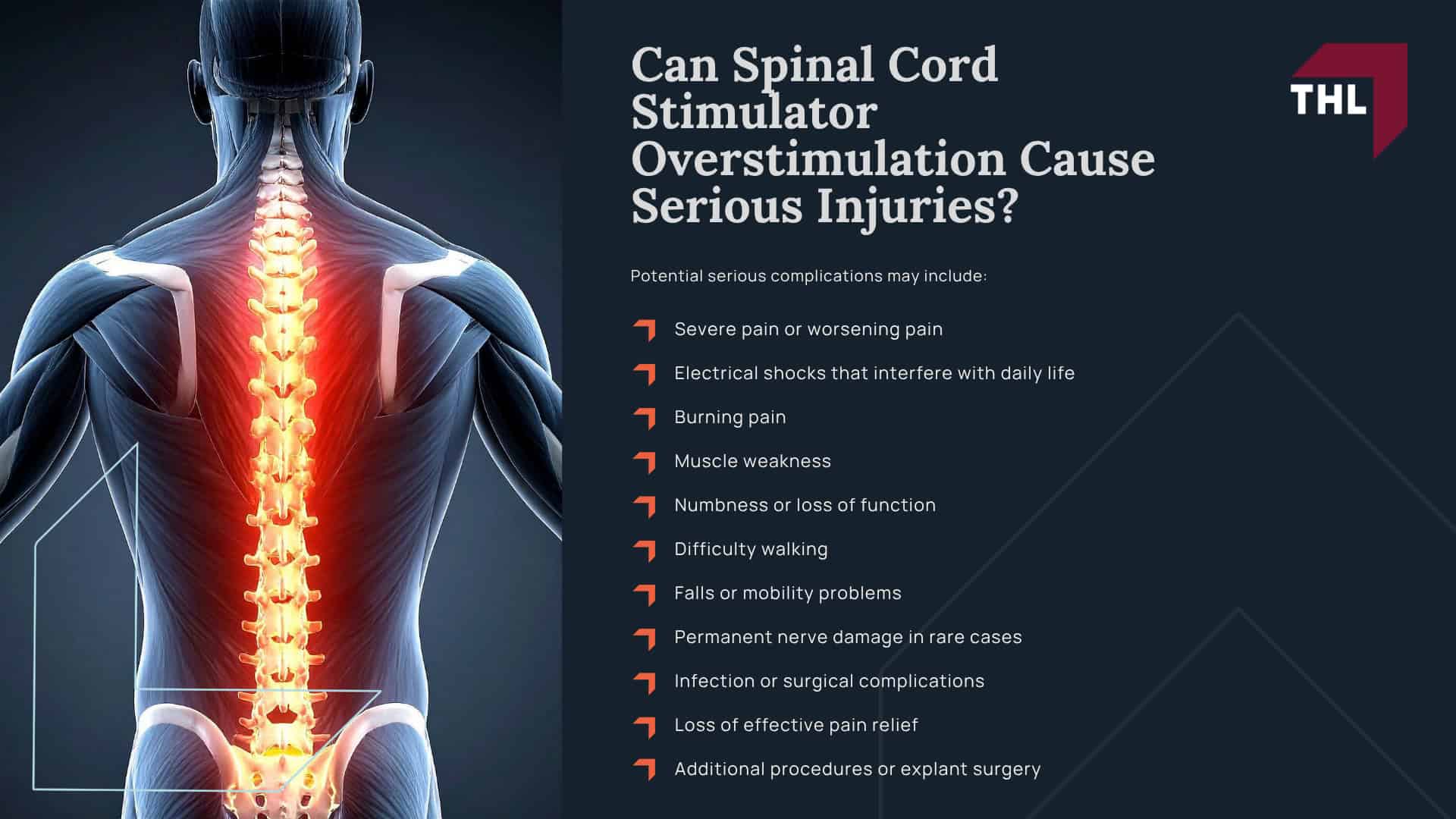
Can Spinal Cord Stimulator Overstimulation Cause Serious Injuries?
Spinal cord stimulator overstimulation may cause serious injuries when painful stimulation is linked to neurological symptoms, device malfunction, surgical complications, or repeated procedures.
In some cases, patients may need reprogramming only.
In more serious cases, they may need imaging, additional pain management, revision surgery, or removal of the stimulator.
Potential serious complications may include:
Severe pain or worsening pain
Electrical shocks that interfere with daily life
Burning pain
Muscle weakness
Numbness or loss of function
Difficulty walking
Falls or mobility problems
Permanent nerve damage in rare cases
Infection or surgical complications
Loss of effective pain relief
Additional procedures or explant surgery
Spinal cord stimulation can help many patients manage chronic pain, but it is still an implanted medical procedure with serious side effects and common complications.
Patients who experience severe injuries after receiving a spinal cord stimulator implant should speak with healthcare providers and preserve records related to the device, symptoms, and treatment.
Spinal Cord Stimulator Overstimulation and Revision Surgery
Revision surgery may be required when overstimulation symptoms cannot be corrected through reprogramming or conservative treatment.
A revision procedure may involve repositioning leads, replacing a fractured lead, repairing a connector, replacing the implanted generator, or removing the spinal cord stimulator entirely.
Revision surgery may be needed when a patient experiences:
Lead migration
Lead fracture
Device migration
Generator malfunction
Loss of pain relief
Severe overstimulation
Painful shocks or burning
Infection
Hardware failure
Failed permanent implantation
Revision surgery can create additional medical risks.
Depending on the procedure, patients may face general anesthesia, infection risk, bleeding, scarring, recovery time, out of pocket costs, missed work, and continued pain.
Some patients may require more than one surgery if the device continues to malfunction or fails to reduce pain after revision.
What to Do If Your Spinal Cord Stimulator Causes Shocks, Burning, or Worsening Pain
Patients who experience electrical shocks, burning pain, worsening pain, or other spinal cord stimulator overstimulation symptoms should report the issue to their healthcare providers.
Symptoms should be evaluated medically before legal conclusions are drawn.
Steps that may help protect your health and preserve evidence include:
Contact your implanting physician, pain management doctor, or device clinic
Ask whether the stimulator should be turned down, adjusted, or turned off
Report severe symptoms, chest pain, weakness, fever, or neurological changes immediately
Keep copies of medical records, imaging, and device interrogation reports
Write down when symptoms started and how they changed
Save the device card, manufacturer information, and model details
Track reprogramming appointments and setting changes
Photograph visible swelling, burns, redness, or surgical-site problems
Preserve receipts, bills, lost wage records, and out of pocket costs
Do not discard device components if the stimulator is removed
Patients should follow medical instructions from their healthcare providers.
Legal claims depend on medical evidence, device records, and proof that the spinal cord stimulator or related procedure caused compensable harm.
Spinal cord stimulator lawsuits involve allegations that defective implanted pain management devices caused patients to suffer serious complications requiring additional medical treatment, revision surgery, or device removal.
Reported claims involve a wide range of alleged problems, including lead migration, lead fracture, battery failures, hardware malfunctions, unexpected electrical stimulation, inadequate warnings, and other device-related complications.
Medical studies have reported that 40% to 65% of spinal cord stimulator patients require revision surgery within 18 months, often because of lead movement, equipment failure, or loss of therapeutic benefit.
FDA data also identified nearly 180,000 adverse event reports between 2004 and 2019, including device malfunctions, patient injuries, and other reported complications associated with spinal cord stimulation systems.
Some lawsuits allege that defective batteries generated excessive heat and caused internal tissue burns, while others focus on failures involving leads, connectors, or implanted pulse generators.
Clinical research has also shown that anatomical differences between patients can affect how electrical current is distributed, making careful device placement, programming, and follow-up evaluation important throughout treatment.
In June 2026, federal lawsuits involving certain Boston Scientific spinal cord stimulators were consolidated into MDL No. 3181 in the U.S. District Court for the Central District of California to coordinate pretrial proceedings, while claims involving other manufacturers continue to be evaluated individually.
Whether a patient has a viable product liability claim depends on the specific device involved, the nature of the alleged defect, the resulting injuries, and the medical evidence connecting the implanted system to the reported complications.
Manufacturers named in spinal cord stimulator injury claims include:
Eligibility depends on the specific facts of your case.
Potential qualifying factors may include:
You received a permanent spinal cord stimulator
You experienced electrical shocks, burning, or painful overstimulation
You developed worsening pain, numbness, muscle weakness, or loss of function
Your device stopped providing pain relief
You were diagnosed with lead migration, lead fracture, or device malfunction
You required revision surgery or explant surgery
You suffered serious injuries or long-term impairment
You incurred medical bills, lost wages, or out of pocket costs
Your medical records connect your symptoms to the stimulator or implantation procedure
Not every patient with spinal cord stimulator symptoms will have a lawsuit.
An attorney can review the device model, manufacturer, medical records, surgical history, complications, and damages to determine whether a claim may be available.
Evidence Needed for a Spinal Cord Stimulator Overstimulation Claim
Evidence is critical in spinal cord stimulator overstimulation injury cases.
Medical records and device information can help show what happened, when symptoms began, and whether the implanted device may have caused the patient’s injuries.
Important evidence may include:
Device identification card
Manufacturer, model, and serial number information
Operative reports from implantation and revision surgery
Records from the trial period and permanent implantation
Device programming and interrogation records
Imaging showing lead migration, lead fracture, or device migration
Pain management records
Emergency room and specialist records
Physical therapy records
Medication records, including pain medication changes
Photos of visible burns, swelling, infection, or implant-site problems
Bills, insurance records, and out of pocket costs
Employment records showing missed work or lost income
Communications with healthcare providers or device representatives
Explanted device components, if available
Preserving the device and related records may be especially important if the case involves manufacturing defects, hardware malfunction, or product liability claims.
Damages in Spinal Cord Overstimulation Injury Cases
Damages in spinal cord overstimulation injury cases depend on the severity of the injuries, medical treatment required, long-term impairment, and available evidence.
Potential compensation may include both economic and non-economic damages.
TorHoerman Law is reviewing spinal cord stimulator lawsuits involving overstimulation symptoms, electrical shocks, burning pain, worsening pain, lead migration, lead fracture, revision surgery, and other serious complications.
Our spinal cord stimulator overstimulation injury lawyers investigate whether an implanted device failed, whether the manufacturer provided adequate warnings, and whether the patient’s injuries support a product liability claim.
We review medical records, device records, surgical history, manufacturer information, and evidence of damages.
TorHoerman Law handles spinal cord stimulator injury claims on a contingency fee basis.
That means there are no upfront costs and no attorney’s fees unless we recover compensation for you.
If you or a loved one suffered serious injuries after receiving a spinal cord stimulator, you may be eligible to file a spinal cord stimulator lawsuit.
Spinal cord stimulator overstimulation symptoms may include electrical shocks, jolting sensations, burning pain, tingling, numbness, muscle weakness, muscle spasms, worsening pain, or stimulation spreading into unintended areas of the body.
These symptoms may occur when the implanted device delivers electrical current that feels too strong, painful, misdirected, or uncontrolled.
Patients should report new or worsening symptoms to their healthcare providers, especially if they interfere with walking, sleeping, working, or daily activities.
Spinal cord stimulator overstimulation does not always mean the device is defective, but it may be a warning sign of a serious device issue.
Painful stimulation may be linked to improper device settings, lead migration, lead fracture, hardware malfunction, manufacturing defects, or other device related complications.
If symptoms continue after reprogramming or lead to revision surgery, device removal, or serious injuries, the patient may want to speak with an attorney about whether a spinal cord stimulator lawsuit may be available.
You may be eligible to file a spinal cord stimulator lawsuit if you received a spinal cord stimulator implant and later suffered serious complications such as painful shocks, burning sensations, worsening pain, lead migration, lead fracture, revision surgery, or device removal.
Eligibility depends on the device involved, the medical treatment required, the evidence connecting your symptoms to the stimulator, and the extent of your injuries.
An attorney can review your medical records, device information, surgical history, and damages to determine whether you may have a valid product liability claim.
Potential compensation in a spinal cord stimulator overstimulation lawsuit may include medical bills, revision surgery costs, device removal expenses, future medical care, pain management treatment, lost wages, out of pocket costs, and pain and suffering.
The value of a claim depends on the severity of the injuries, whether the patient needed additional surgery, whether the symptoms caused long-term impairment, and whether strong evidence supports the connection between the device and the harm.
Cases involving permanent nerve damage, repeated procedures, serious injuries, or major functional decline may involve higher damages than cases with limited treatment or unclear causation.
TorHoerman Law handles spinal cord stimulator injury claims on a contingency fee basis.
This means there are no upfront costs and no attorney’s fees unless compensation is recovered for you.
A free consultation can help determine whether your spinal cord stimulator overstimulation symptoms, medical records, and treatment history may support a lawsuit.
Tor Hoerman has represented injured individuals for more than 30 years, with experience spanning individual personal injury cases and nationwide mass tort litigation. His work includes car accidents, catastrophic injuries, product liability claims, and other serious injury cases. Tor has served in court-appointed leadership roles in national litigation and tried cases involving major corporate defendants.
Legally Reviewed
TorHoerman Law’s legal content is researched and written by our editorial team and attorneys for legal accuracy, clarity, and relevance. We rely on statutes, court records, government publications, medical research, and other authoritative sources when applicable. This page provides general legal information and does not constitute legal advice.
Fact-Checked
TorHoerman Law reviews its legal content for factual accuracy, current information, and relevant legal context before publication and as material developments occur. This article is provided for general informational purposes and does not constitute legal advice. For guidance about a specific case, contact TorHoerman Law.
Additional Spinal Cord Stimulator Lawsuit resources on our website:
TorHoerman Law represents people whose lives have been disrupted by serious injuries, unsafe products, and negligence. Our attorneys handle individual personal injury cases as well as national mass tort lawsuits involving major corporations.
Founded in 2009, our legal team brings more than 100 years of combined experience handling serious injury and complex civil litigation.
Do you believe you’re entitled to compensation?
Use our Instant Case Evaluator to find out in as little as 60 seconds!
In this case, we obtained a verdict of $495 Million for our client’s child who was diagnosed with Necrotizing Enterocolitis after consuming baby formula manufactured by Abbott Laboratories.