Active Litigation
Trampoline Park Injury Lawsuit Facts
TorHoerman Law is actively accepting claims for the Trampoline Park Injury Lawsuit.


Parents often ask, “Can you sue a trampoline park if my child was injured?”
The answer depends on how the injury happened, what safety rules were in place, whether the trampoline park followed those rules, and whether evidence shows the injury was preventable.
Trampoline parks can be different from backyard trampolines or a home trampoline because many facilities place multiple people near each other on connected jumping surfaces.
Kids may be jumping near older children, adults, foam pit areas, dodgeball courts, or high-performance trampoline zones.
When trampoline parks fail to use reasonable safety measures, children can suffer serious injuries, including broken bones, head injuries, neck injuries, sprains, and injuries requiring emergency room care or surgery.

A claim may be possible when the injury was caused by:
The American Academy of Pediatrics has reported that most trampoline injuries occur when multiple people are on the mat, and that cervical spine injuries often involve falls, somersaults, or flips.
This matters because many trampoline park accidents happen in environments where children younger in age are jumping near larger kids, older children, or adults.
A trampoline park may be liable when unsafe equipment or poor maintenance causes a child’s injury.
Trampoline parks must inspect jumping surfaces, padding, frames, springs, foam pit areas, and other equipment so children are not exposed to hidden hazards.

Unsafe equipment may include:
A child who lands on a damaged jumping surface or strikes a hard edge may suffer broken bones, head injuries, neck trauma, back injuries, or other serious injuries.
These are not the same as ordinary awkward landings during trampoline use.
They may be preventable injuries caused by the park’s failure to inspect, repair, or close unsafe equipment.
A trampoline park should not depend only on posted rules.
Staff must supervise jumpers, stop risky stunts, respond to overcrowding, and enforce strict rules that protect small children from avoidable harm.

Lack of supervision may contribute to a claim when employees allow:
Most kids go to trampoline parks for fun, exercise, and a safe way to play.
A park may become legally responsible when it fails to protect them from risks that trained staff should have recognized and stopped.
Overcrowding is one of the most important issues in trampoline park injury cases.
When multiple people jump on connected trampolines, the force created by one jumper can affect another person’s bounce.
This can cause a double bounce, where a larger jumper lands and sends a smaller child into the air with greater force.
A double bounce can cause a child to land wrong, strike the trampoline frame, hit their head, fall into another jumper, or injure the leg, neck, back, or arm.
Little kids face a higher risk when older children or adults are jumping nearby.

A claim may be possible if the trampoline park failed to:
The CPSC identifies collisions with another person, improper landings, falling from the trampoline, and contact with springs or frames as causes of trampoline injuries and deaths.
Trampoline parks often post safety rules, require parents to sign waivers, and advertise that trampolines are safe when used correctly.
Those rules do not protect children unless employees actually enforce them. 
A park’s failure to enforce safety rules may support a claim if staff ignored:
In many cases, the issue is not whether a rule existed.
The issue is whether the park followed its own safety rules before the child was hurt.
Some trampoline park injuries happen because the attraction or layout creates unnecessary danger.
A facility may include trampoline courts, foam pits, ninja courses, dodgeball courts, basketball dunk lanes, climbing walls, and other playground-style attractions.
A dangerous layout may place children too close to hard edges, exposed structures, drop-offs, or other jumpers.
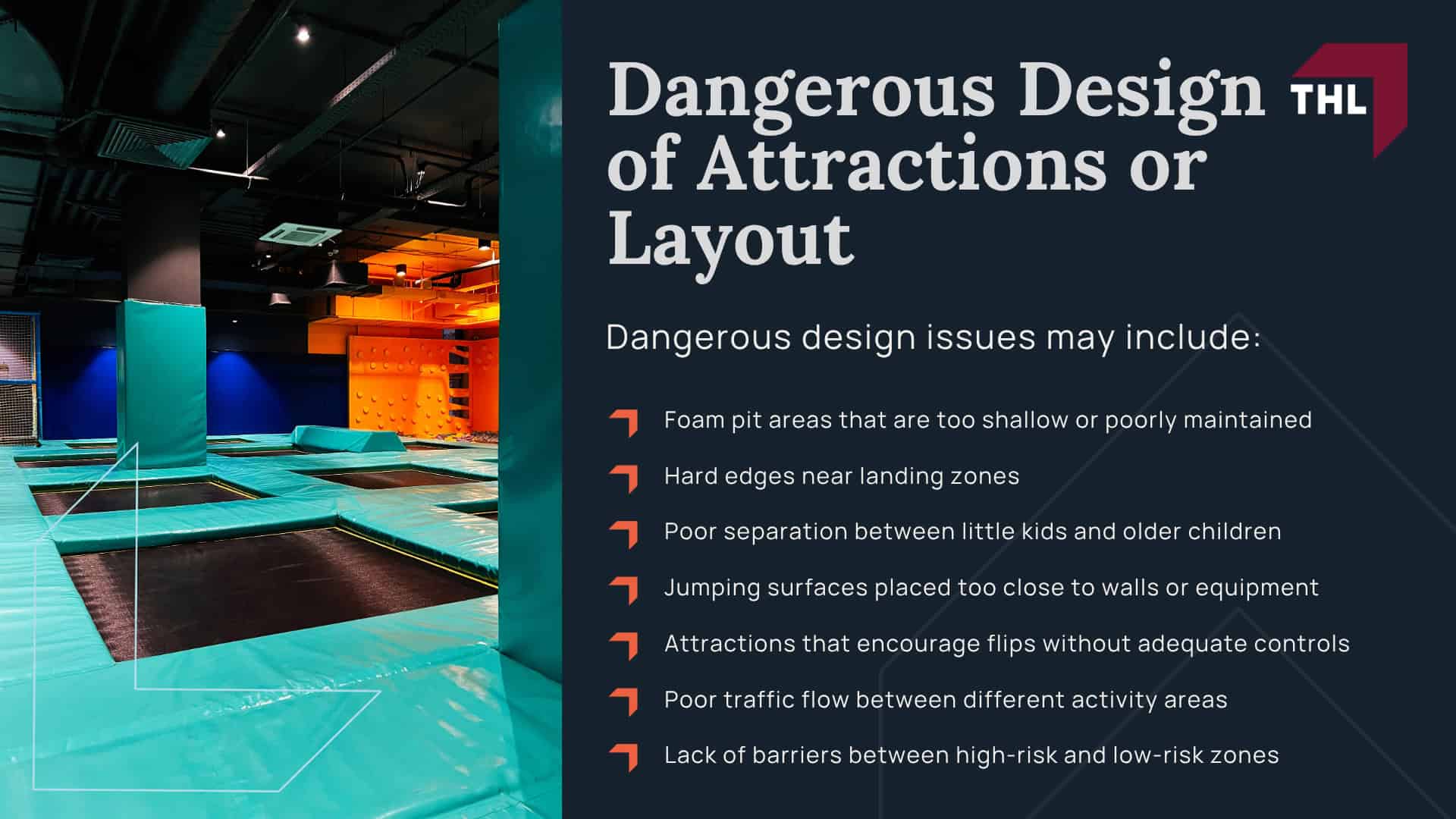
Dangerous design issues may include:
A study published in Pediatrics found that trampoline park injury rates were highest in high-performance areas and inflatable bag or foam pit areas, and 11% of reported injured users sustained significant injuries.
Trampoline parks may also be liable when they fail to provide adequate warnings or safety instructions.
Parents may not know that certain attractions carry a higher risk than ordinary jumping, especially when the park markets the activity as fun, safe, and appropriate for kids.
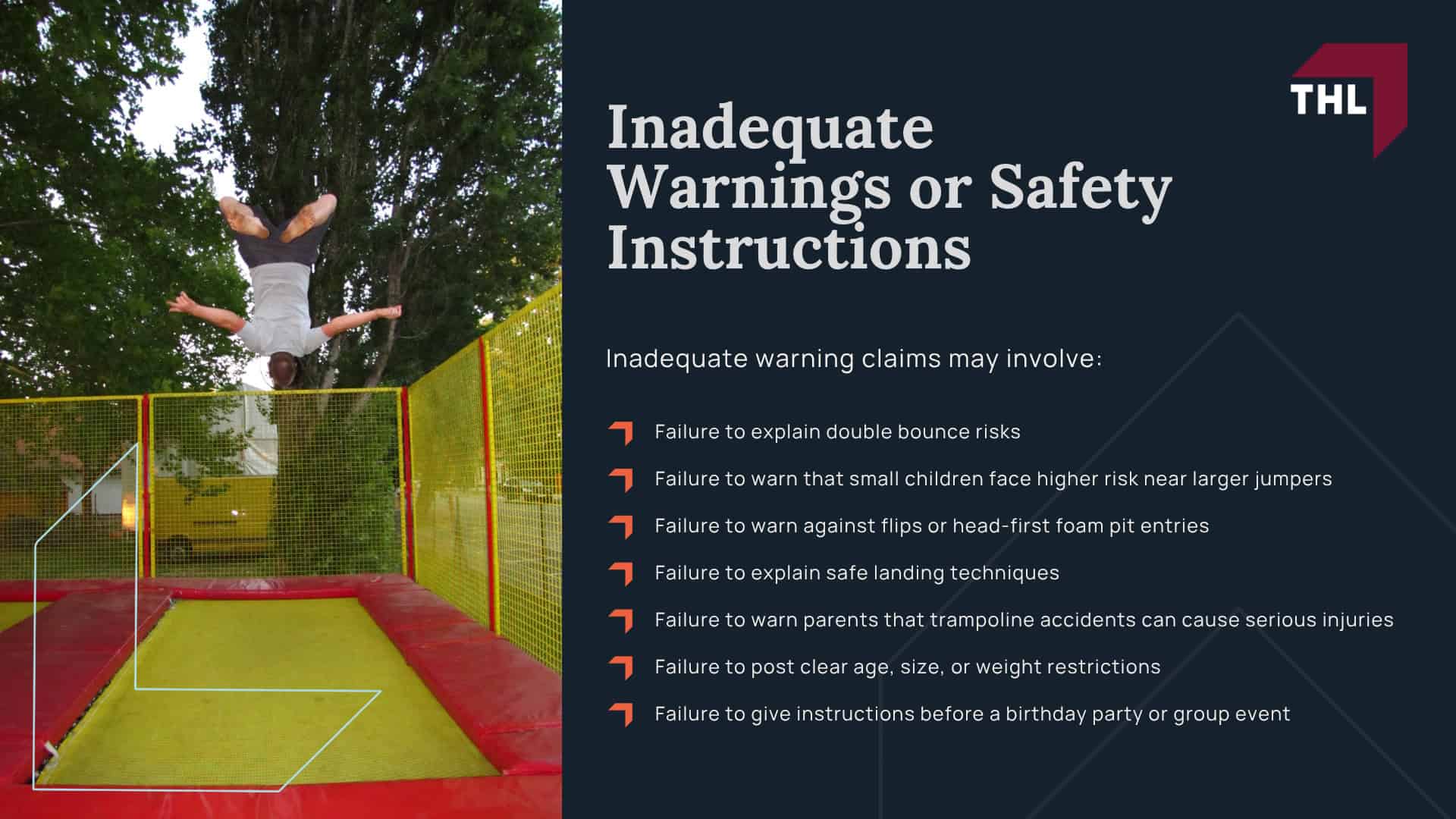
Inadequate warning claims may involve:
Warnings do not excuse unsafe operations.
A park cannot rely on a sign or waiver while allowing dangerous conduct, overcrowding, or defective equipment.
Not every trampoline injury leads to a lawsuit.
Some injuries happen even when a trampoline park uses reasonable safety measures, supervises the area, maintains equipment, and follows applicable rules.
A claim may be limited or not viable when the injury resulted only from an ordinary risk of jumping, there is no evidence of negligence, or the available evidence does not show that the park caused the harm.

Jumping on a trampoline involves some inherent risk.
A child may land awkwardly, twist an ankle, or suffer minor sprains even when the park did nothing wrong.
A claim may be harder to pursue when:
This does not mean a claim is impossible.
It means a lawyer must evaluate whether the accident was truly unavoidable or whether unsafe conditions contributed to the injury.
A trampoline park injury claim usually requires evidence that someone acted carelessly or failed to act reasonably.
If there is no video, no witness, no incident report, no equipment issue, and no proof of unsafe conduct, the case may be difficult to prove.
Useful evidence may include surveillance footage, photos, witness statements, staff admissions, medical records, prior complaints, or maintenance records.
Without evidence, the park or its insurance company may argue that the injury was an ordinary trampoline accident rather than a preventable injury.
Liability waivers can affect trampoline park injury cases.
Many trampoline parks require parents to sign waivers before children can jump, attend a birthday party, or use foam pit attractions.
In some states and in some cases, a clear and enforceable waiver may limit a claim.
This is more likely when an adult signs a waiver for their own participation, the waiver language clearly covers the specific activity, and the claim involves ordinary negligence rather than gross negligence or reckless conduct.
However, waiver law varies by state. Parents should not assume the case is over because they signed a waiver.
A claim may also be limited when the injury was caused solely by participant behavior unrelated to any failure by the park.
For example, if an older child ignores clear instructions, performs prohibited flips, and injures themselves despite active supervision and safe equipment, the park may argue that it did not cause the injury.
That said, many cases require a closer look.
If the park knew kids were performing risky stunts, failed to intervene, failed to separate jumpers, or allowed dangerous conduct to continue, liability may still be possible.
Even serious injuries require proof.
A child may have broken bones, head trauma, or surgery after a trampoline accident, but the family still needs evidence showing how the accident happened and why the park may be legally responsible.
A case may be difficult if:
Parents should act quickly after an injury because evidence at trampoline parks can disappear.
Liability waivers are common at trampoline parks, including national brands such as Sky Zone and other indoor adventure facilities.
A waiver may say that parents accept the risk of trampoline use, agree not to sue, or agree to arbitration.
A waiver can affect a claim, but it does not automatically prevent a lawsuit.
Courts look at state law, the waiver language, who signed the form, the age of the injured person, and the type of conduct alleged.

A lawyer can review whether:
Waivers may be enforced in some cases, especially when an adult signs a clear waiver for their own participation and the injury involves an ordinary risk of the activity.
An adult injured while jumping may face a stronger waiver defense than a child injured by unsafe equipment or poor supervision.
Courts may consider:
Waiver enforceability is a legal question.
Families should have the document reviewed before deciding not to pursue a case.
Waivers may not apply to child injury claims in some states or under some circumstances.
This is especially important when parents sign waivers for children younger than 18.
In 2025, the Pennsylvania Supreme Court addressed claims involving children injured at Sky Zone trampoline parks.
The court held that participation agreements and arbitration provisions signed by one parent were not enforceable against the injured minors or non-signing parents under the facts of those cases.
This does not mean every child injury claim will survive every waiver in every state.
It does mean parents should not assume a signed waiver eliminates their child’s rights.
Waivers often do not protect a business from gross negligence, reckless conduct, or intentional wrongdoing.
Gross negligence may involve more than a simple mistake.
It may involve a serious failure to protect children despite known danger.
Examples may include:
In the most serious cases, a lawyer may investigate whether the park showed reckless disregard for safety.
More than one person or company may be legally responsible for a trampoline park injury.
Liability depends on who controlled the area, who maintained the equipment, who trained employees, and who contributed to the unsafe condition.

Potentially responsible parties may include:
A lawyer can identify which parties had responsibility for the equipment, layout, supervision, training, warnings, and safety practices involved in the accident.
If your child was injured at a trampoline park, your first priority is medical care.
Even if your child can walk or says they feel fine, head injuries, neck injuries, fractures, and internal injuries may not be obvious right away.

Parents should consider these steps:
Prompt action can make a big difference.
Surveillance video may be overwritten, equipment may be repaired, and employees may forget details.
TorHoerman Law represents families whose children suffered serious injuries at trampoline parks and indoor adventure facilities.
Our attorneys investigate whether the injury was truly an accident or whether unsafe equipment, poor supervision, overcrowding, defective design, ignored safety rules, or inadequate warnings caused preventable harm.
We review incident reports, medical records, waiver language, video footage, witness statements, staff training materials, maintenance records, and the layout of the trampoline park.
We also work with medical experts when needed to evaluate the severity of the injury, the treatment required, and the long-term impact on your child’s life.

If your child was hurt at a trampoline park, contact TorHoerman Law today for a free consultation.
You can also use the chatbot on this page to see if you qualify instantly.
Our team can review what happened and explain whether your family may have a claim.


