No Longer Accepting Claims
Camp Lejeune Water Contamination Lawsuit Facts
TorHoerman Law is no longer accepting claims for the Camp Lejeune Water Contamination Lawsuit.
Intake Closed

No Longer Accepting Claims
TorHoerman Law is no longer accepting claims for the Camp Lejeune Water Contamination Lawsuit.
Intake Closed
On this page, we’ll discuss an overview of the Camp Lejeune Brain Cancer Lawsuit, other health conditions linked to the water contamination at Camp Lejeune, who qualifies to file a Camp Lejeune Lawsuit, and much more.
Between 1953 and 1987, toxic substances contaminated wells, treatment plants, and other sources of drinking water at United States Marine Corps Base Camp Lejeune and the nearby Marine Corps Air Station New River.
Military members, family members, and civilian workers exposed to these dangerous chemicals have been diagnosed with often fatal medical conditions, including several types of cancer and other diseases.
Exposure to contaminated drinking water at Camp Lejeune may be linked to an increased risk for brain cancers.

Below, our attorneys look at the studies conducted on the water contamination at Camp Lejeune and evidence linking these substances to brain cancers and other conditions.
If you or a loved one lived or worked at Camp Lejeune for 30 days or more between 1953 and 1987, you may be eligible to file a Camp Lejeune Lawsuit.
Contact TorHoerman Law for a free consultation.
You can also use the chatbot on this page to find out if you qualify for the Camp Lejeune Lawsuit instantly.
Camp Lejeune victims deserve justice and an adequate settlement.
Experienced law firms can help former Camp Lejeune residents participate in the administrative claims process and pursue Camp Lejeune litigation if necessary.
Reach out to our Camp Lejeune lawyers for more information and to ask any questions you may have about the Camp Lejeune Justice Act, Camp Lejeune settlements, and more.
We’re here to help you.
Organizations that have studied water contamination at Camp Lejeune, such as the Agency for Toxic Substances and Disease Registry (ATSDR), Environmental Protection Agency (EPA), and others have linked exposure to toxic water at Camp Lejeune to the development of various health issues, including cancer.
Camp Lejeune water contamination has been associated with an increased risk of brain cancer among military personnel and their families.
Particularly exposure to vinyl chloride, a main contaminant at Camp Lejeune, has been shown to increase risk factors for brain cancers.

Scientific evidence linking vinyl chloride to the increased risk for brain tumors and brain cancers include the following:
Chemicals in the Camp Lejeune water supply have been directly linked to an increased risk of brain tumor symptoms and different types of brain cancer.
If you or a loved one were diagnosed with brain and spinal cord cancer subsequent to being exposed to Camp Lejeune water contamination, you may be eligible to join others in filing Camp Lejeune claims.
Contact TorHoerman Law for more information, or use the chat function on this page to find out if you qualify to take action.
Brain cancer is a devastating disease affecting thousands of individuals worldwide yearly.
Brain cancer occurs when abnormal brain cells grow uncontrollably, forming malignant brain tumors that can interfere with essential brain functions.
The brain is a complex organ filled with specialized regions and cell types.
Among these are the glial cells, which provide support and insulation between neurons.
Gliomas, a common type of brain tumor, start in these glial cells.
In the depths of the brain lies the pineal gland, responsible for melatonin production, and the pituitary gland, the master gland controlling hormonal functions in the body.
Tumors can also arise in or near these glands, affecting their vital functions.
The brain is enveloped by cerebrospinal fluid, which acts as a cushion and provides protection.
This fluid can potentially act as a pathway for tumor cells to spread to other areas of the central nervous system.
The brain’s nourishment and oxygen supply are primarily provided through blood vessels.
These vessels can sometimes be invaded or compressed by tumors, affecting their function and causing various symptoms.
Brain tumor cells can be benign (noncancerous brain tumors) or malignant (cancerous).
A malignant brain tumor, often referred to as a cancerous brain tumor, is the more severe form and can spread to other parts of the brain and to other areas of the body.
Brain tumor diagnosis often includes MRI, CT scans, biopsy, or a combination of all these methods.

Brain tumor symptoms can vary widely but may include:
While the exact causes of brain cancer remain a subject of ongoing research, several risk factors have been identified.
Genetic factors, exposure to ionizing radiation, and certain rare genetic syndromes are known to increase the risk of brain cancer.
However, an emerging concern is the role of environmental contaminants, such as volatile organic compounds (VOCs), in developing brain cancer.

For several decades, military personnel and their families stationed at Camp Lejeune were unknowingly exposed to hazardous chemicals in their drinking water, including:
These chemicals are known carcinogens linked to various health issues, including brain cancer.
Although brain cancer or brain tumors are not on the Department of Veterans Affairs (VA) list of health conditions that have a presumptive service connection, there have been applications for VA health care benefits accepted.
These claims for VA health care benefits were accepted even before the Camp Lejeune Justice Act was signed into law:
Brain and spinal cord cancer can lead to numerous complications that significantly impact an individual’s quality of life.
The severity of these complications often depends on the type, location, brain tumor symptoms, and stage of the brain tumor.

Some common complications of brain cancers and brain tumors include:
For over 30 years, Camp Lejeune residents, military service members, family members, workers, and more were exposed to dangerous and toxic chemicals in drinking water.
The US Military and federal government knew of the toxic water contamination at Camp Lejeune, but did little to intervene and protect residents.
Several attempts have been made to legislate change for Camp Lejeune victims over the years.
The Camp Lejeune Families Act of 2012 secured VA health care benefits and disability compensation for victims with qualifying medical conditions, but it was not comprehensive enough to address the needs of all victims exposed to the contaminated water supply.
President Biden signed the Camp Lejeune Justice Act into law in August 2022, allowing any person who lived or worked at Marine Corps Base Camp Lejeune the ability to file a claim for compensation.
Camp Lejeune victims are able to participate in the administrative claims process for two years after the signing of the bill, with a deadline of August 2024.
The Camp Lejeune Justice Act also allows victims to file Camp Lejeune Lawsuits in the US District Court for the Eastern District of North Carolina if their claims are not adjudicated within six months.
Working with experienced lawyers for the claims process and subsequent Camp Lejeune Lawsuits is highly recommended.
If you or a loved one were exposed to water contamination at Camp Lejeune for at least 30 days between 1953 and 1987, you may be eligible to file a Camp Lejeune claim.
Contact TorHoerman Law for a free consultation.
You can also use the chatbot on this page to find out if you qualify to file a Camp Lejeune Lawsuit instantly.
Several health conditions have been linked to the contaminated water at Camp Lejeune.
While the Department of Veterans Affairs (VA) listed out health conditions that have a presumptive service connection to Camp Lejeune, there are several other conditions that may be linked to Camp Lejeune water contamination.

Below is a comprehensive list of health conditions linked to Camp Lejeune water contamination:
Service members, their families, civilian workers, and countless others were diagnosed with deadly health conditions and, for years, could not secure the benefits they desperately needed.
With the Camp Lejeune Justice Act, victims with conditions such as those listed above may be eligible to seek justice and compensation.
The two primary water treatment plants at Camp Lejeune were found to have fatal concentrations of VOCs.
Volatile organic compounds (VOCs) are a group of organic chemicals that can easily vaporize into the air at room temperature.
VOCs can be found in multiple products, such as solvents, paints, cleaning agents, fuels, and building materials.

Volatile organic compounds that contaminated the Camp Lejeune water supply include:
The Camp Lejeune Justice Act has opened up the opportunity for victims to file claims for compensation related to their exposure to Camp Lejeune water contamination.
If you or a loved one lived or worked at Camp Lejeune for 30 days or more between 1953 and 1987, you may be eligible to file a Camp Lejeune Justice Act claim or a Camp Lejeune Lawsuit.
Contact TorHoerman Law for a free consultation.
You can also use the chatbot on this page to find out if you qualify for the Camp Lejeune Lawsuit instantly.

Experienced Camp Lejeune lawyers will help victims gather evidence for their claim, and assess damages to be included in demands for compensation.
Credible law firms will help victims through the entire legal process and work to ensure they are adequately compensated for what they’ve been through.
Gathering sufficient evidence to support your case is crucial for filing a Camp Lejeune Justice Act claim.
This is a step of the legal process you can begin on your own, but an experienced Camp Lejeune attorney can help you gather and retain evidence for your Camp Lejeune Lawsuit.
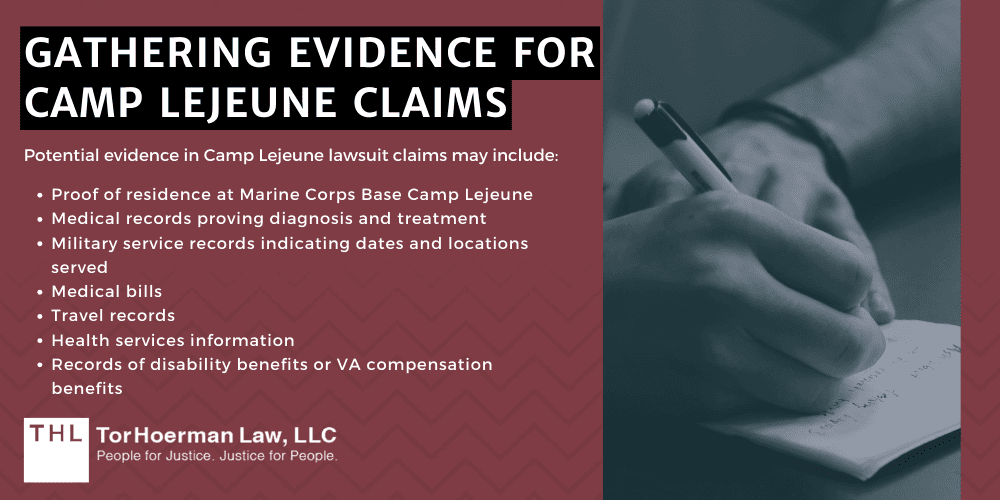
Potential evidence for Camp Lejeune claims may include:
Damages refer to the total amount of losses, economic and non-economic, related to exposure to contaminated water at Camp Lejeune.
Your lawyer will help you assess and calculate damages so that your demand for a Camp Lejeune settlement meets your expectations and covers the extent of your suffering.

Potential damages in Camp Lejeune lawsuits may include:
Seeking appropriate legal help can greatly help in your fight for justice.
At TorHoerman Law, our dedicated team of attorneys has a proven track record of handling toxic exposure cases and fighting for victims’ rights.
We understand the physical, emotional, and financial toll of exposure to contaminated water Camp Lejeune victims and their families have suffered.
Our attorneys are committed to helping you obtain the compensation you deserve.
If you or a loved one were exposed to water contamination at Camp Lejeune between 1953 and 1987 for 30 days or more, you may be eligible to file a Camp Lejeune claim.
Contact us today, and our legal experts will review your case, providing an accessible and instant qualification assessment.
You can contact us directly or use our chatbot for immediate assistance.
Reach out to our law firm with any questions or concerns on the Camp Lejeune Justice Act claims process, Camp Lejeune Lawsuits, and more.
We are here to help you.
The settlement amount for each individual case will differ based upon the injuries suffered, conditions diagnosed, time spent at the base, and more.
Lawsuit settlements would also contain damages incurred, which can include medical bills, lost income, pain and suffering, emotional damages, and more.
Depending on injuries suffered, conditions diagnosed, and evidence available, individual settlement amounts for exposure to contaminated water at Camp Lejeune could be significant.
Camp Lejeune water contamination settlement amounts could be between $10,000 and $500,000 depending on the strength of your case.
These estimates for Camp Lejeune settlement amounts are only estimations based on the Congressional Budget Office (CBO) budget for Camp Lejeune claims.
These estimates are not a guarantee by any means of certain compensation for Camp Lejeune settlements.
Visit this page for more updates on settlement amounts for Camp Lejeune lawsuits as the information becomes more widely available.
The Camp Lejeune water contamination incident was a prolonged and severe case of toxic water contamination at the United States Marine Corps Base Camp Lejeune in North Carolina.
The contamination primarily resulted from the presence of volatile organic compounds (VOCs), including trichloroethylene (TCE), perchloroethylene (PCE), vinyl chloride, and benzene, among other chemicals, in the base’s drinking water supply.
The contamination occurred over several decades, from approximately 1953 to 1987, affecting military personnel, their families, and civilian employees living and working on the base.
Studies and historical documents revealed that a major culprit of the contamination was an off-base dry cleaning shop called ABC One-Hour Cleaners.
The shop’s inappropriate water waste disposal caused the volatile organic compounds to reach and defile two major water treatment facilities in the camp.
The affected water treatment plants, Tarawa Terrace and Hadnot Point, supplied water to housing sectors, offices, and educational areas.
H.R.6482, or the Camp Lejeune Justice Act of 2022, is a legal action allowing qualified individuals to initiate Camp Lejeune administrative claims and recover compensation for the damages they suffered after exposure to the toxic water in Camp Lejeune.
The general qualification for this bill is that the individual must have documents showing residence on the base or exposure to the contaminated water supply between August 1, 1953, and December 31, 1987.
Brain cancer outcomes vary depending on tumor type, stage, location, and individual health.
Inactive tumors, called benign brain tumors, have higher chances of complete recovery.
However, for malignant tumors or metastatic brain tumors (secondary brain tumors), the prognosis depends on the tumor’s aggressiveness, how quickly it develops, and how it responds to brain tumor treatment.
Brain cancer is relatively rare compared to some other types of cancer.
The likelihood of an individual developing a malignant brain or spinal cord tumor in their lifetime is less than 1%.
While it is considered rare, brain cancer is a significant health concern due to its complex nature and potential for severe consequences.

Tor Hoerman has represented injured individuals for more than 30 years, with experience spanning individual personal injury cases and nationwide mass tort litigation. His work includes car accidents, catastrophic injuries, product liability claims, and other serious injury cases. Tor has served in court-appointed leadership roles in national litigation and tried cases involving major corporate defendants.
TorHoerman Law’s legal content is researched and written by our editorial team and attorneys for legal accuracy, clarity, and relevance. We rely on statutes, court records, government publications, medical research, and other authoritative sources when applicable. This page provides general legal information and does not constitute legal advice.
TorHoerman Law reviews its legal content for factual accuracy, current information, and relevant legal context before publication and as material developments occur. This article is provided for general informational purposes and does not constitute legal advice. For guidance about a specific case, contact TorHoerman Law.
You can learn more about this topic by visiting any of our Camp Lejeune Water Contamination Lawsuit pages listed below:
A serious injury can change your life.

TorHoerman Law represents people whose lives have been disrupted by serious injuries, unsafe products, and negligence. Our attorneys handle individual personal injury cases as well as national mass tort lawsuits involving major corporations.
Founded in 2009, our legal team brings more than 100 years of combined experience handling serious injury and complex civil litigation.
Do you believe you’re entitled to compensation?
Use our Instant Case Evaluator to find out in as little as 60 seconds!

In this case, we obtained a verdict of $495 Million for our client’s child who was diagnosed with Necrotizing Enterocolitis after consuming baby formula manufactured by Abbott Laboratories.

In this case, we were able to successfully recover $20 Million for our client after they suffered a Toxic Tort Injury due to chemical exposure.

In this case, we were able to successfully recover $103.8 Million for our client after they suffered a COX-2 Inhibitors Injury.

In this case, we were able to successfully recover $4 Million for our client after they suffered a Traumatic Brain Injury while at daycare.

In this case, we were able to successfully recover $2.8 Million for our client after they suffered an injury due to a Defective Heart Device.
A serious injury can change your life.