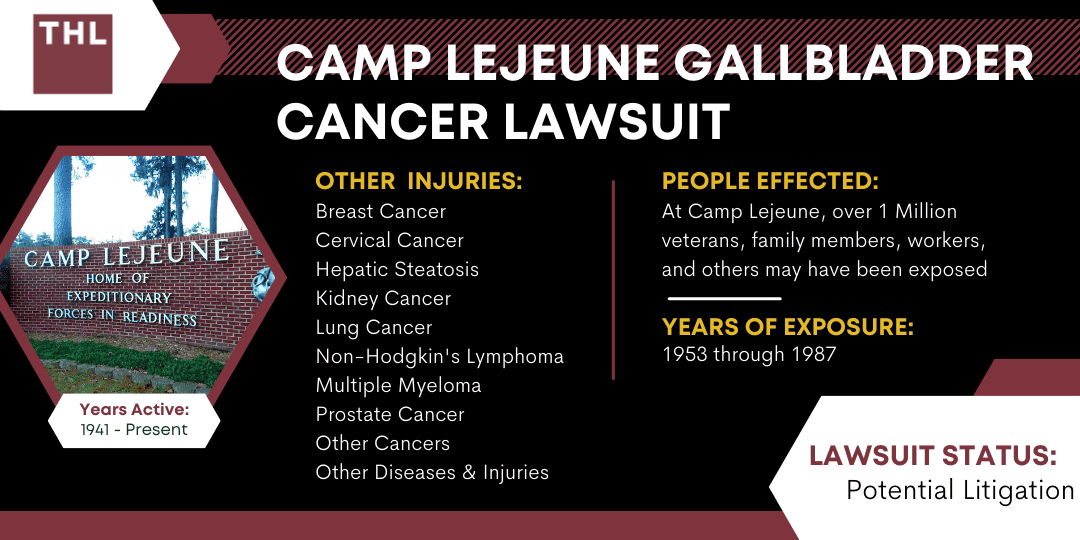
Intro to the Camp Lejeune Gallbladder Cancer Lawsuits
Toxic chemicals contaminated drinking water at Camp Lejeune and the nearby Marine Corps Air Station New River for over 30 years, from approximately 1953 until 1987.
Military service members, their family members, civilian workers, and others were exposed to toxic water contamination for years without knowing it contained toxic chemicals linked to cancer and other severe health conditions.
The Camp Lejeune Justice Act allows victims to file compensation claims for health conditions and damages related to Camp Lejeune water contamination.
If compensation claims are not verified within six months of filing, victims may be eligible to file Camp Lejeune Lawsuits in the US District Court for the Eastern District of North Carolina.
Exposure to contaminated drinking water at Camp Lejeune has been linked to an increased risk for gallbladder cancer.
Below, our Camp Lejeune lawyers look at the studies conducted on the water at Camp Lejeune, scientific evidence displaying links between toxic chemicals in Camp Lejeune’s water supply and gallbladder cancer, and more.
If you or a loved one were exposed to water contamination at Camp Lejeune for 30 days or more between 1953 and 1987, you may be eligible to file a Camp Lejeune claim.
Contact TorHoerman Law for a free consultation.
You can also use the chatbot on this page to find out if you qualify for the Camp Lejeune Lawsuit instantly.
Those who lived or worked at Marine Corps Base Camp Lejeune and were exposed to the contaminated water supply deserve justice.
Reach out to our Camp Lejeune attorneys with any questions you may have about the Camp Lejeune Justice Act, Camp Lejeune Litigation, and more.
We are here to help former Camp Lejeune residents seek justice.
Gallbladder Cancer Linked to Contaminated Drinking Water at Camp Lejeune
Water contamination at Camp Lejeune involved a number of highly toxic chemicals, with over seventy chemicals identified in Camp Lejeune’s water supply by the Agency for Toxic Substances and Disease Registry (ATSDR).
The four main toxic chemicals found in the water at Camp Lejeune included:
Trichloroethylene (TCE)
Tetrachloroethylene (PCE)
Vinyl chloride
Benzene
Several studies, including the landmark assessment by the Agency for Toxic Substances and Disease Registry, showed that people exposed to chemicals in the water have an increased risk of gallbladder dysfunction and other severe health problems.
If you or a loved one were exposed to water contamination at Camp Lejeune and subsequently developed gallbladder cancer, you may be eligible to file a Camp Lejeune claim.
Contact TorHoerman Law for a free consultation.
Use the chatbot on this page to find out if you qualify for a Camp Lejeune claim instantly.
About Gallbladder Cancer
Gallbladder cancer is a relatively uncommon form of cancer that originates in the gallbladder, a pear-shaped organ located beneath the liver.
Its primary function is to store and concentrate bile, a digestive fluid produced by the liver.
Gallbladder cancer typically starts in the inner lining of the organ and can be classified into different stages based on its spread.
Early detection and treatment are crucial for improving chances of survival.
12,220 US adults are diagnosed yearly with gallbladder cancers and similar biliary cancers
From this figure, around 4,510 deaths occur
Given these numbers, gallbladder cancer is still seen as a rare disease.
For comparison, more than 2 million women received a breast cancer diagnosis in 2020 alone.
Gallbladder Cancer and Camp Lejeune Water Contamination
Certain environmental factors, such as exposure to toxic substances in drinking water, have been associated with an increased risk of gallbladder cancer.
Scientific studies have explored the links between exposure to volatile organic compounds (VOCs) and the increased risk for gallbladder cancer:
Gallbladder cancer can result from various factors.
Other potential causes of gallbladder cancer include:
Gallstones: The most common risk factor for gallbladder cancer is gallstones. Gallstones are hard, pebble-like deposits that form in the gallbladder. Not everyone with gallstones will get gallbladder cancer, but the presence of gallstones increases the risk.
Chronic gallbladder inflammation: Repeated episodes of gallbladder inflammation (cholecystitis) can lead to scarring and a higher risk of cancer.
Polyps: Growths on the inner surface of the gallbladder (polyps) can be benign, but some might have the potential to develop into cancer.
Porcelain gallbladder:Porcelain gallbladder is a condition where the gallbladder wall becomes covered in calcium deposits. Some studies suggest it may increase the risk of gallbladder cancer.
Congenital bile duct defects: People born with abnormalities in the bile ducts may have an increased risk of gallbladder cancer.
Obesity:Obesity increases the risk of gallbladder cancer.
Gender: Gallbladder cancer is more common in women, potentially due to gallstones being more frequent in women.
Infections: Chronic infections of the bile duct can increase the risk. Certain liver flukes (parasitic infections common in some Asian countries) can lead to increased risk.
Family history: A family history of gallbladder cancer can increase the risk, though such instances are rare.
Primary sclerosing cholangitis: This rare disease causes hardening and scarring of bile ducts and may increase the risk for gallbladder cancer.
Gallbladder Cancer Complications
Gallbladder cancer can lead to various complications, some of which can significantly impact an individual’s overall health and quality of life.
Gallbladder cancer complications may include:
Jaundice: One of the common complications of gallbladder cancer is jaundice, which is characterized by a yellowing of the skin and eyes due to the buildup of bilirubin in the blood. This can occur if the tumor blocks the bile duct, preventing bile from flowing into the intestines.
Liver dysfunction: As the cancer grows, it can invade the liver or prevent bile from draining out of the liver, leading to liver damage or failure.
Ascites: This is the buildup of fluid in the abdomen and can be a result of liver dysfunction or the cancer itself spreading to the lining of the abdomen.
Nutritional deficiencies: The blockage of the bile duct can lead to problems digesting fats, resulting in nutritional deficiencies.
Infections: Bile duct blockages can lead to infections, including cholangitis, which is an infection of the bile ducts.
Severe Pain: As with many cancers, gallbladder cancer can cause significant pain, especially if it invades into surrounding structures.
Metastasis: Gallbladder cancer can spread to other parts of the body, including the liver, lungs, bones, and other organs. This is one of the most severe complications and makes treatment more challenging.
Blood clots: People with gallbladder cancer might be at a higher risk of developing blood clots in the large veins, especially in the legs.
Weight loss and cachexia: Severe, unintended weight loss can occur, and in advanced stages, cachexia, a syndrome of weight loss, muscle atrophy, and weakness, can develop.
Fistulas: Rarely, gallbladder cancer can erode into adjacent organs like the intestine, creating an abnormal connection called a fistula.
Camp Lejeune’s water supply was contaminated with highly toxic chemicals for over 30 years, and residents at the Marine Corps base drank, bathed in, cooked with, and used the contaminated water without knowing its true dangers.
The government knew about the water contamination at Camp Lejeune, but failed to keep military service members, their dependents, and other workers and residents safe.
Legislation, such as the Camp Lejeune Families Act of 2012, attempted to secure expanded Veterans Affairs benefits for affected individuals, but many victims still faced denials.
It wasn’t until the Camp Lejeune Justice Act of 2022 that Camp Lejeune victims were able to seek justice on a comprehensive scale.
The CLJA established an administrative claims process for victims to seek compensation.
The Camp Lejeune administrative claims process allows victims to file claims with the government, demanding compensation for Camp Lejeune linked illnesses and related damages.
If compensation claims are denied or are not adjudicated within six months of submission, victims may be eligible to file a Camp Lejeune Lawsuit in the US District Court for the Eastern District of North Carolina.
The North Carolina federal court will handle all Camp Lejeune Lawsuits filed against the government.
If you or a loved one were exposed to contamination at Camp Lejeune between 1953 and 1987, you may be eligible to file a Camp Lejeune claim.
Contact our law firm for a free consultation, or use the chatbot on this page to find out if you qualify for the Camp Lejeune Lawsuit instantly.
Adverse Health Effects of Camp Lejeune Water Contamination
The consumption of Camp Lejeune contaminated water has been linked to a number of cancer and non-cancer diagnoses.
Certain cancer diagnoses potentially linked to contaminated water at Camp Lejeune include:
Bladder Cancer
Breast Cancer
Esophageal Cancer
Kidney Cancer
Leukemia
Lung Cancer
Multiple Myeloma
Non-Hodgkin’s Lymphoma
Prostate Cancer
Colorectal Cancer
Rectal Cancer
Pancreatic Cancer
Central Nervous System Cancer
Myelodysplastic Syndromes
Brain Cancer
Cervical Cancer
Ovarian Cancer
Appendix Cancer
Bile Duct Cancer
Gallbladder Cancer
Hodgkin’s Lymphoma
Intestinal Cancer
Sinus Cancer
Soft Tissue Sarcoma
Spinal Cancer
Thyroid Cancer
Non-cancer diagnoses suffered by Camp Lejeune victims include:
Hepatic Steatosis
Miscarriage & Fetal Death
Neurobehavioral Effects
Parkinson’s Disease
Aplastic Anemia
Kidney Disease
Scleroderma
ALS
Lupus
Epilepsy
Alzheimer’s Disease
Cardiac Birth Defects
Infertility
Renal Toxicity
Autoimmune Disease
Birth Defects
Liver Disease
Cognitive Disability
Microcephaly
Renal Disease
Tooth Decay
Hypersensitive Skin Disorder
Nerve Damage
Oral Cleft
Service members, their families, civilian workers, and countless others were diagnosed with deadly health conditions, and for years could not secure the benefits they desperately needed.
With the Camp Lejeune Justice Act (or a potential Camp Lejeune Lawsuit), victims can now seek compensation for their exposure and related health problems.
Family members of victims who’ve passed away may also be eligible to file a Camp Lejeune Wrongful Death Lawsuit on their family member’s behalf.
What Caused the Water Contamination at Camp Lejeune?
Camp Lejeune water contamination resulted from the release of hazardous chemicals into the base’s drinking water supply over several decades.
These chemicals found their way into the groundwater, Camp Lejeune’s water treatment plants, and, subsequently, into the homes of military personnel and their families stationed at Camp Lejeune.
The Camp Lejeune water supply was contaminated because of improper storage practices.
Toxic chemicals seeped from leaking underground storage tanks and hazardous waste sites, as well as improper disposal practices from an off-base dry cleaning business.
What Toxic Substances Were Found in the Water Supply at Camp Lejeune?
The contaminated water at Camp Lejeune contained a mixture of hazardous chemicals, some of which are known carcinogens and can lead to a range of serious health issues.
The four main chemical contaminants found in the water at Camp Lejeune were:
Camp Lejeune victims have suffered for far too long without proper access to compensation, health care benefits, disability compensation, and other forms of relief.
The Camp Lejeune Justice Act forged a pathway to proper compensation for Camp Lejeune victims.
If you or a loved one were exposed to contaminated water at Camp Lejeune for at least 30 days between 1953 and 1987, you may be eligible to file a Camp Lejeune claim.
Contact TorHoerman Law’s Camp Lejeune lawyers for a free consultation.
Use the chatbot on this page for a free and instant case evaluation.
Qualified law firms can help Camp Lejeune victims throughout the legal process, completing the crucial steps of gathering evidence and assessing damages.
Gathering Evidence for Camp Lejeune Claims
Gathering evidence is an extremely important part of the Camp Lejeune claims process.
Camp Lejeune victims can begin to gather evidence on their own, but experienced Camp Lejeune lawyers can help you gather and retain all documents and information for your case.
Evidence in a Camp Lejeune water contamination lawsuit may include:
Documents proving residence at Camp Lejeune
Military service records indicating dates and locations served
Medical records and diagnoses
Medical bills
Travel records
Health care information
Records on disability benefits or VA compensation benefits
Assessing Damages for Camp Lejeune Water Contamination Lawsuits
Damages refer to the total amount of losses, economic and non-economic, incurred as a result of exposure to the contaminated water supply at Camp Lejeune.
Our Camp Lejeune attorneys can help you calculate damages, considering your financial hardships and adding medical expenses, lost wages, and rehabilitation bills to your settlement demands.
Potential damages in Camp Lejeune claims may include:
Medical bills
Pain and suffering
Lost wages
Disability benefits
Loss of companionship, consortium, enjoyment of life, and earning capacity
Our law firm is currently helping former Camp Lejeune residents file claims for compensation.
Camp Lejeune veterans and victims went years without proper restitution, but the CLJA allows the filing of compensation claims and Camp Lejeune Lawsuits.
If you or a loved one were exposed to water contamination at Camp Lejeune for at least 30 days between 1953 and 1987, you may be eligible to file a Camp Lejeune claim.
Contact TorHoerman Law for a free consultation.
Use the chatbot on this page for a free case evaluation to see if you qualify to file a Camp Lejeune Lawsuit instantly.
Camp Lejeune lawyers can help victims understand their rights and advocate on their behalf for a substantial and adequate Camp Lejeune settlement.
Reach out to our lawyers with any questions you may have about the Camp Lejeune Justice Act.
Military personnel, their family members, and civilian workers who were exposed to contaminated water at Camp Lejeune and subsequently suffered health issues may be eligible to file lawsuits seeking compensation and support.
Family members of deceased Camp Lejeune victims can also file Camp Lejeune claims on their behalf.
The settlement amount for each individual case will differ based upon the injuries suffered, conditions diagnosed, time spent at the base, and more.
Lawsuit settlements would also contain damages incurred, which can include medical bills, lost income, pain and suffering, emotional damages, and more.
Depending on injuries suffered, conditions diagnosed, and evidence available, individual settlement amounts for exposure to contaminated water at Camp Lejeune could be significant.
Camp Lejeune water contamination settlement amounts could be between $10,000 and over $1,000,000 depending on the strength of your case.
These estimates for Camp Lejeune settlement amounts are only estimations based on the Congressional Budget Office (CBO) budget for Camp Lejeune claims.
These estimates are not a guarantee by any means of certain compensation for Camp Lejeune settlements.
Visit this page for more updates on settlement amounts for Camp Lejeune lawsuits as the information becomes more widely available.
In August of 2022, President Biden signed the Camp Lejeune Justice Act into law, representing a comprehensive legislative effort to address the concerns of individuals who have been affected by the contaminated drinking water at Camp Lejeune.
This newly enacted law allows individuals, including military personnel and their family members who have been impacted by the water contamination, to file compensation claims.
If claims are not adjudicated within six months of submission or are otherwise denied, victims may be eligible to file Camp Lejeune Lawsuits in the US District Court for the Eastern District of North Carolina.
Tor Hoerman has represented injured individuals for more than 30 years, with experience spanning individual personal injury cases and nationwide mass tort litigation. His work includes car accidents, catastrophic injuries, product liability claims, and other serious injury cases. Tor has served in court-appointed leadership roles in national litigation and tried cases involving major corporate defendants.
Legally Reviewed
TorHoerman Law’s legal content is researched and written by our editorial team and attorneys for legal accuracy, clarity, and relevance. We rely on statutes, court records, government publications, medical research, and other authoritative sources when applicable. This page provides general legal information and does not constitute legal advice.
Fact-Checked
TorHoerman Law reviews its legal content for factual accuracy, current information, and relevant legal context before publication and as material developments occur. This article is provided for general informational purposes and does not constitute legal advice. For guidance about a specific case, contact TorHoerman Law.
Additional Camp Lejeune Water Contamination Lawsuit resources on our website:
TorHoerman Law represents people whose lives have been disrupted by serious injuries, unsafe products, and negligence. Our attorneys handle individual personal injury cases as well as national mass tort lawsuits involving major corporations.
Founded in 2009, our legal team brings more than 100 years of combined experience handling serious injury and complex civil litigation.
Do you believe you’re entitled to compensation?
Use our Instant Case Evaluator to find out in as little as 60 seconds!
In this case, we obtained a verdict of $495 Million for our client’s child who was diagnosed with Necrotizing Enterocolitis after consuming baby formula manufactured by Abbott Laboratories.