
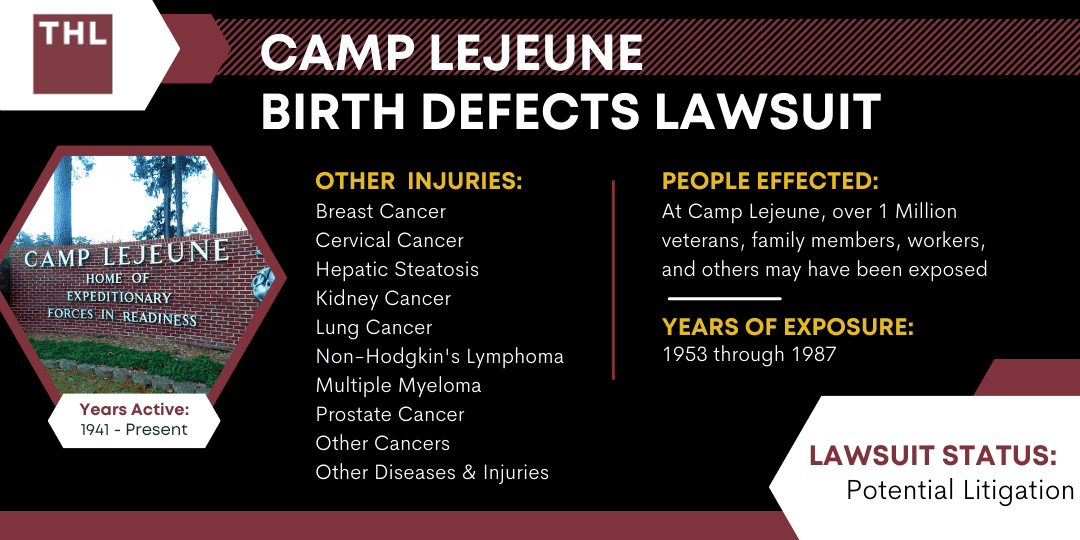
Between 1953 and 1987, the water at Camp Lejeune was contaminated with shocking amounts of volatile organic compounds (VOCs).
Based on investigations carried out by the Environmental Protection Agency (EPA) and the Agency for Toxic Substances and Disease Registry (ATSDR), the contaminated drinking water at Camp Lejeune came from various water treatment plants in and around the Marine Corps base.
The contaminated drinking water at the base rendered active-duty personnel, National Guard members, family members of service members, civilian workers, and others susceptible to various illnesses.
Besides various cancers and autoimmune conditions, Camp Lejeune victims reported birth defects after being exposed to contaminated drinking water.
Although birth defects are not listed on the Department of Veterans Affairs (VA) list of health conditions with a presumptive service connected, there is significant amounts of scientific evidence supporting the connection between exposure to toxic substances and the risk of birth defects.
If your child has suffered from birth defects and you were exposed to contaminated drinking water at Camp Lejeune between 1953 and 1987, you need to seek justice.
Contact TorHoerman Law for a free consultation.
You can also use the chatbot on this page to find out if you qualify for the Camp Lejeune litigation.
About Birth Defects
Birth defects are physical or developmental abnormalities that occur in babies before they are born.
They can affect various parts of the body like the heart and brain and often lead to lifelong health challenges.
Some birth defects are due to exposure to volatile organic compounds (VOCs), which are chemicals that can easily become gases and are often found in products and environments.
What Are the Different Types of Birth Defects?
Birth defects can vary widely in terms of their types and the body systems they affect.
Here are some of the different kinds of birth defects:
- Structural Birth Defects
- Genetic Abnormalities
- Metabolic Disorders
- Functional Birth Defects
- Developmental Delays
- Facial Abnormalities
- Gastrointestinal Defects
- Genital and Urinary Tract Abnormalities
- Sensory Impairments
- Central Nervous System Defects
Birth Defects and Water Contamination at Camp Lejeune
The onset of birth defects can be traced to various causes, including prenatal exposure to hazardous chemicals like volatile organic compounds (VOCs) found in the water at Camp Lejeune.
VOCs are commonly found in products like paints, solvents (like those found in the Camp Lejeune water supply), cleaning agents, and some building materials.
Ingesting, inhaling, or absorbing these chemicals during pregnancy may pose a risk to the developing fetus.
Published in 2013, a study conducted by the Agency for Toxic Substances and Disease Registry (ATSDR) examined exposure to contaminated drinking water at Camp Lejeune and specific birth defects and childhood cancers.
The ATSDR study looked particularly at children born between 1968 and 1985 to mothers with residential exposure to contaminated drinking water at Camp Lejeune, attempting to determine an increased risk for childhood hematopoietic cancers, neural tube defects (NTDs), or oral clefts.
Findings from the ATSDR study on birth defects related to Camp Lejeune water contamination included the following:
- The odds of having neural tube defects (NTDs) for those exposed to any benzene were 4.1 times higher, and the odds of having NTDs for those exposed to trichloroethylene above 5 parts per billion were 2.4 times higher.
- The odds of childhood cancers for those exposed to any tetrachloroethylene were 1.6 times higher.
- The odds of childhood cancers for those exposed to any vinyl chloride were also 1.6 times higher.
Besides neural tube defects and the risk of childhood cancer, one birth defect that has been attributed to VOC exposure is congenital heart disease (CHD) and other cardiac birth defects.
Besides CHD, VOC exposure also led to low birth weights and other birth defects.
One 2017 study suggested that prenatal VOC exposure can significantly decrease birth weights.
Low birth weight is a serious birth defect since it’s a sign of poor physical development.
The lack of development predisposes infants to various infections and illnesses, ultimately leading to a failure to thrive.
Another study from researchers at the Centers for Disease Control and Prevention (CDC) emphasizes the link between VOC exposure and birth defects.
According to a 2016 CDC study, prenatal VOC exposure increased a child’s risk for developing neurocognitive impairments, respiratory ailments, and even cancer.
Other studies linking exposure to certain VOCs in the water at Camp Lejeune include the following:
- Environmental Health Perspectives: Adverse Birth Outcomes and Maternal Exposure to Trichloroethylene and Tetrachloroethylene through Soil Vapor Intrusion in New York State
- Environmental Health Perspectives: A review: trichloroethylene metabolites: potential cardiac teratogens.
- International Journal of Environmental Research and Public Health: Assessment of Exposure to VOCs among Pregnant Women in the National Children’s Study
- Journal of Environmental Health: Maternal residential proximity to chlorinated solvent emissions and birth defects in offspring: a case–control study
- Clinical and Molecular Teratology: Trichloroethylene effects on gene expression during cardiac development
- Critical Reviews in Toxicology: Critical review of the epidemiologic literature regarding the association between congenital heart defects and exposure to trichloroethylene
- Journal of Environmental Research: Associations between exposure to ambient benzene and PM2.5 during pregnancy and the risk of selected birth defects in offspring
- Clinical and Molecular Teratology: Evaluating the effects of maternal exposure to benzene, toluene, ethyl benzene, and xylene on oral clefts among offspring in Texas: 1999–2008
- Journal of Occupational and Environmental Medicine: Exposure to benzene, occupational stress, and reduced birth weight
- American Journal of Epidemiology: Public Drinking Water Contamination and Birth Outcomes
- Toxicology and Industrial Health: Public Drinking Water Contamination and Birthweight, Prematurity, Fetal Deaths, and Birth Defects
- Journal of Teratology: Evaluation of the association between birth defects and exposure to ambient vinyl chloride
- Mutation Research/Fundamental and Molecular Mechanisms of Mutagenesis: Carcinogenic, mutagenic and teratogenic risks associated with vinyl chloride
Other Possible Causes of Birth Defects
While the Camp Lejeune Lawsuit is focused on birth defects related to water contamination, there are several other possible causes of birth defects.
Possible causes of birth defectsinclude:
- Genetic Factors: Inherited conditions or mutations in genes can lead to birth defects.
- Maternal Infections: Infections including rubella (German measles), Zika virus, and cytomegalovirus can increase the risk for certain birth defects.
- Medications and Drugs: Some medications, when taken during pregnancy, can cause birth defects. This includes certain seizure medications, blood thinners, and isotretinoin (Accutane).
- Alcohol: Drinking alcohol during pregnancy can lead to fetal alcohol syndrome and other developmental issues.
- Tobacco Use: Smoking or exposure to secondhand smoke during pregnancy can increase the risk of birth defects.
- Poor Nutrition: A lack of essential nutrients like folic acid, which is crucial for neural tube development, can lead to birth defects.
- Maternal Medical Conditions: Conditions like diabetes, untreated phenylketonuria, or high body temperaturefrom fever or using hot tubs/saunas.
- Advanced Maternal Age: Older mothers, especially those over the age of 30, have a higher risk of having a child with chromosomal abnormalities.
- Premature Birth: Babies born before 37 weeks may have an increased risk of health and developmental complications.
- Radiation Exposure: Being exposed to radiation during pregnancy can lead to birth defects.
- Use of Recreational Drugs: Using drugs like cocaine, marijuana, and opioids during pregnancy can be harmful to the fetus.
- Physical Constraints in the Womb: Sometimes, late in pregnancy, the baby doesn’t have enough room to grow and develop properly, leading to physical deformities.
- Lack of Prenatal Care: Not getting adequate medical care during pregnancy can increase the risk of birth defects.
Complications of Birth Defects
Birth defects can profoundly alter the course of a mother and child’s life, leading to enduring physical challenges and deep-seated emotional repercussions.
Birth defects resulting from VOC exposure can result in the following complications:
- Structural Abnormalities: Birth defects from VOC exposure can result in structural abnormalities in a baby’s organs or body parts. For example, heart defects, cleft lip or palate, limb malformations, or neural tube defects can occur.
- Neurodevelopmental Issues: VOC exposure during pregnancy might affect the baby’s nervous system development. This issue could lead to intellectual disabilities, learning difficulties, or behavioral problems later in life.
- Respiratory Problems: Some VOCs can harm the development of the baby’s respiratory system, potentially causing issues like asthma or other respiratory disorders after birth.
- Low Birth Weight and Prematurity: VOC exposure may increase the risk of premature birth or low birth weight, both of which can have serious health implications for the baby.
- Miscarriage or Stillbirth: In severe cases, exposure to certain VOCs may even lead to miscarriage or stillbirth.


