No Longer Accepting Claims
Camp Lejeune Water Contamination Lawsuit Facts
TorHoerman Law is no longer accepting claims for the Camp Lejeune Water Contamination Lawsuit.
Intake Closed

No Longer Accepting Claims
TorHoerman Law is no longer accepting claims for the Camp Lejeune Water Contamination Lawsuit.
Intake Closed
On this page, we’ll discuss an overview of the Camp Lejeune Scleroderma Lawsuit, how Scleroderma has been linked to the Camp Lejeune Water Contamination, other diseases and health conditions linked to the water contamination at Camp Lejeune, and much more.
Between 1953 and 1987, toxic substances contaminated wells, treatment plants, and other sources of drinking water at United States Marine Corps Base Camp Lejeune and the nearby Marine Corps Air Station New River.
Military members, family members, and civilian workers that were exposed to these dangerous chemicals have been diagnosed with often fatal medical conditions, including several types of cancer and other diseases.
Exposure at Camp Lejeune has been linked to several illnesses.
Based on findings from the Agency for Toxic Substances and Disease Registry (ATSDR), one of these diseases is scleroderma.
Scleroderma is a chronic autoimmune disease characterized by the hardening and tightening of the skin and connective tissues.
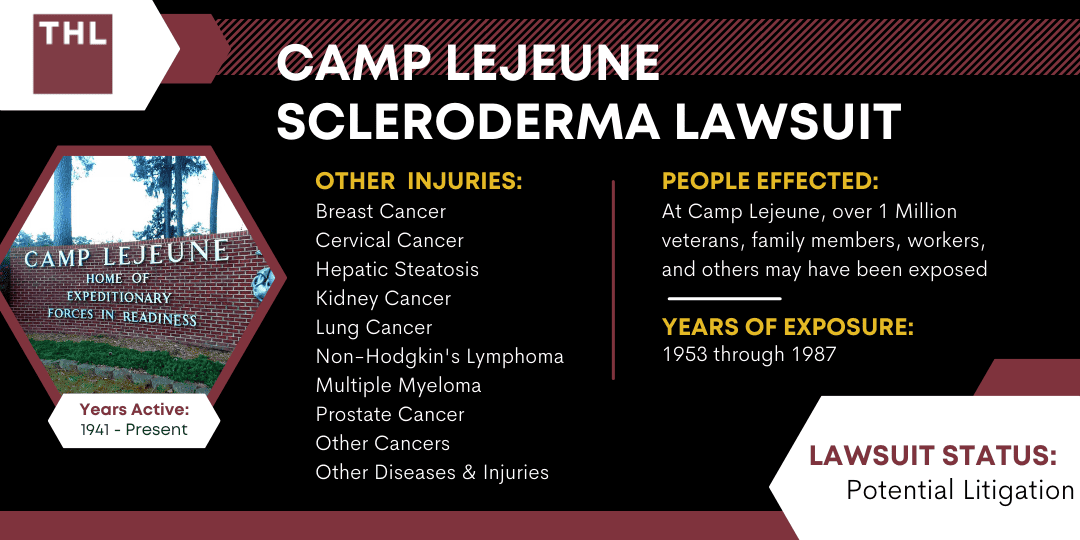
If you or a family member were at Camp Lejeune between 1953 and 1987, and have developed scleroderma, you may be eligible to file a Camp Lejeune Lawsuit claim.
Contact the knowledgeable Camp Lejeune attorneys at TorHoerman Law for a free consultation.
You can also use the chatbot on this page to find out if you qualify for the Camp Lejeune Lawsuit instantly.
Repeated exposure to contaminated drinking water at Camp Lejeune has been linked to several health conditions.
Camp Lejeune veterans and their family members are encouraged to reach out to qualified law firms and assess their legal options.
Contact us today with any questions or concerns you may have about the claims process and the Camp Lejeune Justice Act.
Between 1953 and 1987, volatile organic chemicals (VOCs) seeped into Camp Lejeune’s water supply.
These VOCs have been linked to various conditions, such as scleroderma.
For more than three decades, victims of harmful exposure to the camp’s contaminated water supply have reported various symptoms.

These symptoms range from localized skin patches to more extensive problems like excessive skin tightness, particularly around the fingers.
These symptoms are the hallmark signs of scleroderma.
VOCs in the toxic water at Camp Lejeune include trichloroethylene (TCE).
Exposure to TCE specifically has been linked to an increased risk of scleroderma.
Scleroderma is an autoimmune condition that primarily affects the skin and connective tissues.
Due to its effects on connective tissues, scleroderma can cause skin problems and complications in several internal organs like the bladder, esophagus, and kidneys.

There are two main types of scleroderma: localized and systemic.
Localized scleroderma affects the skin.
However, it can also spread to the underlying tissues under the skin like the muscles.
By comparison, systemic scleroderma is more extensive because it causes problems in other parts of the body with connective tissues.
This form of scleroderma affects the skin, blood vessels, lungs, heart, and even the kidneys.
Like many autoimmune illnesses, scleroderma can be brought on by factors like genetics.
A possible cause of scleroderma is chemical exposure, particularly exposure to solvents like VOCs.

Benzene — which is among the toxic chemicals discovered in the contaminated Camp Lejeune water — is one of the most commonly identified causes of chemical-induced scleroderma.
Scleroderma is a complex autoimmune disease that can lead to various complications, especially in its systemic forms.
The severity and type of complications can vary from person to person based on the subtype of scleroderma and the organs affected.

Here are some of the potential complications that can arise from scleroderma:
Toxic chemicals contaminated the drinking water at Camp Lejeune from approximately 1953 until 1987, putting over one million people at risk of health conditions linked to chemical exposure.
Camp Lejeune victims suffered from these health conditions for years without any help from the Department of Veterans Affairs or other governmental organizations.
Countless Camp Lejeune victims tragically passed away before receiving any sort of relief or recognition.
It wasn’t until the Camp Lejeune Justice Act of 2022 that comprehensive processes were established to get victims the help they deserve.
With this new legislation, Camp Lejeune victims are finally entitled to file claims against the United States government for exposure to contaminated water at Camp Lejeune.
The Camp Lejeune Justice Act builds off of previous legislation, like the Honoring America’s Veterans and Camp Lejeune Families Act of 2012.
The Camp Lejeune Justice Act allows victims seeking monetary recovery to go through an administrative claims process to demand compensation.
If compensation claims are not adjudicated within 6 months of submission, victims can file Camp Lejeune Lawsuits in the US District Court for the Eastern District of North Carolina.

Victims seeking monetary recovery are encouraged to reach out to qualified Camp Lejeune law firms for free consultations.
If you or a loved one were exposed to contaminated drinking water at Camp Lejeune between 1953 and 1987 and developed health problems, you may be eligible to file a Camp Lejeune water contamination lawsuit.
Contact our Camp Lejeune lawyers for a free consultation.
You can also use the chatbot on this page to see if you qualify for a claim instantly.
Our diligent Camp Lejeune lawyers are here to help you and other Camp Lejeune veterans recover the compensation you deserve.
Camp Lejeune’s water supply was contaminated with chemicals known as volatile organic compounds (VOCs), which are toxic substances that have been linked to various illnesses like scleroderma.
The hazardous chemicals found in the contaminated water at Camp Lejeune seeped into water treatment plants from improper waste disposal practices, off-base polluters, and more.
To determine the origins of the VOCs contaminating the water at Camp Lejeune, various agencies like the Environmental Protection Agency (EPA) and the Agency for Toxic Substances and Disease Registry (ATSDR) conducted an investigation.
After the investigation, the EPA discovered some of the highest concentrations of VOCs in two water treatment facilities — those at Hadnot Point and Tarawa Terraces.
Because these facilities served the Marine Corps base, VOCs leaked into the drinking water.
As a result of the harmful exposure, residents and active duty personnel developed various illnesses from the contaminated water.
The consumption of contaminated water at Marine Corps base Camp Lejeune has been linked to several cancer and non-cancer diagnoses.

Water contamination at Camp Lejeune has been linked to:
Those who served at Camp Lejeune — from active duty service members to their families and civilian workers — were diagnosed with these deadly health conditions and suffered for years without help.
Many victims have filed claims for VA health care benefits, disability compensation, and other forms of relief with the Department of Veterans Affairs only to be denied.
The passing of the Camp Lejeune Justice Act has given Camp Lejeune families, active duty personnel, and military veterans an alternative route for recovering compensation.
The passing of the Camp Lejeune Justice Act enables victims seeking recovery options to file claims for compensation, and if those claims are denied, victims can pursue Camp Lejeune litigation in the US District Court for the Eastern District of North Carolina.
The Department of Veterans Affairs has enumerated several illnesses that place individuals in a health eligibility priority category.

These illnesses are known to have a “presumptive service connection” to water contamination at Camp Lejeune:
Individuals who lived or worked at Camp Lejeune between 1953 and 1987 and suffered from health conditions not listed in the Department of Veterans Affairs (VA) presumptive service connection list may still be eligible to file a Camp Lejeune Act claim or Camp Lejeune Lawsuit.
Contact TorHoerman Law for a free consultation.
You can also use the chatbot on this page for a free case evaluation and to get in touch with our Camp Lejeune attorneys today.
Reach out to our Camp Lejeune lawyers for more information on the PACT Act and Camp Lejeune Justice Act, how victims can get compensated for all their health care costs, and other forms of compensation veterans deserve.
Your Camp Lejeune attorneys will help you complete several steps necessary to filing a claim for compensation, including gathering evidence and assessing/calculating damages.
Proving your eligibility for a claim or Camp Lejeune Lawsuit starts with gathering the right evidence.
You will need evidence proving that you served, lived, or worked at Camp Lejeune.
Your service records and residential documents at the base will help us establish your exposure to contaminated water. 
Possible evidence in a Camp Lejeune Justice Act claim or Camp Lejeune Lawsuit may include:
Your Camp Lejeune lawyers will work to recover a fair settlement on your behalf.
This process begins with us assessing the true extent of your damages.
When you have gathered pieces of key evidence, a lawyer will help you to refine your case and assess damages.
Damages are any losses, both physical and mental/emotional, that a person incurs as a result of an injury at no fault of their own.
Damages are the total amount the defendant is liable to pay to the plaintiff to compensate for the damage that they have caused.

Damages in a Camp Lejeune water contamination lawsuit may include:
Scleroderma can affect more than just your skin — it’s a serious medical condition that can damage your organs and reduce your quality of life.
Individuals who have developed scleroderma from the toxic chemicals in Camp Lejeune’s water supply may be eligible to take action.
If you or a loved one were exposed to contaminated drinking water at Camp Lejeune between 1953 and 1987, you may be eligible to file a Camp Lejeune Lawsuit.
Contact TorHoerman Law for a free consultation.
You can also use the chatbot on this page to find out if you qualify for the Camp Lejeune Lawsuit instantly.
Our Camp Lejeune Lawyers are prepared to represent you and seek justice on your behalf.
We understand that the claims process can be confusing and overwhelming, especially if you are dealing with health conditions linked to chemical exposure.
Our Camp Lejeune attorneys are here to help you through this process.
Reach out to us for more information and to find out how our Camp Lejeune Lawyers can help you.
Scleroderma is an autoimmune condition that affects the skin and its underlying connective tissues.
At its worst, it also leads to complications involving vital organs like the lungs and kidneys.
Here are the signs and symptoms to watch out for if you suspect scleroderma:
Besides scleroderma, several other illnesses have been linked to exposure to Camp Lejeune’s contaminated drinking water.
Other health conditions linked to Camp Lejeune water contamination include:
The EPA identified several toxic chemicals in Camp Lejeune’s water supply.
The four main toxic chemicals found in the contaminated water at Camp Lejeune were:
There were up to 70 other toxic substances found in the water at Camp Lejeune.

Tor Hoerman has represented injured individuals for more than 30 years, with experience spanning individual personal injury cases and nationwide mass tort litigation. His work includes car accidents, catastrophic injuries, product liability claims, and other serious injury cases. Tor has served in court-appointed leadership roles in national litigation and tried cases involving major corporate defendants.
TorHoerman Law’s legal content is researched and written by our editorial team and attorneys for legal accuracy, clarity, and relevance. We rely on statutes, court records, government publications, medical research, and other authoritative sources when applicable. This page provides general legal information and does not constitute legal advice.
TorHoerman Law reviews its legal content for factual accuracy, current information, and relevant legal context before publication and as material developments occur. This article is provided for general informational purposes and does not constitute legal advice. For guidance about a specific case, contact TorHoerman Law.
You can learn more about this topic by visiting any of our Camp Lejeune Water Contamination Lawsuit pages listed below:
A serious injury can change your life.

TorHoerman Law represents people whose lives have been disrupted by serious injuries, unsafe products, and negligence. Our attorneys handle individual personal injury cases as well as national mass tort lawsuits involving major corporations.
Founded in 2009, our legal team brings more than 100 years of combined experience handling serious injury and complex civil litigation.
Do you believe you’re entitled to compensation?
Use our Instant Case Evaluator to find out in as little as 60 seconds!

In this case, we obtained a verdict of $495 Million for our client’s child who was diagnosed with Necrotizing Enterocolitis after consuming baby formula manufactured by Abbott Laboratories.

In this case, we were able to successfully recover $20 Million for our client after they suffered a Toxic Tort Injury due to chemical exposure.

In this case, we were able to successfully recover $103.8 Million for our client after they suffered a COX-2 Inhibitors Injury.

In this case, we were able to successfully recover $4 Million for our client after they suffered a Traumatic Brain Injury while at daycare.

In this case, we were able to successfully recover $2.8 Million for our client after they suffered an injury due to a Defective Heart Device.
A serious injury can change your life.