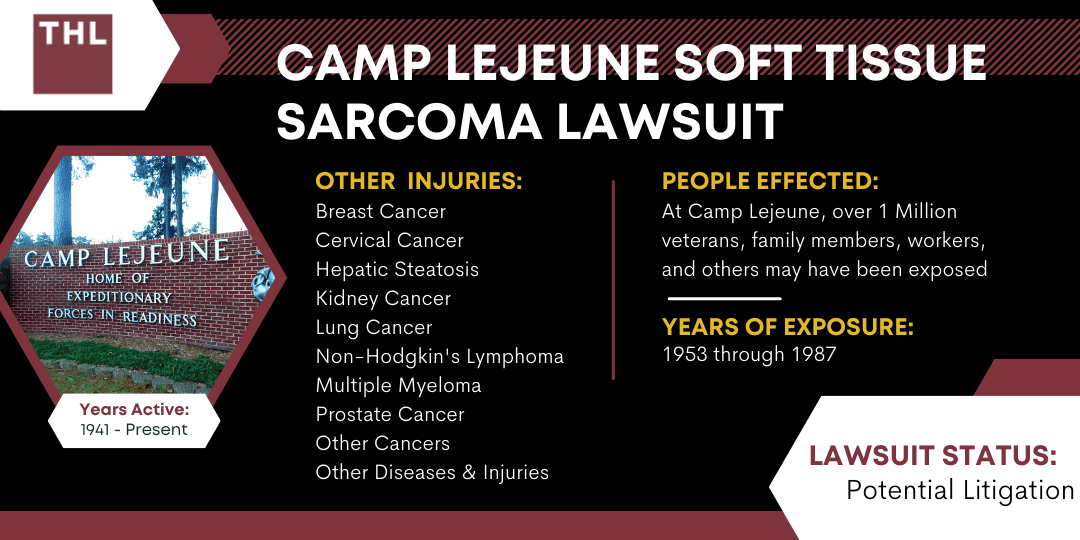
The discovery of contaminated drinking water at Camp Lejeune in 1982 prompted government and medical authorities to evaluate the health of those exposed.
Water analysis revealed high traces of toxic chemicals from industrial solvents and leaks from underground fuel storage tanks.
Exposure to toxic substances in Camp Lejeune’s water supply was the cause many illnesses in Camp Lejeune veterans, family members, and civilian workers stationed at the base.
Victims have suffered from various cancers, including soft tissue sarcoma.
Scientific studies have found that exposure to volatile organic compounds (VOCs) in the water at Camp Lejeune, specifically vinyl chloride, have been linked to an increased risk for soft tissue cancers.
If you or a loved one were exposed to contaminated water at Camp Lejeune and subsequently developed soft tissue cancer, you may be eligible to file a Camp Lejeune claim.
Contact TorHoerman Law’s Camp Lejeune attorneys for a free consultation.
You can also use the chatbot on this page to find out if you qualify to file a Camp Lejeune Lawsuit instantly.
About Soft Tissue Sarcoma
Soft tissue sarcoma is a rare type of cancer that begins in the soft tissues surrounding, connecting, and supporting other body parts.
Soft tissues include muscles, fat, nerves, blood vessels, tendons, cartilage, ligaments, lymphatic vessels, and other structures.
The cancer can also occur in deep skin tissues.
Soft tissue sarcoma can start from anywhere in the body.
However, the malignant tumors usually develop in the arms, legs, chest, and abdomen.
Soft tissue cancer has over 70 different subtypes.
Some varieties are more likely to affect children, while others are more common in adults.
Soft tissue sarcoma is often hard to diagnose since the lumps and growths associated with it may be mistaken for other issues.
Soft tissue tumors usually begin as benign, meaning they are non-cancerous.
However, these tumors can become cancerous and spread to other body parts if left unchecked.
In the case of Camp Lejeune victims, years of exposure to contaminated drinking water potentially caused soft tissue sarcoma and many other conditions to develop.
Unfortunately, it’s possible that these illnesses were not identified until much later in life due to a lack of research and awareness.
Soft Tissue Sarcoma and Camp Lejeune Water Contamination
Chemical exposure is a possible risk factor of developing soft tissue cancer.
Long-term exposure to certain chemicals can increase the risk of developing soft tissue sarcoma.
Several studies named vinyl chloride monomers, arsenic, dioxin, chlorophenols, and phenoxyacetic acid as possible carcinogenic agents.
Vinyl chloride was one of the four main chemical contaminants in the Camp Lejeune water supply.
Studies mentioning the association between vinyl chloride and soft tissue sarcomas include:
- International Archives of Occupational and Environmental Health: Exposure to polymeric materials in vascular soft-tissue sarcomas
- Journal of Oncology: Etiologic Factors in Soft Tissue Sarcomas
- Acta Orthopaedica Scandinavica: An updated review of the epidemiology of soft tissue sarcoma
- Critical Reviews in Toxicology: Vinyl Chloride—A Classical Industrial Toxicant of New Interest
- The Journal of Joint & Bone Surgery: Angiosarcoma of the Hand Associated with Chronic Exposure to Polyvinyl Chloride Pipes and Cement
- Scandinavian Journal of Work, Environment & Health: Epidemiologic evidence for the carcinogenicity of vinyl chloride monomer
- Scandinavian Journal of Work, Environment & Health: A collaborative study of cancer incidence and mortality among vinyl chloride workers
- European Journal of Cancer Prevention: Occupational exposure to vinyl chloride and cancer risk: a review of the epidemiologic literature
- Journal of Epidemiology: Update of the Follow-Up of Mortality and Cancer Incidence among European Workers Employed in the Vinyl Chloride Industry
- American Journal of Epidemiology: A Case-Control Study of Soft-Tissue Sarcoma
Other Causes of Soft Tissue Cancer
The exact cause of soft tissue sarcoma is unknown.
However, researchers believe soft tissue cancers begin when connective tissue cells undergo DNA changes, transforming them into cancerous cells.
John Hopkins Medicine has identified a few possible risk factors that can increase one’s chance of developing soft tissue sarcoma.
Causes and risk factors of soft tissue sarcomas include:
- Genetic disorders: Certain inherited diseases, such as Li-Fraumeni syndrome or neurofibromatosis, increase the risk of soft tissue sarcomas.
- Exposure to radiation: People who have had radiation therapy for other cancers can be at an increased risk of developing soft tissue sarcomas.
- Exposure to certain chemicals: Phenoxy herbicides, chlorophenols, and dioxins have been linked to an increased risk of soft tissue sarcomas.
- Lymphedema: Long-standing severe lymphedema, a condition of localized fluid retention and tissue swelling, can be associated with an increased risk.
- Viral infections: Some evidence suggests that specific viruses, such as the human herpesvirus 8, might be associated with certain types of soft tissue sarcomas.
- History of previous cancer: Patients who’ve had certain types of cancer in the past may have an increased risk of developing soft tissue sarcoma.
- Chronic skin inflammation or skin injuries: Although very rare, longstanding skin inflammation or prior injuries might increase risk.
It’s important to note that while these factors can increase the risk of soft tissue sarcomas, they don’t necessarily cause the disease.
Many people with these risk factors never develop soft tissue sarcomas, and many people without these risk factors do.
Soft Tissue Sarcoma Complications
Soft tissue sarcoma can spread to other parts of the body, so it’s essential to receive prompt medical attention.
Common symptoms of this cancer include:
- A lump or swelling that does not go away after a few weeks
- Pain, redness, and warmth in the affected area
- Fatigue and weakness
- Unexplained weight loss
- Fever
- Night sweats
- Limited range of motion in the joints
- Broken bones with no apparent cause
When left untreated, soft tissue sarcoma can cause serious complications such as:
- Loss of function in affected body parts
- Disfigurement if the tumor is on the face or other visible area
- Spreading to other organs and tissues
- Paralysis due to nerve damage
These complications can significantly decrease the quality of life for victims and even lead to death.
Sadly, this was potentially the circumstance for many Camp Lejeune veterans and family members diagnosed with soft tissue cancers.