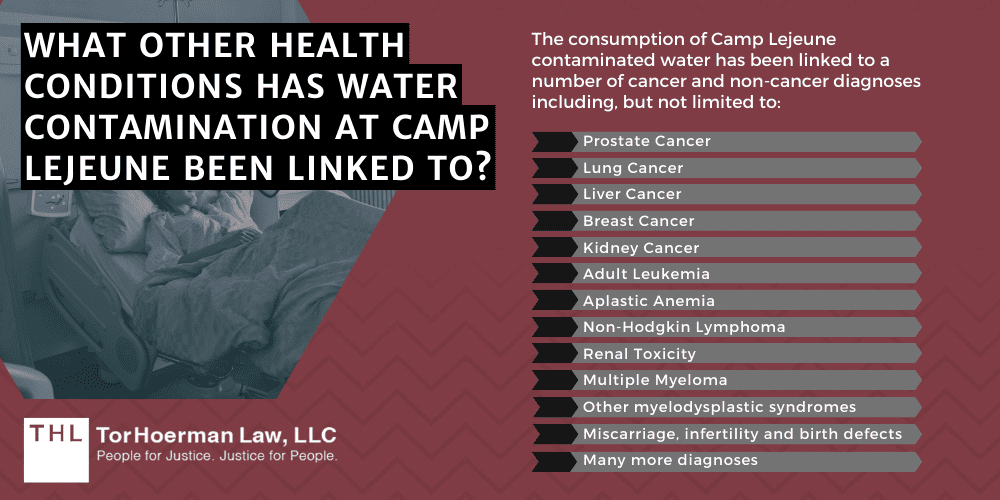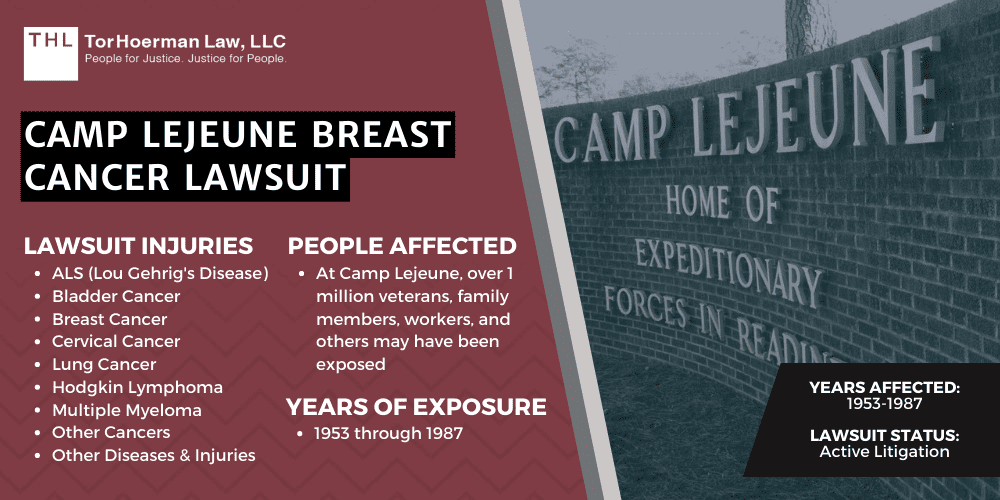
An increased risk of Breast Cancer has been identified by professionals who’ve studied the contaminated water at Camp Lejeune and veteran medical records as a particularly common diagnosis.
About Breast Cancer
Breast Cancer is a cancer that forms in the cells of the breast.
Breast cancer is the second most common type of cancer for women behind skin cancer.
Breast cancer can develop due to a number of different causes, including genetic or environmental risk factors.
In the case of Camp Lejeune water contamination, exposure to certain industrial chemicals or toxic chemicals has been found to lead to breast cancer in both men and women.
The American Cancer Society estimates that in 2022:
- About 287,850 new cases of invasive breast cancer will be diagnosed in women.
- About 51,400 new cases of ductal carcinoma in situ (DCIS) will be diagnosed.
- About 43,250 women will die from breast cancer.
Breast Cancer and its Causes
Breast cancer diagnosis can be linked to a number of different factors, both environmental factors and non-environmental, genetic factors.
Environmental Breast Cancer risk factors include, but are not limited to:
- Previous treatment using radiation therapy. Women who had radiation therapy to the chest or breasts (for instance, treatment of Hodgkin’s lymphoma) before age 30 have a higher risk of getting breast cancer later in life.
- Exposure to the drug diethylstilbestrol (DES). DES was given to some pregnant women in the United States between 1940 and 1971 to prevent miscarriage. Women who took DES, or whose mothers took DES while pregnant with them, have a higher risk of getting breast cancer.
- Exposure to toxic chemicals and volatile organic compounds (VOCs). People who have been exposed to toxic chemicals and VOCs may experience an elevated risk of breast cancer.
In terms of exposure to chemical contaminants, the water contamination at Camp Lejeune is no exception.
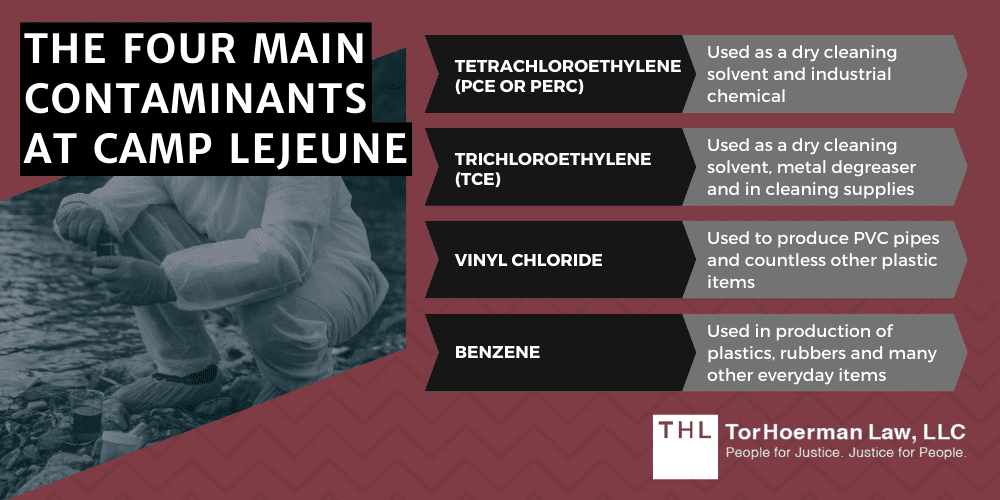
In commentary on the Camp Lejeune water contamination, medical professionals have postulated that exposure to tetrachloroethylene (PCE or PERC), trichloroethylene (TCE) and benzene, main contaminants at the Marine Corps Base, have resulted in breast cancer diagnoses.
Research on the relation of PCE and Breast Cancer include:
- Environmental Health Perspectives: Perchloroethylene-contaminated drinking water and the risk of breast cancer: additional results from Cape Cod, Massachusetts, USA
- Environmental Health Perspectives: Tetrachloroethylene-contaminated drinking water and the risk of breast cancer.
- EPA – Health & Environmental Research Online: Risk of breast cancer following exposure to tetrachloroethylene-contaminated drinking water in Cape Cod, Massachusetts: Reanalysis of a case-control study using a modified exposure assessment
- Biomedical Reports: Occupational exposure and risk of breast cancer
Breast Cancer Symptoms and Complications
Breast cancer symptoms vary, with some being easily visible and detectable, and others being more difficult to identify
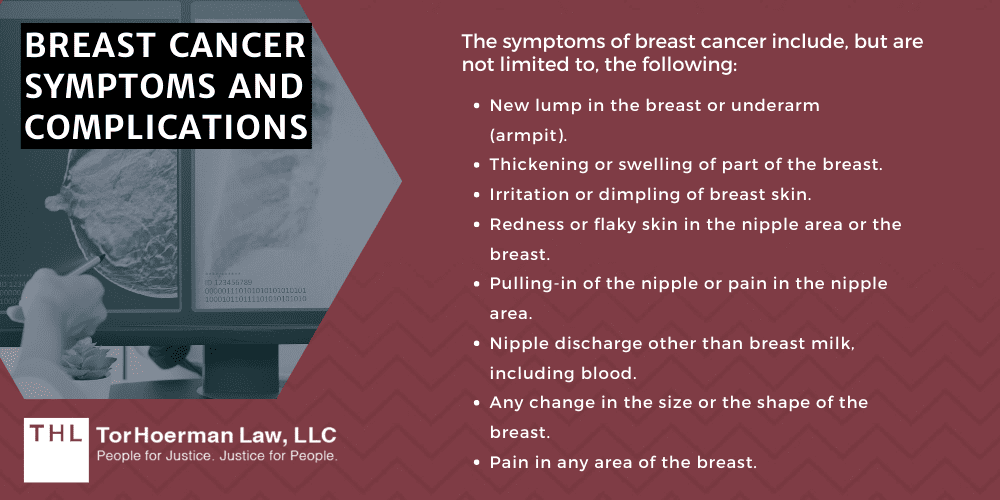
The symptoms of breast cancer include, but are not limited to, the following:
- New lump in the breast or underarm (armpit).
- Thickening or swelling of part of the breast.
- Irritation or dimpling of breast skin.
- Redness or flaky skin in the nipple area or the breast.
- Pulling-in of the nipple or pain in the nipple area.
- Nipple discharge other than breast milk, including blood.
- Any change in the size or the shape of the breast.
- Pain in any area of the breast.
There are serious complications associated with breast cancer, especially if treatment isn’t undertaken as soon as the warning signs appear.
- Cancer-related pain
- Bone-related pain and complications
- Spinal compression
- Hypercalcemia (elevated amounts of calcium in the blood that can lead to kidney stones, kidney failure, irregular heartbeat and neurological issues)
- Lung complications
- Liver complications
- Brain-related complications
- Health problems from cancer treatments