Active Litigation
Infant Sleep Product Lawsuits Facts
TorHoerman Law is investigating claims for the Infant Sleep Product Lawsuits.


The Fisher Price Rock n Play recall involved millions of inclined sleepers sold for infant rest and sleep.
Fisher-Price and the Consumer Product Safety Commission announced the original voluntary recall in April 2019 after reports of infant deaths involving the Rock ’n Play Sleeper.
The recall covered all Fisher Price Rock ’n Play Sleepers.

Consumers were instructed to stop using the product immediately and contact Fisher-Price for a refund or voucher.
The Fisher Price Rock n Play recall became one of the most significant infant sleep product recalls in the United States.
It also helped lead to broader safety action against inclined sleepers and other products that placed babies at an unsafe angle during sleep.
Fisher-Price and the Consumer Product Safety Commission recalled the Rock ’n Play Sleeper in April 2019 after reports of infant deaths involving babies who rolled from their backs onto their stomachs or sides while in the product, as well as other fatal incidents.
At the time of the recall, the CPSC reported more than 30 infant deaths associated with the Rock ’n Play Sleeper and instructed consumers to stop using the product immediately because of the risk of serious injury or death.
The Rock ’n Play differed from traditional cribs, bassinets, and playards because it placed infants in a reclined position rather than on a firm, flat sleep surface.
Safety concerns focused on whether the product’s inclined design increased the risk of rollover, airway obstruction, positional asphyxia, and suffocation.
Positional asphyxia can occur when an infant’s head falls forward and restricts the airway, making it difficult to breathe.
Regulators, pediatric safety advocates, and consumer groups also raised concerns about whether inclined sleepers were appropriate for routine infant sleep.
The Rock ’n Play became one of the most closely scrutinized infant products in the country and helped drive broader regulatory changes that ultimately led to stricter federal safety standards and the eventual ban on inclined infant sleepers.
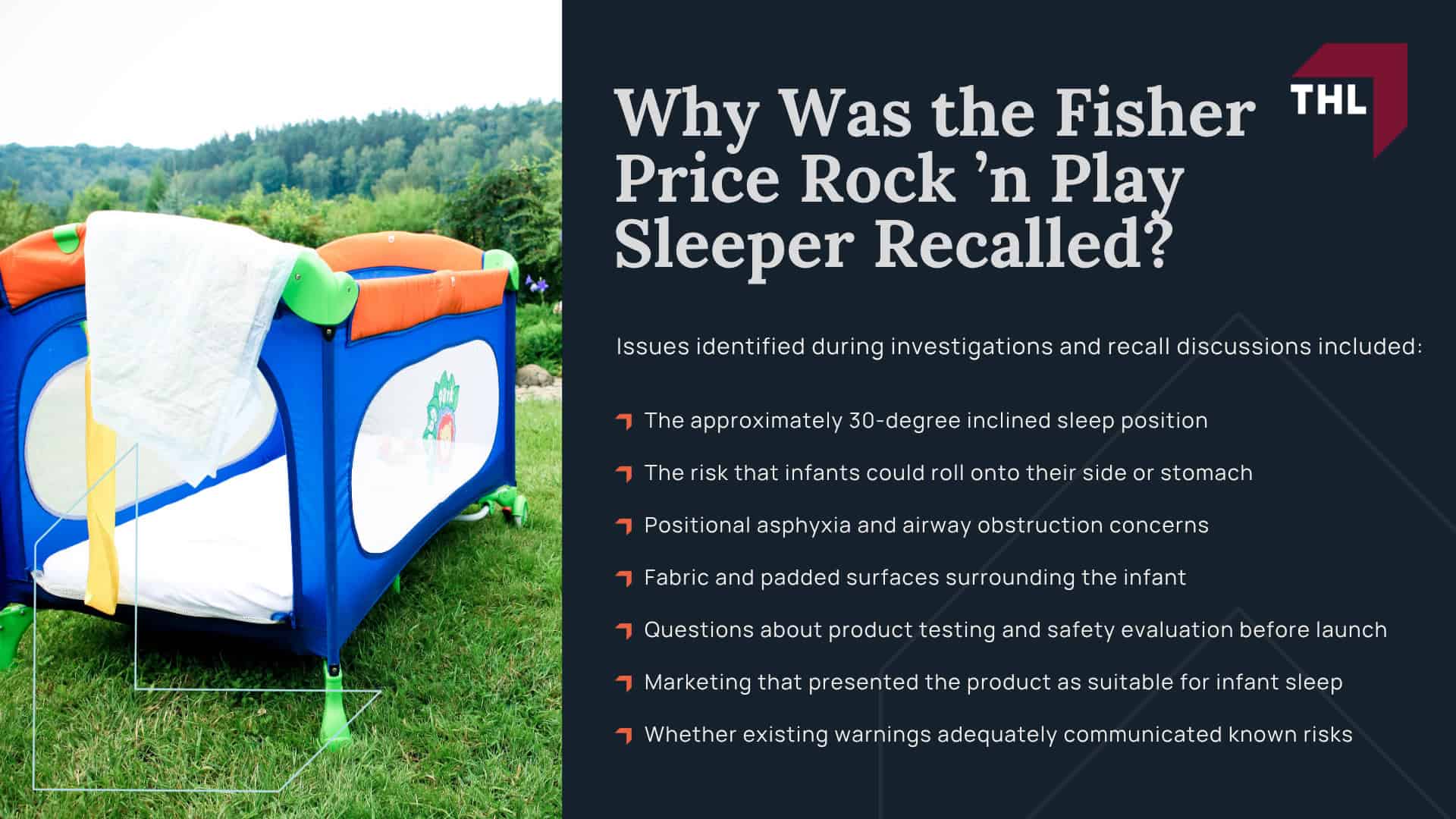
Issues identified during investigations and recall discussions included:
The recall itself does not determine liability in any individual case.
Product liability claims depend on the child’s injuries, the circumstances of the incident, the evidence available, and the legal issues specific to each lawsuit.
On January 9, 2023, Fisher-Price and the Consumer Product Safety Commission reannounced the recall of approximately 4.7 million Rock ’n Play Sleepers after determining that many recalled products remained in homes, childcare settings, secondhand markets, and other locations where they could still be used by infants.
The reannouncement reported that at least eight infant deaths had occurred after the original 2019 recall. Federal regulators also stated that approximately 100 deaths had been reported involving infants in Rock ’n Play Sleepers, although Fisher-Price noted that it could not independently confirm every reported circumstance or verify that every incident involved a Rock ’n Play product.
The reissued warning highlighted an ongoing problem with recalled infant products remaining in circulation years after removal from the market.
Consumers who still own a Rock ’n Play Sleeper should stop using it immediately and follow recall instructions provided by Fisher-Price. Federal law prohibits the sale or distribution of recalled consumer products.
The Fisher Price Rock ’n Play Sleeper settlement resolved a consumer class action lawsuit against Fisher-Price and Mattel involving the marketing, sale, recall, and alleged safety issues associated with the Rock ’n Play Sleeper.
In 2024, the parties agreed to a $19 million settlement fund to resolve certain consumer economic-loss claims brought by individuals who purchased or previously purchased a Rock ’n Play Sleeper.
According to the official settlement website, the court granted final approval of the settlement on February 28, 2025, and the settlement became effective on March 31, 2025.
Depending on the circumstances, eligible class members could seek settlement benefits based on ownership, purchase history, recall participation, voucher history, and other qualifying factors.

The deadline to submit a settlement claim was May 29, 2025.
The settlement does not mean that every family received compensation for personal injuries or wrongful death.
Consumer class action settlements generally address economic losses associated with the purchase of a product, while injury and wrongful death claims involve different legal standards, damages, evidence, and case-specific considerations.
The Fisher Price Rock ’n Play litigation was centralized in the United States District Court for the Western District of New York as In Re: Fisher-Price Rock ’N Play Sleeper Marketing, Sales Practices, and Products Liability Litigation, MDL No. 2903.
The multidistrict litigation involved allegations concerning the marketing, sale, recall, and safety of the Rock ’n Play Sleeper.
Plaintiffs alleged that consumers were harmed by purchasing a product that was marketed and sold despite safety concerns that later resulted in a nationwide recall.
The proceedings in the Western District of New York provide important background for understanding the Rock ’n Play settlement and related consumer claims.
Families whose children suffered serious injuries or death after using a Rock ’n Play Sleeper may require a separate legal evaluation because personal injury and wrongful death claims involve different legal issues than the consumer class action settlement.
The Rock ‘n Play settlement resolved certain consumer economic-loss claims, but it did not automatically resolve every personal injury or wrongful death claim involving the product.
Whether a family retains the right to pursue litigation may depend on factors such as participation in the settlement, the terms of any release, the nature of the alleged injuries, and applicable state law.

Families may need a separate legal review if:
Because the legal effect of a settlement can vary from case to case, families should not assume that settlement participation automatically eliminates their ability to pursue an injury-related claim.
Inclined baby sleepers can be dangerous because babies have limited head, neck, and trunk control.
When infants sleep at an angle, they may slump forward, roll to the side, or become positioned with their face pressed against fabric or padding.
The Fisher Price Rock n Play and other inclined sleepers raised safety concerns because they did not provide the same type of firm, flat sleep environment recommended for infants.
A dangerous product design may increase the risk of suffocation even when parents believe they are following the product’s instructions.

Inclined sleeper risks may include:
A Fisher Price Rock n Play lawsuit may allege that the sleeper’s design created a foreseeable risk that infants could be harmed during ordinary use.
Positional asphyxia can occur when a baby’s body position interferes with breathing.
In an inclined sleeper, an infant’s head may fall forward toward the chest, narrowing the airway and making it harder to breathe.
Babies are especially vulnerable because they may not have the strength or coordination to lift their heads or move out of a dangerous position.
This risk can be greater for young infants, premature babies, or infants with medical vulnerabilities.
In a Fisher Price Rock n Play lawsuit, plaintiffs may argue that the inclined design allowed babies to enter a dangerous sleep position.
These claims may focus on whether Fisher Price and Mattel were aware of positional risks and whether consumers received adequate warnings.
Airway compression can happen when a baby’s airway is narrowed by body position, neck flexion, or pressure from surrounding materials.
Suffocation can occur when the baby’s face presses against fabric, padding, or another surface that blocks airflow.
The Rock n Play Sleeper’s inclined position, fabric surroundings, and padded design may be examined in lawsuits involving airway obstruction or suffocation.
These claims may also review whether the child was restrained, unrestrained, placed with soft bedding, or found on the stomach or side.
Signs of a dangerous sleep environment may include:
Because these incidents can happen quickly, parents may not realize the risk until serious injury has occurred.
Soft bedding, blankets, pillows, inserts, and added padding can increase the risk of suffocation in any infant sleep environment.
These risks may become more serious when combined with an inclined sleeper.
Parents may add bedding because they want the baby to be warm, comfortable, or secure.
Soft materials can block the nose or mouth, trap exhaled air, or make it harder for a baby to move away from an unsafe position.
Unsafe sleep additions may include:
A Fisher Price Rock n Play lawsuit may examine whether warnings clearly told consumers not to add soft bedding, not to use the product for sleep, or not to continue using the product after recall.
Federal safety rules for infant sleep products have changed in response to deaths, injury reports, recalls, and concerns about inclined sleepers.
The Consumer Product Safety Commission now regulates infant sleep products through standards that address sleep surface angle, suffocation, asphyxiation, fall hazards, and other known risks.
These rules matter in Fisher Price Rock n Play lawsuit claims because they show how infant sleep safety standards evolved after years of reported deaths and recalls.
They may also help establish what safer product design and warnings should have looked like.

Federal infant sleep safety principles include:
The 10-degree incline rule is a federal safety requirement for covered infant sleep products.
Under CPSC rules, infant sleep products covered by the Infant Sleep Products Rule must have a sleep surface angle of 10 degrees or less.
This rule is important because products with steeper inclines may allow babies to slump forward or roll into unsafe positions.
The Consumer Product Safety Commission has also defined inclined sleepers for infants as products with an inclined sleep surface greater than 10 degrees that are intended, marketed, or designed to provide sleeping accommodations for an infant.
The Fisher Price Rock n Play and other inclined sleepers helped bring public attention to the danger of inclined sleep.
The Safe Sleep for Babies Act was signed into law in 2022 and prohibits the manufacture and sale of inclined sleepers for infants and crib bumpers in the United States.
The law was enacted after years of safety concerns, recalls, injury reports, and infant fatalities involving inclined sleep products and other sleep environments associated with suffocation hazards.
Under the Act, infant sleep products are not permitted to have sleep surfaces that exceed the federal incline threshold established for safe sleep products.
The legislation reflects a broader shift in federal infant sleep safety standards toward firm, flat sleep surfaces and away from products that position babies at an angle while sleeping.
The Safe Sleep for Babies Act also helps prevent recalled or banned infant sleep products from remaining in circulation through retailers, online marketplaces, secondhand sales, donations, and other distribution channels.
Together with updated Consumer Product Safety Commission regulations, the law represents one of the most significant federal efforts to reduce sleep-related infant injuries and deaths.
You may be able to file a Fisher Price Rock n Play lawsuit if your child suffered serious injury or died after using a Rock n Play Sleeper.
A claim may allege that the product was defectively designed, inadequately warned against, or marketed in a way that exposed infants to unreasonable danger.

Potential claims may involve:
A prior refund, voucher, payment, or class action settlement claim may affect your legal rights.
An attorney can review your circumstances and determine whether you may still be eligible to pursue compensation.
Families may qualify for a Fisher Price Rock n Play lawsuit if a child was seriously harmed or died while using the Rock n Play Sleeper.
The strongest claims generally involve documented injury, product identification, medical proof, and evidence showing how the sleeper was used.

Potential qualifying factors may include:
Not every injury involving a Rock n Play will support a lawsuit.
A law firm must review the details before determining whether a claim can be filed.
If your child was injured in a Fisher Price Rock n Play, seek medical care immediately and preserve all evidence.
Do not throw away, alter, clean, sell, donate, or destroy the product before speaking with an attorney.

Important steps include:
These steps can help protect your claim and preserve the proof needed to determine whether the product caused or contributed to the injury.
Evidence is critical in a Fisher Price Rock n Play lawsuit.
Plaintiffs must show what product was used, how the child was positioned, what injury occurred, and whether the sleeper contributed to the harm.

Important evidence may include:
Families should preserve the product in its post-incident condition whenever possible.
Altering or disposing of the sleeper may make it harder to prove a product liability claim.
Potential compensation in a Fisher Price Rock n Play injury or wrongful death claim depends on the facts, state law, medical evidence, and available defendants.
A lawsuit may seek damages for serious injury, medical care, long-term harm, or the death of a child.

Compensation may include:
No law firm can guarantee compensation, a settlement, or a specific payment amount.
A legal review can determine whether your family may have a claim beyond any consumer refund, purchase price reimbursement, voucher, or class action settlement benefit.
TorHoerman Law is investigating Fisher Price Rock n Play lawsuit claims involving serious injury, suffocation, asphyxia, brain injury, and infant deaths.
Our attorneys review whether the Rock n Play Sleeper’s design, warnings, marketing, recall history, or continued availability may have contributed to a child’s injury or death.
Families may have legal rights if their child was harmed by a dangerous product.

A free case review can help determine whether you are eligible to file a lawsuit and pursue compensation.
Contact TorHoerman Law today if your child was injured or died after using a Fisher Price Rock n Play Sleeper.
You can also use the chat feature on this page to sign up for a free case review.


