Active Litigation
Infant Sleep Product Lawsuits Facts
TorHoerman Law is investigating claims for the Infant Sleep Product Lawsuits.


Safety concerns surrounding the Chicco Lullaby Dream Playard have focused primarily on the product’s inclined napper accessory rather than the playard itself.
The accessory drew public attention after a wrongful death lawsuit alleged that a 3-month-old infant suffocated while using the napper, prompting broader scrutiny of inclined infant sleep products and questions about whether the design provided a safe sleep environment.
Although the Chicco Lullaby Dream Playard has not been the subject of a nationwide recall, lawmakers, consumer advocates, and product safety organizations have questioned whether inclined nappers should be marketed for infant sleep because they do not provide the firm, flat sleep surface recommended by pediatric safe sleep guidance.
Members of Congress also sought additional information from Chicco as federal regulators evaluated inclined sleeper safety across the industry.
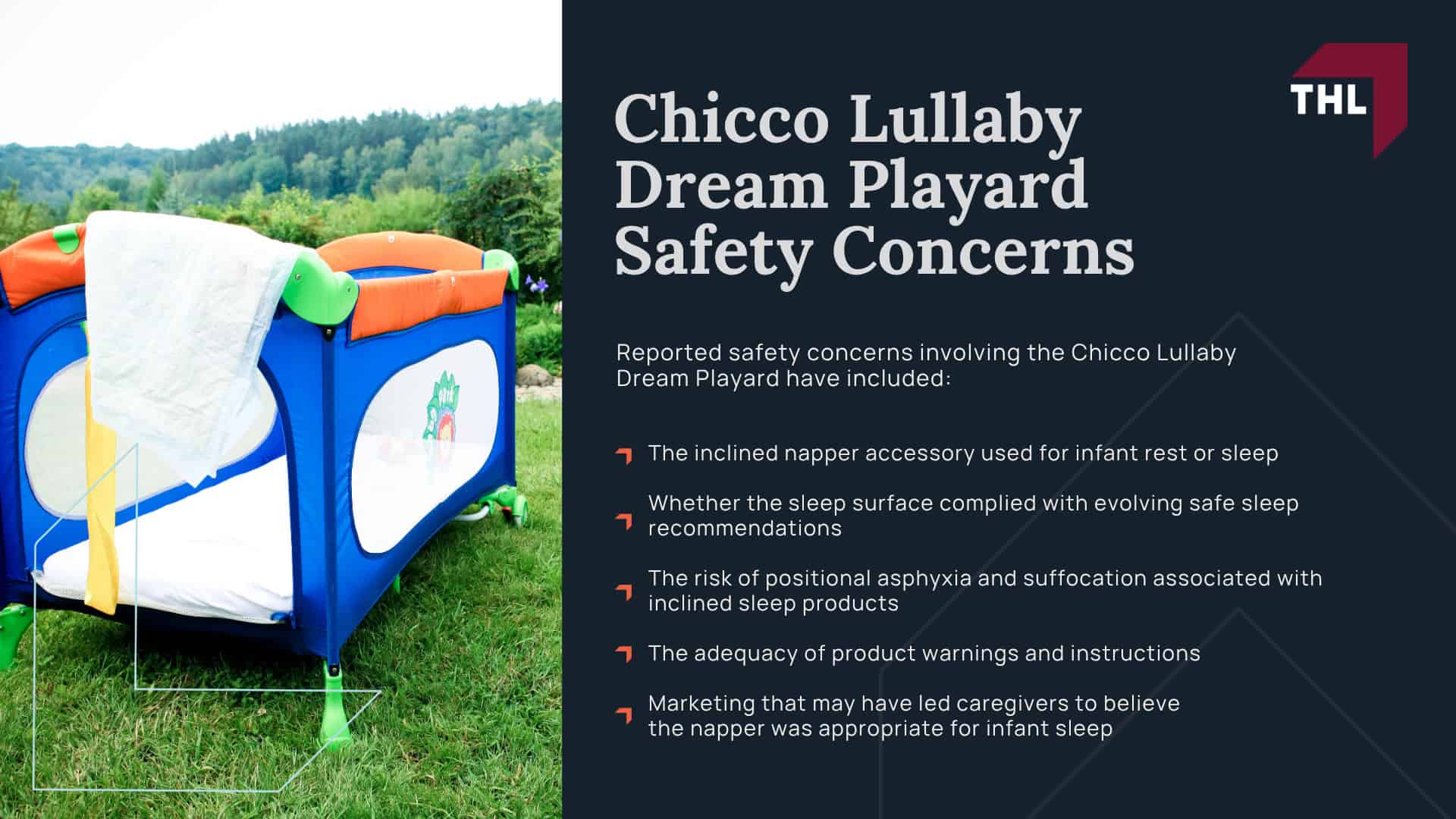
Reported safety concerns involving the Chicco Lullaby Dream Playard have included:
The following sections explain the reported litigation, the alleged infant death, applicable federal safety standards, and the evidence that may be relevant when evaluating a potential product liability claim.
An alleged infant death involving the Chicco Lullaby Dream Playard has been reported in litigation and media coverage.
A lawsuit was filed after a 3-month-old baby allegedly suffocated in a napper accessory attached to a Chicco Lullaby Dream Portable Playard.
The family’s lawsuit reportedly alleged that the napper was defective and dangerous because it placed the child at an unsafe incline.
These allegations have not been presented here as a court finding.
They are lawsuit claims that may be disputed by the company or evaluated by a court based on evidence, expert testimony, and product-specific facts.
This alleged infant death is important to the page because it explains why parents, lawyers, and consumer safety advocates have raised concerns about the Chicco Lullaby Dream Playard.
A law firm reviewing a potential claim must examine the product, model, instructions, warning labels, photos, medical records, and proof of purchase before determining whether the Chicco playard may have contributed to a child’s injury or death.
As of writing, the Chicco Lullaby Dream Playard and its inclined napper accessory have not been the subject of a nationwide Consumer Product Safety Commission recall.
The absence of a recall does not necessarily mean a product is free from safety concerns or that a family cannot pursue a product liability claim if a child was injured.
Public attention surrounding the product has instead focused on a reported wrongful death lawsuit, congressional scrutiny of inclined infant sleepers, and broader changes to federal infant sleep safety standards.
Parents who own a Chicco Lullaby Dream Playard should follow the manufacturer’s instructions, avoid using inclined nappers for infant sleep, and periodically check the CPSC website for any future safety notices or recalls.
Inclined playard accessories may be dangerous because they place a baby at an angle instead of on a flat, firm surface.
Infants have heavy heads compared to their bodies and limited ability to move if their airway becomes blocked or compressed.
The danger may increase when an inclined napper uses padding, soft fabric, curved seating, or sidewalls that can keep the baby in a compromised position.
A baby may look comfortable but still be at risk of suffocation, positional asphyxia, or airway obstruction.

Inclined playard accessory risks may include:
A Chicco playard lawsuit may allege that an inclined napper, seat, or sleeper accessory created risks that parents were not adequately warned about.
Suffocation can occur when a baby’s nose or mouth becomes blocked by fabric, padding, bedding, or another surface.
Positional asphyxia can occur when the baby’s body position interferes with breathing, even without obvious external blockage.
In an inclined napper, a baby’s head may tilt forward or to the side.
This can narrow the airway and reduce oxygen flow.
Because infants may not be able to lift or turn their heads, they can become trapped in a dangerous position before parents realize what has happened.
A lawsuit involving suffocation or positional asphyxia may require medical proof, product testing, expert review, and witness statements.
Lawyers may evaluate whether the Chicco product’s design, incline, warnings, or instructions created an unreasonable risk of serious injury or death.
Airway compression from inclined sleep positioning can occur when gravity pulls a baby’s head forward.
This chin-to-chest position may narrow the airway and make breathing harder.
Inclined sleep positioning is especially concerning for young infants because their muscles are still developing.
A baby may not have enough head control to move away from the position or signal distress.
If the product also includes padding or curved fabric, the child may be held in a position that increases the risk.
A Chicco playard lawsuit may examine whether the napper’s incline, shape, seat design, and safety warnings properly accounted for these risks.
The claim may also review whether the company was aware of broader industry concerns involving inclined sleeper products.
Rollover risks in infant sleep products are a major safety concern.
When infants roll from their backs onto their sides or stomachs, their face can press against fabric or padding, making it harder to breathe.
Inclined nappers may increase rollover risk because gravity and product shape can affect the baby’s position.
Even if a baby is placed on the back, the child may shift during sleep, especially as the baby grows stronger or begins to move more.

Rollover risks may be more serious when:
A product can create safety concerns even when parents use it in a way they believe is normal or foreseeable.
Chicco playard claims should be evaluated against safe sleep guidelines for infants.
Safe sleep recommendations emphasize that babies should sleep on their backs, on a firm and flat surface, without soft bedding or padded items.
A playard may be safe for infant sleep only when it complies with applicable standards and is used according to the manufacturer’s instructions.

A separate inclined napper, seat, or soft accessory is not the same as a flat playard sleep surface.
Parents should avoid using any inclined sleeper, napper, rocker, stroller, or car seat as a routine sleep space.
If a baby falls asleep in a product not designed for safe infant sleep, the baby should be moved to a firm, flat sleep surface as soon as possible.
Firm, flat sleep surfaces for babies reduce the risk of suffocation, airway compression, and rollover.
A firm surface does not conform around the baby’s face, while a flat surface helps keep the baby’s head and airway in a safer position.
The safest infant sleep environment is simple.
Babies should sleep alone, on their backs, on a firm surface covered only by a fitted sheet.
Soft bedding, pillows, stuffed animals, padded inserts, and loose blankets should not be placed in the sleep area.

Examples of safer infant sleep spaces may include:
Inclined nappers, soft seats, loungers, and other products used for soothing are not substitutes for safe sleep surfaces.
Babies should not sleep in inclined nappers because the angled position can create a suffocation hazard.
Even a product that appears comfortable can place an infant in a position that narrows the airway or allows the child to roll into fabric.
Inclined nappers may be especially concerning when they include padding, a curved seat, fabric sidewalls, or a soft surface.
These features may create comfort for supervised soothing but can pose risks if a baby falls asleep or is left unattended.
A Chicco playard lawsuit may allege that parents were not adequately warned that an inclined napper was unsafe for sleep.
It may also examine whether the product’s name, packaging, website materials, box instructions, or marketing led consumers to believe the napper could be used for infant sleep.
Federal safety rules for infant sleep products and playards are relevant to Chicco playard litigation.
The Consumer Product Safety Commission regulates play yards and infant sleep products through mandatory standards intended to reduce risks such as suffocation, entrapment, falls, and unsafe sleep positioning.
These rules do not automatically decide whether a company is liable in a lawsuit.
They do help show what safety hazards regulators have recognized and what standards manufacturers must consider when designing and selling infant sleep products.

Federal safety issues that may be relevant include:
A law firm may use CPSC rules, product instructions, expert testimony, and incident evidence to evaluate a claim.
The 10-degree incline rule is a key federal safety standard for infant sleep products.
CPSC guidance states that in-scope infant sleep products must have a sleep surface angle of 10 degrees or less.
This rule matters because steeper inclined sleeping products can cause babies to slump, roll, or enter a position that interferes with breathing.
Products marketed or intended to provide sleeping accommodations for infants are subject to heightened safety scrutiny when they use an inclined surface.
A Chicco playard lawsuit may examine whether an inclined napper, sleeper, bassinet, or related accessory placed babies at an unsafe angle.
The legal analysis may also consider whether the product was sold before or after newer federal rules took effect.
The Safe Sleep for Babies Act makes inclined sleepers for infants banned hazardous products under federal law.
It also bans crib bumpers.
The law reflects recognized safety concerns involving products that place infants on angled or padded sleep surfaces.
The Act is important for Chicco playard claims because it shows the federal government’s position that inclined sleepers for infants pose unacceptable risks.
It also helps explain why parents should not buy, sell, donate, or use inclined infant sleep products, even if the product was purchased years earlier.
If a Chicco product or accessory was used as an inclined sleeper, attorneys may review whether the product’s design, marketing, warnings, or continued availability created a foreseeable risk.
Each claim depends on the product model, injury, date of use, and evidence available.
You may be able to file a Chicco playard lawsuit if your child suffered serious injury or death after using a Chicco playard, inclined napper, bassinet, mattress, or related infant sleep accessory.
A claim may allege that the product was defectively designed, lacked adequate warnings, or was marketed in a way that exposed infants to unreasonable risks.
Potential claims may involve suffocation, positional asphyxia, airway compression, rollover, entrapment, or wrongful death.

A lawsuit may also examine whether parents were clearly warned not to use the napper or playard accessory for sleep.
A recall is not always required to file a product liability claim.
Lawyers must review the product, model, warnings, medical records, proof of purchase, and incident details to determine whether a legal claim may be filed.
Families may qualify for a Chicco playard lawsuit if a baby was seriously harmed or died after using a Chicco playard or related infant sleep product.
The strongest claims often involve documented medical injuries, product identification, and evidence showing how the child was positioned.

Potential qualifying factors may include:
Not every injury involving a Chicco playard will support a lawsuit.
A law firm must review the specific facts before determining whether a claim can proceed.
If your child was injured in a Chicco playard, seek medical care immediately and preserve every piece of evidence related to the product.
Do not throw away, clean, alter, sell, donate, or disassemble the product before speaking with a lawyer.

Important steps may include:
These steps can help protect your claim and preserve evidence before it is lost or changed.
Evidence in a Chicco playard lawsuit helps lawyers determine whether the product caused or contributed to the child’s injury.
Product liability claims often require proof of the product model, the warning labels, the condition of the product, and the child’s medical outcome.

Important evidence may include:
The product should be preserved in its post-incident condition.
Changing or disposing of the product can make it harder to prove what happened.
Potential compensation in a Chicco playard injury claim depends on the facts of the case, the child’s injuries, state law, and the available evidence.
A lawsuit may seek damages for medical care, long-term harm, pain and suffering, or wrongful death.
Compensation may include:
No law firm can guarantee compensation, a settlement, or a specific court result.
A legal review can determine whether your family may have a claim against the manufacturer, seller, distributor, or another responsible company.
TorHoerman Law is investigating Chicco playard lawsuit claims involving serious injury, suffocation, asphyxia, airway compression, brain injury, and infant death.
Our attorneys review whether a Chicco playard, inclined napper, bassinet, mattress, or related infant sleep product may have exposed a baby to preventable risks.
Parents should not have to determine alone whether a product’s design, warnings, or instructions were adequate.

Our lawyers can review the product, medical records, proof of purchase, website materials, warning labels, and other evidence to determine whether your family may have a legal claim.
Contact TorHoerman Law today for a free case review.
You can also use the chatbot feature on this page to submit your information and learn whether you may qualify for a Chicco playard lawsuit.


