If you or a loved one suffered injuries, property damage, or other financial losses due to another party’s actions, you may be entitled to compensation for those losses.
Contact the experienced Chicago personal injury lawyers from TorHoerman Law for a free, no-obligation Chicago personal injury lawsuit case consultation today.
If you or a loved one suffered a personal injury or financial loss due to a car accident in Chicago, IL – you may be entitled to compensation for those damages.
Contact an experienced Chicago auto accident lawyer from TorHoerman Law today to see how our firm can serve you!
If you or a loved one have suffered injuries, property damage, or other financial losses due to a truck accident in Chicago, IL – you may qualify to take legal action to gain compensation for those injuries and losses.
Contact TorHoerman Law today for a free, no-obligation consultation with our Chicago truck accident lawyers!
If you or a loved one suffered an injury in a motorcycle accident in Chicago or the greater Chicagoland area – you may be eligible to file a Chicago motorcycle accident lawsuit.
Contact an experienced Chicago motorcycle accident lawyer at TorHoerman Law today to find out how we can help.
If you have been involved in a bicycle accident in Chicago at no fault of your own and you suffered injuries as a result, you may qualify to file a Chicago bike accident lawsuit.
Contact a Chicago bike accident lawyer from TorHoerman Law to discuss your legal options today!
Chicago is one of the nation’s largest construction centers.
Thousands of men and women work on sites across the city and metropolitan area on tasks ranging from skilled trades to administrative operations.
Unfortunately, construction site accidents are fairly common.
Contact TorHoerman Law to discuss your legal options with an experienced Chicago construction accident lawyer, free of charge and no obligation required.
Nursing homes and nursing facilities should provide a safe, supportive environment for senior citizens, with qualified staff, nurses, and aids administering quality care.
Unfortunately, nursing home abuse and neglect can occur, leaving residents at risk and vulnerable.
Contact an experienced Chicago nursing home abuse lawyer from TorHoerman Law today for a free consultation to discuss your legal options.
If you are a resident of Chicago, or the greater Chicagoland area, and you have a loved one who suffered a fatal injury due to another party’s negligence or malpractice – you may qualify to file a wrongful death lawsuit on your loved one’s behalf.
Contact a Chicago wrongful death lawyer from TorHoerman Law to discuss your legal options today!
If you have suffered a slip and fall injury in Chicago you may be eligible for compensation through legal action.
Contact a Chicago slip and fall lawyer at TorHoerman Law today!
TorHoerman Law offers free, no-obligation case consultations for all potential clients.
When a child is injured at a daycare center, parents are left wondering who can be held liable, who to contact for legal help, and how a lawsuit may pan out for them.
If your child has suffered an injury at a daycare facility, you may be eligible to file a daycare injury lawsuit.
Contact a Chicago daycare injury lawyer from TorHoerman Law today for a free consultation to discuss your case and potential legal action!
If you or a loved one suffered injuries, property damage, or other financial losses due to another party’s actions, you may be entitled to compensation for those losses.
Contact the experienced Edwardsville personal injury lawyers from TorHoerman Law for a free, no-obligation Edwardsville personal injury lawsuit case consultation today.
If you or a loved one suffered a personal injury or financial loss due to a car accident in Edwardsville, IL – you may be entitled to compensation for those damages.
Contact an experienced Edwardsville car accident lawyer from TorHoerman Law today to see how our firm can serve you!
If you or a loved one have suffered injuries, property damage, or other financial losses due to a truck accident in Edwardsville, IL – you may qualify to take legal action to gain compensation for those injuries and losses.
Contact TorHoerman Law today for a free, no-obligation consultation with our Edwardsville truck accident lawyers!
If you or a loved one suffered an injury in a motorcycle accident in Edwardsville – you may be eligible to file an Edwardsville motorcycle accident lawsuit.
Contact an experienced Edwardsville motorcycle accident lawyer at TorHoerman Law today to find out how we can help.
If you have been involved in a bicycle accident in Edwardsville at no fault of your own and you suffered injuries as a result, you may qualify to file an Edwardsville bike accident lawsuit.
Contact an Edwardsville bicycle accident lawyer from TorHoerman Law to discuss your legal options today!
Nursing homes and nursing facilities should provide a safe, supportive environment for senior citizens, with qualified staff, nurses, and aids administering quality care.
Unfortunately, nursing home abuse and neglect can occur, leaving residents at risk and vulnerable.
Contact an experienced Edwardsville nursing home abuse attorney from TorHoerman Law today for a free consultation to discuss your legal options.
If you are a resident of Edwardsville and you have a loved one who suffered a fatal injury due to another party’s negligence or malpractice – you may qualify to file a wrongful death lawsuit on your loved one’s behalf.
Contact an Edwardsville wrongful death lawyer from TorHoerman Law to discuss your legal options today!
If you have suffered a slip and fall injury in Edwardsville you may be eligible for compensation through legal action.
Contact an Edwardsville slip and fall lawyer at TorHoerman Law today!
TorHoerman Law offers free, no-obligation case consultations for all potential clients.
When a child is injured at a daycare center, parents are left wondering who can be held liable, who to contact for legal help, and how a lawsuit may pan out for them.
If your child has suffered an injury at a daycare facility, you may be eligible to file a daycare injury lawsuit.
Contact an Edwardsville daycare injury lawyer from TorHoerman Law today for a free consultation to discuss your case and potential legal action!
If you or a loved one suffered injuries on someone else’s property in Edwardsville IL, you may be entitled to financial compensation.
If property owners fail to keep their premises safe, and their negligence leads to injuries, property damages or other losses as a result of an accident or incident, a premises liability lawsuit may be possible.
Contact an Edwardsville premises liability lawyer from TorHoerman Law today for a free, no-obligation case consultation.
If you or a loved one suffered injuries, property damage, or other financial losses due to another party’s actions, you may be entitled to compensation for those losses.
Contact the experienced St. Louis personal injury lawyers from TorHoerman Law for a free, no-obligation St. Louis personal injury lawsuit case consultation today.
If you or a loved one suffered a personal injury or financial loss due to a car accident in St. Louis, IL – you may be entitled to compensation for those damages.
Contact an experienced St. Louis car accident lawyer from TorHoerman Law today to see how our firm can serve you!
If you or a loved one have suffered injuries, property damage, or other financial losses due to a truck accident in St. Louis, IL – you may qualify to take legal action to gain compensation for those injuries and losses.
Contact TorHoerman Law today for a free, no-obligation consultation with our St. Louis truck accident lawyers!
If you or a loved one suffered an injury in a motorcycle accident in St. Louis or the greater St. Louis area – you may be eligible to file a St. Louis motorcycle accident lawsuit.
Contact an experienced St. Louis motorcycle accident lawyer at TorHoerman Law today to find out how we can help.
If you have been involved in a bicycle accident in St. Louis at no fault of your own and you suffered injuries as a result, you may qualify to file a St. Louis bike accident lawsuit.
Contact a St. Louis bicycle accident lawyer from TorHoerman Law to discuss your legal options today!
St. Louis is one of the nation’s largest construction centers.
Thousands of men and women work on sites across the city and metropolitan area on tasks ranging from skilled trades to administrative operations.
Unfortunately, construction site accidents are fairly common.
Contact TorHoerman Law to discuss your legal options with an experienced St. Louis construction accident lawyer, free of charge and no obligation required.
Nursing homes and nursing facilities should provide a safe, supportive environment for senior citizens, with qualified staff, nurses, and aids administering quality care.
Unfortunately, nursing home abuse and neglect can occur, leaving residents at risk and vulnerable.
Contact an experienced St. Louis nursing home abuse attorney from TorHoerman Law today for a free consultation to discuss your legal options.
If you are a resident of St. Louis, or the greater St. Louis area, and you have a loved one who suffered a fatal injury due to another party’s negligence or malpractice – you may qualify to file a wrongful death lawsuit on your loved one’s behalf.
Contact a St. Louis wrongful death lawyer from TorHoerman Law to discuss your legal options today!
If you have suffered a slip and fall injury in St. Louis you may be eligible for compensation through legal action.
Contact a St. Louis slip and fall lawyer at TorHoerman Law today!
TorHoerman Law offers free, no-obligation case consultations for all potential clients.
When a child is injured at a daycare center, parents are left wondering who can be held liable, who to contact for legal help, and how a lawsuit may pan out for them.
If your child has suffered an injury at a daycare facility, you may be eligible to file a daycare injury lawsuit.
Contact a St. Louis daycare injury lawyer from TorHoerman Law today for a free consultation to discuss your case and potential legal action!
The Ozempic lawsuit centers on allegations that Novo Nordisk failed to adequately warn consumers about serious risks associated with Ozempic and other GLP-1 medications.
Plaintiffs allege the drug has been linked to severe gastrointestinal injuries, including gastroparesis, as well as vision loss and other complications that have disrupted patients’ health, nutrition, employment, and daily functioning.
If you or a loved one developed gastroparesis, bowel obstruction, severe vomiting, vision loss, or other serious complications after taking Ozempic or another GLP-1 medication, you may have legal options.
Dupixent lawsuits allege that patients treated with dupilumab therapy later developed cutaneous T-cell lymphoma (CTCL), a rare form of non-Hodgkin lymphoma that can closely resemble severe eczema.
Research and published case reports have raised questions about whether some patients with atopic dermatitis face a higher risk of developing CTCL compared to similar patients who did not receive the drug.
Plaintiffs contend that Sanofi and Regeneron failed to warn patients and physicians about the possibility that Dupixent could worsen, accelerate, or reveal previously undiagnosed cutaneous lymphoma.
If you or a loved one has suffered a severe reaction or blood cancer linked to Dupixent, you may be eligible to take action and file a Dupixent lawsuit.
Suboxone, a medication often used to treat opioid use disorder (OUD), has become a vital tool which offers a safer and more controlled approach to managing opioid addiction.
Despite its widespread use, Suboxone has been linked to severe tooth decay and dental injuries.
Suboxone Tooth Decay Lawsuits claim that the companies failed to warn about the risks of tooth decay and other dental injuries associated with Suboxone sublingual films.
The chemotherapy drug Taxotere, commonly used for breast cancer treatment, has been linked to severe eye injuries, permanent vision loss, and permanent hair loss.
Taxotere Lawsuits are being filed by breast cancer patients and others who have taken the chemotherapy drug and subsequently developed vision problems.
If you or a loved one used Taxotere and subsequently developed vision damage or other related medical problems, you may be eligible to file a Taxotere Lawsuit and seek financial compensation.
Tylenol (Acetaminophen), one of the most popular over the counter medications for pain relief and high fever, has been associated with an increased risk of Autism Spectrum Disorder (ASD), Attention Deficit Hyperactivity Disorder (ADHD), and other developmental disorders in children exposed to Acetaminophen during pregnancy.
Legal claims against manufacturers and distributors of generic Acetaminophen have been investigated on behalf of pregnant women who used Tylenol during pregnancy and children who developed disorders such as Autism Spectrum Disorder, ADHD, and more.
TorHoerman Law is actively accepting and reviewing Tylenol lawsuit claims.
Spinal cord stimulator lawsuit claims allege that these devices are defectively designed and improperly marketed without adequate warnings, leading to severe injuries for patients.
TorHoerman Law is investigating claims involving spinal cord stimulators that allegedly caused serious injury instead of the relief patients were led to expect.
If you or a loved one experienced complications following spinal cord stimulator surgery, you may be eligible to pursue compensation through a spinal cord stimulator lawsuit.
Several studies have found a correlation between heavy social media use and mental health challenges, especially among younger users.
Social media harm lawsuits claim that social media companies are responsible for onsetting or heightening mental health problems, eating disorders, mood disorders, and other negative experiences of teens and children
You may be eligible to file a Social Media Mental Health Lawsuit if you are the parents of a teen, or teens, who attribute their use of social media platforms to their mental health problems.
Thousands of Uber sexual assault claims have been filed by passengers who suffered violence during rides arranged through the platform.
The ongoing Uber sexual assault litigation spans both federal law and California state court, with a consolidated Uber MDL (multi-district litigation) currently pending in the Northern District of California.
Uber sexual assault survivors across the country are coming forward to hold the company accountable for negligence in hiring, screening, and supervising drivers.
If you or a loved one were sexually assaulted, sexually battered, or faced any other form of sexual misconduct from an Uber driver, you may be eligible to file an Uber Sexual Assault Lawsuit.
Roblox lawsuit claims center on allegations that the platform allowed predators to groom, exploit, and abuse children through unsafe design and inadequate protections.
TorHoerman Law is dedicated to helping families who believe their child was harmed on Roblox pursue justice and financial recovery.
For many families, legal action represents both a path to compensation and a way to demand systemic change in how Roblox treats the safety of its youngest players.
If your child was sexually abused, exploited, or exposed to harmful content through Roblox, you may be eligible to take legal action by filing a lawsuit against Roblox Corporation.
Although pressure cookers were designed to be safe and easy to use, a number of these devices have been found to have a defect that can lead to excessive buildup of internal pressure.
The excessive pressure may result in an explosion that puts users at risk of serious injuries such as burns, lacerations, an even electrocution.
If your pressure cooker exploded and caused substantial burn injuries or other serious injuries, you may be eligible to file a Pressure Cooker Lawsuit and secure financial compensation for your injuries and damages.
Olympus Scope lawsuit claims center on allegations that certain reusable Olympus endoscopes and related accessories exposed patients to dangerous bacterial contamination after medical procedures.
These infections can lead to hospitalization, IV antibiotic treatment, sepsis, organ failure, and death, leaving many patients with serious medical complications and lasting physical harm.
You may qualify to file an Olympus scope lawsuit if you underwent an ERCP or another endoscopic procedure involving Olympus equipment and later developed a serious bacterial infection.
Families who lost a loved one after infection-related complications linked to an Olympus scope procedure may also be able to pursue a wrongful death claim.
Vaginal Mesh Lawsuits are being filed against manufacturers of transvaginal mesh products for injuries, pain and suffering, and financial costs related to complications and injuries of these medical devices.
Over 100,000 Transvaginal Mesh Lawsuits have been filed on behalf of women injured by vaginal mesh and pelvic mesh products.
If you or a loved one have suffered serious complications or injuries from vaginal mesh, you may be eligible to file a Vaginal Mesh Lawsuit.
Breast mesh lawsuits involve allegations that certain mesh products used during breast reconstruction, augmentation, and lift procedures contributed to postoperative complications and the need for revision surgeries.
Patients who experienced complications after mesh-assisted breast procedures have reported chronic pain, reconstruction problems, cosmetic deformities, and additional revision surgeries.
If you or a loved one experienced serious complications after breast surgery involving mesh or an internal bra technique, you may be eligible to pursue a breast mesh lawsuit claim for the harm caused.
Patients with the PowerPort devices may possibly be at a higher risk of serious complications or injury due to a catheter failure, according to lawsuits filed against the manufacturers of the Bard PowerPort Device.
If you or a loved one have been injured by a Bard PowerPort Device, you may be eligible to file a Bard PowerPort Lawsuit and seek financial compensation.
The AngioDynamics port catheter lawsuit claims that defective implantable ports have caused patients to suffer dangerous fractures, blood clots, and infections due to the breakdown of the catheter’s material inside the body.
These failures can lead to life-threatening complications such as embolism, sepsis, or the need for surgical removal of the device.
If you or a loved one experienced severe complications such as blood clots, infections, or catheter fractures requiring surgery due to a defective AngioDynamics port catheter, you may be eligible to file an AngioDynamics Port Catheter Lawsuit and seek compensation.
NEC Lawsuit claims allege that certain formulas given to infants in NICU settings increase the risk of necrotizing enterocolitis (NEC) – a severe intestinal condition in premature infants.
Parents and guardians are filing NEC Lawsuits against baby formula manufacturers, alleging that the formulas contain harmful ingredients leading to NEC.
Despite the claims, Abbott and Mead Johnson deny the allegations, arguing that their products are thoroughly researched and dismissing the scientific evidence linking their formulas to NEC, while the FDA issued a warning to Abbott regarding safety concerns of a formula product.
You may be eligible to file a Toxic Baby Formula NEC Lawsuit if your child received baby bovine-based (cow’s milk) baby formula in the maternity ward or NICU of a hospital and was subsequently diagnosed with Necrotizing Enterocolitis (NEC).
Paraquat, a widely-used herbicide, has been linked to Parkinson’s disease, leading to numerous Paraquat Parkinson’s Disease Lawsuits against its manufacturers for failing to warn about the risks of chronic exposure.
Due to its toxicity, the EPA has restricted the use of Paraquat and it is currently banned in over 30 countries.
You may be eligible to file a Paraquat Lawsuit if you or a loved one were exposed to Paraquat and subsequently diagnosed with Parkinson’s Disease or other related health conditions.
Ethylene Oxide Lawsuit claims center on allegations that Sterigenics U.S., LLC and other defendants negligently released hazardous levels of ethylene oxide (EtO), exposing nearby residents and workers to a known carcinogen linked to breast cancer, leukemia, lymphoma, and other serious illnesses.
If you or a loved one were diagnosed with cancer or other serious health problems associated with exposure to ethylene oxide and lived near a facility with known emissions, you may be eligible to file an Ethylene Oxide Lawsuit and seek financial compensation.
Nitrous oxide lawsuit claims center on manufacturers, distributors, and retailers who profit from selling canisters that are widely misused as a recreational drug.
Reports link this misuse to severe neurological injuries, psychiatric symptoms, hypoxia, and deaths caused by accidents or overdose.
These cases are rapidly expanding as more evidence emerges of the profound physical, psychological, and social toll caused by nitrous oxide misuse.
If you or a loved one has suffered brain injuries, spinal cord or nerve damage, psychiatric symptoms, or even death linked to misused nitrous oxide, you may be eligible to pursue a nitrous oxide lawsuit claim and seek compensation for the harm caused.
Diacetyl popcorn lung lawsuit claims center on allegations that repeated inhalation of butter-flavoring chemicals in certain workplaces, including diacetyl and related substitutes, caused permanent and preventable airway damage.
Popcorn lung, medically known as bronchiolitis obliterans or constrictive bronchiolitis, is a serious obstructive lung disease that scars and narrows the small airways, leaving many people with persistent shortness of breath, chronic cough, and reduced exercise tolerance.
TorHoerman Law has experience handling diacetyl popcorn lung cases and is currently reviewing claims from workers who believe occupational exposure to these flavoring chemicals contributed to their diagnosis.
If you or a loved one were diagnosed with diacetyl induced lung disease or bronchiolitis obliterans, you may have grounds to pursue a diacetyl popcorn lung lawsuit for the harm caused to your lung tissue and long-term lung function.
Our firm is about people. That is our motto and that will always be our reality.
We do our best to get to know our clients, understand their situations, and get them the compensation they deserve.
At TorHoerman Law, we believe that if we continue to focus on the people that we represent, and continue to be true to the people that we are – justice will always be served.
Without our team, we would’nt be able to provide our clients with anything close to the level of service they receive when they work with us.
The TorHoerman Law Team commits to the sincere belief that those injured by the misconduct of others, especially large corporate profit mongers, deserve justice for their injuries.
Our team is what has made TorHoerman Law a very special place since 2009.
Tor Hoerman has represented injured individuals for more than 30 years, with experience spanning individual personal injury cases and nationwide mass tort litigation. His work includes car accidents, catastrophic injuries, product liability claims, and other serious injury cases. Tor has served in court-appointed leadership roles in national litigation and tried cases involving major corporate defendants.
TorHoerman Law’s legal content is researched and written by our editorial team and attorneys for legal accuracy, clarity, and relevance. We rely on statutes, court records, government publications, medical research, and other authoritative sources when applicable. This page provides general legal information and does not constitute legal advice.
TorHoerman Law reviews its legal content for factual accuracy, current information, and relevant legal context before publication and as material developments occur. This article is provided for general informational purposes and does not constitute legal advice. For guidance about a specific case, contact TorHoerman Law.
Nursing home resident rights are the legal protections that guarantee a resident dignity, safety, medical choice, and control over their own life inside a nursing home.
Congress created these protections through the Nursing Home Reform Act of 1987, and they apply to every home that accepts Medicare or Medicaid funding.
A facility that ignores these rights can lose its certification, face state-survey citations, and be sued by the resident or family for the harm caused.
Nursing home residents in the United States are legally guaranteed comprehensive rights under federal law and individual state statutes.
Ignored rights usually surface as poor care first, and the records that would prove it stay with the facility.
TorHoerman Law represents residents and families harmed when a nursing home fails to meet the standards federal and state law require.
Families who suspect a rights violation often cannot tell whether the facts support a claim.
The answer lies in the facility records, and those records can change once the home knows a complaint is coming.
A single missing record can turn a provable claim into a contested one, and a short delay can be the difference between a recovery and a denial.
If you suspect a nursing home has violated the rights of your family member and caused harm, TorHoerman Law can review the records and explain whether the facts support a nursing home abuse lawsuit.
Contact TorHoerman Law today for a free consultation.
You can also use the chat feature on this page to find out if you qualify for a nursing home negligence claim.
Nursing home residents are protected by federal law and by the law of the state where the facility operates.
The Nursing Home Reform Act of 1987 sets the federal protections, codified at 42 USC 1395i-3 for Medicare and 42 USC 1396r for Medicaid, and was passed as part of OBRA.
The Nursing Home Reform Act ensures dignity, safety, and autonomy for nursing home residents.
The detailed rules sit in federal regulation at 42 CFR 483.10, 483.12, and 483.15, and the Centers for Medicare and Medicaid Services publishes a plain-language summary of these protections.
A facility must follow these rules to receive Medicare and Medicaid funding, which is how most nursing homes operate.
These regulations mandate that facilities promote and protect the dignity, choice, and self-determination of every individual.
State laws go further in many places, reaching assisted living facilities and other care facilities that federal rules leave out, and some apply whether or not a facility takes federal money.
A resident keeps the same legal rights inside a facility that any adult holds in the wider community.
Nursing home residents have the right to receive care that meets their physical, mental, and social needs, as mandated by federal and state laws.
Federal regulations divide resident protections into categories for daily life, medical care, money, transparency, and discharge.
Each category sets a clear duty the nursing home owes the resident, and a violation of any of them can support a complaint, a state investigation, or a civil claim.
A nursing home resident chooses who visits and how they communicate with the outside world, and these residents rights cannot be interfered with by the facility.
Residents have the right to privacy during visits, communication, and medical care.
The visitors a resident may receive include family members, the Long-Term Care Ombudsman, the state health department, a personal physician, and attorneys.
A resident may send and receive unopened mail, make private phone calls, and meet with visitors at times the resident chooses.
A nursing home cannot keep residents apart from other residents against their will or restrict participation in community activities, religious services, or personal decisions about daily routine.
A resident keeps control over personal belongings, money, and living space.
Residents have the right to a clean, comfortable, and homelike environment while maintaining individual sleep and dining schedules.
Personal possessions and clothing belong to the resident, unless a specific item creates a documented safety risk.
Privacy reaches into the room, into medical treatment, and into meetings with family members or resident groups, and the home must keep clinical records and personal information confidential.
Residents can manage personal finances, and if they delegate financial tasks, a mandatory quarterly financial report from the facility is required.
A nursing home cannot require a resident to deposit funds with the home, and any money it holds must stay separate from facility accounts and available for personal needs on request.
A resident has the right to apply for and receive Medicare and Medicaid benefits.
A nursing home cannot refuse care or discharge a resident based on how the bill gets paid.
Federal rules require a home to treat private payers and recipients of Medicaid services on equal terms.
The facility must give the resident a written list of services the home provides, the services Medicare or Medicaid pays for, and any services that come at an extra charge.
A home that quietly moves a Medicaid resident to a lower standard of care, or that pressures a family to convert to private pay, is acting against federal law.
A resident takes an active role in their own medical treatment, and the law gives the resident the final word on most care decisions.
Residents have the right to choose a personal physician, view medical records, participate in care planning, and refuse unwanted treatment or medications.
The home prepares a written care plan for each resident, and the resident or a legal representative has the right to take part in the meetings that shape that care plan.
A resident has the right to be fully informed about their own medical condition in a language they understand, with a loved one included in those discussions when the resident asks.
A resident may decline a medication, a procedure, or participation in research, and the home cannot retaliate for that choice.
A resident can inspect their own records within 24 hours of a request, excluding weekends and holidays, and can obtain copies with 2 working days’ notice under 42 CFR 483.10.
More nursing home lawsuits arise from abuse, neglect, and improper restraint than from any other rights violation.
Residents are protected against physical, verbal, mental, sexual, or financial abuse, and cannot be subjected to unauthorized restraints.
Federal rules at 42 CFR 483.12 bar mental and physical abuse, corporal punishment, and involuntary seclusion.
Financial exploitation and sexual assault fall under the same prohibition, and a separate guide breaks down the types of abuse in nursing homes.
The same rules limit physical and chemical restraints to a documented medical need, so a nursing home cannot use chemical and physical restraints for staff convenience or discipline.
A drug used to sedate a resident to benefit staff, rather than to treat a medical need, is a restraint the law treats as a violation.
A nursing home owes residents and families honest information about the home, the care it provides, and any concerns that arise during the stay.
Residents of nursing homes must be provided with a written statement of their rights and responsibilities upon admission, which the facility must adhere to.
A resident has the right to review the most recent state inspection report, the survey deficiencies, and the plan of correction the home submitted in response.
The facility must disclose its rules, the services available, and any change in ownership or management that affects residents.
A resident has the right to present grievances to nursing home staff and to receive prompt action, free from any reprisal for speaking up.
Residents can utilize a structured escalation path to address violations of their rights.
A facility cannot use a complaint from the resident or family as a reason to evict the resident, alter their care, or move them to a less desirable room.
A nursing home cannot move a resident out at its own discretion.
A lawful transfer or discharge has to rest on one of the narrow grounds set in 42 CFR 483.15.
Those grounds include the resident’s welfare when the facility can no longer meet the resident’s needs, or the resident’s health having improved sufficiently to end the need for care.
They also include danger to other residents or staff, nonpayment after reasonable and appropriate notice, or closure of the facility.
Federal law requires nursing homes to give residents at least 30 days written notice before discharging or transferring them, except in specific circumstances.
The notice must state the reason, the effective date, the destination, and the right to appeal, and a home that manufactures a reason or skips the notice steps is acting against federal law.
The resident can challenge the action through a state hearing and remain in place while the appeal is pending.
Some conduct violates resident rights on its face, with no need to weigh intent or surrounding facts.
Each item below violates a duty set in the Nursing Home Reform Act and 42 CFR Part 483.
A breach of any one of them can support a state survey citation, loss of federal funding, or a civil claim against the home.
The conduct federal regulations explicitly bar inside a nursing home includes:
A single one of these acts can support both a regulatory complaint and a civil claim, and in many cases the records held by the facility are what prove it happened.
Family members are often the first to notice when something is wrong, since a rights violation shows up in the body, mood, and surroundings of the resident before the facility names it.
Around 12% of nursing home caregivers admitted to neglecting residents, according to data from the World Health Organization (WHO).
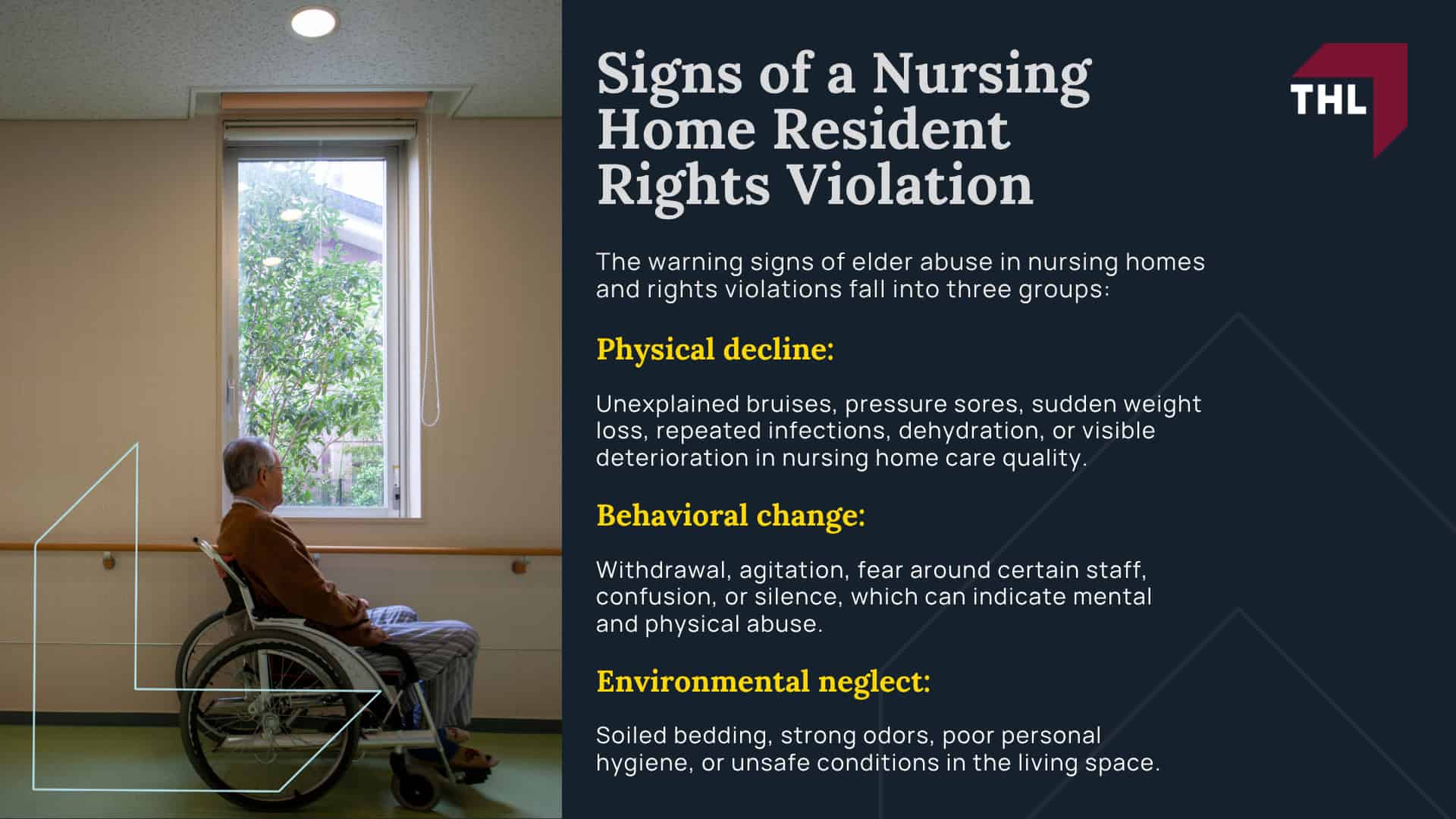
The warning signs of elder abuse in nursing homes and rights violations fall into three groups:
Signs of neglect can also manifest as confusion, weight loss, fear, or silence in residents, indicating a lack of proper care and attention.
Families who notice that should raise it with both a treating doctor and an attorney, who can judge whether the nursing home facility broke the law.
A resident or family does not have to choose between staying silent and filing a lawsuit.
Federal rules set out a graduated path for raising concerns about care for a loved one.
Complaints about nursing home conditions can be filed with state agencies and the Long-Term Care Ombudsman program.
The escalation path runs through four channels:
Families unsure where to begin can review the steps for reporting nursing home abuse before escalating to a state agency.
State inspectors conduct unannounced site surveys to review nursing home conditions and may issue citations for violations.
If a resident faces immediate physical danger, the first call is to 911, before any administrative complaint.
State inspection reports provide an independent record of problems identified by government surveyors during routine inspections and complaint investigations.
These reports often document whether a facility violated federal regulations governing resident dignity, medical care, abuse prevention, discharge procedures, staffing, or other protected rights.
Because the findings come from an outside agency rather than the nursing home itself, inspection reports can provide valuable evidence when a facility disputes allegations of wrongdoing.
A pattern of repeat deficiencies or unresolved violations may help demonstrate that a resident rights violation was not an isolated incident but part of a broader problem within the facility.
Inspection reports may reveal:
A nursing home negligence lawsuit is a civil lawsuit filed when evidence supports a legal claim that a long term care facility failed to meet its duty of care and caused harm to a resident.
The legal process usually begins with gathering evidence, including medical records, care plans, staffing logs, incident reports, inspection findings, photographs, and witness statements.
In nursing home cases, the complaint outlines the facility’s conduct, the injuries suffered, the damages claimed, and the legal basis for holding the facility accountable.
Most cases resolve through settlement negotiations before trial, but a lawsuit may be necessary when the facility or insurer disputes liability, causation, or the value of the harm.
A successful claim can provide financial relief for medical bills, relocation costs, pain and suffering, funeral expenses, and other losses when neglect or abuse causes serious injury or death.
The legal process may include:
A lawsuit can help families seek fair compensation while creating a formal process for obtaining records the facility may not voluntarily provide.
Financial relief depends on the severity of the harm, the strength of the evidence, the applicable state law, and the losses suffered by the resident or family.
When the evidence supports the claim, legal action can hold a nursing home accountable for preventable injuries, rights violations, or wrongful death.
A nursing home negligence claim for a loved one usually depends on the internal records held by the facility.
Those records show what the staff knew, what they did, and what they failed to do for the resident.
A lawyer can step in early to preserve them before they change, then obtain the full file through formal discovery once a case is filed.
That early step is often decisive, since care plans and staffing logs can be revised or lost within weeks of a complaint.
A nursing home lawyer’s role on the case includes several distinct tasks:
The strength of a resident rights case depends on how fast the family acts and how completely the harm is documented.
Care plans, staffing logs, and incident reports can change once a home realizes a claim is coming, so the early record often decides what a family can later prove.
A nursing home lawyer can demand and preserve those records, identify every responsible party, and measure the care against the standard the law sets.
TorHoerman Law reviews these records, analyzes care plans and staffing, and presses the home to account for the harm done to a loved one, in cases involving abuse, neglect, falls, malnutrition, pressure ulcers, and wrongful death.
Call TorHoerman Law for a free consultation about your loved one.
Use the chat feature on this page to find out if you may qualify to file a nursing home negligence claim.
No.
Resident rights are guaranteed by federal law under the Nursing Home Reform Act and by state statutes, and a facility cannot legally remove or restrict them.
A facility may limit a specific activity only when it endangers the resident or the safety of other residents, and even then the limit must be documented.
If a resident or family believes rights are being violated, the facility grievance process, the Long-Term Care Ombudsman, and the state survey agency all provide a way to act before any legal action.
A nursing home found to have violated resident rights can face investigation by the state survey agency, citations, fines, and corrective action requirements.
In serious cases, the home can lose Medicare and Medicaid funding.
If the violation causes injury, financial loss, or death, the resident or family may also pursue a civil claim against the nursing home.
That claim is separate from the regulatory process and seeks compensation for the harm rather than a penalty against the home.
Federal law does not permit a facility to release a resident at will.
A facility must have one of the limited reasons set in 42 CFR 483.15, such as the welfare of the resident, a health improvement, danger to others, or nonpayment.
In most situations the facility must give at least 30 days written notice that states the reason, the effective date, the destination, and the right to appeal.
A family that receives a discharge notice for a loved one can use the appeal window to challenge a move they believe is improper.
Common signs of nursing home neglect include bed sores, depression, poor personal hygiene, unclean living spaces, dehydration, malnutrition, and physical deterioration.
Neglect occurs when a nursing home fails to provide the basic services a resident needs for nutrition, hydration, hygiene, medical care, or a safe environment.
It differs from abuse, which involves an intentional act, but the harm to a loved one can be just as serious.
A documented decline the facility cannot explain through an underlying medical condition is the sign that prompts a closer review.
The average nursing home neglect settlement is about $400,000, according to a study by the medical journal Health Affairs.
That figure is an average, and individual results vary widely with the severity of the harm to a loved one, the strength of the evidence, and the law of the state.
Some cases resolve for less, while cases involving severe injury or death have reached seven figures.
No outcome is guaranteed, and the value of any claim depends on its specific facts.
In most states, the statute of limitations for suing a nursing home for negligence is usually 2 or 3 years from the date the injury or death occurs.
The clock often starts when the injury occurred or when it reasonably should have been found.
Illinois sets a 2 year deadline for personal injury claims.
The exact rule and any exceptions turn on state law and the facts, so families who suspect harm benefit from speaking with an attorney well before the deadline approaches.
Nursing home residents possess a comprehensive set of legal protections guaranteed under the Nursing Home Reform Act and related statutes.
These rights include dignity, privacy, medical choice, freedom from abuse and unauthorized restraints, control over personal funds, facility transparency, and notice before any transfer or discharge.
The full list appears in 42 CFR Part 483, which every nursing home that takes Medicare or Medicaid must follow.
State laws often add protections on top of this federal minimum, including in assisted living facilities and other long term care settings.
Owner & Attorney - TorHoerman Law
Here, at TorHoerman Law, we’re committed to helping victims get the justice they deserve.
Since 2009, we have successfully collected over $4 Billion in verdicts and settlements on behalf of injured individuals.
Would you like our help?
TorHoerman Law represents people whose lives have been disrupted by serious injuries, unsafe products, and negligence. Our attorneys handle individual personal injury cases as well as national mass tort lawsuits involving major corporations.
Founded in 2009, our legal team brings more than 100 years of combined experience handling serious injury and complex civil litigation.
Do you believe you’re entitled to compensation?
Use our Instant Case Evaluator to find out in as little as 60 seconds!
In this case, we were able to successfully recover $20 Million for our client after they suffered a Toxic Tort Injury due to chemical exposure.
In this case, we were able to successfully recover $103.8 Million for our client after they suffered a COX-2 Inhibitors Injury.
In this case, we were able to successfully recover $4 Million for our client after they suffered a Traumatic Brain Injury while at daycare.
In this case, we were able to successfully recover $2.8 Million for our client after they suffered an injury due to a Defective Heart Device.
Here, at TorHoerman Law, we’re committed to helping victims get the justice they deserve.
Since 2009, we have successfully collected over $4 Billion in verdicts and settlements on behalf of injured individuals.
Would you like our help?
How Nursing Home Staff Shortages Contribute to Neglect and Abuse
Infections in Nursing Homes: How Do They Occur?
Physical Abuse in Nursing Homes: Steps to Take If Your Loved One Has Been Harmed
Sexual Abuse in Nursing Homes: Warning Signs and Legal Action
Medication Errors in Nursing Homes
How Is Nursing Home Abuse Compensation Determined?
Is It Difficult to Sue a Nursing Home for Abuse or Neglect?
The Benefits of Hiring a Lawyer for Nursing Home Abuse
Elder Abuse in Nursing Homes: Warning Signs and Legal Action
Who Can File a Nursing Home Wrongful Death Lawsuit?
Can You Sue a Nursing Home for Neglect?
Where To Report Nursing Home Abuse in Cook County, IL
Nursing Home Wrongful Death Settlements
Nursing Home Elopement: Risks, Prevention & Legal Issues
Types of Abuse in Nursing Homes
What is the Process of a Nursing Home Neglect Lawsuit?
How Do You Report Abuse in a Nursing Home?
FAQ: What is Nursing Home Neglect?
Nursing Home Abuse Lawsuit
They helped my elderly uncle receive compensation for the loss of his wife who was administered a dangerous drug. He consulted with this firm because of my personal recommendation and was very pleased with the compassion, attention to detail and response he received. Definitely recommend this firm for their 5 star service.
When I wanted to join the Xarelto class action lawsuit, I chose TorrHoerman Law from a search of a dozen or so law firm websites. I was impressed with the clarity of the information they presented. I gave them a call, and was again impressed, this time with the quality of our interactions.
TorHoerman Law is an awesome firm to represent anyone that has been involved in a case that someone has stated that it's too difficult to win. The entire firm makes you feel like you’re part of the family, Tor, Eric, Jake, Kristie, Chad, Tyler, Kathy and Steven are the best at what they do.
TorHorman Law is awesome
I can’t say enough how grateful I was to have TorHoerman Law help with my case. Jacob Plattenberger is very knowledgeable and an amazing lawyer. Jillian Pileczka was so patient and kind, helping me with questions that would come up. Even making sure my special needs were taken care of for meetings.
TorHoerman Law fights for justice with their hardworking and dedicated staff. Not only do they help their clients achieve positive outcomes, but they are also generous and important pillars of the community with their outreach and local support. Thank you THL!
Hands down one of the greatest group of people I had the pleasure of dealing with!
A very kind and professional staff.
Very positive experience. Would recommend them to anyone.
A very respectful firm.