Over the past several years, an alarming number of sexual assault reports have emerged involving Uber drivers, exposing what many consider to be Uber’s sexual assault problem.
According to a recent New York Times investigation, internal records and court documents reveal that Uber received more than 400,000 reports of sexual assault or misconduct between 2017 and 2022, far exceeding the roughly 12,500 “serious” incidents the company publicly disclosed.
These numbers suggest that incidents of sexual harassment, unwanted touching, and worse have been both more frequent and more hidden than previously understood.
Survivors and advocates say the root of the problem lies in Uber’s failure to properly screen drivers, delay or refuse essential safety measures, and rely on minimal vetting processes tied to algorithmic matching via the Uber app rather than thorough oversight.

Meanwhile, Uber asserts that a vast majority of trips occur without incident and emphasizes improvements in safety features and background check protocols.
Despite these public claims, critics point to the gap between internal data and public disclosures as evidence that the company prioritized growth over passenger safety.
In the face of this data, thousands of Uber sexual assault claims have been filed across the country, demanding accountability, more transparent practices, and real change in how the company safeguards its users.
What is the Uber Sexual Assault Multi-District Litigation?
The Uber Technologies Passenger Sexual Assault Litigation (MDL No. 3084) is the federal mechanism created to consolidate Uber lawsuits brought by Uber sexual assault survivors across the United States so that overlapping legal issues can be managed centrally.
The MDL aims to improve efficiency and consistency in pretrial procedures for cases alleging that the company failed to take adequate steps to prevent sexual misconduct by drivers.
This coordinated framework gives plaintiffs greater leverage in challenging Uber’s defenses and obtaining shared discovery.
While Uber’s legal team has attempted to dismiss or limit claims, the MDL structure helps ensure these efforts are more transparent and subject to common rulings.

Aspects of the MDL include:
- Consolidation of cases involving similar allegations under one judge
- Central management of discovery, motions, and expert issues
- Selection of bellwether trials to test recurring legal and factual issues
- Scheduling through joint case management conferences
- Opportunity to negotiate broader Uber sexual assault settlement approaches
- Preservation of each individual’s right to pursue a trial or distinct settlement
Because the MDL clusters many cases with similar claims, it heightens pressure on Uber to respond collectively rather than in isolated cases.
Plaintiffs use the MDL to more forcefully hold Uber accountable for how it managed safety, driver vetting, and responses to sexual advances or assault reports.
Outcomes in the MDL (especially from bellwether trials) will likely influence how future claims are resolved across the litigation, including potential global settlement negotiations.
Uber Sexual Assault Statistics
The scale of alleged misconduct on the Uber platform is far larger than what’s commonly known from public disclosures.
A New York Times investigation based on court documents revealed that between 2017 and 2022, Uber logged 400,181 reports of sexual assault or misconduct, an average of one report every eight minutes.
This figure is strikingly disproportionate to the 12,522 “serious” incidents Uber had previously disclosed for the same period, raising questions about how much misconduct was categorized, omitted, or suppressed in internal reporting.
Internal documents suggest Uber’s decision-makers were aware of patterns in sexual harassment, assault, and misconduct, but delayed or declined to deploy some enhanced safety measures that experts say might have mitigated risk.
Statistics to know:
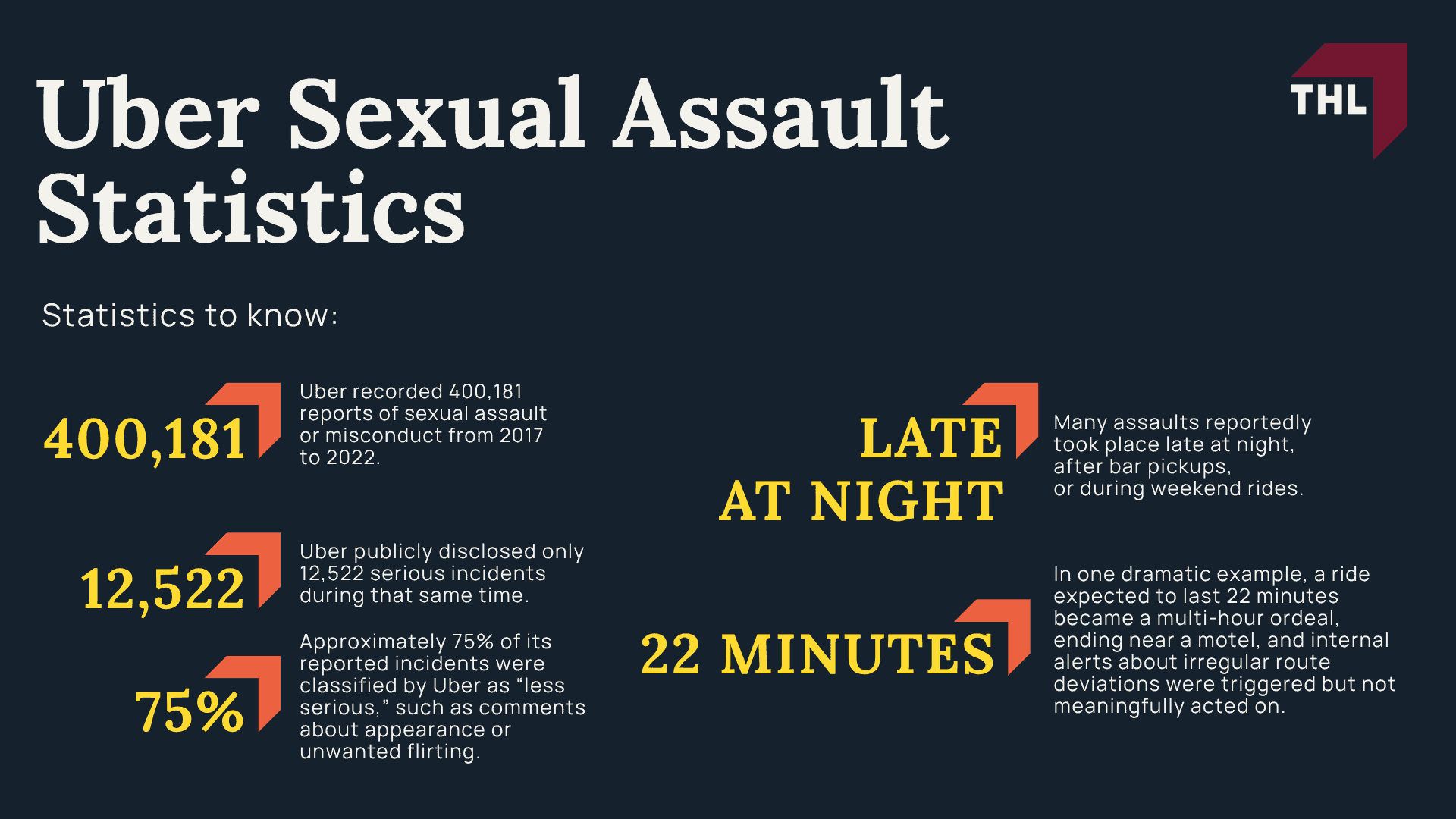
- Uber recorded 400,181 reports of sexual assault or misconduct from 2017 to 2022.
- Uber publicly disclosed only 12,522 serious incidents during that same time.
- Approximately 75% of its reported incidents were classified by Uber as “less serious,” such as comments about appearance or unwanted flirting.
- Many assaults reportedly took place late at night, after bar pickups, or during weekend rides.
- In one dramatic example, a ride expected to last 22 minutes became a multi-hour ordeal, ending near a motel, and internal alerts about irregular route deviations were triggered but not meaningfully acted on.
These numbers aren’t just statistics.
They represent real people whose personal safety was compromised.
Uber has responded by pointing to new safety tools such as GPS tracking, in-app safety buttons, route deviation alarm systems, and audio recording options.
Still, critics argue the company waited too long to adopt more robust interventions and failed to treat early warnings as urgent.
Because Uber controls massive amounts of trip data and internal insight, the revelations suggest that the company’s leadership, including Uber’s head of safety, may have underestimated or deprioritized the seriousness of these allegations.
This backdrop of data and internal recognition sets the stage for the legal claims that survivors and their attorneys are bringing forward, alleging that Uber’s public assurances of safety do not align with the risks revealed in their own internal records.
Uber Sexual Assault Litigation Timeline
The Uber sexual assault litigation has evolved from individual lawsuits into a large-scale federal multidistrict litigation involving thousands of survivors across the United States.
Plaintiffs argue that Uber Technologies Inc. failed to implement basic safety measures that could have helped prevent sexual assaults by dangerous drivers, while Uber argues that drivers are independent contractors who use their private vehicles to transport passengers.
The lawsuits allege that Uber recognized serious risks facing women riders, including prior misconduct complaints, inadequate background checks, and other safety concerns, but failed to take sufficient action.
The ongoing litigation before a federal judge in the Northern District of California continues to examine Uber’s role, business model, corporate culture, and whether the company should be held accountable for alleged assaults committed by ride share drivers under such circumstances.
The Uber sexual assault litigation has progressed through several significant milestones that continue to shape the claims, defenses, and potential resolution of the ongoing litigation:
- 2014–2018: Early lawsuits and public reports involving alleged assaults by Uber drivers begin drawing attention to passenger safety concerns across ride sharing platforms.
- 2019: Uber releases its first U.S. Safety Report, acknowledging thousands of sexual assault reports and publicly addressing rider safety issues for the first time.
- 2022: Uber publishes an updated safety report covering incidents reported during 2019 and 2020, renewing scrutiny over the company’s efforts to prevent sexual assaults.
- October 2023: The Judicial Panel on Multidistrict Litigation creates MDL No. 3084 in the Northern District of California, placing the cases before Judge Charles Breyer, the federal judge overseeing coordinated pretrial proceedings.
- 2024–2025: Discovery efforts focus on Uber’s internal safety practices, driver screening procedures, prior misconduct complaints, and communications involving executives and personnel responsible for safety programs.
- February 2026: The first bellwether trial concludes when an Arizona jury finds Uber liable under an apparent agent theory and awards $8.5 million in damages to a survivor.
- April 2026: A second sexual assault bellwether trial results in another plaintiff verdict, providing additional insight into how juries may evaluate Uber’s role in passenger safety cases.
- Present: Cases remain in the early stages of the broader litigation process, with bellwether results helping shape settlement negotiations, future trials, and efforts by survivors seeking financial compensation and accountability.
Uber Sexual Assault Trial Outcomes
The first bellwether trial in the Uber sexual assault litigation concluded in February 2026 when an Arizona jury found Uber liable and awarded $8.5 million to a passenger who alleged she was raped by an Uber driver during a 2023 ride.
Jurors determined that Uber could be held responsible under an apparent agency theory, finding that the driver acted as an apparent agent of the company even though Uber classifies drivers as independent contractors.
A second bellwether trial in North Carolina also resulted in a plaintiff verdict after a woman alleged an Uber driver grabbed her upper inner thigh and made inappropriate comments during a ride.
The jury awarded $5,000 in damages despite Uber’s efforts to challenge the plaintiff’s credibility by referencing her history of substance abuse.
These verdicts are significant because they provide insight into how juries may evaluate Uber’s liability as the company continues to argue that it functions more like a technology platform than the traditional taxi industry.
While neither verdict determines whether Uber qualifies as legally responsible in every case, both outcomes will likely influence settlement negotiations and future trials involving similar allegations.