Talkie AI is an interactive artificial intelligence chatbot platform that lets users engage in lifelike conversations with customizable AI-generated characters through both text and voice.
It uses advanced generative AI and natural language processing to simulate dynamic interactions that adapt to user input, context, and conversational tone.
Users can select from a range of AI personalities or build their own characters with unique traits and conversational styles.
The platform is often used for entertainment, creative role-playing, storytelling, and social interaction with digital personas.
Talkie AI’s design emphasizes realism and emotional responsiveness, aiming for dialogues that feel more natural and immersive than traditional scripted chatbots.
The experience is powered by generative AI models that produce on-the-fly responses rather than fixed outputs, enabling more fluid back-and-forth exchanges.
While some users explore the app for companionship or creative inspiration, others use it to practice language skills or explore fictional scenarios.
Talkie AI is typically accessible through mobile apps and web interfaces, with basic features available at no cost and optional premium upgrades.
Its conversational approach sets it apart from simple task-oriented bots by focusing on personality and extended engagement.
As with all generative AI systems, the quality and style of responses depend on the underlying model and training data, which shape how the chatbot interprets and generates language.
Who Owns Talkie AI?
Talkie AI is developed and published by SUBSUP PTE. LTD., a Singapore-registered technology company listed as the developer for Talkie and related AI apps in major app stores.
Public reporting on the product’s wider corporate ties indicates that Talkie’s international chatbot offering has also been associated with MiniMax, a Shanghai-based artificial intelligence company known for building and marketing AI products globally.
MiniMax, founded in 2021 and backed by significant investors, has been described in industry sources as the ultimate parent or originator of the Talkie product, even though the immediate publisher appears as Subsup.
Talkie’s presence on mobile platforms has varied regionally, and its developer listing remains SUBSUP in official Apple and Google ecosystem records.
The product’s multinational footprint reflects both the Singapore developer entity and the broader AI development resources tied to the Shanghai company.

Because corporate registrations and publishing entities can differ from ultimate ownership structures, public sources vary in how they describe the relationship between Talkie, Subsup, and MiniMax.
Talkie’s global user base and download figures have made it one of the more visible AI chatbot experiences internationally, which has prompted scrutiny of its corporate affiliations.
In legal and investigatory contexts, identifying the correct corporate entities that developed, published, and operated the software often requires examining app store records, business filings, and contractual relationships, not just consumer-facing branding.
Talkie AI Safety Policies on Self-Harm and Suicide Content
Talkie AI publishes Community Guidelines that prohibit content related to self-harm and suicide in several forms, including material that promotes, glorifies, or provides instructions for suicide or self-harm.
The same policy framework also bans graphic or disturbing material and other content the platform describes as likely to cause psychological distress or trauma.
In its Privacy Policy, Talkie states it uses information from interactions in part to support “individualized and safe conversations and interactions” with its chatbot, which positions safety as an operational goal rather than only a user-facing rule.
In practice, these policies function as written standards for what is allowed on the service, while the effectiveness of moderation depends on how consistently the platform detects and responds to high-risk content.
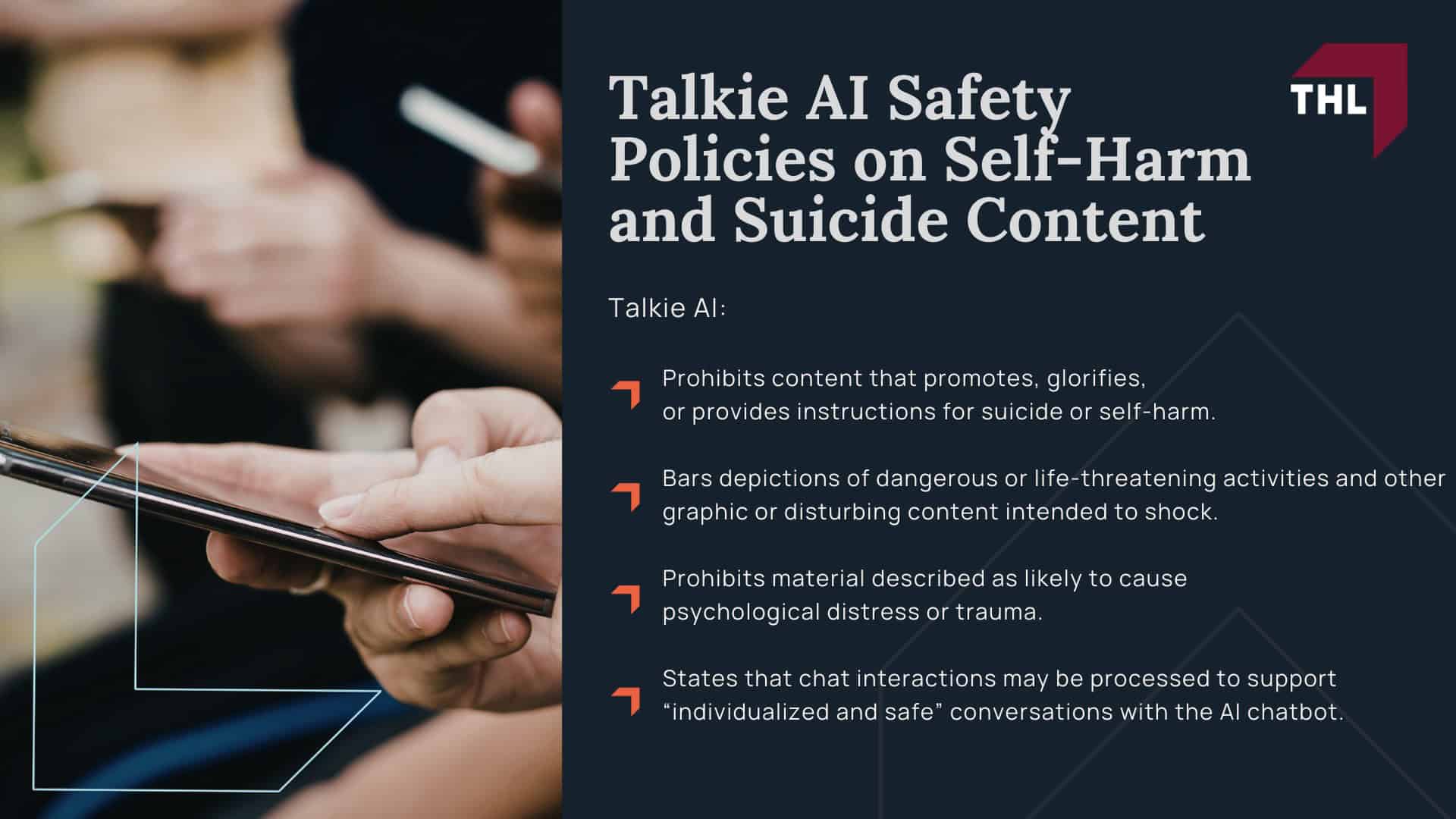
Talkie AI:
- Prohibits content that promotes, glorifies, or provides instructions for suicide or self-harm.
- Bars depictions of dangerous or life-threatening activities and other graphic or disturbing content intended to shock.
- Prohibits material described as likely to cause psychological distress or trauma.
- States that chat interactions may be processed to support “individualized and safe” conversations with the AI chatbot.