Active LitigationMDL 3140
Depo-Provera Lawsuit Facts
TorHoerman Law is actively accepting claims for the Depo-Provera Lawsuit.


In December 2025, the U.S. Food and Drug Administration approved the label change for Pfizer’s long-acting contraceptive Depo-Provera CI, adding an explicit warning for intracranial meningioma risk tied to medroxyprogesterone acetate, the hormone progestin in the injection.
This new warning marks a dramatic departure from decades of U.S. labeling that did not acknowledge a brain tumor risk despite mounting scientific evidence and international regulatory action.
The updated label now states that cases of meningiomas have been reported following repeated administration of medroxyprogesterone acetate, primarily with long-term use, and advises clinicians to monitor patients for signs and symptoms of tumors and discontinue use if a meningioma is diagnosed.
The change follows extensive news coverage by major outlets, including NBC News and Associated Press reporting on the FDA’s decision as a major public health and legal development.
The update comes amid rising Depo-Provera lawsuits, where nearly 2,000 women claim that Pfizer failed to warn patients of the risk, even though similar updates were implemented in Europe and Canada years earlier.

Under the revised U.S. label, medical professionals are instructed to:
The FDA’s decision is significant for both public health and litigation.
The label update aligns with emerging research linking long-term use of high-dose progestins like medroxyprogesterone acetate to meningioma development, including studies showing a substantially elevated risk for women using the product over extended periods.
Regulators in the European Union and Canada implemented meningioma warnings on Depo-Provera and other high-dose progestin products earlier in 2024, a gap that has been a prominent issue in U.S. legal disputes.
Plaintiffs in federal and state court lawsuits have used the absence of a brain tumor warning as evidence that Pfizer should have alerted patients sooner.
The FDA’s new requirement may undermine certain legal defenses previously raised by the company and could influence how courts view claims alleging delayed warnings.
No, the new Depo-Provera meningioma label update is not a Black Box (boxed) warning.
The FDA added the meningioma language to the Warnings and Precautions section (and related patient counseling information), not to the boxed warning section of the label.
The current Black Box warning on Depo-Provera CI is for loss of bone mineral density, which the FDA first added years ago and still appears at the top of the prescribing information.

In other words, the label now carries two distinct safety signals, but only bone mineral density loss is treated as the FDA’s strongest boxed warning.
The meningioma change is still significant because it places brain tumor risk into core U.S. safety labeling and can affect how prescribers counsel and monitor patients.
The Depo-Provera MDL brings together countless claims filed by women who allege they developed a brain or spinal tumor after prolonged use of the injectable birth control drug.
This multidistrict litigation was created to coordinate discovery and pretrial rulings in Depo lawsuits that raise overlapping factual and scientific questions about medroxyprogesterone acetate and meningioma risk.
Plaintiffs across the country are choosing to sue Depo-Provera manufacturer Pfizer, asserting that the company failed to warn patients and physicians about known or knowable tumor risks associated with long-term use.
Many of these cases involve women who received a brain tumor diagnosis years after starting Depo-Provera, often without any prior warning that neurological monitoring was necessary.
The lawsuits argue that research linking high-dose progestins to meningiomas existed long before U.S. labeling was updated, and that patients continued filing lawsuits only after learning the connection through scientific publications, news reports, or in the worst case, medical imaging.
In that sense, the litigation focuses not only on injury, but on whether earlier disclosure could have changed prescribing decisions or prompted earlier detection.
These cases fall within a broader category of dangerous drug lawsuits that examine how pharmaceutical companies communicate emerging safety risks.
At its core, the Depo-Provera litigation alleges a systemic failure to protect women using a long-term hormonal contraceptive.
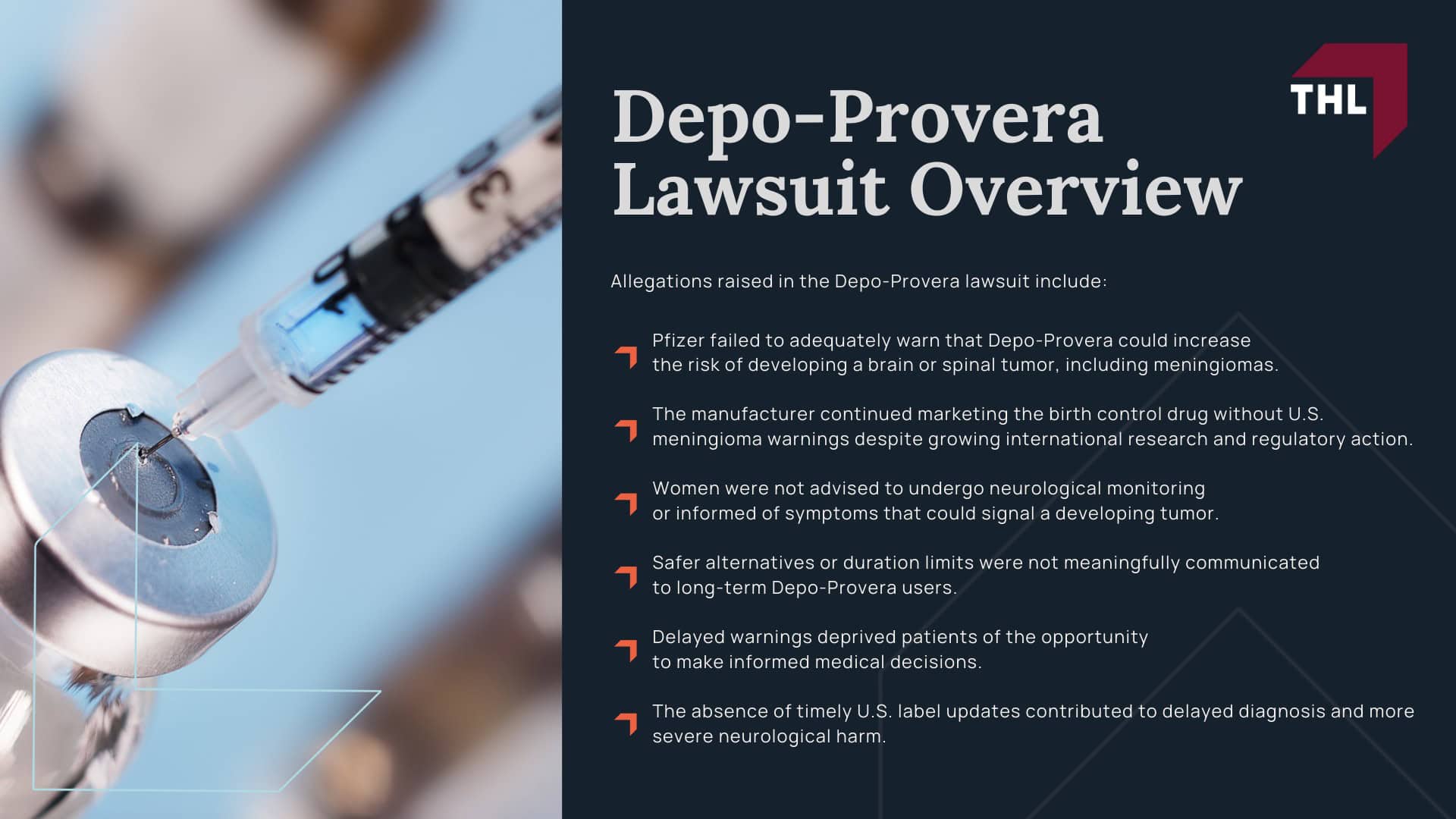
Allegations raised in the Depo-Provera lawsuit include:
No, there is not a single nationwide “Depo-Provera class action” in the usual sense where one or a few plaintiffs represent everyone who used the injectable contraceptive.
Instead, Depo Provera cases are being handled as coordinated individual injury lawsuits inside a federal multidistrict litigation (MDL), which the JPML created to streamline pretrial work for claims sharing common factual questions.
A class action typically decides common issues for a defined class and can resolve claims in a single judgment, which fits best when class members have similar, low-variation harms.
An MDL keeps each person’s lawsuit separate, but consolidates discovery and key pretrial rulings so evidence about the product, labeling, and science is developed once instead of repeated in hundreds of courts.

The court overseeing MDL 3140 explains that this structure exists for cases pending in multiple federal districts that involve common questions of fact, which is exactly how widespread product-injury legal action is usually organized.
MDL is typically selected for alleged drug-injury claims because injuries, medical histories, duration of use, and damages differ sharply from one plaintiff to the next, even when the same product is involved.
In the Depo-Provera litigation, the common questions revolve around the injectable product and allegations that users may develop meningiomas, while the individualized questions involve diagnosis timing, symptoms, medical treatment, and causation.
Depo-Provera lawyers estimate that individual settlement amounts in Depo-Provera cases could range from about $100,000 to $500,000 or more, with actual values depending on the severity of injuries, medical costs, loss of income, and other individual circumstances.
These projections are informed by patterns in similar dangerous drug lawsuits and early assessments by experienced Depo-Provera lawyers handling brain tumor claims.
While settlements have not yet been finalized, the ongoing Depo-Provera MDL and bellwether processes are expected to influence how compensation frameworks are structured in the coming years.
Factors like the extent of neurological harm, documented diagnosis following birth control injections, and evidence of long-term harm can all affect a case’s projected value.

Although averages are not yet established, lawyers emphasize that severe injuries may warrant higher awards reflective of long-term care needs.
Plaintiffs who choose to pursue legal action now may benefit from early negotiation leverage as the litigation develops.
Overall, financial compensation in these Depo-Provera cases seeks to address medical expenses, pain and suffering, and economic impact related to a brain tumor diagnosis linked to prolonged use of the contraceptive.
A brain tumor called meningioma forms in the meninges, the protective layers between the skull and the brain, and it is widely described as the most common primary brain tumor.
Population data also show meningioma is the most common non-malignant primary brain tumor, accounting for roughly 40% of all primary brain and other CNS tumors in U.S. registry reporting.
Meningiomas are typically classified into three grades, with Grade 1 being the most common and least aggressive form, while Grade 2 and Grade 3 tumors are more likely to recur or behave aggressively.
Many meningiomas grow slowly and may not be detected for years, sometimes showing up incidentally when a patient gets imaging for an unrelated problem.
This matters in Depo-Provera reporting because a 2024 national case-control study in The BMJ found prolonged use of injectable medroxyprogesterone acetate was associated with increased intracranial meningioma risk, including findings tied to the widely used contraceptive injection.
Secondary reporting on that study has described the elevated risk as becoming apparent after longer exposure, including an estimate that women using Depo-Provera for over a year had a 5.6 times higher risk in the study population.

Risks and complications linked to meningiomas include:
While meningiomas are often non-cancerous, they are the most common type of brain tumor, accounting for a significant proportion of intracranial tumors and capable of producing debilitating symptoms such as headaches, vision problems, seizures, memory loss, and speech difficulties.
Filing a Depo-Provera lawsuit begins by contacting an experienced attorney who handles drug injury and product liability cases and can evaluate whether the facts of your situation support a viable claim.
The best way to start this process is to connect with a lawyer who regularly works on pharmaceutical injury cases and understands the medical and regulatory issues surrounding Depo-Provera and meningioma risk.
During an initial review, the attorney will assess your history of Depo-Provera use, the timing of your diagnosis, and whether your case meets the legal standards required to pursue a claim against Pfizer.
Plaintiffs must be prepared to provide documentation showing they received Depo-Provera injections and later received a qualifying diagnosis, such as a meningioma, supported by medical records, imaging reports, and treatment history.
Women who received multiple Depo-Provera injections over time and were later diagnosed with a meningioma may be eligible to sue Pfizer for injuries linked to long-term exposure.
A qualified attorney can also help determine whether the available medical evidence supports a causal connection between the drug and the tumor.

Timing is critical because the statute of limitations for filing a Depo-Provera lawsuit varies by state and typically ranges from one to three years after diagnosis or discovery of the injury.
Women who believe they were harmed by Depo-Provera should act quickly, as missing the filing deadline can permanently bar legal action.
Consulting a lawyer early allows time to gather records, consult medical experts, and file the claim properly.
Through a lawsuit, affected individuals may seek compensation for medical expenses, lost wages, ongoing care needs, and other damages tied to their condition.
Evidence drives every stage of a Depo-Provera meningioma claim, from screening the case to proving causation and damages.
The case needs a clean timeline showing Depo-Provera exposure, the onset of symptoms, and the medical basis for a meningioma diagnosis.
Strong documentation also helps separate speculation from medically supported conclusions, especially when tumors can grow slowly and be discovered years after use.
Defense teams often attack gaps in records, alternative risk factors, and inconsistent medical histories, so organized proof matters.
The goal is to present a record that is specific, dated, and hard to dispute.

Evidence in one of these cases may include:
Damages are the legally recognized losses a plaintiff claims after an injury, covering both financial costs and the human impact of the condition.
In Depo-Provera claims, damages focus on what a meningioma diagnosis changed, the medical care it required, and the long-term consequences for work, health, and daily life.
A lawyer helps assess damages by collecting medical and employment records, working with experts when needed, and building a documented timeline that ties each loss to the injury.
That work supports a compensation demand that matches the real costs of treatment and the ongoing impact of the tumor and related care.

Damages in a Depo Provera birth control shot lawsuit may include:
The December 2025 label change put meningioma risk into the U.S. Depo-Provera warnings for the first time, and that timing is central to the questions being litigated nationwide.
Many women did not learn about the potential connection until after a brain tumor diagnosis, when the medical and financial consequences were already in motion.
TorHoerman Law can review Depo-Provera injection history, medical records, imaging, and treatment timelines to determine whether a claim fits the legal and medical requirements of this litigation.
That evaluation helps define the next step, whether that is filing a lawsuit, preserving evidence, or documenting damages tied to the diagnosis.

If you received Depo-Provera injections and were later diagnosed with a meningioma, contact TorHoerman Law to discuss your options.
Statutes of limitation vary, and waiting can cut off your ability to pursue compensation.
Reach out today to speak with a Depo-Provera attorney and get a case review focused on facts, records, and what the law allows.


