Active Litigation
Nitrous Oxide Lawsuit Facts
TorHoerman Law is actively accepting claims for the Nitrous Oxide Lawsuit.

Active Litigation
TorHoerman Law is actively accepting claims for the Nitrous Oxide Lawsuit.
A nitrous oxide pulmonary embolism lawsuit may allege that inadequate product warnings contributed to a blood clot in the lungs after recreational inhalation.
Published medical reports describe pulmonary embolism (PE) in patients with repeated nitrous oxide exposure, often alongside disrupted vitamin B12 function and high homocysteine levels.
A pulmonary embolism is a medical emergency, but exposure alone cannot establish what caused an individual clot.
TorHoerman Law is investigating potential claims involving diagnosed PE, serious complications, and deaths following recreational nitrous oxide use.
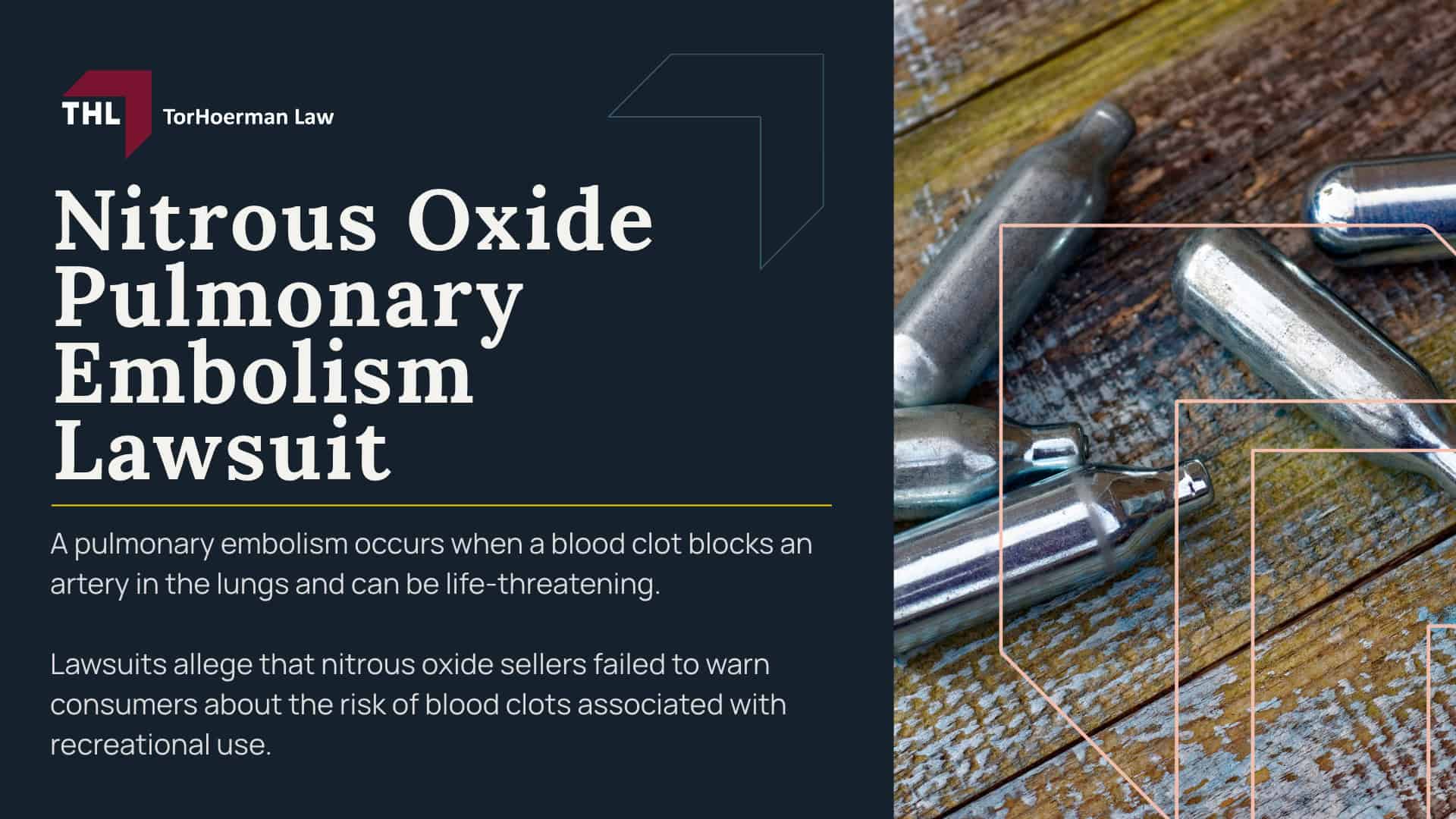
A pulmonary embolism occurs when material, usually a blood clot from a deep vein, blocks an artery supplying the lungs.
The blockage may cause sudden breathing difficulty, chest pain, low blood pressure, or strain on the right side of the heart.
Pulmonary infarction and persistent breathing limitations can affect recovery after the initial emergency.
Some patients also have deep vein thrombosis (DVT) in a leg or the pelvis, but a leg clot is not always found when PE is diagnosed.
Nitrous oxide can inactivate vitamin B12 and disrupt an enzyme involved in homocysteine metabolism, providing a possible pathway for abnormal clot formation after heavy exposure.
Hospital studies and case reports describe the association, but they do not establish how often PE occurs among all people who inhale nitrous oxide recreationally.
Determining the cause of a particular PE requires assessment of the exposure and other risks, including prior clots, surgery, immobility, cancer, and estrogen-containing medication.
A potential nitrous oxide lawsuit also depends on identifying the product and examining the warnings and sales circumstances relevant to its use.
Repeated recreational inhalation can inactivate vitamin B12 and inhibit methionine synthase, an enzyme that helps convert homocysteine to methionine.
Homocysteine may then accumulate in the blood, sometimes to levels far above the laboratory reference range.
Researchers have proposed that high plasma homocysteine may affect the lining of blood vessels, platelet activity, and fibrinolysis, the process that breaks down clots.
Impaired fibrinolysis is one proposed mechanism, but its role in a specific nitrous oxide-associated PE has not been established.
These mechanisms are biologically plausible, but a high homocysteine result cannot by itself establish that nitrous oxide caused a patient’s PE.
Serum vitamin B12 may remain within the normal range even when nitrous oxide has impaired its function.
When this form of deficiency is suspected, NICE recommends plasma homocysteine or serum methylmalonic acid as an initial test.
These tests can help identify metabolic disruption; they do not diagnose a pulmonary clot, and abnormal results may have other causes.
Some patients also develop peripheral neuropathy, weakness, or spinal cord injury after repeated exposure.
Those neurological findings can occur alongside PE but are not required for a clot diagnosis.
The available evidence comes mainly from patients treated in hospitals and from individual case reports.
Those groups are not representative of everyone who uses nitrous oxide, and many patients have other reasons they might develop a clot.
In the ENIGMA-II randomized trial involving patients undergoing major surgery with supervised nitrous oxide anesthesia, the rate of a composite outcome including death and cardiovascular events did not increase in the nitrous oxide group.
That trial examined a different exposure setting and cannot determine the risk from repeated recreational inhalation.
The published reports document diagnosed PE and abnormal B12-related tests, although each patient’s other clotting risks still require assessment.
A 2021 case report described a 19-year-old who was admitted with severe peripheral neuropathy after repeated recreational nitrous oxide inhalation.
His serum vitamin B12 was within the laboratory reference range, but his homocysteine concentration was 92 μmol/L and methylmalonic acid was markedly elevated, consistent with functional B12 disruption.
After approximately two weeks in the hospital, he developed chest pain; CT imaging identified bilateral pulmonary embolism involving central arteries and signs of pulmonary infarction.
He received the oral anticoagulant rivaroxaban, while thrombophilia screening later found no identified disorder.
The PE occurred during hospitalization, so the timing and other possible contributing factors matter when assessing what caused the clot.
A 2023 study in the Journal of Thrombosis and Haemostasis reviewed 326 patients at an Amsterdam hospital who reported recreational nitrous oxide use from January 2015 through May 2021.
Seventeen had serious thrombotic events, including 12 venous and five arterial events.
Ten of the venous events were pulmonary embolisms; the other two involved the portal and cerebral veins.
The median age among patients with thrombotic events was 26 years, and their median homocysteine was 125 μmol/L, compared with a reference level below 15 μmol/L.
About half had reported neurological symptoms before the thrombotic event.
The 17 events represented approximately 5% of this selected hospital group, not 5% of recreational nitrous oxide users generally.
The study described arterial and venous thrombosis, but its five arterial events were distinct from the ten pulmonary embolisms.
One 20-year-old patient with PE and DVT also had obesity, illustrating the need to assess other clotting risks alongside exposure and abnormal laboratory findings.
A 2025 case report described a 31-year-old man with ongoing nitrous oxide use, right-leg DVT, and a saddle PE spanning the main pulmonary artery’s division into its branches.
He had experienced a pulmonary embolism one year earlier and had completed a three-month course of apixaban.
At the new presentation, his homocysteine was 134 μmol/L and vitamin B12 was 142 pg/mL.
He received intravenous heparin, was monitored in intensive care, and later resumed apixaban.
Although a saddle PE can be dangerous, the report noted preserved heart function without evidence of right ventricular strain in this patient.
His prior PE is a significant part of the history when considering recurrence and the possible contribution of nitrous oxide.
A 2026 case report described a 25-year-old man with heavy recreational nitrous oxide use who developed chest pain that worsened with deep breathing.
CT pulmonary angiography showed bilateral subsegmental pulmonary emboli and pulmonary infarction, an area of lung tissue injured by reduced blood supply.
Lower-extremity ultrasound did not detect DVT.
His homocysteine measured 89 μmol/L, and his vitamin B12 was below 150 pg/mL; the reported thrombophilia workup found no other abnormality.
He was prescribed apixaban and vitamins B9 and B12, but the authors reported that follow-up laboratory assessment was pending because of difficulty with treatment adherence.
A negative leg ultrasound does not establish that a pulmonary clot formed independently of the deep veins, and this single report cannot establish a general risk of PE among nitrous oxide users.
PE symptoms after nitrous oxide use resemble those of PE from other causes.
A clot can disrupt blood flow through the lungs and make it harder for the right side of the heart to pump blood.
Symptoms that require urgent attention include:
A pulmonary embolism can occur without recognizable DVT symptoms.
Call 911 for sudden breathing difficulty, chest pain, fainting, or other symptoms suggesting PE.
A pulmonary infarction occurs when reduced blood flow damages an area of lung tissue, sometimes causing pain with breathing or coughing up blood.
A larger or more consequential clot may increase pressure on the right ventricle, leading to right heart dysfunction, low blood pressure, shock, or cardiac arrest.
The term saddle PE describes a clot’s location, not a guaranteed severity level; clinicians assess blood pressure, oxygenation, right ventricular function, and other findings to determine how dangerous the event is.
Some people recover without lasting impairment, while others report persistent breathlessness or reduced exercise capacity.
The 2026 acute PE guideline recommends asking about symptoms and functional limitations during follow-up for at least a year to identify chronic thromboembolic pulmonary disease or other causes of ongoing breathing problems.
For patients presenting to an emergency department with possible acute pulmonary embolism, clinicians assess symptoms, vital signs, oxygen saturation, and clinical probability before selecting tests.
CT pulmonary angiography or another appropriate imaging study is needed to confirm a pulmonary clot.
A D-dimer test can help rule out PE in appropriately selected patients when interpreted alongside clinical probability; an elevated result alone cannot confirm PE.
Ventilation-perfusion scanning may be used when CT pulmonary angiography is unsuitable, while leg ultrasound can identify a concurrent DVT.
Echocardiography and cardiac biomarkers can help assess heart strain and severity, particularly when the patient is unstable.
A normal or near-normal oxygen saturation reading does not by itself exclude PE.
When nitrous oxide exposure is reported, homocysteine, methylmalonic acid levels, and vitamin B12 results may add information about functional B12 disruption without replacing clot imaging.
A patient may also have surgery, prolonged immobility, a previous clot, cancer, estrogen exposure, or an inherited or acquired clotting condition.
Thrombophilia screening is a selective part of the diagnostic workup, and the timing of some tests may be affected by anticoagulation or the acute event.
Treatment of a confirmed PE follows established clinical approaches to venous thromboembolism.
Anticoagulants reduce further clot formation while the body gradually breaks down the existing clot.
Eligible patients may receive a direct oral anticoagulant such as apixaban or rivaroxaban; others need injectable or intravenous anticoagulation, depending on their condition.
When initial parenteral anticoagulation is indicated, the 2026 PE guideline generally recommends therapeutic low-molecular-weight heparin over unfractionated heparin for eligible patients.
The 2026 PE guideline recommends direct oral anticoagulants over vitamin K antagonists for eligible patients and reserves advanced therapies for selected patients with severe cardiopulmonary compromise.
Thrombolytic medication, catheter procedures, mechanical thrombectomy, or surgery may be considered in those severe cases, with bleeding and procedural risks weighed against the danger of the PE.
The decision to admit someone to the hospital depends on severity; some lower-risk patients can be treated without a prolonged stay.
Anticoagulation often continues for at least an initial three-to-six-month phase, with longer treatment depending on recurrence risk, bleeding risk, and whether a persistent risk factor remains.
Patients should not stop prescribed anticoagulants without medical guidance.
No.
Stopping nitrous oxide exposure and treating suspected B12 dysfunction address a possible contributing pathway, but vitamins do not dissolve an existing PE or substitute for anticoagulation.
Continued inhalation can interfere with B12 function despite supplementation.
If folate deficiency is documented, folate supplementation may be appropriate, but a clinical review of nitrous oxide toxicity cautions against giving folate before vitamin B12 repletion.
Homocysteine may decline after exposure stops, but a lower result does not prove that an existing clot has resolved or that recurrence risk has disappeared.
Patients with persistent breathlessness, chest symptoms, bleeding during anticoagulation, or signs of another clot need medical follow-up.
The FDA warns against inhaling nitrous oxide from canisters, tanks, or chargers and identifies blood clots among the possible serious adverse effects.
Its advisory names brands including Galaxy Gas, Cloud 9ine, Cosmic Gas, FastGas, ExoticWhip, Baking Bad, and Whip-it!, while warning about products of any size or brand.
The advisory does not determine that a particular product caused a person’s PE or that any company is liable.
A claim may allege that a manufacturer, distributor, or seller failed to provide adequate warnings despite foreseeable recreational inhalation.
Flavors, large-capacity canisters, packaging, advertisements, retail placement, and the warnings actually provided may be relevant to that allegation.
The fact that a product was sold for culinary use does not, by itself, settle whether its warnings were legally adequate.
For a claim involving Galaxy Gas or another named brand, the product’s identity, purchase, and labeling may be relevant; the FDA’s inclusion of a brand in its advisory is not proof of causation.
Our attorneys are reviewing potential claims involving diagnosed pulmonary embolism, serious complications, and deaths after recreational nitrous oxide use.
Medical diagnosis alone is insufficient; the product, exposure history, other clotting risks, warnings, and legally actionable conduct all require assessment.
Records and materials that may bear on a claim include:
Medical records and product labels may establish different parts of a claim, including the diagnosis and the warnings provided.
A normal serum B12 result does not necessarily rule out functional disruption, while elevated homocysteine does not independently prove what caused the clot.
If PE was fatal, a wrongful death claim involving nitrous oxide may be possible when the evidence supports a claim against a legally responsible company.
Medical records, a death certificate, autopsy findings when available, product identification, and other potential causes of death may be important.
Who may bring the claim and which losses may be recovered depend on state law.
Filing deadlines also vary by state, type of claim, and the facts determining when a claim accrued; exceptions should not be assumed to apply.
Prompt review matters because product packaging, transaction records, and medical information can become harder to locate over time.
Potential personal injury damages may include emergency treatment, hospitalization, anticoagulants, follow-up care, lost income, and pain and suffering when recoverable under applicable law.
Persistent respiratory limitations, chronic thromboembolic disease, or an inability to return to work may affect the documented losses in an individual case.
A wrongful death claim may involve funeral costs, lost financial support, and other damages recognized by the governing state law.
There is no established settlement amount for a nitrous oxide pulmonary embolism lawsuit, and neither a diagnosis nor an FDA warning guarantees compensation.
We are investigating potential claims involving pulmonary embolism and other serious blood clot injuries after recreational nitrous oxide use.
A review of the diagnosed injury, the product used, its warnings, and other clotting risks is necessary to assess a potential claim.
Call TorHoerman Law today for a free consultation, or use the chat feature to tell us about the injury.
A PE can be diagnosed even when leg ultrasound does not find DVT.
A published nitrous oxide case involved bilateral PE and pulmonary infarction without a detectable clot in the lower extremities, but the absence of a leg clot does not establish where the pulmonary clot originated.
No.
High homocysteine may indicate disrupted B12-dependent metabolism after exposure, but it can have other causes and cannot identify the sole cause of an individual’s PE.
Imaging confirms the pulmonary clot, while causation requires a broader medical assessment.
No.
B12 replacement may address nitrous oxide-related functional deficiency, but a diagnosed PE requires clinical evaluation and treatment under established clot protocols, commonly including anticoagulation.
A prior clot is an important risk factor and does not automatically resolve whether later nitrous oxide exposure contributed to another event.
The medical history, timing of exposure, other risks, and available product evidence all matter to a potential claim.
The deadline depends on the applicable state law and whether the case involves personal injury or wrongful death.
A diagnosis date does not automatically set the deadline, and any discovery rule or other exception depends on the governing law and facts.

Tor Hoerman has represented injured individuals for more than 30 years, with experience spanning individual personal injury cases and nationwide mass tort litigation. His work includes car accidents, catastrophic injuries, product liability claims, and other serious injury cases. Tor has served in court-appointed leadership roles in national litigation and tried cases involving major corporate defendants.
TorHoerman Law’s legal content is researched and written by our editorial team and attorneys for legal accuracy, clarity, and relevance. We rely on statutes, court records, government publications, medical research, and other authoritative sources when applicable. This page provides general legal information and does not constitute legal advice.
TorHoerman Law reviews its legal content for factual accuracy, current information, and relevant legal context before publication and as material developments occur. This article is provided for general informational purposes and does not constitute legal advice. For guidance about a specific case, contact TorHoerman Law.
You can learn more about this topic by visiting any of our Nitrous Oxide Lawsuit pages listed below:
A serious injury can change your life.

TorHoerman Law represents people whose lives have been disrupted by serious injuries, unsafe products, and negligence. Our attorneys handle individual personal injury cases as well as national mass tort lawsuits involving major corporations.
Founded in 2009, our legal team brings more than 100 years of combined experience handling serious injury and complex civil litigation.
Do you believe you’re entitled to compensation?
Use our Instant Case Evaluator to find out in as little as 60 seconds!

In this case, we obtained a verdict of $495 Million for our client’s child who was diagnosed with Necrotizing Enterocolitis after consuming baby formula manufactured by Abbott Laboratories.

In this case, we were able to successfully recover $20 Million for our client after they suffered a Toxic Tort Injury due to chemical exposure.

In this case, we were able to successfully recover $103.8 Million for our client after they suffered a COX-2 Inhibitors Injury.

In this case, we were able to successfully recover $4 Million for our client after they suffered a Traumatic Brain Injury while at daycare.

In this case, we were able to successfully recover $2.8 Million for our client after they suffered an injury due to a Defective Heart Device.
A serious injury can change your life.