Active Litigation
Nitrous Oxide Lawsuit Facts
TorHoerman Law is actively accepting claims for the Nitrous Oxide Lawsuit.

Active Litigation
TorHoerman Law is actively accepting claims for the Nitrous Oxide Lawsuit.
A Miami Magic nitrous oxide lawsuit may involve injuries allegedly caused by recreational inhalation of nitrous oxide sold under the Miami Magic brand.
Miami Magic markets 9-gram cream chargers and larger nitrous oxide cylinders, including flavored products advertised for culinary use.
The FDA named Miami Magic in its March 2025 warning against nitrous oxide inhalation, and two lawsuits filed in Washington in January 2026 named businesses associated with the brand.
TorHoerman Law is reviewing potential claims involving nerve damage, spinal cord injuries, paralysis, and other serious complications associated with recreational nitrous oxide use.
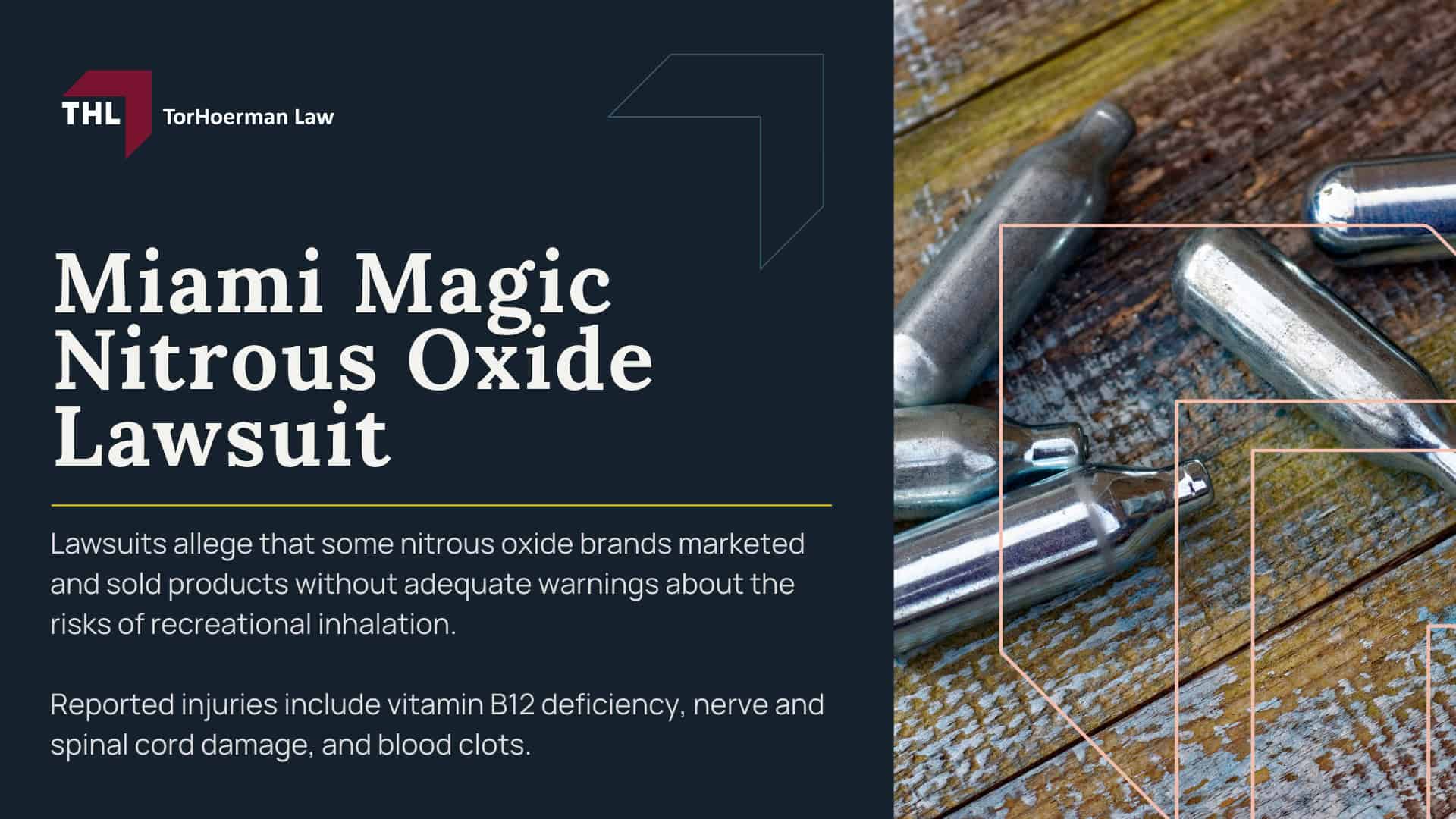
People who inhaled Miami Magic nitrous oxide and later developed serious medical problems may have grounds for a claim against a manufacturer, distributor, or seller, depending on the circumstances.
The injuries reported after recreational nitrous oxide use include numbness, difficulty walking, neurological damage, oxygen deprivation, and potentially life-threatening complications.
Miami Magic’s product range includes small chargers and large cylinders sold in several flavors, so identifying the exact product is important.
A purchase through a third-party website or retailer may also involve businesses beyond the brand named on the container.
Our attorneys examine product labels, purchase information, medical records, and the warnings available to the consumer.
We also consider whether another company’s marketing or sales practices allegedly contributed to foreseeable recreational inhalation.
Families may have legal options when a loved one dies from injuries associated with nitrous oxide exposure.
We review these claims through our broader nitrous oxide lawsuit practice.
Call TorHoerman Law today for a free consultation, or use the chat feature on this page to discuss a potential Miami Magic claim.
Miami Magic sells nitrous oxide products for whipped cream preparation, beverage infusions, and other culinary applications.
Its U.S. website advertises individual products, multipacks, larger cylinders, accessories, and wholesale purchasing.
Miami Magic-branded products advertised online include:
The company’s 320-gram and 2,050-gram product descriptions refer to desserts, cocktails, and flavor-infused beverages.
The larger product listing also describes Miami-inspired branding, while the names Rainbow Candy and Blue Raspberry appear among the advertised flavors.
A 2,050-gram cylinder contains substantially more nitrous oxide than a single 9-gram charger.
For someone who inhaled nitrous oxide from these large cylinders, the amount used and the frequency of exposure are important details in the medical history.
Miami Magic’s online store also lists other brands, including InfusionMax, Baking Bad, and KingWhip, so a receipt from the Miami Magic website does not necessarily identify the purchased product as Miami Magic-branded.
A federal lawsuit filed in 2026 identifies Commerce Enterprises Inc. as doing business under the Miami Magic name.
The company’s published U.S. terms also identify Commerce Enterprises USA as trading under Miami Magic.
Separately, Australia’s official business register lists Miami Magic and InfusionMax among the registered business names of Commerce Enterprises Pty. Ltd., an Australian company.
The U.S. and Australian corporate names should not be treated as interchangeable without confirming which business manufactured, imported, distributed, or sold a particular product.
For an injury claim, the label, retailer, shipping records, and purchase date may identify the businesses involved.
On January 23, 2026, Josh Todd filed a product-liability lawsuit in the U.S. District Court for the Western District of Washington against Amazon-related companies and Commerce Enterprises Inc., doing business as Miami Magic.
The lawsuit alleges injuries following recreational use of flavored nitrous oxide canisters purchased from third-party sellers on Amazon.
The claims concern alleged product defects, inadequate warnings, and other conduct involving the marketing and sale of the canisters.
A federal court order describes the allegations in Todd v. Amazon.com Services, LLC, No. 2:26-cv-00278, and the public docket lists the filings.
The allegations are contested claims, not a finding that Miami Magic or Amazon caused the plaintiff’s injuries.
A separate complaint filed on January 28, 2026, in King County Superior Court in Washington named Commerce Enterprises Inc., doing business as Miami Magic, alongside Amazon and several other nitrous oxide companies.
That case, Lira et al. v. Amazon.com Services LLC et al., No. 26-2-03961-5 SEA, alleges that companies marketed or sold nitrous oxide canisters despite foreseeable recreational inhalation and inadequate warnings.
The complaint names numerous brands; it does not establish that every plaintiff used Miami Magic products.
The case number can be used to locate filings through King County court records.
On March 14, 2025, the FDA warned consumers not to inhale nitrous oxide from tanks, canisters, or chargers of any flavor or size.
Miami Magic was expressly included among the brand names listed in the warning, along with Galaxy Gas and other products sold online and through retail outlets.
The FDA identified serious complications such as numbness, difficulty walking, blood clots, loss of consciousness, frostbite, paralysis, psychiatric disturbances, and death.
The advisory was not a Miami Magic product recall and did not establish that every Miami Magic cylinder was defective.
Miami Magic’s own care and safety instructions warn against inhaling the gas, caution about cold burns and pressurized equipment, and describe the products as intended for catering.
Its sales terms state that buyers must be at least 18, acknowledge the misuse warnings, and avoid purchasing products for inhalation.
Those statements describe published policies, not proof of which warnings an individual purchaser received or how a third-party seller handled an order.
A claim alleging inadequate warnings or misleading marketing would need to consider the product packaging, the listing shown when purchased, and the circumstances of the sale.
Nitrous oxide gas, commonly called laughing gas, is used under medical supervision for sedation and pain relief and in food preparation as a propellant.
When inhaled as a recreational drug, its immediate effects may include euphoria, disorientation, impaired coordination, and reduced oxygen availability.
Rapidly discharged gas can cause cold burns, while oxygen deprivation can lead to loss of consciousness or brain damage.
Repeated use carries additional long-term risks because nitrous oxide interferes with the body’s ability to use vitamin B12, which is essential for healthy nerve function.
Reported complications of recreational nitrous oxide use include:
Chronic use, particularly inhaling large amounts repeatedly, can lead to subacute combined degeneration, a form of spinal cord injury that may cause lasting mobility and sensory problems.
Heavy users may face a higher risk of persistent neurological impairment, although the immediate effects of inhalation can have severe consequences even without a long history of use.
Neurological injuries have also been documented in young adults, and some long-term effects can persist after nitrous oxide use stops.
A 2025 medical study described nitrous oxide-related neurological injuries in patients who showed functional vitamin B12 deficiency even when ordinary serum B12 levels were normal.
Clinicians may use neurological examinations, MRI scans, and blood tests for homocysteine or methylmalonic acid to assess suspected nitrous oxide toxicity.
Medical guidance on nitrous oxide toxicity recommends stopping use and treating the resulting functional vitamin B12 deficiency, often with injections when neurological symptoms are present.
Rehabilitation may help with weakness or impaired mobility, while people struggling with nitrous oxide addiction may also benefit from substance use treatment.
Using nitrous oxide in combination with alcohol or other drugs can be especially dangerous because further impairment increases the risk of falls and other injuries.
Early treatment can improve recovery, but full neurological recovery is not guaranteed.
Anyone with weakness, trouble walking, chest pain, breathing problems, or sudden changes in mental health after inhaling nitrous oxide should seek medical attention promptly and tell the clinician about the exposure.
Identifying the product is especially important when the injured person purchased flavored canisters from a retailer that carries several nitrous oxide brands.
The history of inhalation and medical treatment can also affect whether an injury can be attributed to nitrous oxide exposure.
Relevant evidence may include:
Preserve packaging and digital purchase records when possible, particularly if the product was obtained from a third-party seller or the retailer’s listings have since changed.
Medical evidence can document the injury, while the product and transaction records can identify the companies involved in supplying the gas.
Our attorneys use personal injury evidence to assess whether the available information supports a claim.
Depending on the product and transaction, potential claims may involve a manufacturer, importer, distributor, online marketplace, or retailer.
The allegations may concern inadequate warnings, misleading product representations, or sales practices that allegedly contributed to foreseeable recreational inhalation.
A company’s responsibility depends on its actual role in supplying or selling the product, the injury, and the law governing the claim.
When legally recoverable, damages may include:
The types of personal injury damages depend on the injury and applicable state law.
Deadlines to file a lawsuit vary by state and may differ for an injured person and a family bringing a wrongful death claim.
At TorHoerman Law, we represent people with serious injuries in litigation involving product warnings, corporate conduct, and disputed medical evidence.
For Miami Magic claims, our attorneys review the actual product, the retailer or online seller, warnings available at purchase, the medical diagnosis, and the resulting financial and personal losses.
We also review injuries involving several nitrous oxide brands, particularly where the products were sold through the same website or marketplace.
A confidential consultation gives injured people and families an opportunity to discuss the circumstances of their case and the records available.
Call TorHoerman Law today or contact our firm for a free consultation. You can also use the chat feature on this page.
Yes.
Commerce Enterprises Inc., doing business as Miami Magic, was named in a January 23, 2026 federal lawsuit and a separate January 28, 2026 Washington state complaint.
The lawsuits allege injuries and inadequate warnings associated with recreational nitrous oxide inhalation; the allegations are not findings of liability.
Yes.
Its website advertises 320-gram and 2,050-gram cylinders in flavors such as Blue Raspberry, Strawberry-Guava, and Rainbow Candy.
The available products and flavors may vary by seller and purchase date.
No.
They are separately named products, although Australia’s official business register lists Miami Magic and InfusionMax among business names associated with Commerce Enterprises Pty. Ltd.
The product label and seller should be identified separately, particularly when several brands were purchased from one retailer.
The FDA named Miami Magic in its March 2025 warning about recreational nitrous oxide inhalation.
That advisory was not a recall of Miami Magic products.
Potentially.
The January 2026 federal lawsuit involves allegations concerning flavored nitrous oxide canisters purchased from third-party sellers on Amazon.
Purchase records, the particular product used, medical documentation, and the circumstances of the sale would still need to be reviewed.
The deadline depends on the state, the type of claim, and when the injury occurred or was discovered.
A wrongful death case may have a different deadline, and delay can make it harder to preserve receipts, packaging, and online purchase records.

Tor Hoerman has represented injured individuals for more than 30 years, with experience spanning individual personal injury cases and nationwide mass tort litigation. His work includes car accidents, catastrophic injuries, product liability claims, and other serious injury cases. Tor has served in court-appointed leadership roles in national litigation and tried cases involving major corporate defendants.
TorHoerman Law’s legal content is researched and written by our editorial team and attorneys for legal accuracy, clarity, and relevance. We rely on statutes, court records, government publications, medical research, and other authoritative sources when applicable. This page provides general legal information and does not constitute legal advice.
TorHoerman Law reviews its legal content for factual accuracy, current information, and relevant legal context before publication and as material developments occur. This article is provided for general informational purposes and does not constitute legal advice. For guidance about a specific case, contact TorHoerman Law.
You can learn more about this topic by visiting any of our Nitrous Oxide Lawsuit pages listed below:
A serious injury can change your life.

TorHoerman Law represents people whose lives have been disrupted by serious injuries, unsafe products, and negligence. Our attorneys handle individual personal injury cases as well as national mass tort lawsuits involving major corporations.
Founded in 2009, our legal team brings more than 100 years of combined experience handling serious injury and complex civil litigation.
Do you believe you’re entitled to compensation?
Use our Instant Case Evaluator to find out in as little as 60 seconds!

In this case, we obtained a verdict of $495 Million for our client’s child who was diagnosed with Necrotizing Enterocolitis after consuming baby formula manufactured by Abbott Laboratories.

In this case, we were able to successfully recover $20 Million for our client after they suffered a Toxic Tort Injury due to chemical exposure.

In this case, we were able to successfully recover $103.8 Million for our client after they suffered a COX-2 Inhibitors Injury.

In this case, we were able to successfully recover $4 Million for our client after they suffered a Traumatic Brain Injury while at daycare.

In this case, we were able to successfully recover $2.8 Million for our client after they suffered an injury due to a Defective Heart Device.
A serious injury can change your life.