Active Litigation
Nitrous Oxide Lawsuit Facts
TorHoerman Law is actively accepting claims for the Nitrous Oxide Lawsuit.

Active Litigation
TorHoerman Law is actively accepting claims for the Nitrous Oxide Lawsuit.
A GreatWhip nitrous oxide lawsuit may involve claims that a manufacturer, distributor, or retailer failed to provide adequate warnings about injuries associated with recreational inhalation.
GreatWhip sells conventional cream chargers, flavored nitrous oxide products, and large cylinders marketed for culinary use.
GreatWhip-branded products have been identified in personal injury litigation and in Canadian recalls involving nitrous oxide sold for inhalation without authorization.
TorHoerman Law is reviewing potential claims involving nerve damage, spinal cord injuries, paralysis, and other serious complications associated with nitrous oxide misuse.
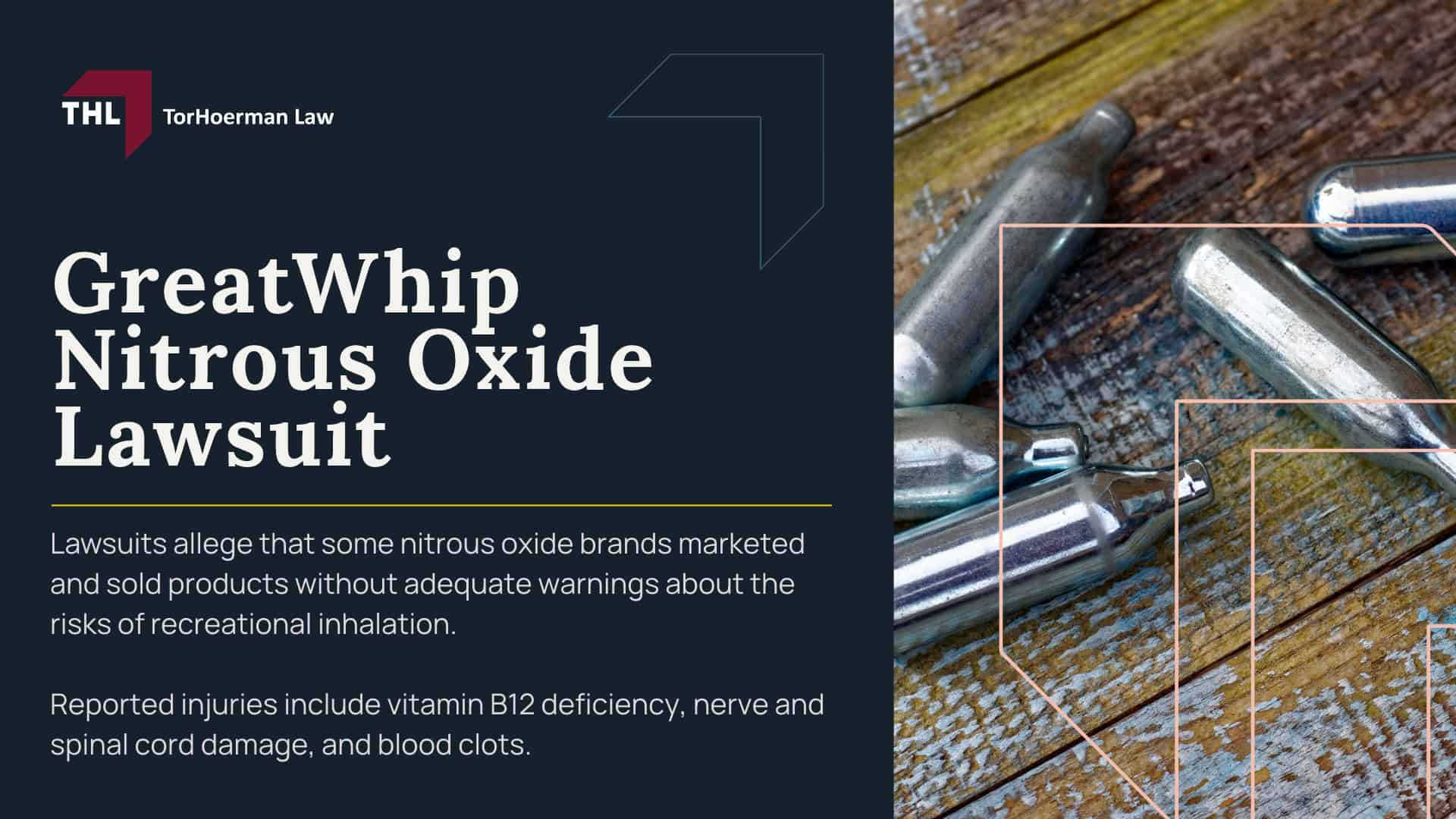
GreatWhip’s product catalog includes small chargers and cylinders containing hundreds or thousands of grams of nitrous oxide.
Its websites also promote wholesale supply, distributor services, and customized product packaging.
These offerings may be relevant when examining which company supplied a product and how it was represented to a purchaser.
In a Louisiana lawsuit filed in 2024, a woman alleged that she used GreatWhip and Galaxy Gas products before developing severe neurological complications.
A separate Texas lawsuit names GreatWhip USA Inc. among multiple defendants.
Health Canada has also identified specific GreatWhip products in recalls and a public advisory concerning unauthorized sales for inhalation.
These records do not establish that every GreatWhip product was defective or that any company is responsible for a particular person’s injuries.
Our attorneys assess these claims through our broader nitrous oxide lawsuit practice, using product information, purchase records, medical findings, and the circumstances of each sale.
Call TorHoerman Law today for a free consultation, or use the chat feature on this page to discuss a potential GreatWhip claim.
GreatWhip describes itself as a China-based manufacturer and supplier of food-grade nitrous oxide canisters, cartridges, and tanks for whipped cream, beverage preparation, and other culinary applications.
Its product catalog includes chargers for conventional dispensers, larger cylinders, pressure regulators, and dispensing equipment.
Products advertised by GreatWhip include:
A 2,000-gram tank contains the same stated mass of nitrous oxide as 250 conventional 8-gram chargers.
That comparison describes container capacity, not evidence that a particular tank was purchased or used for inhalation.
In an injury case, the size of the cylinder, approximate amount inhaled, and frequency of use can help document the person’s exposure history.
GreatWhip’s manufacturer website advertises wholesale and original equipment manufacturer (OEM) services, including customized labels, colors, and packaging for other brands.
It also promotes distribution through warehouses and retailers, rather than sales exclusively to restaurant operators.
Public health guidance from Michigan cautions that brightly packaged, flavored nitrous oxide tanks can appear less dangerous to young adults and other recreational users.
GreatWhip advertises flavored products and customized labels, making the actual packaging and advertising for a particular product relevant to allegations about how it was marketed.
The company’s separate GreatWhip online storefront describes its cylinders as intended for food preparation and states that products should not be sold to people younger than 18.
That storefront warns that pressurized gas becomes extremely cold when released.
Its published terms identify Grtsupply as doing business as Greatwhips and provide a registered address in China.
The GreatWhip manufacturer website separately lists SPOZER USA INC. in its footer.
Those published names should not automatically be treated as the same legal entity as GreatWhip USA Inc., which appears in litigation.
A purchase receipt, cylinder label, shipping information, and the specific seller may help establish which businesses were involved.
On September 18, 2024, Jenna Combel filed a personal injury lawsuit in Louisiana state court alleging harm after repeated recreational nitrous oxide use.
Court filings recount her allegation that she purchased GreatWhip and Galaxy Gas canisters from retail stores and that her use increased substantially between 2019 and 2023.
She alleged that she was hospitalized in November 2023 after experiencing difficulty speaking and moving her arms and legs, and that she subsequently suffered vitamin B12-related neurological injuries, paralysis, and continuing mobility problems.
The lawsuit pursued negligence and product-liability claims against multiple businesses allegedly involved in distributing or selling nitrous oxide.
The claims were removed to federal court in June 2025 as Combel v. Great International Supply Chain Management Co., Ltd., et al., No. 2:25-cv-01252.
On April 7, 2026, the federal court allowed the plaintiff to withdraw the class allegations and remanded her individual claims to Louisiana state court.
That procedural decision did not determine whether a GreatWhip product caused the alleged injuries or whether a defendant was liable.
The case also involved more than one nitrous oxide brand, so it cannot be treated as proof that GreatWhip alone caused the plaintiff’s reported condition.
A separate lawsuit, Winters v. Galaxy Gas LLC et al., lists GreatWhip USA Inc. among numerous defendants, alongside distributors, retailers, and other nitrous oxide businesses.
The case reached the U.S. District Court for the Northern District of Texas on February 13, 2026, under No. 3:26-cv-00397.
On March 4, 2026, the federal court remanded the case to the 192nd District Court of Dallas County because it lacked subject-matter jurisdiction.
Remand is a jurisdictional decision, not a ruling that GreatWhip USA Inc. or any other defendant caused an injury.
The publicly identified defendant name does not by itself establish the relationship between GreatWhip USA Inc., the companies named on GreatWhip websites, and the manufacturer of a particular cylinder.
Unlike the FDA’s general nitrous oxide advisory, Canadian regulators have identified specific GreatWhip products in recall records.
On November 6, 2025, Health Canada recorded a Type I recall, published November 10, concerning products sold for inhalation without the Canadian drug identification number required for that use.
The affected products included GreatWhip Cream Charger, Grand Cream Charger, Infinite Cream Charger, Max Infinite Cream Charger, and Max Cream Charger, with several flavored varieties identified.
That recall listed Maple Craft Inc. in Calgary and was limited to the affected products and distribution circumstances.
A second Type I recall dated March 12, 2026 identified a Great Whip Cream Charger among products associated with Total Merchandise Ltd. in British Columbia.
Separately, Health Canada’s public warning, first published June 6, 2025 and updated November 20, listed GreatWhip Grand Cream Charger, GreatWhip Max Cream Charger, and GreatWhip Max as examples of seized unauthorized products.
These actions concerned Canadian rules governing nitrous oxide sold for inhalation.
They should not be described as a blanket recall of every GreatWhip cylinder sold in the United States or a finding that all GreatWhip products contain defective gas.
On March 14, 2025, the FDA warned consumers not to inhale nitrous oxide from culinary canisters, tanks, or chargers, regardless of size or flavor, citing serious health risks associated with inhalation.
The agency updated its advisory on June 4, 2025, and identified risks including numbness, limb weakness, impaired bowel or bladder function, blood clots, frostbite, paralysis, psychiatric disturbances, and death.
GreatWhip was not specifically included in the FDA’s published brand list, although the warning expressly applies to nitrous oxide products of this type more broadly.
An FDA warning should not be confused with a GreatWhip-specific U.S. recall or an agency determination of civil liability.
Nitrous oxide, also known as laughing gas, is used for sedation and pain relief in monitored medical settings and as a propellant in food preparation.
When used as a recreational drug, inhaling pure nitrous oxide from a cylinder without sufficient oxygen can cause loss of consciousness, asphyxiation, or other severe consequences.
Repeated recreational use can also inactivate vitamin B12, disrupting processes that maintain nerve fibers in the nervous system and increasing the risk of neurological damage, peripheral neuropathy, and spinal cord degeneration.
These health risks are associated with nitrous oxide exposure generally; an injury mechanism unique to GreatWhip has not been established.
Documented complications of nitrous oxide misuse include:
Repeated nitrous oxide exposure can cause functional vitamin B12 deficiency even when an ordinary serum B12 result appears normal.
A 2025 medical study describes neurological injuries linked to nitrous oxide exposure and the limitations of relying on routine B12 measurements alone.
An earlier clinical series involving adolescents and young adults documented spinal cord damage and persistent sensory problems in some patients treated for nitrous oxide abuse.
Medical assessment may include a neurological examination, MRI scans, and blood testing for homocysteine or methylmalonic acid.
Treatment may involve stopping nitrous oxide use, vitamin B12 replacement when clinically indicated, and rehabilitation for weakness or impaired mobility.
Early treatment can improve recovery, but repeated exposure can cause severe nerve damage and lasting neurological impairment, including permanent nerve damage in some patients.
People struggling with repeated use or addiction may need substance-use treatment alongside neurological care.
Someone who develops weakness, trouble walking, chest pain, difficulty breathing, or sudden confusion after inhalation should seek prompt medical attention and disclose the nitrous oxide exposure.
GreatWhip’s use of distributors, multiple product sizes, and customized packaging makes accurate product identification important.
Someone may have purchased a GreatWhip-branded tank, an OEM-supplied product under another name, or several brands from the same store.
The evidence must identify the actual product and connect any alleged misconduct to the diagnosed injury.
Relevant records may include:
Photographs and receipts may be useful even if the original tank has been discarded.
The evidence needed for a personal injury lawsuit varies by the defendants, the injury, and applicable state law.
A GreatWhip-related claim may involve a manufacturer, distributor, importer, wholesale supplier, or retailer, depending on the particular transaction.
Potential personal injury claims may involve inadequate warnings, misleading product representations, or distribution practices that allegedly contributed to foreseeable recreational inhalation.
Some nitrous oxide cases examine the labeling and sale of large, flavored products across several businesses rather than only the conduct of one retailer.
GreatWhip’s culinary-use statements and the warnings actually provided with a product must be considered when assessing such claims.
Neither large cylinder capacity nor flavored packaging alone proves a defect, negligence, or a company’s knowledge of an individual purchaser’s intended use.
When liability is established, recoverable damages may include:
The amount and kinds of personal injury compensation depend on medical evidence, financial losses, and the law governing the case.
A verdict involving another nitrous oxide brand cannot be used to predict the value of a GreatWhip claim.
Deadlines differ by state and may depend on when the injury was diagnosed or discovered; wrongful death actions may have separate filing periods.
Our attorneys represent people in serious injury and product liability matters involving medical evidence, product warnings, and disputed company conduct.
For a potential GreatWhip case, the relevant facts include the exact product, seller, warnings, history of nitrous oxide use, medical records, and resulting losses.
Our nitrous oxide litigation practice also addresses injuries where more than one product or brand may be involved.
We review potential claims individually because a product’s appearance in a lawsuit or regulatory recall does not establish liability for every injury.
Call TorHoerman Law today or contact our firm for a free consultation. You can also use the chat feature on this page.
Yes.
GreatWhip USA Inc. appears among the defendants in Winters v. Galaxy Gas LLC et al., a Texas product-liability case that was returned to state court in March 2026.
A separate Louisiana lawsuit alleges that a plaintiff used GreatWhip and Galaxy Gas products, although that allegation does not establish which product caused the reported injuries.
Health Canada identified specific GreatWhip cream chargers in Type I recalls in November 2025 and March 2026 involving products sold for inhalation without Canadian market authorization.
The recalls covered affected Canadian products and sellers, not every GreatWhip product distributed worldwide.
The FDA’s U.S. advisory warned against nitrous oxide inhalation generally but did not specifically name GreatWhip or announce a GreatWhip recall.
Yes.
GreatWhip’s published catalog lists flavored 640-gram cylinders, as well as conventional 8-gram chargers and larger tanks.
Flavor selections and availability may differ by seller and purchase date.
Possibly, if you developed a qualifying injury and evidence supports a legal claim against a company involved in manufacturing or selling the product.
The location of the sale, the product label, the available warnings, and medical documentation may be relevant, whether the product came from a culinary supplier, a gas station, or an online retailer.
A retail purchase alone does not establish that a seller acted negligently.
Identify and preserve information about both products, including receipts, packaging, estimated dates, and frequency of use.
When several brands were involved, medical and product evidence may be needed to assess exposure and determine whether a claim can be supported against any particular company.
The applicable deadline depends on the state, the type of claim, and when the injury occurred or was discovered.
A different deadline may apply to wrongful death claims, and waiting can make product and purchase records harder to preserve.

Tor Hoerman has represented injured individuals for more than 30 years, with experience spanning individual personal injury cases and nationwide mass tort litigation. His work includes car accidents, catastrophic injuries, product liability claims, and other serious injury cases. Tor has served in court-appointed leadership roles in national litigation and tried cases involving major corporate defendants.
TorHoerman Law’s legal content is researched and written by our editorial team and attorneys for legal accuracy, clarity, and relevance. We rely on statutes, court records, government publications, medical research, and other authoritative sources when applicable. This page provides general legal information and does not constitute legal advice.
TorHoerman Law reviews its legal content for factual accuracy, current information, and relevant legal context before publication and as material developments occur. This article is provided for general informational purposes and does not constitute legal advice. For guidance about a specific case, contact TorHoerman Law.
You can learn more about this topic by visiting any of our Nitrous Oxide Lawsuit pages listed below:
A serious injury can change your life.

TorHoerman Law represents people whose lives have been disrupted by serious injuries, unsafe products, and negligence. Our attorneys handle individual personal injury cases as well as national mass tort lawsuits involving major corporations.
Founded in 2009, our legal team brings more than 100 years of combined experience handling serious injury and complex civil litigation.
Do you believe you’re entitled to compensation?
Use our Instant Case Evaluator to find out in as little as 60 seconds!

In this case, we obtained a verdict of $495 Million for our client’s child who was diagnosed with Necrotizing Enterocolitis after consuming baby formula manufactured by Abbott Laboratories.

In this case, we were able to successfully recover $20 Million for our client after they suffered a Toxic Tort Injury due to chemical exposure.

In this case, we were able to successfully recover $103.8 Million for our client after they suffered a COX-2 Inhibitors Injury.

In this case, we were able to successfully recover $4 Million for our client after they suffered a Traumatic Brain Injury while at daycare.

In this case, we were able to successfully recover $2.8 Million for our client after they suffered an injury due to a Defective Heart Device.
A serious injury can change your life.