Active Litigation
Nitrous Oxide Lawsuit Facts
TorHoerman Law is actively accepting claims for the Nitrous Oxide Lawsuit.

Active Litigation
TorHoerman Law is actively accepting claims for the Nitrous Oxide Lawsuit.
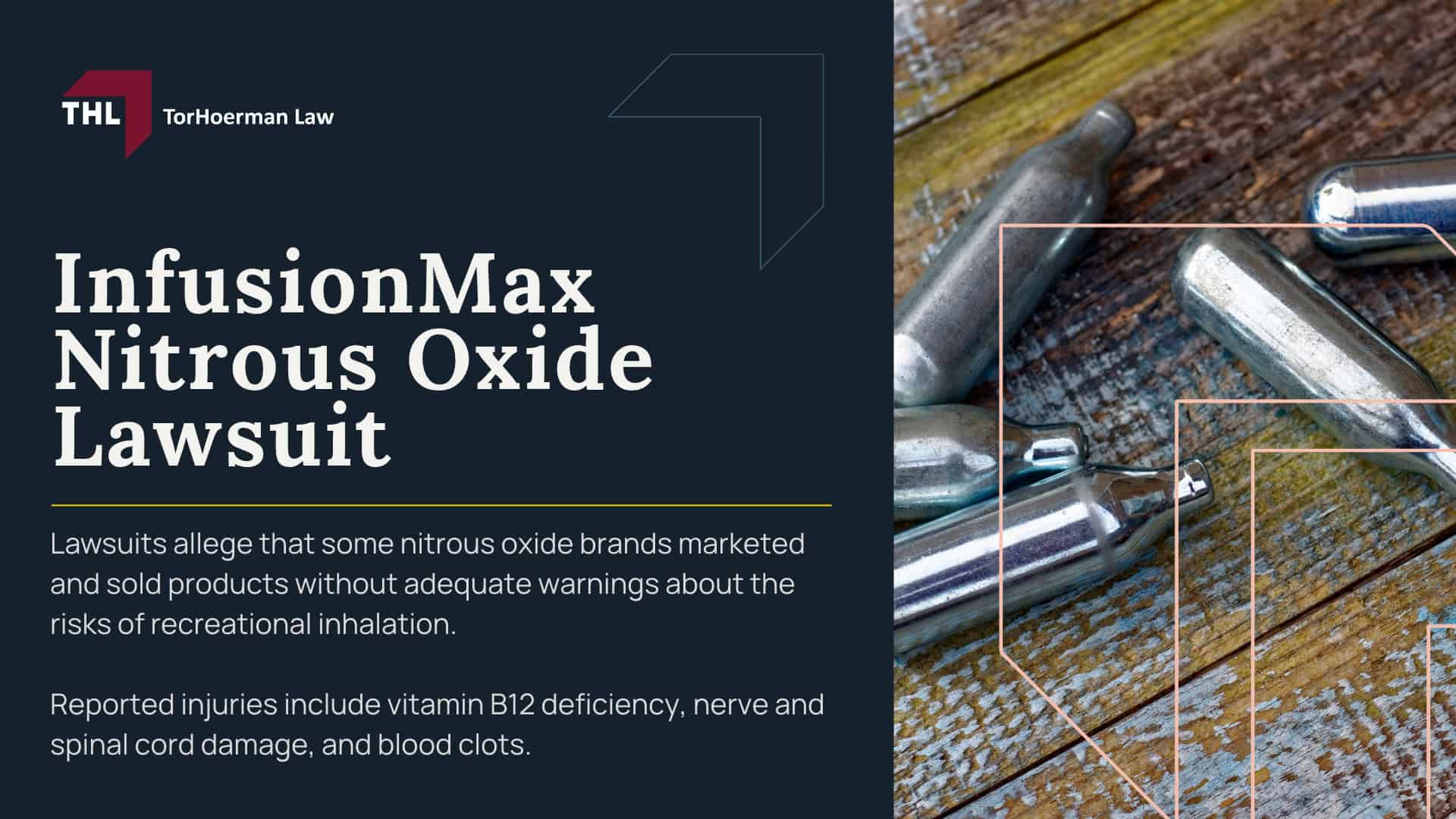
An InfusionMax nitrous oxide lawsuit may involve claims that manufacturers or sellers failed to adequately warn consumers about the risks of recreationally inhaling the brand’s products.
InfusionMax advertises small cream chargers, larger cylinders of nitrous oxide gas, and equipment designed to dispense the gas for food preparation.
InfusionMax was named in a U.S. Food and Drug Administration warning, a Canadian product recall, and a January 2026 complaint involving multiple nitrous oxide brands.
TorHoerman Law is reviewing potential claims involving nerve damage, spinal cord injuries, paralysis, and other serious harm associated with recreational nitrous oxide use.
People who developed a serious medical condition after inhaling InfusionMax nitrous oxide may have a legal claim against a manufacturer, distributor, or seller, depending on the circumstances.
Possible injuries include peripheral neuropathy, difficulty walking, spinal cord damage, loss of mobility, and complications requiring hospitalization.
Some people develop symptoms after repeated inhalation, while others experience an immediate medical emergency involving loss of consciousness, oxygen deprivation, or a cold burn.
The product, its packaging, purchase history, and safety warnings may help establish what was used and which businesses were involved.
If someone died following recreational use, surviving relatives may also have legal options under applicable wrongful death law.
Our attorneys review the product involved, the medical evidence, and the companies responsible for its sale as part of our nitrous oxide lawsuit practice.
Call TorHoerman Law today for a free consultation, or use the chat feature on this page to discuss a potential InfusionMax claim.
InfusionMax markets culinary equipment for preparing whipped cream, infused drinks, and other foods.
Its larger cylinders can connect to compatible cream dispensers through a pressure regulator, hose, and adapter rather than requiring a separate small charger for each use.
Products identified on the InfusionMax website include:
InfusionMax’s 0.95-liter cylinder listing describes food and drink applications, including whipped cream and culinary infusions.
Its dispensing system uses a regulator to control gas flow from larger cylinders.
A 580-gram cylinder contains more than 60 times as much nitrous oxide as a 9-gram charger.
InfusionMax markets these products for food preparation, and its published product descriptions do not promote recreational inhalation.
The FDA identified InfusionMax in a U.S. consumer warning, and Health Canada listed specific InfusionMax products in a Canadian recall.
On March 14, 2025, the FDA warned consumers not to inhale nitrous oxide from canisters, tanks, or chargers of any flavor or size.
InfusionMax appeared on the FDA’s list of nitrous oxide brands.
The FDA identified serious risks including blood clots, frostbite, loss of consciousness, spinal cord damage, paralysis, psychiatric symptoms, and death.
The FDA warning addressed recreational inhalation across multiple brands; it was not an InfusionMax product recall in the United States.
On November 28, 2025, Health Canada published a recall of nitrous oxide products sold for inhalation without the required Canadian market authorization.
The affected-product list expressly identified Infusionmax Rapid flavour infusions and Infusionmax Pro Aluminium.
The notice listed ChrisG Kitchen Supply of Markham, Ontario, as the company associated with the recall.
The recall applied to the products listed in Canada, not every InfusionMax cylinder worldwide.
Health Canada listed the flavor for both InfusionMax products as “N/A.”
The recall does not establish that either product contained flavored gas.
A complaint filed on January 28, 2026, in King County Superior Court, Washington, listed “Doe Entity 1 d/b/a InfusionMax” among several defendants, including Amazon.
The case is listed as 26-2-03961-5 SEA in King County court records.
The plaintiffs allege that companies marketed or sold nitrous oxide canisters without adequate warnings, despite the foreseeable risk of recreational inhalation.
The complaint does not identify the registered company behind the InfusionMax name or establish that every plaintiff used its products.
The allegations have not been proven in court.
InfusionMax’s published care and safety instructions state that its products are intended for catering and warn that inhaling nitrous oxide can cause asphyxiation, loss of consciousness, and death.
The company also states that it has a policy against selling to people believed to be under 18 or likely to misuse the products.
Its safety instructions address cold burns, pressurized cylinders, and the use of a regulator and adapter with the larger 0.95-liter canister.
InfusionMax’s published policies do not establish how a third-party retailer handled a particular sale.
The packaging, retail listing, and warnings supplied with the product may differ from the information on the company’s website.
Nitrous oxide, sometimes called laughing gas, is a colorless gas used under medical supervision for sedation and pain relief and in food preparation as a propellant.
Recreational inhalation can cause immediate injury or neurological problems after repeated exposure.
These risks arise from inhaling nitrous oxide, regardless of brand.
Possible injuries associated with recreational nitrous oxide use include:
Repeated nitrous oxide misuse can interfere with the body’s ability to use vitamin B12, which is necessary for healthy nerve function.
This can produce neurological impairment or subacute combined degeneration, a form of spinal cord degeneration that can impair balance, sensation, and walking.
A 2025 medical study described recreational nitrous oxide-related neurological injuries in patients whose routine serum B12 levels were sometimes normal despite evidence of functional deficiency.
Michigan health officials reported a 533% increase in nitrous oxide poison-center calls from 2019 to 2024 and a 757% increase in related emergency department visits from 2019 to 2023.
Doctors may evaluate symptoms through neurological examinations, imaging, and blood tests for markers such as methylmalonic acid or homocysteine.
People experiencing weakness, walking difficulties, chest pain, or breathing problems after inhaling nitrous oxide should seek prompt medical attention and tell treating clinicians about the exposure.
People who struggle to stop using nitrous oxide may also need substance use treatment alongside neurological care to reduce the risk of further harm.
An injury claim requires evidence identifying the InfusionMax product, where it was purchased, and the medical condition following inhalation.
InfusionMax sells several charger and cylinder formats, and its online shop also lists products under other names.
Useful information may include:
Keep the original product container and warning labels when possible, and preserve electronic purchase records before listings change or accounts become inaccessible.
Medical records can document neurological injury and a history of nitrous oxide exposure.
Packaging and purchase records can identify the product and seller.
Our attorneys review medical records, purchase documentation, and other evidence when assessing an InfusionMax claim.
Depending on the purchase and injury, a potential case may involve a company that manufactured, imported, distributed, marketed, or sold the InfusionMax product.
Possible claims may concern inadequate warnings, misleading product representations, or sales practices that allegedly contributed to foreseeable recreational inhalation.
A claim against a particular business requires evidence connecting its conduct to the injury under applicable law.
Depending on the claim, recoverable losses may include:
Personal injury damages depend on the medical evidence, the injury’s lasting effects, and applicable law.
Filing deadlines also vary by state and may differ for personal injury and wrongful death claims.
Our law firm represents people with serious injuries in product liability cases involving corporate conduct, product warnings, and disputed medical evidence.
Our legal team reviews the InfusionMax product used, the seller, the available warnings, medical records, and the resulting financial losses.
When several nitrous oxide brands were used, we examine the purchase and exposure history for each product.
Injured people and families can discuss their circumstances and available documentation during a confidential consultation.
Call TorHoerman Law today or contact our firm for a free consultation. You can also use the chat feature on this page.
InfusionMax advertises culinary infusion equipment, but its product listings do not identify its gas as candy- or fruit-flavored.
Health Canada listed the flavor information as “N/A” for the recalled InfusionMax products, including Rapid flavour infusions.
The FDA named InfusionMax in a warning against recreational inhalation, but that advisory was not a U.S. recall of InfusionMax products.
Health Canada’s November 2025 recall identified specific Infusionmax products associated with a Canadian retailer.
Potentially. Keep records of each product, where and when it was purchased, and how much was used.
Using several brands can make it harder to determine which business may be legally responsible for the injury.
Online order histories, retailer information, payment records, photographs, and witness accounts may help identify the product.
A receipt is not always required, but the product must still be identified through reliable evidence.
The deadline depends on the state, the type of claim, and circumstances such as when the injury occurred or was discovered.
A wrongful death claim may have a different filing deadline from a claim brought by an injured person.

Tor Hoerman has represented injured individuals for more than 30 years, with experience spanning individual personal injury cases and nationwide mass tort litigation. His work includes car accidents, catastrophic injuries, product liability claims, and other serious injury cases. Tor has served in court-appointed leadership roles in national litigation and tried cases involving major corporate defendants.
TorHoerman Law’s legal content is researched and written by our editorial team and attorneys for legal accuracy, clarity, and relevance. We rely on statutes, court records, government publications, medical research, and other authoritative sources when applicable. This page provides general legal information and does not constitute legal advice.
TorHoerman Law reviews its legal content for factual accuracy, current information, and relevant legal context before publication and as material developments occur. This article is provided for general informational purposes and does not constitute legal advice. For guidance about a specific case, contact TorHoerman Law.
You can learn more about this topic by visiting any of our Nitrous Oxide Lawsuit pages listed below:
A serious injury can change your life.

TorHoerman Law represents people whose lives have been disrupted by serious injuries, unsafe products, and negligence. Our attorneys handle individual personal injury cases as well as national mass tort lawsuits involving major corporations.
Founded in 2009, our legal team brings more than 100 years of combined experience handling serious injury and complex civil litigation.
Do you believe you’re entitled to compensation?
Use our Instant Case Evaluator to find out in as little as 60 seconds!

In this case, we obtained a verdict of $495 Million for our client’s child who was diagnosed with Necrotizing Enterocolitis after consuming baby formula manufactured by Abbott Laboratories.

In this case, we were able to successfully recover $20 Million for our client after they suffered a Toxic Tort Injury due to chemical exposure.

In this case, we were able to successfully recover $103.8 Million for our client after they suffered a COX-2 Inhibitors Injury.

In this case, we were able to successfully recover $4 Million for our client after they suffered a Traumatic Brain Injury while at daycare.

In this case, we were able to successfully recover $2.8 Million for our client after they suffered an injury due to a Defective Heart Device.
A serious injury can change your life.