Active Litigation
Pig Butchering Scam Facts
TorHoerman Law is actively accepting claims for the Pig Butchering Scam.


A crypto recovery expert is a legal or investigative professional who assists defrauded investors in tracing stolen digital assets and identifying legitimate pathways for potential recovery.
These professionals often work with federal prosecutors, the Financial Crimes Enforcement Network (FINCEN), and other enforcement bodies that oversee digital markets and investigate large-scale fraud.
Because crypto scams revolve around transactions utilizing blockchain technology, recovery experts must have a deep understanding of how funds move through digital wallets, mixers, bridges, and crypto exchanges.
Their work involves analyzing digital investments, reconstructing transaction timelines, and determining whether stolen assets have been linked to wallets that authorities have identified or seized.
Agencies like the Securities and Exchange Commission frequently pursue civil actions against fraudulent crypto operations, and recovery experts track these developments to identify opportunities for victims to submit claims.
By mapping wallet flows and correlating them with known fraud investigations, they help victims understand whether their losses intersect with active cases.
In short, a crypto recovery expert bridges the gap between technical blockchain analysis and legal strategy, guiding victims through recovery channels that often require precise evidence and agency coordination.
The world of cryptocurrency fraud recovery has become a magnet for fake recovery services that prey on victims of scams like pig-butchering, fake ICOs, and other con schemes.
Many of these fraudulent outfits claim they can “restore” your funds, reverse blockchain transfers, or unlock wallets, but in reality they often demand upfront fees and disappear without delivering anything meaningful.
Genuine legal help from a qualified blockchain lawyer or recovery-specialist law firm, by contrast, doesn’t rely on magic.
It relies on legal tools, documented evidence, and cooperation with state or federal regulators or enforcement agencies.
Legitimate legal counsel understands that cryptocurrency transactions utilize public ledgers, immutable ledger online records, and established procedures for asset seizure, forfeiture, and potential restitution, but that recovery is often complex, uncertain, and must be approached with transparency and honesty.
Fake services often exaggerate the ease of recovery, request payment in advance (often in crypto), or assert they have influence over exchanges and regulators: promises that should raise immediate warning flags.
Legitimate professionals, on the other hand, work under normal legal structures: they represent clients, coordinate with investigators if appropriate, and only proceed when there is a credible path to recovery.
Working through real legal channels means aligning with law enforcement or regulatory actions, rather than depending on guarantee-based promises that often prove empty.
How to verify the legitimacy of a crypto recovery service:
Cryptocurrency recovery requires specialized knowledge because investment fraud and cryptocurrency theft often involve cross-border transactions, anonymous wallet structures, and rapidly evolving scam techniques.
Many cryptocurrency users do not realize how easily funds can be moved through mixers, bridges, or fake exchanges, making tracing extremely difficult without trained professionals.
Recovery also depends on understanding when law enforcement has seized assets, how forfeiture works, and what documentation victims must provide to be considered in a claim.
Lawyers who regularly work in this field know how to track on-chain activity, authenticate transaction records, and navigate the agency procedures that support legitimate recovery.
These professionals often represent investors whose losses range from a few thousand dollars to life-altering sums, giving them perspective on the patterns and red flags common across cases.
Because scammers adapt quickly, only practitioners who study new fraud models and investigative strategies can identify potential recovery pathways.
Ultimately, expertise ensures that victims avoid misinformation, stay away from fraudulent “recovery agents,” and pursue the limited but real channels available through legal and regulatory systems.
When dealing with stolen cryptocurrency, recovery experts don’t act alone.
They collaborate with a network of governmental agencies, regulatory bodies, and compliant players within the cryptocurrency ecosystem to trace, seize, and (when possible) return assets to victims.
Because digital assets reside in a decentralized, often global crypto market, these institutions provide structure, investigative power, and mechanisms that make recovery feasible even when funds appear to have vanished.
Experts also rely on cooperation from cryptocurrency companies (exchanges, custodians, wallet providers) that operate within regulatory frameworks such as anti-money laundering laws.
This collaboration is often key to unraveling complex frauds and tracking stolen assets through the web of on-ramps and off-ramps.
Below are some of the primary authorities, institutions, and agencies that legitimate crypto-recovery teams may engage with:
Working with these institutions gives crypto-recovery experts the legal authority, investigative resources, and institutional legitimacy to pursue recovery on behalf of victims.
By aligning with regulators, prosecutors, and compliant exchanges, these experts help victims through a fragmented regulatory environment in which digital-asset fraud and theft intersect with evolving laws and enforcement protocols.
Crypto scam recovery begins with understanding how cryptocurrency investments can be manipulated, whether through fraudulent initial coin offerings, fake trading platforms, or pig-butchering scams that quietly drain victims over time.
Because digital assets function as a virtual currency in global markets, scammers have developed increasingly sophisticated methods to hide stolen funds using mixers, cross-chain transfers, and deceptive interfaces.
Recovering those losses requires pursuing a complex legal landscape involving federal agencies, foreign jurisdictions, and financial-crime protocols that dictate when and how victims may participate in restitution efforts.
Many cases also involve security and data breaches, where scammers trick victims into revealing seed phrases or allowing remote access tools to compromise their accounts.
Even though blockchain relies on cryptographic techniques that record every transaction permanently, identifying who controls a wallet and how to freeze those assets is an entirely separate challenge.
Recovery efforts often start by determining how the scammer managed to gain access to the victim’s accounts or redirect the funds contributed during the fraudulent scheme.
From there, investigators analyze the flow of money between cryptocurrency wallets to see whether the assets intersect with known seizure events.
This preliminary work lays the foundation for understanding which recovery avenues are realistic and what evidence must be documented before any formal claim can be made.
Tracing stolen cryptocurrency relies on one core advantage of blockchain networks: even as digital assets gain mainstream acceptance, blockchains are still built on an immutable ledger recording transactions in permanent, time-stamped sequences.
This transparency allows investigators to follow funds through dozens (or sometimes hundreds) of wallet hops, even when scammers use ponzi-like schemes, pig butchering, or romance scams to disguise their origins.
Because many digital investments range across multiple chains and platforms, tracing often involves identifying when stolen assets were swapped, bridged, or laundered through decentralized services.
Investigators look for patterns, including rapid transfers, cross-chain activity, or the use of mixers commonly associated with illicit flows.
In some cases, funds are moved using more traditional cybercrime techniques, such as a SIM card swap hack, which allows scammers to bypass two-factor authentication and redirect outgoing transfers.
Even when scammers hide behind pseudonymous wallet addresses, blockchain networks still reveal the full map of movement, offering critical clues for law enforcement and recovery teams.
Although tracing alone doesn’t guarantee recovery, it is the first step in determining whether the stolen assets intersect with known scam clusters or wallets that have already been seized by authorities.
Once investigators establish a transaction trail, the next stage of crypto recovery involves cooperation with law enforcement and financial institutions that hold critical digital information.
Agencies such as the FBI, Secret Service, and DOJ rely on compliance records from exchanges and banks to piece together how cryptocurrency investors were targeted, whether through ponzi schemes, pig-butchering networks, or direct digital hacking incidents.
These institutions provide details on account ownership, transfer authorizations, IP logs, and suspicious activity patterns that help distinguish legitimate business operations from coordinated fraud.
In cases involving identity theft, banks and exchanges may also assist by flagging unauthorized transactions or freezing accounts linked to the scammer.
This collaboration is essential because recovery often depends on whether law enforcement can identify, trace, and ultimately seize the assets connected to criminal activity.
While the blockchain shows where the money went, only coordinated investigative action can turn those insights into meaningful recovery opportunities for victims.
When law enforcement successfully identifies and freezes wallets tied to fraud, the recovery process shifts from investigation to formal legal action.
Seized assets enter a government-managed system where agencies evaluate whether victims can be compensated through established forfeiture programs.
Victims must provide documentation linking their losses to the seized property, and only those with verifiable evidence qualify for review.
The final stage, remission or restoration, allows eligible victims to receive a portion of the seized assets based on their documented financial losses.
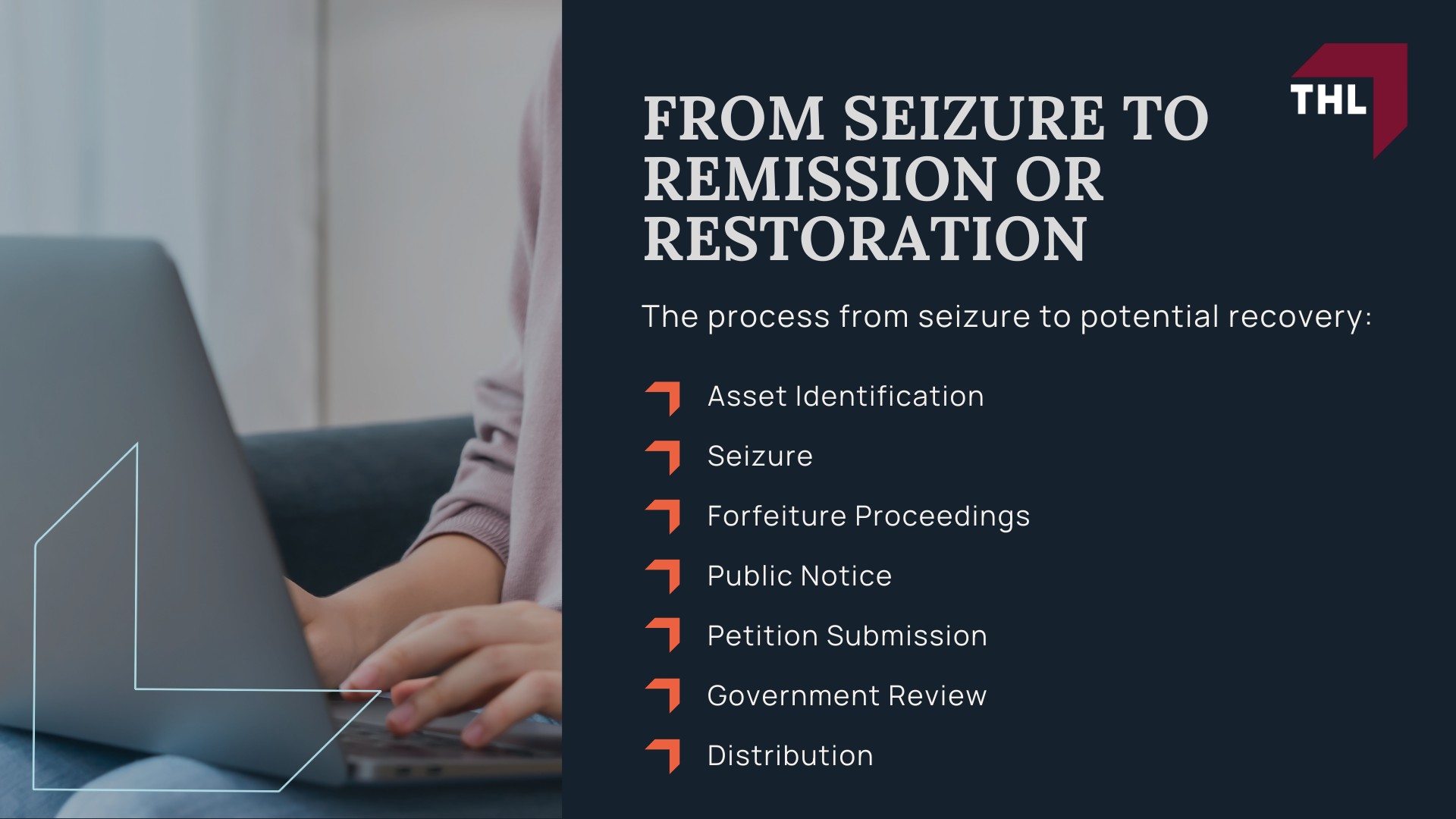
The process from seizure to potential recovery:
Crypto scams have surged over the past few years, and along with them, the demand for trained recovery professionals.
In 2024, Americans lost approximately $9.3 billion to crypto-related fraud schemes, a dramatic 66% increase over the prior year.
Many of those losses stem from increasingly sophisticated scams that combine romance or social-engineering tactics with fake investment platforms.
These schemes don’t just target casual investors.
They often prey on older adults, retirees, and individuals new to cryptocurrency investments who may be less familiar with red flags.
Because the cryptocurrency ecosystem uses blockchain technology, where transactions are transparent but wallets are pseudonymous, tracking stolen funds is possible but requires deep technical and legal expertise.
That’s why crypto recovery experts play a critical role: they help analyze transaction data, trace wallet flows, and coordinate with investigators when assets are seized.
Without this expert help, many victims simply accept their financial losses as permanent, even though there may still be a path to recovery through seizure, forfeiture, or restitution.
For anyone who’s lost funds in a crypto scam, engaging a qualified recovery lawyer can significantly improve the odds of retrieving at least a portion of what was lost.
Pig butchering scams (also often lumped together with crypto-romance or romance baiting schemes) represent some of the most devastating forms of crypto fraud today.
What begins as a friendly message on social media or a dating app can quickly evolve into a long-term con: scammers build emotional trust over weeks or months, then pitch victims on “exclusive” cryptocurrency investments that promise high returns.
Once victims commit money, often in the tens or hundreds of thousands of dollars, the scammers vanish, sometimes after layering withdrawals through complex wallet networks, leaving victims with nothing and often no straightforward way to recover what was lost.
These scams commonly target vulnerable individuals who may be emotionally isolated, unfamiliar with crypto, or newly enticed by the promise of quick gains.
Because many of these victims are new to cryptocurrency investments or do not understand how cryptocurrency wallets and transfers work, they are especially vulnerable.
The scammers themselves often operate out of overseas “fraud factories,” where organized networks use large teams to manage dozens or hundreds of victims at once.
Despite the complexity and scope, there is a growing record of large-scale law enforcement actions against such operations and real opportunities for victims to recover funds.

In 2025, for example, the U.S. Secret Service and the Federal Bureau of Investigation (FBI) working with other agencies seized over $225 million in cryptocurrency tied to pig-butchering and other fraudulent investment scams.
Just recently, the FBI shut down a domain that hundreds of scam victims used: a clear sign that authorities are actively dismantling these networks.
While many victims never see their money again, these high-profile crackdowns demonstrate that recovery can be possible under the right circumstances.
Investment and Ponzi-style crypto scams operate by convincing victims to deposit funds into what appear to be high-yield trading platforms or exclusive investment opportunities, only for those deposits to be used to pay earlier investors or pocketed outright by the scammers.
These schemes often promise guaranteed profits in Bitcoin and other digital assets, exploiting public excitement and fear of missing out as cryptocurrency markets fluctuate dramatically.
Because crypto investing is still seen as extremely speculative, scammers use this uncertainty to justify sudden gains, rapid “account growth,” or fabricated charts meant to lure victims into depositing more.
In many cases, the platforms victims interact with are nothing more than polished interfaces designed to imitate legitimate exchanges, complete with fake balances, manipulated graphs, and simulated “trades.”
These scams target a wide range of people: inexperienced traders who believe they’ve discovered a trusted mentor, retirees looking for alternative investments, and even experienced crypto investors who are deceived by convincing web dashboards and persuasive representatives.
The operators of these Ponzi-style schemes typically run them offshore or through anonymous networks, which allows them to solicit funds globally while hiding behind pseudonymous wallet addresses.
Once deposits slow down or victims begin requesting withdrawals, the platform either shuts down, delays payouts, or claims “liquidity issues” before disappearing entirely.
Phishing scams, wallet theft, and compromised private keys represent some of the most direct and technically sophisticated forms of cryptocurrency fraud.
Unlike investment schemes or pig-butchering operations, these attacks often rely on security breaches or highly targeted social engineering designed to trick users into revealing their seed phrases, recovery codes, or login credentials.
Once a scammer obtains this information, they can drain a wallet within seconds, leaving only a small portion of cases where recovery is realistically possible.
These attacks frequently occur through fake exchange websites, fraudulent customer-support numbers, malicious browser extensions, SIM-swapping incidents, or phishing emails that imitate trusted brands.
Because blockchain transactions are irreversible, victims often discover the theft only after funds have already been moved into clusters of unknown wallets or sent through mixers that obscure their destination.
This form of fraud disproportionately targets everyday users who may not fully understand the difference between a public address and a private key, or who fall prey to cleverly designed prompts that appear legitimate.
Law enforcement can intervene when stolen funds intersect with known seizure events, but traceability varies widely depending on how quickly and aggressively scammers move the assets.
When someone falls victim to a crypto scam, whether a romance scam, investment fraud, or pig-butchering scheme, the sense of loss and desperation can make the notion of getting funds back very appealing.
Unfortunately, that desperation is exactly what drives a newer wave of fraud: fake recovery services (also called “crypto recovery scams”) that target victims again, often with the promise of retrieving stolen cryptocurrency, only to steal more.
The Federal Bureau of Investigation (FBI) and regulators have repeatedly issued public warnings about these operations, noting they cause additional losses amounting to millions.
Fake recovery firms may masquerade as law offices, investigators, or “privileged partners” with enforcement agencies; sometimes they impersonate government or regulatory bodies to gain credibility.
They often demand up-front fees or payments in cryptocurrency or gift cards, something legitimate recovery or legal services almost never require.
Real recovery, by contrast, is rarely quick, guaranteed, or based on upfront payment; it depends on whether stolen assets have been traced, seized, or are connected to a broader enforcement or forfeiture case.
Legitimate professionals focus on evidence (transaction history, wallet addresses, exchange records) and coordinate with authorities or compliant exchanges when warranted.
Here’s a breakdown of how fake recovery scams operate and what to watch out for:
Because of this danger, victims who try to recover funds should be extremely cautious as this second scam can deepen their losses.
As crypto fraud (especially complex investment scams and pig-butchering) spreads, there is a large population of people who have lost funds and are actively searching for help.
That pool of scam victims becomes fertile ground for predatory recovery schemes.
A crypto recovery lawyer provides legal and investigative guidance to victims seeking legitimate avenues for recovering stolen digital assets.
These attorneys work across several specialized cryptocurrency practice areas, including fraud investigation, asset tracing, forfeiture law, and financial-crime response.
Their role begins with reviewing blockchain-based evidence such as wallet addresses, transaction IDs, and exchange logs to determine whether a victim’s losses intersect with known scam networks or government seizures.
They then prepare detailed documentation that aligns with federal or state processes for potential restitution, such as petitions for remission or restoration.
Crypto recovery lawyers also communicate with exchanges, financial institutions, and law enforcement agencies to clarify facts and corroborate evidence.
Because many victims are overwhelmed or uncertain about how transfers occurred, these attorneys help reconstruct the full transaction path and interpret technical data.
They also protect clients from predatory “recovery” companies, advising them on what legitimate recovery looks like and what red flags to avoid.
Ultimately, their work transforms scattered digital records into an organized, legally credible case for potential review by authorities.
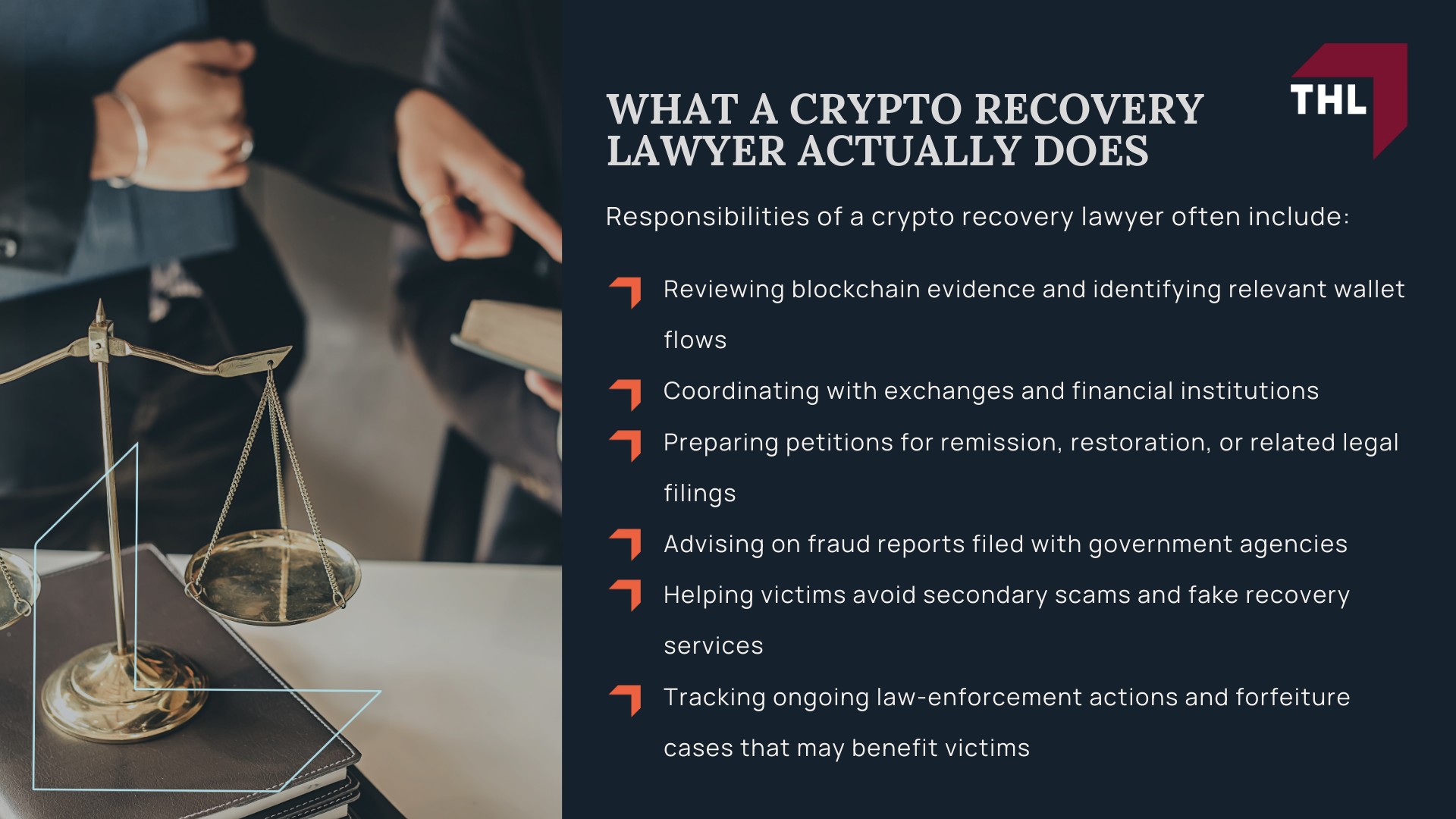
Responsibilities of a crypto recovery lawyer often include:
Crypto recovery becomes possible when stolen assets can be traced to wallets or accounts that law enforcement has already identified, frozen, or seized during broader fraud investigations.
Because blockchain transactions are permanent, investigators can sometimes follow the money long enough to connect a victim’s transfers to a scam network under active scrutiny.
Recovery is also viable when exchanges or custodians cooperate by providing records, freezing accounts, or alerting authorities to suspicious activity tied to known fraud rings.
In cases involving pig-butchering, Ponzi-style schemes, or fake platforms, coordinated investigations may uncover large pools of stolen funds that can later be distributed to verified victims.
Victims with clear documentation of their losses and transaction history are typically better positioned to participate in these processes.
While no recovery is guaranteed, the right set of facts, timing, and evidence can create a realistic pathway toward compensation.
Circumstances in which crypto recovery may be possible:
Acting quickly after discovering a crypto scam can significantly improve the chances of aligning your case with an active investigation or future recovery opportunity.
The goal is to preserve every piece of evidence and establish a clear, credible timeline of events before scammers move or obscure the funds further.
Victims should also notify exchanges, banks, and the appropriate authorities as soon as possible to create an official record of the fraud.
These early steps form the foundation that recovery lawyers and investigators rely on when evaluating whether restitution may be possible.
Immediate steps to take:
Crypto scams leave victims feeling overwhelmed, isolated, and unsure where to turn next, but legitimate recovery begins with clear guidance and a structured legal approach.
At TorHoerman Law, our attorneys analyze your documentation, assess whether your losses may align with active investigations or seizure events, and help you avoid the predatory “recovery” scams that target victims a second time.
We understand the technical, emotional, and financial challenges involved in reclaiming stolen assets, and we work diligently to build a credible case grounded in evidence and established recovery channels.

If you or a loved one has suffered losses from a crypto scam, you do not have to pursue the recovery process alone.
Contact TorHoerman Law today for a confidential consultation.
Our cryptocurrency recovery lawyers will review your records, answer your questions, and help determine whether a legitimate path to recovery may be available in your case.


