If you suffered injuries at work and are having issues filing a worker’s compensation claim, or you are not receiving adequate coverage from your worker’s compensation coverage, contact a Chicago workers compensation lawyer from TorHoerman Law for a free, no-obligation case consultation to discuss your legal options.
You can use our chatbot to take an instant online case evaluation quiz to find out if you qualify for legal action right now, free of charge.
Illinois workers’ compensation laws have recently changed.
If you were recently injured while on the job, it is important to know your choices, starting with a visit to the emergency room or doctor.
Companies have begun recommended doctors to employees injured, which are included in their Preferred Provider Program.
If you choose to see a doctor not included in the program or outside of the network, you may be forgoing your right to file a workers’ compensation claim and could be held responsible for any medical bills.
It is our recommendation that you take proactive steps should an injury, or death of a loved one, ever occur.
Contact the employer and ask about the Preferred Provider Program.
The employer can provide you with a list that you can keep handy should an accident happen.
Workers’ compensation laws were some of the first social legislation laws in the country.
In Illinois, the first law was passed in 1911, going into effect on May 1, 1912.
However, it was not until 1948 that every state in the United States had passed workers’ compensation legislation.
The Illinois Workers’ Compensation Commission is the official agency designated with presiding over all workers’ compensation claims.
According to the State of Illinois Workers’ Compensation Commission Fiscal Year 2016 Annual Report:
“Claims are first heard by Arbitrators, whose decisions may be appealed to Commissioners. Cases may proceed on to the Circuit Court, Illinois Appellate Court, and if leave is granted, the Illinois Supreme Court.”
However, like most personal injury lawsuits, most workers’ compensation claims are settled prior to the initial arbitration.
Federal and state regulations aim to reduce the number of injuries and deaths at job sites and the Occupational Safety and Health Administration (OSHA) “routinely investigates and penalizes negligent employers”, but those repercussions have not prevented more injuries and deaths from occurring.
Apparently, the problem is even getting worse.
According to Fair Warning, the Bureau of Labor Statistics shows that 887 workers died in falls in 2017:
“The most since the agency started tracking job-related fatalities nearly three decades ago.”
Regulating industries have attempted to educate both companies and employees on safety through a public awareness campaign, but those efforts seem to have made little difference.
The major problem?
Large companies adhere to safety standards and even go as far as sending their employees to safety classes, but the gap is with small companies who primarily work in residential construction.
The Center for Construction Research and Training says fatal falls more than doubled in residential construction between 2011 and 2015.
Chris Cain, the center’s executive director, said:
“Contractors with very few employees don’t have sophisticated safety and health programs.”
From 2011 to 2015, less than one-third of construction workers were employed by firms with 10 or fewer employees.
But this group accounted for over 60 percent of fall deaths in construction, according to the center.
How Common are Claims?
“Each year, approximately 200,000 work-related accidents occur.”
The statistics do not lie – work-related accidents are unfortunately common, and in turn, workers’ compensation claims are also common.
Of those 200,000 accidents, 40,000-45,000 were filed with the Illinois Workers’ Compensation Commission in 2016.
In Chicago alone, 17,495 claims were filed, not including the surrounding suburbs such as Joliet or Geneva.
Many think work-related accidents only occur in construction.
But, in reality, there are many industries that, if an employee is injured, can fall under the Workers’ Compensation Commission.
Of course, construction is one of those industries, but there are also factories, railroads, trucking, and even organizations that employ union workers.
This is a difficult question to answer as each individual case is different, but if you have any damages as a result of the accident, you may qualify for a workers’ compensation lawsuit.
You may be wondering, “What are damages?”
According to The People’s Law Dictionary, damages are:
“The amount of money in which a plaintiff (the person suing) may be awarded in a lawsuit.”
So, to put it plainly, damages can include a multitude of things.
Has your job-related injury resulted in any of the following?
Lost earnings or wages
Unexpected medical expenses
Inability to perform work duties
Loss of quality of life
If you answered yes to any of the above questions, you likely have a workers’ compensation lawsuit.
The party liable for your job-related injury should be held responsible for your suffering.
At this point, it is strongly recommended you contact a workers’ compensation attorney to discuss your options.
The legal industry can be difficult to navigate, as is the workers’ compensation industry.
Hiring an experienced, knowledgeable Chicago workers’ compensation lawyer who can help you through both processes will be beneficial.
It should come as no surprise that workers’ compensation laws were some of the first social legislation laws in the country.
When the industrial revolution was taking hold, workers worried an injury on the job could affect their financial well-being.
The laws were designed to protect the worker. Workers’ compensation laws safeguard:
Any injuries suffered by an employee while on employer property or at an employer’s event, given that the employee is not inebriated or practicing dangerous and unacceptable behavior.
Any injuries suffered by an employee because of faulty or broken equipment supplied by the employer.
Any injuries suffered by an employee due to exposure to a dangerous workplace environment.
Certain situations may arise where employers are not immune to legal action brought against them by employees.
Common situations where employees take legal action against employers are:
The employer fails to carry workers’ compensation insurance
An employer that does not carry required workers’ compensation coverage does not meet their end of the workers’ compensation bargain and therefore gives up their immunity from a lawsuit.
An employee is wrongfully terminated by their employer
This includes any breach in an implied or written contract of employment, a breach of an employer’s covenant of fair dealing, or violation of public policy.
The employer engages in flagrant behavior resulting in injury to an employee
Even though workers’ compensation laws protect employers from being sued due to most cases of negligence, employers are not protected if their negligent actions are intentional or their conduct is egregious.
The employer takes retaliatory action against an employee
Statutory laws protect employees from employer retaliation, including termination, demotion, interference with workers’ compensation, threats, isolation, or unwarranted disciplinary action.
The employer discriminates against an employee
Employees and potential employees who face discriminatory because of their nationality, gender, age, personal beliefs, or personal practices can take legal action against an employer or potential employer.
An employee is injured by a third-party
Employees who suffer a work-related injury due to the negligence of a third-party, commonly a coworker, can take legal action against their employer.
An employee is exposed to dangerous conditions or substances
Federal and state laws protect workers from being exposed to unexpectedly dangerous work conditions. This also includes exposure to dangerous chemicals such as asbestos, benzene, silica, or any substance that is known to cause adverse effects from exposure.
The employer provides defective products to employees
If an employer provides any product they know to be defective to an employee.
The Illinois Workers’ Compensation Act covers “most employees who are hired, injured, or whose employment is localized in the State of Illinois.”
The Act explains the rights of the injured worker.
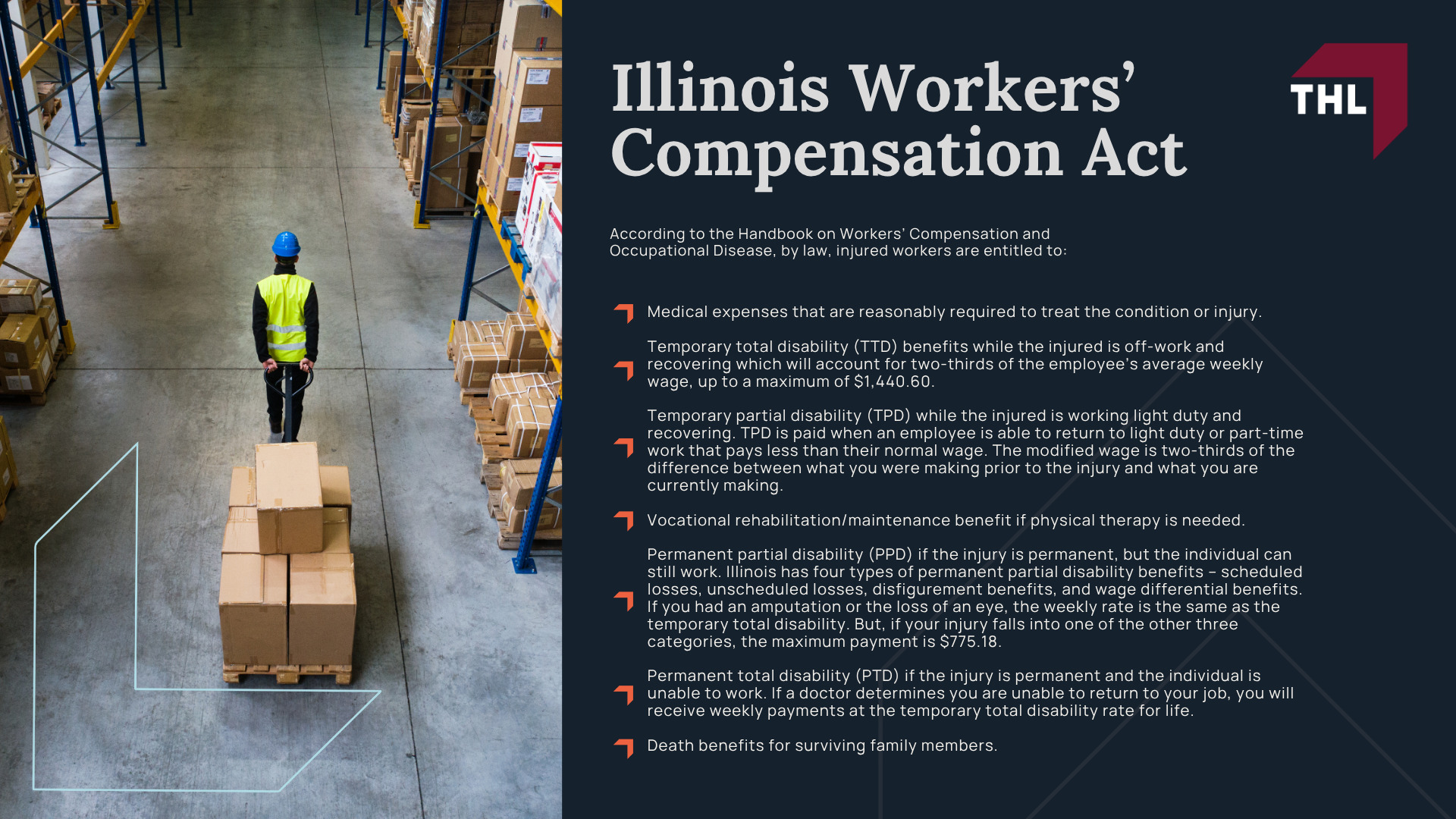
According to the Handbook on Workers’ Compensation and Occupational Disease, by law, injured workers are entitled to:
Medical expenses that are reasonably required to treat the condition or injury.
Temporary total disability (TTD) benefits while the injured is off-work and recovering which will account for two-thirds of the employee’s average weekly wage, up to a maximum of $1,440.60.
Temporary partial disability (TPD) while the injured is working light duty and recovering. TPD is paid when an employee is able to return to light duty or part-time work that pays less than their normal wage. The modified wage is two-thirds of the difference between what you were making prior to the injury and what you are currently making.
Vocational rehabilitation/maintenance benefit if physical therapy is needed.
Permanent partial disability (PPD) if the injury is permanent, but the individual can still work. Illinois has four types of permanent partial disability benefits – scheduled losses, unscheduled losses, disfigurement benefits, and wage differential benefits. If you had an amputation or the loss of an eye, the weekly rate is the same as the temporary total disability. But, if your injury falls into one of the other three categories, the maximum payment is $775.18.
Permanent total disability (PTD) if the injury is permanent and the individual is unable to work. If a doctor determines you are unable to return to your job, you will receive weekly payments at the temporary total disability rate for life.
Death benefits for surviving family members.
The cap for disability payments is updated every six months and can be found on the Illinois Workers’ Compensation Commission website.
By law, employers are required to carry workers’ compensation insurance for their employees.
If an injury or death does occur, the employer is responsible for the cost of the workers’ compensation benefits.
If an employer fails to obtain insurance or pay for the workers’ compensation benefits for an injured employee, the employer is subject to substantial fines and penalties.
While an injured employee should absolutely file a claim to recover compensation for their suffering, there are specific situations when a workers’ compensation claim will be denied.
Those circumstances include:
Self-inflicted injuries
Injuries suffered while the worker commits a crime
Injuries suffered while not on the job
Injuries suffered when the worker’s actions go against company policy
TorHoerman Law, Chicago Workers Compensation Lawyer
Workers’ compensation claims are very time-extensive, convoluted matters which is why hiring a Chicago workers’ compensation lawyer is in your best interest.
At TorHoerman Law, our focus is to help those who have been injured through no fault of their own.
We want to help you receive the compensation you deserve.
As your lawyer, we can help and guide you through the legal process.
The first and most important thing you should do is seek medical attention.
Then, notify your employer of the injury.
Once those two things have been done, your lawyer will step in to guide you through the other necessary steps such documenting all evidence, including medical records and bills, reporting to the Illinois Workers’ Compensation Commission if hearings are scheduled, presenting evidence on your behalf, and working to negotiate your claim.
If you do not hire an attorney, you will have to do all of those aforementioned steps on your own which can potentially get messy as it is likely your employer will hire a lawyer to work on their behalf, too.
If you have any questions, our Chicago workers compensation lawyers are here to help.
The Illinois Workers’ Compensation Commission strongly suggests you contact the Commission’s Insurance Compliance Division to provide the employer’s name and address, and the date of injury.
The Division can be reached at
inscompquestions.wcc@illinois.gov or at 312-814-6611, toll-free 866-352-3033.
Unlike other personal injury claims with a statute of limitations of two years, a workers’ compensation claim must be filed “within three years after an injury, death, or disablement from an occupational disease, or within two years of the last payment of TTD or a medical bills, whichever is later.”
However, there are special circumstances which are why hiring an attorney to represent you will be beneficial.
“Census of Fatal Occupational Injuries Summary, 2017.” U.S. Bureau of Labor Statistics, U.S. Bureau of Labor Statistics, 18 Dec. 2018, www.bls.gov/news.release/cfoi.nr0.htm.
Tor Hoerman has represented injured individuals for more than 30 years, with experience spanning individual personal injury cases and nationwide mass tort litigation. His work includes car accidents, catastrophic injuries, product liability claims, and other serious injury cases. Tor has served in court-appointed leadership roles in national litigation and tried cases involving major corporate defendants.
Legally Reviewed
TorHoerman Law’s legal content is researched and written by our editorial team and attorneys for legal accuracy, clarity, and relevance. We rely on statutes, court records, government publications, medical research, and other authoritative sources when applicable. This page provides general legal information and does not constitute legal advice.
Fact-Checked
TorHoerman Law reviews its legal content for factual accuracy, current information, and relevant legal context before publication and as material developments occur. This article is provided for general informational purposes and does not constitute legal advice. For guidance about a specific case, contact TorHoerman Law.
Have you or a loved one been injured in
Chicago, Illinois?
A serious injury can change your life.
Speak with an experienced Chicago personal injury lawyer about your rights, your case, and the legal options available to you.
TorHoerman Law represents people whose lives have been disrupted by serious injuries, unsafe products, and negligence. Our attorneys handle individual personal injury cases as well as national mass tort lawsuits involving major corporations.
Founded in 2009, our legal team brings more than 100 years of combined experience handling serious injury and complex civil litigation.
Do you believe you’re entitled to compensation?
Use our Instant Case Evaluator to find out in as little as 60 seconds!
In this case, we obtained a verdict of $495 Million for our client’s child who was diagnosed with Necrotizing Enterocolitis after consuming baby formula manufactured by Abbott Laboratories.
They helped my elderly uncle receive compensation for the loss of his wife who was administered a dangerous drug. He consulted with this firm because of my personal recommendation and was very pleased with the compassion, attention to detail and response he received. Definitely recommend this firm for their 5 star service.
★★★★★Rated 5 out of 5
Philip Storey
When I wanted to join the Xarelto class action lawsuit, I chose TorrHoerman Law from a search of a dozen or so law firm websites. I was impressed with the clarity of the information they presented. I gave them a call, and was again impressed, this time with the quality of our interactions.
★★★★★Rated 5 out of 5
Krista Miller
TorHoerman Law is an awesome firm to represent anyone that has been involved in a case that someone has stated that it's too difficult to win. The entire firm makes you feel like you’re part of the family, Tor, Eric, Jake, Kristie, Chad, Tyler, Kathy and Steven are the best at what they do.
★★★★★Rated 5 out of 5
Joe Smith
TorHorman Law is awesome
★★★★★Rated 5 out of 5
Karen Levy
I can’t say enough how grateful I was to have TorHoerman Law help with my case. Jacob Plattenberger is very knowledgeable and an amazing lawyer. Jillian Pileczka was so patient and kind, helping me with questions that would come up. Even making sure my special needs were taken care of for meetings.
★★★★★Rated 5 out of 5
Lauren B
TorHoerman Law fights for justice with their hardworking and dedicated staff. Not only do they help their clients achieve positive outcomes, but they are also generous and important pillars of the community with their outreach and local support. Thank you THL!
★★★★★Rated 5 out of 5
Joey
Hands down one of the greatest group of people I had the pleasure of dealing with!
★★★★★Rated 5 out of 5
Nickie Shewmake
A very kind and professional staff.
★★★★★Rated 5 out of 5
Jeannette Johnson
Very positive experience. Would recommend them to anyone.