Active Litigation
Fire Truck Antitrust Lawsuit Facts
TorHoerman Law is actively accepting claims for the Fire Truck Antitrust Lawsuit.


The fire truck antitrust lawsuit is a group of federal antitrust lawsuits, now centralized in an MDL, involving public entities that allege major fire truck manufacturers, private equity interests, and industry participants reduced competition in the fire apparatus market.
The lawsuits claim that cities, counties, municipalities, and fire departments paid inflated prices for fire trucks, fire engines, ladder trucks, pumpers, rescue vehicles, and other essential equipment because of alleged anticompetitive conduct in the fire truck market.
The litigation focuses on public entities that purchased fire trucks or new fire apparatus during the alleged period of reduced competition.
Plaintiffs claim that the defendants used consolidation, supply restrictions, and other business practices to raise prices, extend lead times, and limit practical alternatives for public buyers.
These are allegations that must still be proven in federal court, and defendants may dispute liability.

Several cases have been centralized in the Eastern District of Wisconsin as In re: Fire Apparatus Antitrust Litigation, MDL No. 3179.
Public case materials and reporting identify different defendants depending on the complaint.
Some cases name Oshkosh Corporation, Pierce Manufacturing, REV Group, Rosenbauer America LLC, and the Fire Apparatus Manufacturers Association. Los Angeles County’s public announcement names American Industrial Partners, REV Group, Oshkosh Corporation, and Boise Mobile Equipment.
Public agencies are filing fire truck antitrust claims because many departments say they have faced soaring prices, long delivery delays, and limited purchasing options for fire apparatus over the past decade.
Fire departments nationwide rely on these vehicles for emergency response, and plaintiffs claim the alleged conduct has made it harder to replace aging apparatus on time.
For public entities, the alleged harm can extend beyond the sticker price of a truck.
A delayed apparatus purchase may force a fire department to keep older vehicles in service longer, pay higher maintenance costs, delay replacement planning, and divert money from other public safety needs.
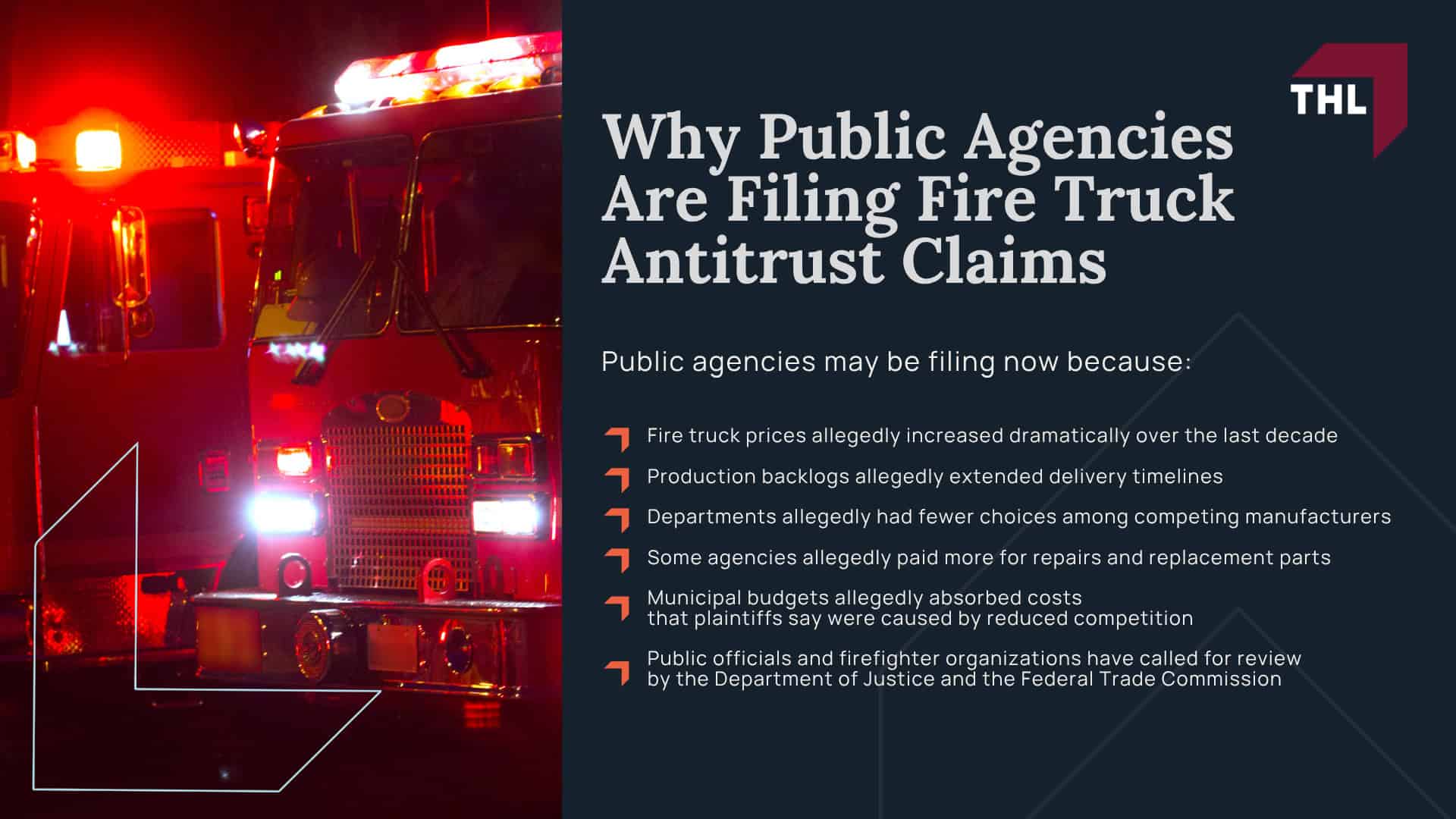
Public agencies may be filing now because:
The International Association of Fire Fighters and the American Economic Liberties Project asked federal antitrust enforcers to investigate REV Group, Oshkosh, and Rosenbauer, citing concerns about high prices, long wait times, and possible antitrust business practices affecting firefighters and the public.
The lawsuits allege that certain fire apparatus manufacturers, private equity-backed entities, and industry participants engaged in conduct that reduced competition in the fire apparatus market.
Plaintiffs claim this conduct violated federal antitrust laws, including the Sherman Act, and similar state antitrust statutes.

The central allegations include:
A lawsuit filed by the City of La Crosse alleged that major manufacturers conspired to suppress competition, restrict supply, and drive up fire truck costs.
Later cases expanded the litigation across the country, including actions involving public entities from multiple states.
A major theme in the litigation is alleged market consolidation.
Plaintiffs claim that the fire apparatus market became a highly concentrated market controlled by a small number of large companies, leaving cities and fire districts with fewer meaningful choices.
Some lawsuits and public reporting focus on three manufacturers or corporate groups that allegedly dominate much of the U.S. market: REV Group, Oshkosh Corporation through Pierce Manufacturing, and Rosenbauer America.
A Wall Street Journal report summarized allegations that Rev Group, Pierce, and Rosenbauer control roughly 70% to 80% of the market, while American Industrial Partners denied wrongdoing and said it would defend itself.
Plaintiffs claim that this alleged consolidation may have substantially lessened competition by reducing the number of independent competing companies.
The lawsuits allege that fewer competitors gave dominant companies greater ability to control supply, influence pricing, and reduce purchasing leverage for public agencies.
The lawsuits claim that public entities paid higher prices because defendants allegedly restricted output, reduced competition, and used market power to raise fire truck prices.
Plaintiffs allege these were not ordinary market conditions, but the result of an alleged conspiracy and anticompetitive structure in the fire truck market.
Public reports describe steep price hikes and long waits for new apparatus.
Connecticut officials and fire chiefs warned that some sophisticated ladder trucks can cost more than $2 million and that delivery timelines may stretch up to four years, creating budget and operational strain for departments.
The allegations include claims that defendants:
These allegations remain disputed and must be proven through evidence, expert analysis, and court proceedings.
The fire apparatus crisis also involves alleged delayed deliveries and difficulty obtaining replacement parts.
Fire departments nationwide have reported waiting years for new vehicles, while departments with aging fleets may need additional repairs, interim purchases, or parts to keep existing trucks operational.
Plaintiffs claim that these delays affected public safety planning because fire departments depend on reliable apparatus for emergency response.
When new vehicles are delayed, departments may be forced to keep older equipment in service longer, increasing maintenance costs and potentially reducing fleet reliability.
Evidence related to delivery delays may include:
The IAFF has stated that consolidation among emergency vehicle manufacturers has contributed to high apparatus prices and long wait times, and it has called for federal investigation.
The defendants vary by complaint, but publicly reported lawsuits and MDL docket materials identify several major companies and entities tied to the litigation.
The fire truck antitrust lawsuit has named or referenced major fire truck makers, related subsidiaries, private equity entities, and the Fire Apparatus Manufacturers Association.
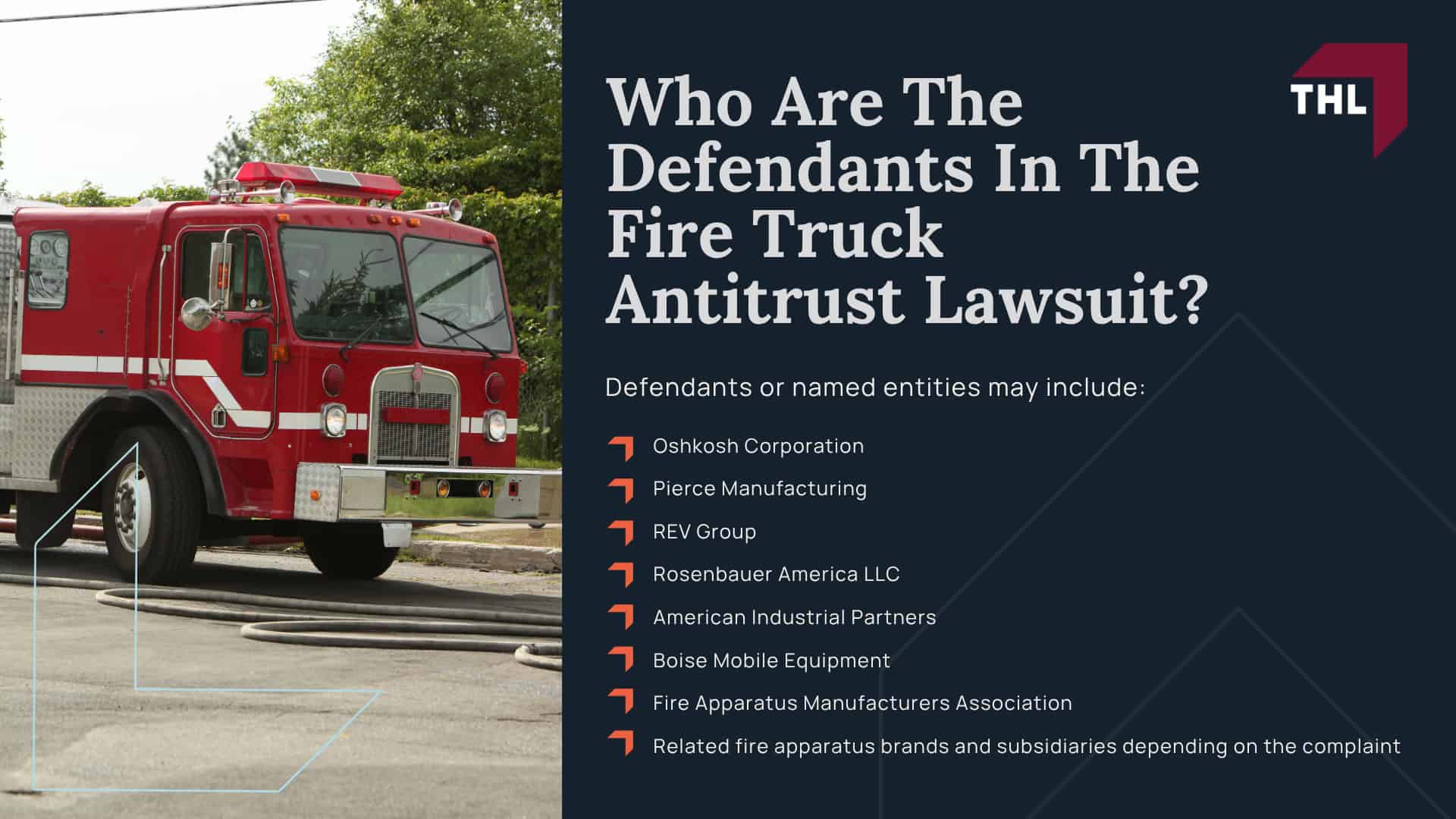
Defendants or named entities may include:
Los Angeles County announced a lawsuit against American Industrial Partners, REV Group, Oshkosh Corporation, and Boise Mobile Equipment, alleging federal and state antitrust and unfair competition claims tied to consolidation in the fire truck market.
Defendants may deny liability, dispute market definition, challenge causation, or argue that price increases and delays resulted from supply-chain, labor, demand, or production factors.
Public entities allege that fire truck overcharges affect more than municipal budgets.
Fire trucks are essential emergency response equipment, and delays or inflated prices may affect how agencies plan fleet replacement, staffing, mutual aid coverage, and long-term capital budgets.

Alleged overcharges may affect public safety by forcing agencies to:
Los Angeles County alleged that fire truck companies overcharged public buyers and sought both monetary recovery and relief aimed at unwinding alleged anticompetitive mergers.
Public entities may qualify for a fire truck antitrust claim if they purchased fire trucks or other fire apparatus during the alleged period and paid prices allegedly affected by reduced competition.
Eligibility depends on the entity, purchase dates, vendor records, apparatus type, jurisdiction, and the final class or claim structure.

Potentially eligible entities may include:
The MDL docket identifies public-entity plaintiffs including La Crosse, Augusta, Newstead Fire Company, Onalaska, Philadelphia, Ann Arbor, Milwaukee, Nashville and Davidson County, Claverack Fire District, and others.
Cities, counties, and municipalities may be affected if they purchased fire apparatus during the alleged period.
These entities often approve purchases through city councils, county boards, procurement departments, capital improvement plans, or public safety budgets.
Examples from public reporting include Los Angeles County, La Crosse, Ann Arbor, Milwaukee, Des Moines, and other public buyers across the country.
Des Moines officials reportedly approved outside counsel to pursue an antitrust and unfair competition lawsuit after spending more than $12 million on major apparatus since January 2016.
Fire districts and fire departments may qualify if they bought fire engines, ladder trucks, rescue trucks, aerial apparatus, or other fire apparatus at prices allegedly inflated by anticompetitive conduct.
These entities may have direct purchase records, bid documents, and delivery communications that help establish a claim.
Fire departments may also have evidence of operational impacts, including:
Public entities that purchased fire apparatus should preserve procurement and financial records now.
The strongest eligibility review will usually depend on what the entity bought, when it bought it, which manufacturer or dealer was involved, and whether delivery delays or price increases affected the purchase.
Relevant apparatus purchases may include new fire apparatus, replacement trucks, large capital equipment orders, and potentially related equipment or replacement parts depending on the claim.
The litigation may involve multiple entities across the country, including entities in states such as California, Wisconsin, South Dakota, and others, depending on the specific complaint or MDL activity.
The lawsuits generally focus on purchases of fire trucks and related fire apparatus used by public safety agencies.
The scope may vary by complaint, but qualifying purchases may involve vehicles made, sold, or distributed by named defendants or alleged co-conspirators.

Potentially involved purchases may include:
The key records will usually include bid documents, purchase orders, contracts, invoices, change orders, delivery schedules, and vendor communications.
A fire truck antitrust lawsuit may seek monetary compensation for alleged overcharges and related financial harm.
Depending on the claims, public entities may also seek injunctive relief, civil penalties, attorneys’ fees, and other remedies allowed under federal or state antitrust statutes.

Potential remedies may include:
No recovery is guaranteed.
Public entities must prove liability, damages, causation, and eligibility under the applicable antitrust laws.
Overcharge damages are intended to compensate purchasers who allegedly paid more than they would have paid in a competitive market.
In this litigation, public entities may claim that fire truck prices were artificially inflated because of reduced competition, restricted output, or coordination among competitors.
To evaluate overcharge damages, attorneys and experts may review:
Economic experts may compare actual prices against estimated competitive-market prices to evaluate alleged overcharges.
Federal antitrust laws may allow successful plaintiffs to recover treble damages, meaning three times proven antitrust damages, if the legal requirements are met.
Treble damages are not automatic; plaintiffs must prove an antitrust violation, injury, causation, and damages.
The lawsuits may rely on the Sherman Act and Clayton Act remedies, depending on the complaint.
Claims under federal antitrust laws often require economic analysis of market power, competitive effects, pricing, supply, and damages.
Some lawsuits may seek injunctive relief or market reforms in addition to monetary damages.
Injunctive relief can include a court order requiring defendants to stop certain conduct or address conditions that allegedly restrain trade.
Depending on the case, requested relief may involve:
Los Angeles County’s public announcement described relief aimed at recovering overcharges and unwinding allegedly anticompetitive mergers.
Evidence is critical because fire truck antitrust claims often depend on procurement history, purchase pricing, vendor communications, delivery timelines, and budget impacts.
Public entities should preserve records as early as possible.

Important evidence may include:
Public entities should consider implementing a litigation hold so emails, attachments, procurement files, and financial records are not destroyed under routine retention policies.
The fire apparatus antitrust cases have been centralized as In re: Fire Apparatus Antitrust Litigation, MDL No. 3179, in the U.S. District Court for the Eastern District of Wisconsin.
MDL centralization allows one district court to manage shared pretrial issues across related cases.
The Judicial Panel on Multidistrict Litigation ordered related fire apparatus antitrust cases transferred to the Eastern District of Wisconsin for coordinated or consolidated pretrial proceedings.

In an MDL, the court may coordinate:
For public entities, the legal process usually begins with an eligibility review.
Attorneys review purchase history, vendor information, apparatus type, pricing, delivery records, and related budget impacts.

A typical process may include:
The deadline to file a fire truck antitrust claim depends on the claim, jurisdiction, purchase dates, tolling issues, and whether federal or state antitrust statutes apply.
Federal antitrust claims often involve a four-year statute of limitations, but accrual, concealment, continuing violations, class action tolling, and state-law claims can affect the analysis.
Public entities should not assume they have time to wait.

Purchase dates, delivery dates, pricing records, and procurement communications may all matter in determining whether a claim is timely.
Because the litigation is ongoing and some public entities are filing new claims, municipalities, counties, fire districts, and fire departments should contact counsel promptly if they purchased apparatus during the relevant period.
TorHoerman Law is reviewing potential fire truck antitrust claims for public entities that purchased fire apparatus and may have been affected by alleged inflated prices, restricted supply, or delayed deliveries.
Our legal team can evaluate procurement records, identify potentially relevant manufacturers, review delivery communications, and explain whether your agency may have a claim.

If your city, county, municipality, fire district, or fire department purchased fire apparatus during the past decade and experienced soaring prices, delayed deliveries, restricted supply, or replacement parts issues, contact TorHoerman Law.
You can also use the chatbot on this page to see if you qualify today.


