Chicago
Case Types We Handle
Personal Injuries
Car Accidents
Truck Accidents
Motorcycle Accidents
Bicycle Accidents
Construction Accidents
Nursing Home Abuse
Wrongful Death
Slip and Fall Accidents
Daycare Injury & Abuse
Edwardsville
Case Types We Handle
Personal Injuries
Car Accidents
Truck Accidents
Motorcycle Accidents
Bicycle Accidents
Nursing Home Abuse
Wrongful Death
Slip and Fall Accidents
Daycare Injury & Abuse
Premises Liability
St. Louis
Case Types We Handle
Personal Injuries
Car Accidents
Truck Accidents
Motorcycle Accidents
Bicycle Accidents
Construction Accidents
Nursing Home Abuse
Wrongful Death
Slip and Fall Accidents
Daycare Injury & Abuse
Dangerous Drugs
Defective Products
Chemical Exposure

Extended Stay America Human Trafficking Lawsuit

4.9
Google
677 reviews

Survivors Are Filing Lawsuits Involving Extended Stay America Hotels

Extended Stay America human trafficking lawsuit claims allege that survivors were trafficked at certain properties while hotel employees, owners, managers, or other defendants encountered warning signs or otherwise interacted with alleged trafficking activity.

Survivors who allege that they were trafficked at Extended Stay America properties may have legal recourse against hotel owners, operators, managers, or other entities if the evidence supports a civil claim.

These lawsuits can involve allegations that hotel personnel encountered warning signs, interacted with traffickers, or failed to respond to suspicious activity while trafficking occurred at the property.

This page explains the major Extended Stay America trafficking cases, the companies involved, the evidence courts may consider, and the legal options that may be available to survivors.

The information is intended for survivors and families trying to understand whether conduct at a specific Extended Stay America property may support a lawsuit.

TorHoerman Law is reviewing potential claims involving Extended Stay America properties and can explain the legal options that may be available.

Extended Stay America Human Trafficking Lawsuit; Extended Stay America Human Trafficking Lawsuit Overview; Who Owns Extended Stay America; Can Extended Stay America Owners or Managers Be Liable Separately From a Franchisor; What Evidence May Be Relevant in Lawsuits Involving Extended Stay America Properties; Extended Stay America Human Trafficking Policies and Prevention Efforts; Do You Qualify to File a Human Trafficking Lawsuit Involving an Extended Stay America Property; TorHoerman Law_ Investigating Claims Involving Extended Stay America Properties

What Do Lawsuits Involving Extended Stay America Properties Allege?

Extended Stay America human trafficking lawsuit claims allege that sex trafficking and child sexual exploitation occurred in hotel rooms while employees, owners, managers, or other defendants failed to respond to warning signs.

One lawsuit alleges that hotel personnel accepted payments from traffickers, acted as lookouts, witnessed abuse, or otherwise interacted directly with alleged trafficking activity.

Other complaints describe repeated stays, cash or prepaid-card payments, frequent visitors, restrictions on housekeeping, visible injuries, and other circumstances plaintiffs contend occurred on the hotel premises.

Under federal law, trafficking at a hotel does not automatically establish liability.

A TVPRA claim may require proof that a defendant knowingly benefited from participation in a trafficking venture the defendant knew or should have known involved unlawful conduct, making evidence of knowledge and the role of each ESA-related entity important to the analysis.

Extended Stay America has historically included both company-owned and franchised properties, so ownership, management, and control can differ from one hotel to another.

TVPRA litigation can create significant financial exposure through settlements, judgments, defense costs, and potentially higher insurance costs, but the result depends on the facts and defendants involved.

Survivors may seek compensation for legally recoverable harm associated with the trafficking.

TorHoerman Law is reviewing potential claims involving Extended Stay America properties and offers free, confidential consultations to survivors and their families.

Extended Stay America Human Trafficking Lawsuit Overview

Extended Stay America properties have appeared in federal human trafficking litigation involving hotels in Maryland, Illinois, Utah, Ohio, Georgia, and Michigan.

The cases have produced different results, including claims surviving motions to dismiss and other claims being dismissed where courts concluded that the allegations did not sufficiently establish the knowledge or participation required against particular hotel defendants.

Extended Stay America is also distinct from many hotel brands because its system has historically included a substantial portfolio of company-owned and operated hotels in addition to franchised properties.

That structure can affect which entity managed the hotel, employed staff, collected room revenue, or received reports concerning activity at a property.

Some lawsuits contain relatively direct allegations involving hotel personnel.

In C.L. v. ESA P Portfolio MD LLC, for example, the plaintiff alleges that employees accepted payments to act as police lookouts and that a hotel manager obtained commercial sex from her.

Extended Stay America Human Trafficking Lawsuit Overview

Those allegations have not been established as facts.

Other cases have involved more general allegations concerning repeated stays, cash or prepaid-card payments, frequent male visitors, restrictions on housekeeping, visible injuries, and other alleged warning signs.

These cases do not establish a single result applicable to every Extended Stay America property.

The outcome of a particular lawsuit depends on the hotel, defendants, corporate structure, evidence, and legal issues before the court.

Recent Lawsuits and Court Decisions Involving Extended Stay America Properties

Federal human trafficking litigation involving Extended Stay America properties has produced different results depending on the hotel, corporate structure, allegations, evidence, legal theories, and procedural stage.

Some lawsuits involve ESA-related companies alleged to have directly owned or managed the hotel.

Others involve franchisors, independent operators, or multiple entities performing different functions at the same property.

A ruling allowing a claim to proceed does not establish that a defendant participated in trafficking.

Dismissal of a claim does not necessarily establish that the alleged trafficking did not occur.

Significant Extended Stay America human trafficking litigation includes:

  • July 6, 2026, C.L. v. ESA P Portfolio MD LLC: The plaintiff alleges that she was subjected to sex trafficking at an Extended Stay America hotel in Gaithersburg, Maryland, between 2015 and 2017. She alleges that hotel employees accepted payments from her trafficker to act as police lookouts, witnessed physical abuse, encountered repeated sex-buyer traffic, and that a hotel manager obtained commercial sex from her. A federal court denied a motion to dismiss filed by the property owner and management entity and allowed the TVPRA claim to continue. The ruling did not establish liability or determine that the allegations were true.
  • May 8, 2026, T. v. SBY Downers Grove: Two plaintiffs alleged trafficking at an Extended Stay America property in Schaumburg, Illinois. The court denied a motion to dismiss filed by ESA P Portfolio LLC, which was alleged to own and operate the property. It separately dismissed certain direct federal theories against ESH Strategies Franchise LLC while allowing an indirect beneficiary theory and an Illinois trafficking claim to continue. The differing results illustrate why a property-level owner or operator and a franchisor may be evaluated separately.
  • March 31, 2026, Keller v. Danford: The plaintiff alleged that she was subjected to commercial sex at several Utah hotels, including an Extended Stay America property in Salt Lake City. The court dismissed the claims against the remaining ESA property defendants after concluding that the allegations did not sufficiently establish that those defendants knew or should have known she was being compelled into commercial sex through force, fraud, threats, or coercion.
  • August 12, 2024, R.A. v. Best Western International: The plaintiff alleged that she was trafficked at several Columbus-area hotels, including an Extended Stay America property, for at least eight months during 2012 and 2013. The court noted that the Extended Stay America property was not a franchise and denied the ESA defendants’ motion to dismiss. The decision allowed the claims to continue at the pleading stage and did not establish final liability.
  • November 15, 2024, S.J.C. v. ESA P Portfolio LLC: The plaintiff alleged trafficking at an Extended Stay America property on Hammond Drive in Atlanta and described cash or prepaid-card payments, restrictions on housekeeping, and substantial male visitor traffic. The Northern District of Georgia dismissed the claims after concluding that the allegations did not sufficiently establish that the defendants knew or should have known she was being compelled into commercial sex through force, fraud, or coercion.
  • March 2024, K.O. v. Red Lion Hotels Corporation: The plaintiff alleged trafficking at multiple Michigan hotels, including three Extended Stay America properties. The Eastern District of Michigan dismissed the claims against ESA Management after concluding that the allegations did not sufficiently connect that entity to the particular trafficking venture.

These cases illustrate a recurring issue in hotel-trafficking litigation: evidence suggesting prostitution or commercial sex does not necessarily establish that a particular defendant knew or should have known that a person was being trafficked.

They also demonstrate why property owners, management companies, operators, and franchisors must be evaluated according to their individual roles.
Who Owns Extended Stay America?

Extended Stay America is privately held following its 2021 acquisition by a joint venture involving funds managed by Blackstone Real Estate Partners and Starwood Capital Group.

The transaction was announced as a 50/50 joint venture and valued at approximately $6 billion.

Extended Stay America differs from hotel systems that rely almost entirely on independently owned franchises.

In January 2025, ESA reported an owned-and-operated portfolio of approximately 600 hotels, along with more than 125 franchised properties.

Historical corporate records and federal litigation identify several separate companies involved in Extended Stay America property ownership, operations, management, branding, or franchising.

Extended Stay America Human Trafficking Lawsuit Overview; Who Owns Extended Stay America

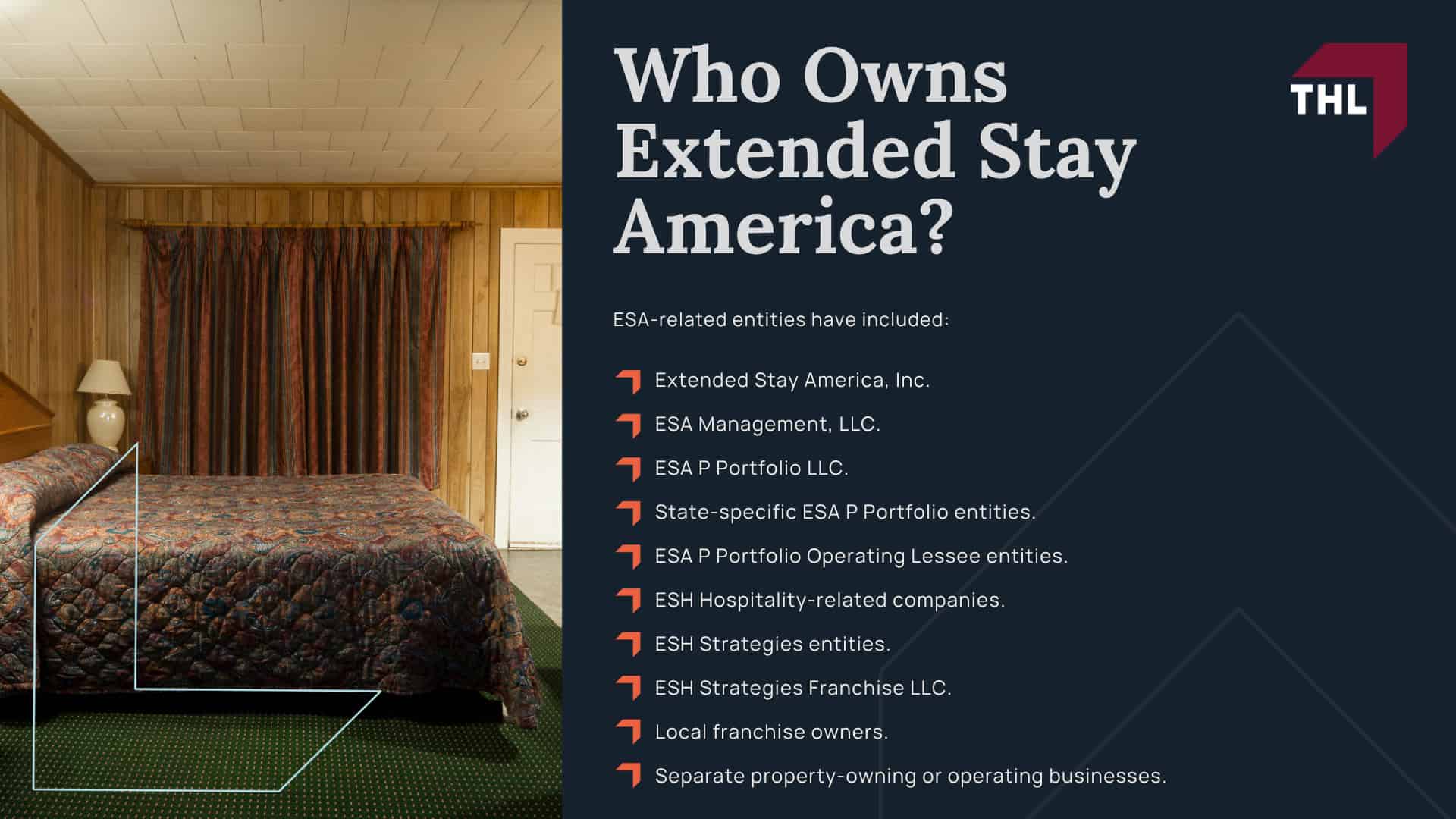
ESA-related entities have included:

  • Extended Stay America, Inc.
  • ESA Management, LLC.
  • ESA P Portfolio LLC.
  • State-specific ESA P Portfolio entities.
  • ESA P Portfolio Operating Lessee entities.
  • ESH Hospitality-related companies.
  • ESH Strategies entities.
  • ESH Strategies Franchise LLC.
  • Local franchise owners.
  • Separate property-owning or operating businesses.

Those companies are not legally interchangeable.

Depending on the hotel and time period, one company may own the real estate while another operates the property, employs hotel personnel, manages housekeeping and security, or holds a franchise agreement.

Court records provide examples. C.L. identifies an ESA P Portfolio entity as the property owner and ESA Management as the management entity, while T. v. SBY Downers Grove identifies ESA P Portfolio as the alleged owner/operator and ESH Strategies Franchise as a separate franchisor.

Property records, management agreements, corporate filings, operating leases, employment records, franchise agreements, and court documents may help identify the businesses associated with a particular hotel during the alleged trafficking period.

Can Extended Stay America Owners or Managers Be Liable Separately From a Franchisor?

Yes.

A property owner, hotel operator, management company, and franchisor may be evaluated as separate defendants.

Extended Stay America Human Trafficking Lawsuit Overview; Who Owns Extended Stay America; Can Extended Stay America Owners or Managers Be Liable Separately From a Franchisor

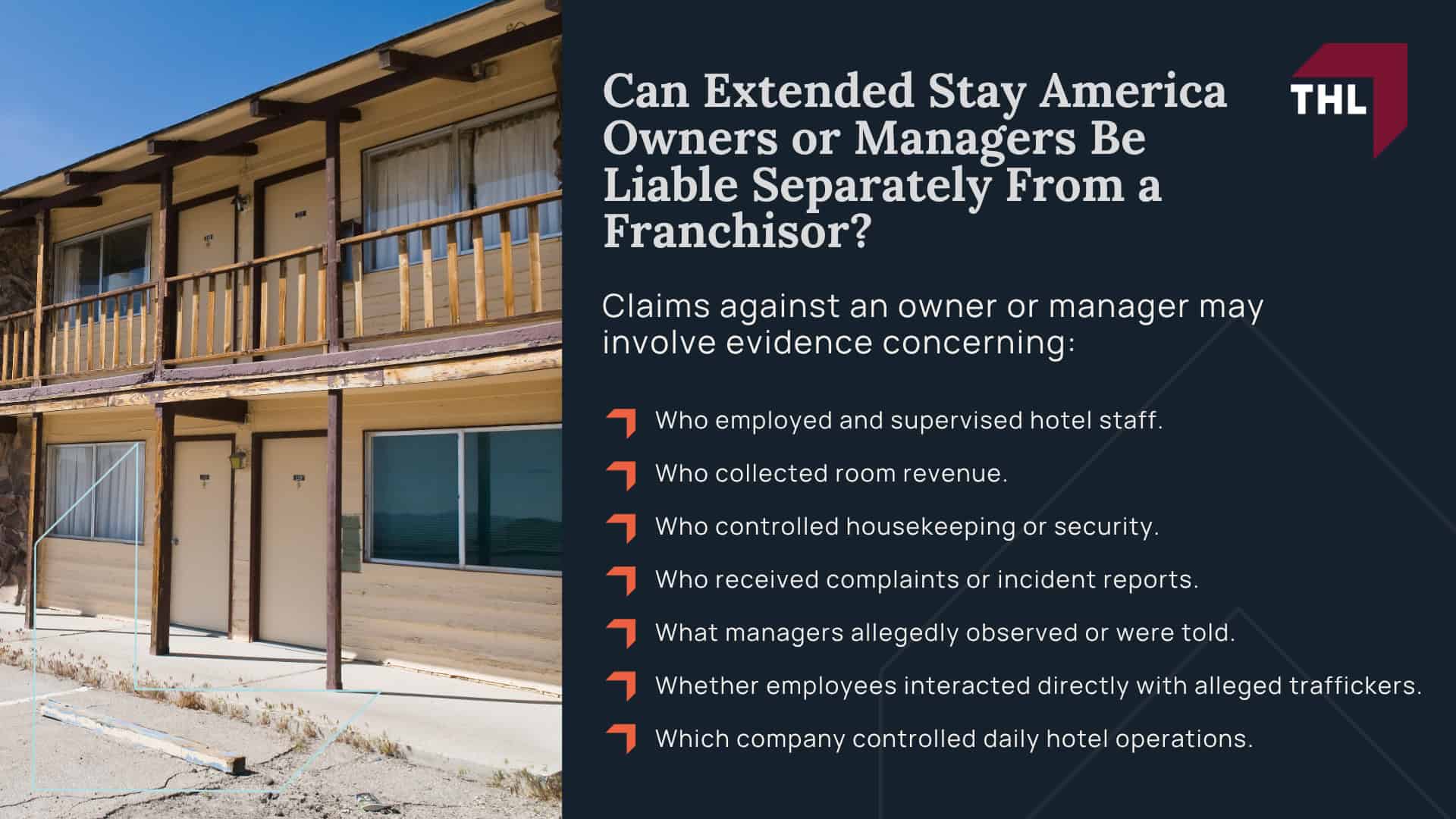
Claims against an owner or manager may involve evidence concerning:

  • Who employed and supervised hotel staff.
  • Who collected room revenue.
  • Who controlled housekeeping or security.
  • Who received complaints or incident reports.
  • What managers allegedly observed or were told.
  • Whether employees interacted directly with alleged traffickers.
  • Which company controlled daily hotel operations.

Claims against a franchisor may instead involve franchise agreements, reservation systems, brand standards, inspection rights, training requirements, reporting procedures, franchise fees, and the degree of control retained over the local business.

The 2026 T. v. SBY Downers Grove decision illustrates this distinction.

The court denied the motion to dismiss filed by the alleged property owner/operator while reaching a narrower result on the direct federal claims asserted against ESH Strategies Franchise.

That procedural ruling did not establish liability against either defendant.

What Evidence May Be Relevant in Lawsuits Involving Extended Stay America Properties?

Evidence may help document a survivor’s presence at an Extended Stay America property, alleged trafficking activity, interactions with hotel personnel, and other circumstances relevant to a potential civil claim.

Extended Stay America Human Trafficking Lawsuit Overview; Who Owns Extended Stay America; Can Extended Stay America Owners or Managers Be Liable Separately From a Franchisor; What Evidence May Be Relevant in Lawsuits Involving Extended Stay America Properties

Survivor-facing evidence may include:

  • Hotel reservations, receipts, and registration records.
  • Credit-card, prepaid-card, or cash payment records.
  • Records documenting repeated or extended stays.
  • Text messages, phone records, and online communications.
  • Police reports or records of prior law-enforcement activity.
  • Witness statements from survivors, guests, or hotel personnel.
  • Surveillance footage and security records.
  • Housekeeping records or documentation concerning restrictions on room access.
  • Medical records documenting physical or psychological harm.

Complaints involving Extended Stay America properties have alleged repeated cash payments, long stays, frequent male visitors, visible injuries, poor hygiene, sleep deprivation, physical abuse, and commercial-sex activity.

Some cases contain more direct allegations, including hotel employees allegedly accepting payments, acting as police lookouts, witnessing abuse, or repeatedly interacting with alleged traffickers.

Other records may become important during an investigation or lawsuit, including internal employee communications, incident reports, management agreements, operating leases, franchise documents, training materials, and records identifying which company employed or supervised hotel staff.

Survivors are not expected to possess those corporate or internal hotel records themselves. Relevant documents may be obtained through investigation, public records, subpoenas, or civil discovery.

Courts have also distinguished between evidence suggesting prostitution or commercial sex and evidence showing that a defendant knew or should have known that force, fraud, coercion, or child exploitation was involved.

Extended Stay America Human Trafficking Policies and Prevention Efforts

Extended Stay America states that it works year-round to raise awareness about human trafficking and educate people about how to identify, prevent, and respond to suspected exploitation.

The company also participates in the American Hotel & Lodging Association Foundation’s No Room for Trafficking initiative, which coordinates prevention, education, and survivor-support efforts across the hospitality industry.

In 2022, Extended Stay America and G6 Hospitality jointly contributed $500,000 to the No Room for Trafficking Survivors Fund.

The AHLA Foundation states that the fund supports housing, transportation, childcare, career training, direct financial assistance, and other resources for trafficking survivors.

Extended Stay America Human Trafficking Lawsuit Overview; Who Owns Extended Stay America; Can Extended Stay America Owners or Managers Be Liable Separately From a Franchisor; What Evidence May Be Relevant in Lawsuits Involving Extended Stay America Properties; Extended Stay America Human Trafficking Policies and Prevention Efforts

Extended Stay America’s publicly described efforts for addressing trafficking include:

  • Educating hotel personnel and the public about recognizing potential trafficking indicators.
  • Supporting industry initiatives intended to prevent sex trafficking and other forms of human sex trafficking.
  • Participating in broader hospitality industry education and awareness efforts.
  • Supporting survivor services through the No Room for Trafficking Survivors Fund.
  • Promoting information about how individuals should respond when they suspect trafficking may be occurring.
  • Working with the AHLA Foundation on industry-wide anti-trafficking initiatives.

Anti-trafficking policies and anti-trafficking protocols can help hotel personnel recognize suspicious circumstances and determine when concerns should be reported, but even seemingly obvious signs do not independently establish that trafficking is occurring.

Current prevention programs also do not establish what policies, training, or reporting procedures were in effect at a specific Extended Stay America property during an earlier alleged trafficking period.

In a civil lawsuit, the relevant evidence concerns the particular hotel, employees, corporate entities, policies, reports, and circumstances in place when the alleged trafficking occurred.

Do You Qualify to File a Human Trafficking Lawsuit Involving an Extended Stay America Property?

A survivor may have grounds to pursue a civil claim if sex trafficking, child sexual exploitation, forced labor, or another form of human trafficking occurred at an Extended Stay America property.

Eligibility depends on the specific hotel involved, the dates of the alleged trafficking, the survivor’s age at the time, and the conduct attributed to the companies or individuals connected to the property.

Because Extended Stay America has historically included both company-owned hotels and franchised locations, an investigation may need to determine which entity owned, operated, or managed the hotel and which company employed or supervised its staff.

Evidence concerning repeated stays, room payments, employee interactions, prior complaints, police activity, restrictions on housekeeping, or other alleged warning signs may also be relevant.

Survivors do not need to know the hotel’s complete ownership structure or possess internal company records before speaking with an attorney.

Extended Stay America Human Trafficking Lawsuit Overview; Who Owns Extended Stay America; Can Extended Stay America Owners or Managers Be Liable Separately From a Franchisor; What Evidence May Be Relevant in Lawsuits Involving Extended Stay America Properties; Extended Stay America Human Trafficking Policies and Prevention Efforts; Do You Qualify to File a Human Trafficking Lawsuit Involving an Extended Stay America Property

Additional evidence, including management agreements, employee communications, incident reports, surveillance records, and corporate documents, may be obtained during an investigation or through civil discovery.

Federal TVPRA claims and potential state-law claims can also have different legal requirements and filing deadlines.

If the available evidence supports a claim, a survivor may seek compensation for legally recoverable physical, psychological, and financial harm associated with the trafficking.

TorHoerman Law: Investigating Claims Involving Extended Stay America Properties

TorHoerman Law is reviewing potential human trafficking claims involving survivors who allege that they were trafficked at Extended Stay America properties.

Our attorneys can investigate the specific hotel, identify the companies that owned, operated, or managed the property during the relevant period, and determine how those entities were connected to the hotel’s employees and daily operations.

A case review may involve reservation and payment records, police reports, surveillance footage, employee communications, witness statements, medical records, online advertisements, and other evidence concerning the alleged trafficking.

We can also evaluate whether hotel personnel or corporate defendants allegedly encountered warning signs, received reports of suspicious activity, or interacted directly with traffickers.

If the evidence supports a civil claim, we can determine what remedies may be available under applicable federal or state law.

Extended Stay America Human Trafficking Lawsuit Overview; Who Owns Extended Stay America; Can Extended Stay America Owners or Managers Be Liable Separately From a Franchisor; What Evidence May Be Relevant in Lawsuits Involving Extended Stay America Properties; Extended Stay America Human Trafficking Policies and Prevention Efforts; Do You Qualify to File a Human Trafficking Lawsuit Involving an Extended Stay America Property; TorHoerman Law_ Investigating Claims Involving Extended Stay America Properties

If you or someone you care about experienced trafficking at an Extended Stay America property, contact TorHoerman Law or use the chat feature on this page for a free and confidential consultation about the legal options that may be available.

Frequently Asked Questions

Published by:
Share
Picture of Tor Hoerman
Tor Hoerman

Tor Hoerman has represented injured individuals for more than 30 years, with experience spanning individual personal injury cases and nationwide mass tort litigation. His work includes car accidents, catastrophic injuries, product liability claims, and other serious injury cases. Tor has served in court-appointed leadership roles in national litigation and tried cases involving major corporate defendants.

TorHoerman Law’s legal content is researched and written by our editorial team and attorneys for legal accuracy, clarity, and relevance. We rely on statutes, court records, government publications, medical research, and other authoritative sources when applicable. This page provides general legal information and does not constitute legal advice.

TorHoerman Law reviews its legal content for factual accuracy, current information, and relevant legal context before publication and as material developments occur. This article is provided for general informational purposes and does not constitute legal advice. For guidance about a specific case, contact TorHoerman Law.

Additional Hotel Human Trafficking Lawsuit resources on our website:
All
FAQs
Injuries & Conditions
Legal Help
Other Resources
Settlements & Compensation
News

You can learn more about this topic by visiting any of our Hotel Human Trafficking Lawsuit pages listed below:

Days Inn Human Trafficking Lawsuit
Hilton Human Trafficking Lawsuit
Holiday Inn Human Trafficking Lawsuit
Hotel Human Trafficking Lawsuit
Lawsuit Against Hotels for Human Trafficking: Who Qualifies?
Marriott Human Trafficking Lawsuit
Motel 6 Human Trafficking Lawsuit
Red Roof Inn Human Trafficking Lawsuit
Super 8 Hotel Human Trafficking Lawsuit
Travelodge Human Trafficking Lawsuit
Have you or a loved one been injured?

A serious injury can change your life.

Speak with an experienced personal injury lawyer about your rights, your case, and the legal options available to you.
Google
677 reviews
4.9
★★★★★
Recovered damages
$4 Billion+

Table of Contents

Guides & Resources
About TorHoerman Law

TorHoerman Law represents people whose lives have been disrupted by serious injuries, unsafe products, and negligence. Our attorneys handle individual personal injury cases as well as national mass tort lawsuits involving major corporations.

Founded in 2009, our legal team brings more than 100 years of combined experience handling serious injury and complex civil litigation.

Do you believe you’re entitled to compensation?

Use our Instant Case Evaluator to find out in as little as 60 seconds!

$495 Million
Baby Formula NEC Lawsuit

In this case, we obtained a verdict of $495 Million for our client’s child who was diagnosed with Necrotizing Enterocolitis after consuming baby formula manufactured by Abbott Laboratories.

$20 Million
Toxic Tort Injury

In this case, we were able to successfully recover $20 Million for our client after they suffered a Toxic Tort Injury due to chemical exposure.

$103.8 Million
COX-2 Inhibitors Injury

In this case, we were able to successfully recover $103.8 Million for our client after they suffered a COX-2 Inhibitors Injury.

$4 Million
Traumatic Brain Injury

In this case, we were able to successfully recover $4 Million for our client after they suffered a Traumatic Brain Injury while at daycare.

$2.8 Million
Defective Heart Device

In this case, we were able to successfully recover $2.8 Million for our client after they suffered an injury due to a Defective Heart Device.

Other Hotel Human Trafficking Lawsuit Resources

All
FAQs
Injuries & Conditions
Legal Help
Other Resources
Settlements & Compensation
News