Active Litigation
Hotel Human Trafficking Lawsuit Facts
TorHoerman Law is actively accepting claims for the Hotel Human Trafficking Lawsuit.


Human trafficking lawsuits involving the hotel industry generally allege that traffickers used hotel rooms or other hotel facilities while employees, owners, operators, or corporate defendants encountered circumstances plaintiffs contend were signs of exploitation.
These cases can involve sex and labor trafficking, including allegations of child sex trafficking, coercion, forced commercial sex, or other criminal conduct.
Human trafficking survivors may pursue legal action against perpetrators and, in qualifying cases, other parties whose conduct satisfies the requirements of federal or state law.
Hotel companies are not automatically responsible simply because a crime occurred at one of their properties, and liability must be evaluated separately for each defendant.
Many cases involving major hotel brands also arise at franchised hotels, where the property owner and day-to-day operator may be separate from the national company associated with the brand.

Travelodge litigation reflects that broader structure because Travelodge is part of the Wyndham Hotels & Resorts portfolio while individual properties may be independently owned and operated.
Plaintiffs in Travelodge cases have alleged repeated room rentals, prepaid or cash payments, extended stays, frequent short-term visitors, visible injuries, and interactions between alleged traffickers and hotel staff members.
Courts have allowed some claims involving Wyndham and Travelodge-related defendants to proceed while dismissing others when the allegations did not sufficiently establish participation, knowledge, agency, or another required basis for liability.
Whether a Travelodge human trafficking lawsuit can proceed therefore depends on the survivor’s circumstances, the specific property, the entities connected to it, and the evidence showing what each defendant allegedly knew or did.
Federal courts have considered several human trafficking lawsuits involving Travelodge properties and Wyndham-related defendants, with outcomes varying based on the allegations against each company and the procedural stage of the case.
Some courts have allowed TVPRA claims to proceed when plaintiffs alleged facts sufficient to connect Wyndham or Travelodge-related entities to the alleged trafficking venture, while others have dismissed claims where the allegations did not adequately establish knowledge or participation.
These decisions do not establish that Travelodge or Wyndham is generally liable for trafficking occurring at franchised hotels.
Each case depends on the particular property, defendants, alleged conduct, and evidence available to the survivor.
Significant Travelodge-related cases include:
Travelodge by Wyndham is an economy hotel brand within the Wyndham Hotels & Resorts portfolio in the United States and Canada.
Travelodge Hotels, Inc. is a Delaware subsidiary within the Wyndham Hotels & Resorts corporate structure and serves as a franchising entity associated with the North American Travelodge brand.
Wyndham describes itself as primarily a hotel franchising company, meaning most Travelodge properties are not directly owned or operated by Wyndham or Travelodge Hotels, Inc.
As of December 31, 2025, Wyndham reported 414 Travelodge properties with 30,772 hotel rooms, including 320 hotels in the United States and 94 in Canada.
Wyndham’s current Travelodge development materials likewise identify the brand as a franchising opportunity and report 414 hotels as of year-end 2025.
At a franchised Travelodge, a separate local company may own the real estate, employ hotel staff, collect room revenue, and oversee day-to-day operations while using the Travelodge name, Wyndham reservation systems, Wyndham Rewards program, brand standards, and other franchise services.

This structure appears directly in Travelodge trafficking litigation, where local hotel owners and operators have been sued alongside Travelodge Hotels, Inc. or other Wyndham-related entities.
Identifying the owner, operator, franchisee, and relevant Wyndham entities connected to the property during the alleged trafficking period is therefore an important part of evaluating a potential claim.
The Travelodge by Wyndham system discussed on this page should also not be confused with Travelodge Hotels Limited in the United Kingdom, which operates a separate hotel business across the UK, Ireland, and Spain and is not the North American Travelodge by Wyndham franchise system.
Potentially, but neither Wyndham Hotels & Resorts nor Travelodge Hotels, Inc. is automatically liable because trafficking allegedly occurred at a franchised Travelodge.
Like many hotels and motels operating under national brands, Travelodge properties may be owned and operated by separate franchisees that employ staff and control day-to-day operations.
A direct TVPRA beneficiary claim against a Wyndham-related entity generally requires allegations and evidence showing that the defendant knowingly benefited from participation in a venture it knew or should have known violated federal trafficking law.
Separate agency or vicarious-liability theories may depend on the relationship between the franchisor and local operator, including the degree of control exercised over relevant hotel operations.
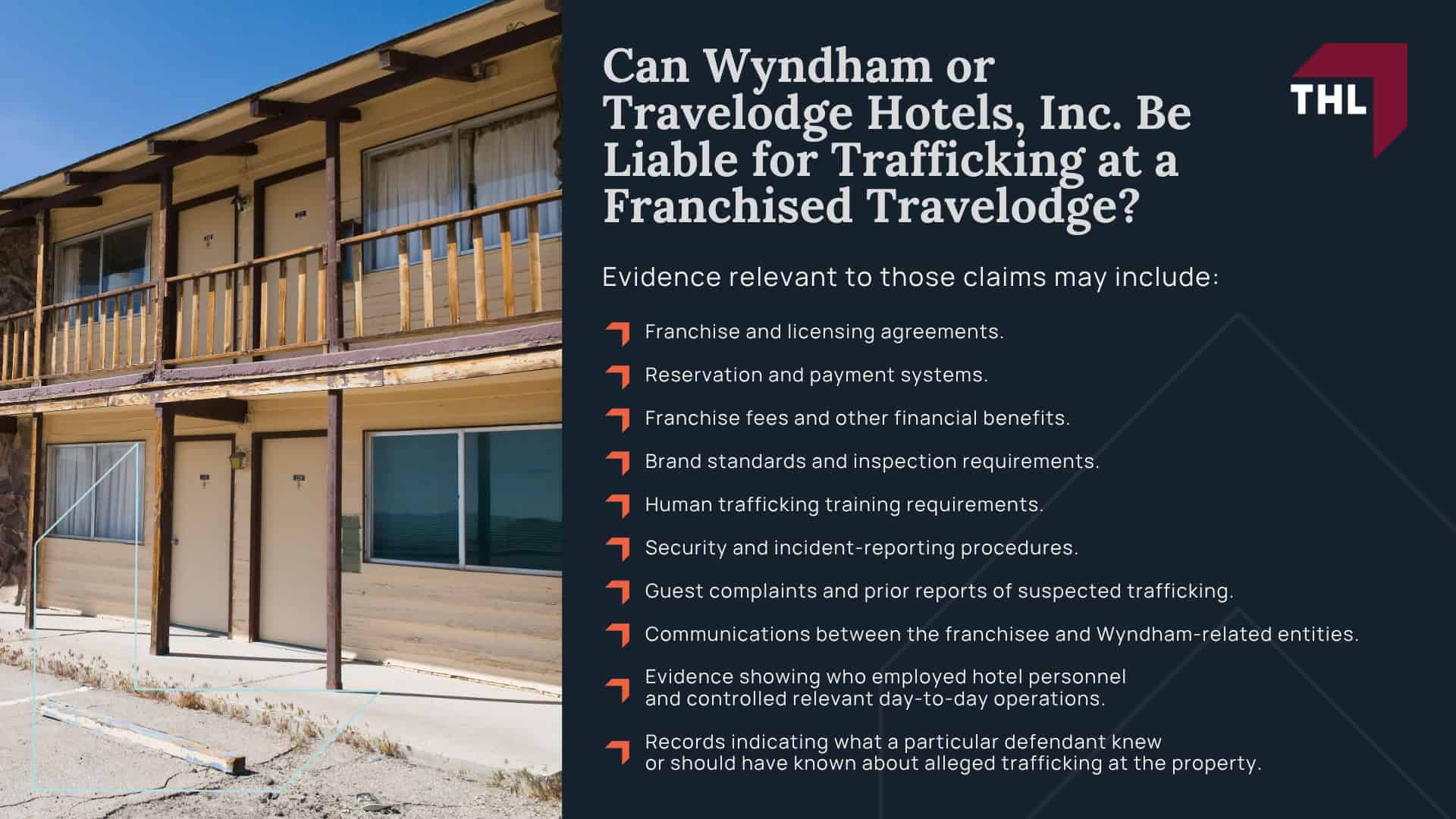
Evidence relevant to those claims may include:
Courts have allowed some Travelodge-related claims against Wyndham and Travelodge Hotels, Inc. to proceed when the allegations were sufficiently detailed; for example, the Southern District of Ohio denied their motion to dismiss in G.P. v. Wyndham Hotels & Resorts, which involved two Cincinnati Travelodge properties and a Super 8.
That ruling did not establish liability, however, and a franchise relationship, collection of franchise fees, or general knowledge that trafficking can occur in hotels and motels does not by itself prove participation in a particular trafficking venture.
Evidence in hotel trafficking lawsuits may help establish when trafficking victims were present at a property, what occurred during the stay, and what hotel employees or other defendants allegedly observed.
Relevant records may also help document whether the allegations involve sex trafficking, forced labor, or another form of exploitation and whether the survivor experienced coercion, control, or other circumstances relevant to the claim.
Factors involving vulnerable populations, including minors or individuals facing language barriers, may provide context but do not independently prove that trafficking occurred.
Whether a hotel owner, operator, franchisor, or other defendant can be held responsible depends on evidence connecting that specific party to the alleged conduct and the legal requirements of the claim.

Relevant evidence may include:
Travelodge operates within the Wyndham Hotels & Resorts system, so current trafficking-prevention requirements for Travelodge properties largely come from Wyndham’s company-wide policies and franchise standards.
Hotels and motels have been identified by Polaris as one of the most common venues appearing in sex-trafficking reports, and hotel and motel staff can encounter information that may help identify potential exploitation.
Wyndham states that it has strengthened its policies, training, and reporting resources to help employees and franchisees recognize red flags and combat trafficking across its hotel system.
Wyndham has partnered with Businesses Ending Slavery and Trafficking (BEST) since 2019 to provide human trafficking prevention and awareness training.
Under Wyndham’s current brand standards, general managers at franchised hotels must complete assigned human trafficking training and certify that their hotel staff have received training on the same topics at least every two years.
Wyndham corporate team members are required to complete human trafficking training annually.

Wyndham’s current trafficking-prevention measures include:
Wyndham reported approximately 86,000 training impressions in 2024 among corporate team members, managed-hotel employees, and employees of independently owned franchisees, although that figure covered several human-rights training topics.
Proper training can give hotel employees additional information about recognizing patterns of exploitation and following established reporting procedures, but the existence of a current training program does not establish what employees at a particular Travelodge knew during an earlier alleged trafficking period.
Several Travelodge lawsuits involve conduct alleged to have occurred years before Wyndham’s current requirements, so the training, policies, reports, and resources actually in place at the specific hotel during the relevant period may be more significant to a civil claim.
A survivor may have grounds to pursue a civil claim if sex trafficking, child sex trafficking, forced labor, or another form of trafficking occurred at a Travelodge property.
Eligibility depends on the specific hotel, when the exploitation occurred, the survivor’s age, the available evidence, and the conduct attributed to the owners, operators, franchisees, or Wyndham-related entities connected to the property.
The Trafficking Victims Protection Act may provide a basis for legal action when the facts satisfy the requirements of federal law.
Some cases involving exploited women allege that traffickers used the same hotel repeatedly while employees encountered circumstances plaintiffs contend were warning signs of ongoing exploitation.

Survivors do not need to know who owned the Travelodge or how the Wyndham franchise relationship was structured before speaking with an attorney.
They also do not need to possess reservation records, internal communications, franchise agreements, or employee files before requesting a case review.
Additional evidence may be obtained through investigation, public records, subpoenas, or civil discovery after a lawsuit is filed.
An attorney can evaluate the property, potential defendants, applicable filing deadlines, and available federal or state claims to determine whether the evidence may support a lawsuit.
TorHoerman Law is reviewing potential human trafficking claims involving survivors who allege that they were trafficked at Travelodge properties.
Our attorneys can investigate the specific hotel, identify the companies that owned, operated, managed, or franchised the property during the relevant period, and evaluate the role of Travelodge Hotels, Inc., Wyndham-related entities, and local operators.
A case review may include reservation and Wyndham Rewards records, payment information, surveillance footage, police reports, witness statements, employee communications, online advertisements, and medical or counseling records.
We can also examine franchise agreements, training materials, prior complaints, security records, inspection documents, and other evidence that may show what individual defendants knew or controlled.

Because Travelodge properties are commonly operated through franchise arrangements, the potential responsibility of each owner, operator, franchisor, or corporate entity must be evaluated separately.
Survivors do not need to know the complete ownership structure of the hotel or possess every relevant document before contacting our firm.
If you or someone you care about experienced trafficking at a Travelodge property, contact TorHoerman Law or use the chat feature on this page for a free and confidential consultation about the legal options that may be available.


