Chicago
Case Types We Handle
Personal Injuries
Car Accidents
Truck Accidents
Motorcycle Accidents
Bicycle Accidents
Construction Accidents
Nursing Home Abuse
Wrongful Death
Slip and Fall Accidents
Daycare Injury & Abuse
Edwardsville
Case Types We Handle
Personal Injuries
Car Accidents
Truck Accidents
Motorcycle Accidents
Bicycle Accidents
Nursing Home Abuse
Wrongful Death
Slip and Fall Accidents
Daycare Injury & Abuse
Premises Liability
St. Louis
Case Types We Handle
Personal Injuries
Car Accidents
Truck Accidents
Motorcycle Accidents
Bicycle Accidents
Construction Accidents
Nursing Home Abuse
Wrongful Death
Slip and Fall Accidents
Daycare Injury & Abuse
Dangerous Drugs
Defective Products
Chemical Exposure

Motel 6 Human Trafficking Lawsuit

4.9
Google
•
677 reviews

Survivors Are Filing Lawsuits Involving Motel 6 Properties and G6 Hospitality

Motel 6 human trafficking lawsuit claims allege that commercial sex trafficking and child sexual exploitation occurred at specific properties while hotel personnel failed to respond to repeated warning signs.

Human trafficking survivors have filed civil lawsuits naming local property owners, hotel operators, G6 Hospitality entities, and other corporate defendants whose conduct must be evaluated separately.

Under the Trafficking Victims Protection Act, survivors may have legal recourse when evidence connects a defendant’s financial benefit and participation to a trafficking venture the defendant knew or should have known involved unlawful conduct.

TorHoerman Law is reviewing potential claims involving Motel 6 properties and can explain the legal options that may be available.

Motel 6 Human Trafficking Lawsuit; Motel 6 Human Trafficking Lawsuit Overview; What Do Motel 6 Human Trafficking Lawsuits Allege; Who Can Be Named in a Motel 6 Trafficking Lawsuit; Recent Motel 6 Human Trafficking Lawsuits, Settlements, and Court Decisions; Who Owns Motel 6, and Why Does the Franchise Structure Matter (2); Evidence Used in Motel 6 Human Trafficking Lawsuits; Do You Qualify to File a Motel 6 Human Trafficking Lawsuit; TorHoerman Law_ Investigating Motel 6 Human Trafficking Claims

Motel 6 Human Trafficking Lawsuits Allege That Hotel Defendants Benefited From or Failed to Respond to Exploitation

Motel 6 human trafficking lawsuit claims allege that commercial sex trafficking and child sexual exploitation occurred at specific hotel properties while employees, owners, operators, or corporate defendants failed to respond to repeated warning signs.

Survivors have filed civil claims involving local franchisees, property-owning companies, Motel 6 operators, and G6 Hospitality entities, depending on who owned, managed, or controlled the location during the alleged trafficking activities.

Complaints involving Motel 6 properties have described traffickers using hotel rooms to arrange commercial sex acts, meet sex buyers, and maintain control over children and adults subjected to sexual exploitation.

Reported allegations include repeated cash payments, frequent male visitors entering one room, requests to prevent housekeeping access, minors arriving without identification, and guests showing injuries, fear, exhaustion, or other obvious signs of severe abuse.

Some lawsuits claim hotel employees ignored suspicious activity or failed to notify management or local law enforcement.

Other complaints allege that individual hotel staff members provided more direct assistance, such as warning traffickers about police activity, allowing unregistered guests to enter rooms, or acting as lookouts.

Each allegation depends on the conduct attributed to the defendants involved and must be proven through evidence.

Federal law does not impose liability merely because trafficking occurred on hotel premises.

Under the Trafficking Victims Protection Act, a survivor may pursue a civil lawsuit against a party that knowingly benefited from participation in a trafficking venture the party knew or should have known involved unlawful conduct.

Courts examine whether the evidence connects a specific hotel owner, operator, employee, franchisee, or corporate defendant to the alleged venture.

The existence of a Motel 6 sign or franchise agreement alone does not establish liability against G6 Hospitality or another national entity.

Human trafficking survivors may seek compensation for physical injuries, psychological trauma, medical treatment, lost income, and other severe harm connected to the alleged exploitation.

TorHoerman Law is reviewing potential claims involving trafficking at Motel 6 properties.

Survivors and their families can contact THL for a free and confidential consultation to discuss the circumstances and the legal options that may be available.

Motel 6 Human Trafficking Lawsuit Overview

Motel 6 human trafficking cases consist of separate federal lawsuits and state civil actions involving different survivors, hotel properties, and alleged trafficking ventures.

The lawsuit claims commonly arise under the Trafficking Victims Protection Reauthorization Act, which permits survivors to pursue parties that knowingly benefited from participation in a trafficking venture they knew or should have known involved unlawful conduct.

Some complaints also assert state-law theories involving corporate negligence, premises liability, or vicarious liability for the conduct of hotel employees.

Motel 6 locations may be operated as franchised hotels, which means the property owner, hotel operator, and national brand may be separate entities.

A defendant is not automatically held liable because trafficking allegedly occurred at a Motel 6 hotel property.
Motel 6 Human Trafficking Lawsuit Overview

Courts examine the legal duties, knowledge, financial benefit, operational control, and alleged conduct attributed to each defendant.

Rulings in Motel 6 and G6 Hospitality litigation have varied, with some claims proceeding and others dismissed for insufficient defendant-specific allegations.

Current and resolved cases continue to shape how courts apply federal trafficking law to hotel operators, franchisees, and national hospitality companies.

What Do Motel 6 Human Trafficking Lawsuits Allege?

Motel 6 human sex trafficking lawsuits generally allege that trafficking occurred repeatedly at specific properties while warning signs were visible to hotel personnel.

Some complaints involving child sex trafficking claim that employees, managers, owners, or other defendants had actual or constructive knowledge of the conduct but failed to intervene or report it.

Similar allegations have appeared in broader lawsuits involving major hotel chains and other hotel and motel chains, although the facts and defendants differ from case to case.
Motel 6 Human Trafficking Lawsuit Overview; What Do Motel 6 Human Trafficking Lawsuits Allege

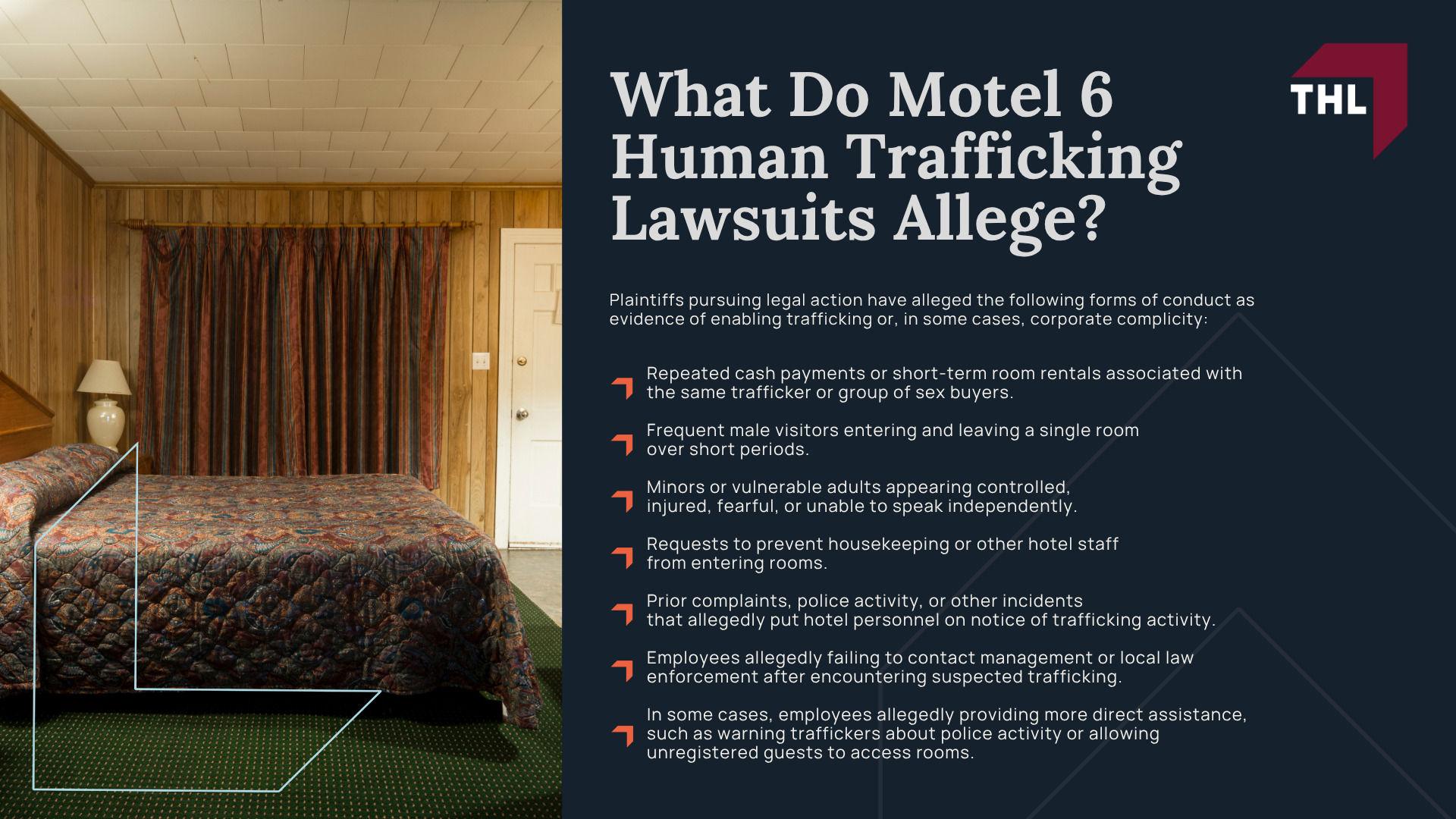
Plaintiffs pursuing legal action have alleged the following forms of conduct as evidence of enabling trafficking or, in some cases, corporate complicity:

  • Repeated cash payments or short-term room rentals associated with the same trafficker or group of sex buyers.
  • Frequent male visitors entering and leaving a single room over short periods.
  • Minors or vulnerable adults appearing controlled, injured, fearful, or unable to speak independently.
  • Requests to prevent housekeeping or other hotel staff from entering rooms.
  • Prior complaints, police activity, or other incidents that allegedly put hotel personnel on notice of trafficking activity.
  • Employees allegedly failing to contact management or local law enforcement after encountering suspected trafficking.
  • In some cases, employees allegedly providing more direct assistance, such as warning traffickers about police activity or allowing unregistered guests to access rooms.

Each allegation must be evaluated against the evidence involving the specific property and defendant, and inclusion in a complaint does not establish liability.

Who Can Be Named in a Motel 6 Trafficking Lawsuit?

A Motel 6 trafficking lawsuit may name the local property owner, hotel operator, franchisee, management company, G6 Hospitality entity, or individual employees, depending on the facts of the case.

The hospitality industry commonly uses franchise structures in which the national brand and the company operating a specific property are separate legal entities.
Motel 6 Human Trafficking Lawsuit Overview; What Do Motel 6 Human Trafficking Lawsuits Allege; Who Can Be Named in a Motel 6 Trafficking Lawsuit

Courts examine each defendant’s role, operational control, financial benefit, knowledge, and response to suspected trafficking.

Claims may also consider whether managers or hotel staff followed internal procedures to report trafficking activities or escalate concerns to local law enforcement.

Naming a company or employee in a complaint does not establish liability, and the claims against each defendant must be supported by defendant-specific evidence.
Recent Motel 6 Human Trafficking Lawsuits, Settlements, and Court Decisions

Motel 6 and G6 Hospitality continue to appear in human trafficking litigation involving new lawsuits, motions to dismiss, discovery disputes, and settlements in courts across the United States. Recent cases form part of broader litigation against hotel companies, but courts evaluate the alleged conduct of each franchisor, owner, operator, and property separately.

Plaintiffs have alleged that certain Motel 6 properties were used to facilitate sexual services and other sex trafficking activities while employees encountered signs of exploitation or continued providing rooms to alleged traffickers.

Federal court decisions show that trafficking at a hotel does not, by itself, establish civil liability against the national brand or other corporate defendants.

Although federal anti-trafficking law also addresses forced labor, the recent Motel 6 cases discussed below primarily involve allegations of commercial sex trafficking and child sex trafficking.

Human trafficking is a heinous crime, but allegations against members of the hotel industry must still be established through evidence against the defendants named in each case.

Recent developments include lawsuits filed in 2026 and a February 2025 complaint alleging that a survivor was trafficked at eight hotels across Los Angeles and Texas while she was a minor.

Motel 6 Human Trafficking Lawsuit Overview; What Do Motel 6 Human Trafficking Lawsuits Allege; Who Can Be Named in a Motel 6 Trafficking Lawsuit; Recent Motel 6 Human Trafficking Lawsuits, Settlements, and Court Decisions

Recent Motel 6 human trafficking lawsuit developments include:

  • March 20, 2026, SeaTac, Washington: A federal lawsuit was filed against G6 Hospitality entities, Motel 6 Operating L.P., SeaTac Hotels LLC, and other defendants over alleged sex trafficking at Motel 6 properties in King County. The complaint alleges that the defendants allowed, facilitated, profited from, or concealed trafficking involving a minor. The filing represents allegations, and no final determination of liability has been made.
  • February 11, 2026, SeaTac, Washington: A separate survivor filed a lawsuit in the U.S. District Court for the Western District of Washington naming G6 Hospitality LLC, several related G6 entities, Motel 6 Operating L.P., and SeaTac Hotels LLC. The case invokes the civil remedy under 18 U.S.C. § 1595 and remained pending in 2026.
  • February 10, 2026, Fort Worth, Texas: A federal court dismissed TVPRA claims against G6 Hospitality Franchising LLC and other hotel defendants with prejudice. The court concluded that the complaint did not adequately plead the defendants’ participation in the relevant trafficking venture and required knowledge, demonstrating the defendant-specific showing necessary in hotel trafficking cases.
  • August 2025, Maple Shade, New Jersey: A woman identified as Jane Doe filed federal litigation alleging that she was trafficked as a 17-year-old at a Motel 6 in Maple Shade and a Red Roof Inn in Mount Laurel between 2014 and 2015. She alleged that hotel personnel witnessed signs of physical and sexual abuse while her trafficker arranged commercial sex with multiple buyers. Motel 6 responded that the property was independently operated and cited the company’s anti-trafficking policies.
  • March 13, 2025, Philadelphia, Pennsylvania: The owners of a Motel 6, Days Inn, and North American Motor Inn agreed to a combined $17.5 million settlement with three women who alleged that they were trafficked at the properties as minors between 2015 and 2017. The public settlement reporting does not allocate the $17.5 million among the three hotels, so the full amount should not be characterized as a payment by Motel 6 or G6 Hospitality.
  • February 4, 2025, California and Texas: Jane AB Doe filed a lawsuit against G6 Hospitality, Wyndham Hotel Group, Red Roof Inn, and related defendants alleging that she was subjected to child sex trafficking beginning at age 13. The complaint alleges that she was raped nearly 1,000 times at eight hotels across Los Angeles and Texas between 2012 and 2014, including Motel 6 properties in Los Angeles and Gardena, and that some hotel employees knew of or participated in the alleged conduct.

The cases have produced different results, including settlements, dismissals, pending federal litigation, and rulings allowing particular claims to continue.

No individual development establishes liability across Motel 6 properties generally, and settlement agreements do not necessarily constitute admissions of wrongdoing.

The litigation instead shows how courts are examining property-level conduct, franchise relationships, employee knowledge, and the connection between specific hotel defendants and alleged trafficking ventures.

Who Owns Motel 6, and Why Does the Franchise Structure Matter?

Motel 6 is part of G6 Hospitality, the parent company and franchisor associated with the Motel 6 and Studio 6 brands.

In December 2024, Oravel Stays, the parent company of OYO, completed its $525 million acquisition of G6 Hospitality from Blackstone Real Estate.

Motel 6 and Studio 6 operate through a combination of company-owned and franchised locations across the United States and Canada.

That franchise structure is relevant in human trafficking litigation because the company displaying the Motel 6 brand may be different from the entity that owns the real estate, employs hotel staff, or manages day-to-day operations at a specific property.

Motel 6 Human Trafficking Lawsuit Overview; What Do Motel 6 Human Trafficking Lawsuits Allege; Who Can Be Named in a Motel 6 Trafficking Lawsuit; Recent Motel 6 Human Trafficking Lawsuits, Settlements, and Court Decisions; Who Owns Motel 6, and Why Does the Franchise Structure Matter (2)

Courts may therefore examine franchise agreements, operational control, employee relationships, brand standards, and the conduct attributed to each defendant before determining whether G6 Hospitality, a local franchisee, a property owner, or another entity may be held liable.

The presence of the Motel 6 name alone does not establish that G6 Hospitality owned or operated the property involved in a particular trafficking lawsuit.

Evidence Used in Motel 6 Human Trafficking Lawsuits

Evidence can help establish what occurred at a specific Motel 6 property, what hotel personnel knew, and whether a defendant can be connected to the alleged trafficking venture.

Federal court records in G6 Hospitality litigation show that discovery has included reservation data, customer information, police reports, internal reports, and records concerning prostitution or commercial sex at company-owned Motel 6 properties.

Other G6 cases have examined housekeeping, payment, occupancy, safety, and training records as potentially relevant to a defendant’s knowledge or participation.

Motel 6 Human Trafficking Lawsuit Overview; What Do Motel 6 Human Trafficking Lawsuits Allege; Who Can Be Named in a Motel 6 Trafficking Lawsuit; Recent Motel 6 Human Trafficking Lawsuits, Settlements, and Court Decisions; Who Owns Motel 6, and Why Does the Franchise Structure Matter (2); Evidence Used in Motel 6 Human Trafficking Lawsuits

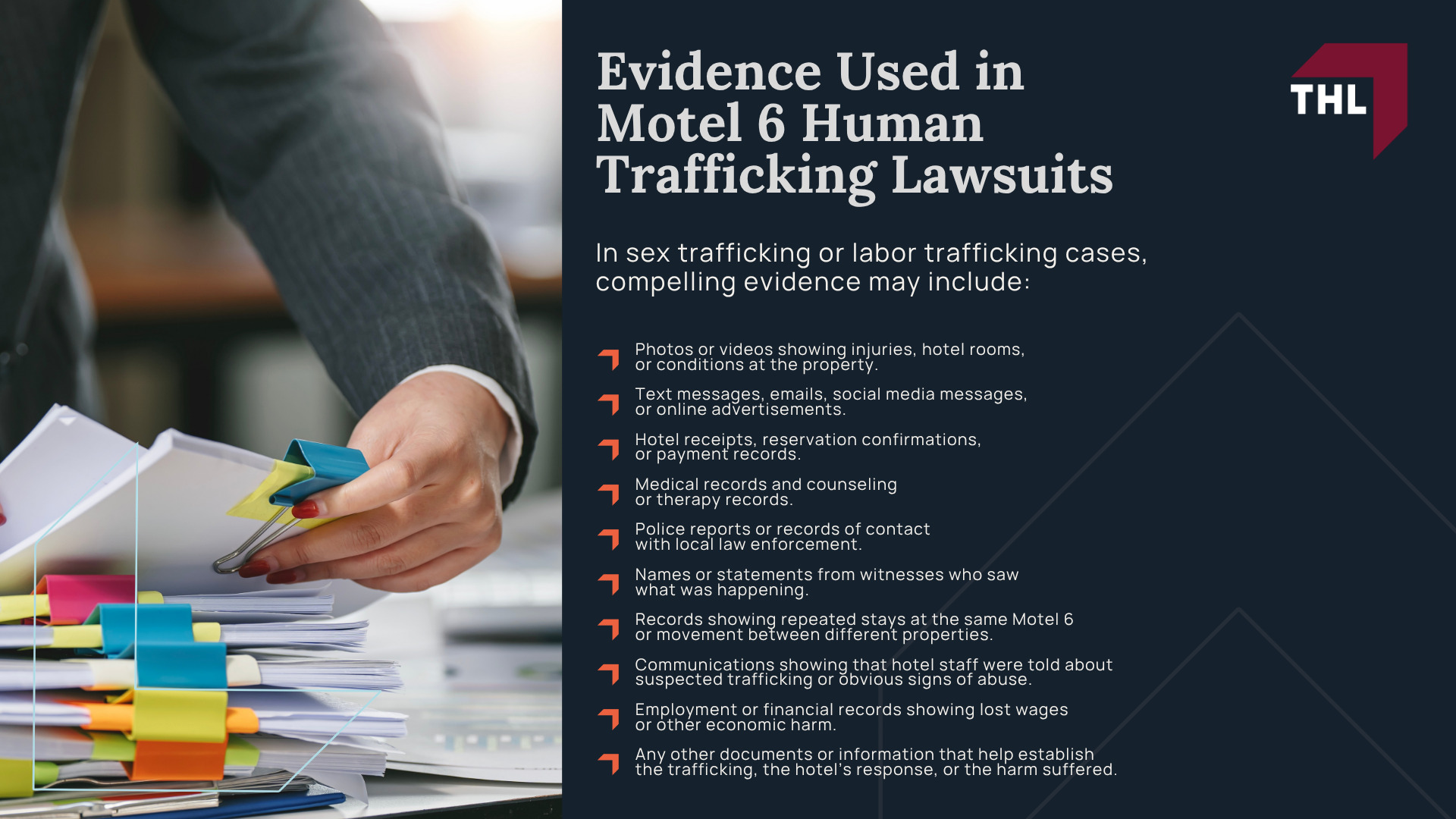
In sex trafficking or labor trafficking cases, compelling evidence may include:

  • Photos or videos showing injuries, hotel rooms, or conditions at the property.
  • Text messages, emails, social media messages, or online advertisements.
  • Hotel receipts, reservation confirmations, or payment records.
  • Medical records and counseling or therapy records.
  • Police reports or records of contact with local law enforcement.
  • Names or statements from witnesses who saw what was happening.
  • Records showing repeated stays at the same Motel 6 or movement between different properties.
  • Communications showing that hotel staff were told about suspected trafficking or obvious signs of abuse.
  • Employment or financial records showing lost wages or other economic harm.
  • Any other documents or information that help establish the trafficking, the hotel’s response, or the harm suffered.

No single record necessarily proves that a hotel defendant participated in trafficking or possessed the knowledge required for liability.

Courts evaluate the available evidence collectively to determine whether the facts support the survivor’s claims against each owner, operator, franchisee, employee, or corporate defendant.

What Warning Signs May Be Relevant?

Warning signs can help show whether hotel employees encountered circumstances consistent with ongoing trafficking operations.

In cases involving the sex industry, plaintiffs may point to repeated patterns of guest activity, room use, payments, and interactions between suspected traffickers and victims.

No single warning sign proves that human trafficking occurred, and the significance of each indicator depends on the surrounding facts.

Warning signs that may become relevant in a Motel 6 trafficking lawsuit include:

  • Frequent male visitors entering and leaving the same room over short periods.
  • Repeated cash payments or short-term room extensions.
  • A guest appearing fearful, injured, exhausted, malnourished, or controlled by another person.
  • Minors staying with unrelated adults or arriving without identification.
  • One person speaking for another guest or controlling their money, identification, transportation, or movements.
  • Requests to keep housekeeping or other hotel staff out of a room for extended periods.
  • Large quantities of condoms, condom wrappers, or other indicators of repeated commercial sex activity.
  • Repeated police visits, guest complaints, or reports of suspicious activity involving the same room or individuals.
  • Hotel employees allegedly observing trafficking indicators without reporting the activity to management or local law enforcement.

Motel 6 Human Trafficking Policies and Staff Training

G6 Hospitality, the parent company associated with Motel 6 and Studio 6, states that it condemns human trafficking and maintains training and reporting procedures intended to help employees recognize and respond to suspected exploitation.

G6 requires trafficking-awareness training for team members at owned and franchised locations and has developed its “Room Next Door” program to address warning signs and response procedures within hotel settings.

Motel 6 also states that employees from general managers through housekeeping staff are instructed to alert property management, local police, and the G6 hotline when they observe suspected human trafficking or prostitution.

G6 has participated in the AHLA Foundation’s No Room for Trafficking initiative and has supported survivor-focused programs and industry-wide prevention efforts.

The company also reports partnerships with organizations focused on child exploitation, survivor services, and trafficking prevention, including PACT and Polaris.

Published policies and training requirements do not establish how employees responded at a particular Motel 6 property, and lawsuits may examine whether those procedures were followed in practice.

Do You Qualify to File a Motel 6 Human Trafficking Lawsuit?

You may qualify to file a Motel 6 human trafficking lawsuit if you were subjected to sex trafficking, child sexual exploitation, forced labor, or related crimes at a Motel 6 property.

Eligibility depends on the specific facts of the case, including what occurred at the hotel, who owned or operated the property, and what hotel employees or management knew.

Relevant evidence may include repeated warning signs, reports to staff, prior police activity, room-rental records, or allegations that employees assisted or protected a trafficker.

Survivors may seek compensation for physical injuries, medical treatment, lost income, psychological abuse, and other harm caused by the trafficking.

Claims may also involve long-term conditions such as PTSD when supported by medical or counseling records.

Motel 6 Human Trafficking Lawsuit Overview; What Do Motel 6 Human Trafficking Lawsuits Allege; Who Can Be Named in a Motel 6 Trafficking Lawsuit; Recent Motel 6 Human Trafficking Lawsuits, Settlements, and Court Decisions; Who Owns Motel 6, and Why Does the Franchise Structure Matter (2); Evidence Used in Motel 6 Human Trafficking Lawsuits; Do You Qualify to File a Motel 6 Human Trafficking Lawsuit

A national brand, local franchisee, property owner, operator, or individual employee may be named depending on the conduct attributed to each defendant.

The fact that trafficking occurred at a Motel 6 does not automatically establish liability, and each claim must satisfy the requirements of applicable federal or state law.

TorHoerman Law can review the circumstances and explain whether a potential Motel 6 trafficking claim may warrant further legal action.

TorHoerman Law: Investigating Motel 6 Human Trafficking Claims

TorHoerman Law is reviewing potential claims involving survivors who experienced sex trafficking, child sexual exploitation, forced labor, or related abuse at Motel 6 properties.

A case review may examine the property involved, the identity of the owner or operator, the conduct of hotel employees, reported warning signs, prior complaints, and other evidence connecting a defendant to the alleged trafficking venture.

THL can also evaluate the physical, psychological, and financial harm caused by the trafficking and determine which federal or state claims may apply.

Motel 6 Human Trafficking Lawsuit Overview; What Do Motel 6 Human Trafficking Lawsuits Allege; Who Can Be Named in a Motel 6 Trafficking Lawsuit; Recent Motel 6 Human Trafficking Lawsuits, Settlements, and Court Decisions; Who Owns Motel 6, and Why Does the Franchise Structure Matter (2); Evidence Used in Motel 6 Human Trafficking Lawsuits; Do You Qualify to File a Motel 6 Human Trafficking Lawsuit; TorHoerman Law_ Investigating Motel 6 Human Trafficking Claims

Speaking with a lawyer does not require you to file a lawsuit, and consultations with TorHoerman Law are free and confidential.

If you or someone you care about experienced human trafficking at a Motel 6, contact TorHoerman Law to discuss the circumstances and the legal options that may be available.

Frequently Asked Questions

Published by:
Share
Picture of Tor Hoerman
Tor Hoerman

Tor Hoerman has represented injured individuals for more than 30 years, with experience spanning individual personal injury cases and nationwide mass tort litigation. His work includes car accidents, catastrophic injuries, product liability claims, and other serious injury cases. Tor has served in court-appointed leadership roles in national litigation and tried cases involving major corporate defendants.

TorHoerman Law’s legal content is researched and written by our editorial team and attorneys for legal accuracy, clarity, and relevance. We rely on statutes, court records, government publications, medical research, and other authoritative sources when applicable. This page provides general legal information and does not constitute legal advice.

TorHoerman Law reviews its legal content for factual accuracy, current information, and relevant legal context before publication and as material developments occur. This article is provided for general informational purposes and does not constitute legal advice. For guidance about a specific case, contact TorHoerman Law.

Additional Hotel Human Trafficking Lawsuit resources on our website:
All
FAQs
Injuries & Conditions
Legal Help
Other Resources
Settlements & Compensation
News

You can learn more about this topic by visiting any of our Hotel Human Trafficking Lawsuit pages listed below:

Best Western Human Trafficking Lawsuit
Days Inn Human Trafficking Lawsuit
Extended Stay America Human Trafficking Lawsuit
Hilton Human Trafficking Lawsuit
Holiday Inn Human Trafficking Lawsuit
Hotel Human Trafficking Lawsuit
Lawsuit Against Hotels for Human Trafficking: Who Qualifies?
Marriott Human Trafficking Lawsuit
Quality Inn Human Trafficking Lawsuit
Red Roof Inn Human Trafficking Lawsuit
Super 8 Hotel Human Trafficking Lawsuit
Travelodge Human Trafficking Lawsuit
Accepting Clients
Hotel Human Trafficking Lawsuit Facts
Defendants
  • Wyndham Hotels & Resorts
  • Choice Hotels
  • IHG / Holiday Inn
  • Red Roof Inn
  • Motel 6 / G6 Hospitality
  • Extended Stay America
  • Marriott
  • Hilton
  • Other hotel owners, operators, and franchisees
    Injuries named in lawsuit
    • Sexual assault and rape
    • Forced commercial sexual activity
    • Physical abuse and injuries
    • Post-traumatic stress disorder (PTSD)
    • Anxiety and depression
    • Emotional and psychological trauma
    • Financial exploitation
    • Long-term effects of sexual abuse and trafficking
      You may qualify to file a claim if...
      • You were subjected to sex trafficking, forced sexual activity, or sexual exploitation at a hotel or motel.
      • Hotel employees, owners, operators, or other hotel-related parties encountered circumstances that may have indicated trafficking was occurring, such as repeated visitors, visible abuse, frequent room activity, unusual payment patterns, or efforts to prevent housekeeping from entering.
      • The available evidence may show that a hotel-related defendant benefited from the activity and knew or should have known about the trafficking, or that employees otherwise assisted or failed to respond to circumstances indicating exploitation.
      Have you or a loved one been injured?

      A serious injury can change your life.

      Speak with an experienced personal injury lawyer about your rights, your case, and the legal options available to you.
      Google
      •
      677 reviews
      4.9
      ★★★★★
      Recovered damages
      $4 Billion+

      Table of Contents

      Guides & Resources
      About TorHoerman Law

      TorHoerman Law represents people whose lives have been disrupted by serious injuries, unsafe products, and negligence. Our attorneys handle individual personal injury cases as well as national mass tort lawsuits involving major corporations.

      Founded in 2009, our legal team brings more than 100 years of combined experience handling serious injury and complex civil litigation.

      Do you believe you’re entitled to compensation?

      Use our Instant Case Evaluator to find out in as little as 60 seconds!

      $495 Million
      Baby Formula NEC Lawsuit

      In this case, we obtained a verdict of $495 Million for our client’s child who was diagnosed with Necrotizing Enterocolitis after consuming baby formula manufactured by Abbott Laboratories.

      $20 Million
      Toxic Tort Injury

      In this case, we were able to successfully recover $20 Million for our client after they suffered a Toxic Tort Injury due to chemical exposure.

      $103.8 Million
      COX-2 Inhibitors Injury

      In this case, we were able to successfully recover $103.8 Million for our client after they suffered a COX-2 Inhibitors Injury.

      $4 Million
      Traumatic Brain Injury

      In this case, we were able to successfully recover $4 Million for our client after they suffered a Traumatic Brain Injury while at daycare.

      $2.8 Million
      Defective Heart Device

      In this case, we were able to successfully recover $2.8 Million for our client after they suffered an injury due to a Defective Heart Device.

      Other Hotel Human Trafficking Lawsuit Resources

      All
      FAQs
      Injuries & Conditions
      Legal Help
      Other Resources
      Settlements & Compensation
      News