Chicago
Case Types We Handle
Personal Injuries
Car Accidents
Truck Accidents
Motorcycle Accidents
Bicycle Accidents
Construction Accidents
Nursing Home Abuse
Wrongful Death
Slip and Fall Accidents
Daycare Injury & Abuse
Edwardsville
Case Types We Handle
Personal Injuries
Car Accidents
Truck Accidents
Motorcycle Accidents
Bicycle Accidents
Nursing Home Abuse
Wrongful Death
Slip and Fall Accidents
Daycare Injury & Abuse
Premises Liability
St. Louis
Case Types We Handle
Personal Injuries
Car Accidents
Truck Accidents
Motorcycle Accidents
Bicycle Accidents
Construction Accidents
Nursing Home Abuse
Wrongful Death
Slip and Fall Accidents
Daycare Injury & Abuse
Dangerous Drugs
Defective Products
Chemical Exposure

Hilton Human Trafficking Lawsuit

4.9
Google
677 reviews

Hilton Human Trafficking Lawsuit Overview

Hilton human trafficking lawsuit claims allege that survivors were trafficked at certain Hilton-branded properties while hotel employees, owners, operators, franchisees, or other defendants encountered warning signs or otherwise failed to respond to alleged trafficking activity.

Survivors who allege that they were trafficked at Hilton-branded properties may have legal recourse against hotel owners, operators, franchisees, management companies, or Hilton-related entities if the evidence supports a civil claim.

Hilton human trafficking lawsuits have involved brands such as DoubleTree, Hampton Inn, and Hilton Garden Inn, with courts reaching different results based on the conduct and evidence connected to each defendant.

This page explains the major Hilton trafficking cases, the companies involved, Hilton’s ownership and franchise structure, the evidence courts may consider, and the legal options that may be available.

The information is intended for survivors and families trying to understand whether trafficking at a specific Hilton-branded property may support a lawsuit.

TorHoerman Law is reviewing potential claims involving Hilton-branded hotels and can explain the legal options that may be available.

Hilton Human Trafficking Lawsuit; Hilton Human Trafficking Lawsuit Overview; Who Owns Hilton; Can Hilton Be Liable for Trafficking at a Franchised Hilton Hotel; What Evidence May Be Relevant in Lawsuits Involving Hotel Human Trafficking; Hilton Human Trafficking Policies and Training; Do You Qualify to File a Human Trafficking Lawsuit Involving a Hilton-Branded Property; TorHoerman Law_ Investigating Claims Involving Hilton-Branded Hotels

What Do Human Trafficking Lawsuits Involving Hilton-Branded Hotels Allege?

Hilton human trafficking lawsuit claims allege that sexual exploitation occurred in hotel rooms at certain Hilton-branded properties while employees, owners, operators, franchisees, or other defendants encountered circumstances plaintiffs contend were warning signs of trafficking.

Human trafficking cases involving DoubleTree, Hampton Inn, and Hilton Garden Inn properties have described repeated room rentals, frequent visitors, cash or prepaid-card payments, restrictions on housekeeping, visible injuries, and other alleged indicators involving potential victims.

Some complaints also allege that hotel personnel interacted with traffickers or failed to report suspicious activity.

Federal law does not impose liability simply because trafficking allegedly occurred at a Hilton-branded hotel.

Courts evaluating civil claims may examine what a particular defendant knew or should have known, whether it financially benefited from participation in a trafficking venture, and how ownership, management, or franchise relationships affected control over the property.

Because much of the hospitality industry operates through franchised and independently owned hotels, the presence of a Hilton name alone does not establish liability against a national Hilton entity.

Claims may involve sex trafficking, child sexual exploitation, or labor trafficking depending on the circumstances.

Survivors may seek compensation for legally recoverable physical, psychological, and financial harm when the evidence supports a civil claim.

TorHoerman Law is reviewing potential claims involving trafficking at Hilton-branded hotels.

If you or someone you care about experienced sex trafficking, child sexual exploitation, or labor trafficking at a Hilton property, contact TorHoerman Law or use the chat feature on this page for a free and confidential consultation about the legal options that may be available.

Hilton Human Trafficking Lawsuit Overview

Hilton human trafficking lawsuits are part of broader litigation involving major hotel chains and allegations that trafficking occurred at specific branded properties.

Cases involving DoubleTree, Hampton Inn, Hampton Inn & Suites, and Hilton Garden Inn hotels have named local owners, operators, franchisees, management companies, and Hilton-related corporate entities.

Sex trafficking victims may pursue legal action when the evidence supports claims against a defendant connected to the alleged trafficking venture.

Courts have reached different results depending on the property, defendant, allegations, and stage of the case.

Hilton Human Trafficking Lawsuit Overview

Some claims against Hilton-related entities have survived motions to dismiss, while other defendants have obtained dismissal or summary judgment when the evidence was insufficient to support liability.

Alleged red flags involving hotel staff members, repeated room activity, visitor traffic, payments, or other circumstances may be relevant, but they do not by themselves establish that a hotel company should be held responsible.

Because many Hilton-branded properties are franchised hotels owned or operated by separate companies, each defendant’s role must be evaluated individually.

Recent Lawsuits and Court Decisions Involving Hilton-Branded Hotels

Federal human trafficking litigation involving Hilton-branded properties has produced substantially different results depending on the hotel, defendants, allegations, available evidence, and stage of the case.

Some survivors have been permitted to continue pursuing claims after motions to dismiss.

In another Hilton case, however, the defendants obtained summary judgment after discovery because the court concluded that the evidentiary record was insufficient to support liability.

Litigation has involved DoubleTree by Hilton, Hampton Inn and Hampton Inn & Suites, and Hilton Garden Inn properties, as well as local owners, franchise companies, management entities, Hilton Domestic Operating Company Inc., Hilton Franchise Holding LLC, and other defendants.

A ruling allowing a complaint to proceed does not establish that trafficking occurred as alleged or that a Hilton-related defendant is liable.

A summary-judgment ruling occurs later and examines whether the available evidence is sufficient for the claim to proceed toward trial.

Significant federal cases involving Hilton-branded hotels include:

  • November 21, 2025, Jane Doe (J.R.F.) v. Hilton Domestic Operating Company Inc: The plaintiff alleges that she was subjected to sex trafficking at the Hilton Garden Inn in Anchorage, Alaska, during a broader period of exploitation extending through at least December 31, 2014. The court granted a motion to dismiss filed by BRE Select Hotels Properties LLC and joined by Hilton Domestic Operating Company, concluding that the amended complaint did not sufficiently identify potentially timely conduct within the TVPRA’s 10-year filing period. The court granted the plaintiff leave to file a second amended complaint, so the ruling did not determine whether the alleged trafficking occurred or establish that Hilton or BRE Select were not liable on the merits.
  • November 18, 2025, J.R.L. v. Hilton Domestic Operating Company Inc.: The plaintiff alleges that she was subjected to sex trafficking involving a Hampton Inn & Suites in Boston between 2010 and 2014. The District of Massachusetts denied motions to dismiss filed by Hilton Domestic Operating Company and the local property company, allowing the TVPRA claims to continue at the pleading stage. The court did not determine that either defendant knew about or participated in the alleged trafficking.
  • September 4, 2025, K.R.D. v. Hilton Worldwide Holdings Inc.: The plaintiff alleges that she was subjected to sex trafficking at the DoubleTree by Hilton Hotel San José for more than a year. The Northern District of California denied motions to dismiss filed by Hilton Domestic Operating Company and local franchisee HLT San Jose LLC, concluding that the complaint sufficiently alleged TVPRA claims and an agency relationship at the pleading stage. The case subsequently proceeded into discovery, with the court issuing additional discovery orders in April and May 2026 concerning evidence sought by Hilton. No final determination of liability has been made.
  • August 11, 2025, S.A.S. v. Hilton Domestic Operating Company: The plaintiff alleged that she was trafficked at the DoubleTree Seattle Airport during a broader period of exploitation. After discovery, the court granted summary judgment to Hilton Domestic Operating Company and DoubleTree Management because the evidence did not sufficiently establish that the plaintiff’s trafficking occurred at the property during the relevant dates or otherwise connect her trafficking to those defendants. The court did not dispute that the plaintiff had experienced trafficking elsewhere. On November 14, 2025, the court denied the plaintiff’s motion to amend the summary-judgment order.
  • 2024-2025, S.C. v. Hilton Franchise Holding LLC: The plaintiff alleged that she was subjected to child sex trafficking at a Nevada Hampton Inn when she was 16 to 17 years old. The court denied Hilton Franchise Holding’s motion to dismiss in November 2024. In October 2025, the parties later stipulated to dismiss the claims against Hilton Franchise Holding and SSJV Hospitality without prejudice. The stipulation did not contain a finding of liability or state that Hilton admitted wrongdoing.

An earlier case, A.B. v. Hilton Worldwide Holdings Inc., is also frequently cited in hotel-trafficking litigation.

The plaintiff alleged that she was trafficked at several branded hotels, including a DoubleTree property in Portland, Oregon, and asserted TVPRA claims against Hilton and other hotel companies.

The District of Oregon dismissed the TVPRA claim against Hilton with leave to amend after concluding that the allegations did not sufficiently connect Hilton to the plaintiff’s particular trafficking venture.

The plaintiff later filed an amended complaint that proceeded against Wyndham, Marriott, and Red Lion rather than Hilton.

Pleading-stage decisions such as K.R.D. and J.R.L. determine whether allegations are sufficient to continue, while S.A.S. demonstrates what can happen when a court examines the actual evidentiary record after discovery.

Who Owns Hilton?

Hilton Worldwide Holdings Inc. is the publicly traded parent company of the Hilton enterprise.

Hilton’s corporate materials describe a structure in which Hilton Worldwide Holdings Inc. owns Hilton Worldwide Parent LLC, which in turn owns Hilton Domestic Operating Company Inc.

Hilton states that Hilton Worldwide Holdings itself has no independent operations and that Hilton Domestic Operating Company is the parent of Hilton’s operating subsidiaries.

Federal human trafficking lawsuits sometimes name multiple Hilton-related entities whose legal roles are not interchangeable.

Hilton also operates primarily through franchise and management arrangements rather than direct hotel ownership.

Hilton Human Trafficking Lawsuit Overview; Who Owns Hilton

At the end of 2025, Hilton reported 9,158 operating properties, including:

  • 8,239 franchised or licensed properties.
  • 873 managed properties.
  • 46 properties within Hilton’s ownership segment.

Approximately 90% of Hilton’s operating properties were therefore franchised or licensed.

Depending on the property, a separate company may own the real estate, hold the Hilton franchise agreement, employ hotel personnel, manage daily operations, collect room revenue, maintain security systems, or receive local incident reports.

Hilton states that approximately 328,000 workers at franchised properties are employed by franchise owners or their designees rather than Hilton itself.

Federal trafficking cases discussed on this page have involved several Hilton brands, including DoubleTree by Hilton, Hampton Inn and Hampton Inn & Suites, and Hilton Garden Inn.

Can Hilton Be Liable for Trafficking at a Franchised Hilton Hotel?

Potentially, but Hilton is not automatically liable when a trafficking situation is alleged at an independently owned Hilton-branded property.

Many hotels operate through franchise arrangements in which the local owner or operator, rather than Hilton itself, employs hotel or motel staff, manages daily operations, and controls the property.

A direct TVPRA claim against a Hilton-related corporate entity may require evidence that the company knowingly benefited from participation in a trafficking venture it knew or should have known violated federal law.

Separate agency or vicarious-liability theories may depend on evidence showing the degree of control Hilton allegedly exercised over the local operator or relevant hotel operations.

Hilton Human Trafficking Lawsuit Overview; Who Owns Hilton; Can Hilton Be Liable for Trafficking at a Franchised Hilton Hotel

Relevant evidence may include franchise or management agreements, reservation and property-management systems, brand standards, inspection rights, training requirements, reporting procedures, franchise fees, guest complaints, communications, and evidence concerning control over property-level personnel.

The presence of these ordinary franchise features does not by itself establish liability. Courts evaluate how the evidence relates to the specific defendant, property, trafficking allegations, and legal theory asserted.

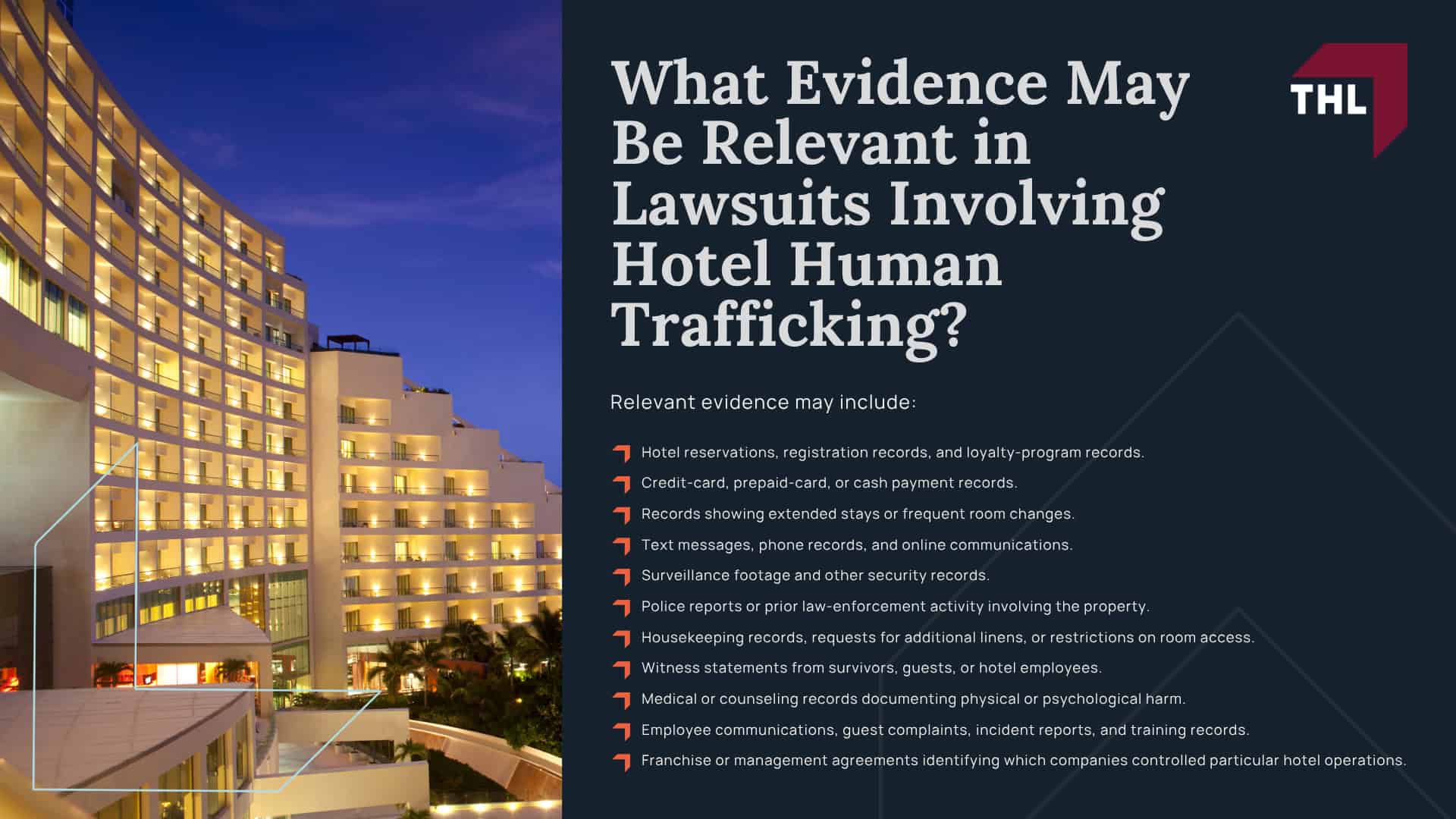
What Evidence May Be Relevant in Lawsuits Involving Hotel Human Trafficking?

Evidence can help document a survivor’s presence at a hotel, the alleged trafficking activity, interactions with hotel personnel, and what specific defendants may have known.

Because hotels and motels are common venues where trafficking can occur, relevant records often involve room activity, payments, communications, security, and staff observations.

Many survivors will not have access to every record themselves, and additional evidence may be obtained through investigation or civil discovery.

Hilton Human Trafficking Lawsuit Overview; Who Owns Hilton; Can Hilton Be Liable for Trafficking at a Franchised Hilton Hotel; What Evidence May Be Relevant in Lawsuits Involving Hotel Human Trafficking

Relevant evidence may include:

  • Hotel reservations, registration records, and loyalty-program records.
  • Credit-card, prepaid-card, or cash payment records.
  • Records showing extended stays or frequent room changes.
  • Text messages, phone records, and online communications.
  • Surveillance footage and other security records.
  • Police reports or prior law-enforcement activity involving the property.
  • Housekeeping records, requests for additional linens, or restrictions on room access.
  • Witness statements from survivors, guests, or hotel employees.
  • Medical or counseling records documenting physical or psychological harm.
  • Employee communications, guest complaints, incident reports, and training records.
  • Franchise or management agreements identifying which companies controlled particular hotel operations.

Complaints in hotel trafficking cases have also described circumstances such as frequent visitors, repeated room payments, limited personal possessions, visible injuries, and interactions between alleged traffickers and hotel personnel.

Such evidence may be relevant to claims involving exploited women, minors, or other survivors, but no individual warning sign proves trafficking or establishes that a hotel defendant knew exploitation was occurring.

The evidence must be evaluated in the context of the specific property, defendants, alleged trafficking period, and legal claims involved.

Hilton Human Trafficking Policies and Training

Hilton describes a combination of anti-trafficking policies, mandatory training, risk assessments, reporting systems, and industry partnerships intended to identify and reduce human trafficking risks across its operations.

Hilton’s Human Rights Principles prohibit its properties, products, and services from being used to support abuse or exploitation, and the company recognizes that hotels may be used by traffickers for sexual exploitation or activity involving commercial sex acts.

Hilton also addresses forced-labor risks involving hotel operations, recruitment, and supply chains as part of its broader human-rights program.

Hilton Human Trafficking Lawsuit Overview; Who Owns Hilton; Can Hilton Be Liable for Trafficking at a Franchised Hilton Hotel; What Evidence May Be Relevant in Lawsuits Involving Hotel Human Trafficking; Hilton Human Trafficking Policies and Training

Hilton’s current approach to addressing trafficking includes:

  • Mandatory training: Hilton requires all hotel-based Hilton Team Members globally to complete its Preventing Human Trafficking training program within 90 days of hiring and annually thereafter. The course covers recognizing warning signs in hotel settings, responding appropriately, and using internal procedures to report trafficking activities. Hilton reported a 100% completion rate at managed properties and 90% at franchised properties in FY2025, representing an estimated 409,000 Team Members.
  • Updated survivor-informed training: In 2025, Hilton worked with Hyatt, IHG Hotels & Resorts, Protect All Children from Trafficking, and Unboxed Training & Technology to develop an enhanced training curriculum using live-action scenarios. Hilton hosts the course through Hilton University in 21 languages, while an industry version has been made available free to independent hotel owners, operators, and brands.
  • Reporting and escalation procedures: Hilton uses its internal Hilton Hotline and a crisis-communications application to allow suspected trafficking concerns to be escalated. Hilton states that reports concerning leased and managed properties are reviewed internally, while allegations involving franchised hotels are communicated to the applicable franchise owner along with information about contractual obligations, brand standards, and applicable law.
  • Risk monitoring and enhanced policies: Hilton’s Global Intelligence team uses social-media monitoring and commercial-ad information to identify possible trafficking situations. Properties are also assessed using human-rights risk indicators, and managed properties receive risk information intended to help them understand and respond to trafficking and modern-slavery concerns.
  • Awareness requirements: Hilton states that its managed hotels globally display trafficking and modern-slavery awareness information in Team Member areas.
  • Industry-wide prevention efforts: Hilton participates in the AHLA Foundation’s No Room for Trafficking initiative and works with other hospitality companies and anti-trafficking organizations on prevention and survivor support. AHLA Foundation reports that more than 2.6 million specialized anti-trafficking trainings have been completed by hotel-industry employees since 2020.

Hilton tracks human-trafficking prevention as part of its broader Travel with Purpose human-rights goals through 2030, including mandatory annual training, risk identification, due diligence, and collaboration with industry partners.

The company’s enhanced policies reflect a broader shift within the hospitality industry toward training hotel personnel to recognize suspicious circumstances and establishing procedures for reporting potential trafficking rather than relying only on a response after exploitation has been identified.

AHLA similarly recommends that hotels maintain training programs developed with recognized anti-trafficking organizations and report suspicious activity to appropriate authorities.

Hilton’s current policies do not establish what training, reporting systems, or anti-trafficking procedures existed at a particular Hilton-branded hotel during an earlier alleged trafficking period.

They also do not establish whether an employee recognized trafficking or whether a particular Hilton-related defendant had legally sufficient knowledge in an individual lawsuit.

Do You Qualify to File a Human Trafficking Lawsuit Involving a Hilton-Branded Property?

A survivor may have grounds to pursue a civil human trafficking claim if sex trafficking, child sexual exploitation, labor trafficking, or another form of trafficking occurred at a Hilton-branded property.

Eligibility depends on the specific hotel involved, the dates of the alleged trafficking, the survivor’s age, and the conduct attributed to the owners, operators, franchisees, managers, or Hilton-related entities connected to the property.

Survivors who were sexually assaulted, physically abused, threatened, or otherwise exploited may be able to seek damages for legally recoverable harm.

Relevant injuries can include physical injuries, medical expenses, lost income, and mental health issues such as anxiety, depression, post-traumatic stress, or sleep disorders.

Several notable cases involving Hilton-branded hotels show that courts closely examine what particular defendants allegedly knew, how they benefited, and whether the evidence connects them to the trafficking venture.

Hilton Human Trafficking Lawsuit Overview; Who Owns Hilton; Can Hilton Be Liable for Trafficking at a Franchised Hilton Hotel; What Evidence May Be Relevant in Lawsuits Involving Hotel Human Trafficking; Hilton Human Trafficking Policies and Training; Do You Qualify to File a Human Trafficking Lawsuit Involving a Hilton-Branded Property

A survivor does not need to know the complete ownership or franchise structure of the hotel before contacting an attorney.

Additional evidence, including reservation records, employee communications, security footage, police reports, and corporate documents, may be obtained through investigation or civil discovery.

An attorney can evaluate the circumstances, applicable filing deadlines, and available evidence to determine whether a civil claim may be supported under federal or state law.

TorHoerman Law: Investigating Claims Involving Hilton-Branded Hotels

TorHoerman Law is reviewing potential human trafficking claims involving survivors who allege that they were trafficked at Hilton-branded properties.

Our attorneys can investigate the specific hotel, identify the companies that owned, operated, managed, or franchised the property during the relevant period, and evaluate how those entities were connected to hotel personnel and daily operations.

A case review may include hotel records, reservations, payment information, surveillance footage, police reports, witness statements, employee communications, medical records, online advertisements, and other evidence related to the alleged trafficking.

We can also evaluate whether hotel personnel or corporate defendants encountered warning signs, received reports of suspicious activity, or had other information relevant to the claims.

The available evidence and procedural history in Hilton-related cases show that outcomes can differ significantly depending on the defendant and the strength of the factual record.

Survivors do not need to know the hotel’s complete ownership structure or possess every relevant document before contacting our firm.

Hilton Human Trafficking Lawsuit Overview; Who Owns Hilton; Can Hilton Be Liable for Trafficking at a Franchised Hilton Hotel; What Evidence May Be Relevant in Lawsuits Involving Hotel Human Trafficking; Hilton Human Trafficking Policies and Training; Do You Qualify to File a Human Trafficking Lawsuit Involving a Hilton-Branded Property; TorHoerman Law_ Investigating Claims Involving Hilton-Branded Hotels

If you or someone you care about experienced trafficking at a Hilton-branded hotel, contact TorHoerman Law or use the chat feature on this page for a free and confidential consultation about the legal options that may be available.

Frequently Asked Questions

Published by:
Share
Picture of Tor Hoerman
Tor Hoerman

Tor Hoerman has represented injured individuals for more than 30 years, with experience spanning individual personal injury cases and nationwide mass tort litigation. His work includes car accidents, catastrophic injuries, product liability claims, and other serious injury cases. Tor has served in court-appointed leadership roles in national litigation and tried cases involving major corporate defendants.

TorHoerman Law’s legal content is researched and written by our editorial team and attorneys for legal accuracy, clarity, and relevance. We rely on statutes, court records, government publications, medical research, and other authoritative sources when applicable. This page provides general legal information and does not constitute legal advice.

TorHoerman Law reviews its legal content for factual accuracy, current information, and relevant legal context before publication and as material developments occur. This article is provided for general informational purposes and does not constitute legal advice. For guidance about a specific case, contact TorHoerman Law.

Additional Hotel Human Trafficking Lawsuit resources on our website:
All
FAQs
Injuries & Conditions
Legal Help
Other Resources
Settlements & Compensation
News

You can learn more about this topic by visiting any of our Hotel Human Trafficking Lawsuit pages listed below:

Days Inn Human Trafficking Lawsuit
Extended Stay America Human Trafficking Lawsuit
Holiday Inn Human Trafficking Lawsuit
Hotel Human Trafficking Lawsuit
Lawsuit Against Hotels for Human Trafficking: Who Qualifies?
Marriott Human Trafficking Lawsuit
Motel 6 Human Trafficking Lawsuit
Red Roof Inn Human Trafficking Lawsuit
Super 8 Hotel Human Trafficking Lawsuit
Travelodge Human Trafficking Lawsuit
Have you or a loved one been injured?

A serious injury can change your life.

Speak with an experienced personal injury lawyer about your rights, your case, and the legal options available to you.
Google
677 reviews
4.9
★★★★★
Recovered damages
$4 Billion+

Table of Contents

Guides & Resources
About TorHoerman Law

TorHoerman Law represents people whose lives have been disrupted by serious injuries, unsafe products, and negligence. Our attorneys handle individual personal injury cases as well as national mass tort lawsuits involving major corporations.

Founded in 2009, our legal team brings more than 100 years of combined experience handling serious injury and complex civil litigation.

Do you believe you’re entitled to compensation?

Use our Instant Case Evaluator to find out in as little as 60 seconds!

$495 Million
Baby Formula NEC Lawsuit

In this case, we obtained a verdict of $495 Million for our client’s child who was diagnosed with Necrotizing Enterocolitis after consuming baby formula manufactured by Abbott Laboratories.

$20 Million
Toxic Tort Injury

In this case, we were able to successfully recover $20 Million for our client after they suffered a Toxic Tort Injury due to chemical exposure.

$103.8 Million
COX-2 Inhibitors Injury

In this case, we were able to successfully recover $103.8 Million for our client after they suffered a COX-2 Inhibitors Injury.

$4 Million
Traumatic Brain Injury

In this case, we were able to successfully recover $4 Million for our client after they suffered a Traumatic Brain Injury while at daycare.

$2.8 Million
Defective Heart Device

In this case, we were able to successfully recover $2.8 Million for our client after they suffered an injury due to a Defective Heart Device.

Other Hotel Human Trafficking Lawsuit Resources

All
FAQs
Injuries & Conditions
Legal Help
Other Resources
Settlements & Compensation
News