(404) 618-5545

Atlanta Workplace Injury Lawyer

4.9
•
37 reviews

Injured at Work in Atlanta? Contact Our Workplace Injury Lawyers

A work-related injury can leave injured workers facing serious injuries, medical treatment, lost income, and uncertainty about which legal options apply.

Depending on how the accident occurred, the case may involve a workers’ comp claim, a separate personal injury case against a third party, or both.

Our Atlanta workplace injury lawyers investigate the circumstances of the accident, identify potentially responsible parties, and determine which claims may provide a path to recover compensation.

When contractors, property owners, manufacturers, motorists, or other outside parties contributed to the injury, TorHoerman Law can evaluate whether additional civil claims may be available beyond workers’ compensation.

Atlanta Workplace Injury Lawyer; Common Workplace Accidents and Industries in Atlanta; Workplace Accidents We Handle; Atlanta Industries Where Serious Workplace Injuries Occur; Common Workplace Injuries; What Should You Do After a Workplace Injury in Georgia; Workers’ Compensation vs. a Third-Party Workplace Injury Lawsuit; Who Can Be Liable for an Atlanta Workplace Injury; When Can You File a Third-Party Workplace Injury Lawsuit in Georgia; Do You Qualify for an Atlanta Workplace Injury Claim; Gathering Evidence For Your Atlanta Workplace Injury Claim; Common Damages in Workplace Injury Claims; TorHoerman Law_ Lawyers for Atlanta Workplace Injuries

Atlanta Workplace Injury Lawyers

A serious workplace accident can leave injured employees facing medical treatment, lost income, permanent limitations, and difficult questions about which legal rights apply.

Depending on how the injury occurred, the workers’ compensation process may provide benefits for medical care and a portion of lost wages, while a separate personal injury case may be available when a contractor, property owner, manufacturer, motorist, or another third party contributed to the accident.

Our attorneys investigate the circumstances of the injury, preserve evidence, identify potentially responsible parties, and evaluate every available source of recovery.

We also deal with insurance companies, review medical and employment records, and assess how the injury has affected the client’s ability to work and daily life.

When a third-party claim is supported by the evidence, a personal injury lawyer from our team can pursue fair compensation for losses that may not be available through workers’ compensation alone.

We guide clients through the legal process from the initial investigation through settlement negotiations and litigation when necessary.

In fatal workplace accidents, we also evaluate whether surviving family members may have rights under the workers’ compensation system, a wrongful death lawsuit, or both.

If you or a loved one suffered a workplace injury in Atlanta, call TorHoerman Law today for a free, no-obligation consultation or use the chat feature on this page to contact our legal team.

Common Workplace Accidents and Industries in Atlanta

Workplace accidents can occur in nearly any industry, but the circumstances surrounding an injury often determine whether the case involves workers’ compensation alone or a separate third-party claim.

Unsafe working conditions, defective equipment, negligent contractors, vehicle collisions, and failures to maintain a worksite can all contribute to serious injuries.

Common Workplace Accidents and Industries in Atlanta

A worker’s injuries may require emergency care, surgery, rehabilitation, or long-term treatment depending on the severity of the accident.

Some injuries heal with time, while others result in temporary or permanent disability that affects the person’s ability to return to the same job or perform ordinary activities.

The type of workplace, the companies involved, and control over the equipment or property can all affect which parties may be legally responsible.

Workplace Accidents We Handle

Our Atlanta workplace injury practice focuses on accidents where negligence by a contractor, property owner, manufacturer, motorist, maintenance company, equipment supplier, or other third party may support a personal injury claim.

Factory, plant, and industrial accidents can involve multiple companies, heavy machinery, hazardous materials, complex maintenance responsibilities, and serious failures in worksite safety.

Depending on the circumstances, an industrial accident may cause a traumatic injury or illness that results in permanent disability, occupational disease, or death.

Our attorneys investigate who controlled the equipment, property, or work activity and determine whether the evidence supports a civil claim beyond workers’ compensation.

Common Workplace Accidents and Industries in Atlanta; Workplace Accidents We Handle

Workplace accidents we handle may include:

  • Factory and manufacturing plant accidents: Injuries involving production lines, industrial machinery, conveyor systems, presses, furnaces, processing equipment, or hazardous work areas where another company may bear responsibility.
  • Industrial accidents: Serious incidents at manufacturing facilities, processing plants, utility sites, chemical facilities, and other industrial workplaces involving negligent contractors, unsafe equipment, inadequate maintenance, or other third-party conduct.
  • Machinery and equipment accidents: Injuries involving forklifts, cranes, lifts, presses, saws, industrial tools, or other equipment that may be defective, improperly maintained, or negligently operated.
  • Construction site accidents: Incidents involving negligent contractors, subcontractors, equipment operators, property owners, or other companies working on the same site.
  • Falls from heights: Injuries involving scaffolds, ladders, roofs, platforms, elevated equipment, or other work areas where a third party may have created or failed to correct an unsafe condition.
  • Slip and fall accidents: Claims involving hazardous floors, walkways, stairs, spills, or other property conditions controlled by someone other than the injured worker’s employer.
  • Work-related vehicle accidents: Collisions involving negligent motorists, commercial drivers, delivery vehicles, construction vehicles, or other third parties while an employee is performing job duties.
  • Falling-object and struck-by accidents: Injuries caused by unsecured materials, machinery, vehicles, tools, or equipment under another company’s control.
  • Crush and caught-between accidents: Injuries involving heavy machinery, vehicles, collapsing structures, production equipment, or improperly secured materials.
  • Electrical accidents, fires, and explosions: Incidents involving defective equipment, unsafe electrical systems, combustible materials, chemical processes, or negligent maintenance.
  • Toxic exposure incidents: Injury or illness caused by chemicals, fumes, flavoring compounds, industrial substances, or other hazardous materials where a manufacturer, supplier, contractor, or another third party may be legally responsible.

Industrial cases are also an established part of our Atlanta practice.

Our Atlanta partner Alan Holcomb has served as co-counsel for the family of a military veteran killed in a North Georgia industrial accident, helping obtain a significant confidential settlement.

He also represented a former flavoring-industry worker in a toxic-exposure bellwether trial that resulted in $4.4 million in compensatory and punitive damages, along with an award of attorney fees.

Atlanta Industries Where Serious Workplace Injuries Occur

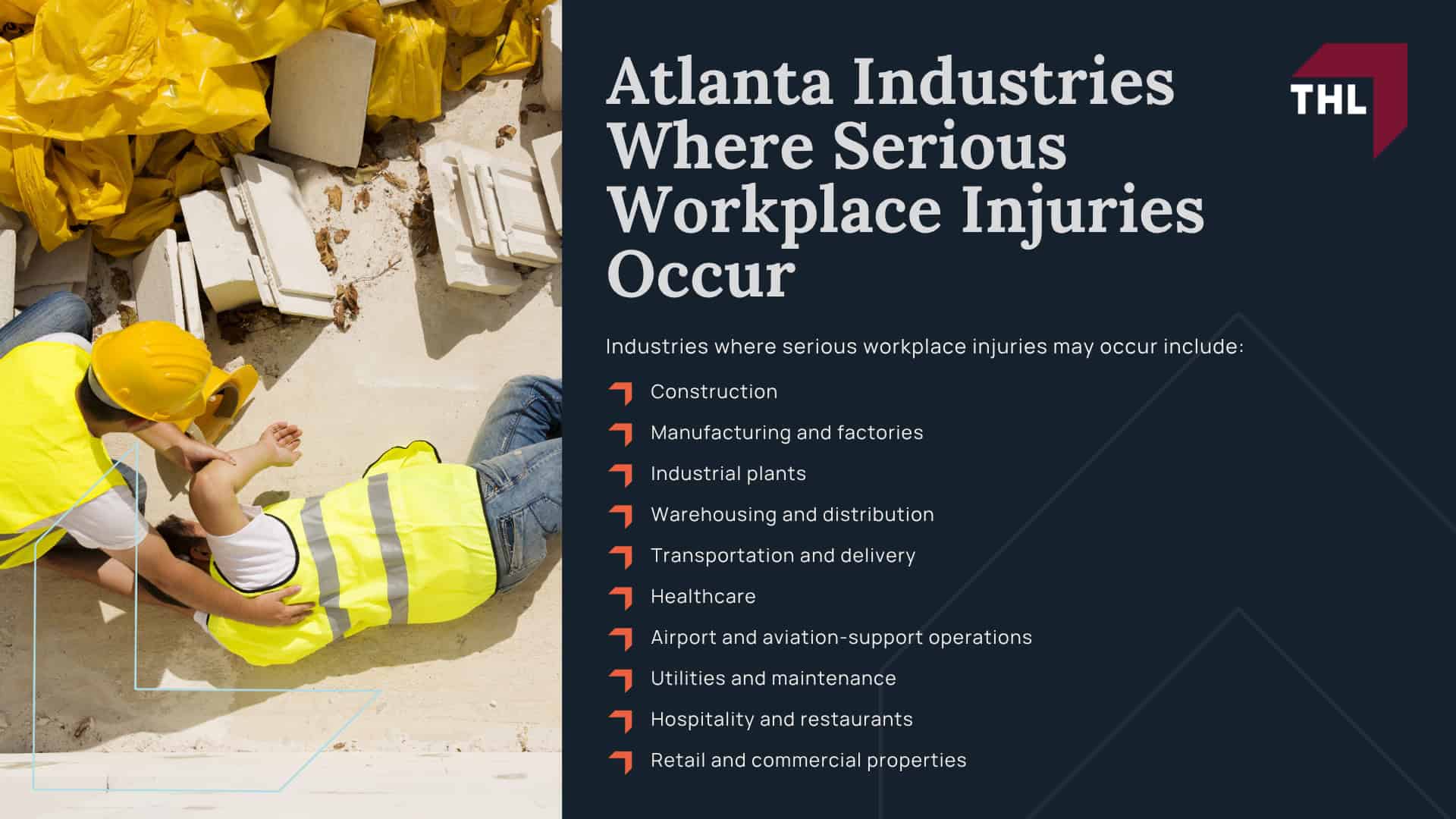
Serious workplace injuries can occur across Atlanta’s construction, industrial, transportation, healthcare, and service sectors.

The legal issues can differ substantially depending on the worksite, the companies involved, and which party controlled the property, equipment, or activity that caused the injury.

Industrial and construction environments may involve multiple contractors, equipment manufacturers, property owners, and service companies whose conduct must be evaluated separately from the injured worker’s employer.

Our attorneys investigate those relationships to determine whether a third party may bear civil liability for the accident.
Common Workplace Accidents and Industries in Atlanta; Workplace Accidents We Handle; Atlanta Industries Where Serious Workplace Injuries Occur

Industries where serious workplace injuries may occur include:

  • Construction: Commercial building projects, roadwork, demolition, roofing, utility work, and other sites involving multiple contractors and subcontractors.
  • Manufacturing and factories: Production facilities involving industrial machinery, conveyor systems, presses, furnaces, processing equipment, and material-handling systems.
  • Industrial plants: Chemical, processing, energy, food production, and other facilities where heavy equipment, hazardous materials, and complex maintenance operations can contribute to serious accidents.
  • Warehousing and distribution: Facilities involving forklifts, loading docks, pallet systems, conveyors, shelving, and commercial vehicle traffic.
  • Transportation and delivery: Trucking, delivery, courier, logistics, and field-service work involving motor vehicle collisions and loading or unloading accidents.
  • Healthcare: Hospitals, clinics, nursing facilities, and related settings where outside contractors, defective equipment, or unsafe property conditions may contribute to injury.
  • Airport and aviation-support operations: Ground handling, baggage operations, fueling, maintenance, transportation, and other work performed around aircraft and heavy equipment.
  • Utilities and maintenance: Electrical, telecommunications, HVAC, mechanical, and infrastructure work involving energized systems, confined spaces, ladders, vehicles, and specialized equipment.
  • Hospitality and restaurants: Hotels, restaurants, event venues, and commercial kitchens involving dangerous property conditions, equipment failures, burns, falls, and contractor-related hazards.
  • Retail and commercial properties: Stores, shopping centers, office buildings, and other properties where maintenance companies, landlords, contractors, or other outside parties may be responsible for unsafe conditions.

Common Workplace Injuries

Workplace accidents can cause injuries ranging from short-term physical harm to permanent conditions that affect a person’s ability to work and live independently.

Industrial, construction, transportation, and manufacturing accidents can produce traumatic injuries, while repetitive stress may cause conditions that develop gradually over time.

Our attorneys review medical records, work restrictions, prognosis information, and other evidence to document the extent of the injury and its long-term effects.

Common Workplace Accidents and Industries in Atlanta; Workplace Accidents We Handle; Atlanta Industries Where Serious Workplace Injuries Occur; Common Workplace Injuries

Common workplace injuries may include:

  • Brain injuries and concussions
  • Spinal injuries and back injuries
  • Broken bones and orthopedic injuries
  • Lacerations and scarring
  • Crush injuries and amputations
  • Burns and electrical injuries
  • Internal injuries
  • Nerve damage
  • Carpal tunnel syndrome
  • Repetitive stress injuries
  • Permanent disability or loss of function

What Should You Do After a Workplace Injury in Georgia?

After a workplace injury, the steps you take can affect both your workers’ compensation benefits and any separate personal injury claim against a third party.

Georgia generally requires employers with three or more regular employees to carry workers’ compensation insurance, which may provide medical benefits and partial wage replacement after a covered job-related injury.

Reporting workplace injuries promptly is important because Georgia requires workers to report an on-the-job accident to the employer immediately, and waiting more than 30 days may jeopardize benefits.

Medical treatment should also follow the applicable workers’ compensation procedures, including the employer’s authorized provider system when required.

A personal injury attorney can separately investigate whether the situation is covered by workers’ compensation alone or whether negligence by a contractor, manufacturer, property owner, driver, or another third party may support an additional civil claim.

Common Workplace Accidents and Industries in Atlanta; Workplace Accidents We Handle; Atlanta Industries Where Serious Workplace Injuries Occur; Common Workplace Injuries; What Should You Do After a Workplace Injury in Georgia

After a workplace injury in Georgia, consider taking the following steps:

  1. Report the injury to your employer immediately: Provide clear information about when, where, and how the accident occurred.
  2. Seek appropriate medical treatment: Follow the authorized medical-care process that applies to the workers’ compensation claim and keep records of diagnoses, restrictions, referrals, and treatment.
  3. Document the accident: Photograph the scene, equipment, hazardous condition, visible injuries, or other relevant evidence when it is safe to do so.
  4. Identify witnesses: Obtain names and contact information for coworkers or others who saw the accident or the conditions that contributed to it.
  5. Preserve records: Keep copies of incident reports, medical records, wage information, work restrictions, photographs, emails, and communications with insurers or employers.
  6. Preserve potentially defective equipment or other physical evidence: Machinery, tools, vehicles, or products involved in the accident may become important in a third-party liability investigation.
  7. Avoid signing releases or settlement documents without understanding their effect: A document resolving one part of the case could affect other available rights or claims.
  8. Contact our law firm if the injury is serious or another party may be responsible: We can evaluate how the accident occurred, identify potential third-party liability, and determine which legal claims should be investigated.

Workers’ compensation and third-party personal injury claims operate under different legal standards, so the existence of one does not automatically answer whether another claim is available.

Our law firm reviews both the employment-related benefits and the conduct of outside parties when evaluating a serious workplace injury.

Workers’ Compensation vs. a Third-Party Workplace Injury Lawsuit

Workers’ compensation and third-party personal injury claims are separate legal paths that may arise from the same workplace accident.

Georgia’s workers’ compensation system operates as a no-fault system, so an injured employee generally does not need to prove employer negligence to receive covered benefits.

Employers that meet Georgia’s requirements must provide workers’ compensation coverage, which may pay for authorized medical expenses, partial wage replacement, and certain disability benefits.

Common Workplace Accidents and Industries in Atlanta; Workplace Accidents We Handle; Atlanta Industries Where Serious Workplace Injuries Occur; Common Workplace Injuries; What Should You Do After a Workplace Injury in Georgia; Workers’ Compensation vs. a Third-Party Workplace Injury Lawsuit

A workers’ compensation case generally does not provide the broader categories of damages available in a civil lawsuit, including pain and suffering.

Third-party personal injury claims may be available when a contractor, manufacturer, property owner, motorist, or another outside party contributed to the injury through negligence or other wrongful conduct.

The sections below explain how each system works and when an injured worker may have rights under both.

Georgia Workers’ Compensation Explained

Georgia workers’ compensation laws provide benefits to employees who suffer qualifying injuries or illnesses arising out of and in the course of their employment without requiring them to prove employer negligence.

Receiving workers’ compensation benefits may include payment for authorized medical treatment, rehabilitation, and partial wage replacement when an injury prevents or limits the employee’s ability to work.

Georgia currently provides qualifying temporary total disability benefits at two-thirds of the worker’s average weekly wage, subject to the statutory maximum, while separate benefits may apply for permanent impairment or reduced earning capacity.

If an employer or insurance carrier disputes the claim, the worker can request a hearing before the Georgia State Board of Workers’ Compensation by filing Form WC-14.

A disputed claim may involve questions about whether the injury was work-related, whether required notice or paperwork was completed, or whether the medical evidence supports the requested benefits.

A workers’ compensation lawyer can review the reason benefits were denied or controverted, gather additional evidence, and represent the worker during hearings, mediation, and any subsequent appeal.

When a Georgia workers’ compensation claim is disputed, the process may include:

  • Reviewing the denial or notice of controversion: Identify whether the dispute involves missing documentation, medical evidence, work-related causation, notice requirements, or another eligibility issue.
  • Gathering additional evidence: Medical records, accident reports, witness statements, wage records, and employment documents may address the issues raised by the employer or insurer.
  • Requesting mediation: A worker may use Form WC-14 to request mediation of issues other than settlement, while settlement mediation generally uses Form WC-100 and requires agreement from both sides.
  • Requesting a hearing: Form WC-14 can also be used to request a hearing, which is generally conducted before an administrative law judge rather than a workers’ compensation “appeals board.”
  • Presenting the case with legal representation: An injured worker may represent themselves, but they also have the right to retain an attorney to present evidence and arguments during disputed proceedings.
  • Appealing an unfavorable decision: A party dissatisfied with an administrative law judge’s final award or order generally has 20 days to appeal to the State Board’s Appellate Division.

Mediation can resolve some benefit disputes without a formal hearing, but settlement is voluntary and the appropriate procedure depends on the issue being contested.

Workers’ compensation benefits are defined by Georgia law and do not provide the same categories of recovery available in a personal injury lawsuit, including ordinary damages for pain and suffering.

A separate lawsuit for future lost income, long-term disability, pain and suffering, or other civil damages may be available only when the facts support a claim against a qualifying third party outside the workers’ compensation system.

Third-Party Personal Injury Claims

A workplace injury may support a separate personal injury claim when someone other than the employer or a protected co-worker contributed to the accident.

Georgia law preserves an injured employee’s right to pursue qualifying third-party tortfeasors even when the worker is also receiving workers’ compensation benefits.

Unlike workers’ compensation, a third-party claim requires evidence establishing civil liability, which may involve negligence, defective products, dangerous property conditions, or other wrongful conduct.

Our attorneys investigate who controlled the worksite, equipment, vehicle, property, or activity involved and determine whether an outside person or company owed the injured worker a legal duty.

A successful third-party claim may provide financial compensation for losses that workers’ compensation does not ordinarily address, including pain and suffering and other noneconomic harm.

Workers’ compensation and third-party claims can sometimes proceed at the same time, but each follows different legal standards and procedures.

Third-party personal injury claims may involve:

  • General contractors and subcontractors: A separate company may be liable when its employees, equipment, or unsafe work practices contribute to an accident.
  • Equipment and machinery manufacturers: Defective industrial machinery, tools, lifts, forklifts, safety devices, or other products may support a product liability claim.
  • Property owners: Dangerous premises, structural defects, inadequate maintenance, or other hazardous property conditions may create liability depending on who controlled the property.
  • Maintenance and repair companies: Outside contractors responsible for servicing machinery, electrical systems, elevators, vehicles, or industrial equipment may be liable when negligent work contributes to an injury.
  • Motorists and transportation companies: Employees injured in traffic collisions while working may have claims against negligent drivers, trucking companies, delivery companies, or other responsible parties.
  • Vendors, suppliers, and service companies: Outside businesses working at a jobsite may create hazards through negligent operations, unsafe materials, or defective equipment.
  • Other companies operating at the same worksite: Industrial plants, factories, warehouses, and construction projects often involve multiple businesses whose separate duties and conduct must be investigated.

Georgia law also allows an employer or workers’ compensation insurer to assert a subrogation lien against certain proceeds from a third-party recovery when workers’ compensation benefits have already been paid, subject to statutory limits and the requirement that the injured employee be fully and completely compensated for economic and noneconomic losses.

Our attorneys account for those reimbursement issues when evaluating settlement value and the net recovery available to the client.

We also preserve evidence, identify all potentially responsible parties and insurance policies, calculate current and future damages, negotiate with liability insurers, and file a personal injury lawsuit when the evidence supports further legal action.

Who Can Be Liable for an Atlanta Workplace Injury?

Liability for a workplace injury can extend beyond the injured worker’s employer when another person or company contributed to the accident through negligence, defective products, unsafe property conditions, or other wrongful conduct.

Identifying responsible parties often requires reviewing contracts, ownership records, maintenance responsibilities, worksite control, equipment records, and the conduct of each company involved.

Multiple defendants may share responsibility in construction, industrial, transportation, and manufacturing accidents where several businesses operate at the same location.

Our attorneys investigate those relationships to determine whether the evidence supports a third-party personal injury claim in addition to any available workers’ compensation benefits.

Common Workplace Accidents and Industries in Atlanta; Workplace Accidents We Handle; Atlanta Industries Where Serious Workplace Injuries Occur; Common Workplace Injuries; What Should You Do After a Workplace Injury in Georgia; Workers’ Compensation vs. a Third-Party Workplace Injury Lawsuit; Who Can Be Liable for an Atlanta Workplace Injury

Potentially liable parties may include:

  • General contractors: A general contractor may bear responsibility for unsafe work practices, site conditions, or failures involving work under its control.
  • Subcontractors: Another contractor or subcontractor may be liable when its employees, equipment, or operations contribute to an accident.
  • Property owners: Owners may face liability when dangerous property conditions, inadequate maintenance, or other premises hazards contribute to an injury.
  • Equipment and machinery manufacturers: Defective machinery, tools, lifts, forklifts, safety devices, or other products may support a product liability claim.
  • Maintenance and repair companies: Outside companies responsible for servicing industrial equipment, electrical systems, vehicles, or machinery may be liable when negligent work contributes to an accident.
  • Drivers and transportation companies: Negligent motorists, trucking companies, delivery companies, or other commercial transportation businesses may be responsible for work-related vehicle accidents.
  • Vendors and suppliers: Outside businesses may contribute to an injury through unsafe materials, defective products, improper deliveries, or negligent operations.
  • Security or service contractors: Companies responsible for security, cleaning, maintenance, or other site services may be liable when their conduct creates or fails to correct a dangerous condition.
  • Other companies operating at the worksite: Factories, plants, warehouses, and construction projects often involve multiple businesses whose separate actions may need to be evaluated.

Can You Receive Workers’ Compensation and File a Personal Injury Lawsuit?

Yes, an injured worker in Georgia may be able to receive workers’ compensation benefits while also pursuing a separate personal injury lawsuit when a qualifying third party contributed to the workplace accident.

Georgia workers’ compensation is generally the exclusive remedy against the employer for a covered injury, but the law preserves potential claims against negligent third parties outside the employer relationship.

The role of a workers’ compensation attorney versus a personal injury lawyer reflects this difference: a workers’ compensation attorney focuses on statutory medical, wage, and disability benefits, while a personal injury lawyer investigates negligence and pursues broader civil damages against responsible third parties.

A workers’ compensation settlement may resolve some or all issues within the workers’ compensation claim depending on its terms, but settlement of that claim is a separate legal matter from determining whether a third-party personal injury case exists.

When workers’ compensation benefits have already been paid and the worker later recovers compensation from a third party, the employer or insurer may assert a subrogation lien against part of the third-party recovery under Georgia law.

Our attorneys evaluate the accident, the parties involved, available insurance coverage, damages, and any workers’ compensation payments or liens to determine how the two claims may affect the client’s overall recovery.

When Can You File a Third-Party Workplace Injury Lawsuit in Georgia?

A third-party workplace injury lawsuit may be available when someone other than the injured worker’s employer or a protected co-worker contributed to the accident through negligence, a defective product, unsafe property conditions, or other wrongful conduct.

These claims are separate from workers’ compensation and require evidence establishing the third party’s legal responsibility for the injury.

Common Workplace Accidents and Industries in Atlanta; Workplace Accidents We Handle; Atlanta Industries Where Serious Workplace Injuries Occur; Common Workplace Injuries; What Should You Do After a Workplace Injury in Georgia; Workers’ Compensation vs. a Third-Party Workplace Injury Lawsuit; Who Can Be Liable for an Atlanta Workplace Injury; When Can You File a Third-Party Workplace Injury Lawsuit in Georgia

Whether a lawsuit is available depends on who controlled the worksite, equipment, property, vehicle, or activity involved and how that party’s conduct contributed to the accident.

The sections below explain common situations in which an injured worker may have grounds to pursue a third-party personal injury claim in Georgia.

Construction Contractor or Subcontractor Negligence

Construction sites often involve several companies working alongside one another, which can create third-party liability when a contractor or subcontractor contributes to an accident.

A claim may arise from unsafe work practices, improperly secured materials, negligent equipment operation, dangerous scaffolding, or other hazards created by a company other than the injured worker’s employer.

Georgia workers’ compensation generally serves as the exclusive remedy against the employer, but qualifying claims against negligent third parties may still be available.

Our attorneys review contracts, site responsibilities, witness accounts, safety records, and other evidence to determine which companies controlled the work that caused the injury.

Defective Machinery or Equipment

Factory, plant, warehouse, and construction workers may suffer catastrophic injuries when machinery, tools, lifts, forklifts, safety devices, or other equipment fails during normal use.

A third-party claim may be available when a defective product, unsafe design, manufacturing defect, inadequate warning, or negligent repair contributed to the accident.

The investigation may involve preserving the equipment, obtaining maintenance and service records, identifying manufacturers and suppliers, and consulting engineering or other technical experts.

Workers’ compensation benefits do not necessarily eliminate a separate claim against an outside company responsible for defective equipment.

Motor Vehicle Accidents While Working

Employees who drive, make deliveries, travel between worksites, perform roadside work, or operate vehicles as part of their jobs may be injured by negligent motorists or commercial drivers.

When another driver causes the collision, the injured worker may have a personal injury claim against that driver or another responsible company in addition to potential workers’ compensation benefits.

Dangerous Property Conditions

A workplace injury may occur on property owned or controlled by a business other than the injured worker’s employer.

Unsafe walkways, defective stairs, inadequate lighting, structural hazards, uncorrected spills, falling materials, or other dangerous conditions may support a premises liability claim when an outside property owner or occupier had a legal responsibility for the hazard.

Determining liability requires examining who possessed or controlled the property, who was responsible for maintenance, and what each party knew or should have known about the condition.

Third-Party Maintenance or Service Companies

Industrial facilities and other workplaces frequently rely on outside companies to inspect, repair, clean, maintain, or service machinery, electrical systems, elevators, vehicles, ventilation systems, and other equipment.

A maintenance or service company may face liability when negligent inspection, repair, installation, or servicing contributes to a worker’s injury.

These cases can require examination of service contracts, maintenance logs, inspection records, work orders, equipment history, and technical evidence showing how the failure occurred.

Do You Qualify for an Atlanta Workplace Injury Claim?

You may qualify for an Atlanta workplace injury claim if you were injured while performing job-related duties and another person or company may have contributed to the accident.

Workers’ compensation may apply to a covered work-related injury regardless of fault, while a separate personal injury claim may be available when a contractor, property owner, manufacturer, driver, maintenance company, or other third party acted negligently.

Serious accidents involving defective equipment, unsafe property conditions, vehicle collisions, construction hazards, or industrial machinery may require investigation beyond the workers’ compensation system.

You should seek medical treatment promptly and follow applicable workers’ compensation procedures so the injury, diagnosis, and work restrictions are properly documented.

Accident reports, photographs, witness statements, medical records, maintenance documents, contracts, and other evidence may help establish how the injury occurred and who may be legally responsible.

Common Workplace Accidents and Industries in Atlanta; Workplace Accidents We Handle; Atlanta Industries Where Serious Workplace Injuries Occur; Common Workplace Injuries; What Should You Do After a Workplace Injury in Georgia; Workers’ Compensation vs. a Third-Party Workplace Injury Lawsuit; Who Can Be Liable for an Atlanta Workplace Injury; When Can You File a Third-Party Workplace Injury Lawsuit in Georgia; Do You Qualify for an Atlanta Workplace Injury Claim

The value of a third-party claim depends on factors such as the severity of the injuries, future medical needs, lost income, reduced earning capacity, pain and suffering, available insurance coverage, and the strength of the liability evidence.

Our attorneys evaluate both workers’ compensation issues and potential third-party liability when determining what legal options may provide a path toward maximum compensation.

We offer a free case evaluation to review the accident, identify potentially responsible parties, and determine whether the facts support further legal action.

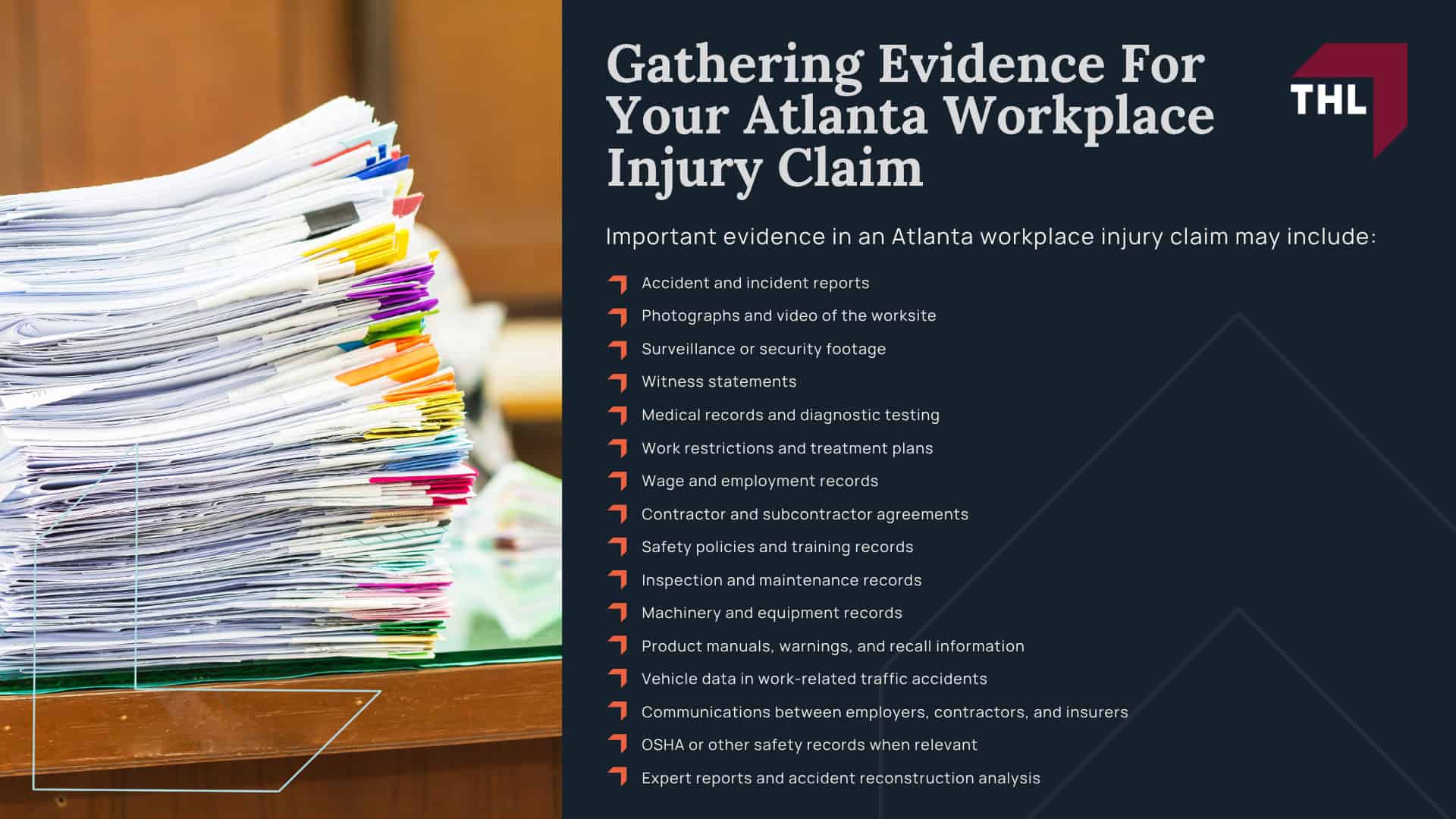
Gathering Evidence For Your Atlanta Workplace Injury Claim

Evidence can establish how a workplace accident occurred, which third parties may be legally responsible, and what losses resulted from the injury.

In serious workplace cases, important records may be controlled by contractors, property owners, manufacturers, maintenance companies, or other businesses, so early preservation can be critical.

An experienced attorney can identify which records matter, send preservation requests when appropriate, and organize the evidence needed to support liability, causation, and damages.

Common Workplace Accidents and Industries in Atlanta; Workplace Accidents We Handle; Atlanta Industries Where Serious Workplace Injuries Occur; Common Workplace Injuries; What Should You Do After a Workplace Injury in Georgia; Workers’ Compensation vs. a Third-Party Workplace Injury Lawsuit; Who Can Be Liable for an Atlanta Workplace Injury; When Can You File a Third-Party Workplace Injury Lawsuit in Georgia; Do You Qualify for an Atlanta Workplace Injury Claim; Gathering Evidence For Your Atlanta Workplace Injury Claim

Important evidence in an Atlanta workplace injury claim may include:

  • Accident and incident reports
  • Photographs and video of the worksite
  • Surveillance or security footage
  • Witness statements
  • Medical records and diagnostic testing
  • Work restrictions and treatment plans
  • Wage and employment records
  • Contractor and subcontractor agreements
  • Safety policies and training records
  • Inspection and maintenance records
  • Machinery and equipment records
  • Product manuals, warnings, and recall information
  • Vehicle data in work-related traffic accidents
  • Communications between employers, contractors, and insurers
  • OSHA or other safety records when relevant
  • Expert reports and accident reconstruction analysis

Common Damages in Workplace Injury Claims

When a person is injured on the job because of a third party’s negligence, a personal injury lawsuit may provide compensation beyond the benefits available through workers’ compensation.

Our attorneys assess medical bills, lost income, future treatment needs, permanent limitations, and the effect of the injury on the client’s ability to work and live independently.

Workers’ compensation payments, including temporary disability benefits or permanent partial disability benefits, are evaluated separately because those benefits may affect the financial structure of a related third-party recovery.

Serious workplace injuries may also support noneconomic damages that workers’ compensation does not ordinarily provide, including pain and suffering and loss of normal life.

We document each category of loss and account for applicable workers’ compensation liens when pursuing the maximum financial recovery supported by the evidence and Georgia law.

Common Workplace Accidents and Industries in Atlanta; Workplace Accidents We Handle; Atlanta Industries Where Serious Workplace Injuries Occur; Common Workplace Injuries; What Should You Do After a Workplace Injury in Georgia; Workers’ Compensation vs. a Third-Party Workplace Injury Lawsuit; Who Can Be Liable for an Atlanta Workplace Injury; When Can You File a Third-Party Workplace Injury Lawsuit in Georgia; Do You Qualify for an Atlanta Workplace Injury Claim; Gathering Evidence For Your Atlanta Workplace Injury Claim; Common Damages in Workplace Injury Claims

Damages available in a qualifying third-party workplace injury claim may include:

  • Medical expenses: Past medical bills for emergency treatment, hospitalization, surgery, rehabilitation, medication, and other care.
  • Future medical expenses: Anticipated treatment, therapy, surgeries, assistive devices, or long-term medical care.
  • Lost wages: Income lost while the injured person is unable to work.
  • Reduced earning capacity: Compensation when permanent injuries limit the person’s ability to earn income in the future.
  • Pain and suffering: Physical pain and the broader effects of the injury on daily life.
  • Emotional distress: Psychological and emotional effects resulting from the accident and injuries.
  • Disability and loss of normal life: Limitations on mobility, independence, employment, recreation, and ordinary activities.
  • Scarring and disfigurement: Compensation for permanent physical changes caused by burns, lacerations, amputations, or other traumatic injuries.
  • Out-of-pocket expenses: Other reasonable costs resulting from the accident and recovery.
  • Wrongful death damages: Additional forms of compensation may be available to qualifying family members when a workplace accident results in death.

Fatal Workplace Accidents and Wrongful Death Claims

Fatal workplace accidents may create rights under Georgia’s workers’ compensation system and, when a qualifying third party contributed to the death, a separate wrongful death claim.

Georgia workers’ compensation provides death benefits to eligible dependents after a compensable on-the-job death, including weekly income benefits and burial benefits allowed by law.

Apart from filing a workers’ compensation claim, surviving family members may be able to pursue a wrongful death lawsuit against a negligent contractor, property owner, manufacturer, motorist, maintenance company, or another third-party tortfeasor.

Georgia’s Workers’ Compensation Act generally makes workers’ compensation the exclusive remedy against the employer for a covered workplace death, while preserving qualifying claims against third parties.

Under Georgia wrongful death law, a surviving spouse or, when there is no surviving spouse, the deceased person’s child or children may seek recovery for the full value of the deceased person’s life as shown by the evidence.

Our attorneys investigate the accident, identify outside companies that may share responsibility, preserve evidence, and evaluate the financial and personal losses resulting from the death.

When workers’ compensation and wrongful death rights arise from the same workplace accident, we assess how the separate claims interact before pursuing recovery against responsible third parties.

TorHoerman Law: Lawyers for Atlanta Workplace Injuries

TorHoerman Law represents people who suffered serious workplace injuries when negligence by a contractor, property owner, manufacturer, motorist, maintenance company, or other third party may support a personal injury claim.

Our attorneys investigate how the accident occurred, identify potentially responsible companies, preserve evidence, review insurance coverage, and document the medical and financial effects of the injury.

We handle cases involving construction accidents, factory and plant injuries, defective machinery, industrial accidents, work-related vehicle crashes, dangerous property conditions, and other incidents where liability may extend beyond the employer.

Common Workplace Accidents and Industries in Atlanta; Workplace Accidents We Handle; Atlanta Industries Where Serious Workplace Injuries Occur; Common Workplace Injuries; What Should You Do After a Workplace Injury in Georgia; Workers’ Compensation vs. a Third-Party Workplace Injury Lawsuit; Who Can Be Liable for an Atlanta Workplace Injury; When Can You File a Third-Party Workplace Injury Lawsuit in Georgia; Do You Qualify for an Atlanta Workplace Injury Claim; Gathering Evidence For Your Atlanta Workplace Injury Claim; Common Damages in Workplace Injury Claims; TorHoerman Law_ Lawyers for Atlanta Workplace Injuries

When necessary, we work with medical professionals, engineers, accident reconstruction specialists, economists, and other experts to evaluate causation, future treatment needs, reduced earning capacity, and long-term disability.

We prepare each case for negotiation and litigation based on the available evidence rather than assuming workers’ compensation is the only source of recovery after an on-the-job injury.

We offer a free case review and handle qualifying personal injury cases on a contingency fee basis, so clients do not pay attorney fees upfront.

If you or a loved one suffered a workplace injury in Atlanta, call TorHoerman Law today for a free, no-obligation consultation or use the chat feature on this page to contact our legal team.

Frequently Asked Questions

Other Atlanta personal injury cases we handle
All
Car Accidents
Truck Accidents
Motorcycle Accidents
Other Accidents & Injuries
Auto Accidents
Premises Liability
Auto Accident Causes
Auto Accident Injuries
Workplace Injuries
Intentional Torts
Catastrophic Injuries
Chemical Exposure
Other Accidents
You can learn more about other Atlanta personal injury cases we handle below:
Atlanta Lyft Sexual Assault Lawyer
Atlanta Negligent Security Lawyer
Atlanta Uber Sexual Assault Lawyer
Atlanta Broken Bone Lawyer
Atlanta Workers' Compensation Lawyer
Atlanta Assault Lawyer
Atlanta Insurance Claim Lawyer
Atlanta MARTA Accident Lawyer
Atlanta T-Bone Accident Lawyer
Atlanta Spinal Cord Injury Lawyer
Atlanta Head On Collision Lawyer
Atlanta Failure To Yield Accident Lawyer
Atlanta Dog Bite Lawyer
Atlanta Motor Vehicle Accident Lawyer
Atlanta Traumatic Brain Injury Lawyer
Atlanta Bus Accident Lawyer
Atlanta Public Transportation Accident Lawyer
Atlanta Premises Liability Lawyer
Atlanta Uber Accident Lawyer
Atlanta Lyft Accident Lawyer
Atlanta ATV Accident Lawyer
Atlanta Construction Accident Lawyer
Atlanta Slip and Fall Lawyer
Atlanta Drunk Driving Accident Lawyer
Atlanta Rideshare Accident Lawyer
Atlanta Fatal Car Accident Lawyer
Atlanta Drowning Accident Lawyer
Atlanta Pedestrian Accident Lawyer
Atlanta Daycare Injury Lawyer
Atlanta Bicycle Accident Lawyer
Atlanta Medical Malpractice Lawyer
Atlanta Nursing Home Abuse Lawyer
Atlanta Wrongful Death Lawyer
Atlanta Motorcycle Accident Lawyer
Atlanta Truck Accident Lawyer
Atlanta Car Accident Lawyer
Personal Injury Lawyer Atlanta, Georgia
Published by:
Share
Picture of Tor Hoerman
Tor Hoerman

Tor Hoerman has represented injured individuals for more than 30 years, with experience spanning individual personal injury cases and nationwide mass tort litigation. His work includes car accidents, catastrophic injuries, product liability claims, and other serious injury cases. Tor has served in court-appointed leadership roles in national litigation and tried cases involving major corporate defendants.

TorHoerman Law’s legal content is researched and written by our editorial team and attorneys for legal accuracy, clarity, and relevance. We rely on statutes, court records, government publications, medical research, and other authoritative sources when applicable. This page provides general legal information and does not constitute legal advice.

TorHoerman Law reviews its legal content for factual accuracy, current information, and relevant legal context before publication and as material developments occur. This article is provided for general informational purposes and does not constitute legal advice. For guidance about a specific case, contact TorHoerman Law.

Have you or a loved one been injured in Atlanta, Georgia?

A serious injury can change your life.

Speak with an experienced Atlanta personal injury lawyer about your rights, your case, and the legal options available to you.
•
37 reviews
5.0
★★★★★
Recovered damages
$4 Billion+

Table of Contents

About TorHoerman Law

TorHoerman Law represents people whose lives have been disrupted by serious injuries, unsafe products, and negligence. Our attorneys handle individual personal injury cases as well as national mass tort lawsuits involving major corporations.

Founded in 2009, our legal team brings more than 100 years of combined experience handling serious injury and complex civil litigation.

Do you believe you’re entitled to compensation?

Use our Instant Case Evaluator to find out in as little as 60 seconds!

$495 Million
Baby Formula NEC Lawsuit

In this case, we obtained a verdict of $495 Million for our client’s child who was diagnosed with Necrotizing Enterocolitis after consuming baby formula manufactured by Abbott Laboratories.

$20 Million
Toxic Tort Injury

In this case, we were able to successfully recover $20 Million for our client after they suffered a Toxic Tort Injury due to chemical exposure.

$103.8 Million
COX-2 Inhibitors Injury

In this case, we were able to successfully recover $103.8 Million for our client after they suffered a COX-2 Inhibitors Injury.

$4 Million
Traumatic Brain Injury

In this case, we were able to successfully recover $4 Million for our client after they suffered a Traumatic Brain Injury while at daycare.

$2.8 Million
Defective Heart Device

In this case, we were able to successfully recover $2.8 Million for our client after they suffered an injury due to a Defective Heart Device.

Guides & Resources

Share

Other Atlanta Personal Injury Cases

All
Car Accidents
Truck Accidents
Motorcycle Accidents
Other Accidents & Injuries
Auto Accidents
Premises Liability
Auto Accident Causes
Auto Accident Injuries
Workplace Injuries
Intentional Torts
Catastrophic Injuries
Chemical Exposure
Other Accidents
TorHoerman Law: Injury & Car Accident Lawyers in Atlanta, GA
TorHoerman Law Personal Injury Lawyer Atlanta Georgia Sidebar Image
Local Atlanta Resources
Education
Emergency Services
Courthouses
Department of Motor Vehicles
Sights to See
Counties We Serve
Cities We Serve

What Our Clients Have To Say