Active Litigation
Polaris Off-Road Vehicle Injury Lawsuit Facts
TorHoerman Law is actively accepting claims for the Polaris Off-Road Vehicle Injury Lawsuit.

Yes.
Polaris Ranger Crew XP 1000 vehicles have been recalled because of electrical shorts, fuel leaks, damaged fuel lines, defective seat-belt attachments, improperly installed brake lines, throttle problems, and clutch failures that may create fire, ejection, or crash risks.
The official model name has varied across years and recall notices.
Depending on the vehicle, Polaris and the Consumer Product Safety Commission may refer to it as the Ranger Crew XP 1000, Ranger XP 1000 Crew, Ranger Crew XP 1000 NorthStar, or Ranger XP 1000 NorthStar Crew.
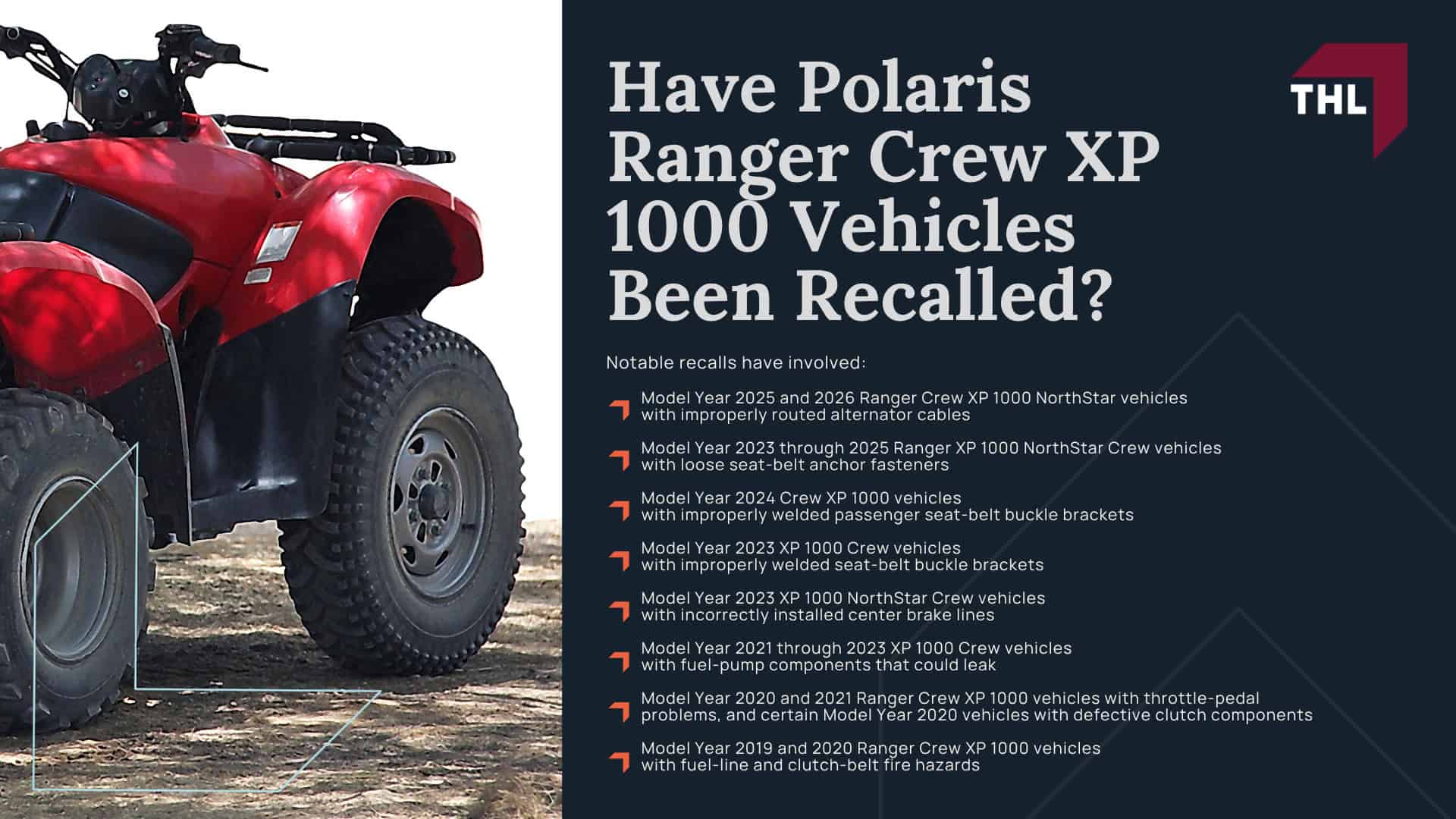
Notable recalls have involved:
Each recall involves certain VINs, so ownership of a vehicle from an affected model year does not automatically mean it is included.
Consumers should check the complete vehicle identification number and follow the instructions for the applicable recall.
On October 30, 2025, Polaris Industries Inc. recalled approximately 5,130 Model Year 2025 and 2026 Ranger XP 1000 NorthStar and Ranger Crew XP 1000 NorthStar recreational off-road vehicles in the United States.
In addition, approximately 460 recalled vehicles were sold in Canada.
The recall involves an alternator cable that may have been routed improperly near the battery.
The cable can become damaged and contact the negative battery post, resulting in an electrical short and posing a fire hazard and risk of serious injury.
Before the recall was announced, Polaris had received:
No injuries had been reported in connection with that specific recall at the time of the announcement.
A Ranger Crew XP 1000 fire may nevertheless expose multiple passengers to flames, smoke, extreme heat, and injuries suffered while attempting to escape the vehicle.
The recalled vehicles were sold by Polaris dealers nationwide from March through August 2025 for approximately $28,000 to $38,000.
The combined recall population included three-seat and six-seat Ranger configurations and was sold in black, blue, bronze, brown, camouflage, gray, orange, red, and white.
“POLARIS” is stamped on the front grille, while the VIN is printed on the left rear frame, on the driver’s side under the cargo box.
Consumers were told to immediately stop using the recalled vehicles and check whether their VIN was included.
Polaris provided instructions concerning limited continued use while awaiting a permanent repair, or owners could contact an authorized Polaris dealer to schedule a free repair.
Polaris Industries, the manufacturer located in Medina, Minnesota, could be contacted from 7 a.m. to 7 p.m. CT Monday through Friday or through its online recall page.
Polaris has recalled multiple Crew XP 1000 vehicles because seat-belt defects could reduce occupant restraint protection and brake-line defects could cause overheating, reduced braking performance, fire, or loss of control.
In May 2025, Polaris recalled approximately 640 Model Year 2023 through 2025 Ranger XP 1000 NorthStar and Ranger XP 1000 NorthStar Crew vehicles because lower seat-belt anchor fasteners may not have been properly tightened.
A loose fastener could allow the seat belt to separate from the vehicle frame, leaving an occupant vulnerable to ejection during a crash.
Polaris identified two vehicles with loose fasteners, but no injuries had been reported.
Consumers were instructed to stop using the recalled vehicles and contact an authorized Polaris dealer for a free inspection and repair.
Polaris stated that consumers could continue operating the vehicle before the dealer inspection only after completing the company’s seat-belt fastener verification instructions and confirming that the fasteners were secure.
Polaris was contacting registered owners directly.
A separate recall covered approximately 2,500 Model Year 2024 Ranger and commercial utility vehicles, including certain Ranger XP 1000 and Crew XP 1000 models.
A defective weld could allow the passenger-side seat-belt buckle anchor point to separate from the frame, exposing a passenger to impact from the loose bracket or restraint failure during a crash.
Polaris identified three reports of improper welds, and no injuries had been reported.
In September 2023, another recall covered approximately 280 vehicles, including certain Model Year 2023 Ranger XP 1000 and XP 1000 Crew models.
The passenger-side seat-belt buckle bracket may not have been welded properly, allowing the anchor point to separate from the frame.
No incidents or injuries were reported when that recall was announced.
An earlier recall announced in 2018 involved certain Model Year 2017 Ranger Crew XP 1000 vehicles because of potentially insufficient welds between the center seat-belt bracket and vehicle frame.
Polaris received five reports of insufficient welds found by dealers during vehicle setup inspections, but no accidents or injuries were reported.
Polaris also recalled approximately 1,025 Model Year 2023 Ranger XP 1000 NorthStar and XP 1000 NorthStar Crew vehicles because the center brake line may have been installed improperly.
The condition could keep the rear brake circuit pressurized, causing the brakes to overheat and reducing braking performance.
Polaris identified one fire and three kinked brake lines but reported no crashes or injuries at the time of the recall.
The affected model depends on the specific recall.
Consumers may see the Crew vehicle identified under different official names, including “Ranger Crew XP 1000,” “Ranger XP 1000 Crew,” and “Ranger XP 1000 NorthStar Crew.”
Recalls discussed on this page have included certain VINs of:
A model year, exterior color, model number, or seating configuration alone cannot establish whether a particular vehicle is recalled.
On many newer Ranger Crew vehicles, the model number and VIN are printed on a portion of the left rear frame, on the driver’s side under the cargo box.
Some older recall notices place the VIN label in the left front wheel well, so consumers should follow the identification instructions for their specific vehicle.
The Polaris name is generally stamped on the front grille, and “Ranger” may be printed along the side of the cargo area.
Owners should use the complete VIN to check the official Polaris recall database or contact an authorized Polaris dealer for recall information specific to their vehicle.
A Crew XP 1000 defect may cause a fire or accident when an electrical, fuel, braking, restraint, throttle, or drivetrain component fails during use.
Reported defect mechanisms have included:
A 2020 recall involved approximately 80,000 Model Year 2018 through 2020 Ranger XP 1000 and Crew XP 1000 vehicles because a broken clutch belt could damage the secondary clutch and fuel line.
Polaris received four reports in which broken clutch belts resulted in fuel-line damage and fires, although no injuries were reported.
Another 2020 recall involved approximately 7,000 Model Year 2019 and 2020 Ranger XP 1000 and Crew XP 1000 vehicles with fuel lines that may have been routed above the protective bracket.
A broken belt could damage the exposed line and result in a fuel leak or fire.
No incidents were reported when that recall was announced.
A 2021 recall covered Model Year 2020 and 2021 Ranger Crew XP 1000 vehicles because a throttle pedal could return to idle more slowly than expected or stick in the depressed position.
Polaris received 114 reports involving slow or sticking pedals, including 12 crashes and one leg injury that required surgery.
A fire, rollover, ejection, restraint failure, or sudden loss of control can cause serious and potentially fatal injuries to a Crew XP 1000 driver or passenger.

Possible injuries include:
Crew XP 1000 vehicles can carry multiple occupants, exposing both the driver and passengers to injury when a fire, restraint failure, rollover, or loss-of-control accident occurs.
The extent of the injuries can depend on whether the vehicle caught fire, accelerated unexpectedly, overturned, struck another object, trapped an occupant, or allowed someone to be ejected.
Treatment may require emergency transportation, hospitalization, surgery, skin grafts, orthopedic hardware, rehabilitation, physical therapy, or lifelong medical care.
A Crew XP 1000 fire may expose occupants to flames, extreme heat, smoke, and burning vehicle components.
Fuel or electrical fires can spread after reaching plastic body panels, seats, clothing, stored cargo, dry vegetation, or nearby property.
Burn injuries may occur from direct contact with flames, burning fuel, heated vehicle components, or melted materials, as well as while an occupant attempts to escape a burning vehicle.
Severe burns can damage skin, muscle, nerves, blood vessels, and underlying tissue.
Treatment may include debridement, skin grafting, reconstructive surgery, infection management, and extended rehabilitation.
Smoke inhalation may damage the lungs and airway even when external burns appear limited.
Severe burn injuries may result in permanent scarring, restricted movement, chronic pain, and extended rehabilitation.
A defective seat-belt fastener or buckle bracket may fail to keep an occupant within the Crew XP 1000’s passenger compartment during a collision or rollover.
Brake, throttle, clutch, and engine-braking failures may also prevent a driver from controlling the vehicle.
During a rollover, ejection, or loss-of-control accident, an occupant may:
A recall involving a safety component does not automatically prove that the defect caused a particular accident.
Investigators may consider seat-belt use, vehicle speed, terrain, maintenance, aftermarket modifications, driver conduct, and the physical condition of the failed component.
A Crew XP 1000 rollover or collision may cause blunt-force injuries to the head, neck, back, chest, arms, legs, and pelvis.
A traumatic brain injury may involve a concussion, skull fracture, bleeding, swelling, or permanent cognitive impairment.
Symptoms can include headaches, dizziness, confusion, memory loss, mood changes, difficulty concentrating, and loss of consciousness.
Spinal injuries may involve fractured vertebrae, herniated discs, nerve damage, or trauma to the spinal cord.
Severe spinal cord injuries can cause paralysis, loss of sensation, impaired mobility, and long-term medical or personal assistance needs.
Broken bones may affect the ribs, pelvis, arms, legs, hands, feet, or facial structures.
Complex fractures can require surgery, internal fixation hardware, physical therapy, extended recovery, and time away from work.
Yes.
Fires, crashes, property damage, and at least one physical injury have been reported in connection with recalls that included Ranger Crew XP 1000 vehicles.
Other recall notices identified component failures without reported injuries at the time of publication.
Reported incidents have included:
Recall incident counts reflect the information available to Polaris and the CPSC when each notice was issued.
They do not prove that no later injury occurred or that no similar failure happened in a vehicle outside the recalled group.
You may be able to file a Polaris Crew XP 1000 lawsuit if an alleged design defect, manufacturing defect, inadequate warning, or negligent repair caused a fire, rollover, ejection, crash, physical injury, death, or property damage.

Depending on the facts and applicable state law, potential claims may include:
A recall does not automatically establish that Polaris is legally responsible for every accident involving a recalled vehicle.
A claimant generally must identify the alleged defect, connect it to the incident, and document the injuries and financial losses that resulted.
A vehicle does not necessarily have to be included in a recall for a claim to be investigated.
A non-recalled Crew XP 1000 may have experienced a similar failure or another independently identifiable defect.
Polaris, a component manufacturer, dealer, repair provider, vehicle owner, rental company, or negligent driver may be responsible, depending on what caused the accident and the law governing the claim.

Potentially liable parties may include:
Technical investigation may be required to determine whether the failure originated during manufacturing, developed because of inadequate maintenance, or resulted from an improper repair or aftermarket modification.
Evidence can determine whether a Crew XP 1000 defect caused the fire, crash, rollover, ejection, or resulting injuries.
The vehicle should be preserved before it is repaired, altered, sold, or discarded so qualified experts can inspect the suspected failure.

Important evidence may include:
Preserving the vehicle and its components can be critical.
Repairing or disposing of the Crew XP 1000 before an expert inspection may prevent investigators from determining what failed.
After a Crew XP 1000 fire, rollover, brake failure, seat-belt failure, or loss-of-control accident, seek emergency help and obtain medical treatment for all injuries.

When it is safe to do so:
Owners of unrepaired recalled vehicles should follow the instructions issued for their specific recall campaign and VIN.
Depending on the recall, Polaris and the CPSC may instruct owners to stop using the vehicle, stop carrying passengers, complete an interim inspection, or schedule a free dealer repair.
Compensation in a Crew XP 1000 lawsuit depends on the type of claim, severity of the injuries, property losses, available evidence, responsible parties, and applicable state law.
A claimant must also establish the required connection between the alleged defect and the resulting injuries or losses.

Potential damages may include:
There is no standard or guaranteed Polaris Crew XP 1000 settlement amount.
The potential value of a claim depends on the medical consequences, strength of the defect and causation evidence, financial losses, available insurance or other sources of recovery, and applicable state law.
Eligible surviving family members may be able to pursue a wrongful death claim when an alleged Crew XP 1000 defect causes a fatal fire, rollover, ejection, collision, or other accident.
Depending on state law, wrongful death damages may include:
A separate survival or estate claim may also be available for certain losses incurred by the deceased person before death, including medical expenses or other damages permitted under applicable state law.
The person authorized to bring a wrongful death action varies by jurisdiction. A surviving spouse, child, parent, personal representative, estate administrator, or another statutorily authorized person may have filing rights depending on state law.
Any wrongful death or survival claim must still establish that the alleged product defect or other legally actionable conduct caused the fatal incident.
The deadline to file a Polaris Crew XP 1000 lawsuit depends on the state where the claim is brought, the type of claim, the date of injury or death, and any applicable statute of repose.
Personal injury, wrongful death, property damage, warranty, and consumer-protection claims may follow different filing rules.
Some states also impose statutes of repose that can restrict product liability claims based on the amount of time that has passed since a vehicle was manufactured, sold, or delivered.
The recall date does not automatically determine the filing deadline.
An older Crew XP 1000 recall may still be relevant when a component fails and causes a more recent injury, while a claim involving an older accident may already be time-barred.
Additional rules may apply to minors, delayed discovery, fraudulent concealment, or other circumstances recognized under state law.
Participating in a recall or waiting for a dealer repair should not be assumed to pause an applicable filing deadline.
You may qualify for a Polaris Crew XP 1000 lawsuit if an alleged design defect, manufacturing defect, defective component, inadequate warning, or negligent repair caused a fire, crash, rollover, occupant ejection, serious injury, death, or property damage.
A recalled vehicle does not automatically support a product liability claim, and a vehicle does not necessarily need to appear in a recall for a claim to be investigated.
A potential claimant generally must identify an alleged defect or other legally actionable conduct, connect it to the incident, and document the resulting injuries or financial losses.

The vehicle’s model, VIN, recall history, maintenance and repair records, accident circumstances, and physical condition may help determine whether the available evidence supports a claim.
Preserving the Crew XP 1000 and any suspected failed components can be particularly important when an engineering or fire investigation is needed.
TorHoerman Law is investigating potential claims involving Ranger Crew XP 1000 fires, electrical failures, fuel leaks, brake problems, throttle defects, seat-belt failures, rollovers, occupant ejections, serious injuries, deaths, and property damage.
Attorneys can review whether an alleged design defect, manufacturing defect, defective component, inadequate warning, or negligent repair contributed to the incident.
Our investigation may include preserving the vehicle and failed components, reviewing recall and dealer records, obtaining fire and accident reports, and consulting engineering, medical, or accident reconstruction experts when necessary.
We can also evaluate the vehicle’s VIN, maintenance history, prior repairs, and available evidence to determine whether the facts support a product liability claim.
We handle qualifying Polaris Crew XP 1000 claims on a contingency-fee basis, which means clients do not pay legal fees unless we recover compensation on their behalf.

Contact TorHoerman Law for a free consultation about a Polaris Crew XP 1000 lawsuit.
Use the chat feature on this page to start a free case review.


