(888) 508-6752

Polaris UTV Lawsuit [2026 Investigation]

4.9
Google
•
705 reviews

Polaris UTV Recall Lawsuit Investigation

Polaris recall notices have identified problems involving fuel leaks near hot surfaces, damaged electrical components, battery-terminal contact, defective clutches, brake and steering failures, seat-belt attachments, and excessive heat.

Product liability lawsuits may separately allege that a design, manufacturing, or warning defect caused an individual fire, crash, or injury.

TorHoerman Law is investigating claims involving recalled Polaris UTVs and other incidents in which a defective side-by-side may have caused injury, death, or property damage.

Polaris UTV Lawsuit; Have Polaris UTVs Been Recalled; Polaris UTV Fire Hazard Recalls; Which Polaris UTV Models Have Been Recalled; Why Are Polaris UTVs Being Recalled; How Alleged Polaris UTV Defects May Cause Fires or Accidents; Polaris UTV Injury Risks; Does a Polaris Recall Prove the UTV Was Defective; Who May Be Liable for a Polaris UTV Injury; Evidence Needed for a Polaris UTV Lawsuit; What to Do After a Polaris UTV Fire or Accident; Compensation in a Polaris UTV Lawsuit; Do You Qualify for a Polaris UTV Lawsuit; TorHoerman Law Is Investigating Polaris UTV Claims

Polaris UTVs Recalled Due to Fire Hazards and Injury Risk

Polaris Industries has recalled Ranger, RZR, General, Pro XD, Kinetic, and other UTV models because of defects involving fuel leaks, electrical shorts, battery components, excessive heat, braking systems, steering parts, clutches, throttles, and occupant restraints.

Although consumers may sometimes refer to these vehicles as Polaris ATVs, the recalled models discussed on this page are commonly classified as utility terrain vehicles, recreational off-highway vehicles, or side-by-sides.

Polaris Industries has received reports involving sparking, smoke, melted components, fuel leaks, vehicle fires, sticking throttles, clutch failures, reduced braking performance, rollovers, crashes, injuries, and deaths across different UTV recalls and incidents.

Some individual recall notices reported no injuries at the time of their announcement.

A Polaris UTV fire or mechanical failure can expose drivers and passengers to severe burns, smoke inhalation, occupant ejection, crush injuries, permanent scarring, and injuries suffered while escaping or losing control of the vehicle.

Polaris recalls and lawsuits have involved allegations concerning fuel leaks near hot surfaces, damaged electrical wiring, battery-terminal contact, defective clutches, brake and steering failures, inadequate seat-belt attachments, and excessive heat near occupants or combustible materials.

Injured consumers may pursue product liability claims when evidence shows that a design defect, manufacturing problem, inadequate warning, or another preventable failure caused the fire, rollover, crash, or resulting harm.

Potential compensation may include medical expenses, lost income, pain and suffering, permanent disability, disfigurement, property damage, and wrongful death losses.

The legal options available depend on the Polaris UTV model and year, the alleged defect, whether the vehicle was recalled, the injuries sustained, and the filing laws that apply to the claim.

Contact TorHoerman Law for a free consultation to discuss your legal options after a Polaris UTV fire, serious injury, fatal accident, or property damage incident.

You can also use the chat feature on this page to start a free case review.

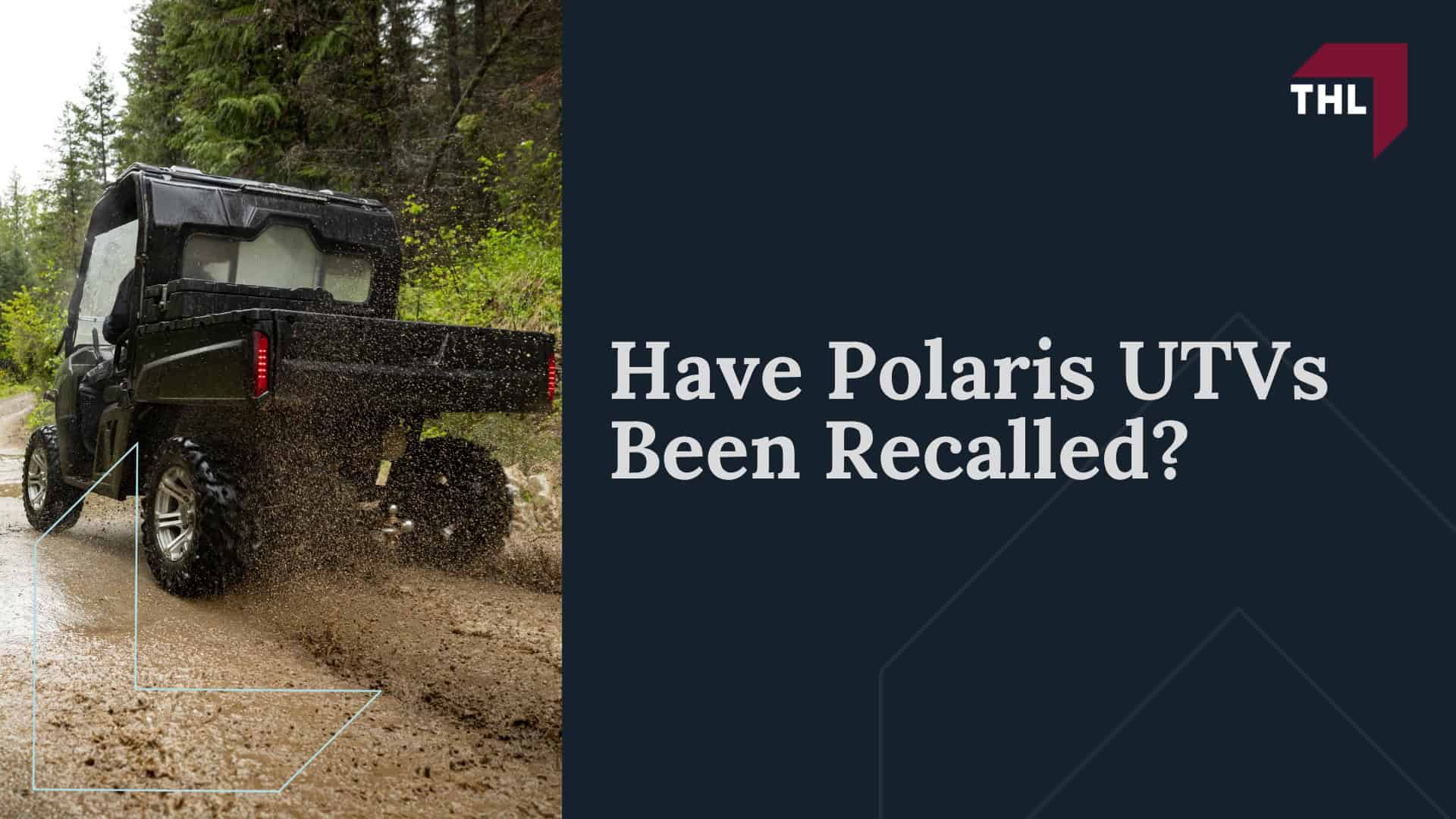
Have Polaris UTVs Been Recalled?

Yes.

Polaris Industries has recalled numerous utility terrain vehicles and recreational off-road vehicles because of defects that may create fire, burn, rollover, ejection, collision, and other serious injury risks.

The recalled vehicles have included models from the Polaris Ranger, Ranger Crew, RZR, General, Pro XD, Ranger XP Kinetic, and Pro XD Kinetic product lines.

Depending on the recall, the identified problem or hazard has involved fuel leaks, electrical shorts, overheating components, defective clutches, damaged brake lines, sticking throttles, steering failures, loose seat-belt anchors, defective door handles, or missing rollover-protection fasteners.
Have Polaris UTVs Been Recalled

Each recall generally applies to particular model years and certain VINs.

Consumers should search using the complete vehicle identification number (VIN) rather than assuming that every vehicle with the same model name is included.

Polaris’s online recall tool allows owners to search by VIN, model year, and model, and its current database covers incomplete safety recalls conducted within the past 15 calendar years.

Polaris UTV Fire Hazard Recalls

Polaris UTV fire recalls have involved fuel leaks, overheated engines, damaged electrical wiring, battery-terminal contact, loose charging-system components, broken clutch belts, defective winch wiring, and excessive heat near combustible vehicle parts.

Have Polaris UTVs Been Recalled; Polaris UTV Fire Hazard Recalls

Significant Polaris UTV fire recalls have included:

  • 2013–2016 RZR 900 and RZR 1000 vehicles: Approximately 133,000 vehicles were recalled after more than 160 reported fires. The incidents included 19 reported injuries and the death of a 15-year-old passenger following a rollover and fire.
  • 2016 RZR XP Turbo and XP 4 Turbo vehicles: Approximately 13,000 vehicles were recalled because the engine could overheat and a turbo drain tube could loosen. Polaris received 19 fire reports and six reports of burn injuries, including severe burns to a young child in a fire that also burned 15 acres of forest.
  • 2014 Ranger XP 900 and Crew 900 vehicles: Approximately 42,500 vehicles were recalled because a heat shield could fall off. Polaris received 36 reports of overheating or fire, including three minor burns and one sprained wrist.
  • 2024–2025 RZR XP 1000 and XP 4 1000 vehicles: Approximately 21,000 UTVs were recalled because the seat base could damage the positive battery-terminal cover, exposing the battery post and causing an electrical short.
  • 2023–2024 Ranger XP Kinetic and 2025 Pro XD Kinetic vehicles: A cracked charging-system component could allow water to contact high-voltage components and cause a short circuit. Polaris identified 47 reports of component failures, including six reports of melting or fire and four reports of sparking or smoke.
  • 2024 Ranger XD 1500 and Crew XD 1500 vehicles: Winch wiring could overheat because of a loose ground connection. The firm received a report of fire, although no injuries were reported.
  • 2022–2023 RZR Pro R and Pro R 4 vehicles: An improperly manufactured alternator could fail and create a fire hazard. Polaris identified four incidents, including two alternator failures and two fires.

The remedy for many fire recalls is a free repair performed by an authorized Polaris dealer.

Recall notices frequently instruct consumers to immediately stop using the affected vehicles until the inspection or repair has been completed.

Polaris UTV Mechanical and Safety Recalls

Not every Polaris UTV recall concerns a fire.

Other recalls have involved steering, braking, throttles, doors, seat belts, clutches, rollover protection, and vehicle-control software.

Examples include:

  • A Ranger and Pro XD throttle recall involving approximately 104,178 vehicles globally. Polaris received 279 reports of slow-returning or sticking throttle pedals, including 19 crashes and three reported injuries.
  • A Polaris General recall involving approximately 19,000 vehicles because the steering shaft could shift and detach. Polaris received five reports of steering-shaft separation and one report of a broken hand.
  • A Pro XD recall involving approximately 760 vehicles because the rear brake line could be punctured and cause the rear brakes to fail. Polaris received eight reports of rear-brake failure, although no crashes or injuries were reported at the time.
  • A 2023–2024 RZR recall involving improperly routed brake lines that could contact the front wheels and cause brake loss. Polaris received three reports of incorrect brake-line installation and loss of brakes, including one vehicle that struck a large rock.
  • A 2025 recall of RZR Pro R and Pro R 4 vehicles because rollover protective structure fasteners could be loose or missing. The defect could reduce the structure’s ability to protect occupants during a tip-over or rollover.
  • A Ranger XD 1500 recall because doors could unexpectedly open during operation, potentially allowing an unrestrained occupant to be ejected or increasing the risk of a crash. Polaris received 20 reports of doors opening unexpectedly.
  • A Ranger and Pro XD recall because a defective weld could allow a passenger-side seat-belt anchor to separate from the frame. Polaris received three reports of improper welds, with no reported injuries at the time of the recall.

A failure involving brakes, steering, restraints, doors, throttles, or rollover protection can result in loss of control, occupant ejection, rollover, or impact injuries.

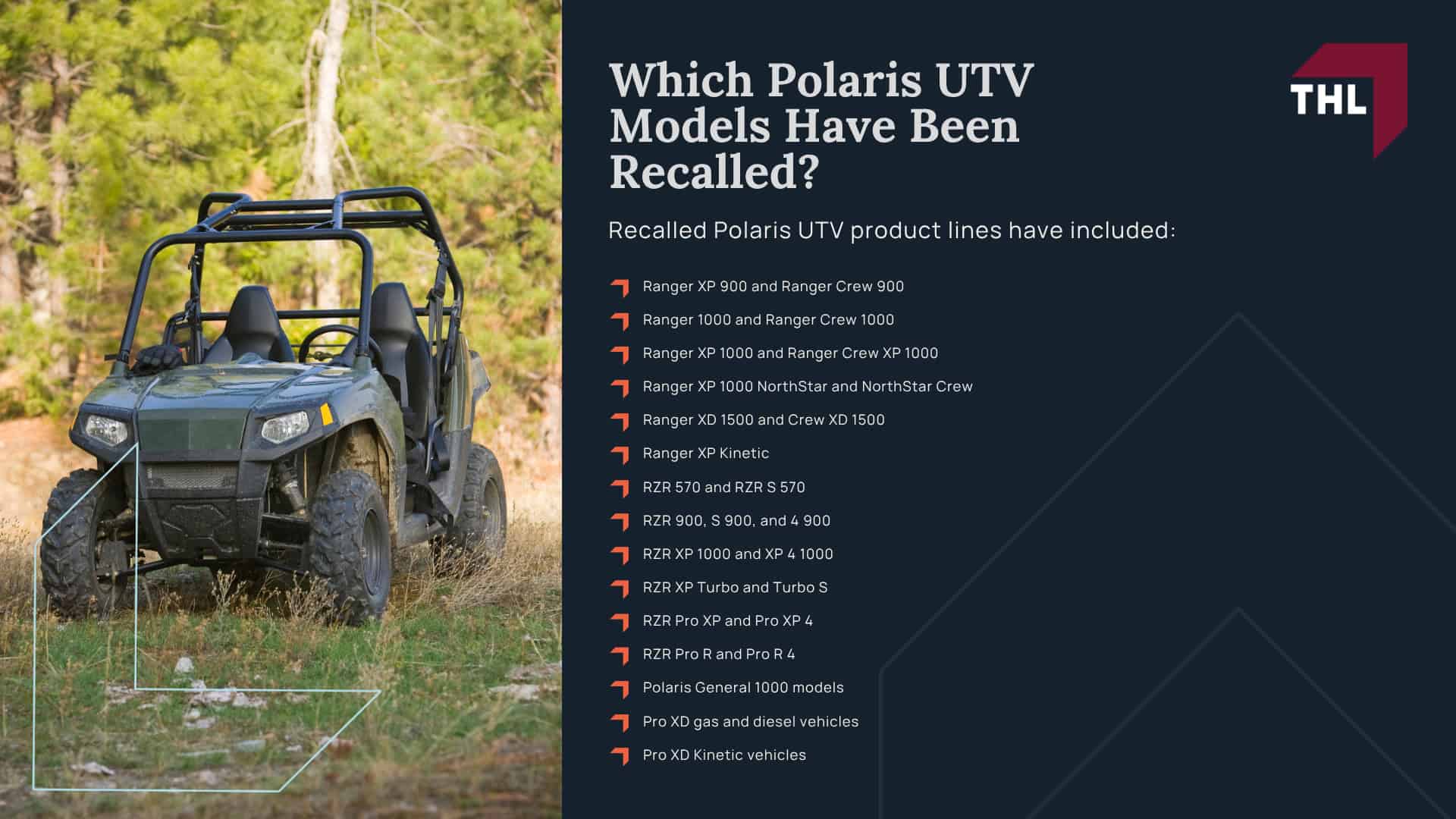
Which Polaris UTV Models Have Been Recalled?

Polaris recalls have affected numerous two-seat, three-seat, four-seat, and six-seat configurations.

The models involved have changed over time, and a vehicle may be identified differently depending on the specific recall notice.
Have Polaris UTVs Been Recalled; Polaris UTV Fire Hazard Recalls; Which Polaris UTV Models Have Been Recalled

Recalled Polaris UTV product lines have included:

  • Ranger XP 900 and Ranger Crew 900
  • Ranger 1000 and Ranger Crew 1000
  • Ranger XP 1000 and Ranger Crew XP 1000
  • Ranger XP 1000 NorthStar and NorthStar Crew
  • Ranger XD 1500 and Crew XD 1500
  • Ranger XP Kinetic
  • RZR 570 and RZR S 570
  • RZR 900, S 900, and 4 900
  • RZR XP 1000 and XP 4 1000
  • RZR XP Turbo and Turbo S
  • RZR Pro XP and Pro XP 4
  • RZR Pro R and Pro R 4
  • Polaris General 1000 models
  • Pro XD gas and diesel vehicles
  • Pro XD Kinetic vehicles

Many recalled vehicles were available in black, blue, gray, orange, red, white, and camouflage color schemes.

Exterior color, seating capacity, or model name alone does not determine whether a UTV is included in a recall. Owners should use the complete VIN to check the official recall database.

On many Ranger, General, and Kinetic vehicles, the VIN is printed on the left rear portion of the frame, on the driver’s side under the cargo box.

On many RZR vehicles, the VIN is located in the left rear wheel well or on the driver’s-side rear frame rail.

“POLARIS” is commonly stamped on the front grille, while the product-line name may be printed on the side panels, fenders, or cargo area.

Polaris Ranger and Ranger Crew Recalls

Polaris Ranger and Ranger Crew recalls have involved fires, fuel leaks, electrical shorts, sticking throttles, defective brake lines, loose heat shields, defective seat-belt anchors, winch wiring, and doors that may open unexpectedly.

Notable examples include:

  • Model Year 2014 Ranger XP 900, XP 900 EPS, and Crew 900 vehicles recalled because a heat shield could detach and create fire and burn hazards
  • Certain Model Year 2020–2021 Ranger and Pro XD vehicles recalled because throttle pedals could stick or return to idle too slowly
  • Certain Model Year 2021–2023 Ranger vehicles recalled because a fuel-pump outlet connector could leak fuel near an ignition source
  • Model Year 2023 Ranger XP 1000 NorthStar and NorthStar Crew vehicles recalled because an improperly installed brake line could cause overheated brakes, reduced braking, fire, or a crash
  • Model Year 2024 Ranger and Crew vehicles recalled because a defective weld could allow a passenger seat-belt anchor to detach
  • Model Year 2024 Ranger XD 1500 and Crew XD 1500 vehicles recalled because winch wiring could overheat
  • Model Year 2024–2025 Ranger XD 1500 and Crew XD 1500 vehicles recalled because a door could unexpectedly open during operation
  • Model Year 2025–2026 Ranger XP 1000 NorthStar and Crew XP 1000 NorthStar vehicles recalled because an improperly routed alternator cable could contact the battery and cause an electrical short

The 2023 Ranger XP 1000 NorthStar brake-line recall included one report of fire and three reports of kinked brake lines.

Consumers were instructed to immediately stop using the recalled vehicles and contact Polaris or an authorized dealer to schedule a free inspection and repair.

Polaris RZR Recalls

Polaris RZR recalls have involved some of the most serious publicly reported Polaris UTV fires and burn injuries.

They have also addressed fuel leaks, engine overheating, battery-terminal contact, clutch fractures, brake loss, steering or braking components, and rollover-protection fasteners.

The April 2016 RZR recall covered approximately 133,000 Model Year 2013–2016 RZR 900 and RZR 1000 vehicles.

Polaris had received more than 160 fire reports involving the recalled vehicles, including 19 reported injuries and one death.

The reported injuries included first-, second-, and third-degree burns.

Additional RZR recalls have included:

  • Approximately 53,000 Model Year 2015 RZR vehicles with fuel-tank vent lines that could become pinched and cause fuel leaks. Polaris received reports of fuel leaks, two fires, and one minor burn injury involving an RZR 900.
  • Approximately 13,000 Model Year 2016 RZR XP Turbo vehicles recalled after 19 fire reports and six burn injuries.
  • Approximately 27,300 Model Year 2021 RZR XP Turbo and Turbo S vehicles recalled because the clutch could fracture and eject fragments. Polaris received 206 clutch-failure reports, including six fires, two injuries, and one vehicle tip-over.
  • Model Year 2024–2025 RZR XP 1000 and XP 4 1000 vehicles recalled because the seat base could damage a battery-terminal cover and create an electrical short.
  • Model Year 2022–2025 RZR Pro R and Pro R 4 vehicles recalled because loose or missing ROPS fasteners could reduce occupant protection during a rollover.

A recalled RZR should not continue to be used contrary to the stop-ride or inspection instructions provided by Polaris and the CPSC.

Polaris General, Pro XD, and Kinetic Recalls

Polaris General vehicles have been recalled because of fire, burn, steering, brake, and tire-pressure concerns.

A 2017 recall involving RZR and General vehicles addressed engine misfires that could cause excessive exhaust heat and contaminated brake master cylinders that could create unintended brake drag.

Polaris received 14 reports of fires involving the brake-master-cylinder issue and additional reports involving fire or melted vehicle components after engine misfires.

A separate General recall involved approximately 19,000 Model Year 2016 and 2017 vehicles because the steering-wheel shaft could shift and detach.

The firm received five reports of steering separation and one report of a broken hand.

Pro XD recalls have included:

  • Rear brake lines that could be punctured and cause brake failure
  • Sticking or slow-returning throttle pedals
  • Fuel-pump connections that could leak near an ignition source
  • Defective passenger seat-belt anchor welds
  • High-voltage charging components used in Pro XD Kinetic vehicles

The 2025 Ranger XP Kinetic and Pro XD Kinetic recall included all VINs of the affected Model Year 2023–2024 Ranger XP Kinetic and Model Year 2025 Pro XD Kinetic vehicles.

The recalled electric UTVs were sold at Polaris dealers nationwide, and approximately 7,100 vehicles were affected globally.

Another Kinetic recall involved loose high-voltage motor-controller cables that could arc or overheat during operation, posing fire and crash hazards and a risk of serious injury.

Why Are Polaris UTVs Being Recalled?

Polaris UTVs have been recalled when a component, assembly process, software condition, or safety system may expose drivers and passengers to unreasonable fire, crash, ejection, or injury risks.
Have Polaris UTVs Been Recalled; Polaris UTV Fire Hazard Recalls; Which Polaris UTV Models Have Been Recalled; Why Are Polaris UTVs Being Recalled

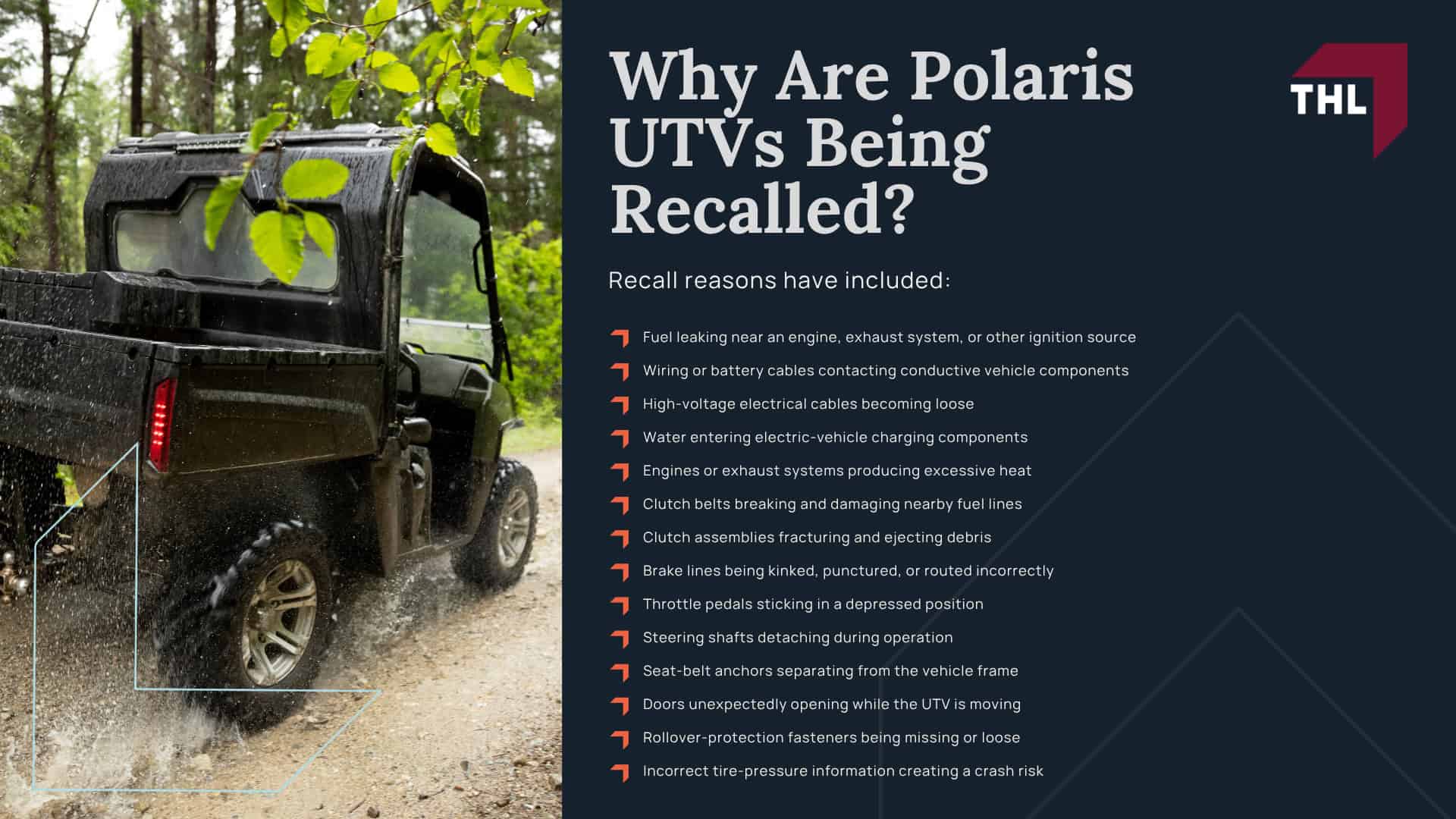
Recall reasons have included:

  • Fuel leaking near an engine, exhaust system, or other ignition source
  • Wiring or battery cables contacting conductive vehicle components
  • High-voltage electrical cables becoming loose
  • Water entering electric-vehicle charging components
  • Engines or exhaust systems producing excessive heat
  • Clutch belts breaking and damaging nearby fuel lines
  • Clutch assemblies fracturing and ejecting debris
  • Brake lines being kinked, punctured, or routed incorrectly
  • Throttle pedals sticking in a depressed position
  • Steering shafts detaching during operation
  • Seat-belt anchors separating from the vehicle frame
  • Doors unexpectedly opening while the UTV is moving
  • Rollover-protection fasteners being missing or loose
  • Incorrect tire-pressure information creating a crash risk

A recall notice describes a potential hazard affecting an identified vehicle population.

It does not mean that every recalled UTV has experienced the defect or that every accident involving that model was caused by the recalled condition.

How Alleged Polaris UTV Defects May Cause Fires or Accidents

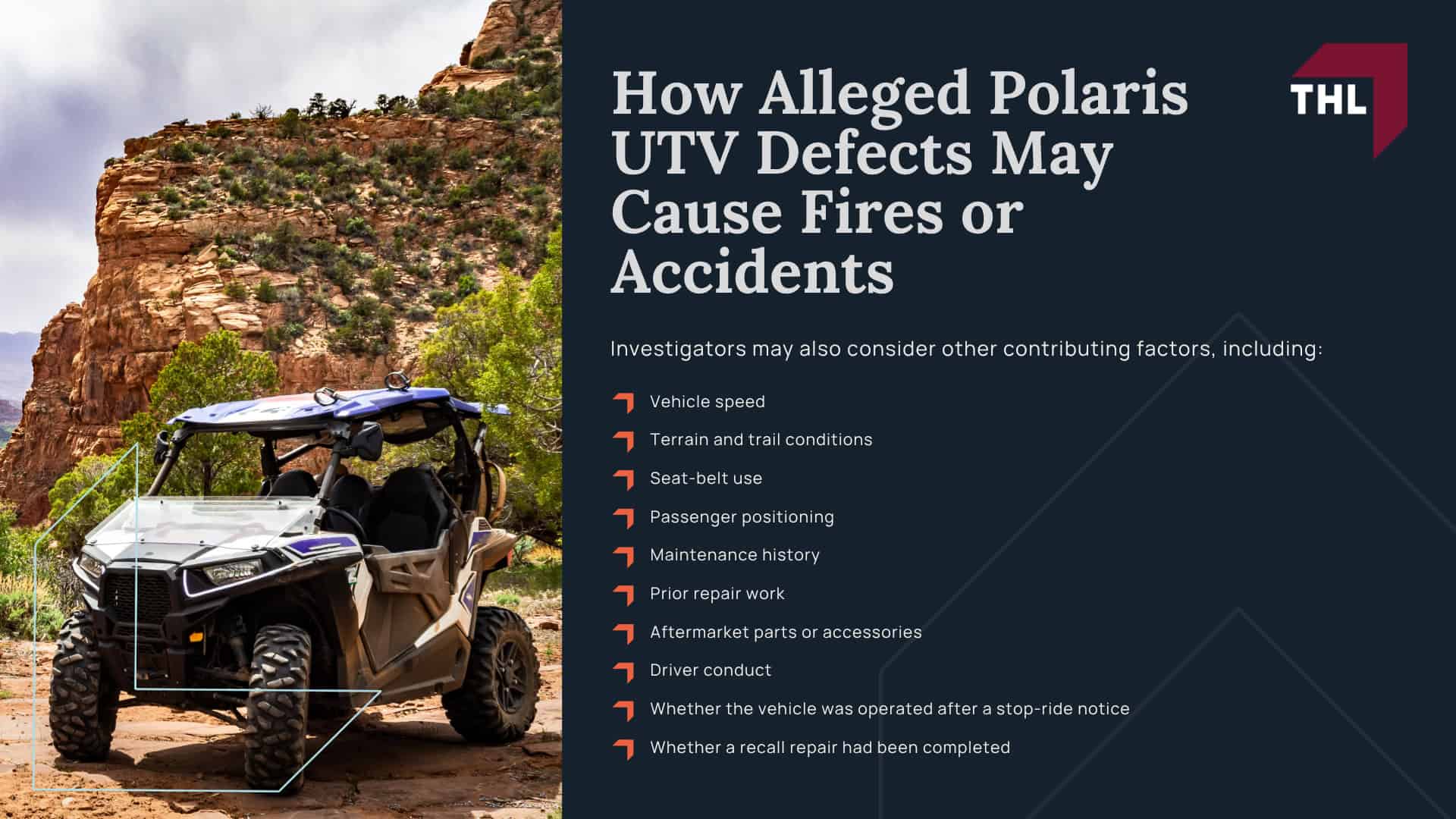
A Polaris UTV defect may cause an accident when a component failure interrupts the driver’s ability to steer, stop, regulate speed, or keep occupants safely contained within the vehicle.

A fuel leak may allow gasoline to reach a hot engine or exhaust component and ignite.

An electrical cable may arc against the frame or battery post, producing sparks, melted components, smoke, or fire.

A defective brake or throttle system may cause a driver to lose control and strike an object, leave the trail, or roll the vehicle.

Restraint and structural defects can worsen the consequences of an initial crash.

A failed seat-belt anchor, open door, or compromised rollover protective structure may leave an occupant vulnerable to partial ejection, complete ejection, entrapment, or contact with the ground.
Have Polaris UTVs Been Recalled; Polaris UTV Fire Hazard Recalls; Which Polaris UTV Models Have Been Recalled; Why Are Polaris UTVs Being Recalled; How Alleged Polaris UTV Defects May Cause Fires or Accidents

Investigators may also consider other contributing factors, including:

  • Vehicle speed
  • Terrain and trail conditions
  • Seat-belt use
  • Passenger positioning
  • Maintenance history
  • Prior repair work
  • Aftermarket parts or accessories
  • Driver conduct
  • Whether the vehicle was operated after a stop-ride notice
  • Whether a recall repair had been completed

Fuel Leaks, Electrical Shorts, and Battery Defects

Fuel-system defects may involve the fuel pump, fuel-tank vent, connector, line, flange, or another component that allows gasoline to escape.

When leaking fuel reaches a hot surface, electrical spark, or open flame, the result may be a rapidly spreading vehicle fire.

Polaris recalls have identified fuel leaks caused by:

  • Pinched or misrouted fuel-tank vent lines
  • Defective fuel-pump outlet connectors
  • Broken clutch belts damaging nearby fuel lines
  • Fuel lines positioned outside protective brackets
  • Leaks near hot engine or exhaust components

Electrical fire recalls have involved damaged battery-terminal covers, loose motor-controller cables, improperly routed alternator cables, defective alternators, cracked charging-system filters, and overheated winch wiring.

An electric UTV may also create a fire risk during charging.

Polaris instructed owners affected by the 2025 Kinetic recall to avoid washing or operating the vehicle in wet conditions and to charge the vehicle outside while monitoring the beginning of the charging process until the repair was completed.

Clutch, Brake, Steering, and Throttle Failures

A clutch failure can cause fragments to leave the clutch housing, damage a fuel line, produce a fire, or interfere with vehicle movement.

The 2023 RZR XP Turbo recall followed 206 reports of clutch failures, including fires, injuries, and a vehicle tip-over.

Brake defects may cause reduced stopping ability, brake loss, overheating, or fire.

An improperly routed brake line may contact a wheel, while a kinked line may keep the brakes pressurized during operation.

The driver may be unable to stop before hitting a tree, rock, vehicle, embankment, or other obstacle.

A steering shaft that separates can produce a sudden loss of directional control.

A sticking throttle can cause the UTV to continue accelerating even after the driver releases the pedal.

Polaris’s expanded throttle recall involved 19 reported crashes and three reported injuries.

Seat Belt, Door, and Occupant-Restraint Defects

Seat belts, doors, and nets can help restrain or contain occupants within the passenger area during a crash or rollover.

The rollover protective structure is designed to preserve protective space around occupants if the vehicle tips or rolls.

A failed restraint or containment component may increase the risk of partial or complete ejection, while a compromised rollover structure may reduce occupant protection during a rollover.

Polaris recalls have addressed:

  • Loose seat-belt anchor fasteners
  • Improperly welded seat-belt buckle brackets
  • Seat-belt anchor points separating from the frame
  • Door handles sticking and doors opening during operation
  • Loose or missing rollover-protection fasteners

In the 2024 Ranger and Pro XD seat-belt recall, the passenger-side anchor could separate because of a defective bracket weld.

Consumers were instructed not to operate the recalled vehicle with passengers until an authorized dealer completed the inspection and necessary repair.

Polaris was contacting registered owners directly about the recall.

The 2025 Ranger XD door recall involved 20 reports of doors opening unexpectedly while the recalled vehicles were being used.

Although no injuries or crashes had been reported at the time, an open door may increase the risk that an unrestrained occupant is ejected.

Polaris UTV Injury Risks

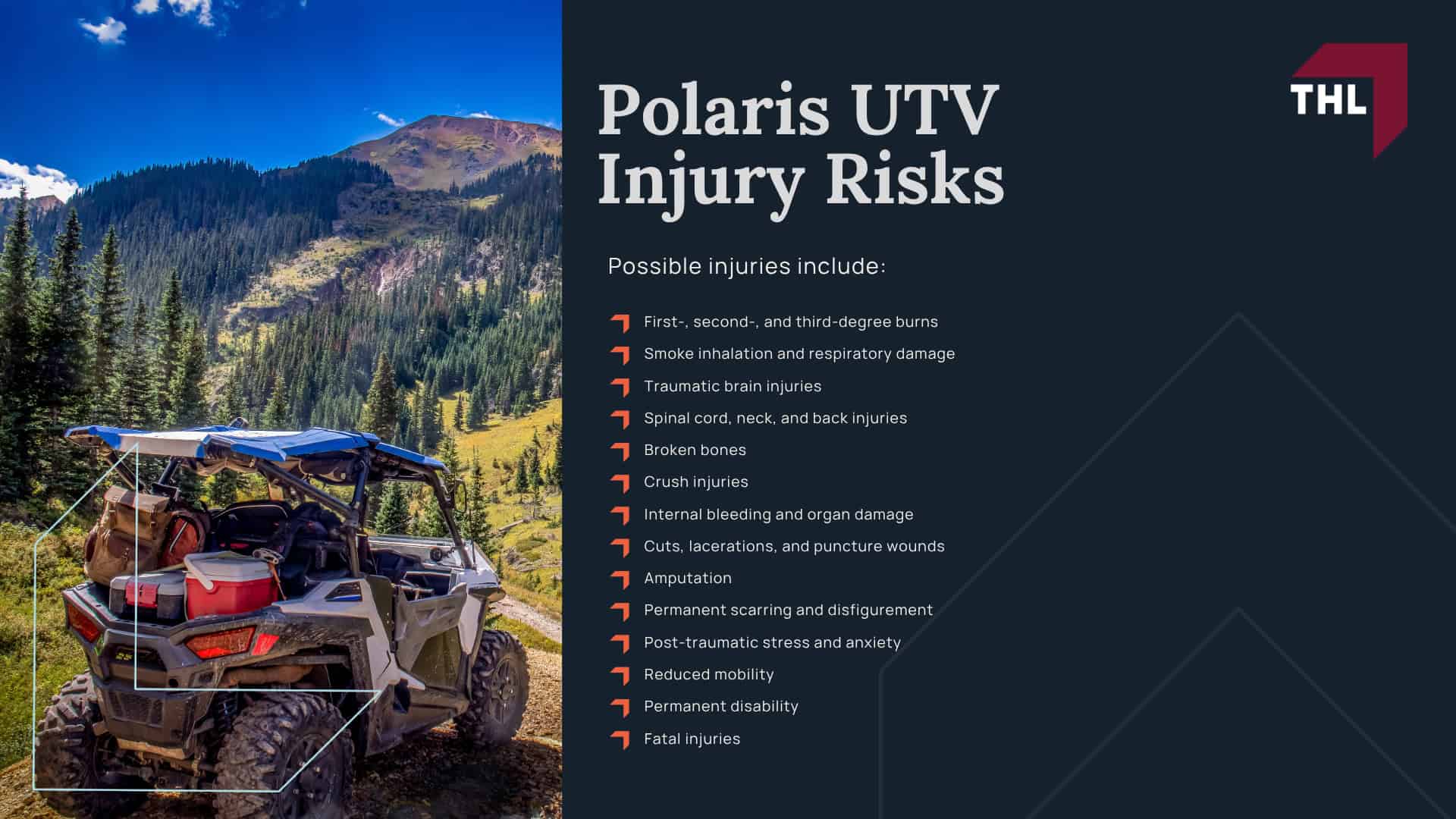
A Polaris UTV fire, rollover, ejection, brake failure, steering failure, or collision can cause serious and potentially fatal injuries.
Have Polaris UTVs Been Recalled; Polaris UTV Fire Hazard Recalls; Which Polaris UTV Models Have Been Recalled; Why Are Polaris UTVs Being Recalled; How Alleged Polaris UTV Defects May Cause Fires or Accidents; Polaris UTV Injury Risks

Possible injuries include:

  • First-, second-, and third-degree burns
  • Smoke inhalation and respiratory damage
  • Traumatic brain injuries
  • Spinal cord, neck, and back injuries
  • Broken bones
  • Crush injuries
  • Internal bleeding and organ damage
  • Cuts, lacerations, and puncture wounds
  • Amputation
  • Permanent scarring and disfigurement
  • Post-traumatic stress and anxiety
  • Reduced mobility
  • Permanent disability
  • Fatal injuries

The severity of an injury may depend on the speed of the vehicle, whether it rolled, whether the occupants were restrained, whether a fire occurred, and whether a rider became trapped or ejected.

Burn Injuries and Smoke Inhalation

A Polaris UTV fire may expose drivers and passengers to direct flames, extreme heat, smoke, melted plastic, burning fuel, and toxic combustion products.

Burn injuries may result from direct contact with flames, burning fuel, heated vehicle components, or melted materials, as well as while an occupant attempts to escape a burning vehicle.

Severe burns can damage the skin, nerves, blood vessels, muscles, and underlying tissue.

Treatment may involve hospitalization, debridement, skin grafts, reconstructive surgery, infection control, rehabilitation, and long-term follow-up care.

Smoke inhalation may injure the throat, airway, and lungs even when visible burns are limited.

Survivors may experience breathing difficulties, chronic respiratory symptoms, permanent scarring, reduced range of motion, and psychological trauma.

Rollover, Ejection, and Crush Injuries

A UTV may roll after a loss of control caused by a steering, brake, or throttle failure, or after striking an obstacle or entering unstable terrain.

An occupant may also be ejected when a seat belt, buckle, door, or other containment component fails.

During a rollover or ejection, a driver or passenger may:

  • Strike the frame, roof, door, ground, tree, or another object
  • Be thrown from the passenger compartment
  • Have an arm or leg extend outside the vehicle
  • Become pinned beneath the UTV
  • Suffer injuries from loose cargo
  • Be struck by another passenger
  • Sustain burns while trapped in a burning vehicle
  • Suffer crush damage to the chest, pelvis, head, arms, or legs

Crush injuries can damage muscles, nerves, blood vessels, and internal organs.

Severe cases may result in compartment syndrome, amputation, paralysis, kidney complications, or death.

Brain Injuries, Spinal Injuries, and Broken Bones

A UTV crash can cause the head to strike the frame, rollover structure, windshield, door, ground, or another object.

Traumatic brain injuries may include concussions, skull fractures, bleeding, brain swelling, memory problems, cognitive impairment, and permanent neurological disability.

Spinal injuries may involve:

  • Fractured vertebrae
  • Herniated or damaged discs
  • Spinal cord trauma
  • Nerve compression
  • Partial or complete paralysis
  • Loss of sensation
  • Chronic pain
  • Bowel or bladder complications

Broken bones may involve the ribs, pelvis, arms, wrists, legs, ankles, feet, or facial structures.

Complex fractures may require surgery, implanted hardware, physical therapy, and extended time away from work.

Polaris UTV Fires, Injuries, and Deaths

CPSC recall records document fires, burn injuries, crashes, and at least one death connected with specific recalled Polaris UTV populations.

The April 2016 RZR recall followed more than 160 reported fires involving recalled RZR vehicles.

The reported incidents resulted in 19 injuries and the death of a 15-year-old passenger after a rollover and fire.

Other documented recall incidents include:

  • Six burn-injury reports involving recalled RZR XP Turbo vehicles
  • Three minor burns and one sprained wrist involving Ranger 900 fires
  • Two injuries connected with recalled RZR clutch failures
  • Three injuries connected with sticking Ranger and Pro XD throttle pedals
  • One broken hand after a General steering-shaft separation
  • Fires caused by damaged fuel lines, electrical shorts, alternator failures, battery-terminal contact, winch wiring, and overheated brakes

In April 2018, Polaris agreed to pay a $27.25 million civil penalty to settle CPSC staff charges that the company failed to immediately report certain fire and safety hazards involving RZR and Ranger recreational off-road vehicles.

Polaris did not admit the CPSC staff’s charges as part of the settlement.

Does a Polaris Recall Prove the UTV Was Defective?

No.

A recall may provide evidence that Polaris or a regulator identified a safety concern affecting a particular group of vehicles, but recall status does not automatically establish liability in an individual product liability case.

The elements a claimant must prove depend on the applicable state law and the legal theory asserted.

A claim generally requires evidence of a legally recognized product defect, negligent act, breach of warranty, or other basis for liability, along with evidence connecting that conduct or condition to the accident and resulting injuries or financial losses.

Polaris or another defendant may dispute causation and argue that terrain, maintenance, aftermarket modifications, driver conduct, seat-belt use, or another factor caused or contributed to the accident.
Have Polaris UTVs Been Recalled; Polaris UTV Fire Hazard Recalls; Which Polaris UTV Models Have Been Recalled; Why Are Polaris UTVs Being Recalled; How Alleged Polaris UTV Defects May Cause Fires or Accidents; Polaris UTV Injury Risks; Does a Polaris Recall Prove the UTV Was Defective

A vehicle also does not necessarily need to appear in an official recall for a claim to be investigated.

An independent inspection may identify a similar component failure or another design, manufacturing, or warning issue supported by the evidence.

Can You File a Polaris UTV Lawsuit?

You may be able to file a Polaris UTV lawsuit if an alleged design defect, manufacturing defect, inadequate warning, defective component, or negligent repair caused a fire, rollover, ejection, collision, serious injury, death, or property damage.

Depending on the facts and applicable state law, potential claims may include:

  • Strict product liability based on an alleged design, manufacturing, or warning defect
  • Negligence
  • Negligent repair or service
  • Breach of express or implied warranty
  • Wrongful death when an alleged defect causes a fatal injury
  • Property-damage claims when recognized under applicable law

A recall repair does not necessarily resolve a claim arising from an injury or property loss that occurred before the repair.

The effect of any settlement agreement, reimbursement, or release depends on its terms and applicable law.

Who May Be Liable for a Polaris UTV Injury?

The party responsible for a Polaris UTV injury depends on what failed and how the accident occurred.

Have Polaris UTVs Been Recalled; Polaris UTV Fire Hazard Recalls; Which Polaris UTV Models Have Been Recalled; Why Are Polaris UTVs Being Recalled; How Alleged Polaris UTV Defects May Cause Fires or Accidents; Polaris UTV Injury Risks; Does a Polaris Recall Prove the UTV Was Defective; Who May Be Liable for a Polaris UTV Injury

Potential defendants may include:

  • Polaris Industries Inc. or another related corporate entity
  • A fuel-pump, battery, brake, clutch, steering, restraint, or electrical-component manufacturer
  • A Polaris dealer that performed an improper repair
  • A repair shop that negligently serviced or modified the UTV
  • A rental company that provided an unsafe vehicle
  • A distributor or seller
  • A negligent driver
  • A vehicle owner who knowingly permitted use of an unsafe UTV

A dealer is not automatically responsible merely because it sold the vehicle.

Liability may require evidence that the dealer performed negligent work, ignored an identified hazard, failed to complete an agreed repair, or engaged in other conduct recognized by applicable state law.

Evidence Needed for a Polaris UTV Lawsuit

Product liability cases often depend on physical and technical evidence showing what failed and how the failure caused the accident.

Have Polaris UTVs Been Recalled; Polaris UTV Fire Hazard Recalls; Which Polaris UTV Models Have Been Recalled; Why Are Polaris UTVs Being Recalled; How Alleged Polaris UTV Defects May Cause Fires or Accidents; Polaris UTV Injury Risks; Does a Polaris Recall Prove the UTV Was Defective; Who May Be Liable for a Polaris UTV Injury; Evidence Needed for a Polaris UTV Lawsuit

Important evidence may include:

  • The complete Polaris UTV
  • Burned, broken, detached, or melted components
  • The vehicle identification number
  • The exact model and model year
  • Fuel pumps, tanks, connectors, and lines
  • Batteries, cables, alternators, chargers, and wiring
  • Brake lines, calipers, and master-cylinder components
  • Clutches, belts, and drivetrain parts
  • Steering and throttle components
  • Seat belts, anchors, brackets, doors, and ROPS fasteners
  • Photographs and videos of the vehicle and accident scene
  • Police, fire, and emergency medical reports
  • Recall and stop-ride notices
  • Purchase and warranty documents
  • Maintenance and repair records
  • Communications with Polaris or a dealer
  • Documentation of aftermarket equipment
  • Medical records and injury photographs
  • Lost-wage records
  • Property-damage estimates
  • Witness statements
  • Expert engineering, fire-origin-and-cause, or accident-reconstruction analyses

The vehicle should generally be preserved before repairs, disposal, or destructive testing.

Altering or discarding the UTV may prevent an expert from identifying the alleged defect.

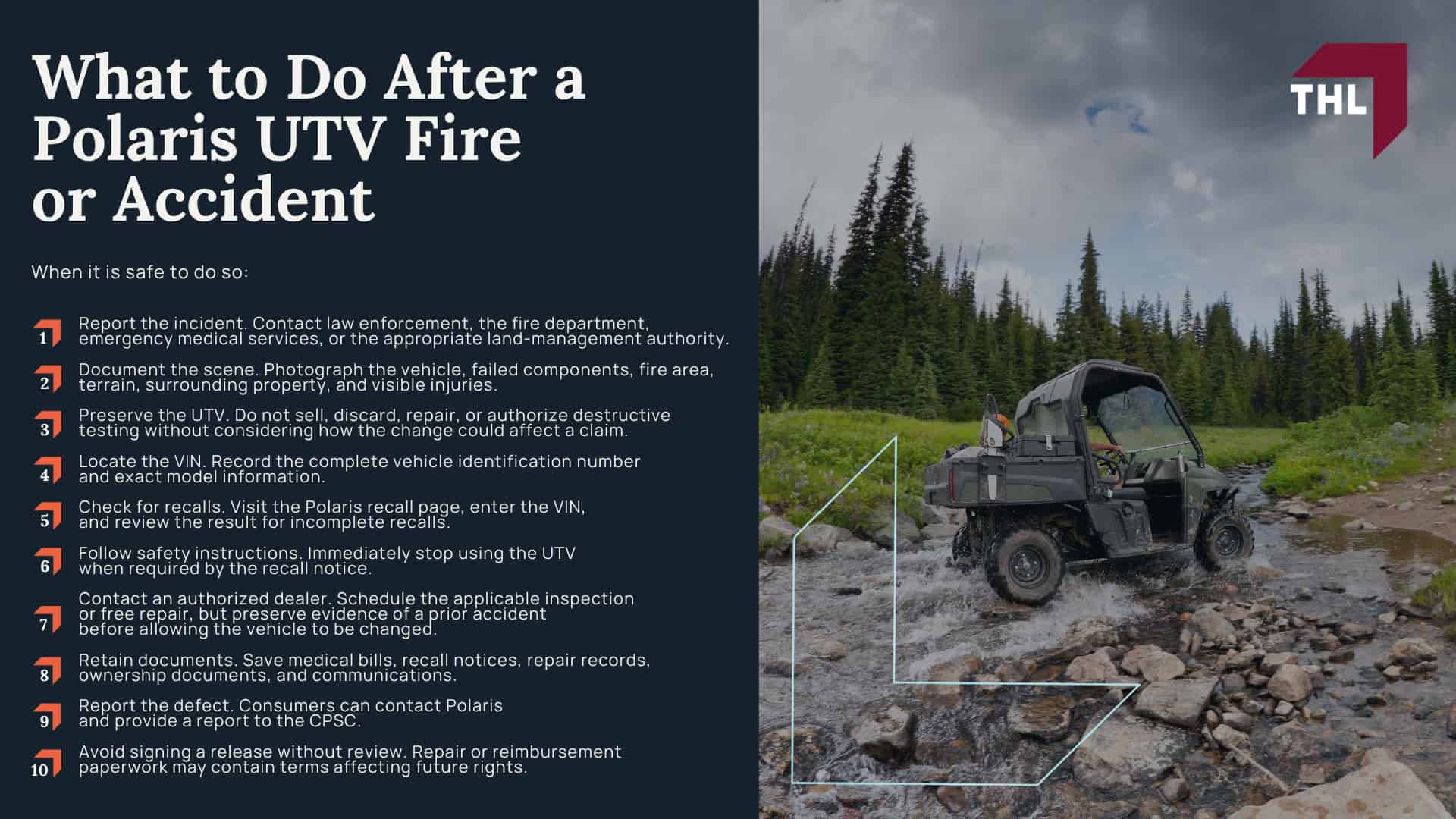
What to Do After a Polaris UTV Fire or Accident

After a Polaris UTV fire, rollover, ejection, or mechanical failure, seek emergency assistance and obtain medical care.
Have Polaris UTVs Been Recalled; Polaris UTV Fire Hazard Recalls; Which Polaris UTV Models Have Been Recalled; Why Are Polaris UTVs Being Recalled; How Alleged Polaris UTV Defects May Cause Fires or Accidents; Polaris UTV Injury Risks; Does a Polaris Recall Prove the UTV Was Defective; Who May Be Liable for a Polaris UTV Injury; Evidence Needed for a Polaris UTV Lawsuit; What to Do After a Polaris UTV Fire or Accident

When it is safe to do so:

  1. Report the incident. Contact law enforcement, the fire department, emergency medical services, or the appropriate land-management authority.
  2. Document the scene. Photograph the vehicle, failed components, fire area, terrain, surrounding property, and visible injuries.
  3. Preserve the UTV. Do not sell, discard, repair, or authorize destructive testing without considering how the change could affect a claim.
  4. Locate the VIN. Record the complete vehicle identification number and exact model information.
  5. Check for recalls. Visit the Polaris recall page, enter the VIN, and review the result for incomplete recalls.
  6. Follow safety instructions. Immediately stop using the UTV when required by the recall notice.
  7. Contact an authorized dealer. Schedule the applicable inspection or free repair, but preserve evidence of a prior accident before allowing the vehicle to be changed.
  8. Retain documents. Save medical bills, recall notices, repair records, ownership documents, and communications.
  9. Report the defect. Consumers can contact Polaris and provide a report to the CPSC.
  10. Avoid signing a release without review. Repair or reimbursement paperwork may contain terms affecting future rights.

Owners of recalled vehicles should follow the instructions issued for their specific VIN and recall campaign.

Some Polaris recalls require owners to stop using the vehicle until repair, while others permit limited operation only after specified inspections or precautions have been completed.

Compensation in a Polaris UTV Lawsuit

Compensation in a Polaris UTV case depends on the type of claim, severity of the injuries, available evidence, property losses, responsible parties, and applicable state law.

Depending on the claim and jurisdiction, potential damages may include:

Have Polaris UTVs Been Recalled; Polaris UTV Fire Hazard Recalls; Which Polaris UTV Models Have Been Recalled; Why Are Polaris UTVs Being Recalled; How Alleged Polaris UTV Defects May Cause Fires or Accidents; Polaris UTV Injury Risks; Does a Polaris Recall Prove the UTV Was Defective; Who May Be Liable for a Polaris UTV Injury; Evidence Needed for a Polaris UTV Lawsuit; What to Do After a Polaris UTV Fire or Accident; Compensation in a Polaris UTV Lawsuit

Potential damages may include:

  • Emergency medical treatment
  • Hospitalization
  • Surgery
  • Burn care and skin grafts
  • Medication and diagnostic testing
  • Physical and occupational therapy
  • Future medical care
  • Lost wages
  • Reduced earning capacity
  • Pain and suffering
  • Emotional distress
  • Scarring and disfigurement
  • Permanent disability
  • Loss of mobility
  • Loss of enjoyment of life
  • Vehicle repair or replacement
  • Damage to a trailer, garage, home, land, or other property
  • Funeral and burial expenses in a qualifying wrongful death claim
  • Loss of companionship or consortium when permitted by state law
  • Punitive damages when legally permitted and supported by the evidence

There is no standard or guaranteed Polaris UTV settlement amount.

A severe burn, spinal cord injury, traumatic brain injury, amputation, or death may produce substantially different losses than a minor injury or vehicle-only fire.

Polaris UTV Wrongful Death Claims

Eligible surviving family members may be able to pursue a wrongful death lawsuit when an alleged Polaris UTV defect causes a fatal fire, rollover, ejection, collision, or other accident.

Depending on state law, wrongful death damages may include:

  • Funeral and burial expenses
  • Lost income and financial support
  • Loss of household services
  • Loss of companionship, care, or guidance
  • Other economic and non-economic losses suffered by eligible survivors

A separate survival or estate claim may also be available for certain losses incurred by the deceased person before death, including medical expenses and other damages permitted under applicable state law.

The person authorized to bring a wrongful death claim varies by jurisdiction.

A surviving spouse, child, parent, personal representative, estate administrator, or another statutorily authorized person may have filing rights depending on state law.

Any wrongful death or survival claim must still establish that the alleged product defect or other legally actionable conduct caused the fatal incident.

How Long Do You Have to File a Lawsuit?

The filing deadline for a Polaris UTV lawsuit depends on the state, the type of legal claim, the date of injury, and whether a statute of repose applies.

The date of a recall does not automatically determine when an individual claim expires.

Personal injury and product liability statutes of limitations commonly provide a limited period measured from the accident or discovery of the injury.

Wrongful death claims may have a separate deadline that begins on the date of death.

Property damage, warranty, and consumer-protection claims may follow different rules.

A statute of repose can bar a product claim after a specified period measured from the date the UTV was manufactured, sold, or first delivered.

Special rules may apply to minors, delayed injury discovery, fraudulent concealment, or defendants located outside the state.

Waiting for a recall notice, dealer appointment, or repair generally does not pause every filing deadline.

Prompt investigation also helps preserve the vehicle, records, electronic information, and witness testimony.

Do You Qualify for a Polaris UTV Lawsuit?

You may qualify for a Polaris UTV lawsuit if an alleged design defect, manufacturing defect, defective component, inadequate warning, or negligent repair caused a fire, crash, rollover, ejection, serious injury, death, or significant property damage.

Recall status alone does not determine whether a claim is viable.

A recalled UTV does not automatically establish liability, and a non-recalled vehicle may still support a claim when evidence identifies a similar component failure or another legally recognized defect.

Have Polaris UTVs Been Recalled; Polaris UTV Fire Hazard Recalls; Which Polaris UTV Models Have Been Recalled; Why Are Polaris UTVs Being Recalled; How Alleged Polaris UTV Defects May Cause Fires or Accidents; Polaris UTV Injury Risks; Does a Polaris Recall Prove the UTV Was Defective; Who May Be Liable for a Polaris UTV Injury; Evidence Needed for a Polaris UTV Lawsuit; What to Do After a Polaris UTV Fire or Accident; Compensation in a Polaris UTV Lawsuit;  Do You Qualify for a Polaris UTV Lawsuit

The vehicle model, VIN, recall history, maintenance and repair records, accident circumstances, failed components, and resulting injuries or property losses may help determine whether the available evidence supports a claim.

Preserving the UTV before substantial repair or disposal can be important when an engineering or fire investigation is required.

TorHoerman Law Is Investigating Polaris UTV Claims

TorHoerman Law is investigating claims involving Polaris Ranger, Ranger Crew, RZR, General, Pro XD, and Kinetic UTV fires and mechanical failures.

Our legal team can investigate whether a design defect, manufacturing problem, defective component, inadequate warning, or negligent repair contributed to an accident.

This may include preserving the vehicle, reviewing recall and dealer records, obtaining police and fire reports, and consulting engineering, medical, fire-origin, and accident-reconstruction experts.

Have Polaris UTVs Been Recalled; Polaris UTV Fire Hazard Recalls; Which Polaris UTV Models Have Been Recalled; Why Are Polaris UTVs Being Recalled; How Alleged Polaris UTV Defects May Cause Fires or Accidents; Polaris UTV Injury Risks; Does a Polaris Recall Prove the UTV Was Defective; Who May Be Liable for a Polaris UTV Injury; Evidence Needed for a Polaris UTV Lawsuit; What to Do After a Polaris UTV Fire or Accident; Compensation in a Polaris UTV Lawsuit;  Do You Qualify for a Polaris UTV Lawsuit; TorHoerman Law Is Investigating Polaris UTV Claims

Polaris UTV claims are handled on a contingency fee basis.

Clients do not pay legal fees unless compensation is recovered.

Contact TorHoerman Law for a free consultation about a Polaris UTV lawsuit.

Use the chat feature on this page to start a free case review.

Frequently Asked Questions

Published by:
Share
Picture of Tor Hoerman
Tor Hoerman

Tor Hoerman has represented injured individuals for more than 30 years, with experience spanning individual personal injury cases and nationwide mass tort litigation. His work includes car accidents, catastrophic injuries, product liability claims, and other serious injury cases. Tor has served in court-appointed leadership roles in national litigation and tried cases involving major corporate defendants.

TorHoerman Law’s legal content is researched and written by our editorial team and attorneys for legal accuracy, clarity, and relevance. We rely on statutes, court records, government publications, medical research, and other authoritative sources when applicable. This page provides general legal information and does not constitute legal advice.

TorHoerman Law reviews its legal content for factual accuracy, current information, and relevant legal context before publication and as material developments occur. This article is provided for general informational purposes and does not constitute legal advice. For guidance about a specific case, contact TorHoerman Law.

Additional Polaris Off-Road Vehicle Injury Lawsuit resources on our website:
All
FAQs
Injuries & Conditions
Legal Help
Other Resources
Settlements & Compensation
News

You can learn more about this topic by visiting any of our Polaris Off-Road Vehicle Injury Lawsuit pages listed below:

Polaris Crew XP 1000 Lawsuit
Polaris Off-Road Vehicle Injury Lawsuit
Polaris Ranger XP 1000 Lawsuit
Have you or a loved one been injured?

A serious injury can change your life.

Speak with an experienced personal injury lawyer about your rights, your case, and the legal options available to you.
Google
•
705 reviews
4.9
★★★★★
Recovered damages
$4 Billion+

Table of Contents

Guides & Resources
About TorHoerman Law

TorHoerman Law represents people whose lives have been disrupted by serious injuries, unsafe products, and negligence. Our attorneys handle individual personal injury cases as well as national mass tort lawsuits involving major corporations.

Founded in 2009, our legal team brings more than 100 years of combined experience handling serious injury and complex civil litigation.

Do you believe you’re entitled to compensation?

Use our Instant Case Evaluator to find out in as little as 60 seconds!

$495 Million
Baby Formula NEC Lawsuit

In this case, we obtained a verdict of $495 Million for our client’s child who was diagnosed with Necrotizing Enterocolitis after consuming baby formula manufactured by Abbott Laboratories.

$20 Million
Toxic Tort Injury

In this case, we were able to successfully recover $20 Million for our client after they suffered a Toxic Tort Injury due to chemical exposure.

$103.8 Million
COX-2 Inhibitors Injury

In this case, we were able to successfully recover $103.8 Million for our client after they suffered a COX-2 Inhibitors Injury.

$4 Million
Traumatic Brain Injury

In this case, we were able to successfully recover $4 Million for our client after they suffered a Traumatic Brain Injury while at daycare.

$2.8 Million
Defective Heart Device

In this case, we were able to successfully recover $2.8 Million for our client after they suffered an injury due to a Defective Heart Device.

Other Polaris Off-Road Vehicle Injury Lawsuit Resources

All
FAQs
Injuries & Conditions
Legal Help
Other Resources
Settlements & Compensation
News