
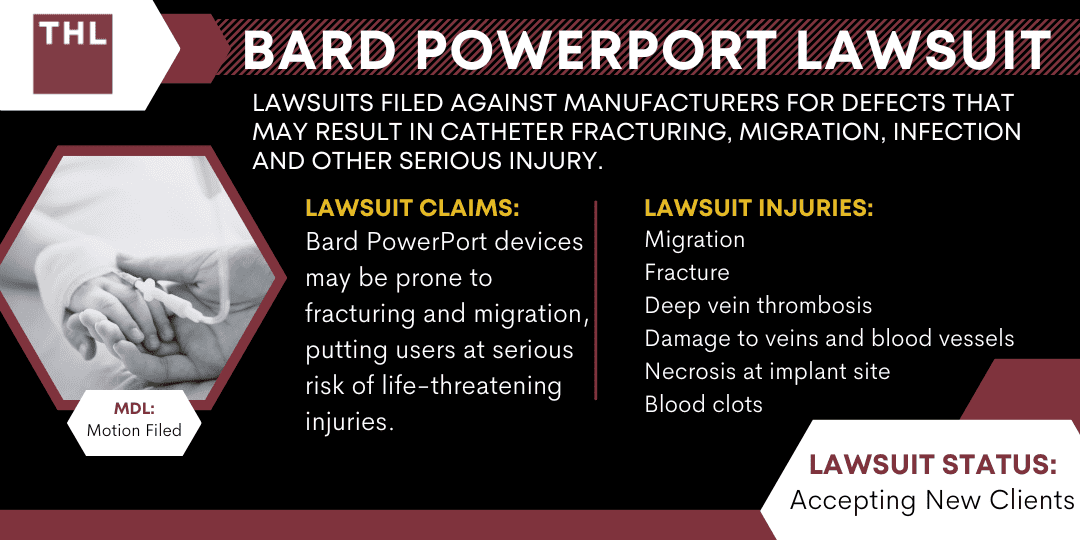
The Bard PowerPort Lawsuit consolidates claims that Bard’s implantable port systems were defectively designed and manufactured, exposing patients to preventable risks during long-term vascular access.
Plaintiffs argue that flaws in the catheter material, specifically the Chronoflex AL blend with barium sulfate, made the device prone to cracking, fracturing, and migrating inside the body.
These failures have been linked to severe infections, blood clots, pulmonary embolism, cardiac complications, and in some cases, life-threatening emergencies requiring surgical intervention.
Bard PowerPort Lawsuits claim that Bard Access Systems and its parent company, Becton Dickinson, failed to adequately test the device or warn patients and physicians of the risks associated with its use.
In August 2023, in response to growing litigation nationwide, the United States Judicial Panel on Multidistrict Litigation created MDL No. 3081 in the District of Arizona, assigning the cases to Judge David G. Campbell.
The judicial panel centralized lawsuits to streamline the exchange of evidence, manage expert testimony, and coordinate pretrial rulings across thousands of claims.
Since then, the Bard PowerPort multidistrict litigation has grown steadily, with over 3,000 lawsuits pending in federal court.

Quick facts about the Bard PowerPort litigation:
- Court: U.S. District Court, District of Arizona (Judge David G. Campbell)
- Process: Currently in the discovery process, including document production, depositions, and testing of explanted devices
- Core Allegations: Design defects, failure to warn, and negligent manufacturing
- Injuries Reported: Catheter fracture, device migration, blood clots, and severe infections leading to hospitalization or sepsis
- Next Phase: Bellwether trials scheduled to evaluate representative cases and guide potential settlements
The discovery process has focused heavily on engineering analyses, company testing records, and physician testimony about complications observed in clinical practice.
Bellwether cases have been selected to move toward trial, where juries will assess whether Bard’s design and warnings were adequate under federal product liability law.
While verdicts in bellwether trials apply only to the individual plaintiffs involved, they play an important role in shaping the overall litigation.
Jury responses to evidence of design defects and corporate negligence will influence both sides’ settlement strategies and may drive the framework for financial compensation across the MDL.
What Is the Bard PowerPort Device and Why Are Lawsuits Being Filed?
The Bard PowerPort is an implanted port catheter system manufactured by Bard Access Systems and Bard Peripheral Vascular, subsidiaries of medical device conglomerate Becton, Dickinson and Company.
It is designed to provide long-term access to a patient’s vascular system for repeated intravenous treatments such as chemotherapy, antibiotics, and parenteral nutrition.
The Bard PowerPort Lawsuit consolidates claims that Bard’s implantable port systems were defectively designed and manufactured, exposing patients to preventable risks during long-term vascular access.
Plaintiffs argue that flaws in the catheter material, specifically the Chronoflex AL blend with barium sulfate, made the device prone to cracking, fracturing, and migrating inside the body.
These failures have been linked to severe infections, blood clots, pulmonary embolism, cardiac complications, and in some cases, life-threatening emergencies requiring surgical intervention.
Bard PowerPort Lawsuits claim that Bard Access Systems and its parent company, Becton Dickinson, failed to adequately test the device or warn patients and physicians of the risks associated with its use.
In August 2023, in response to growing litigation nationwide, the United States Judicial Panel on Multidistrict Litigation created MDL No. 3081 in the District of Arizona, assigning the cases to Judge David G. Campbell.
The judicial panel centralized lawsuits to streamline the exchange of evidence, manage expert testimony, and coordinate pretrial rulings across thousands of claims.
Since then, the Bard PowerPort multidistrict litigation has grown steadily, with over 2,000 lawsuits pending in federal court.

The Bard PowerPort Device consists of two parts:
- The Injection Port, implanted underneath the skin on an arm, or in the chest, the injection port allows easy access for injections and is made of a self-sealing material that allows multiple needle punctures.
- The Polyurethane Catheter is a small, flexible tube connected to the port, and is installed inside one of the large central veins that take blood to your heart.
To use the PowerPort, medical professionals need to use a special needle (the PowerLoc needle) to “access” the bloodstream.
From there, medicine and fluids can be administered through the needle and blood samples can be withdrawn.
While this medical device is intended to reduce the need for repeated needle sticks and support critical treatments, serious concerns have emerged about its safety and long-term durability.
Reports of Device Defects and Patient Harm
Thousands of patients have reported complications involving catheter failure, migration, and infection after receiving a Bard implanted port catheter.
In many cases, the polyurethane catheter—often made with a polymer blend called Chronoflex AL—has fractured or degraded over time.
Fragments of the device may travel through the blood vessels, leading to vascular damage, embolisms, and other internal injuries.
These failures have triggered emergency medical procedures and even permanent harm for affected users.
Experts argue that the material, which contains high concentrations of barium sulfate to improve imaging visibility, may weaken the structural integrity of the catheter over time.
How Many Bard PowerPort Lawsuits Have Been Filed? Current Status of the Bard PowerPort MDL
The Bard PowerPort MDL continues to grow, with more than 3,000 pending Bard PowerPort Lawsuits filed.
The litigation is overseen by Judge Campbell in the Arizona district court, where the court continues to manage the case through recurring status conference proceedings and structured pretrial scheduling.
New Bard PowerPort Lawsuits are currently being filed by lawyers across the country.
If you were injured or suffered other Bard PowerPort complications, you may be eligible to file a Bard PowerPort Lawsuit and seek compensation.
Contact TorHoerman Law for a free consultation.
You can also use the chatbot on this page to find out if you qualify for a Bard PowerPort Lawsuit.
Bard PowerPort Settlement Amounts: Projections & Estimates
Bard PowerPort lawsuits are still in progress, and no settlements have been reached.
However, attorneys estimate that potential Bard PowerPort settlement amounts could range between $10,000 and over $250,000, depending on individual damages and the direction of the litigation.
These figures are general estimations and not guaranteed, as each case is unique and outcomes can vary.

While exact settlement figures are not yet determined, attorneys have provided estimated ranges based on the severity of injuries:
- Tier 1 – Severe Injuries: Cases involving life-threatening and serious medical complications such as cardiac punctures, pulmonary embolism, or stroke. Estimated settlements may exceed $100,000.
- Tier 2 – Moderate Injuries: Cases with significant injuries like deep vein thrombosis, catheter infections, or hematomas. Estimated settlements range between $50,000 and $100,000.
- Tier 3 – Mild Injuries: Cases involving less severe complications requiring minimal medical intervention. Estimated settlements range between $10,000 and $50,000.
These estimates are based on similar previous litigations and are meant to provide a general idea of potential settlement ranges.
For a more accurate assessment of your case, it’s advisable to consult directly with a qualified attorney.


