Chicago
Case Types We Handle
Personal Injuries
Car Accidents
Truck Accidents
Motorcycle Accidents
Bicycle Accidents
Construction Accidents
Nursing Home Abuse
Wrongful Death
Slip and Fall Accidents
Daycare Injury & Abuse
Edwardsville
Case Types We Handle
Personal Injuries
Car Accidents
Truck Accidents
Motorcycle Accidents
Bicycle Accidents
Nursing Home Abuse
Wrongful Death
Slip and Fall Accidents
Daycare Injury & Abuse
Premises Liability
St. Louis
Case Types We Handle
Personal Injuries
Car Accidents
Truck Accidents
Motorcycle Accidents
Bicycle Accidents
Construction Accidents
Nursing Home Abuse
Wrongful Death
Slip and Fall Accidents
Daycare Injury & Abuse
Dangerous Drugs
Defective Products
Chemical Exposure

Social Media Mental Health Lawsuit

Use the chatbot on this page to find out if you qualify for a Social Media Mental Health Lawsuit. You can also contact TorHoerman Law for a free consultation.
4.9
Google
677 reviews

Most recent updates:

  • There are currently more than 2,660 lawsuits pending in the Social Media Adolescent Addiction/Personal Injury Products Liability Litigation.
  • Social Media Lawsuits allege that excessive social media use contributes to mental health issues in teenagers and young adults through the promotion of addictive behaviors and failure to shield users from harmful content.
  • Lawsuits claim that social media companies were aware of the negative impacts of their products but did not take sufficient measures to address these issues.

Social Media Mental Health Lawsuit Overview

The social media mental health lawsuit claims that major social media companies designed and marketed platforms that contribute to addiction, depression, anxiety, and other serious mental health issues in young users.

Social media lawsuits argue that years of exposure to harmful algorithms, endless scrolling, and unrealistic social comparisons have fueled a national youth mental health crisis.

TorHoerman Law is actively accepting new clients who believe they or their children were harmed by social media use and are seeking justice through this ongoing litigation.

social media mental health lawsuit, social media addiction lawsuit, social media mental health claims, facebook mental health lawsuit, instagram mental health lawsuit, tiktok mental health lawsuit;social media mental health lawsuit, social media addiction lawsuit, social media mental health problems, social media mental health effects; Social Media Mental Health Lawsuit - Overview of the Social Media Addiction Lawsuit - - torhoerman law; Social Media Mental Health Lawsuit - How Many Social Media Addiction Lawsuits Have Been Filed Current Status of the Social Media Harm MDL - torhoerman law; Who is Filing Social Media Mental Health Lawsuit Claims_ - torhoerman law; Social Media Mental Health Lawsuit - What Social Media Companies are Named in the Lawsuit_ - torhoerman law; Social Media Mental Health Lawsuit - Mental Health and Physical Harms Linked to Social Media Use - torhoerman law; Social Media Mental Health Lawsuit - Mental Health Issues Linked to Excessive Social Media Use - torhoerman law; Social Media Mental Health Lawsuit - Physical Harm Linked to Compulsive Social Media Use - torhoerman law; Social Media Mental Health Lawsuit - Do You Qualify for the Social Media Mental Health Lawsuit_ - torhoerman law; Social Media Mental Health Lawsuit - Gathering Evidence for a Social Media Mental Health Lawsuit - torhoerman law; Social Media Mental Health Lawsuit - Damages in a Social Media Addiction Case - torhoerman law; Social Media Mental Health Lawsuit - TorHoerman Law_ National Product Liability Lawyers - torhoerman law

Do You Qualify for the Social Media Addiction Lawsuit?

The Social Media Mental Health Lawsuit targets major social media platforms like Instagram, TikTok, Snapchat, and YouTube for allegedly prioritizing engagement and profit over user safety.

Plaintiffs claim that these platforms were designed to maximize time spent online, leading to excessive social media use that causes serious psychological or physical harm, especially among children, teens, and young adults.

The lawsuits have been consolidated in federal court under the Social Media Adolescent Addiction/Personal Injury Products Liability Litigation (MDL No. 3047), overseen by Judge Yvonne Gonzalez Rogers in the Northern District of California.

This multidistrict litigation allows thousands of similar cases to move forward efficiently while addressing shared allegations of negligent design, failure to warn, and corporate disregard for user well-being.

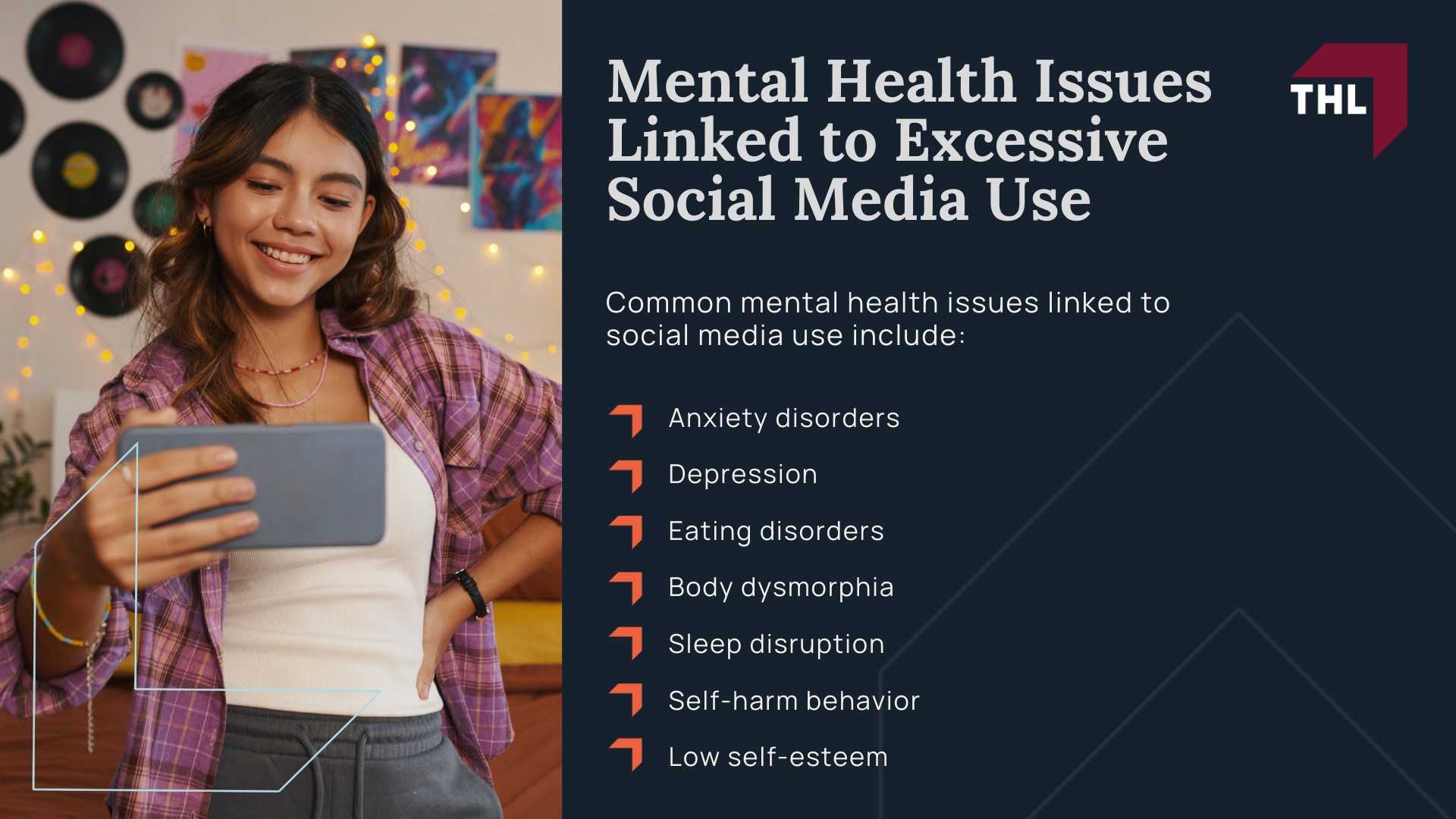
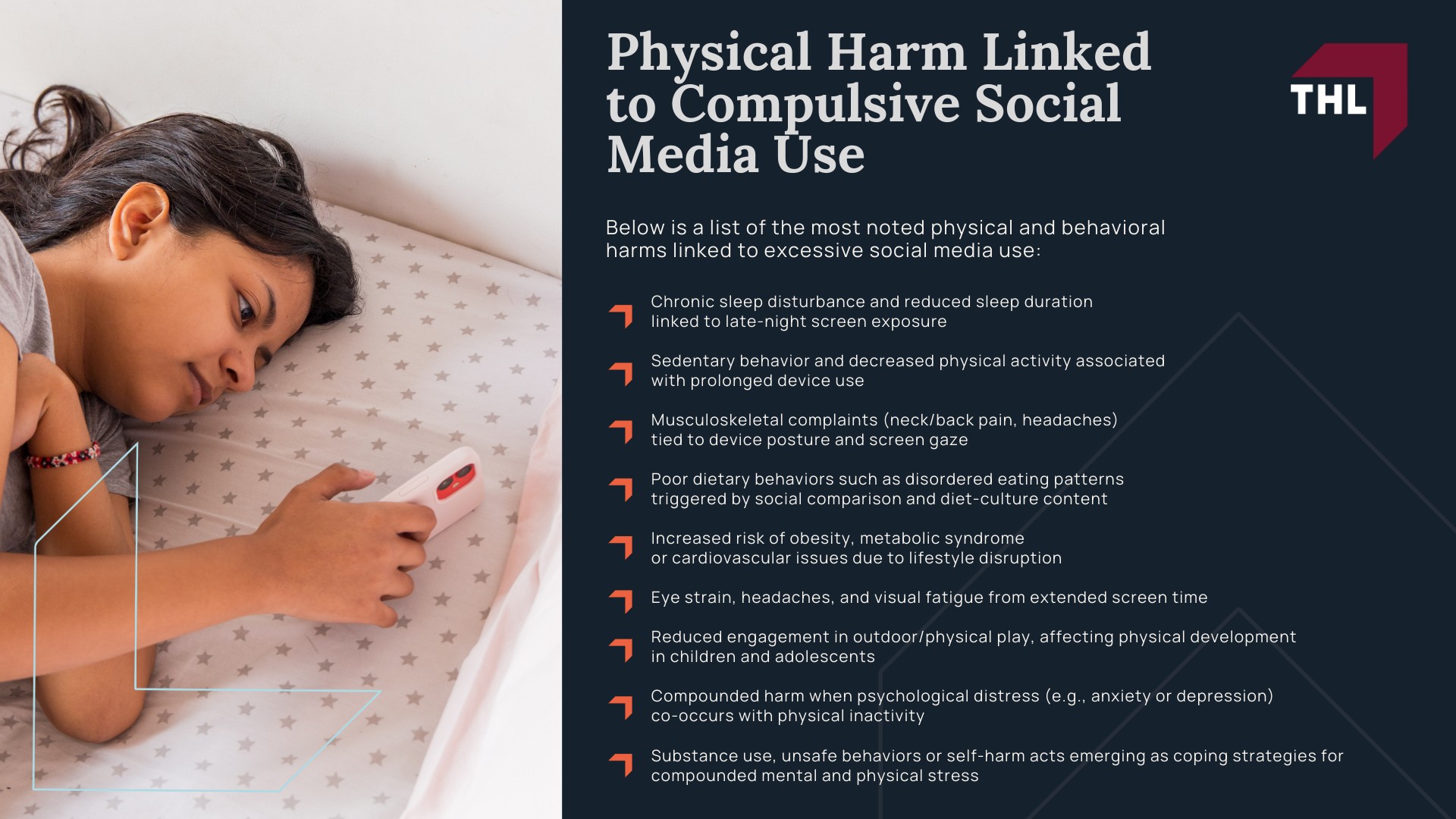
Studies from leading health organizations link chronic platform use to worsening mental health consequences, including anxiety, depression, eating disorders, and self-harm.

Families across the country are now demanding accountability for the preventable damage these products have caused to developing minds.

The social media harm lawsuits seek compensation for victims while pushing for meaningful safety reforms within the tech industry.

TorHoerman Law is reviewing claims from individuals and families nationwide who were harmed by social media addiction and are ready to take legal action against negligent companies.

If you or a loved one have suffered anxiety, depression, self-harm, or other mental health consequences linked to excessive social media use on platforms like Instagram, TikTok, Snapchat, or YouTube, you may be eligible to join the social media mental health lawsuit.

Contact TorHoerman Law for a free consultation.

You can also use the chat feature on this page to find out if you qualify to file a social media mental health lawsuit instantly.

social media mental health lawsuit, social media addiction lawsuit, social media mental health claims, facebook mental health lawsuit, instagram mental health lawsuit, tiktok mental health lawsuit;social media mental health lawsuit, social media addiction lawsuit, social media mental health problems, social media mental health effects; Social Media Mental Health Lawsuit - Overview of the Social Media Addiction Lawsuit - - torhoerman law; Social Media Mental Health Lawsuit - How Many Social Media Addiction Lawsuits Have Been Filed Current Status of the Social Media Harm MDL - torhoerman law; Who is Filing Social Media Mental Health Lawsuit Claims_ - torhoerman law; Social Media Mental Health Lawsuit - What Social Media Companies are Named in the Lawsuit_ - torhoerman law; Social Media Mental Health Lawsuit - Mental Health and Physical Harms Linked to Social Media Use - torhoerman law; Social Media Mental Health Lawsuit - Mental Health Issues Linked to Excessive Social Media Use - torhoerman law; Social Media Mental Health Lawsuit - Physical Harm Linked to Compulsive Social Media Use - torhoerman law; Social Media Mental Health Lawsuit - Do You Qualify for the Social Media Mental Health Lawsuit_ - torhoerman law; Social Media Mental Health Lawsuit - Gathering Evidence for a Social Media Mental Health Lawsuit - torhoerman law; Social Media Mental Health Lawsuit - Damages in a Social Media Addiction Case - torhoerman law; Social Media Mental Health Lawsuit - TorHoerman Law_ National Product Liability Lawyers - torhoerman law

Social Media Mental Health Lawsuit Updates Timeline

September 17th, 2026: Pennsylvania Sues Snap and TikTok Over Child Safety Failures

Lawsuits were filed last month by the Pennsylvania Attorney General’s office against Snap Inc. and TikTok over alleged failures to protect children from platform addiction.

The suits allege both companies misrepresented how often content involving nudity, suicidal ideation, and drug use appears on their platforms.

That content, the suits claim, was concealed to preserve an age 13+ App Store rating.

TikTok is separately accused of building its platform around a model of compulsive use at all costs, expanding its user base through deception about the content children could access.

Snapchat is accused of leading young users to believe shared content disappears permanently.

The lawsuits seek to hold both companies accountable for allegedly prioritizing engagement and profit over user safety.

September 16th, 2026: Meta and Other Platforms Face Billions in Settlements Over Youth Mental Health Harms

Social media platforms are facing mounting financial accountability on two fronts, both stemming from claims that their products were designed to be addictive to minors.

In August 2026, Meta agreed to pay approximately $17.1 billion to settle claims brought by 47 state attorneys general, along with the District of Columbia, Puerto Rico, American Samoa, and the Northern Mariana Islands. 

The settlement resolves allegations that the company violated child privacy laws and deliberately designed Instagram and Facebook to be addictive to young users. 

Kansas alone will receive $134 million of that total.

The settlement requires Meta to implement a series of concrete safety measures. 

These include a two hour daily time cap with mandatory pauses, nighttime access blocks between midnight and 6 a.m., limits on school hour notifications, stronger age verification systems, and restrictions on features such as beauty filters and visible like counts, which have been linked to poor mental health outcomes in teens. 

An independent auditor will monitor Meta’s compliance with these terms going forward.

That settlement is fueling a parallel track of litigation, with school districts suing platforms directly to recover the institutional costs of the teen mental health crisis. 

In a bellwether case that reached the eve of trial, Meta, Snap, TikTok, and YouTube collectively agreed to pay $27 million to Breathitt County School District in Kentucky. 

Meta contributed $9 million, Snap and TikTok each paid $8 million, and YouTube paid slightly more than $2 million. 

This was the first settlement of its kind, and it now serves as a signal to the more than 6,000 similar school district lawsuits filed nationwide, with more districts expected to pursue their own claims on similar terms.

Between the state attorney general settlement and the growing wave of school district claims, social media companies are absorbing billions of dollars in liability tied to youth addiction and mental health harm.

September 14th, 2026: Texas Judge Rules TikTok Violated Consumer Protection Law Over Child Safety Claims

A Texas state judge ruled that TikTok misled consumers about its content moderation and parental control features.

Travis County District Court Judge Cory Liu granted summary judgment Thursday in favor of the state on two claims, finding TikTok Inc., ByteDance Inc. and related companies twice violated the Texas Deceptive Trade Practices Act.

The ruling found TikTok’s internal policies placed content violating its community guidelines into a “hard to find” category rather than removing it entirely.

This included content depicting drug use, gambling, sexually suggestive behavior involving children and graphic injuries.

The judge also found TikTok’s “restricted mode” failed to filter out inappropriate content as advertised, despite the company’s knowledge of the feature’s shortcomings.

Texas Attorney General Ken Paxton’s office called the decision a first-of-its-kind victory against the platform.

Texas filed the underlying lawsuit in early 2025, alleging TikTok marketed itself as safe for children while knowing the app exposed them to explicit and graphic material.

September 11th, 2026: 19 Plaintiffs Sue Major Platforms Over Child Suicides Linked to Social Media Addiction

On August 27, 2026, 19 plaintiffs from 12 states filed a new lawsuit in Los Angeles County Superior Court against Meta, Snap, TikTok/ByteDance, Google/YouTube, Discord, and Roblox. 

The complaint, which is expected to be related to California’s coordinated social media litigation, JCCP No. 5255, alleges that the companies designed their platforms to maximize engagement among children and teenagers while failing to adequately disclose the potential risks of compulsive use.

Plaintiffs point to algorithm-driven feeds, repeated notifications, social comparison features, reward systems, personalized recommendations, weak age verification, and limited parental controls. 

They allege these features were designed to keep young users engaged and contributed to sleep deprivation, anxiety, depression, self-harm, suicidal thoughts, sexual exploitation, and other injuries.

Several of the individual accounts included in the complaint describe children beginning to use social media at young ages and developing increasingly compulsive patterns of use as their mental health declined. 

In one wrongful death claim, the family of a 13-year-old alleges that TikTok allowed the child to maintain an account unknown to a parent where posts discussing suicide appeared before the child’s death. 

The complaint also alleges that notifications, recommendation systems, advertising, and social comparison tools repeatedly encouraged continued platform use.

The lawsuit includes three wrongful death claims involving young people who died by suicide, alongside claims brought by other plaintiffs alleging serious but nonfatal injuries.

The plaintiffs assert claims including defective design, failure to warn, negligence, fraudulent concealment, negligence per se, wrongful death, survival, and loss of consortium. 

They are seeking compensatory and, where permitted, punitive damages, along with medical, funeral, and other economic losses.

September 10th, 2026: TikTok Refuses Senators' Demand for Sealed Algorithm Document Tied to Teen's Suicide

Senators Marsha Blackburn and Richard Blumenthal sent TikTok’s CEO and U.S. business chief a letter last month demanding the company turn over a sealed internal document describing an algorithm experiment that withheld a safety feature from roughly 15 million U.S. users, including a teenager who later died by suicide. 

The senators called the experiment “depraved,” posed 13 specific questions, including which employees knew about the test and whether the company ever avoided rolling out a safety feature over engagement concerns, and set a September 1 deadline to respond.

TikTok’s lawyer responded on the deadline, refusing to hand over the document or answer the senators’ questions, citing ongoing litigation in which the document remains sealed. 

The senators called the company’s refusal “appalling” and “offensive.” 

The underlying document, first reported by Bloomberg Businessweek last month, describes a 2021 change to TikTok’s algorithm meant to prevent users from being funneled into harmful content “filter bubbles,” which the company reportedly withheld from a 10% control group to measure its impact on engagement.

The controversy adds pressure to TikTok as it separately navigates its recently finalized $400 million settlement with the Justice Department over children’s privacy violations, a deal that resolves data collection claims but doesn’t address the algorithm allegations raised in the senators’ letter.

September 9th, 2026: Columbus City Schools Joins National Social Media Addiction Lawsuit

Yet another school district, Columbus City Schools, has joined the national litigation against social media companies.

School districts and other government entities are filing claims against social media companies for allegedly designing addictive platforms that drive up costs for student mental health services, counseling, and staff training, resources districts say they’ve had to divert from education to manage the fallout of student social media use.

Columbus’s school board voted Tuesday to join the federal MDL, which now includes more than a thousand school districts nationwide.

The district’s stated goals go beyond a financial payout, seeking “meaningful changes,” including stronger youth safety requirements and design changes limiting addictive features.

Any recovery would reportedly be reinvested into student well-being programs.

The tech companies have argued in court that districts’ costs are too indirectly connected to their platforms to support legal liability.

Despite that defense, in May a small Kentucky district selected as a bellwether case reached a $27 million settlement before trial, an amount exceeding that district’s entire annual budget.

Columbus, whose budget tops $1 billion, is unlikely to see a comparably transformative payout, but the case underscores a broader pattern of districts turning to litigation as a way to recoup costs and pressure platforms into safety changes.

The next school district trials, involving Arizona and South Carolina, are scheduled for February 2027.

September 7th, 2026: Meta's $17.1 Billion Settlement Requires Two-Hour Daily Time Limits, Nighttime Blackouts for Young Users

Meta’s landmark multistate settlement over child safety claims requires the company to build in specific default protections rather than leaving safety features optional. 

Under the deal, Facebook and Instagram combined will default to a two-hour daily time limit for young users, which can only be disabled with parental permission. 

The apps will also automatically block access between midnight and 6 a.m. and mute all notifications except direct messages and security alerts during school hours from 8 a.m. to 3 p.m.

The settlement resolves a case filed in 2023 by 47 states, Washington D.C., and several U.S. territories, alleging Meta knowingly designed its platforms with addictive features and misled the public about the risks to children. 

Meta will pay a base $12.7 billion, rising to the full $17.1 billion only if TikTok and YouTube separately agree to comparable restrictions, including a one-hour daily limit and their own age-assurance systems. 

State officials have called it one of the largest consumer protection settlements in history outside the 1990s tobacco settlements.

The deal still requires approval from the federal court overseeing the underlying multidistrict litigation. 

Meta continues to face thousands of individual lawsuits and school district claims that remain separate from the state settlement, and the company has not admitted wrongdoing as part of the deal.

September 7th, 2026: Meta's $17.1 Billion Settlement Requires Two-Hour Daily Time Limits, Nighttime Blackouts for Young Users

Meta’s landmark multistate settlement over child safety claims requires the company to build in specific default protections rather than leaving safety features optional.

Under the deal, Facebook and Instagram combined will default to a two-hour daily time limit for young users, which can only be disabled with parental permission.

The apps will also automatically block access between midnight and 6 a.m. and mute all notifications except direct messages and security alerts during school hours from 8 a.m. to 3 p.m.

The settlement resolves a case filed in 2023 by 47 states, Washington D.C., and several U.S. territories, alleging Meta knowingly designed its platforms with addictive features and misled the public about the risks to children.

Meta will pay a base $12.7 billion, rising to the full $17.1 billion only if TikTok and YouTube separately agree to comparable restrictions, including a one-hour daily limit and their own age-assurance systems.

State officials have called it one of the largest consumer protection settlements in history outside the 1990s tobacco settlements.

The deal still requires approval from the federal court overseeing the underlying multidistrict litigation.

Meta continues to face thousands of individual lawsuits and school district claims that remain separate from the state settlement, and the company has not admitted wrongdoing as part of the deal.

September 4th, 2026: Plaintiffs Ask Court to Appoint Special Master Over Meta's Privilege Claims

Personal injury plaintiffs asked a federal judge to appoint a special master to review Meta’s attorney-client privilege designations in the social media addiction MDL, arguing the company can’t be trusted to police itself after the judge found certain trial-exhibit redactions “entirely inappropriate.” 

The request came days after Meta offered to voluntarily review its own privilege redactions following criticism during last week’s bellwether trial, which ended when Meta abruptly settled for $17.1 billion mid-trial.

During that trial, the judge rejected Meta’s theory that an attorney’s involvement in reviewing business presentations automatically made those documents privileged, warning the logic would let Meta shield nearly all leadership communications from discovery. 

Plaintiffs argue Meta’s proposed voluntary review lacks a real deadline, wouldn’t be complete until after the point plaintiffs could use the documents at the next scheduled trial in February, and shouldn’t be controlled solely by the company accused of misusing privilege in the first place. 

Meta contends it has only withheld about 2% of documents produced and says it will turn over any newly unredacted materials by year’s end. The next case management conference in the MDL is set for September 14.

September 1st, 2026: September 2026 JPML Update

The Social Media Addiction MDL added 71 cases between August and September, increasing from 3,137 to 3,208.

The continued growth comes shortly after Meta reached a proposed settlement worth up to $17.1 billion with a multistate coalition of attorneys general over allegations involving addictive platform features and harms to children, while individual personal injury claims in the federal MDL remain pending.

With more than 3,200 cases now pending, the MDL continues to focus on allegations that social media platforms deliberately used features designed to encourage compulsive engagement despite known risks to youth mental health.

August 31st, 2026: TikTok Agrees to $400 Million Settlement Over Children's Data Privacy Violations

TikTok has agreed to pay $400 million to resolve a Department of Justice lawsuit alleging the platform violated federal children’s privacy law.

The DOJ’s complaint alleged TikTok knowingly allowed children under 13 to create accounts and collected their personal data without obtaining verifiable parental consent, in violation of the Children’s Online Privacy Protection Act.

The settlement ranks among the largest COPPA-related recoveries to date and requires TikTok to implement stronger age-verification measures going forward.

It adds to mounting regulatory and legal pressure on the platform, which continues to face separate state and federal litigation over allegations that its features are designed to be addictive to young users.

August 27th, 2026: Meta Reaches $17.1 Billion Settlement With States Over Child Harm Claims

Meta has agreed to pay up to $17.1 billion and enact platform reforms to resolve sprawling social media addiction claims brought by state enforcers. 

The settlement comes in the midst of a high-stakes bellwether trial over whether Meta hid or downplayed the harm its platforms caused minors.

Meta will pay states $12.19 billion over 10 years as a baseline. 

That figure can rise to $17.1 billion if TikTok, YouTube and Snapchat, which face similar state investigations, also agree to reforms. 

The settlement resolves claims from 51 state and territorial attorneys general.

Under the deal, Meta will implement two-hour time limits on Facebook and Instagram use for minors. 

The company will also strengthen content filtering and parental controls. 

Meta has agreed to add programmed interruptions designed to stop endless scrolling.

August 26th, 2026: Instagram CEO Says He Was Unaware Lawyers Edited Teen Safety Data From Presentation

Instagram CEO Adam Mosseri said he was unaware Meta’s in-house lawyers removed data from a teen safety presentation to limit his litigation exposure.

He testified Tuesday during the fourth day of the advisory jury trial in Oakland, where 29 state attorneys general accuse Meta of hiding social media’s harms to teens.

States’ counsel asked Mosseri whether he knew Meta lawyers had edited presentations to reduce his exposure to litigation risk.

Mosseri denied that lawyers intentionally withheld information from him, and he generally wants more data from experts, not less, when making decisions.

Counsel then pointed to a newly unredacted July 2023 text exchange between product design director Francesco Fogu and two colleagues.

In the exchange, a colleague wrote that Meta’s senior general counsel, Rachany Vohminceva, directed the team to remove data from a teen safety presentation so it would carry no litigation exposure risk for executives.

Mosseri said he had never seen the conversation and called it news to him.

Fogu testified earlier Tuesday and repeatedly denied that lawyers scrubbed his presentation to shield Mosseri.

But the unredacted exchange showed Fogu and his colleagues complaining in real time as lawyers removed statistics, including data showing teens encounter harmful content 1.5 times more often than adults on the platform.

Fogu asked colleagues at the time what the problem was with showing leadership actual data.

On the stand, he said he chose not to push back against the lawyers’ edits.

Judge Yvonne Gonzalez Rogers ordered Meta to unseal the redacted exchange after Fogu repeatedly refused to answer questions about it, citing attorney-client privilege.

The judge later ruled that nearly all of Meta’s privilege claims over the exchange were improper, calling the redacted material business advice filtered through a lawyer rather than legal advice.

The ruling came days after the judge separately flagged that a Meta in-house attorney had misstated the legal privilege standard in another document.

August 25th, 2026: Pennsylvania AG Sues Snap Over Addictive Platform Design

Pennsylvania Attorney General Dave Sunday filed suit against Snap Inc., alleging the company designed Snapchat features like Snapstreaks and disappearing messages to be intentionally addictive to teens.

The suit follows a similar lawsuit Sunday’s office filed against TikTok weeks earlier, part of a broader pattern of state enforcement actions targeting platform design choices rather than user-generated content.

The complaint alleges Snap knew its engagement-driving features carried mental health risks for young users but continued marketing the platform without adequate safeguards or warnings.

The case from the Pennsylvania AG adds to the growing number of state attorney general litigation against social media companies, joining ongoing cases against Meta, TikTok, and other platforms over similar addictive-design allegations.

August 24th, 2026: States Push for Review of Meta's Privilege Claims During Social Media Addiction Trial

States pursuing claims against Meta asked a California federal judge Monday to order a full re-review of Meta’s attorney-client privilege designations. 

They argued it would be implausible for Meta to have misapplied the privilege standard in only one document.

U.S. District Judge Yvonne Gonzalez Rogers declined the request, noting there is currently no evidence Meta misapplied the standard beyond the single document flagged last week and asked the states to bring specific evidence if they have any.

Jean Twenge, a San Diego State University psychology professor testifying as the state’s expert, told jurors her analysis found a clear causal link between social media use and declining teen mental health. 

She cited data showing depression, self harm and suicide rates rose sharply among teens starting in 2008 and 2009, coinciding with social media’s growth. 

She testified that other potential causes did not match that timing. 

On cross-examination, Meta’s counsel got Twenge to acknowledge that light social media use correlates with increased happiness among teens.

The states also called George Volichenko, a former Instagram statistician who worked on the platform’s mental well-being team from 2022 to 2023. 

He testified that adoption of voluntary usage-limiting tools was minimal. 

He said his team’s push to make such features mandatory was blocked over concerns about other company metrics. 

He left after being told the team’s real purpose was to shield Meta from anticipated litigation.

August 23rd, 2026: Meta Trial Enters Second Week With Focus on Children's Brain Development

The California trial against Meta enters its second week, with states expected to present additional evidence on how social media affects children’s developing brains.

Twenty-nine states accuse the company of designing its platforms to addict young users, misleading the public about the platforms’ safety, and improperly collecting data from children under 13.

Four of those states are currently part of the trial, while the remaining 25 will go to trial separately at a later date.

The states’ central claim is that Meta exploited children’s underdeveloped brains to boost engagement regardless of the harm it caused.

This week’s testimony is expected to bring more evidence about what Meta knew internally and more detail on the effects its platforms have had on children.

Last week’s proceedings closed with brief testimony from a psychology professor at San Diego State University, which is expected to resume this week.

Meta CEO Mark Zuckerberg is expected to testify at some point during the trial, though a date hasn’t been set.

August 22nd, 2026: TikTok Reaches $400 Million Settlement With DOJ Over Children's Privacy Violations

TikTok has agreed to pay $400 million to resolve the Department of Justice’s COPPA claims over the platform’s collection of personal data from children under 13, ending litigation the government filed in August 2024.

TikTok will pay $300 million immediately, with the remaining $100 million due once a court vacates the 2019 consent decree the FTC entered against TikTok’s predecessor, Musical.ly.

The parties filed a joint notice in the U.S. District Court for the Central District of California stipulating to dismissal of the case with prejudice.

The DOJ also moved Friday to vacate the 2019 FTC consent decree.

The department argued that TikTok’s ownership overhaul, following ByteDance’s sale of its majority stake in the platform’s U.S. operations earlier this year, along with its updated compliance practices, makes the decree’s terms unnecessary given TikTok’s continuing COPPA obligations.

Associate Attorney General Stanley E. Woodward Jr. called the settlement a recovery of one of the largest sums ever obtained under COPPA.

The DOJ noted the claims remain allegations with no determination of liability.

For families whose children were affected by TikTok’s data practices, the settlement closes out the federal government’s case but doesn’t resolve private claims that may still be pursued separately.

August 21st, 2026: Former Meta Engineer: Instagram Took "Don't Ask, Don't Tell" Approach on Kids Under 13

A former Meta engineering director testified Wednesday in the federal Oakland trial that the company took a “don’t ask, don’t tell” approach toward users under the platform’s minimum age of 13.

He said Meta consistently prioritized profit-driving metrics like frequency and duration of use over user well-being when designing product features, regardless of the harm those features caused. “If you step away from the product, they are not going to make any money,” he told jurors.

He walked through specific Instagram features he said were originally built for adults but were nonetheless made available to, and used heavily by, teenage and preteen users, calling them “inherently unsafe for teenagers.”

The testimony, delivered on his second day on the stand, came from a witness who has previously testified before Congress on Instagram’s child safety practices.

The trial pits four states, California, Colorado, Kentucky, and New Jersey, against Meta over claims the company violated child privacy law and deceived the public about the platform’s risks.

Twenty-five additional states that joined the original lawsuit will have their claims heard in separate trials later.

The current trial is expected to run roughly six weeks and will reportedly feature testimony from Meta CEO Mark Zuckerberg before it concludes.

August 20th, 2026: New Jersey Teen Drops Social Media Addiction Lawsuit Against Meta, Google, and Snap

A 15-year-old New Jersey girl, identified in court filings by her initials, dismissed her lawsuit against Meta, Google, and Snap on Thursday, according to Reuters.

She had accused all three companies of deliberately designing their platforms to foster addiction in young users, contributing to depression, anxiety, and other mental health harms.

Her case had been scheduled for an October trial as part of the broader federal social media addiction MDL and would have been one of the earliest individual personal injury cases to reach a jury.

She had also brought claims against TikTok as part of the same suit, but that portion of her case was already resolved separately before Thursday’s dismissal.

New Jersey Attorney General Jennifer Davenport, who is separately pursuing the state’s own claims against Meta in the ongoing federal trial, reacted publicly to news of the dismissal in a video posted to social media.

“I’m disgusted. I’m angry. We all should be angry,” she said.

The dismissal echoes a similar pattern from earlier this year, when a Florida teen dropped his own case against Meta days before his scheduled bellwether trial, after having already settled with the platform’s co-defendants.

August 19th, 2026: States Tell Jury "Profits Won" as Federal Meta Trial Opens

An attorney for 29 states told jurors Tuesday that Meta hid known mental health harms to hook kids on its platforms. 

California’s lead attorney said Meta’s business model relies on capturing children’s time and data and Meta failed to take basic steps to remove users under 13. 

Meta’s attorney countered that the company invested years into meaningful safety improvements. 

The defense argued more kids use TikTok, Snapchat, and YouTube underage than Instagram or Facebook. 

He called age verification an industry-wide challenge, not a Meta-specific failure.

States allege Meta violated federal child privacy law by knowingly leaving nearly 150,000 underage accounts active. 

Four states also allege Meta made deceptive public statements about its safety practices. 

An expert is expected to testify that 4.6 million Instagram users were under 13 during the relevant period. 

Meta’s attorney said many underage-account reports turn out to be false, creating a review backlog. 

He also noted plaintiff-state health officials haven’t issued formal warnings on social media’s mental health impact.

After openings, a Meta whistleblower took the stand, testifying Instagram “changed from a product you use, to a product that uses you.” 

He said Meta’s own 2021 internal survey found 27% of teen respondents reported being bullied, nearly 19% reported unwanted nudity, and 13% reported unwanted advances from strangers. 

He said these findings contradicted the company’s public safety statistics at the time. 

He also described his own daughter’s negative experience shortly after joining Instagram. 

Testimony is expected to continue Wednesday, with CEO Mark Zuckerberg expected to testify later in the six-week trial.

August 18th, 2026: Judge Denies Meta's "Hail Mary" Bid to Block Whistleblower Testimony

A federal judge denied Meta’s request for sanctions against state attorneys general Sunday. 

Meta sought to bar a key whistleblower from testifying in the upcoming federal bellwether trial. 

The judge called the request an “obvious” attempt to eliminate a strong witness. 

Meta argued the witness improperly destroyed messages sent through an encrypted app, yet the judge found Meta had no legal mechanism to enforce that obligation.

The witness has testified in all three trials against Meta so far, in New Mexico, Tennessee, and California state court. 

The judge also granted states permission to use exhibits during opening statements. 

Meta had opposed any exhibit use during openings. 

The ruling clears the way for Tuesday’s opening statements in the federal MDL trial in Oakland. 

Four states bring consumer protection claims, while 29 states allege COPPA violations separately.

August 17th, 2026: Meta Safety Executive Admits She Can't "Rule Out" Instagram Addiction

A Meta safety executive testified Monday in Tennessee’s trial against Meta, admitting she cannot “rule out” that Instagram use can cause addiction. 

She said no evidence currently identifies anything beyond “problematic use.” 

She testified the company continues researching the issue closely and said Meta has flagged concerns to parents since 2012.

Under cross-examination, she detailed Meta’s outreach efforts, including blog posts, parent meetings, and congressional testimony. 

She cited cases where Meta’s reports helped save children from exploitation, yet acknowledged many children under 13 create accounts despite platform rules against it. 

She said Meta prefers app stores handle age verification directly, rather than requiring individual apps to check IDs.

The testimony came in the second trial nationwide over Meta’s alleged concealment of Instagram’s harms to minors. 

The case centers on Tennessee’s claims that Meta hid known risks from the public.

August 14th, 2026: Jury Impaneled in Landmark Trillion-Dollar Meta Social Media Trial

A jury was impaneled Wednesday in the federal trial over claims Meta’s platforms harm children’s mental health. 

No prospective juror said they believed Facebook or Instagram are safe for kids. 

Opening statements are scheduled for Tuesday in Oakland federal court. 

Four states bring consumer protection claims: Kentucky, California, Colorado, and New Jersey. 

Separately, 29 states allege Meta violated the federal Children’s Online Privacy Protection Act.

During jury selection, a Colorado attorney asked if anyone believed the platforms are safe for kids.

No one raised a hand. 

He also asked whether parents alone bear responsibility when a child struggles with social media. 

About a dozen prospective jurors raised their hands. 

A man who said it’s “not your job to raise my kid” was not selected. 

Another man, who called it a shared challenge between parents and platforms, was later chosen.

Meta’s attorney told jurors the company takes platform safety seriously. 

The states will present their case first, before Meta responds. 

During a pretrial hearing, the judge called the states’ $1.4 trillion damages estimate “unreasonable.” 

She also said Meta’s $4 million estimate “is not even a slap on the hand.”

The trial follows Monday’s Ninth Circuit ruling rejecting Meta’s bid to halt the case on Section 230 grounds. 

California Attorney General Rob Bonta said Meta “lied to children, families, and the community” about known risks. 

Meta said it strongly disagrees with the states’ claims and remains confident in its safety record.

August 12th, 2026: Trial Called "Existential" for Social Media Industry as $1.4 Trillion Case Nears

A potential trillion-dollar bellwether trial is set to begin Wednesday in Oakland federal court, with states alleging Meta’s platforms harm children’s mental health by design. 

One legal expert called the stakes “existential” for the social media industry, as state attorneys general are seeking $1.4 trillion in damages. 

Jury selection starts Wednesday, with opening statements set for August 18.

Meta has already lost two related trials earlier this year related to youth mental health harm. 

A Los Angeles jury awarded $6 million to a single plaintiff over platform addiction harms in March. 

A New Mexico jury ordered Meta to pay $375 million in March, with the judge later adding an additional $567 million to fund a treatment abatement program.

Meta is appealing both losses. 

The trial follows Monday’s Ninth Circuit ruling rejecting Meta and TikTok’s bid to halt the case. 

The panel found Section 230 offers a defense, not immunity from suit. 

Experts expect Meta to keep pressing that argument in other courts.

Meta says it strongly disagrees with the states’ claims. 

California Attorney General Rob Bonta said Meta “lied to children, families, and the community” about known risks. 

The broader MDL also includes claims from school districts, tribes, and individual plaintiffs nationwide.

August 11th, 2026: Roblox, Discord, TikTok Seek Dismissal of Teen Suicide Suit, Citing Section 230

Roblox, Discord, and TikTok are asking a Kentucky federal court to dismiss a lawsuit over a teen’s suicide.

A mother filed suit in October, alleging her daughter was exposed to harmful content and predatory contact across the platforms before taking her own life in December 2024.

In separate motions filed Friday, each company argued Section 230 blocks the claims, saying the law shields them from liability for third-party content and user activity on their platforms.

The companies also argued the claims are barred by the First Amendment, saying that organizing and presenting user content counts as protected expression.

Discord separately argued it can’t be held liable without proof it knew the specific content in question.

The companies further argued suicide isn’t a foreseeable result of ordinary platform use and Kentucky law doesn’t establish a duty of care in this context.

Additionally, the companies argued the platforms are services, not products, so product liability law doesn’t apply.

The plaintiff’s attorney pushed back strongly, accusing the companies of trying to evade accountability.

Roblox and Discord previously attempted to push the case into arbitration.

The plaintiff’s attorney pointed out that the child was eight years old when she agreed to the platforms’ terms of use.

Plaintiff’s counsel intends to fight the motions and get the case in front of a jury.

August 10th, 2026: Ninth Circuit Dismisses Meta's Appeal, Clearing Way for Social Media Trial

The Ninth Circuit ruled Monday it lacks jurisdiction to hear Meta’s appeal at this stage.

The panel dismissed appeals from both Meta and TikTok entities.

It found Section 230 offers a legal defense, not immunity from being sued.

That distinction matters for whether a party can appeal mid-case.

The court said Meta could still raise Section 230 after a final judgment.

Meta had argued Judge Yvonne Gonzalez Rogers wrongly forced it to litigate claims it says are Section 230-protected.

The panel disagreed, citing a similar 2016 Tenth Circuit ruling on the same question.

The decision clears the way for the first bellwether trial to begin Wednesday.

State attorneys general from Kentucky, California, Colorado, and New Jersey are suing Meta in that trial.

An earlier Kentucky school district trial was avoided through a late-May settlement instead.

California Attorney General Rob Bonta said Meta’s “last procedural off-ramp” has failed. Plaintiffs’ co-lead counsel said the ruling finally lets a jury hear the case.

They said trial is how the public will learn what Meta knew, and when.

August 7th, 2026: Meta Ordered to Pay Additional $567M, Implement Safety Reforms in New Mexico

A New Mexico judge ordered Meta to create a $567 million treatment abatement fund

This adds to the $375 million jury verdict from March. Judge Bryan Biedscheid found Meta’s platforms “substantially contributed to a public nuisance” in the state. 

Of the fund, $420 million goes toward treatment services for young people. 

The remaining $147 million covers awareness, prevention, and screening efforts. 

The judge rejected the state’s request for a 15-year abatement period, ordering a five-year timeline instead.

Beyond the fund, Meta must implement several safety measures for five years, including: 

  • Improving age verification tools to catch underage accounts

  • Maintaining default safety settings for users under 18

  • Blocking unconnected adults from messaging minors

  • Eliminating overnight and school-hour push notifications for underage users

  • Barring underage New Mexico users from romantic or sexualized chatbot interactions 

  • Preventing adults from simulating romantic or sexual interactions with a minor AI persona

  • Displaying monthly safety banners to adult users and weekly banners to minors. 

  • Funding an educational campaign about platform risks in the state.

The state’s attorney general called the ruling “a blueprint” for holding tech companies accountable. 

Meta said it plans to appeal, citing First Amendment and Section 230 protections as central to its case.

August 6th, 2026: TikTok Settles Ahead of October Social Media Addiction Trial

TikTok has reached a settlement resolving three teen social media addiction cases set for trial this October, according to Reuters.

The settlement comes as Meta, Snap, and Google/YouTube remain defendants in the same case and are still set to proceed to trial as scheduled. Terms of the deal have not been disclosed.

The settlement follows a pattern seen earlier this year, when a Florida teen dropped his case against Meta days before a separate bellwether trial in California state court, after already settling with TikTok, YouTube, and Snap ahead of that trial.

TikTok has now resolved several individual claims this year even as it continues to face thousands of pending cases across the broader social media addiction MDL.

August 5th, 2026: Confidential TikTok Document Shows Company Withheld Safety Feature From Millions to Test Impact on Engagement

A confidential internal TikTok document shows the company knowingly withheld a safety upgrade from millions of users to measure its effect on engagement. 

In 2021, TikTok modified its algorithm to reduce harmful content shown to vulnerable users but held back the safer version from 10% of U.S. users, roughly 15 million people, as a control group. 

The goal was to test whether the fix would reduce app “stickiness” and hurt engagement.

One user in that unprotected group was a 16-year-old with no prior history of mental illness, who was fed thousands of videos about suicide and hopelessness before dying by suicide. 

The document itself opens by warning its findings are “potentially disturbing.” TikTok did not disclose this experiment in written responses to Congress about algorithmic testing and user harm. 

A related wrongful death suit was dismissed on Section 230 grounds and remains on appeal.

August 4th, 2026: Tennessee Official Testifies Teen Sadness Rates Rising, Can't Directly Link to Social Media

An executive with Tennessee’s Commission on Children and Youth testified Monday in the state’s trial against Meta that teen sadness and hopelessness rates have climbed sharply since 2017.

He presented data showing the share of high schoolers reporting feeling sad or hopeless stayed roughly flat from 2003 to 2017, then rose markedly through 2021, reaching 55% for girls and 30% for boys.

He also cited an 80% rise in suicide attempts among high school girls and a 59% rise among boys since 2013.

On cross-examination, the witness acknowledged he couldn’t tie any of these statistics to a specific cause, including social media, due to a lack of quantitative data.

He said he wasn’t aware of any specific case connecting social media to mental health harm in a Tennessee teen, describing his knowledge as anecdotal.

The jury also saw deposition testimony from a Meta teen experience researcher, who had previously written in internal materials that Instagram gives teens “hits of dopamine” and remarked in a chat log, “Oh my gosh yall IG is a drug.”

In her deposition, she said she isn’t a brain scientist, doesn’t know what specifically triggers dopamine, and called the chat log comments a “joke” meant to grab colleagues’ attention.

August 3rd, 2026: Families of Four Teens Sue Meta, TikTok, Snap, and YouTube Over Suicide Deaths

Four families have filed a wrongful death suit against Meta, TikTok, Snapchat, and YouTube in Delaware Superior Court, alleging “years of escalating harms” from the platforms contributed to their teenage children’s deaths by suicide. 

The families, from Texas, North Carolina, Minnesota, and Tennessee, allege their children experienced social media addiction, severe sleep deprivation, depression, anxiety, and suicidal ideation after years of platform use. 

The teens died over a 14-month period between July 2024 and September 2025, ranging in age from 13 to 18 at the time of their deaths.

The complaint alleges the social media companies knew their platforms were causing harm to young users but failed to adequately protect them.

August 3rd, 2026: August 2026 JPML Update

The Social Media Addiction MDL added 244 cases between July and August, increasing from 2,893 to 3,137.

The continued growth comes as momentum builds behind the Kids Online Safety Act (KOSA), which would require social media platforms to take greater responsibility for protecting minors from harmful and addictive online content.

Many of the bill’s proposed safeguards mirror allegations in the MDL that platforms knowingly designed features to maximize youth engagement despite documented mental health risks.

With more than 3,100 pending cases, the Social Media Addiction MDL remains one of the fastest-growing multidistrict litigations in the federal court system.

July 30th, 2026: Ex-Facebook Safety Executive Testifies Meta's "Problematic Use" Definition Has Major Gaps

Former Facebook senior director of engineering Arturo Béjar testified Wednesday in Tennessee’s trial against Meta. 

He argued the company’s definition of “problematic use” is deficient and lacks proper data. Béjar said Meta’s approach only focuses on cases where kids “lose control” and get harmed.

He said this ignores critical measures like daily hours spent on the app and notification frequency. It also ignores users’ self-reported emotional impact.

Béjar testified that even internal studies have placed problematic use at closer to a third of under-18 users.

Béjar’s comments referenced the Bad Experiences and Encounters Framework.

He developed this survey as an independent contractor after returning to Facebook in 2019. Plaintiffs allege Meta ordered the data deleted before it could be analyzed.

On cross-examination, Meta’s attorney got Béjar to make a key admission. He acknowledged having no concerns about the company’s safety approach during his earlier tenure.

Béjar led Facebook’s safety organization from 2009 to 2015.

He also agreed Meta’s process for reporting underage users remains largely unchanged since 2013.

The only difference is Meta now lets users add an email address to their report.

Béjar testified similarly as a lead witness in Meta’s earlier New Mexico attorney general trial.

This marks the third major trial against Meta this year, following a personal injury bellwether verdict in California and the New Mexico AG case.

A federal bellwether trial is set to begin on August 12.

July 29th, 2026: Tennessee's Trial Against Meta Opens With Claims Company Buried Internal Research on Teen Harm

Tennessee’s attorney general went to trial Monday in Davidson County Chancery Court, arguing Meta concealed internal research showing its platforms harm teen mental health.

Attorney Tom Cartmell told the jury a 2017 internal report warned Meta’s products “exploit weaknesses in human psychology” and recommended alerting users but said “this warning never came” in the decade since.

He alleged Meta deleted survey data from 237,000 users in 2021 after employees were told to avoid analyzing results for “policy/legal reasons,” and that a researcher studying virtual reality was told to delete findings showing children were being targeted by sexual predators in VR.

Meta’s defense, led by Kevin Huff, argued the company has followed a consistent “find it, fix it” pattern since acquiring Instagram in 2012, pointing to past public warnings, teen account protections, and tools like Sleep Mode and Daily Limit.

Huff noted Tennessee’s own state government rated Instagram in the “green zone” for teen safety, and argued leading medical authorities don’t support the state’s position that social media causes mental health harm.

The case brings claims under Tennessee’s Consumer Protection Act for deceptive and unfair business practices.

This is the third major trial against Meta this year, following a personal injury bellwether verdict in California and an attorney general trial in New Mexico.

A federal class action is set to begin its own first bellwether trial on August 12.

July 28th, 2026: California Woman Sues Discord and Meta as Defective Products, Not Publishers, Over Child Exploitation

A California woman filed suit against Discord and Meta in San Francisco Superior Court on April 16, alleging predator networks used both platforms to groom and exploit her starting when she was a minor.

The complaint avoids claims based on user-posted content, instead pleading product liability and negligence tied to platform design, a strategy meant to avoid Section 230 immunity.

Against Discord, the suit targets anonymity, voice and video calls with minors, and screen sharing, alleging the company refused age and identity verification to protect user growth.

Against Meta, it alleges Instagram’s lack of age gates and its recommendation systems made it easier for predators to find minors.

The plaintiff alleges she was targeted by multiple predator networks across both platforms over several years, escalating to threats against her and her family.

Discord has moved to dismiss on Section 230 grounds, while Meta has asked to fold the case into the existing social media addiction MDL.

The suit follows a March verdict awarding $375 million against Meta over child-safety misrepresentations in New Mexico and joins separate suits against Discord from Texas, Arkansas, New Jersey, and Nevada.

July 27th, 2026: Meta Asks Ninth Circuit to Halt August Trial Over Section 230 Appeal

Meta has asked the Ninth Circuit to stay its upcoming trial on claims from 29 state attorneys general that Facebook and Instagram were intentionally designed to be addictive to youth.

Meta argued in a Wednesday filing that the district court lost jurisdiction over the case once the Ninth Circuit agreed to review whether Section 230 of the Communications Decency Act shields the company from the states’ claims and that its appeal is neither waived nor frivolous.

The trial is set to begin August 18 as a bellwether in the coordinated social media addiction MDL.

Meta contends the states’ fraud-by-omission claims are functionally the same as failure-to-warn claims, since both allege Meta hid the addictive nature of its platforms, meaning the Section 230 question is squarely at issue even though the states aren’t formally bringing failure-to-warn claims.

The company also argued that letting the trial proceed while the appeal is pending risks inconsistent judgments and wasted resources if the verdict is later vacated.

A spokesperson for the New Jersey Attorney General’s Office said the state looks forward to proving its case when trial begins.

The dispute adds a procedural wrinkle to one of the highest-profile trials in the social media addiction litigation, which already includes a $6 million jury verdict against Meta and Google from March and multiple pending appeals of that verdict.

July 24th, 2026: Teen Withdraws Mental Health Lawsuit Against Meta Before Bellwether Trial

A Florida teenager has voluntarily dismissed his lawsuit against Meta just days before a scheduled bellwether trial in the coordinated California social media addiction litigation.

The plaintiff, identified as R.K.C., alleged that he developed an addiction to several social media platforms, including Instagram, Snapchat, YouTube, and TikTok, which harmed his mental health. 

Before dismissing his claims against Meta, he had reached settlements with TikTok, YouTube, and reportedly Snap, leaving Meta as the sole remaining defendant.

According to a statement from the plaintiff’s attorneys, R.K.C. chose to withdraw his claims after considering the results achieved through the litigation and his desire to avoid a lengthy trial. 

The attorneys said he intends to focus on his recovery and ongoing therapy.

Meta stated that the plaintiff dismissed his claims without receiving any payment from the company. 

The company maintained that the allegations lacked merit and said it would continue defending itself against similar lawsuits.

The dismissal comes ahead of what would have been the second bellwether trial in the Los Angeles coordinated proceedings involving thousands of claims alleging that social media platforms contributed to mental health harms among young users. 

The first bellwether trial concluded earlier this year with a jury awarding a $6 million verdict against Meta, Google, and YouTube.

July 23rd, 2026: Symptoms of Depression Reinforced by Social Media Algorithms, Study Warns

A JAMA Psychiatry study published July 8 found social media “likes” reinforce posting behavior more strongly in users with depression. 

Researchers from Princeton and Trinity College Dublin analyzed over 17 million posts across three datasets. 

Users with depression or greater symptoms increased posting activity after receiving likes. The pattern held consistently across all three datasets tested.

The findings surface amid ongoing social media addiction litigation against Meta, Google, TikTok, Snap, and YouTube. 

The federal MDL is before Judge Yvonne Gonzalez Rogers in the Northern District of California. The next bellwether trial is scheduled for February 8, 2027.

July 22nd, 2026: Meta Faces Tennessee Trial Over Instagram Addiction Claims

Meta’s trial in Tennessee began July 20 in Nashville, testing the state’s claims against Instagram’s design. 

Attorney General Jonathan Skrmetti’s office alleges Meta violated consumer protection law by building an addictive product.

The state claims Meta knowingly designed features that drive teens toward compulsive, repeated platform use. It also alleges Meta misled the public about how safe Instagram actually was for minors.

According to the complaint, Meta failed to disclose internal research showing Instagram could harm teenagers. The state says CEO Mark Zuckerberg was repeatedly warned internally but declined to fund efforts addressing the harm.

Tennessee is seeking financial penalties and, notably, a court order forcing Meta to redesign parts of Instagram.

This is one of more than 40 state-led actions now pending against Meta over similar addiction allegations.

A Los Angeles jury already found Meta liable in a related case in March, awarding $375 million in damages.

July 21st, 2026: Judge Allows Key Damages Expert to Testify in State Social Media Addiction Lawsuit Against Meta

A federal judge has largely denied Meta’s attempt to exclude testimony from the states’ damages expert ahead of the August 18 trial brought by 29 attorneys general, allowing the expert’s opinions on teen harm, platform use, and Meta’s alleged profits to be presented to a jury.

The court ruled that most of Meta’s objections go to the weight of the testimony rather than whether it is admissible.

At the same time, the judge limited portions of Meta’s rebuttal expert’s testimony, finding that he cannot offer causation opinions or interpret third-party research outside his area of expertise.

The ruling clears the way for the states to present their damages case at trial and marks another significant pretrial victory in the broader Social Media Addiction MDL.

The court also rejected Meta’s argument that Section 230 shields it from these claims, reiterating that the lawsuit targets Meta’s own alleged conduct in designing addictive platform features, not third-party content.

July 20th, 2026: Judge Calls Meta and States’ Penalty Estimates ‘Extreme’ Ahead of August Bellwether Trial

U.S. District Judge Yvonne Gonzalez Rogers called both sides’ penalty estimates “extreme” during a July 17 pretrial hearing ahead of the Aug. 12 bellwether trial against Meta in the Northern District of California.

The states want $1.4 trillion; Meta has floated a maximum of $4 million, and Gonzalez Rogers rejected both figures.

She told Meta’s lawyers a $4 million penalty “is not even a slap on the hand,” while warning the states that their trillion-dollar demand risks making them “seem unreasonable” to jurors.

The judge also denied Meta’s request to pursue an interlocutory appeal to the Ninth Circuit on certain state deception claims, faulting the company for waiting too long to raise it.

She ordered both sides to cut their exhibit lists down to 300 “core” exhibits by Monday, rejecting the roughly 34,000 exhibits currently proposed.

She told the parties to “figure it out” given how close they are to trial.

This hearing sets the stage for the first bellwether trial in the MDL, following Meta, Snap, TikTok and YouTube’s May settlement with the Kentucky school district that had originally been slated to go first.

The Aug. 12 trial will now proceed with an advisory jury weighing state consumer protection claims from Kentucky, California, Colorado and New Jersey, while Gonzalez Rogers decides the states’ COPPA claims herself.

July 19th, 2026: YouTube Joins Meta in Appealing Landmark Social Media Addiction Verdict

YouTube has filed a notice of appeal in Los Angeles County Superior Court, challenging the jury verdict in the first-of-its-kind trial that found the platform, along with Meta, liable for a young woman’s social media addiction.

The filing came less than a week after Meta filed its own appeal.

The jury had awarded the plaintiff, referred to by her initials KGM, $3 million in compensatory damages and recommended an additional $3 million in punitive damages.

This decision followed their finding that both companies’ negligence substantially contributed to her harm.

Both companies had already sought a new trial through post-trial motions, which the trial judge denied in early June.

Plaintiff’s counsel has said he expects the appellate court to affirm the verdict.

TikTok and Snap, also originally named as defendants, settled before trial for undisclosed amounts.

The appeal’s outcome could influence thousands of similar social media addiction claims now working through courts nationwide.

July 15th, 2026: Judge Signals Dismissal of Meta Scam-Ad Investor Lawsuits Over Securities Law

U.S. District Judge William Orrick has indicated that he plans to dismiss two class actions accusing Meta of enabling scam ads that funnel investors into fraudulent stock purchases.

Orrick says he intends to follow fellow judge Richard Seeborg, who dismissed a similar case in June, ruling that the Securities Litigation Uniform Standards Act (SLUSA) bars the claims because they involve fraud connected to a securities purchase and must instead meet the stricter pleading standards of federal securities law.

The plaintiffs allege Meta ran Facebook and Instagram ads falsely claiming celebrity or financial-advisor endorsements, then allowed scammers to lure victims into buying inflated overseas stock before dumping their shares.

Meta had previously lost a bid to invoke Section 230 immunity after Seeborg found it plausible that Meta’s AI ad tools helped create the fraudulent ads rather than merely host them.

Meta’s securities-law argument sidesteps that finding, shifting the focus from Meta’s conduct to what the ads ultimately persuaded users to buy.

Seeborg’s June dismissal is on appeal before the Ninth Circuit. If it stands, Meta’s liability would depend on the type of scam involved.

Victims of product or cryptocurrency scams could still bring consumer class actions against Meta, while those steered into stock purchases could not.

Orrick has not yet issued a formal ruling in the two cases before him.

July 13th, 2026: Meta appeals landmark jury verdict that found it to blame for social media addiction for young users

Meta has appealed a Los Angeles jury verdict that found the company negligently designed Facebook and Instagram to foster compulsive use among young users.

The appeal follows a judge’s decision to deny Meta’s post-trial motions seeking to overturn the verdict or obtain a new trial. The company will now challenge the jury’s findings before a higher court.

The appeal keeps one of the first successful social media addiction cases active as similar lawsuits continue to move through courts nationwide.

The California verdict focused on platform design features such as infinite scroll and autoplay rather than third-party content.

The outcome of the appeal could influence how courts evaluate thousands of related claims against social media companies.

July 9th, 2026: Meta’s Zuckerberg Ordered Back For 2nd LA Social Media Trial

Los Angeles Superior Court Judge Carolyn B. Kuhl has ordered Meta CEO Mark Zuckerberg to testify in person at the second social media addiction bellwether trial, rejecting Meta’s argument that his videotaped deposition should replace live testimony.

Instagram head Adam Mosseri and Snap CEO Evan Spiegel must also testify at the trial, which is scheduled to begin July 27.

The case involves a teenage boy identified as R.K.C., who alleges harmful addiction to several social media platforms and has settled his claims against TikTok and YouTube.

Judge Kuhl also ruled that the executives’ testimony may be recorded for possible use in future trials.

Zuckerberg and Mosseri previously testified during the first bellwether trial, which ended with a $6 million verdict against Meta, Google, and YouTube.

July 8th, 2026: Meta Pans States’ Bid For $1.4T In Social Media Addiction MDL

Meta is challenging more than $1 trillion in potential penalties sought by California, Colorado, Kentucky, and New Jersey ahead of an Aug.

12 advisory jury trial in the social media addiction MDL.

The states allege Meta misled consumers about whether its platforms were designed with addictive features that harmed minors.

In a July 6 filing, Meta argued that the states’ penalty calculations could reach $1.4 trillion by counting every teen who uses a Meta platform and each month a teen spends more than 30 minutes on one.

Meta also argues that the states’ liability theory improperly relies on platform features already protected by Section 230 immunity under the court’s prior rulings.

The trial will take place in federal court in Oakland, with U.S. District Judge Yvonne Gonzalez Rogers overseeing the proceedings.

An advisory jury will consider the state consumer protection claims, while Judge Rogers is expected to decide the states’ federal Children’s Online Privacy Protection Act claims.

July 7th, 2026: Judge Allows Next Social Media Addiction Bellwether Trial to Move Forward

A California judge has cleared the next social media addiction bellwether case to proceed to trial, rejecting efforts to prevent the plaintiff’s claims from reaching a jury.

The case is scheduled for trial on July 27, 2026, and involves allegations that social media platforms caused mental health injuries through addictive product features and prolonged use.

The trial follows the first California bellwether case, which ended with a jury finding Meta and Google negligent and awarding the plaintiff $6 million in damages.

The upcoming trial will provide another jury test of claims and defenses that may affect how attorneys evaluate the remaining social media addiction lawsuits.

July 6th, 2026: Minnesota Delays Social Media Warning Label Enforcement Amid Industry Lawsuit

Minnesota’s social media mental health warning label law took effect on July 1, 2026, but the state has agreed not to enforce it while a federal court considers a challenge brought by the technology industry group NetChoice.

The law requires covered platforms to display a mental health warning each time a user accesses the platform.

The warning must remain visible until the user exits or acknowledges the potential risk and chooses to continue, and it must provide access to mental health crisis resources.

NetChoice argues that the requirement violates the First Amendment by forcing social media companies to display a government message about the mental health effects of social media use.

The group has asked the court to block enforcement and declare the requirement unconstitutional.

The Minnesota Attorney General’s Office has agreed to delay enforcement unless the court rules against the companies, and the judge has not yet issued a decision.

July 5th, 2026: TikTok reaches settlement with Florida teen ahead of July social media addiction trial

TikTok has reached a confidential settlement with a Florida teenager who alleged the platform’s addictive design features contributed to his depression, anxiety, and compulsive social media use.

The agreement removes TikTok from an upcoming California state court trial, making it the second defendant to settle the case after YouTube reached its own confidential settlement last month.

The trial will now move forward against Meta and Snap, with jury selection expected to begin later this month.

The plaintiffs allege that major social media companies intentionally designed their platforms to maximize user engagement while exposing young users to harmful and compulsive use patterns.

That case resulted in a multimillion-dollar verdict against Meta and Google after a jury found the companies liable for failing to adequately warn users about the mental health risks associated with their platforms.

TikTok’s settlement means the company will avoid a public trial and any potential jury verdict in this case, while the claims against Meta and Snap will continue toward trial.

July 4th, 2026: Federal Judge Clears Path for First Bellwether Trial in Meta Social Media Addiction Litigation

A federal judge has largely denied Meta’s request for summary judgment in the multistate litigation accusing the company of designing Facebook and Instagram with addictive features. 

The ruling clears the way for the first bellwether trial to begin in August.

The court also rejected Meta’s argument that “social media addiction” cannot be recognized as a legitimate condition. 

The judge found that factual disputes remain over whether Meta intentionally designed its platforms to encourage compulsive use and whether the company’s public statements about those designs were misleading.

The court also refused to dismiss claims that Meta’s platform design harms teens, ruling that the states presented enough internal company documents and expert evidence for those claims to proceed to trial. 

In addition, the judge found that Meta did not comply with the notice and parental consent requirements of the Children’s Online Privacy Protection Act (COPPA), although questions about whether liability applies under the statute remain for trial. 

Jury selection is scheduled to begin on August 12, with opening statements set for August 18.

July 2nd, 2026: Federal Judge Blocks Key Portions of Nebraska’s Social Media Age Verification Law

A federal judge has temporarily blocked key provisions of Nebraska’s Parental Rights in Social Media Act, preventing the state from enforcing requirements that social media companies verify users’ ages and obtain parental consent before allowing minors under 18 to create accounts.

The ruling came in a lawsuit filed by NetChoice, a technology industry trade group whose members include major social media platforms such as Meta, YouTube, Discord, and Snap.

NetChoice challenged the law before it was scheduled to take effect, arguing that several provisions were unconstitutional.

U.S. District Judge John Gerrard granted a preliminary injunction blocking the law’s age verification and parental consent requirements, finding that NetChoice had demonstrated a likelihood of success on its constitutional claims.

However, the court declined to block a separate provision requiring social media companies to provide parents with tools to monitor and manage their children’s online activity.

In reaching its decision, the court noted that social media platforms serve as important forums for communication and that the challenged provisions directly affected users’ ability to access those platforms.

The court concluded that the parental oversight requirements, unlike the age verification provisions, could remain in effect while the litigation proceeds.

The decision is the latest in a series of legal challenges involving state laws regulating minors’ access to social media.

Similar measures have been challenged in several other states, with courts reaching differing conclusions as litigation over online child safety laws continues nationwide.

July 1st, 2026: July 2026 JPML Update

The Social Media Addiction MDL added 229 cases between June and July, increasing from 2,664 to 2,893.

The increase comes as lawmakers continued advancing the Kids Online Safety Act (KOSA), bipartisan legislation that would require social media companies to take reasonable steps to protect minors from harmful and addictive online content.

Although the bill is separate from the MDL, many of its proposed safeguards address the same platform design practices challenged in the litigation.

As the federal docket continues to expand, plaintiffs remain focused on allegations that social media companies knowingly designed features that encouraged excessive use and contributed to mental health harms among children and teenagers.

June 30th, 2026: U.S. House Passes KIDS Act to Expand Online Protections for Children and Teens

The U.S. House of Representatives has passed the Kids Internet and Digital Safety (KIDS) Act, advancing a wide-ranging package of online safety and privacy protections for children and teenagers.

The bill passed in a 267-117 bipartisan vote and now moves to the U.S. Senate for consideration.

The KIDS Act combines provisions from multiple previously introduced bills, including the Kids Online Safety Act (KOSA) and the Children and Teens’ Online Privacy Protection Act (COPPA 2.0).

Among its provisions are enhanced privacy protections for minors, stronger parental controls, new safeguards for online gaming environments, increased transparency for data brokers, age verification requirements for adult websites, and measures addressing artificial intelligence chatbots and platform features such as autoplay, push notifications, and infinite scrolling.

Supporters said the legislation is intended to give parents greater control over their children’s online experiences while requiring technology companies to adopt stronger protections for young users.

House Energy and Commerce Committee Chairman Brett Guthrie described the bill as a significant step toward creating a safer digital environment for children and teens.

The legislation, however, faces uncertainty in the Senate.

Several senators and child safety advocates have criticized the House version for omitting provisions included in earlier Senate proposals, particularly a requirement that would impose a legal duty on technology companies to prevent harm to minors.

Critics also argued that portions of the bill rely too heavily on studies and voluntary policies rather than enforceable obligations.

Following the House vote, advocacy organizations offered mixed reactions.

Some praised the legislation as meaningful progress toward improving online child safety, while others urged lawmakers to strengthen the bill before final passage by including additional accountability measures for technology companies.

June 29th, 2026: Judge Signals Broad Denial of Pretrial Motions Ahead of First Meta Social Media Addiction Bellwether Trial

A federal judge overseeing the first bellwether trial in the social media addiction MDL signaled that she will likely deny most pretrial motions filed by both the states and Meta, calling many of the requests overly broad.

During a lengthy pretrial hearing, U.S. District Judge Yvonne Gonzalez Rogers also sharply criticized Meta’s numerous sealing requests, stating that she saw little justification for keeping the filings confidential.

The judge indicated she will issue a limited ruling preventing one of Meta’s experts from offering certain legal opinions and ordered additional briefing on Meta’s request to limit arguments involving Section 230 of the Communications Decency Act.

She also questioned both sides’ efforts to exclude broad categories of evidence, including testimony about platform changes, internal research, and alleged misrepresentations.

The rulings will shape the evidence presented when the advisory jury trial begins on August 12.

The case marks the first trial in the federal social media addiction MDL after the previously scheduled Kentucky school district bellwether resolved through settlement, making the states’ claims against Meta the first to test the litigation before a fact-finder.

June 27th, 2026: Meta Whistleblower Sues Company Over Alleged Efforts to Silence Memoir

Former Meta executive and whistleblower Sarah Wynn-Williams has filed a lawsuit accusing the company of unlawfully trying to silence her following the publication of Careless People, a memoir describing her time at the company.

The complaint alleges Meta used a private arbitration ruling, a severance agreement, and other tactics to suppress her speech and limit promotion of the book.

The memoir describes Meta’s internal culture and alleges the company repeatedly prioritized growth and profits over user safety.

It discusses issues including political disinformation, social media addiction, sexual content, and claims that company leaders concealed what they knew about the platform’s effects on younger users and the addictive nature of its products.

Meta denies the allegations in both the lawsuit and the memoir, arguing Wynn-Williams violated the terms of her separation agreement and disputing the accuracy of her claims.

The company has previously characterized the book as containing false and outdated allegations about its business practices.

Although Wynn-Williams’ lawsuit focuses on Meta’s alleged attempts to restrict her speech, it has renewed attention on allegations that company executives knew about the potential harms associated with their platforms.

Plaintiffs continue to allege Meta prioritized user growth and engagement despite those risks, and those claims remain central to the ongoing social media addiction litigation.

June 25th, 2026: Florida Files Lawsuit Against TikTok Over Alleged Child Safety Violations

Florida Attorney General James Uthmeier has filed a lawsuit against TikTok, alleging the platform violates the state’s online child safety law by allowing children under 14 to create accounts.

The complaint also alleges TikTok failed to obtain parental consent for some users between the ages of 14 and 15.

The lawsuit further claims TikTok misled parents by downplaying the amount of harmful content available to minors.

It also alleges the platform uses algorithms and engagement features that encourage children and teenagers to spend more time on the app.

Florida is seeking civil penalties, injunctive relief, and other remedies under the state’s consumer protection and child online safety laws.

June 24th, 2026: Google Settles Ahead of Upcoming Social Media Addiction Bellwether Trial

Google has agreed to settle claims against YouTube in an upcoming social media addiction bellwether trial scheduled to begin in California next month.

Terms of the settlement were not disclosed. The agreement resolves claims against YouTube, which is owned by Google, in the upcoming proceeding.

The bellwether trial is expected to continue against Meta, TikTok, and Snapchat.

The case is one of thousands of lawsuits alleging that social media companies designed their platforms to be addictive and failed to adequately warn users about associated mental health risks.

Google’s settlement removes one defendant from the upcoming trial but does not affect the thousands of social media addiction lawsuits that remain pending nationwide.

June 23rd, 2026: Meta Pushes Congress for Immunity From Social Media Addiction Lawsuits

Meta is lobbying Congress to include language in the proposed Kids Online Safety Act (KOSA) that would shield social media companies from many state-law claims involving alleged harm to minors.

According to reports, the provision would limit lawsuits arising from child safety and privacy issues online, a move that plaintiffs’ attorneys and consumer advocates argue could significantly affect pending litigation against social media platforms.

Meta maintains that the proposed legislation is intended to create a uniform national standard and has stated that the provision would not eliminate existing claims.

For plaintiffs pursuing social media addiction claims, the proposal is noteworthy because it signals that major technology companies are seeking legislative protections while litigation continues to advance in courts across the country.

The debate over whether platforms can be held liable for the design of their products remains a central issue in the ongoing lawsuits.

June 22nd, 2026: House Leaders Reach Bipartisan Agreement on Kids Online Safety Legislation

House Energy and Commerce Committee Chairman Brett Guthrie and Ranking Member Frank Pallone announced a bipartisan agreement on a children’s online safety package after months of negotiations.

The proposal would require social media companies to implement new safeguards and parental tools for minors and is intended to establish federal standards governing youth online safety.

The legislation still must pass both chambers of Congress before it can become law.According to reports, negotiators removed a proposed “duty of care” provision that would have required companies to design their platforms with children’s safety in mind.

Lawmakers also agreed to preserve states’ ability to enact stronger protections than those included in the federal legislation.

The legislation does not directly affect the claims currently pending in the social media litigation.

However, it reflects growing bipartisan support for increased regulation of platforms accused of causing harm to children and teenagers.

The debate surrounding the bill has also focused on whether federal law should limit future state regulations or lawsuits against technology companies.

June 18th, 2026: Massachusetts Judge Questions Meta’s First Amendment Defense in Youth Social Media Lawsuit

A Massachusetts judge pushed back on Meta’s attempt to dismiss the state’s lawsuit alleging Instagram’s design harms young users.

During a June 18 hearing, Meta argued that features such as autoplay and infinite scroll are protected under the First Amendment because they reflect the company’s decisions about how content is presented.

The company compared those decisions to a newspaper editor choosing what appears on a front page.

Suffolk County Superior Court Judge Peter Krupp questioned that comparison.

He noted that Instagram’s content recommendations are driven by algorithms rather than individual editorial decisions.

Massachusetts argued its claims focus on product design features that allegedly encourage compulsive use, not on the content users see on the platform.

Meta also asked the court to dismiss claims alleging deceptive advertising and public nuisance.

The company argued there is no scientific consensus that social media addiction exists and disputed allegations that Instagram’s design causes mental health harm.

State attorneys responded that Meta’s public statements created a misleading impression about the platform’s safety for young users.

They also pointed to evidence they say shows broader impacts on schools, families, and healthcare providers.Judge Krupp did not issue a ruling from the bench.

The court will also consider Meta’s request to exclude testimony from several proposed experts.

Those experts include researchers expected to address social media addiction and mental health harms.

The decision could affect what evidence is presented if the case proceeds to trial.

June 16th, 2026: Florida Attorney General Sues TikTok Over Minor Safety and Age Verification Practices

Florida Attorney General James Uthmeier has filed a lawsuit against TikTok, alleging the platform is violating the state’s Online Protections for Minors Act and engaging in deceptive business practices by allowing underage users to access the app without complying with Florida’s age-based restrictions.

According to the complaint, TikTok permits users as young as 13 to create accounts and allegedly fails to obtain parental consent for users ages 14 and 15 as required under Florida law.

The attorney general contends that TikTok has not adequately implemented the safeguards required by House Bill 3, a 2024 law aimed at restricting social media access for minors and addressing concerns about youth online safety.

The lawsuit also alleges that TikTok misrepresents the nature of content available on the platform by portraying it as safe for younger users while allegedly exposing minors to material involving sexual content, drugs, alcohol, profanity, self-harm, and other mature topics.

The state further claims that TikTok’s practices have harmed public health and contributed to social media addiction among minors.

Florida is seeking civil penalties, punitive damages, disgorgement of funds, attorney fees, and injunctive relief.

The lawsuit was filed in St. Lucie County Circuit Court.

TikTok responded that it is reviewing the complaint and intends to defend its safety practices.

The company stated that it has been working with state officials, has suspended accounts for users under 14 in Florida, and continues updating its platform to comply with state requirements.

TikTok also pointed to its existing safety and privacy features designed for teens and parents.

The lawsuit is the latest enforcement action brought by Florida under House Bill 3, which remains the subject of ongoing legal challenges regarding its constitutionality.

The state has previously pursued actions against other online platforms over compliance with the law’s age-verification and parental consent requirements.

June 15th, 2026: UK Announces Social Media Ban for Children Under 16

The United Kingdom has announced plans to prohibit children under the age of 16 from accessing major social media platforms, with the government describing the move as a landmark effort to “give kids their childhood back.”

Prime Minister Keir Starmer said the policy is intended to address growing concerns about the impact of social media on young people’s mental health, wellbeing, and online safety.

Under the proposal, children under 16 will be barred from creating or maintaining accounts on major social media platforms, including services such as Instagram, TikTok, Snapchat, Facebook, YouTube, and X.

The restrictions are expected to take effect in spring 2027 and will be enforced through age-verification measures overseen by UK regulators.

The announcement follows months of consultation and pilot programs examining social media bans, digital curfews, and parental controls.

Government officials cited widespread public support for stronger online protections, as well as concerns about cyberbullying, harmful content, exploitation, and excessive screen time among children.

The policy has received support from many child safety advocates and families who argue that social media companies have not done enough to protect young users.

However, some technology companies and digital rights groups have raised concerns about enforcement challenges, privacy implications, and the possibility that young users may attempt to circumvent the restrictions through alternative platforms or VPN services.

The UK joins a growing number of countries pursuing age-based restrictions on social media access for minors, reflecting increasing global scrutiny of the role digital platforms play in children’s online experiences and mental health.

June 13th, 2026: Psychiatric Times Highlights ‘Engineered Addiction’ in Social Media Cases

A new Psychiatric Times report argues that social media addiction may warrant classification as an “engineered addiction,” citing platform features such as algorithms, endless scrolling, and autoplay tools designed to maximize user engagement.

The report notes that although gambling disorder and gaming disorder have formal clinical diagnoses, social media addiction lacks an official classification, despite growing concern among mental health professionals about its effects on young users.

The report follows a recent U.S. Surgeon General advisory warning about the mental health risks of excessive social media use among children and adolescents.

Mental health experts cited by Psychiatric Times say social media can contribute to anxiety, depression, loneliness, and compulsive use, particularly among teenagers whose developing brains are more sensitive to reward-based feedback and social validation.

These concerns remain central to the nationwide social media addiction litigation.

More than 2,500 lawsuits have been consolidated before Judge Yvonne Gonzalez Rogers in the Northern District of California.

Plaintiffs allege that Meta, Google, TikTok, Snapchat, and other companies intentionally designed their platforms to keep children engaged despite known mental health risks.

The discussion of “engineered addiction” mirrors allegations already raised in the litigation and may continue to shape expert testimony and evidence in upcoming bellwether trials, with the next federal trial scheduled for February 2027.

June 12th, 2026: Canada Advances Bill to Ban Social Media Access for Children Under 16

Canada has introduced legislation that would prohibit children under 16 from holding social media accounts unless platforms meet specific safety requirements established by regulators.

The proposed Safe Social Media Act, introduced on June 11, is part of a broader Digital Safety Act aimed at addressing online harms affecting minors.

Under the bill, social media companies would be required to prevent users under 16 from creating or maintaining accounts unless they qualify for exemptions based on child safety standards.

The legislation would establish a new Digital Safety Commission of Canada to oversee compliance and determine whether platforms satisfy regulatory requirements.

Companies that fail to comply could face significant financial penalties.

The proposal follows growing international efforts to restrict youth access to social media.

Australia previously passed legislation establishing age based social media restrictions, while lawmakers in several other countries continue to debate similar measures.

The bill has been introduced in Parliament and must complete the legislative process before becoming law.

Regulators, technology companies, privacy advocates, and child safety organizations are expected to closely monitor its progress as lawmakers consider questions surrounding enforcement and age verification requirements.

June 11th, 2026: California Court Refuses to Overturn Landmark Social Media Addiction Verdict

A California judge has refused to overturn a landmark $6 million jury verdict against Meta and YouTube, marking another significant development in the growing social media addiction litigation.

The ruling preserves one of the first plaintiff victories to emerge from the coordinated proceedings involving allegations that social media platforms were intentionally designed to maximize engagement among children and adolescents despite known mental health risks.

The lawsuit was brought by a young woman who alleged she became addicted to Instagram and YouTube as a child, contributing to serious mental health injuries.

Following a six-week bellwether trial, jurors found both companies negligent and concluded that the platforms’ design features were a substantial factor in causing her harm.

The jury ultimately awarded $3 million in compensatory damages and $3 million in punitive damages.

In denying post-trial motions filed by Meta and Google, the court rejected arguments that Section 230 immunity and First Amendment protections shielded the companies from liability.

The judge emphasized that the plaintiff’s claims were based on allegedly harmful platform design features, not the content posted by third parties, and found there was substantial evidence that Instagram’s and YouTube’s engagement-driven architecture contributed to the plaintiff’s injuries.

The ruling may carry broader implications for thousands of pending social media addiction claims nationwide.

Notably, the court cited evidence that company employees were aware of potential harms associated with certain platform features and allowed the jury’s findings regarding punitive damages to stand.

The decision preserves a significant bellwether verdict that plaintiffs are likely to point to as evidence that juries may be receptive to claims alleging social media companies prioritized user engagement and growth over the safety of younger users.

Both Meta and Google have indicated they intend to appeal, meaning the legal battle is far from over.

However, the court’s refusal to disturb the verdict represents another hurdle for defendants seeking early dismissal of claims centered on platform design and may provide additional momentum for plaintiffs pursuing similar allegations throughout the broader social media litigation.

June 5th, 2026: Meta and YouTube Seek to Overturn $6 Million Social Media Addiction Verdict

Meta and Google’s YouTube have asked a California judge to overturn a $6 million jury verdict   awarded to a young woman who alleged the platforms harmed her mental health through addictive social media features.

During a hearing on post-trial motions, Meta argued that the jury’s verdict should be set aside following a March trial that resulted in findings that Instagram and YouTube were responsible for harming the plaintiff.

The jury awarded $3 million in compensatory damages and $3 million in punitive damages, allocating 70% of responsibility to Instagram and 30% to YouTube.

The plaintiff alleged she became addicted to the platforms as a child and that platform features contributed to mental health injuries.

The trial included testimony from several high-profile witnesses, including Meta CEO Mark Zuckerberg, Instagram head Adam Mosseri, and YouTube executives.

Meta and YouTube are now seeking judgment notwithstanding the verdict or, alternatively, a new trial.

The companies challenged both the liability findings and the punitive damages award during the June hearing.

Attorneys for the plaintiff argued that substantial evidence presented during trial supported the jury’s conclusions and the damages awarded.

Judge Carolyn Kuhl has not yet ruled on the post-trial motions. The case remains one of the most closely watched social media addiction lawsuits following the jury’s verdict earlier this year.

June 2nd, 2026: Meta Pays $9 Million in Kentucky School District Social Media Settlement

Meta agreed to pay $9 million to resolve claims brought by Kentucky’s Breathitt County School District over allegations that Facebook and Instagram contributed to a student mental health crisis.

The settlement is part of roughly $27 million in total agreements reached with Meta, TikTok, Snap, and YouTube.

According to Reuters, Meta paid the largest share, while TikTok and Snap each agreed to pay $8 million.

YouTube agreed to pay about $2 million.

The school district alleged that the companies designed social media platforms with addictive features that harmed students and forced schools to spend additional resources addressing anxiety, depression, self harm, and learning disruptions.

The companies denied wrongdoing.

The case had been selected as a bellwether in broader litigation involving more than 1,000 similar lawsuits filed by school districts across the country.

Bellwether cases are often used to help parties assess how future claims may be valued or resolved.

The Breathitt County settlement applies only to that school district.

Similar lawsuits against social media companies remain pending.

June 1st, 2026: June 2026 JPML Update

The Social Media Addiction MDL added 137 cases between May and June, increasing from 2,527 to 2,664.

The growth comes as Meta continues to face lawsuits from dozens of state attorneys general alleging that Facebook and Instagram knowingly used addictive platform features that harmed young users’ mental health.

Several state cases remain active alongside the federal MDL, with courts continuing to address discovery disputes involving internal company documents and youth engagement research.

The parallel state and federal proceedings continue to increase pressure on social media companies as the litigation moves toward future bellwether and trial-track proceedings.

If you or your child has suffered from social media addiction, mental health disorders, an eating disorder, or other health issues related to excessive social media use, you may be eligible to file a social media mental health lawsuit.

Contact TorHoerman Law for a free consultation or use the chatbot on this page to see if you qualify for legal action instantly.

May 29th, 2026: Supreme Court Declines Meta Appeal in Vermont Social Media Addiction Lawsuit

The U.S. Supreme Court declined to hear Meta’s appeal challenging whether Vermont courts can exercise jurisdiction over the company in a lawsuit alleging that Instagram and Facebook were intentionally designed to addict young users and harm their mental health.

Meta had argued that Vermont lacked sufficient connections to the company to justify personal jurisdiction and warned that allowing the lawsuit to proceed could expose internet-based companies to litigation in virtually any state where users access their platforms. The company claimed the Vermont Supreme Court improperly relied on Meta’s nationwide business model rather than specific in-state conduct.

Vermont’s attorney general argued the state has jurisdiction because Meta allegedly targeted and studied teenage users within Vermont while designing platform features intended to maximize youth engagement and advertising revenue. The lawsuit alleges Meta violated consumer protection laws by concealing harms tied to addictive platform design and youth mental health risks.

The Supreme Court’s refusal to review the case allows Vermont’s lawsuit to proceed and represents another setback for Meta amid expanding nationwide litigation involving social media addiction allegations. Similar lawsuits brought by states, school districts, and private plaintiffs claim platforms used engagement-driven features such as notifications, recommendation systems, infinite scroll, and autoplay to increase compulsive use among minors despite known mental health risks.

May 28th, 2026: Judge Plans Advisory Jury Trial in State AG Social Media Addiction Case Against Meta

A California federal judge announced plans to impanel an eight-member advisory jury in August to assist in deciding claims brought by multiple state attorneys general against Meta in the ongoing social media addiction multidistrict litigation.

The upcoming trial will focus on claims brought by attorneys general from Kentucky, California, Colorado, and New Jersey alleging Meta designed Instagram and Facebook with addictive features that harmed minors through excessive engagement, mental health impacts, and inadequate child safety protections. The court indicated the advisory jury may weigh issues tied to consumer protection claims and potentially factual questions connected to COPPA allegations.

During the hearing, the judge expressed frustration that states had not yet fully disclosed their maximum damages demands and civil penalty calculations. One state estimated that potential exposure against Meta could exceed tens of billions of dollars if every alleged violation were proven. The court emphasized that damages theories and alleged deceptive statements should be clearly identified before trial.

The hearing also addressed disputes over Meta witnesses, age-verification evidence, sealing requests, and platform policies concerning users under 13. The judge indicated that preventing underage users from accessing Meta platforms has been a core issue throughout the litigation.

The trial now becomes the first major federal proceeding in the MDL after settlement agreements resolved claims brought by the original school district bellwether plaintiff. The litigation broadly centers on allegations that social media companies intentionally designed engagement features such as infinite scroll, autoplay, notifications, and recommendation systems in ways that foreseeably harmed minors and contributed to youth mental health crises.

May 23rd, 2026: Meta Opposes Court-Appointed Monitor in New Mexico Social Media Harm Trial

Meta argued during the New Mexico attorney general’s bench trial that placing the company under the supervision of a court-appointed compliance monitor would slow the development and rollout of new youth safety features across its platforms.

A Meta compliance executive testified that the state’s proposed oversight structure would function more like a receivership by inserting outside control into core product operations and requiring approvals for numerous internal decisions.

Meta argued this type of monitoring could create operational bottlenecks and interfere with both platform innovation and implementation of child safety tools.

The testimony came during the remedies phase of the litigation, where New Mexico is seeking a 15-year, $3.71 billion abatement plan following a jury verdict that found Meta concealed the extent of sexual predation, bullying, and mental health harms involving minors on Instagram, Facebook, and WhatsApp.

The proposed relief includes independent oversight, structural platform changes, and expanded safety requirements.

Meta instead proposed alternatives including annual reporting to the court and attorney general, third-party safety audits, and advisory boards involving parents, teachers, and youth advocates.

The company also stated it already implements many of the safety measures sought by the state while arguing other proposals would be impractical or ineffective.

The hearing additionally focused on Meta’s age-detection technology, with testimony that Instagram’s age prediction systems are reportedly 89% to 90% accurate in identifying underage users who claim to be adults.

The court questioned how effective those systems are at detecting adults falsely presenting themselves as minors, an issue central to allegations involving child safety and platform misuse.

The case continues to test how far courts can go in imposing operational oversight and structural changes on social media companies as remedies for alleged harms tied to platform design, youth engagement systems, and online safety failures.

May 22nd, 2026: Meta Expert Challenges Causation Claims in New Mexico Teen Mental Health Trial

A Stanford statistics expert testifying for Meta challenged claims that social media directly caused rising mental health issues among teenagers during the ongoing New Mexico bench trial over alleged harms tied to Meta’s platforms.

The expert criticized reliance on correlational studies linking increased social media use with higher rates of depression, anxiety, and other mental health conditions among adolescents.

He argued that broader societal factors (including expanded mental health awareness, diagnosis rates, and access to care)  were not sufficiently accounted for in the research relied upon by the state’s experts.

Meta’s witness also argued that many studies fail to distinguish between harmful content posted by users and the platforms themselves, a distinction central to ongoing Section 230 legal defenses.

The testimony emphasized that different types of online content may have different psychological impacts and argued that current research does not conclusively establish platform design alone as the cause of worsening youth mental health outcomes.

The testimony came during the remedies phase of the New Mexico litigation, where the state is seeking sweeping injunctive relief and billions in abatement measures after a jury previously found Meta liable for concealing the extent of harms involving sexual predation, bullying, and youth safety risks on its platforms.

The dispute highlights a major issue across social media litigation nationwide: whether plaintiffs can scientifically and legally prove that platform design features, rather than broader societal trends or user-generated content, directly caused measurable mental health harms among minors.

May 20th, 2026: : Meta Opposes Court-Appointed Monitor in New Mexico Teen Harm Bench Trial

Meta argued during the New Mexico attorney general’s bench trial that placing the company under supervision of a court-appointed monitor would hinder the rollout of new youth safety features and interfere with broader platform operations.

A Meta compliance executive testified that the state’s proposed monitoring structure would function more like a receivership by inserting outside oversight into core product development decisions.

The company argued that requiring approval layers for platform changes could slow implementation of safety tools and create operational bottlenecks affecting both compliance and product updates.

The testimony came during the remedies phase of the litigation, where New Mexico is seeking a sweeping 15-year abatement plan following a jury verdict that awarded $375 million in civil penalties tied to allegations that Meta concealed harms to minors on its platforms.

Proposed remedies include independent oversight, safety audits, platform restrictions, and structural changes to youth-related features.

Meta instead proposed alternatives including annual reporting requirements, third-party safety audits, and advisory boards focused on youth safety.

The company also highlighted ongoing efforts involving age-detection systems and safety feature development while disputing the practicality of several proposed injunctions.

May 19th, 2026: California Advances Regulations for Social Media Age Verification and Addictive Feed Restrictions

California Attorney General Rob Bonta has opened a public comment period on proposed regulations implementing key portions of the state’s Social Media Addiction Act, including rules governing age verification and parental consent for addictive platform features.

The proposed regulations would require covered platforms to use measurable and testable age assurance systems to reasonably determine whether users are minors before providing algorithmically curated “addictive feeds” or sending notifications during restricted nighttime and school hours.

Platforms would also be required to implement parental consent systems, anti-circumvention measures, reporting requirements, and appeals processes related to age determinations.

The regulations follow ongoing constitutional challenges brought by NetChoice and major technology companies against California’s Social Media Addiction Act.

While portions of the law were blocked on First Amendment grounds, several provisions involving parental consent, age determination, and privacy settings survived preliminary appellate review because courts found additional factual development was necessary.

May 14th, 2026: New Mexico Social Media Mental Harm Trial Advances After Meta Directed Verdict Bid Denied

A New Mexico bench trial involving Meta Platforms advanced after Judge Bryan Biedscheid denied Meta’s request for a midtrial directed verdict over alleged harm to underage users on Instagram, Facebook, and WhatsApp.

A March jury verdict found Meta concealed the scope of sexual predation and bullying on its platforms and presented public statements inconsistent with internal discussions. The jury awarded $375 million in civil penalties.

New Mexico Attorney General Raúl Torrez also advanced a proposed 15-year, $3.712 billion abatement plan separate from the jury award.

Judge Bryan Biedscheid stated testimony presented during the state’s case-in-chief supported potential findings of public nuisance and additional remedies under the New Mexico Unfair Practices Act.

Court discussion addressed limits on available relief tied to common-law nuisance principles, Section 230 of the Communications Decency Act, and constitutional considerations raised under the First Amendment. Section 230 limits liability for third-party content on social media platforms.

Meta child safety executive Ravi Sinha testified regarding internal experiments on user reporting pathways for harmful content.

A redesign reducing the number of reporting screens resulted in fewer reports and reduced actionability, according to Sinha. Meta testimony asserted additional steps in reporting processes may filter out lower-quality reports while preserving actionable safety signals.

Sinha addressed state proposals requiring human review of CyberTips involving suspected child sexual abuse material submitted to the National Center for Missing and Exploited Children.

Meta testimony described risks including repeated victim exposure, reviewer psychological impact, duplication of previously cataloged material, and slower review timelines compared with automated systems.

May 13th, 2026: Expert Testimony in Meta Bench Trial Targets Engagement-Based Algorithms and Teen Harm

Testimony in the New Mexico bench trial against Meta is increasingly focused on whether courts can require social media algorithms to prioritize user safety instead of maximizing engagement for minors.

A Princeton computer science expert testified that Meta’s recommendation systems currently treat engagement metrics as the primary optimization goal while treating safety protections as secondary “guardrails.”

The expert recommended requiring Meta to redesign recommendation formulas for underage users so that safety and “integrity” signals are weighted at least as heavily as engagement metrics.

The testimony was presented as part of New Mexico’s request for a $3.7 billion abatement plan and broad injunctive relief following a prior jury verdict finding Meta liable for concealing harms associated with its platforms.

The state is arguing that changes to platform architecture and recommendation systems are necessary to address what it characterizes as a youth mental health crisis linked to social media use.

The proceedings directly test a central issue in social media litigation: whether courts can order structural changes to engagement-based algorithms as a remedy for alleged harms to minors.

The case also raises broader questions about public nuisance liability, Section 230 protections, and the extent to which platform design decisions can create legal exposure for social media companies.

May 11th, 2026: Meta Seeks to Overturn Landmark Social Media Addiction Verdict in California Litigation

Meta is asking a California judge to throw out a landmark jury verdict that found Instagram contributed to a young woman’s social media addiction and mental health injuries, arguing the decision violated the company’s First Amendment protections and federal immunity under Section 230 of the Communications Decency Act.

The motion follows a March 2026 bellwether verdict in Los Angeles County Superior Court, where jurors awarded approximately $3 million in compensatory damages and millions more in punitive damages against Meta and Google. 

Jurors found that Instagram and YouTube were substantial factors in causing harm to a plaintiff who said she became addicted to the platforms as a child.

In its new filing, Meta argues that the case improperly targeted protected editorial decisions involving how Instagram curates and displays content. 

The company also claims Section 230 shields it from liability because the alleged harms stem from third-party content posted on the platform.

Meta specifically challenged claims tied to features such as infinite scroll, autoplay, notifications, algorithms and “likes,” arguing those tools are commonly used across the tech industry and are designed to distribute user-generated content.

The company also contends the plaintiff failed to prove Instagram directly caused her mental health injuries or that Meta knowingly concealed dangers tied to alleged social media addiction. 

Meta further argues there was insufficient evidence to justify punitive damages, pointing to testimony that the science surrounding social media addiction remains unsettled and evolving.

Plaintiffs’ attorneys, however, argue the motion simply repeats defenses courts have already rejected throughout the litigation. 

They maintain the lawsuits focus on intentionally addictive platform design features, not protected speech or third-party content alone.

The verdict is being closely watched nationwide because it was the first bellwether trial in the broader California social media addiction litigation involving thousands of claims against Meta, Google, TikTok and Snapchat. 

Plaintiffs in those cases allege the companies deliberately designed platforms to maximize compulsive use among minors despite mounting evidence of mental health risks.

A second bellwether trial involving all four social media companies is expected to move forward later this year.

May 9th, 2026: Social Media Mental Health Lawsuits Gain Momentum as Courts Signal New Path

Recent verdicts in Social Media Mental Health Lawsuits are increasing pressure on technology companies and lawmakers to address allegations that social media platforms use addictive design features that harm children and teenagers.

Recent courtroom victories against Meta and Google may provide a legal path for future regulation after multiple state laws restricting social media use faced constitutional challenges.

A California jury awarded a 20-year-old plaintiff $6 million after finding Meta and Google liable for mental health harms tied to prolonged social media use that allegedly began during childhood.

A separate New Mexico jury ordered Meta to pay $375 million after state attorneys argued Meta concealed the extent of mental health risks associated with Instagram and Facebook use by minors.

Social Media Mental Health Lawsuits increasingly focus on platform design rather than user-generated content. The litigation strategy may also help plaintiffs overcome legal defenses tied to Section 230 of the Communications Decency Act and First Amendment protections. Section 230 generally shields technology companies from liability for user-generated content.

The first federal bellwether trial is scheduled for summer 2026 and involves claims brought by a Kentucky school district against Meta, Google, ByteDance, and Snap.

Bellwether trials are early test cases used in multidistrict litigation to help parties evaluate evidence, legal arguments, and potential settlement values before larger groups of lawsuits move forward.

Congress continues to evaluate measures such as the Kids Online Safety Act and the Kids Internet and Digital Safety Act, which would require platforms to implement stronger safety protections for minors.

May 8th, 2026: New Mexico Seeks $3.7B Abatement Plan in Meta Public Nuisance Litigation

New Mexico’s attorney general is seeking a $3.7 billion abatement plan against Meta in a bench trial focused on remedies following a jury finding that the company misrepresented harms to minors.

The proposed plan would fund long-term interventions including mental health services, school support, law enforcement resources, and public education initiatives aimed at addressing harms linked to social media use among youth.

The state is also requesting sweeping injunctive relief, including limits on platform features, restrictions on adult-minor interactions, and oversight through a court-appointed compliance monitor.

Meta argues the proposal improperly seeks compensation for downstream effects rather than addressing specific unlawful conduct and contends the requested remedies would fundamentally alter or make its platforms untenable to operate.

The company also disputes the application of public nuisance law, arguing the claims involve individualized harms rather than interference with a common public right.

May 7th, 2026: NetChoice Challenges Minnesota Social Media Warning Label Law

A new lawsuit is challenging a Minnesota law that requires social media platforms to display mental health warning labels to users, arguing the mandate violates constitutional protections.

The law requires platforms to present state-approved warnings about potential mental health harms and force users to acknowledge those risks before continuing to use the service.

The challenge argues this effectively compels platforms to deliver government messaging each time users access their products.

The lawsuit also raises concerns about vagueness, noting that platforms are given limited guidance on which warnings must be shown and how they can respond, while restrictions limit their ability to modify or contextualize the required messaging.

This dispute goes directly to a central issue in social media litigation, specifically whether platform design and user interface requirements, such as warning labels, can be mandated as consumer protection measures or whether they constitute unconstitutional compelled speech.

May 6th, 2026: Massachusetts Court Allows TikTok Addiction Lawsuit to Proceed

A Massachusetts judge has allowed the state attorney general’s social media addiction lawsuit against TikTok to move forward, rejecting the company’s arguments that it is protected by Section 230 and the First Amendment.

The court found no meaningful distinction between the claims against TikTok and a similar case against Meta that was already upheld by the state’s highest court.

The lawsuit alleges TikTok’s platform is intentionally designed to attract and addict teens through algorithm-driven features, contributing to mental and physical health harms.

TikTok argued its content recommendation system is protected as third-party content under federal law and as speech under the Constitution, but the court expressed skepticism that the algorithmic features are meaningfully different from those already challenged in prior litigation.

By allowing the case to proceed, the court reinforces a growing trend of limiting Section 230 and First Amendment defenses in cases focused on addictive design, youth targeting, and foreseeable harm.

May 4th, 2026: Bench Trial to Determine Platform Changes in Meta Teen Harm Litigation

Following a $375 million jury verdict against Meta,a New Mexico court is now set to decide whether to impose sweeping changes to the company’s platform design in a bench trial focused on injunctive relief.

The state is seeking court-ordered modifications to features it alleges contribute to harm among minors, including limits on usage, removal or alteration of engagement tools such as infinite scroll and “like” counts, enhanced detection of harmful content, and restrictions on certain chatbot interactions with underage users.

The court will also consider whether Meta’s platforms constitute a public nuisance.

Meta opposes the proposed measures, arguing they would fundamentally alter how its platforms operate and raise constitutional concerns, particularly around compelled speech and First Amendment protections.

The company also disputes the feasibility of certain requirements, including high thresholds for automated detection of harmful material.

This phase of the case centers on core issues in social media litigation, specifically whether courts can require changes to platform design as a remedy and how claims based on public nuisance and consumer protection translate into operational mandates affecting product features and user experience.

May 1st, 2026: May 2026 JPML Update

The Social Media Mental Health MDL added 62 cases between April and May, increasing from 2,465 to 2,527 cases pending.

These cases are garnering national attention, with two recent trials resulting in plaintiff victories.

In March, a California jury awarded an individual plaintiff $6 million total.

Another verdict in New Mexico (earlier in March) resulted in a $375 million verdict awarded to the State of New Mexico after it was found that Meta violated consumer protection laws and misled consumers about the safety of its platforms.

If you or your child has suffered from social media addiction, mental health disorders, an eating disorder, or other health issues related to excessive social media use, you may be eligible to file a social media mental health lawsuit.

Contact TorHoerman Law for a free consultation or use the chatbot on this page to see if you qualify for legal action instantly.

April 17th, 2026: Judge Signals Social Media Addiction Claims Should Proceed to Trial

A federal judge expressed skepticism toward Meta’s attempt to win summary judgment against claims brought by state attorneys general in social media addiction litigation, indicating that many of the disputes should be resolved at trial rather than dismissed early.

The hearing focused on allegations that Meta designed its platforms with addictive features and made misleading statements about user safety and the impact on minors.

The judge emphasized that key issues, including alleged misrepresentations and consumer protection violations, were not clearly defined by either side and would require further factual development.

Meta argued that claims should be dismissed based on defenses including statutes of limitations, Section 230 immunity, and the position that social media addiction is not a recognized condition.

The judge questioned several of these arguments and suggested that similar defenses had already been rejected in earlier rulings within the litigation.

The court also pushed back on Meta’s interpretation of federal children’s privacy law, indicating skepticism toward arguments that would limit the company’s obligations under COPPA.

Overall, the hearing underscored that core issues such as alleged deceptive practices, platform design, and data collection practices remain unresolved and are likely to be decided at trial.

April 16th, 2026: Court Bars Social Media Companies from Using Internal Data to Vet Jurors in Addiction MDL

A federal judge has barred Meta and other social media companies from using nonpublic or internal user data to investigate potential jurors in an upcoming bellwether trial involving claims of social media addiction.

The ruling limits juror research to publicly available information, preventing defendants from leveraging their extensive internal data systems during jury selection.

The restriction was unopposed by the companies and applies to the first school district bellwether trial, which will examine claims that platform design contributed to student mental health harms.

The dispute highlights concerns over the scope of data access held by social media companies and whether that information could provide an unfair advantage in litigation.

Plaintiffs argued that allowing access to internal data could enable deeper profiling of jurors beyond what is typically permitted in court proceedings.

The order focuses on maintaining fairness in jury selection as the case proceeds, where core allegations center on whether social media platforms were designed in a way that foreseeably contributed to harm among young users.

April 14th, 2026: Appellate Panel Questions TikTok’s Bid to Dismiss Addiction-Based Product Liability Claims

A New York appellate panel expressed skepticism toward TikTok’s attempt to dismiss claims brought by the state attorney general alleging the platform functions as an addictive product that harms children.

Judges questioned whether TikTok can rely on free speech protections to avoid liability, signaling that the claims may proceed.

The lawsuit alleges that TikTok’s design intentionally promotes compulsive use among minors, framing the platform as a defective and unreasonably dangerous product.

The state argues that TikTok’s algorithm and engagement features contribute to mental health harms, positioning the case within traditional product liability theories such as defective design and failure to warn.

During oral arguments, members of the five judge panel pushed back on TikTok’s argument that its platform constitutes protected speech rather than a product.

The court’s concerns focused on whether the company’s design choices, rather than user generated content, could form the basis of liability.

The case reflects a broader shift in product liability litigation, where plaintiffs increasingly characterize digital platforms as consumer products subject to traditional tort principles.

These claims typically rely on established frameworks including strict liability, negligence, and failure to warn, but apply them to emerging technologies and algorithm driven systems.

If the court allows the claims to move forward, the litigation could expand the scope of product liability law to include social media platforms, particularly where plaintiffs allege that product design features contribute to user harm.

April 11th, 2026: Meta Removes Plaintiff Recruitment Ads Amid Expanding Litigation

Meta Platforms Inc. has removed advertisements from Facebook and Instagram that were aimed at recruiting plaintiffs for ongoing Social Media Mental Health Lawsuits.

The decision comes as thousands of claims continue to move forward in state and federal courts, primarily in California.

Meta stated that it is actively defending against the litigation and will not allow law firms to use its platforms to recruit plaintiffs while alleging that the same platforms cause harm.

The litigation involves allegations that social media companies, including Meta, designed platforms such as Instagram to encourage compulsive use among minors, contributing to mental health harms.

Claims across Social Media Mental Health Lawsuits include depression, anxiety, suicidal ideation, and exposure to harmful content.

Public entities, including school districts and municipalities, have also filed claims alleging increased costs tied to youth mental health impacts.

The decision to remove advertisements follows recent plaintiff verdicts.

A Los Angeles jury awarded $6 million in damages in a case involving claims of social media addiction.

A separate New Mexico jury awarded $375 million after finding that Meta misled users about platform safety and failed to mitigate risks to minors.

More than 3,300 cases are pending in California state courts, with an additional 2,400 cases consolidated in federal court.

Meta and other defendants, including Google, Snap Inc., and ByteDance, have denied the allegations and maintain that they implement safety measures for younger users.

April 10th, 2026: Massachusetts High Court Allows Claims Against Meta to Proceed

The Massachusetts Supreme Judicial Court ruled that a lawsuit filed by the state attorney general against Meta Platforms Inc. can proceed.

The court rejected Meta’s attempt to dismiss the case and found that the claims focus on the company’s conduct rather than third-party content.

The lawsuit alleges that Instagram’s design features contribute to compulsive use among minors. The court determined that the claims target platform features such as infinite scroll, autoplay, intermittent reward systems, and ephemeral content. The ruling states that liability is not based on user-generated content, but on how the platform is structured to prolong engagement.

The court also found that Section 230 of the Communications Decency Act does not shield Meta from the claims. Section 230 is a federal law that generally protects online platforms from liability for content posted by users.

The court concluded that the Massachusetts attorney general presented plausible allegations that Meta’s own design decisions and business practices caused harm, placing the claims outside Section 230 protections.

The lawsuit also includes allegations that Meta made misleading statements regarding the safety and addictive nature of Instagram. The court pointed to claims that the company publicly stated that the platform is safe for young users while internal communications may have acknowledged potential mental health risks.

Meta stated that it disagrees with the ruling and characterized the decision as procedural. The company indicated it intends to defend its platform design and cited efforts to introduce safety features, including tools for parents and protections for teenage users.

April 9th, 2026: NY Appellate Panel Questions TikTok’s First Amendment Defense in Addiction Lawsuit

A New York appellate panel expressed skepticism toward TikTok’s attempt to dismiss claims brought by the state attorney general, signaling concerns over whether the platform’s design features are protected by the First Amendment.

Judges challenged TikTok’s argument that its algorithmic content curation constitutes protected speech, questioning whether an automated system can receive the same constitutional protections as traditional editorial decision-making.

The court also pressed TikTok on inconsistencies in its position, noting the tension between denying responsibility for third-party content while claiming protection for how that content is delivered.

The state’s claims focus on platform design rather than content, alleging that features such as autoplay and infinite scroll are intentionally engineered to increase engagement among minors.

The attorney general argues these features function more like a product designed to retain users than protected expression.

The exchange highlights a central issue in social media litigation, namely whether claims targeting addictive design features can proceed without being barred by First Amendment or Section 230 defenses.

The panel has not yet issued a decision.

April 8th, 2026: Dual Jury Verdicts Reinforce Design Defect and Consumer Protection Theories in Social Media Litigation

Two recent jury verdicts against Meta and other social media companies show the primary legal theories driving current litigation, focusing on platform design and consumer protection rather than user content.

In California, a jury found Meta and YouTube liable based on claims that platform features such as infinite scroll, autoplay, and notifications were designed in a way that contributed to compulsive use and harm.

The case was framed as a product liability action, with jurors instructed to focus on design choices and alleged failure to warn, rather than the content users viewed.

In contrast, a New Mexico jury found Meta liable under the state’s consumer protection law, concluding the company engaged in deceptive or unfair practices related to child safety and exploitation.

That case was brought by the state attorney general and focused on alleged misrepresentations and conduct toward minors.

Together, the verdicts reflect two distinct but parallel approaches in social media litigation, one targeting product design and the other focusing on alleged deceptive practices.

Both approaches center on whether companies failed to adequately address known risks to younger users and whether those risks were sufficiently disclosed.

April 3rd, 2026: North Carolina Urges Court to Allow TikTok Addiction Claims to Proceed

North Carolina’s attorney general is urging the state Supreme Court to allow claims against TikTok and its parent company ByteDance to move forward, arguing the companies have sufficient ties to the state through their interactions with users, data collection, and targeted content delivery.

The state alleges TikTok was designed to encourage prolonged use among minors through features such as algorithm-driven content feeds, notifications, and engagement tools, while publicly indicating that safeguards like time limits and parental controls effectively protect young users.

According to the filing, TikTok engaged directly with North Carolina residents by collecting user data, delivering personalized content, working with in-state advertisers, and promoting the platform’s safety to parents and schools.

These activities form the basis for claims that the company knowingly targeted minors and misrepresented the effectiveness of its safety measures.

The court is now considering whether those contacts are sufficient to establish jurisdiction, a threshold issue that would allow the state’s claims regarding alleged addictive design and deceptive practices affecting minors to proceed in North Carolina courts.

April 2nd, 2026: Federal Bill Would Require Apple and Google to Verify User Ages Before App Downloads

A newly introduced federal bill would require Apple and Google to verify users’ ages before allowing app downloads.

The proposal is aimed at preventing minors from accessing social media and other digital services.

The legislation would mandate device-level age verification and restrict access to apps based on verified age, addressing longstanding concerns that current safeguards are non-existent.

It also contemplates standardized data-sharing practices between app stores and developers, along with enforcement mechanisms for noncompliance.

The bill directly intersects with issues at the center of ongoing social media litigation, where plaintiffs have alleged that platforms failed to adequately prevent underage users from accessing services despite known risks.

Claims in these cases frequently focus on ineffective age verification systems, exposure of minors to harmful content, and insufficient parental controls.

April 1st, 2026: April 1st, 2026: April 2026 JPML Update

The Social Media Mental Health MDL added 58 cases between March and April, increasing from 2,465 to 2,407.

The docket continues to grow as new claims alleging platform design harms and youth mental health injuries enter the litigation.

If you or your child has suffered from social media addiction, mental health disorders, an eating disorder, or other health issues related to excessive social media use, you may be eligible to file a social media mental health lawsuit.

Contact TorHoerman Law for a free consultation or use the chatbot on this page to see if you qualify for legal action instantly.

March 30th, 2026: Meta and Google Found Liable in Social Media Addiction Lawsuit

A jury has found Meta and Google liable in a social media addiction lawsuit, marking one of the first verdicts holding major technology companies responsible for harms tied to platform design.

The case involved allegations that the companies’ products contributed to compulsive use and resulting mental health injuries.

The jury awarded approximately six million dollars in damages to the plaintiff.

The verdict is significant because it advances a legal theory that social media platforms can be treated as defectively designed products.

Plaintiffs argued that features such as autoplay, algorithmic content delivery, and persistent notifications were intentionally developed to maximize user engagement while disregarding risks to minors.

The jury concluded that the companies failed to adequately warn users about these risks.

This decision may influence a growing number of similar cases pending across the United States.

Courts have been evaluating whether claims centered on product design can proceed despite federal protections that generally shield online platforms from liability for user generated content.

The outcome in this case suggests that claims focused on design and addictive functionality may survive those defenses.

Meta and Google have indicated they disagree with the verdict and are expected to pursue appeals.

Both companies maintain that their platforms include safety tools and that mental health outcomes are influenced by multiple factors beyond social media use.

March 26th, 2026: Jury Orders Meta to Pay $375M in New Mexico Child Exploitation Case

A New Mexico jury has ordered Meta to pay $375 million after finding the company liable for failing to protect children from sexual exploitation and misleading users about the safety of its platforms.

The verdict follows a multi-week trial brought by the state’s attorney general under consumer protection laws.

Jurors concluded that Meta engaged in deceptive and unconscionable practices toward minors, including failing to adequately enforce age restrictions and allowing harmful content and interactions with predators on Facebook and Instagram.

The damages reflect statutory penalties tied to violations of the state’s Unfair Practices Act.

The case stemmed from a 2023 lawsuit alleging that Meta’s platform design and public statements about safety exposed children to risks such as sexual solicitation and exploitation.

Evidence included undercover investigations using decoy accounts posing as minors, which reportedly received explicit content and contact from adults.

Meta has stated it disagrees with the verdict and plans to appeal, maintaining that it has invested heavily in safety tools and content moderation.

The litigation is ongoing, with a separate phase expected to address potential remedies and platform changes beyond monetary penalties.

March 25th, 2026: Jury Finds Meta and Google Liable in Social Media Addiction Case

A California jury has found Meta Platforms and Google liable in a case alleging that their social media products contributed to compulsive use and resulting psychological harm.

The verdict marks a notable development in litigation targeting technology companies over claims that platform design features can drive addictive behavior and negatively impact mental health.

The case centered on allegations that Instagram and YouTube were designed with engagement driven mechanisms that encouraged excessive use despite known risks.

Jurors agreed with the plaintiff’s argument that the platforms played a role in causing harm, placing responsibility on the companies under product liability theories.

The decision is among the first jury verdicts to directly address liability in social media addiction claims, which have been consolidated into broader litigation in federal and state courts.

Similar lawsuits argue that algorithmic recommendation systems and infinite scroll features contribute to compulsive usage patterns, particularly among younger users.

The outcome may influence ongoing proceedings and settlement discussions in related cases as courts continue to evaluate how traditional product liability standards apply to digital platforms.

March 25th, 2026: Jury Deadlock Reported in Social Media Addiction Trial Against Meta and YouTube

Jurors in the landmark Los Angeles social media addiction trial involving Meta and Google-owned YouTube have reported difficulty reaching a unanimous verdict, signaling a potential deadlock after extended deliberations.

The case centers on a 20-year-old plaintiff who alleges that early and prolonged use of Instagram and YouTube led to addiction and contributed to depression and suicidal thoughts.

Jurors are tasked with determining whether the platforms’ design features were a “substantial factor” in causing those harms, even if other personal factors were involved.

After more than a week of deliberations, the jury informed the court it was struggling to reach consensus on liability.

The judge has instructed jurors to continue deliberating, but if no agreement is reached, the case could result in a hung jury and potential retrial.

The trial follows roughly a month of testimony from experts, executives, and the plaintiff, and is being closely watched as a bellwether case testing whether social media companies can be held liable for alleged addiction-related harms.

March 24th, 2026: Closing Arguments Delivered in New Mexico Trial Against Meta Over Teen Safety

Closing arguments were delivered in New Mexico’s case against Meta, with the state urging the jury to impose up to $2 billion in statutory penalties for alleged failures to protect minors on Facebook and Instagram.

After a six-week trial, the attorney general’s office argued that Meta prioritized growth and user engagement over safety, pointing to internal documents and testimony suggesting the company was aware of risks to teens, including exposure to harmful content, predation, and underage use.

The state also alleged Meta failed to enforce its own policies prohibiting users under 13 and misrepresented the safety of its platforms.

Plaintiffs’ counsel argued that key platform features, including algorithm-driven feeds, contributed to compulsive use and loss of control among young users, and that internal discussions showed awareness of these effects.

They presented multiple penalty calculations based on alleged violations and user counts in the state.

Meta’s defense emphasized that the company provides widespread disclosures about risks, employs tens of thousands of personnel focused on safety, and removes the majority of harmful content.

Defense counsel also argued that users and parents are generally aware of social media risks and that the state failed to show that any alleged misrepresentations affected user decisions.

The defense further pointed to legal protections for online platforms and challenged the scope and basis of the proposed penalties.

The case is now with the jury for deliberation.

March 19th, 2026: Judge Signals Zuckerberg, Snap CEO Will Likely Testify in First School District Bellwether Trial

A federal judge indicated that Meta CEO Mark Zuckerberg and Snap CEO Evan Spiegel will likely be required to testify in the first school district bellwether trial, rejecting Meta’s effort to keep them off the stand.

Judge Yvonne Gonzalez Rogers said executive testimony is appropriate for the first federal MDL trial, even if it may not be required in later proceedings. Jury selection is set to begin June 12.

The court also denied several key defense motions ahead of trial.

Judge Gonzalez Rogers refused to block arbitration demands, telling Meta to raise those issues directly with the arbitration panel.

She also declined to bar the use of terms like “addiction” and “compulsive use,” and rejected broad efforts to exclude evidence tied to Section 230 and the First Amendment.

At the same time, she limited certain arguments, including attempts to introduce unrelated misconduct by school officials or turn the case into side disputes over other MDLs or foreign investigations.

These rulings shape the scope of evidence and testimony heading into the first school district trial, which will test claims that social media platforms forced districts to spend resources addressing student mental health harms.

March 14th, 2026: Jury Hears Closing Arguments in Social Media Addiction Lawsuit as Bellwether Trial Nears Verdict on Platform Liability

Closing arguments have begun in a closely watched social media addiction lawsuit in Los Angeles, where jurors are being asked to determine whether platforms operated by Meta Platforms and YouTube can be held liable for alleged harms suffered by a minor user.

The case is being heard at the Spring Street Courthouse and is one of several bellwether trials selected to help gauge how juries may respond to similar claims filed nationwide.

The lawsuit was brought by a 20-year-old plaintiff, identified in court filings as KGM, who alleges that early exposure to social media platforms contributed to addictive use patterns, worsening depression, and suicidal ideation.

Attorneys for the plaintiff argue that internal company documents demonstrate awareness of potentially addictive platform designs and their impact on young users. The case claims that these features were implemented without adequate safeguards or warnings regarding risks to minors.

Defense attorneys for Meta and YouTube dispute those claims, arguing that the plaintiff’s mental health challenges predated her use of social media and were influenced by external factors, including her personal and family circumstances.

Representatives for Meta maintain that the central legal question is whether the alleged harm would have occurred independent of platform use.

YouTube’s defense has also argued that its platform differs from traditional social media services, emphasizing that its features are more comparable to television content consumption rather than interactive social networking.

Jurors have been instructed to determine whether the defendants’ conduct was a “substantial factor” in causing the plaintiff’s injuries, which is a key legal standard in civil liability cases.

The panel will evaluate each defendant separately and decide whether damages should be awarded if liability is established.

Under California civil procedure, at least nine of the twelve jurors must agree on each claim for a verdict to be reached.

March 13th, 2026: Meta Faces Trial Allegations That Child Sexual Abuse Material Was Easily Accessible Across Its Platforms

Jurors in an ongoing trial in New Mexico heard testimony alleging that child sexual abuse material was easily accessible on platforms operated by Meta Platforms, as part of a lawsuit brought by the New Mexico Department of Justice.

The case centers on claims that Meta misrepresented the safety of its platforms, including Facebook, Instagram, WhatsApp, and Messenger, particularly regarding risks posed to minors.

The lawsuit  alleges that Meta exposed teens to harmful content, including sexual exploitation and predatory behavior, while failing to adequately disclose or address those risks.

During the trial, jurors were shown deposition testimony from Anthony Eastin, a former Meta employee who conducted an independent review of content on the company’s platforms.

Eastin testified that he was able to locate child sexual abuse material using publicly available methods, describing the content as accessible without specialized tools or internal access.

He stated that the material was “publicly available for anybody,” raising concerns about the effectiveness of Meta’s content moderation systems.

The testimony is being used to support claims that harmful content could be easily discovered despite the company’s safeguards.

The defense challenged Eastin’s credibility by highlighting his investigative methods, including the use of purchased accounts and engagement with users suspected of distributing illegal material.

Testimony indicated that Eastin did not report the content he identified to law enforcement or to the National Center for Missing and Exploited Children, which typically receives reports from technology platforms. Instead, he reported findings to attorneys involved in the litigation.

Meta has emphasized that it submits millions of reports related to suspected child exploitation to the National Center for Missing and Exploited Children each year and maintains that harmful content is the result of user behavior rather than platform design.

The company has also pointed to the scale of its services, which reach billions of users globally, as part of its defense.

The New Mexico case is one of several proceedings examining allegations that social media platforms failed to protect minors from harmful content.

March 12th, 2026: Meta and Google Rest Defense as Social Media Harm Bellwether Heads to Jury

Meta Platforms and Google rested their defense on Wednesday in the first bellwether trial over claims that social media platforms harmed a teenage user, bringing the evidentiary phase of the case to a close.

The final testimony was presented through video depositions, including psychiatrist Dr. Thomas Suberman, who treated the plaintiff known as Kaley G.M. Suberman told jurors that social media “played some part” in Kaley’s mental health struggles but stated it was not the main factor, citing family conflict and bullying as the primary contributors.

Jurors also reviewed excerpts from depositions of Meta researcher Elena Goetz Davis and former global affairs president Nick Clegg.

Both described safety measures the company implemented after research showed some users exhibited signs of “problematic” platform use.

Plaintiffs’ attorneys questioned the witnesses about whether those steps were enough.

With evidence now closed, Los Angeles County Superior Court Judge Carolyn B. Kuhl informed jurors to expect closing arguments Thursday, followed by deliberations beginning Friday.

The trial is the first of several bellwether cases scheduled in the coordinated litigation, which could influence settlement talks across thousands of pending claims accusing major social media companies of designing addictive platform features that harm young users.

March 11th, 2026: Instagram Executive Testifies About Advertiser Pressure in Ongoing Social Media Mental Health Lawsuit

Court testimony in a New Mexico trial involving Social Media Mental Health Lawsuits has focused on internal incentives that influence safety policies on major social media platforms.

Instagram head Adam Mosseri testified that advertising revenue and brand pressure play a significant role in shaping content moderation and platform safety efforts.

The lawsuit was filed by New Mexico Attorney General Raúl Torrez against Meta Platforms Inc., the parent company of Facebook, Instagram, WhatsApp, and Messenger.

The state alleges that Meta misled the public about the risks social media platforms pose to teenagers. The complaint claims that social media platforms exposed minors to harmful content, addictive design features, and potential online exploitation.

During testimony, Mosseri told jurors that advertiser expectations influence Meta’s approach to safety measures. Mosseri stated that advertisers often demand strict control over the environment where advertisements appear.

Advertising partners typically avoid placing marketing content next to material considered unsafe or harmful. Mosseri explained that advertiser concerns create economic pressure for platforms to improve moderation systems and enforce content policies.

Mosseri also described other incentives tied to platform safety. User migration to competing social media platforms represents a financial risk when safety concerns emerge. Reputational damage associated with unsafe environments may also influence platform policies and long-term business performance.

The trial also examined the presence of underage users on social media platforms. Instagram and Facebook require users to be at least 13 years old. Mosseri acknowledged that verifying user age remains difficult across the technology industry.

Mosseri stated that Instagram removed approximately 850,000 underage accounts during a prior period.

Mosseri suggested that device manufacturers such as Apple and Google could help reduce underage access by allowing applications to verify a user’s birth date through device settings.

Attorneys for the New Mexico attorney general also raised questions about an abandoned internal project called “Instagram Kids,” which was reportedly designed for children between ages 10 and 12. Mosseri testified that Meta discontinued development after concerns raised by policymakers and child safety advocates.

March 10th, 2026: Former Meta Executive Tells Jury ‘Addiction’ Became a ‘Dirty Word’ Inside Instagram

A former Meta executive and consultant told jurors in the social media addiction bellwether trial that internal discussions about Instagram addiction became effectively off-limits by the time he returned to the company in 2019.

Arturo Bejar testified that researchers previously studied addiction openly during his earlier tenure at Facebook from 2009 to 2015, but later shifted to using the term “problematic use” because leadership discouraged research or discussion around addiction.

Bejar said internal data showed a significant number of Instagram users reported negative experiences but continued using the platform.

He also testified that company leadership knew the platform could harm young users but declined to implement technical changes that could reduce compulsive use, such as limiting notifications, autoplay, or other engagement features.

His testimony directly challenges statements from Meta CEO Mark Zuckerberg and Instagram CEO Adam Mosseri, who told the jury earlier in the trial that they do not believe social media addiction exists.

The whistleblower’s testimony is part of the plaintiff’s case alleging that design features on platforms like Instagram and YouTube were built to drive compulsive use among minors and contribute to serious mental health harm.

March 9th, 2026: ​​Plaintiff Rests in First Social Media Addiction Bellwether as Meta, Google Begins Defense

Attorneys for the plaintiff in the first bellwether trial over alleged social media addiction injuries rested their case Friday in Los Angeles Superior Court, paving the way for Meta and Google to begin their defense.

The plaintiff’s legal team chose not to call the plaintiff’s mother as a live witness but instead read a brief part of her deposition testimony to the jury that covered her limited knowledge of her daughter’s social media use during childhood.

Defense attorneys have repeatedly highlighted the mother’s parenting and the plaintiff’s home environment as possible reasons for the plaintiff’s mental health issues, including anxiety, depression, and body dysmorphia.

Plaintiff’s counsel argued that the case focuses on the platforms’ alleged design features and liability, not the conduct of a non-party parent.

The defense started its case shortly after the plaintiff rested, beginning with deposition testimony from administrators at the plaintiff’s high school.

The bellwether trial is the first of several planned proceedings expected to test claims that design features on platforms like Instagram and YouTube were created to encourage compulsive use among minors and contributed to serious mental health issues.

March 8th, 2026: Florida Reports 1,400 Child Exploitation Arrests as Cases Highlight Social Media’s Role in Online Predator Activity

Florida officials report more than 1,400 arrests tied to child exploitation investigations since 2025, as prosecutors and law enforcement continue targeting individuals accused of using social media platforms to solicit and distribute child sexual abuse material.

The announcement was made by James Uthmeier, who stated that many cases involve offenders initiating contact with minors through widely used apps, including TikTok, Discord, Instagram, and Roblox.

Authorities cited a recent case involving a 20-year-old defendant accused of possessing and distributing child sexual abuse material after an investigation triggered by a tip submitted to the National Center for Missing and Exploited Children.

Investigators allege the individual used TikTok and Discord to communicate with minors and solicit illegal content. In a separate case, a 52-year-old defendant was sentenced to 25 years in prison after pleading guilty to multiple charges involving possession and promotion of child sexual abuse material.

The announcement also follows the enactment of new state legislation signed by Ron DeSantis, which restricts social media account access for children under the age of 14 and requires parental consent for users aged 14 and 15.

State officials indicate that enforcement actions against platforms that fail to comply with the law may begin following designated compliance periods.

The increase in arrests and enforcement activity reflects broader national scrutiny of social media companies and their role in preventing child exploitation.

March 6th, 2026: Meta Seeks Bench Trial in Social Media Addiction MDL

Meta requests a California federal judge to conduct a bench trial instead of a jury trial in the social media addiction MDL filed by state attorneys general.

In a new filing, the company contends that the states are seeking only equitable relief, which it claims does not entitle them to a jury.

Meta also asserts that the states waived any jury demand by not requesting one during the early stages of the litigation.

The request signals a change from Meta’s previous stance.

The company initially requested a jury trial, but now aims to withdraw that request and stop the states from insisting on one.

The attorneys general opposed the move and previously proposed a single four-week jury trial covering 37 consumer protection counts brought under multiple state laws.

U.S. District Judge Yvonne Gonzalez Rogers has expressed a preference for including a jury if feasible.

The dispute over the trial format arises as the court continues to decide how the first bellwether proceedings in the MDL will be organized.

March 5th, 2026: Zuckerberg Denies “Addiction” as Testimony Highlights Internal Research on Problematic Use

New Mexico jurors watched videotaped deposition testimony from Meta CEO Mark Zuckerberg on Wednesday as the state attorney general nears the end of presenting its case.

Zuckerberg acknowledged that a “meaningful number” of users report using Meta’s platforms more than they would like, describing the issue as “problematic use,” but he rejected the characterization of Facebook or Instagram as addictive or habit-forming.

During the testimony, state lawyers pointed jurors to internal Meta research, including a 2019 presentation stating that the average effect of Facebook on user well-being may be “slightly negative.”

The materials also estimate that about 3.1% of U.S. Facebook users experience severe problematic use.

Prosecutors claim that the documents show Meta was aware of the risks associated with excessive platform use while publicly minimizing them.

The deposition occurs as New Mexico Attorney General Raúl Torrez prepares to rest the state’s case.

The lawsuit alleges that Meta misled the public about dangers to teenagers from its platforms, including exposure to violence, sexual predation, and features meant to encourage prolonged use.

The claims are similar to allegations made in the federal social media addiction MDL and related state court litigation.

March 4th, 2026: More Than 100 Indiana School Districts Join Social Media Litigation Alleging Addictive Platform Design

More than 100 Indiana school corporations have joined nationwide Social Media Addiction Lawsuits that allege major technology companies designed platforms that harm student mental health and disrupt classroom learning.

At least 104 Indiana school districts have filed claims in federal court against companies that operate major social media platforms, including Meta Platforms, Snapchat, and TikTok.

The lawsuits form part of a broader multidistrict litigation involving more than 2,000 school districts across the United States.

School districts allege that social media companies intentionally designed platforms to maximize user engagement through addictive features that encourage prolonged use among minors.

The complaints state that design elements such as algorithmic content feeds and constant notifications contribute to compulsive use patterns among students.

School administrators participating in the litigation report that social media use has contributed to increased anxiety, decreased attention spans, and disruptive behavior in classrooms. Educators also report that social media activity frequently contributes to student conflicts that originate outside school but carry into school environments.

School administrators argue that social media platforms now play a significant role in shaping student behavior, communication patterns, and self-perception.

The Social Media Addiction Lawsuits coincide with legislative efforts in Indiana to limit student exposure to digital distractions.

Indiana Senate Bill 78 would restrict student phone use throughout the school day.

Indiana House Bill 1408 would require parental consent before children age 16 or younger can create certain social media accounts.

March 3rd, 2026: Meta Attorney Reveals Protected Plaintiff Identity During Ongoing Social Media Addiction Bellwether Trial

A California judge ordered the removal of a plaintiff’s full name from the official court record after an attorney representing Meta Platforms inadvertently disclosed the protected identity during a bellwether trial involving allegations that social media platforms caused mental health injuries to minors.

The incident occurred during testimony in a Los Angeles County Superior Court trial overseen by Judge Carolyn B. Kuhl.

The plaintiff, identified publicly in the proceedings as “Kaley G.M.,” alleges that use of platforms including Instagram and YouTube contributed to mental health conditions that began while she was a minor.

During cross-examination of the plaintiff’s expert witness, Meta attorney Paul W. Schmidt appeared to state the plaintiff’s full last name while questioning psychiatrist Dr. Kara Bagot.

Dr. Bagot serves as an expert witness for the plaintiff and has testified that social media addiction can develop through platform design features.

Judge Kuhl immediately ordered the statement stricken from the record and instructed all individuals in the courtroom not to repeat or disclose the plaintiff’s full identity.

Court orders in the trial have repeatedly limited disclosure of identifying details because the alleged injuries occurred while the plaintiff was a minor.

The bellwether trial represents one of the first cases selected from a large group of Social Media Mental Health Lawsuits consolidated in California state court.

Consolidated proceedings allow courts to manage large groups of lawsuits involving similar allegations through coordinated discovery and pretrial rulings.

Defense attorneys for Meta and Google have focused on alternative explanations for the plaintiff’s mental health conditions.

Cross-examination addressed testimony regarding family conflict, bullying experiences, and childhood stressors that defense attorneys argue could have contributed to the plaintiff’s psychological diagnoses.

Dr. Bagot acknowledged during questioning that family conflict may exacerbate mental health conditions.

Dr. Bagot maintained that platform design features played a significant role in the plaintiff’s reported social media addiction.

March 2nd, 2026: March 2026 JPML Update

The Social Media Mental Health MDL added 82 cases between February and March, increasing from 2,325 to 2,407.

The docket continues to grow as new claims alleging platform design harms and youth mental health injuries enter the litigation.

TikTok and Snap each reached confidential settlements in early 2026 in a landmark California youth social media addiction case brought by a young woman known as KGM, resolving her claims against those companies just before the first jury trial on these issues was set to begin.

Shortly afterward, Meta CEO Mark Zuckerberg took the stand in Los Angeles in that same landmark trial, marking the first time he has testified before a jury about youth safety and addiction claims tied to Instagram and other Meta platforms.

If your child has suffered from social media addiction, mental health disorders, an eating disorder, or other health issues related to excessive social media use, you may be eligible to file a Social Media Mental Health Lawsuit.

Parents of teenage users who have tragically taken their own life as a result of mental health problems linked to social media usage may be eligible to file a wrongful death claim.

Contact TorHoerman Law for a free consultation or use the chatbot on this page to see if you qualify for legal action instantly.

February 26th, 2026: Plaintiff Testimony Highlights Harms in Los Angeles Social Media Addiction Trial

The plaintiff in the Los Angeles social media addiction trial testified about her experiences using Instagram and YouTube as a minor, describing what she characterized as compulsive use and worsening mental health.

She told jurors that she began using the platforms at a young age and gradually became preoccupied with checking notifications, posting photos, and monitoring likes and comments.

According to her testimony, she felt pressure to present a curated image online and frequently compared herself to other users, which she said contributed to anxiety, depression, and body image issues.

She testified that she would check her accounts repeatedly throughout the day and late into the night, disrupting her sleep and affecting her mood.

The plaintiff described feeling distress when posts did not receive expected engagement and said that features such as beauty filters and algorithm-driven content recommendations amplified her insecurities.

She also stated that despite periods where she recognized the platforms were negatively affecting her, she found it difficult to disengage.

Defense attorneys have argued that the platforms provide tools that allow users to limit notifications and screen time, and they have questioned whether the plaintiff’s mental health challenges can be attributed directly to social media use.

The trial remains ongoing in Los Angeles Superior Court.

February 25th, 2026: NCMEC Executive Testifies on Encryption and Reporting in New Mexico Trial Against Meta

Testimony in the New Mexico attorney general’s trial against Meta this week focused on the company’s implementation of end-to-end encryption and its impact on reporting suspected child exploitation activity.

An executive from the National Center for Missing and Exploited Children testified by video deposition that Meta’s encryption changes reduced the volume and quality of reports submitted to the organization’s CyberTipline.

The state alleges that Meta deceived the public about risks posed to teens on Facebook, Instagram, WhatsApp, and Messenger, including exposure to sexual predation and harmful design features.

According to the witness, NCMEC raised concerns with Meta, including in meetings with senior leadership, before the rollout of enhanced encryption in Messenger.

She testified that after encryption was implemented, the organization saw a decline in reports originating from Facebook and expressed concern that encrypted systems can limit a platform’s ability to detect and report abusive conduct.

However, on cross examination, the witness acknowledged that part of the reported decline was attributable to changes in how Facebook grouped or bundled certain reports together.

She also agreed that decisions about what content to report ultimately rest with the platform.

The jury also viewed the conclusion of cross examination of an addiction expert and the beginning of testimony from a computer science and digital forensics expert.

That expert is expected to opine that Meta’s safety tools were delayed or deprioritized and that detection systems were insufficient.

Defense counsel has previously emphasized that Meta provides user disclosures about objectionable content and has implemented safeguards, arguing that warnings and moderation efforts reflect proactive measures rather than deception.

February 24th, 2026: Addiction Expert Testifies in New Mexico AG’s Trial Against Meta

An addiction medicine specialist testified in New Mexico state courtin the attorney general’s case alleging that Meta’s Facebook and Instagram platforms harm teen mental health and misrepresent associated risks.

The lawsuit claims the company failed to protect minors from harmful content, predatory conduct, and allegedly addictive design features, while misleading the public about those risks.

The expert, a Stanford physician specializing in addiction medicine, testified that teenagers are uniquely vulnerable to compulsive social media use due to developmental factors, including heightened sensitivity to peer validation and ongoing brain development.

She described social media platforms as reinforcing behavior in a manner that can resemble addiction patterns, including tolerance, withdrawal-like symptoms, and difficulty disengaging despite diminished enjoyment.

According to the testimony, some adolescents in clinical settings report extremely high daily usage levels.

The expert opined that, over time, social media addiction may be formally recognized as a distinct diagnosis in psychiatric classification systems.

On cross-examination, defense counsel challenged both the scientific framing of social media as an addiction and the expert’s comparisons between platform use and substance abuse.

The defense also referenced public health advisories acknowledging both potential risks and potential benefits of social media use.

The expert maintained that her testimony reflects peer-reviewed research and clinical experience, and denied overstating conclusions.

The case follows similar claims litigated in California and in federal multidistrict proceedings, where plaintiffs allege design defect and failure-to-warn theories centered on engagement-driven features.

In opening statements, defense counsel emphasized that Meta provides disclosures about potential exposure to objectionable content and has implemented safety measures, arguing that the company has not deceived users about risks.

As the New Mexico trial continues, the court will evaluate competing expert testimony regarding causation, foreseeability, and the scope of any duty owed to teen users.

February 20th, 2026: Former Meta Executive Testifies on Algorithms and Safety in California Bellwether Trial

A former Meta vice president testified before a California jury in the ongoing social media bellwether trial, stating that he left the company due to concerns about safety prioritization and the increasing complexity of its algorithms. The testimony comes as part of a closely watched proceeding testing claims that Instagram and YouTube harmed a young user’s mental health through allegedly addictive design features.

The former executive, who worked at Meta from 2009 to 2020, described the company’s recommendation systems as highly sophisticated and continuously optimized to pursue engagement goals. He analogized the algorithm to a bookstore that reorganizes itself in real time based on user preferences, becoming more refined as user behavior generates additional data. He characterized the systems as relentless in pursuing defined objectives, without embedded moral considerations.

He further testified that, in his experience, product and growth teams focused heavily on metrics such as usage and revenue, while safety teams operated separately. When asked whether algorithms were tested for safety before deployment, he stated that he did not personally observe such testing during his tenure.

The testimony followed a full day of testimony from Meta’s CEO, who told the jury that current scientific literature does not establish a causal link between social media use and worsening teen mental health. He also disputed suggestions that the company targets minors or prioritizes engagement at the expense of safety. Instagram’s CEO previously testified that he does not consider social media addiction to be a clinically established condition.

On cross examination, the former executive acknowledged that he did not report directly to the CEO, has no direct knowledge of the company’s safety practices since leaving in 2020, and does not possess professional expertise in adolescent mental health. He also confirmed that his concerns at the time were not specifically focused on teen mental health issues. When challenged on his understanding of algorithm mechanics, he maintained that his experience explaining the systems to advertisers provided him with meaningful insight.

February 19th, 2026: Federal Court Admits School District Experts as Zuckerberg Testifies in California Social Media Bellwether Trial

Two significant developments occurred this week in the coordinated social media addiction litigation landscape, affecting both the federal school district MDL and the high-profile California bellwether trial involving youth mental health claims.

In the federal multidistrict litigation brought by school districts, a California judge denied motions by Meta, TikTok, Google, and Snapchat seeking to exclude six expert witnesses ahead of the first bellwether trial scheduled for June.

The experts are expected to testify regarding alleged classroom disruption, teacher time diversion, school mental health impacts, and economic damages tied to student social media use.

The court largely held that defendants’ challenges go to weight rather than admissibility, noting that concerns about generalized “social media” references, survey methodology, and cost calculations can be addressed through cross-examination.

The judge did, however, indicate that portions of one expert’s opinions may be limited where they stray outside his expertise.

At the same time, Meta CEO Mark Zuckerberg took the stand in the first California state bellwether personal injury trial, marking the first time he has testified before a jury evaluating alleged harm caused by Instagram and Facebook.

Zuckerberg testified that his understanding of the current scientific literature is that there is no established causal link between social media use and worsening teen mental health.

He stated that Meta considers multiple viewpoints and research sources when evaluating platform policies, including the use of features such as beauty filters.

During direct examination, plaintiff’s counsel challenged Zuckerberg by presenting internal company documents and questioning whether Meta had long been aware of the risks to minors.

Zuckerberg disputed the characterization, explaining that internal documents reflect competing perspectives rather than definitive conclusions.

He also testified that Meta does not target teens for profit and claimed teens represent a minimal share of Instagram’s revenue.

Zuckerberg further addressed internal discussions about increasing time spent on the platform, maintaining that while engagement metrics are monitored, they are not framed as formal “goals” as plaintiffs suggest.

He also acknowledged that Meta is aware that some children under 13 access Instagram, but testified that the company attempts to detect and remove such accounts and has worked to improve age-verification measures.

Both developments highlight the continued progression of these cases toward trial, with courts allowing plaintiffs to present broad expert testimony while defendants prepare to challenge causation and damages theories through cross-examination and competing evidence.

Although plaintiffs may view these rulings and testimony as momentum, significant legal and factual issues remain unresolved, and the litigation is still far from any final outcome or comprehensive resolution.

February 18th, 2026: Social Media Addiction Bellwether Trial Briefly Paused Ahead of Zuckerberg Testimony

The first California bellwether trial involving claims that social media platforms harmed a young user’s mental health was temporarily delayed after a seated juror was hospitalized with an illness.

The Los Angeles Superior Court judge overseeing the case indicated the proceedings will resume the following day, with Meta CEO Mark Zuckerberg scheduled to testify.

The delay was agreed to by counsel for the plaintiff, Meta, and Google, with the parties opting to allow the juror time to recover rather than immediately replacing him with an alternate.

The court noted that six alternates remain available, and the parties agreed the juror will be replaced if he is unable to return when trial resumes.

The brief interruption is the latest in a series of logistical disruptions in the highly watched proceeding, which has already faced delays during jury selection due to attorney illness and courthouse facility issues.

Despite these setbacks, plaintiff’s counsel represented to the court that the trial remains on schedule and that witnesses can be adjusted to accommodate the delay.

February 17th, 2026: Expert Testimony on Social Media Addiction Presented in California Bellwether Trial

A Stanford University professor of psychiatry and addiction medicine returned to the witness stand in the ongoing California bellwether trial examining claims that social media platforms harmed a young user’s mental health.

The case is one of several coordinated proceedings testing allegations that certain platform design features are addictive and contributed to psychological injuries.

The plaintiff’s expert testified that peer reviewed studies support the concept of social media addiction and that heavy use may contribute to or worsen symptoms such as depression, anxiety, insomnia, and suicidal ideation in minors.

She referenced a large National Institutes of Health funded study tracking more than 11,000 youth, which she said found that higher levels of social media use were associated with later onset of depressive symptoms among participants who were not initially depressed.

The companies dispute the addiction characterization.

Earlier in the trial, Instagram’s CEO testified that he does not believe social media addiction is a clinically established condition.

Defense counsel also challenged the expert’s framework, questioning whether she oversimplifies addiction concepts and probing whether platform features such as notifications and autoplay are easily disabled by users.

The expert acknowledged she did not focus on how to deactivate features, but maintained her opinions center on the alleged addictive design elements rather than user settings.

The trial has been narrowed by prior court rulings to focus on alleged design defects and failure to warn theories, rather than liability for third party content posted on the platforms.

The plaintiff, now an adult, alleges that compulsive use of social media beginning in childhood contributed to mental health issues.

This bellwether proceeding is one of several planned trials intended to test liability theories in the broader coordinated litigation involving thousands of claims.

While expert testimony regarding addiction may shape how juries evaluate foreseeability and causation, significant legal and factual issues remain to be resolved as the case continues.

February 16th, 2026: Landmark trial accusing tech giants of harming children with addictive social media begins

Opening day has arrived in a high-profile federal lawsuit alleging that major social media companies designed their platforms in ways that are addictive and harmful to children’s mental health, marking a key moment in emerging litigation over tech’s role in youth well-being. The case, closely watched by legal and policy communities, centers on claims that platforms knowingly incorporated design features that promote compulsive use among young users, contributing to anxiety, depression, and other psychological harms.

Plaintiffs allege that features such as infinite scrolling, personalized algorithms, and persistent notifications were engineered to maximize engagement and that companies failed to implement reasonable safeguards or to warn parents and caregivers about foreseeable risks. These claims are being tested in court as part of broader theories seeking to hold tech companies accountable under negligence, product liability, and failure-to-warn doctrines.

Defense teams counter that existing evidence does not demonstrate legally actionable addiction caused by platform design and that users ultimately make choices about how they engage with social media. They also highlight positive uses of social platforms for connection, information, and community.

The start of this trial represents a significant procedural milestone in social media litigation and could influence other cases claiming that digital products contribute to harm in children. Judges and juries will be asked to weigh complex technical evidence about how social media systems operate, how they affect behavioral patterns, and whether companies knew or should have known of harmful impacts on minors.

As evidence unfolds, the outcome may shape future arguments on duty of care, foreseeability of harm, and product design in litigation involving digital technologies. This trial also adds momentum to parallel federal and state claims nationwide that raise similar questions about corporate responsibility and the legal standards for technology that interacts with vulnerable populations.

February 12th, 2026: ​​Judge Questions Meta’s Push to Rein In Arbitration Demands as First MDL Trial Nears

U.S. District Judge Yvonne Gonzalez Rogers questioned whether she has jurisdiction to intervene in newly filed arbitration demands a gainst Meta, pushing back on the company’s request to force plaintiffs’ firms to bring those claims into the social media addiction MDL.

At a Wednesday hearing, the judge noted that Meta drafted the arbitration provision in its Instagram terms and commented that companies often insist on arbitration until they object to its outcome.

The dispute stems from nine arbitration demands filed last month on behalf of young Instagram users, along with threats of mass arbitration involving up to 175,000 claimants.

Meta argued that the claims overlap with the MDL and should be covered by the court’s common benefit order.

Plaintiffs’ counsel agreed to meet and confer but insisted that any disputes regarding the arbitration demands must first be resolved through arbitration.

The judge instructed counsel to coordinate but expressed doubt that she could manage proceedings outside the MDL.

The hearing is scheduled for days after the court rejected summary judgment for a Kentucky school district on its public nuisance and negligence claims, paving the way for the first federal bellwether trial, scheduled for June 15.

The judge is now considering whether to bifurcate that trial to handle punitive damages separately and has outlined a tentative August trial involving 29 state attorneys general pursuing privacy and consumer protection claims against Meta.

She also indicated she is willing to allow a jury to hear the state’s claims if permitted by law.

February 11th, 2026: New Mexico Trial Examines Safety Practices in Social Media Mental Health Lawsuit

A former Facebook safety executive testified in a New Mexico trial that safety proposals inside Meta faced increasing resistance.

The testimony occurred in a lawsuit filed by the New Mexico attorney general that alleges Meta misled the public about mental health risks to teenagers using Facebook, Instagram, WhatsApp, and Messenger.

The social media mental health lawsuit centers on claims that Meta allowed children under 13 to join platforms and failed to protect teenagers from sexual exploitation, harassment, and addictive platform design.

The New Mexico attorney general alleges the conduct violates the state’s Unfair Practices Act, a consumer protection law that prohibits deceptive business practices.

Former Facebook engineering director Arturo Béjar told jurors that safety teams lost influence after 2015 when Meta reorganized internal leadership.

Béjar said safety initiatives required approval from non-safety teams focused on user growth and engagement.

Béjar testified that proposed safety tools were weakened or rejected during internal review.

One proposed tool would have allowed teenagers to explain why they blocked another user, including reporting suspected impersonation. Béjar said Meta never implemented the feature.

Béjar also described internal research indicating low reporting rates of harmful interactions.

Béjar testified that only 100 out of 10,000 harmful interactions were reported, and only two resulted in content removal.

Béjar said many interactions caused distress without violating removal standards, leaving teenagers without effective reporting tools.

The New Mexico attorney general contrasted Béjar’s survey results with Meta’s public transparency reports.

Béjar said 16.3% of young survey participants reported exposure to inappropriate sexual images.

Opening statements referenced Meta enforcement data showing a much lower rate of 0.02%.

Meta’s defense argues that the company discloses risks and uses automated systems to identify underage users.

Defense counsel stated that teen accounts are assigned default safety settings and that public reporting tools exist to flag suspected underage accounts.

Jurors are expected to hear testimony from Meta safety personnel later in the trial.

February 9th, 2026: Meta Child Safety Case Moves Toward Trial as Company Advances AI Expansion

A major child safety lawsuit against Meta is moving closer to trial, even as the company continues to expand its aggressive artificial intelligence infrastructure.

In the New Mexico state court, jury selection is underway in a case brought by the state attorney general, which alleges Meta failed to protect children from sexual exploitation and mental health harms on Instagram, Facebook, and WhatsApp.

The case is expected to last several weeks and centers on whether Meta ignored known risks to minors despite internal safety tools and reports

Meta denies liability and argues its safety measures and First Amendment protections shield it from responsibility.

The company is also appealing a prior ruling that resulted in a $425 million damages award, signaling that the litigation will likely extend well beyond this trial phase.

Courts have allowed the case to proceed while those appeals remain pending, reflecting judicial willingness to examine platform conduct rather than dismiss claims at the outset

At the same time, Meta announced a multi-year deal valued at up to $6 billion to expand its AI data center infrastructure in the United States.

This contrast has drawn attention in the litigation, as plaintiffs argue the company continues to prioritize growth and engagement technologies while safety failures involving children remain unresolved.

The case highlights a broader legal trend: courts are increasingly willing to scrutinize whether social media companies invested adequately in child protection relative to their scale and resources.

Why this matters:

This lawsuit could shape how courts evaluate platforms’ responsibility for child-safety harms, even when companies claim robust internal safeguards.

The outcome may influence future state-led enforcement actions and how social media companies balance rapid AI expansion against obligations to protect minors online.

February 8th, 2026: Jury Seated in First California Bellwether Trial Alleging Social Media Harm to Minors

A jury has been seated in Los Angeles Superior Court for the first California bellwether trial alleging that major social media platforms harmed a minor’s mental health. The case, brought by a plaintiff identified as K.G.M., targets Meta and Google, alleging that Instagram, Facebook, and YouTube were designed in ways that foster compulsive use and contributed to anxiety, depression, sleep disruption, and other psychological harms beginning when she was a child.

The trial is proceeding against Meta and Google after TikTok and Snap reached settlement agreements in this individual case. Those settlements do not resolve the broader coordinated proceedings, which involve approximately 1,000 consolidated personal injury cases pending before the same court.

Jury selection spanned nearly two weeks and involved questioning hundreds of potential jurors about their views on social media companies, personal platform usage, and potential biases. The final panel consists of 12 jurors and six alternates. The trial is expected to feature testimony from high profile executives, including Meta CEO Mark Zuckerberg, following a prior court ruling requiring certain corporate leaders to appear.

The plaintiff alleges that social media use beginning at age six contributed to mental health struggles and emotional distress. The claims focus on product design theories, including allegations that platforms incorporated features that encouraged prolonged engagement without adequate safeguards for young users.

This California bellwether trial runs parallel to federal multidistrict litigation in the Northern District of California, where parents, school districts, and state attorneys general assert similar claims that social media companies deliberately engineered addictive features harmful to minors. The outcome of this trial is expected to influence the trajectory of related litigation nationwide, particularly with respect to design defect, causation, and corporate knowledge of alleged risks.

February 7th, 2026: Opening Arguments Underway in Landmark Social Media Addiction Trial

Opening arguments have begun in a pivotal federal lawsuit seeking to hold major social media companies legally accountable for alleged addiction caused by their platforms. The trial, one of the first of its kind, centers on claims that companies engineered features designed to maximize user engagement in ways that foster compulsive use and harm mental health—especially among teens and young adults.

Plaintiffs in the case outlined their position to the jury, asserting that platform design elements such as endless scrolling, auto-play, and personalized recommendation algorithms were intentionally built to be habit-forming. They argue that these features contributed to addiction-like behaviors and that the companies failed to provide adequate safeguards or warnings to users and families about foreseeable risks.

Defense attorneys countered that users ultimately choose how they engage with social media and that technological benefits outweigh alleged harms. The defense also emphasized that current evidence does not establish a legally actionable addiction tied to platform design.

February 6th, 2026: Federal Judge Clears Path for First School District Bellwether Trial in Social Media Addiction MDL

A California federal judge has denied summary judgment motions filed by several major social media companies, allowing the first school district bellwether trial in the social media addiction multidistrict litigation to proceed in June. The ruling permits negligence and public nuisance claims brought by the Breathitt County School District in Kentucky to move forward against Meta, Google, ByteDance, and Snap.

The school district alleges that the companies knowingly designed platforms with addictive features that foster compulsive use among minors and failed to implement adequate parental controls, age verification systems, screen time limitations, and other protective tools. According to the district, these design choices forced schools to divert substantial resources to address classroom disruptions, student mental health issues, and property damage linked to social media use.

In rejecting the companies’ defenses, the court found that there are genuine disputes of fact regarding whether the platforms’ design features were defective and whether they substantially contributed to the district’s alleged harms.

The judge also declined to dismiss the case under Section 230 of the Communications Decency Act, concluding that the claims center on product design rather than third party content. Statute of limitations arguments were likewise rejected, with the court noting that awareness of social media content does not equate to knowledge of allegedly defective product attributes.

The district claims damages including expenditures on monitoring tools, physical property damage, and millions of dollars in lost staff time spent addressing social media related issues. The court ruled that the district may pursue both monetary damages and injunctive relief.

The case is scheduled for jury selection in mid June, marking the first bellwether trial in the federal MDL consolidating claims by school districts, personal injury plaintiffs, attorneys general, and tribal entities.

February 5th, 2026: Social Media Mental Health Lawsuit Jury Selection Delayed

Jury selection in the Social Media Mental Health Lawsuit has been postponed after defense counsel reported an illness that prevented participation in scheduled proceedings.

The presiding judge dismissed the pool of potential jurors who were expected to report during the week of the original start date. According to court scheduling updates, jury selection is expected to resume on Thursday.

The delay shifts the anticipated timeline for trial openings. The court had scheduled opening statements for Wednesday, February 4.

The revised schedule places completion of jury selection near the end of the week, with opening arguments projected to begin Monday, February 9. Court administrators have not indicated that the illness will cause long-term disruption to the trial calendar.

The Social Media Mental Health Lawsuit stands among the first large-scale jury trials testing claims that digital platform design can create foreseeable health risks.

Similar lawsuits have been consolidated in federal and state courts across the country.

February 4th, 2026: Massachusetts Judge Allows Continued Review of Health Claims Data in Instagram Addiction Suit

A Massachusetts Superior Court judge has ruled that the state attorney general may continue reviewing health insurance claims data obtained after the close of fact discovery in the state’s social media addiction lawsuit against Instagram.

The decision permits the state to rely on records subpoenaed from the Center for Health Information Analysis and the Massachusetts Health Policy Commission, despite Meta’s objections that the requests came too late in the discovery process.

Fact discovery in the case closed in May 2025, but the state sought the records in November and received them the following month.

The data consists of aggregated health insurance claims tied to nearly three dozen diagnosis codes that the state contends demonstrate the financial impact of an alleged rise in teen mental health issues linked to social media use.

Meta argued that the state is attempting to cure deficiencies in its case and should have identified the data earlier.

The company further asserted that allowing the materials would require it to reopen discovery and conduct additional depositions.

In his ruling, the court rejected Meta’s request to exclude the records but stated that Meta may depose representatives of the state agencies as necessary.

The court also postponed summary judgment arguments from May to June and allowed discovery to continue while awaiting a ruling from the Massachusetts Supreme Judicial Court on Meta’s contention that Section 230 of the Communications Decency Act and the First Amendment bar the claims.

The attorney general’s office declined to comment on the order, and Meta has not publicly responded.

February 2nd, 2026: February 2026 JPML Update

The Social Media MDL added 81 cases between January and February, increasing from 2,243 to 2,324.

The rise reflects continued filings tied to youth mental health and platform design allegations.

The court remains focused on coordinated discovery and pretrial case management, with no new JPML activity reported.

If your child has suffered from social media addiction, mental health disorders, an eating disorder, or other health issues related to excessive social media use, you may be eligible to file a Social Media Mental Health Lawsuit.

Parents of teenage users who have tragically taken their own life as a result of mental health problems linked to social media usage may be eligible to file a wrongful death claim.

Contact TorHoerman Law for a free consultation or use the chatbot on this page to see if you qualify for legal action instantly.

January 28th, 2026: TikTok Settles First Bellwether Trial in Youth Social Media Harm Litigation

TikTok reached a last-minute confidential settlement just before jury selection in the first bellwether trial alleging that social media platforms harm young users’ mental health.

The deal resolves claims brought by a minor plaintiff in Los Angeles County Superior Court but does not affect roughly 1,000 other coordinated personal injury cases pending in the same proceeding.

The settlement follows a similar agreement reached days earlier by Snap, leaving Meta and YouTube as the remaining defendants set to proceed to trial.

The bellwether case alleges that design features such as infinite scroll, autoplay, notifications, and reward systems intentionally encourage compulsive use, contributing to anxiety, depression, sleep disruption, and insecurity among minors.

While TikTok remains a defendant in other cases within the coordinated proceeding, the settlement narrows the immediate trial focus to Meta and YouTube.

The court has allowed negligence, failure-to-warn, and concealment claims to move forward and has rejected arguments that federal immunity shields the companies from liability.

The state court proceedings are unfolding alongside parallel federal litigation, where thousands of similar claims by individuals, school districts, and government entities are consolidated.

The early settlements are viewed as a significant development, but leave the broader litigation landscape largely intact as the first jury trials begin.

January 27th, 2026: Muskegon County Family Sues Snapchat Over Alleged Child Predator Access

A Muskegon County family has filed a lawsuit against Snapchat, alleging the platform allowed an adult predator to contact and exploit their teenage child.

The complaint claims Snapchat failed to implement adequate safety measures to protect minors from online predators, leading to harmful interactions.

The lawsuit asserts that Snapchat’s messaging tools made it possible for the predator to target the teen, bypassing safeguards that should have prevented such contact.

The family seeks damages for the emotional distress and harm caused by the alleged failures of the platform to protect children in its care.

This case is part of a growing wave of litigation nationwide alleging that social media platforms, including Snapchat, have historically allowed predators to exploit minors due to insufficient moderation, weak age verification, and unsafe default communication settings.

Plaintiffs argue that the platform’s design and features made such interactions foreseeable and preventable.

Snapchat has faced prior criticism and lawsuits related to child safety, and plaintiffs contend that existing safety measures may not address harm that occurred before the platform implemented more robust protections.

January 27th, 2026: Federal Judge Advances Social Media Addiction MDL Toward Trial

A federal judge in California signaled that claims by six school districts alleging social media platforms including Meta, TikTok, YouTube, and Snap are addictive and have harmed students will move forward. 

Defendants sought dismissal under Section 230, arguing the claims focus on user content, but the judge said factual disputes over platform design warrant jury review.

The first bellwether trial in the multidistrict litigation is set for June 15, 2026. 

The districts claim platform features forced schools to address mental health and behavioral issues, while defendants contend safeguards mitigate harm and responsibility lies with users. 

The trial is expected to influence how courts handle product liability theories for digital platforms.

January 21st, 2026: Snapchat Settles to Avoid First Social Media Bellwether Trial

Snap Inc. has reached a settlement just days before the first bellwether trial in the nationwide social media harm litigation, avoiding what would have been a closely watched jury trial over allegations that social media platforms harm young users’ mental health.

The deal resolves only the individual case scheduled for trial and one related family case.

It does not resolve the roughly 1,000 other social media lawsuits consolidated in California state court.

Because of the settlement, Snapchat will no longer participate in the first bellwether trial, and its CEO will not testify.

The broader litigation accuses major platforms of deliberately designing features that encourage compulsive use among minors.

Courts have allowed key claims, such as failure to warn, negligence, and concealment, to move forward, while rejecting arguments that federal law fully shields the companies from liability.

Why this matters: Snapchat’s last-minute exit underscores the legal risk surrounding the first bellwether trial.

The case will now proceed against other defendants, including Meta Platforms and TikTok, and the outcome could shape settlement pressure and trial strategy across the entire social media addiction litigation.

January 21st, 2026: Snapchat Settles to Avoid First Social Media Bellwether Trial

Snap Inc. has reached a settlement just days before the first bellwether trial in the nationwide social media harm litigation, avoiding what would have been a closely watched jury trial over allegations that social media platforms harm young users’ mental health.

The deal resolves only the individual case scheduled for trial and one related family case.

It does not resolve the roughly 1,000 other social media lawsuits consolidated in California state court.

Because of the settlement, Snapchat will no longer participate in the first bellwether trial, and its CEO will not testify.

The broader litigation accuses major platforms of deliberately designing features that encourage compulsive use among minors.

Courts have allowed key claims, such as failure to warn, negligence, and concealment, to move forward, while rejecting arguments that federal law fully shields the companies from liability.

Why this matters: Snapchat’s last-minute exit underscores the legal risk surrounding the first bellwether trial.

The case will now proceed against other defendants, including Meta Platforms and TikTok, and the outcome could shape settlement pressure and trial strategy across the entire social media addiction litigation.

January 17th, 2026: Social Media Mental Health Litigation Expands as Australia Enforces Under-16 Ban

According to The New York Times, nearly 4.7 million social media accounts belonging to Australian users under age 16 were removed or deactivated within the first month of Australia’s new nationwide social media ban.

The law, which took effect in December 2025, requires major platforms to prevent children under 16 from accessing their services.

Covered companies include Instagram, Facebook, Snapchat, Reddit, and other widely used platforms.

Australia’s law imposes financial penalties of up to 49.5 million Australian dollars for companies that fail to take “reasonable steps” to restrict underage access.

Government officials have described the measure as a response to documented concerns about youth mental health, online exploitation, and exposure to harmful content.

Prime Minister Anthony Albanese characterized the law as an effort to reduce mental health risks associated with prolonged social media use among children and young teenagers.

Developments in Australia are closely watched by regulators in the European Union, France, Denmark, New Zealand, Malaysia, and the United Kingdom, where similar restrictions are under consideration.

Social media mental health lawsuits in the United States allege that platform design features contributed to anxiety, depression, compulsive use, and other psychological harms among minors.

January 16th, 2026: Study Links Internet Gaming Disorder and Screen Time to Adolescent Mental Health Risks

A study published in the Journal of Medical Internet Research reports that excessive leisure screen time and internet gaming disorder are associated with increased mental health disorders among adolescents, with gaming disorder showing substantially stronger effects.

Researchers analyzed data from 13,240 adolescents in Sichuan Province, China, assessing daily leisure screen use, symptoms of internet gaming disorder, and mental health outcomes, including depression, psychological distress, paranoia, insomnia, and suicidal ideation.

More than half of the participants had at least one assessed mental health disorder.

Nearly half reported more than two hours of daily leisure screen time, while 1.4% met criteria for internet gaming disorder.

After adjusting for demographic and lifestyle factors, excessive screen time was associated with a modest increase in poor mental health outcomes.

Internet gaming disorder, however, was linked to significantly higher odds across all measured conditions.

Adolescents with both excessive screen time and gaming disorder showed the highest risk levels.

The authors note that the cross-sectional design does not establish causation, but conclude that addictive gaming behaviors are more strongly associated with adolescent mental health disorders than screen time alone.

January 15th, 2026: Judge Upholds Meta’s Attorney-Client Privilege in Youth Social Media Harm MDL

A California federal judge overseeing discovery in the social media youth mental health multidistrict litigation ruled that the crime-fraud exception does not strip attorney-client privilege from certain internal Meta documents tied to research on young users.

U.S. District Judge Peter Kang found that plaintiffs failed to show Meta destroyed or improperly altered evidence related to its internal “Meta & Youth Social Emotional Trends” (MYST) study.

While some documents reflected discussions with Meta’s attorneys about potential language changes, the judge noted the language was not ultimately altered and that multiple versions of the study, both before and after legal input, still exist and have been produced.

Because earlier and later versions of the research materials remain available, the court concluded there was no spoliation or irreversible alteration of evidence.

Judge Kang ordered Meta to produce earlier versions of certain study proposals and presentation slide decks, rejecting Meta’s argument that doing so would be overly burdensome, but declined to pierce the attorney-client privilege over redacted communications.

The ruling diverges from a prior decision in related Washington, D.C., litigation, where a state court judge applied the crime-fraud exception based on findings that Meta may have used legal advice to hinder investigations.

Judge Kang emphasized that in this MDL, plaintiffs can assess changes to the research through document comparisons without accessing privileged legal communications.

Meta welcomed the decision, stating the ruling confirms its attorneys acted appropriately and that privilege protections remain intact as the broader litigation, brought by injured youths, school districts, and state attorneys general, continues.

January 12th, 2026: Indiana Lawmakers Propose Limits on Children’s Social Media Use Citing Mental Health Concerns

Indiana legislators have introduced proposals aimed at restricting social media use by minors, asserting that excessive engagement with platforms can harm children’s mental health.

Lawmakers pointed to rising rates of anxiety, depression, and related emotional distress among young people, which they link in part to unmoderated and addictive design features found on popular social media apps.

The proposals would impose age-based limits, strengthen parental control requirements, and require clearer disclosures about mental health risks for youth users.

Supporters argue that new rules could help shield children from harmful content loops, cyberbullying, and features that exploit psychological vulnerabilities.

They frame the issue as preventive: reducing exposure and encouraging healthier digital habits before serious problems emerge.

Critics, however, caution that implementation and enforcement could be technically challenging and that policy must balance safety with access to positive social connections.

January 11th, 2026: Ninth Circuit Questions Meta’s Attempt to Dismiss Social Media Addiction MDL Under Section 230

Meta urged the Ninth Circuit to dismiss the social media addiction MDL under Section 230, claiming that the plaintiffs’ allegations undermine the statute’s core protections.

At oral argument, Meta told the panel that failure-to-warn and design-based claims would require the company to monitor or remove content, which Section 230 is meant to shield.

Meta characterized the district court’s refusal to dismiss as a denial of immunity that requires immediate appellate review.

The panel focused less on the substance of Section 230 and more on whether it has the jurisdiction to decide the issue now.

Judges Jacqueline Nguyen and Mark Bennett repeatedly cited Judge Yvonne Gonzalez Rogers’ order, which held that Section 230 issues remain unresolved and closely linked to the merits, and warned that early review could result in piecemeal appeals.

Both judges questioned whether Meta would face irreparable harm if it waited for a final judgment, noting that the district court has not yet ruled on claims brought by states or school districts.

Plaintiffs and state attorneys general argued that Meta is trying to shortcut the litigation by pushing for an early decision on the merits.

They emphasized that many claims target deceptive conduct and product design, not third-party content, and therefore fall outside Section 230’s scope.

The panel did not rule from the bench, leaving open whether Meta’s Section 230 defense will be addressed now or deferred until the MDL proceeds further toward bellwether trials.

January 10th, 2026: Judge Denies Meta’s Attempt to Reclaim Attorney Communications in D.C. Youth Harm Case

A D.C. Superior Court judge has refused to reconsider her previous order blocking Meta from reclaiming attorney communications produced in discovery, ruling that the company cannot reframe the documents to restore attorney-client privilege.

Judge Yvonne Williams ruled that the communications, on their face, would lead a reasonable reader to believe they were intended to promote fraud or misconduct by instructing employees to alter or conceal internal research on youth mental health risks.

The court rejected Meta’s claim that the attorneys were simply proposing edits to research summaries, noting the documents clearly instruct researchers to “remove,” “block,” “button up,” and “limit” findings to reduce future liability.

Judge Williams also refused to consider new declarations Meta submitted with its reconsideration motion, concluding the company provided no explanation for why those statements were not included during the original clawback dispute.

Judge Williams further denied Meta’s request for interlocutory review, emphasizing that discovery orders are generally not appealable and that the ruling does not decide admissibility at trial.

The order requires Meta to deliver the documents to the District by Jan. 12, so the case can proceed with the disputed communications in the record.

January 9th, 2026: New York Requires Warning Labels on Social Media Used by Minors

New York has enacted a law requiring social media platforms to display warning labels to users under 18 about potential mental health risks linked to certain platform features.

The law targets design elements such as infinite scrolling, autoplay video, and algorithmically curated feeds.

The statute applies to social media platforms operating in New York and mandates that warnings be clearly visible to minor users, rather than buried in terms of service or user agreements.

Enforcement authority is vested in the New York Attorney General, who may seek civil penalties of up to $5,000 per violation for noncompliance.

Lawmakers cited research and public health concerns connecting heavy social media use among adolescents to anxiety, depression, and other mental health effects.

The law is part of a broader national effort by states to regulate social media’s impact on children.

Similar laws in other states have faced constitutional challenges, including First Amendment objections to compelled speech requirements.

Those cases may influence future litigation involving New York’s statute.

January 7th, 2026: Study Connects Infant Screen Time to Teen Anxiety, Bolstering Evidence of Youth Addiction

A new longitudinal study published on December 29 in eBioMedicine found that children exposed to more screen time before age 2 showed measurable changes in brain development linked to slower decision-making and higher anxiety levels by adolescence.

Researchers studied 168 children over more than ten years, using repeated brain scans to see how early screen exposure influenced the development of cognitive and visual processing networks.

The study found that heavy screen exposure during infancy accelerated the specialization of brain networks for vision and cognitive control, but also disrupted the development of efficient connections necessary for flexible thinking.

Children with these altered networks performed more slowly on cognitive tasks by age 8.5, and those who made slower decisions reported higher anxiety symptoms at age 13.

Notably, screen time at ages 3 and 4 showed no similar effects, emphasizing the infant brain’s sensitivity.

The findings come as federal and state courts continue to handle consolidated social media addiction lawsuits filed by parents, school districts, and states claiming that platform design features encourage compulsive use and cause psychological harm to children.

Plaintiffs in the MDL before Judge Yvonne Gonzalez Rogers have cited emerging neuroscience research to support claims that early and excessive exposure can cause lasting developmental injuries—an issue expected to be central as bellwether trials approach in 2026.

January 5th, 2026: Social Media Mental Health Lawsuit January JPML Filing Update

The Social Media Mental Health Harm lawsuit recorded an increase in total multidistrict litigation (MDL) cases from December 2025 to January 2026.

The docket rose from 2,191 total cases in December 2025 to 2,243 total cases in January 2026, resulting in 52 new filings during the month.

The Social Media Mental Health Harm lawsuit involves claims that major social media platforms contributed to depression, anxiety, eating disorders, and other mental health injuries among adolescent and young users.

Plaintiffs allege that platform design features, including algorithm-driven content, engagement optimization tools, and inadequate safety controls, exposed users to foreseeable psychological harm.

If your child has suffered from social media addiction, mental health disorders, an eating disorder, or other health issues related to excessive social media use, you may be eligible to file a Social Media Mental Health Lawsuit.

Parents of teenage users who have tragically taken their own life as a result of mental health problems linked to social media usage may be eligible to file a wrongful death claim.

Contact TorHoerman Law for a free consultation or use the chatbot on this page to see if you qualify for legal action instantly.

December 23rd, 2025: South Carolina Lawmakers Propose Mandatory Mental Health Warnings Inside Social Media Feeds

South Carolina lawmakers have proposed a bill that would mandate social media platforms to include state-produced mental health public service announcements in users’ feeds after every 10 posts.

The South Carolina Department of Mental Health will create the warnings.

They would address risks related to excessive social media use, including anxiety, depression, and self-harm, with links to support resources.

The proposal would apply to any social media platform accessed in South Carolina and would require companies to submit annual reports detailing how frequently users see the warnings.

Platforms that do not comply could face civil fines of up to $25,000 per day, with collected penalties allocated to a new Youth Mental Health Awareness Fund for education and outreach programs.

The bill, sponsored by Reps. David Martin, Brandon Guffey, and Tommy Pope have been referred to the House Judiciary Committee.

Lawmakers are expected to review it when the General Assembly reconvenes on January 13.

December 18th, 2025: 29 States Push for Single Trial in Meta Youth Mental Health Lawsuit

Attorneys general from 29 states asked a California federal court to hold one unified trial in their lawsuit accusing Meta of designing Facebook and Instagram to addict and harm minors.

The states argue a single trial would be more efficient than the nearly 20 trials Meta proposes, because the claims rely on the same nationwide conduct, evidence, and witnesses.

In a new filing, the attorneys general pointed to another case where multiple states’ consumer protection claims were resolved in one bench trial, saying that precedent supports a consolidated approach here.

The states say Meta’s alleged use of addictive features such as infinite scroll, autoplay, notifications, and reward systems affected minors across the country in the same way, regardless of state law differences.

Meta opposes a unified trial, arguing that differing state legal standards would confuse a jury, but the judge overseeing the social media addiction MDL has already indicated she will not hold separate trials for all 29 states.

The request keeps pressure on Meta as the youth mental health lawsuit moves closer to trial in the nationwide social media addiction litigation.

December 17th, 2025: Lawsuits Allege Instagram Recommendations Enabled Teen Sextortion Suicides

Newly unsealed lawsuits accuse Meta and Instagram of knowingly exposing children to online predators through Instagram’s account recommendation system, leading to sextortion and the deaths of two teenage boys.

Parents allege Meta knew as early as 2019 that Instagram’s “Accounts You May Follow” feature was recommending children to adult sexual predators, but chose to prioritize user engagement and profits over safety.

According to the complaints, Meta’s internal data estimated millions of accounts were pursuing inappropriate interactions with children, and that nearly two million children’s accounts were recommended to adult predators in just three months.

The lawsuits say Meta rejected basic safety measures, including default private accounts and blocking adult direct messages, after internal teams warned those changes would reduce teen engagement.

The parents claim the boys were targeted, extorted with sexually explicit images, and threatened with exposure after being connected to predators through Instagram’s recommendations, and later died by suicide.

The lawsuits bring claims including product liability design defect, failure to warn, negligence, wrongful death, and fraudulent concealment, and seek damages and other relief against Meta and Instagram.

December 16th, 2025: Judge Warns Plaintiffs Over Excessive Exhibits in Social Media Addiction MDL

A California federal judge overseeing the multidistrict litigation accusing major social media companies of designing addictive platforms for minors warned plaintiffs that they could face sanctions if they overwhelm the docket with irrelevant evidence.

During a case management conference, U.S. District Judge Yvonne Gonzalez Rogers said she would penalize plaintiffs’ counsel if their planned 17,000 pages of exhibits, submitted in response to defendants’ summary judgment motions, prove unnecessary or immaterial.

Plaintiffs said they had already reduced their proposed filings from roughly 70,000 pages by excerpting documents, arguing the volume is proportionate for a large MDL involving personal injury claims, school districts and state attorneys general.

Defendants, including Meta, countered that plaintiffs refused to meaningfully narrow or share excerpts in advance, leaving many exhibits potentially unrelated to the pending motions.

Judge Gonzalez Rogers allowed the exhibits to be filed but cautioned that relevance would be closely scrutinized.

The conference also addressed disputes over expert testimony, with Meta challenging opinions on whether its statements were misleading or intended to target children: arguments the judge suggested may ultimately be for a jury to decide.

The court set accelerated deadlines for jury instructions as the case continues toward a potential mid-2026 trial.

December 11th, 2025: Australia’s Under-16 Social Media Ban Raises Global Attention and Potential Legal Ripple Effects

Australia has enacted the world’s strictest social media ban for children under 16, requiring major platforms to prevent minors from holding accounts and to implement robust age verification.

The law applies only to platforms that algorithmically surface and recommend content, including Meta apps, TikTok, YouTube, Snapchat, and similar feeds designed to shape what users see.

Messaging-only or non-algorithmic services are excluded, reflecting the government’s view that algorithmic amplification, not simple communication, is the core safety risk.

Regulators say the ban is necessary to protect children from harmful content loops, addictive recommendation systems, and exploitative interactions.

Tech companies argue the requirements are overly broad and difficult to implement at scale, but Australia maintains that algorithm-based platforms must be held accountable for the risks they create.

With countries already watching Australia as a test case, the policy marks a significant escalation in global efforts to regulate algorithmic environments that shape children’s online experiences.

December 8th, 2025: Hawaii Targets TikTok With New Suit Alleging Harmful Youth-Addictive Design and COPPA Violations

Hawaii filed a new state-level lawsuit against TikTok on Dec. 3, adding to the increasing number of claims that the platform’s design harms young users’ mental health.

The complaint claims that TikTok based its business model on maximizing youth engagement, using “coercive design tactics” that resemble gambling industry methods to keep children on the app and boost advertising revenue.

The state emphasizes TikTok’s management of users under 13.

Hawaii cites internal data showing that a large portion of TikTok’s U.S. daily users were 14 or younger, and states the company had actual knowledge that many were under 13.

The suit references previous COPPA actions, including the FTC’s 2019 settlement and a renewed enforcement case in 2024, and claims TikTok still collects children’s data without parental consent while only conducting superficial account reviews.

This filing ranks Hawaii with more than twenty other states pursuing similar claims against major platforms.

Those state actions mirror the consolidated federal MDL in California, where youth mental health cases against TikTok, Meta, and others are heading toward bellwether trials expected next summer.

December 4th, 2025: One-Week Social Media Break Linked to Sharp Drop in Depression as Addiction Litigation Advances

A new study published in JAMA Network Open shows that just one week off social media can significantly decrease depression, anxiety, and insomnia in young users.

Researchers at Beth Israel Deaconess Medical Center analyzed data from 373 participants aged 18 to 24 and found that a short detox reduced depressive symptoms by 25%, anxiety by 16%, and insomnia by 15%.

The break also reduced compulsive use, with post-detox screen time decreasing by about 30 minutes per day.

The findings emerge as lawsuits keep alleging that major platforms create features that encourage addictive behavior in teens and young adults.

December 2nd, 2025: Social Media Mental Health Lawsuit December JPML Filing Update

The Social Media Mental Health lawsuit recorded an increase in total multidistrict litigation (MDL) cases between November 2025 and December 2025.

The docket rose from 2,172 cases in November 2025 to 2,191 cases in December 2025, resulting in 19 new filings.

The Social Media Mental Health lawsuit involves allegations that major social media platforms contributed to the development or worsening of mental health conditions in minors and young adults.

Plaintiffs claim that platform design features—such as algorithm-driven content delivery, engagement prompts, and continuous notifications—created addictive user behavior and exposed individuals to harmful content.

If your child has suffered from social media addiction, mental health disorders, an eating disorder, or other health issues related to excessive social media use, you may be eligible to file a Social Media Mental Health Lawsuit.

Parents of teenage users who have tragically taken their own life as a result of mental health problems linked to social media usage may be eligible to file a wrongful death claim.

Contact TorHoerman Law for a free consultation or use the chatbot on this page to see if you qualify for legal action instantly.

November 27th, 2025: 11th Circuit Allows Florida to Enforce Child Safety Law

On November 22, 2025, the 11th Circuit Court of Appeals lifted a lower court’s injunction, allowing Florida to begin enforcing key parts of its new social media child protection law during an ongoing appeal.

The law, known as HB 3, prohibits social media platforms from allowing minors under 14 to hold accounts and requires parental consent for users between 14 and 16.

The panel found that the plaintiffs, NetChoice and the Computer & Communications Industry Association, had not demonstrated how enforcement during the appeal would cause irreparable harm, despite their First Amendment objections.

Florida argued the law was designed to reduce the harms of addictive design features and sexual exploitation of children online.

The law will now remain in effect while litigation proceeds. A full appeal on the constitutionality of the measure is still pending.

The case is NetChoice LLC et al. v. Moody et al., case number 24-12121, in the U.S. Court of Appeals for the Eleventh Circuit.

November 26th, 2025: Meta Faces Growing Social Media Lawsuit Over Harm to Children and Concealed Internal Research

Meta Platforms Inc. is at the center of intensifying legal action as a sweeping multidistrict lawsuit accuses the tech giant of knowingly endangering children’s mental health and concealing internal research that confirmed the dangers of its platforms.

Allegations of Concealed Research and Misleading Congress

Unsealed court filings reveal that Meta initiated an internal study, Project Mercury, in 2019 to investigate how its platforms impact user well-being, polarization, and daily social interactions.

Preliminary findings indicated that users who stopped using Facebook and Instagram for just one week experienced decreased anxiety, depression, and loneliness.

Rather than disclose these results, the lawsuit claims Meta shut down the study and failed to alert the public or Congress.

When asked by the Senate Judiciary Committee in 2020 whether increased platform usage among teen girls correlated with depression and anxiety, Meta responded with a single word: “No.”

An internal Meta employee likened the company’s behavior to that of tobacco companies concealing the dangers of cigarettes: “If the results are bad and we don’t publish and they leak, is it going to look like tobacco companies…?”

17-Strikes Policy on Sex Trafficking and Inadequate Child Protections

The lawsuit also includes damning testimony from Vaishnavi Jayakumar, Instagram’s former head of safety and well-being, who revealed that the platform had a “17-strike” policy for sex trafficking content.

According to her deposition, accounts accused of prostitution or sexual solicitation would only be removed after 16 confirmed violations.

Plaintiffs allege that Instagram failed to provide a straightforward way for users to report child sexual abuse content, while less serious violations like “spam” and “promotion of firearms” were easier to report.

Jayakumar testified that Meta’s leadership ignored her concerns.

Addictive Design and Harmful Algorithms

The plaintiffs, comprising more than 1,800 individuals, school districts, and state attorneys general, claim Meta intentionally designed Facebook and Instagram to be addictive for young users.

Internal documents quote employees referring to Instagram as “a drug,” with executives allegedly shelving safety features like hiding likes and banning beauty filters due to concerns about decreased user engagement and advertising revenue.

A “quiet mode” feature intended to reduce compulsive use was reportedly deprioritized over concerns it would harm business metrics.

Targeting Children Under 13

Despite Meta’s policies prohibiting users under 13, internal research cited in the lawsuit suggests the company knew that millions of underage children were using its platforms.

In 2018, Meta reportedly found that nearly 40% of children aged 9–12 used Instagram daily.

Instead of implementing age verification or protective measures, the company allegedly pursued strategies to grow that user base, such as using location data to send push notifications to students during school hours.

Delayed Safety Improvements

Meta eventually implemented “Teen Accounts” in 2024, which include privacy defaults and limited adult interaction.

However, plaintiffs argue the company knew years earlier that making teen accounts private by default could have prevented millions of unwanted adult-child interactions.

Internal audits even found Instagram’s “Accounts You May Follow” feature recommended suspicious adults to teen users and vice versa.

Meta’s Response and Ongoing Litigation

Meta has denied the allegations, calling them “cherry-picked” and “misinformed.”

The company defends its record on child safety and highlights recent updates to its platforms, including parental controls and content moderation tools.

However, critics argue these measures came years too late, and only after mounting public pressure and legal scrutiny.

The litigation continues in the U.S. District Court for the Northern District of California, where Meta, along with Snap, TikTok, and YouTube, faces a unified challenge over claims of prioritizing profit over the well-being of young users.

As the case unfolds, it could set a precedent for tech industry accountability regarding youth safety, content moderation, and the long-term impact of social media on mental health.

November 19th, 2025: Plaintiffs Seek Unredacted Meta Research Documents in Youth Mental Health Litigation

Plaintiffs in the coordinated social media mental health litigation are asking a Los Angeles judge to compel Meta to turn over unredacted internal research documents, arguing that Meta’s legal team improperly altered and suppressed findings about the harm its platforms pose to young users.

The request draws heavily on a recent ruling by a Washington, D.C., judge, who found that Meta attorneys instructed researchers to change studies on teen mental health to reduce the company’s potential liability.

According to the motion, former Meta researchers testified before Congress that company lawyers routinely inserted themselves into youth‑safety research, pressured scientists to delete unfavorable data, and used attorney‑client privilege as a shield to keep harmful findings from children, parents, and regulators.

Plaintiffs argue the crime‑fraud exception applies, making the documents discoverable.

Four key documents are at issue.

Plaintiffs say the redacted versions already show Meta researchers responding to legal pressure to remove evidence that the company knew teens were developmentally vulnerable to compulsive platform use.

Other communications allegedly detail attorneys blocking or reshaping research on teen exposure to harmful content and editing internal presentations meant for Meta executives.

The plaintiffs also note that Judge Yvonne Williams in Washington, D.C., recently ruled that Meta’s conduct met the crime‑fraud threshold, finding that lawyers advised researchers to amend studies once the California federal MDL began.

Plaintiffs argue this strengthens the case for full disclosure in the Los Angeles proceeding, where the first bellwether trial is set for January.

Meta denies wrongdoing, calling the allegations “wrong” and claiming its legal‑research communications were routine.

The company says it has approved dozens of youth‑related studies since 2022.

Plaintiffs, however, maintain that transparency is essential given the more than 1,000 consolidated cases alleging that Meta and other social media platforms intentionally designed addictive products that harm minors.

The request is before Los Angeles Superior Court Judge Carolyn Kuhl in Social Media Cases, JCCP 5255, as litigation continues in both state court and the related federal MDL.

November 18th, 2025: TikTok, Meta, and Google Sue California to Block New Limits on Personalized Feeds for Kids

TikTok, Meta, and Google have filed federal lawsuits seeking to block California’s new requirement that platforms obtain parental consent before delivering personalized algorithmic feeds to minors.

The companies argue the rule violates their First Amendment rights by restricting their ability to curate content and organize user speech, relying on recent Supreme Court decisions that treat content moderation as protected expression.

They also claim personalized feeds help minors safely find age-appropriate material and that existing protections already address the state’s concerns.

California Attorney General Rob Bonta maintains the law is necessary to curb addictive design features that target children, reflecting broader nationwide litigation accusing social-media companies of contributing to youth mental health harms.

November 13th, 2025: DeKalb County Schools Clamor for Legal Recourse Over $4M Social Media Addiction Costs

DeKalb County Schools report spending more than $4.3 million to address student social-media addiction, including over $400,000 on cellphone lockers in just one year, according to new filings in the district’s lawsuit against major tech companies.

Administrators say platforms like TikTok, Instagram, YouTube, and Snapchat are deliberately designed to hook children, forcing teachers to spend up to 20% of class time managing phone-related disruptions and contributing to rising student anxiety and depression.

The district argues these costs and harms justify seeking damages (potentially in the billions) as part of a broader wave of litigation by school systems nationwide.

The disclosures strengthen claims that social-media companies have imposed measurable financial burdens on schools and should be held legally accountable for youth addiction and its educational fallout.

November 7th, 2025: Social Media Giants Must Face Trial Over Youth Addiction Claims

A California court has ruled that major social media companies, including Meta, TikTok owner ByteDance, Alphabet’s YouTube, and Snap, must face trial over allegations that their platforms are designed to addict young users.

The lawsuits claim the companies intentionally engineered features such as infinite scrolling, push notifications, and algorithmic feeds to prolong engagement among minors, resulting in harms including anxiety, depression, and body-image issues.

The ruling, issued by Los Angeles Superior Court Judge Carolyn B. Kuhl, allows the cases to proceed after prior motions to dismiss were denied.

Plaintiffs’ attorneys say the decision opens the door for discovery of internal company documents regarding platform design and risk assessments.

November 6th, 2025: California DOJ Takes Public Comment on New Social Media Addiction Rules

The California Department of Justice will hold a public hearing on November 5 to collect input on new regulations aimed at safeguarding minors from social media addiction and exploitation.

The proposed rules originate from SB-976, the Protecting Our Kids from Social Media Addiction Act, signed into law by Governor Gavin Newsom in September 2024.

The law directs the Attorney General to establish standards for verifying users’ ages and obtaining parental consent for minors on social media platforms.

State officials are seeking public comment on potential verification methods and compliance obligations for platforms such as Facebook, Instagram, and TikTok.

The regulatory process follows a surge in social media addiction lawsuits, many of which are centralized in California due to the state’s ties to major tech companies.

Federal cases have been consolidated before U.S. District Judge Yvonne Gonzalez Rogers in the Northern District of California, while Los Angeles Superior Court Judge Carolyn Kuhl oversees state cases.

Both judges are managing coordinated discovery and planning bellwether trials to test the strength of claims.

The first state bellwether trial, initially involving plaintiff Heaven Moore, has been delayed and replaced by a case brought by plaintiff K.G.M., now scheduled to begin jury selection on January 27, 2026.

The first federal bellwether will involve claims by school districts seeking to recover costs related to the educational and mental health impacts of students’ social media use.

If no resolution follows the bellwether process, both courts are expected to begin remanding individual cases for trial.

November 3rd, 2025: November 2025 JPML Update

The Social Media multidistrict litigation rose from 2,053 cases in October to 2,172 in November.

Plaintiffs claim that platforms like Instagram, Facebook, and TikTok contributed to mental health issues in children and teens.

Allegations focus on product design, including features that encourage excessive use and exposure to harmful content.

The MDL remains in the early stages of discovery.

Coordination among parties continues as the court manages pretrial motions and evidence gathering.

If your child has suffered from social media addiction, mental health disorders, an eating disorder, or other health issues related to excessive social media use, you may be eligible to file a Social Media Mental Health Lawsuit.

Parents of teenage users who have tragically taken their own life as a result of mental health problems linked to social media usage may be eligible to file a wrongful death claim.

Contact TorHoerman Law for a free consultation or use the chatbot on this page to see if you qualify for legal action instantly.

October 31st, 2025: Social Media Companies Cite Section 230 to Deflect Mental Health Lawsuits

Meta, YouTube, Snap, and TikTok are pushing to dismiss claims ahead of a January bellwether trial in California, arguing that Section 230 of the Communications Decency Act shields them from liability for content-related harms.

At the heart of the case are over 1,000 lawsuits alleging social media platforms caused or worsened youth mental health issues like eating disorders and suicidal ideation.

While a judge previously allowed claims based on addictive design features to move forward, tech attorneys now argue that most harms stem from user-generated content, protected under Section 230.

Plaintiffs say the companies are seeking absolute immunity that would leave families without recourse.

With failure-to-warn and concealment claims still alive, the legal battle over platform responsibility is far from over.

October 24th, 2025: California Jury to Hear First Social Media Harm Lawsuit Involving Minors in January 2026

A California state court will begin jury selection on January 27, 2026, in a lawsuit alleging that major social media platforms, including Facebook, Instagram, and TikTok, contributed to mental health issues in minors.

The plaintiff, identified as K.G.M., claims the platforms’ design and algorithms promote addictive behaviors that resulted in anxiety, depression, and self-harm.

Subsequent trials are scheduled for April 13 and June 8, 2026, involving plaintiffs R.K.C. and Moore.

Judge Carolyn B. Kuhl has ordered both sides to submit proposals for jury instructions and verdict forms by November 21, 2025, with a hearing on the proposals set for December 12, 2025.

The lawsuits assert that the companies engineered their platforms to maximize engagement at the expense of user well-being.

The outcomes could have broad implications for litigation related to social media’s impact on youth mental health nationwide.

October 20th, 2025: Parents Urge Ninth Circuit to Reject Meta’s Section 230 Immunity Claim

Parents and school districts suing Meta Platforms over youth social media addiction are urging the Ninth Circuit to deny Meta’s bid for Section 230 immunity, arguing the law does not protect the company’s design choices, like infinite scroll, autoplay, and like counts – that allegedly harm children’s mental health.

In a reply brief, plaintiffs said Section 230 shields platforms only for publishing third-party content, not for creating addictive features.

They also argued that Meta’s appeal is premature and would invite endless delays.

If the court hears the case, plaintiffs want dismissed claims reinstated, saying Meta’s design decisions fall outside Section 230’s protections.

The ruling could shape how courts apply online immunity laws to modern algorithmic platforms accused of harming youth.

October 15th, 2025: California Enacts Sweeping Child Safety Tech Bills to Curb Social Media & AI Harms

California Governor Gavin Newsom has signed a series of new laws aimed at safeguarding children from the risks of social media and AI technologies.

The new laws include requirements for age verification across apps and devices, limits on liability defenses for AI developers and users, mandatory warnings on social media for young users, and protections specific to chatbot interactions.

Under S.B. 243, for example, companion chatbots must disclose that they are AI, prompt minors to take breaks, and block sexually explicit content.

Another new law, A.B. 316, prevents defendants from escaping liability by claiming that harm was autonomously caused by the AI itself.

These measures mark a regulatory milestone: California now requires platforms to build in defenses against exploitation, mental health harms, and content risks for minors.

The state’s approach could reverberate nationally, particularly given its role as a legal and technological bellwether.

October 9th, 2025: New York City Refiles Social Media Addiction Lawsuit, Citing Youth Mental Health Crisis

New York City has refiled its lawsuit against Facebook, Instagram, Snapchat, TikTok, and YouTube in federal court, accusing the companies of intentionally designing addictive platforms that harm children’s mental health.

The city withdrew from coordinated California litigation, saying it could more effectively pursue its claims in New York.

The 327-page complaint alleges the platforms’ algorithms exploit minors’ vulnerabilities, fueling anxiety, depression, and academic decline.

City officials cite sharp increases in youth suicide rates and widespread feelings of hopelessness among high school students, particularly among girls and students of color.

The lawsuit claims the companies prioritized profits over safety, creating a public nuisance that burdens schools and public health systems.

YouTube’s parent company, Google, denied wrongdoing, while other defendants have yet to comment.

The case joins a growing wave of national litigation seeking to hold social media firms accountable for their role in the youth mental health crisis.

October 8th, 2025: Chinese Study Shows Social Media Use Linked to Anxiety — Implications for U.S. Users

A new paper published in Frontiers in Psychology examines how social media addiction correlates with mental health issues such as anxiety, and the findings are based on data collected in China.

The authors report that higher levels of problematic use are associated with greater psychological distress, and over time the relationship may be bidirectional (i.e. distress can also increase social media use).

While the research is rooted in a Chinese context, the underlying mechanisms (such as social comparison, feedback reinforcement, and emotional vulnerability) transcend national borders.

U.S. users may face similar risks, particularly in environments where social media platforms use algorithmic reinforcement and constant engagement.

From a legal perspective, this kind of evidence may strengthen claims in U.S. cases about duty of care and design responsibility.

If platforms are aware of the mental health risks associated with their features, plaintiffs may argue those platforms are obligated to mitigate harms, especially for users who exhibit signs of vulnerability.

October 7th, 2025: OSU Study Links Higher Social Media Use to Increased Loneliness in Adults

A new Oregon State University study of over 1,500 U.S. adults ages 30 to 70 finds a clear correlation between both the amount of time spent and the frequency of checking social media and heightened feelings of loneliness.

 Each additional increase in social media use was independently associated with greater odds of loneliness, even after adjusting for age, education, marital status, and other demographics. 

Yet the authors emphasize that the data are correlational, it remains unclear whether heavy social media use causes loneliness or lonely individuals gravitate toward social media more often. 

The results suggest, however, that frequent “check-ins” may be as consequential as prolonged use, pointing to complex dynamics in how digital habits affect social well-being.

Given loneliness’s known links to poor mental health, cardiovascular disease, and other societal risks, the study’s authors call for careful monitoring of social media’s role in adult psychosocial health.

September 30th, 2025: Social Media Addiction Lawsuits: Choctaw and Chickasaw Nations File Claims Against Tech Companies

The Choctaw Nation of Oklahoma and the Chickasaw Nation of Oklahoma have filed lawsuits against major social media companies, alleging the platforms fuel youth addiction and contribute to a growing mental health crisis among tribal members.

The lawsuits, filed September 16, 2025, in the U.S. District Court for the Northern District of California, name Meta Platforms (owner of Facebook and Instagram), Snap Inc. (Snapchat), ByteDance (TikTok), and Alphabet (Google and YouTube) as defendants. Each company must respond by October 7.

The tribal nations claim the companies designed their platforms to be addictive for adolescents and knowingly exposed young users to harmful content while concealing internal research about the risks.

The lawsuits argue that rising levels of depression, suicidal ideation, and compulsive social media use have strained tribal health care and social service systems, forcing both nations to redirect significant resources.

The Choctaw Nation stated that its programs have been pushed “to their breaking points,” while the Chickasaw Nation reported similar strain on its Zero Suicide initiative and behavioral health programs.

September 24th, 2025: California Judge Allows Expert Testimony on Social Media Design in Youth Mental Health Litigation.

A California state judge has ruled that jurors in upcoming bellwether trials against major social media companies will be permitted to hear expert testimony on how the design and operation of social media platforms may harm young users’ mental health.

In a September 22, 2025 order, Los Angeles County Superior Court Judge Carolyn B. Kuhl rejected arguments from Meta Platforms, Inc., Snap Inc., ByteDance and Google to bar the testimony in the consolidated litigation involving hundreds of cases.

The defendants argued that the testimony would improperly circumvent Section 230 of the Communications Decency Act, which generally shields platforms from liability based on third-party content.

Judge Kuhl disagreed, emphasizing that negligence claims could proceed where a jury finds that harm stemmed from the platforms’ own design or operational features rather than from content decisions.

The ruling reiterates her prior position that companies may be held liable if their platforms’ design substantially contributes to addictive use or other harmful behaviors in minors.

The court also addressed challenges under California’s Sargon standard, which governs the admissibility of expert opinion testimony.

Of the 11 experts proposed by the plaintiffs, 10 were cleared to testify after the judge found their opinions met the required scientific foundation.

Plaintiffs’ counsel hailed the decision as a significant validation of their claims, asserting that social media platforms are “engineered environments that can profoundly affect adolescent brain development and harm mental health.”

This state-court multidistrict litigation, Social Media Cases, Case No. JCCP5255, parallels a federal proceeding in the U.S. District Court for the Northern District of California in which parents, school districts, and numerous state attorneys general allege that the platforms deliberately design products to keep children engaged to their detriment.

The first bellwether trials are expected to set critical benchmarks for liability and damages in this closely watched area of technology and public health law.

September 18th, 2025: Competing Bellwether Trial Schedules Submitted for Social Media Addiction Lawsuits

Social media addiction lawsuits consolidated in multidistrict litigation (MDL) before U.S. District Judge Yvonne Gonzalez Rogers continue to move toward the first bellwether trials.

More than 1,800 lawsuits are currently pending, including cases brought by individuals and school districts alleging that platforms such as Meta’s Facebook and Instagram, TikTok, and YouTube intentionally designed their products to maximize user engagement, leading to compulsive use and mental health harms in children.

Families seek compensation for conditions such as anxiety, depression, and suicidal ideation. School districts seek reimbursement for costs associated with counseling, crisis intervention, and special education services tied to social media addiction.

Judge Rogers announced that six school district lawsuits would serve as the first bellwether cases. 

Bellwether trials are early test cases designed to help the court and parties understand how juries may respond to common evidence and testimony across the litigation.

The selection and order of trials remain in dispute.

Plaintiffs requested that the Tucson Unified School District lawsuit proceed first, citing that the case is trial-ready, representative of the broader claims, and includes both negligence and public nuisance causes of action.

The platforms argue that most of the 1,000 school district complaints involve small districts, and a verdict in a larger district like Tucson would not provide a reliable measure for potential outcomes in future social media addiction settlements.

The federal bellwether trials are not expected to begin until late 2026.

Before that, the first trial involving social media addiction claims will take place in California state court, scheduled for November 24, 2025, with the next federal case management conference is set for September 19.

September 16th, 2025: Judge Denies Bid to Dismiss Social Media Mental Health Suit in California MDL

Los Angeles County Superior Court Judge Carolyn B. Kuhl denied Meta, Snap, and TikTok’s motion for summary judgment in the consolidated social media mental health litigation, keeping plaintiff Jamie Loach’s claims alive for an upcoming bellwether trial.

The defendants argued Loach’s case was time-barred, saying her past suspicions of addiction and publicly available news articles should have put her on notice years earlier.

Judge Kuhl rejected that reasoning, emphasizing that the issue is whether Loach suspected wrongdoing by the companies in 2022, based on her own research.

She added that whether a reasonable person should have been aware of reports in outlets like the Washington Post or Vice is a question for the jury.

Loach’s case, filed in 2023, now proceeds with two negligence claims against Meta, Snap, and TikTok, along with a negligence nonproduct failure-to-warn and fraudulent concealment claim against Meta.

The case is set for the third bellwether trial in the California coordinated proceedings, which run parallel to the federal multidistrict litigation in the Northern District of California.

September 11th, 2025: Legal Pressure Mounts on Engagement-Driven Algorithms

Sir Tim Berners-Lee, inventor of the World Wide Web, recently urged governments to make “addictive algorithms” illegal, warning that social-media ranking systems designed to maximize engagement, often by amplifying negative or polarizing content, harm mental health and public discourse.

In the September 8, 2025, ITV News interview, he said these engagement-driven systems reward platforms financially when users stay online longer, even if the content promoted fuels hate or anxiety.

He proposed legislation that would ban such algorithms outright or require child-specific devices and apps to exclude them while preserving non-manipulative features.

Litigation and regulation are starting to reflect these concerns.

California’s Protecting Our Kids from Social Media Addiction Act, which prohibits “addictive feeds” for minors without parental consent, was largely upheld by the Ninth Circuit in early September 2025 despite First Amendment challenges.

Minnesota’s attorney general has sued TikTok, alleging its recommender system deliberately hooks children, while multi-state and school-district suits against Meta, Snap, and TikTok advance claims of product defects and consumer fraud tied to endless scroll and algorithmic notifications.

These cases increasingly survive motions to dismiss, signaling courts’ willingness to treat addictive design as a legal harm.

Beyond the U.S., the EU’s Digital Services Act and the UK’s Online Safety Act impose transparency and risk-mitigation duties on large platforms.

Although not explicit bans, their enforcement, such as demanding internal algorithm documentation and imposing heavy fines, creates pathways to limit engagement-maximizing recommender systems.

Key hurdles remain, including defining “addictive algorithm,” proving causation, and reconciling regulation with free-expression protections.

Yet the growing mix of legislation and active litigation shows that Berners-Lee’s call is no longer theoretical and may soon influence how major technology companies design and deploy their core algorithms.

September 10th, 2025: California’s ‘Addictive Feeds’ Law Largely Upheld

The Ninth Circuit has upheld most of California’s Protecting Our Kids from Social Media Addiction Act (S.B. 976), rejecting NetChoice’s attempt to block the law entirely.

The panel ruled that provisions restricting children’s access to personalized algorithmic feeds without parental consent and requiring private-mode defaults can take effect, finding them constitutional under the intermediate scrutiny standard.

The court enjoined the law’s requirement that minors’ accounts hide like and share counts by default, ruling that the restriction is content-based and does not meet strict scrutiny.

The panel concluded that California could instead encourage the use of voluntary filters or provide education for parents and children.

That provision was considered severable, so the rest of the law could stay in effect.

Challenges to S.B. 976’s age-verification rules, which do not take effect until 2027, were considered premature.

The court stated that any injury caused by compliance costs is speculative until California clarifies what it means to “reasonably determine” a user’s age.

The case now goes back to the district court with instructions to modify the injunction so that it only blocks enforcement of the like-count requirement.

September 9th, 2025: JAMA Neurology Findings Reinforce THL’s Case Against Social Media Giants

A new JAMA Neurology study (Sept. 2, 2025) is highlighting how sensitive the human brain is to biological and environmental exposures.

In the digital realm, decades of research now demonstrate that algorithm-driven social media platforms contribute to depression, anxiety, eating disorders, and other serious mental health harms in young people.

That evidence supports the foundation of social media lawsuits against companies like Meta, TikTok, YouTube, and Snapchat.

Despite knowing the risks, these corporations designed and deployed addictive features, such as endless scroll, algorithmic amplification, and manipulative notifications, without adequate safeguards for their youngest and most vulnerable users.

Today, more than 1,800 cases have been consolidated in MDL No. 3047 in California.

The courts will soon decide whether social media companies can be held accountable for knowingly putting user well-being behind engagement and profit.

The principle is clear: when the science shows harm, corporations must take responsibility.

September 3rd, 2025: Teen Anxiety and School Absences Linked to Social Media

A new Times poll highlights the impact of social media on the mental health of teenage girls.

The survey found that many are skipping school due to anxiety tied to constant online exposure.

Alongside pandemic stress and heavy screen use, social media stood out as a key driver of poor mental health.

These results directly connect to the claims being raised in lawsuits against major platforms like Meta, TikTok, Snap, and YouTube. Families and school districts argue that the design of these apps, centered on addictive features such as algorithms, likes, and endless scrolling, has created widespread harm.

Courts have recently allowed many of these lawsuits to move forward, and school districts across the country have joined, saying they’ve been forced to increase spending on mental health resources as more students struggle.

The Times findings reinforce what these lawsuits allege: that social media is not just a communication tool but a powerful influence on young users’ health, education, and wellbeing.

With anxiety contributing to school absences, plaintiffs now have additional evidence that the platforms’ design choices are linked to real-world consequences for students.

August 27th, 2025: TikTok Appeals North Carolina Addiction Lawsuit to State Supreme Court

TikTok and its parent company, ByteDance, have appealed to the North Carolina Supreme Court after a Business Court judge allowed the state’s deceptive trade practices claim to move forward.

Judge Adam Conrad denied the companies’ request to dismiss the case on August 19, ruling that TikTok and ByteDance have significant business ties to the state, including marketing efforts, user engagement, and school grant programs.

He determined these ties are sufficient to establish jurisdiction and support the state’s claim.

North Carolina filed the lawsuit in October 2024, accusing TikTok of intentionally designing its platform to addict young users while misleading families about the risks.

The case stems from a multistate investigation launched in 2022 into the platform’s effect on minors.

The appeal shifts the case to the state’s highest court, where TikTok will once again argue that North Carolina does not have a valid reason to pursue the claim.

August 15th, 2025: Supreme Court Permits Mississippi to Enforce Social Media Age-Verification Law

The U.S. Supreme Court on Thursday allowed Mississippi to enforce its new age-verification and parental-consent law for social media platforms while legal challenges to its constitutionality continue.

The decision upholds the Fifth Circuit’s stay of a federal judge’s preliminary injunction that blocked the law, H.B. 1126, which applies to platforms like Facebook, X, YouTube, Reddit, and Snapchat.

Justice Brett Kavanaugh, in a solo concurrence, stated that the law is likely unconstitutional under current First Amendment precedent but agreed that NetChoice, representing the platforms, had not demonstrated entitlement to emergency relief.

The law also requires platforms to implement content moderation measures designed to decrease minors’ exposure to content that encourages violence, illegal drug use, or other unlawful acts.

NetChoice claims that the statute illegally limits access to protected speech, violates anonymous online expression, and amounts to an unconstitutional prior restraint.

Mississippi Attorney General Lynn Fitch states that the law is a legal way to protect minors, referencing a recent Supreme Court decision that upheld a similar Texas age-verification requirement for pornography websites.

The case has now been sent back to the lower courts for further proceedings on the merits.

August 8th, 2025: Harford County Schools Named Bellwether in Social Media Addiction Lawsuit Against Tech Giants

Harford County Public Schools has been selected as one of six school districts nationwide to serve as a bellwether case in ongoing litigation against major social media companies, including Meta, Google, Snap Inc., and ByteDance.

The lawsuit, filed in 2023, alleges that these platforms are intentionally designed to be addictive, contributing to widespread student mental health issues and placing financial and operational burdens on school systems.

Other Maryland districts involved in the litigation include Anne Arundel, Carroll, Cecil, and Howard counties.

Baltimore City Schools has filed a separate but related lawsuit.

The cases have been consolidated with similar lawsuits from across the country, with other bellwether districts in Georgia, Kentucky, New Jersey, Arizona, and South Carolina.

Five individual lawsuits will also be part of the initial trial group.

According to the complaints, the defendants’ platforms cause or exacerbate mental health conditions such as anxiety, depression, and social isolation among students.

The plaintiffs argue that addressing these harms has required schools to divert resources from educational services to mental health interventions, and they seek to hold the companies financially responsible.

Bellwether trials are intended to provide representative case outcomes that may guide resolutions in the broader litigation.

The first trials in the consolidated proceedings are expected to begin in 2026.

August 7th, 2025: MDL Judge Extends Deadlines in Teen Social Media Addiction Lawsuits

U.S. District Judge Yvonne Gonzalez Rogers has approved a three-week extension for important deadlines in the teen social media addiction MDL, following a joint request from both sides.

The ruling grants defendants, including Meta, Google, TikTok, and YouTube, more time to contest expert witness testimony from plaintiffs claiming the platforms caused serious mental health issues in children and young adults.

The extension moves the close of expert discovery to September 17, 2025.

Depositions for two of the plaintiffs’ experts are now due by September 24, with Rule 702 motions from defendants on those experts also due that day.

Plaintiffs must respond by November 5, and defendants are required to reply by November 25.

These developments occur as 11 bellwether cases proceed with case-specific discovery in federal court ahead of a projected late 2026 trial.

Meanwhile, the first state court trial in the litigation is scheduled to start on November 24, 2025, in California.

Additional state trials are planned for March and May 2026.

August 1st, 2025: August 2025 JPML Update

The Social Media MDL grew from 1,867 cases to 1,922 between July and August.

Plaintiffs allege that platforms like Instagram, TikTok, and Snapchat contributed to youth mental health crises through addictive design and insufficient safeguards.

The court continues to coordinate discovery across defendants, with recent filings focusing on internal research and platform algorithms.

If your child has suffered from social media addiction, mental health disorders, an eating disorder, or other health issues related to excessive social media use, you may be eligible to file a Social Media Mental Health Lawsuit.

Parents of teenage users who have tragically taken their own life as a result of mental health problems linked to social media usage may be eligible to file a wrongful death claim.

Contact TorHoerman Law for a free consultation or use the chatbot on this page to see if you qualify for legal action instantly.

July 30th, 2025: Social Media MDL Judge Details Split Trial Plan for Bellwether Cases

To streamline proceedings, the judge in the Social Media MDL intends to separate jury trials from issues decided by the court when injunctive relief is requested.

Juries will review evidence and deliver verdicts on liability and damages, while any requests for future platform modifications will be reserved for a bench trial.

The court has selected five individual plaintiffs and six school districts to serve as bellwether cases.

Although no dates are scheduled, the judge indicated that at least one case might go to trial in early 2026.

All bellwether cases will adhere to a unified timeline, regardless of case-specific motions or settlement talks.

By dividing trial phases and coordinating the schedule across all selected cases, the court aims to prevent delays and keep the litigation moving smoothly, providing plaintiffs with a clearer path forward while holding defendants accountable on multiple levels.

July 29th, 2025: Surgeon General Urges Social Media Warning Labels

U.S. Surgeon General Dr. Vivek Murthy urges Congress to require warning labels on social media platforms, citing increasing research that connects social media use to declining mental health among adolescents.

In a guest essay published Monday in The New York Times, Murthy compared the proposed labels to those used on tobacco and alcohol, stating that social media “has not been proven safe” for children and teens.

Murthy highlighted that warning labels alone won’t resolve the youth mental health crisis, but they can increase awareness and influence behavior, especially when combined with other policy measures.

He also renewed calls for legislation that would limit data collection on minors, establish health and safety standards, and improve transparency around platform algorithms.

The statement builds on a 2023 advisory in which Murthy warned that social media could be contributing to increasing rates of depression and anxiety among teens, especially girls.

July 23rd, 2025: Study Links Addictive Screen Use in Teens to Increased Mental Health Risks

A recent report by Science News, grounded in data published in JAMA, underscores a sharp distinction between general screen time and addiction-like behaviors in teens—signaling a shift in how mental health professionals and legal experts may approach the teen digital media crisis.

The large-scale study, involving over 50,000 adolescents, found that teens exhibiting signs of screen addiction—such as emotional distress when not using devices, compulsive checking, and using digital media to escape problems—were nearly twice as likely to experience suicidal ideation, attempts, or behavioral health issues.

Notably, these outcomes were consistent across total screen usage, suggesting the severity of psychological impacts hinges more on behavior than on time spent.

What’s new in the recent coverage is the emphasis on specific behavioral patterns as more predictive of mental health outcomes, rather than raw usage metrics.

This represents a significant pivot from previous discourse, which primarily focused on screen time limits.

According to experts, interventions that fail to address compulsive use may miss the root problem.

Additionally, researchers suggest that this new behavioral framework may help pinpoint which users are most at risk—potentially aiding ongoing legal efforts targeting tech companies for allegedly deploying addictive design features.

Legal observers believe this nuanced evidence could bolster product liability claims by more clearly establishing foreseeable harm and causation.

The findings arrive as Congress and state legislatures weigh new regulations on youth social media access.

If adopted, behavior-based risk models may also shape policy—potentially pushing platform operators to deploy addiction-mitigating features or face increased liability.

July 21st, 2025: Judge Weighs Bifurcation of Bellwether Trials in Social Media Harm MDL

A federal judge overseeing the social media multidistrict litigation (MDL) in California is considering bifurcating upcoming bellwether trials, according to a recent Law360 report.

The litigation consolidates claims that major social media platforms—including Meta, TikTok, Snap, and YouTube—contributed to youth mental health crises and school-related harms.

Bifurcation would split the trials into separate phases, with liability determined before moving on to damages.

This approach could streamline proceedings by avoiding full trials in cases where the defendants are not found liable.

The judge indicated that bifurcation may help manage the complex nature of the MDL, which includes hundreds of claims from school districts and individuals.

The proposal comes as parties prepare for a series of bellwether trials designed to test the strength of the claims and inform potential settlement discussions.

No final decision on the bifurcation request has been issued.

The social media MDL, centralized in the U.S. District Court for the Northern District of California, continues to advance through pretrial stages, with trial dates expected in the coming year.

July 18th, 2025: Study Highlights Mental Health Risks of Social Media Use Among Youth Amid Ongoing Litigation

A new study published July 18, 2025, by researchers cited in News Medical found that adolescents who use social media heavily are more likely to experience reduced attention span, emotional fatigue, and symptoms resembling addiction.

The study highlights “problematic social media use” among youth, marked by behaviors such as withdrawal, craving, and increased stress levels.

The findings contribute to ongoing legal and regulatory scrutiny over social media companies’ role in youth mental health.

Lawsuits filed across the U.S. accuse platforms such as Meta, TikTok, Snapchat, and YouTube of designing addictive features that contribute to anxiety, depression, and other mental health issues in minors.

Plaintiffs in these cases include parents, school districts, and municipalities.

The latest research underscores a growing body of scientific evidence connecting excessive or passive social media use to negative mental health outcomes.

Prior studies have shown that adolescents engaging in high screen time exhibit higher rates of depressive symptoms, anxiety, suicidal ideation, and impaired cognitive function.

This new study may provide further support for plaintiffs seeking to demonstrate a causal link between platform design and youth mental health harm.

The litigation continues to expand as more entities, including public school systems, join multidistrict proceedings consolidated in the Northern District of California.

TorHoerman Law is actively monitoring developments related to social media mental health litigation.

July 17th, 2025: Addictive Screen Use Among Teens Linked to Increased Suicide Risk, Study Finds

A new study published in JAMA Network Open has found that adolescents who engage in addictive use of social media, mobile phones, or video games face a significantly higher risk of suicidal thoughts and behaviors compared to peers with non-addictive patterns of use.

The research, part of the Adolescent Brain Cognitive Development (ABCD) Study, followed approximately 4,300 U.S. children starting at ages 9–10 over a four-year period.

Researchers measured patterns of screen use, focusing on indicators of addiction such as compulsive behavior, emotional distress when not using, and reliance on devices to cope with negative emotions.

Key findings indicate that by age 14, roughly one-third of participants exhibited increasing signs of addictive social media use, one-quarter with mobile phones, and over 40% with video games.

Adolescents in high or escalating use groups were two to three times more likely to report suicidal ideation or behavior by year four.

Specifically, 18% reported suicidal thoughts, and nearly 5% engaged in suicidal actions.

Importantly, the study emphasized that total screen time was not predictive of mental health risk.

Instead, compulsive and emotionally driven patterns of use were strongly associated with poor mental health outcomes.

The type of platform also showed differentiated effects: social media addiction correlated more with externalizing symptoms like aggression, while video game addiction was linked with internalizing symptoms such as anxiety and depression.

The findings add new support to public concerns and ongoing litigation involving the mental health impact of social media and screen addiction on minors.

July 16th, 2025: Bernalillo Public Schools Join Social Media Addiction Lawsuit

Bernalillo Public Schools in New Mexico has officially joined a growing lawsuit alleging that major social media companies contribute to addiction and harm among minors.

The district’s participation marks an expansion of institutional support in the litigation targeting platforms like TikTok, Instagram, and Snapchat.

The lawsuit claims these companies designed their apps to be addictive, negatively impacting mental health, development, and academic performance of children and teenagers.

Bernalillo Public Schools argue the platforms have caused increased distractions, behavioral issues, and psychological harm among their students.

This action follows similar lawsuits filed nationwide by school districts, parents, and state attorneys general, seeking accountability and damages for social media’s alleged role in escalating youth addiction and related problems.

July 15th, 2025: New Study Strengthens Link Between Social Media Use and Youth Mental Health Harm

A newly accepted peer-reviewed study published in Frontiers in Psychology (July 2025) found that upward social comparisons on platforms like Instagram and Facebook are associated with reduced self-esteem and increased depressive symptoms among young adults.

The findings may have implications for ongoing and future litigation related to social media’s impact on youth mental health.

The research, conducted in two phases, analyzed behaviors and mental health outcomes among a total of 552 participants.

In both studies, participants who engaged more frequently in upward social comparisons (comparing themselves to others who appear better off) reported significantly lower global and physical self-esteem.

In the second study, such comparisons were also linked to higher depressive symptoms.

These findings add to a growing body of scientific literature related to lawsuits against social media companies, including claims that platforms intentionally design their services to be addictive and harmful to minors.

Plaintiffs allege that these companies fail to warn users or adequately safeguard against mental health risks.

TorHoerman Law is actively monitoring developments in social media mental health litigation and is accepting cases involving youth harmed by excessive or harmful platform use.

July 11th, 2025: Study Highlights Addiction-Like Brain Effects of Social Media, Raises Concerns for Youth Mental Health Litigation

A July 2025 article published in Cureus titled “Modern Day High: The Neurocognitive Impact of Social Media Usage” highlights growing concerns over the neurological and psychological consequences of frequent social media use, especially among adolescents.

The peer-reviewed study suggests that social media activates the brain’s mesolimbic dopamine system—commonly associated with addictive behaviors—through algorithmic reward structures such as likes and comments.

This activity mirrors the patterns seen in substance addiction and may reinforce compulsive usage patterns.

Researchers also point to structural brain changes linked to heavy social media engagement, including alterations in the basal ganglia, amygdala, and prefrontal cortex.

These areas govern emotion regulation, decision-making, and impulse control.

The study indicates that these changes may impair cognitive development and increase emotional reactivity, particularly in young users.

The article also raises ethical concerns related to algorithm-driven engagement, user data exploitation, and the vulnerability of children and teens to targeted content.

The authors recommend early intervention by parents, educators, and policymakers to reduce habitual usage and mitigate long-term effects.

The findings come amid a broader wave of legal scrutiny involving social media companies and their alleged role in youth mental health crises.

Ongoing litigation, including cases handled by TorHoerman Law, continues to examine whether these platforms are designed in ways that knowingly exploit users’ neuropsychological vulnerabilities.

July 10th, 2025: Utah Files Lawsuit Against Snapchat Over Addictive Features and AI Risks to Minors

On June 30, 2025, the State of Utah filed a lawsuit against Snap Inc., the parent company of Snapchat, alleging the social media platform harms children through addictive design features and unsafe implementation of artificial intelligence technology.

The complaint was filed in Salt Lake County District Court by Governor Spencer Cox, Attorney General Derek Brown, and the Department of Commerce’s Division of Consumer Protection.

Utah’s lawsuit accuses Snapchat of deploying deceptive and manipulative design elements (such as Snapstreaks, ephemeral messages, and algorithmically driven push notifications) that are intended to foster compulsive use among minors.

The state also cites Snapchat’s AI chatbot, “My AI,” which allegedly provided inappropriate or dangerous advice to young users, including instructions on hiding drug use and sexually suggestive content to accounts representing minors.

The lawsuit also raises concerns about privacy violations. Utah alleges the platform collects biometric, behavioral, and location data from underage users without proper disclosure or consent.

The complaint asserts these practices violate the Utah Consumer Privacy Act and the Utah Consumer Sales Practices Act.

Additional allegations include facilitating illegal drug sales and exploitation through features such as Snap Map, which allows users to share their location in real-time.

The complaint states that these features have been linked to real-world harms, including predatory behavior and overdose incidents.

Utah seeks civil penalties, restitution, and injunctive relief to prevent Snapchat from continuing the alleged practices.

This marks the fourth legal action by Utah targeting a major tech company over youth safety concerns, following earlier suits against Meta and TikTok.

July 3rd, 2025: Study Links Social Media Burnout to Problematic Use and Anxiety in Young Adults

A peer-reviewed study published July 2, 2025, in Scientific Reports finds that problematic social media use and anxiety related to online platforms contribute significantly to social media burnout and temporary disengagement among university students.

The study surveyed undergraduate students and applied the stressor–strain–outcome (SSO) model to evaluate how social media burnout mediates the relationship between problematic use and discontinuous usage—defined as taking intentional breaks or quitting social platforms.

Researchers concluded that higher levels of problematic use led to greater burnout, which in turn increased the likelihood of stepping away from social media.

Social media-related anxiety, including fears tied to self-presentation and content sharing, was also shown to amplify both the effects of problematic use on burnout and burnout’s influence on discontinuous use.

This indicates anxiety functions as a moderator in the SSO model.

Despite these associations, researchers noted that many users who experience burnout or anxiety continue to use social media heavily, highlighting the compulsive nature of digital engagement.

The study has several limitations. It focused on a relatively small and homogenous sample of university students, rather than the broader and younger population—including children and adolescents—most often involved in litigation related to social media harms.

Findings were also based on self-reported behaviors, and the study did not distinguish between individual social media platforms.

While not directly generalizable to the primary demographic in ongoing lawsuits, the results may lay a foundation for future research into the psychological and behavioral effects of social media across younger age groups.

These findings may become relevant as litigation and regulatory efforts continue to examine the mental health impacts of social media use, particularly among children and adolescents.

July 2nd, 2025: Utah Sues Snapchat Over Addictive Features and Harmful AI Targeting Minors

On June 30, 2025, the State of Utah filed a 90-page lawsuit against Snap Inc., the parent company of Snapchat, alleging the platform uses intentionally addictive design features and unsafe AI technologies that target and harm minors.

The complaint was filed in Salt Lake County’s 3rd District Court and seeks injunctive relief, civil penalties exceeding $300,000, and restitution.

The lawsuit claims Snapchat’s features—including Snapstreaks, disappearing messages, push notifications, filters, Snap Map, and the “My AI” chatbot—are engineered to exploit psychological vulnerabilities in young users to increase engagement and corporate profit.

Utah officials argue that these features, combined with personalized algorithms, function similarly to gambling mechanisms by creating reward loops that drive compulsive use.

The complaint also accuses Snap of violating the Utah Consumer Privacy Act by collecting biometric data, geolocation information, and failing to provide clear opt-out options. Investigators with the Utah Division of Consumer Protection, posing as minors, reportedly received sexualized content, drug-related suggestions, and AI-generated instructions on hiding alcohol or initiating sexual activity.

Utah contends Snap misled parents and the public by marketing Snapchat as a safe platform while failing to disclose the risks associated with its features and AI technology.

The state seeks court-ordered changes to the platform’s design and disclosures, as well as financial penalties.

Snap Inc. responded by defending its platform, highlighting its teen privacy settings, parental controls, and support for federal age verification measures.

The company also claimed Utah’s lawsuit attempts to circumvent prior constitutional setbacks, referencing the federal court’s earlier block of Utah’s app-store age verification law.

This is the fourth lawsuit Utah has filed against a major social media company, following similar legal actions against Meta and TikTok, as part of an ongoing effort to address youth mental health risks associated with digital platforms.

July 1st, 2025: July 2025 JPML Update

The Social Media MDL rose to 1,867 cases between June and July, an increase of 53 total Social Media Addiction Lawsuits over the month.

Plaintiffs continue to allege that platforms like Meta, TikTok, and Snapchat contributed to youth mental health crises by designing addictive algorithms without adequate warnings.

The growing docket reflects sustained legal interest following recent expert reports and procedural rulings.

Discovery efforts remain focused on internal corporate communications and product design data relevant to harm and causation.

If your child has suffered from social media addiction, mental health disorders, an eating disorder, or other health issues related to excessive social media use, you may be eligible to file a Social Media Mental Health Lawsuit.

Parents of teenage users who have tragically taken their own life as a result of mental health problems linked to social media usage may be eligible to file a wrongful death claim.

Contact TorHoerman Law for a free consultation or use the chatbot on this page to see if you qualify for legal action instantly.

June 26th, 2025: Study Links Screen Addiction to Higher Risk of Teen Mental Health Issues

Two new studies have reinforced the growing consensus that addictive screen use—not overall screen time—is strongly linked to serious mental health risks in adolescents and children, including increased rates of suicidal thoughts and behaviors.

The first study, led by researchers from Weill Cornell Medicine, Columbia University, and UC Berkeley, tracked over 10,000 adolescents for two years.

The study found that teenagers exhibiting signs of screen addiction were nearly twice as likely to experience suicidal ideation, depression, anxiety, aggression, and rule-breaking behavior.

The study emphasized that compulsive usage patterns—such as emotional distress when disconnected, using screens to escape negative emotions, and repeated failed attempts to cut back—were stronger predictors of harm than total hours spent on screens.

A second study, published June 24, 2025, using data from the Adolescent Brain Cognitive Development (ABCD) study, followed over 4,000 children from ages 9–10 across four years.

By the end of the study, nearly 18% of participants had reported suicidal ideation, and over 5% had engaged in suicidal behavior.

Children identified with mobile phone addiction were more than twice as likely to engage in suicidal behavior, with social media addiction showing similar risk levels.

Video game addiction was linked to a moderate increase in risk.

The ABCD study also found platform-specific mental health outcomes: video game addiction was tied more closely to anxiety and depression, while social media addiction was associated with externalizing behaviors such as aggression.

By year four, 41% of participants showed high video game addiction, 25% showed increasing social media addiction, and nearly 50% demonstrated rising mobile phone addiction.

Together, these studies bolster concerns about the mental health impact of digital technologies on youth and may influence pending litigation against social media and tech companies.

Thousands of lawsuits are currently in progress, alleging that these companies have intentionally designed platforms to encourage addictive use among minors, contributing to a growing youth mental health crisis.

June 25th, 2025: Judge Names First Trials in Social Media MDL

U.S. District Judge Yvonne Gonzalez Rogers has approved the initial bellwether cases in the Social Media Addiction MDL, selecting six school districts and five individual plaintiffs for early jury trials.

On June 16, the court issued Case Management Order No. 24, specifying the claims that will move forward to test legal theories and evidence regarding youth mental health issues linked to platforms such as Instagram, TikTok, Snapchat, and YouTube.

The selected school district cases span diverse geographic and socioeconomic regions, including Maryland, Georgia, Kentucky, New Jersey, Arizona, and South Carolina.

Each district claims the platforms have worsened a student mental health crisis, causing schools to shift resources to counseling and suicide prevention.

DeKalb County (GA) notably raised a Lexecon objection that might influence its trial location, whereas Tucson Unified (AZ) was involved in a discovery dispute regarding late-stage witness disclosures.

The five individual cases—D’Orazio, Smith, Melton, Mullen, and Clevenger v. Meta Platforms—were brought forward on behalf of young users who suffered from conditions like depression, anxiety, eating disorders, and suicidal thoughts following extensive social media use.

If someone is dismissed prior to the trial, S.K. v. Meta could serve as a contingency.

The initial trial is scheduled for 2026.

Although nonbinding, these key outcomes could shape how juries perceive claims that social media companies deliberately designed addictive features to exploit teenagers’ psychological vulnerabilities.

June 23rd, 2025: Addictive Screen Use in Teens Linked to Suicide Risk as States Expand School Cellphone Bans

A new report published by K–12 Dive highlights mounting evidence that compulsive use of digital devices—particularly cellphones and social media—is associated with a significantly increased risk of suicidal behavior in teens.

The findings come as 21 states implement or expand restrictions on cellphone use during school hours.

The data draws from a study of over 4,000 adolescents, revealing that approximately one-third of teens exhibited addictive social media behaviors, and about one-quarter showed signs of cellphone addiction.

These patterns—characterized by emotional distress and compulsive checking—were directly linked to a higher risk of suicidal ideation and attempts.

Notably, the study found that it was the nature of use, not the total amount of screen time, that correlated with mental health concerns.

In one Florida school district that enacted a classroom cellphone ban in 2023, researchers found students who used social media more than six hours daily were three times more likely to receive mostly D and F grades and six times more likely to report symptoms of severe depression.

The analysis accounted for age, race, gender, and household income.

The report also cites a meta-analysis of 117 studies showing a feedback loop: screen use can both cause and result from emotional or behavioral problems in youth.

As schools and lawmakers respond with broader restrictions, critics argue that school-based policies may not reduce overall usage, since most device time occurs outside of school.

Nevertheless, the Surgeon General and international bodies like UNESCO continue to call for aggressive action, including social media warning labels and federal regulation of youth access.

June 18th, 2025: Social Media Platforms Under Legal Fire for Dopamine-Driven Design Impacting Youth Mental Health

Social media companies are facing increased legal scrutiny over the use of dopamine-triggering design features that may contribute to youth mental health issues.

A June 17, 2025 report by The Jerusalem Post highlighted how platforms use variable rewards—such as likes, algorithmic content feeds, and notification prompts—to exploit the brain’s dopamine response, potentially leading to compulsive use patterns.

Pending lawsuits allege that companies like Meta, TikTok, and Snapchat have intentionally designed features to maximize user engagement at the expense of psychological well-being, particularly among teens.

Plaintiffs claim these practices contribute to rising rates of anxiety, depression, and attention disorders, and that the platforms failed to provide adequate warnings about these risks.

Legal arguments in these cases focus on product liability, negligence, and deceptive business practices.

Attorneys contend that the design of these platforms amounts to a form of digital manipulation that disproportionately affects vulnerable populations, including minors.

Some courts are now considering whether algorithmic design elements may fall under defective product claims.

Meanwhile, federal lawmakers and regulatory agencies are evaluating whether new regulations are needed to limit or disclose the psychological impacts of social media design.

June 17th, 2025: Minnesota Passes Groundbreaking Social Media Warning Label Law

Minnesota has become the first state to enact legislation mandating mental health warning labels and usage timers on social media platforms.

The bill, passed by the Legislature and awaiting Governor Tim Walz’s signature, imposes requirements that will take effect in two phases.

The warning label mandate is set to begin on July 1, 2026, while the usage timer notifications will be required starting July 1, 2025.

The law mandates that social media platforms display a prominent mental health warning label each time a user accesses the platform.

The label must remain visible until the user either exits or acknowledges the warning.

Platforms must also implement pop-up notifications that alert users to their time spent on the platform, providing updates every 30 minutes.

These notifications will also offer users the option to deactivate the timer or adjust it, but the maximum allowable interval is 60 minutes.

The warning labels are required to include information about the potential negative mental health impacts of excessive social media use, as well as contact details for the 988 Suicide and Crisis Lifeline.

The Minnesota Commissioner of Health, in collaboration with the Department of Commerce, will establish evidence-based guidelines for the content of these warnings.

Enforcement will fall under the purview of the state’s Attorney General.

Supporters of the legislation have cited growing concerns over the mental health impacts of social media, particularly among young users.

Advocates pointed to data linking social media usage to increased rates of depression, anxiety, eating disorders, and self-harm.

The law has drawn criticism from industry groups, including NetChoice, which argue that it infringes upon First Amendment rights by compelling speech.

The legal challenges expected from the social media industry will likely center on whether the mandated warnings meet the constitutional standard of “purely factual and uncontroversial information” as required under First Amendment doctrine.

June 16th, 2025: Social Media Addiction MDL Bellwether Pool Finalized

U.S. District Judge Yvonne Gonzalez Rogers has finalized the first school district bellwether trial pool in the Social Media Addiction MDL, selecting six districts from Maryland, Georgia, Kentucky, New Jersey, North Carolina, and Arizona.

The selection consists of three picks for the plaintiffs and three for the defense, designed to showcase a broad spectrum of geographic and socioeconomic diversity.

Judge Gonzalez Rogers highlighted the necessity of demographic diversity in the bellwether process, turning down a suggested Utah school district due to its distinctive state-specific factors.

The court selected Hartford, Maryland, along with districts in Georgia and Kentucky, to showcase income diversity, and chose Irvington, New Jersey, for its largely underrepresented student body.

The judge dismissed the defense’s objections, including TikTok’s concerns about Tucson’s history of segregation, deeming them irrelevant.

Both Tucson, Arizona, and Charleston, North Carolina, were included in the proceedings.

The judge plans to bring a rural case to trial in Eureka, California, to guarantee representation from rural communities.

The judge lowered the suggested pool for personal injury plaintiffs from seven cases to five, while confirming the inclusion of two plaintiffs.

Nuala Mullen is one individual whose reported struggles with anorexia and body dysmorphia are allegedly linked to her use of social media, garnering public interest.

A different plaintiff suffering from anorexia was excluded because of a recent relapse; nonetheless, Judge Gonzalez Rogers indicated that she would reconsider if another case is withdrawn.

Meta’s statute of limitations defenses regarding a Pennsylvania plaintiff’s journal entries were deferred, allowing the case to remain active for now.

Finally, Judge Gonzalez Rogers acknowledged a continuing discovery dispute related to YouTube’s redactions.

She may take action following U.S. Magistrate Judge Peter H. Kang’s recent directive for an in-camera examination of unredacted documents.

June 11th, 2025: “Switch Off” Digital Detox Campaign Targets Teen Screen Addiction, Rising Depression Rates

A global initiative set for June 18, 2025, known as “Switch Off,” aims to draw attention to the growing crisis of teen digital addiction and its link to rising depression rates.

The 24-hour digital detox campaign is a response to data showing that teen depression has doubled in recent years.

Organizers of the event encourage schools, families, and individuals to disconnect from non-essential digital devices, including social media and streaming platforms, for one day.

The goal is to promote awareness of how excessive screen time may contribute to mental health issues in adolescents.

Research cited by campaign organizers links prolonged screen exposure to increased risks of anxiety, depression, and social isolation.

The initiative comes amid growing public health discussions about regulating screen time and educating youth on the risks of digital overuse.

The event underscores broader legal and policy conversations surrounding social media regulation, teen mental health protections, and potential corporate accountability for harmful digital design practices.

June 10th, 2025: Columbia Report Evaluates Impact of Social Media Restrictions for Teens

A new Columbia University study published in JAMA Pediatrics has made headlines for questioning the effectiveness of state laws restricting teen social media use.

While critics may use this study to cast doubt on regulation, the study strikes the core premise behind the active Social Media Addiction Lawsuit: Big Tech’s platforms were never designed with children’s mental health in mind and lawmakers are scrambling to address a crisis that tech companies created and continue to profit from.

Columbia’s researchers reviewed over 50 regulatory initiatives and found that laws requiring age verification, time restrictions, or content moderation have not been proven effective.

That is not surprising.

These interventions are inherently reactive and are crafted after damage has already been done.

What has been proven, and what the Social Media Addiction Lawsuit is built on, is that excessive social media use correlates strongly with depression, anxiety, sleep disruption, and behavioral dysregulation in children and teens.

Internal documents, whistleblower testimony, and research – including Meta’s own leaked studies – show that platforms like Instagram, TikTok, Snapchat, and others were deliberately engineered to exploit addictive tendencies and prolong screen time, regardless of harm to young users.

The Social Media Addiction Lawsuit does not claim these state laws are a magic fix to the crisis.

The lawsuit asserts something more urgent: these platforms knew their algorithms harmed youth and failed to act.

This new Columbia University study should be interpreted as a call for deeper research.

It also confirms what families and our attorneys already know: the social media industry has not been transparent, has not been accountable, and cannot be trusted to police itself.

June 9th, 2025: Lawmakers and Experts Push for Action on Social Media’s Role in Teen Mental Health Crisis

Efforts to address the mental health risks of teen social media use are intensifying, with experts, educators, and lawmakers calling for regulatory and educational interventions.

A recent special report by the South China Morning Post highlights the mounting pressure on governments and tech platforms to mitigate the psychological harms linked to compulsive social media use among adolescents.

Researchers and educators emphasize that social media platforms—designed with features such as infinite scroll, algorithm-driven content, and real-time feedback—can contribute to addictive behaviors and mental health issues such as anxiety, depression, and low self-esteem.

These concerns are further heightened by the prevalence of curated content that fosters unrealistic standards and negative self-comparison among teens.

The report outlines that some school systems are implementing media literacy programs aimed at promoting critical engagement with digital content, rather than focusing solely on limiting screen time.

Mental health professionals are also advocating for regulatory oversight of platform design choices that may exploit teen vulnerabilities.

Calls for a coordinated response—including legislation to limit harmful design elements and greater parental education—reflect a growing consensus that voluntary reforms by tech companies may not be sufficient to protect younger users.

The teen mental health crisis has become a focal point of broader public health and legal discussions, with potential implications for future litigation and policymaking.

June 5th, 2025: TikTok Mental Health Misinformation Raises Concerns Over Unregulated Content

A new investigation reviewed by The Guardian found that more than half of TikTok’s top #mentalhealthtips videos contain some form of misinformation.

Out of 100 highly viewed videos, 52 misrepresented mental health conditions or promoted unevidenced treatments, according to a team of reviewing psychologists.

The misleading content included claims that normalize clinical diagnoses based on common feelings, misuse clinical terms like “abuse,” promote unsupported treatments such as trauma cures in under an hour, and share anecdotal experiences as generalized medical advice.

One psychologist, Amber Johnston, noted that this type of content can make viewers feel worse when the so-called tips fail to help.

This study could have implications for ongoing social media platform litigation, especially as tech companies face increased scrutiny over their role in distributing health misinformation.

While TikTok maintains that it removes 98% of harmful misinformation before it’s reported and collaborates with health organizations like the WHO and the NHS, its response has emphasized free expression over content accuracy.

The findings may fuel arguments in lawsuits concerning digital harm, algorithmic amplification of false medical claims, and platform accountability.

June 4th, 2025: Study Reveals Over Half of Viral TikTok Mental Health Videos Contain Misinformation

A May 2025 study reported by The Guardian found that more than 50% of the top 100 most-viewed TikTok videos tagged with #mentalhealthtips contain some form of misinformation.

The review, conducted by licensed psychiatrists and psychologists, evaluated videos for clinical accuracy and determined that many offered misleading, unverified, or harmful advice.

The analysis highlighted a range of issues, including the promotion of unproven treatments, misuse of psychological terminology, and the trivialization of mental health disorders.

Some videos suggested trauma could be cured in minutes or equated everyday emotions with psychiatric conditions.

TikTok, which has a significant youth user base, is under scrutiny for its algorithmic amplification of such content.

Despite platform policies claiming to work with health authorities to curb misinformation, critics argue enforcement is inadequate.

In response to the findings, mental health professionals and UK Members of Parliament are calling for stricter regulation of mental health-related content on social media platforms.

June 3rd, 2025: Experts Warn That Social Media Fuels Eating Disorders Among Teens

A growing body of expert warnings connects social media use to worsening eating disorders among young people, highlighting content that glorifies extreme thinness and promotes dangerous dieting behaviors.

Dietitians and psychiatrists indicate that platforms like TikTok and Instagram are hastening the onset of conditions such as anorexia, bulimia, and binge eating, especially among teenage girls.

French nutritionist Carole Copti states that treating eating disorders now always involves addressing social media use, which she describes as both a “trigger” and a central “obstacle to recovery.”

Trends like #skinnytok spread harmful advice, including the normalization of purging behaviors and extreme calorie restriction.

Health professionals are increasingly concerned about the impact of pseudo-nutrition influencers who promote unscientific and sometimes illegal advice.

Psychiatrist Nathalie Godart states that these voices often carry more influence than official health institutions.

Some users even profit from disordered behaviors, creating a feedback loop that validates and generates financial gain.

Despite repeated efforts to flag content, clinicians say that platforms rarely remove it, prompting some to recommend that patients delete social apps entirely.

June 2nd, 2025: June 2025 JPML Update

The Social Media MDL added 27 new cases between May and June, bringing the total to 1,814.

Plaintiffs continue to file claims alleging that prolonged exposure to platforms like Instagram, TikTok, and Snapchat contributed to eating disorders, anxiety, depression, and self-harm—particularly among teens.

Recent complaints include school counselor records, pediatric mental health diagnoses, and evidence of algorithm-driven content surfacing harmful material.

Lawyers are organizing expert panels focused on adolescent neurodevelopment, content moderation practices, and the addictive design features of platform interfaces.

The court is expected to address motions on platform immunity and data preservation later this summer.

If your child has suffered from social media addiction, mental health disorders, an eating disorder, or other health issues related to excessive social media use, you may be eligible to file a Social Media Mental Health Lawsuit.

Parents of teenage users who have tragically taken their own life as a result of mental health problems linked to social media usage may be eligible to file a wrongful death claim.

Contact TorHoerman Law for a free consultation or use the chatbot on this page to see if you qualify for legal action instantly.

May 27th, 2025: Study Connects Increased Social Media Use to Significant Rise in Pre-Teen Depression Symptoms

A major new study published in JAMA Network Open has found that when preteens increase their social media use, depressive symptoms rise significantly in the following year.

The findings derive from nearly 12,000 children tracked between the ages of 9 and 13, utilizing self-reported social media usage and parent-reported depression scores.

Every year, increases in social media usage were linked to a 7–9% rise in symptoms of depression.

There was no evidence that symptoms of depression predicted increased use of social media later, suggesting that the relationship is one-directional.

Researchers concluded that social media use is not only correlated with but also likely contributes to worsening emotional health.

The study found that increases in social media use were linked to higher rates of reported symptoms, including persistent sadness, social withdrawal, and hopelessness.

May 13th, 2025: Legislative Push for Social Media Warning Labels Gains Momentum Amid Concerns Over Youth Mental Health

A growing movement across multiple states is pushing for legislation that would mandate warning labels on social media platforms, highlighting potential mental health risks to teenagers.

The latest proposal under consideration in the California Assembly mandates platforms display a warning when users log in and, after three hours of continuous use, pause activity for 90 seconds while the warning remains on screen.

The initiative, supported by the Kids Code Coalition, aims to raise awareness about the potential psychological effects of social media use, especially among adolescents.

Advocates argue that while warning labels are not a cure-all, they represent an essential step toward transparency and early intervention in the ongoing youth mental health crisis.

The California proposal has bipartisan support and is expected to be reviewed by the committee later this month.

Similar efforts are ongoing in Texas, where a similar bill has already passed the state House.

Momentum is also building in other states, including New York, as part of a coordinated effort to create broader protections for minors online.

Supporters of these legislative efforts hope that widespread state adoption will pressure Congress to consider federal action.

May 1st, 2025: May 2025 JPML Update

The Social Media Mental Health Lawsuit involves claims that platforms like Facebook, Instagram, TikTok, and others have contributed to rising rates of anxiety, depression, eating disorders, and suicidal behavior—especially among adolescents.

Plaintiffs allege that social media companies failed to address known mental health harms caused by their platforms’ addictive design and content algorithms.

42 cases have been added to the Social Media MDL in the past month.

This growth has been consistent throughout this year, with 813 cases added to the litigation since January 1st.

Families and young users continue to come forward, holding platforms accountable for the psychological effects linked to excessive social media use.

If your child has suffered from social media addiction, mental health disorders, an eating disorder, or other health issues related to excessive social media use, you may be eligible to file a Social Media Mental Health Lawsuit.

Parents of teenage users who have tragically taken their own life as a result of mental health problems linked to social media usage may be eligible to file a wrongful death claim.

Contact TorHoerman Law for a free consultation or use the chatbot on this page to see if you qualify for legal action instantly.

April 29th, 2025: Teen Mental Health Crisis Deepens Amid Rising Social Media Addiction

The negative impact of social media on teen mental health is growing more severe, according to a new national survey.

Nearly half of U.S. teens (48%) say social media platforms have a mostly adverse effect on people their age, a sharp rise from 32% in 2022.

At the same time, 45% of teens report spending too much time on these platforms, with girls particularly vulnerable to the harms.

Teen girls are significantly more likely than boys to say social media has hurt their mental health, sleep, and self-confidence.

About 25% of teen girls report worsened mental health due to social media, compared to 14% of boys.

Disrupted sleep is another major issue, with half of teen girls and 40% of boys saying social media hurts their sleep habits.

Feelings of pressure, exclusion, and emotional distress are common.

Around 39% of teens report feeling overwhelmed by drama on social media, and nearly a third feel pressure to post content that gains approval from their peers.

Teen girls are particularly affected, reporting higher rates of feeling excluded by friends and worse about their own lives compared to boys.

Although some teens have attempted to cut back, the majority continue to struggle with heavy usage.

The percentage of teens who recognize they are spending too much time on social media has climbed significantly, indicating a worsening pattern of dependency and its toll on adolescent mental health.

April 23rd, 2025: Federal Judge Strikes Down Ohio Law Limiting Teen Social Media Use

An Ohio law aimed at limiting children’s use of social media by requiring parental consent before teens can access platforms has been struck down by a federal judge, who deemed it unconstitutional due to its violation of First Amendment rights.

U.S. District Court Judge Algenon Marbley issued the ruling on April 16, 2025, siding with NetChoice, a trade association representing major tech companies like Meta, Google, and X (formerly Twitter).

The law, which was set to take effect in 2024, would have required social media operators to obtain parental consent for children under 16 and notify parents about content moderation practices.

Judge Marbley acknowledged the law’s intent to protect children but found it overly broad, potentially infringing on both children’s free speech rights and parental rights.

This decision follows a wave of social media addiction lawsuits across the country, with parents alleging that platforms’ algorithms intentionally foster addictive behaviors, leading to mental health issues like depression, anxiety, eating disorders, and self-harm.

Over 1,500 such lawsuits have been filed, and many have been consolidated into multidistrict litigation in California.

If your child has suffered from social media addiction, mental health disorders, an eating disorder, or other health issues related to excessive social media use, you may be eligible to file a Social Media Mental Health Lawsuit.

Parents of teenage users who have tragically taken their own life as a result of mental health problems linked to social media usage may be eligible to file a wrongful death claim.

Contact TorHoerman Law for a free consultation or use the chatbot on this page to see if you qualify for legal action instantly.

April 14th, 2025: Zuckerberg Testifies in FTC Antitrust Trial: Potential Ripple Effects for Mental Health Litigation

Meta CEO Mark Zuckerberg recently provided more than ten hours of testimony in a high-stakes antitrust trial initiated by the Federal Trade Commission (FTC).

The case revolves around allegations that Meta’s acquisitions of Instagram and WhatsApp were intended to stifle competition and establish dominance in the social networking market.

According to the FTC, internal communications suggest that Meta leadership considered spinning off Instagram in 2018 to preempt regulatory scrutiny, a move the agency argues reflects awareness of potential monopolistic behavior.

Meta asserts that its acquisition strategy was legally approved at the time and was motivated by efforts to enhance user experience through innovation and integration.

Although this case primarily concerns antitrust law, its implications may reach a broader legal context, especially lawsuits regarding the role of social media platforms in youth mental health.

Across the country, Meta and other companies are facing litigation that claims their platforms are designed to promote compulsive use among young users, contributing to mental health challenges such as anxiety, depression, and sleep disruption.

While these lawsuits are legally separate, they intersect with the antitrust trial in significant ways.

The FTC trial offers a unique, detailed insight into Meta’s long-term strategy and internal decision-making processes.

If the government succeeds in demonstrating that Meta knowingly pursued growth and dominance at the expense of competition, that narrative could support claims in the addiction-related lawsuits that the company similarly prioritized engagement and revenue over user well-being.

Both sets of litigation are asking the courts to evaluate the extent to which social media companies are responsible for the consequences of their business practices, including whether they acted with knowledge of potential harm.

A ruling against Meta in the antitrust case would not directly affect the outcome of the mental health cases.

Nevertheless, it could help shape the legal and regulatory environment in which those cases are evaluated.

It may also heighten public and legal scrutiny regarding how platforms are designed and marketed to users, especially minors.

As litigation continues on both fronts, courts, regulators, and policymakers are being asked to consider not only how these companies compete but also how their business models impact consumers and society as a whole.

f your child has suffered from social media addiction, mental health disorders, an eating disorder, or other health issues related to excessive social media use, you may be eligible to file a Social Media Mental Health Lawsuit.

Parents of teenage users who have tragically taken their own life as a result of mental health problems linked to social media usage may be eligible to file a wrongful death claim.

Contact TorHoerman Law for a free consultation or use the chatbot on this page to see if you qualify for legal action instantly.

April 9th, 2025: Washington Lawmakers Consider Social Media Tax to Fund Youth Mental Health

With the growing concern over youth mental health, Washington state lawmakers are considering a new tax on prominent social media companies.

The aim is to address the funding gap for youth mental health services.

The proposed law, House Bill 2038, will take effect in early 2026 and is expected to raise about $45 million over six years. This significant amount could positively change the state’s youth mental health services.

The bill adds a 0.4% tax on the income of companies that run social media platforms in the state.

This is in addition to the taxes they already pay under Washington’s business and occupation (B&O) tax system.

The money collected would go into a special fund, the Youth Behavioral Health Account, used only for programs supporting mental health care for people from birth through age 25.

The funds would support a wide range of services, including:

  • Therapy and support programs in schools through telehealth
  • Help for youth with complex mental health needs.
  • Implementation of the state’s youth mental health plan (currently in development)

The bill also creates a new leadership position in the Governor’s office, the Chief Officer of Youth Behavioral Health, to oversee and improve youth mental health programs across different systems, such as health care, education, and child welfare.

Only large, for-profit companies would pay the tax.

Nonprofits and small businesses earning less than $125,000 annually would be exempt.

The bill doesn’t expire after 10 years, as many taxes do, and it avoids the usual review by the state’s audit committee, signaling a long-term commitment.

Supporters believe the tax is necessary because of growing concerns about the impact of social media on youth mental health.

However, several tech industry groups oppose the bill.

They say it could violate the Internet Tax Freedom Act, a federal law that prevents unfair taxes on online services.

They also argue that the bill’s definition of “social media” is too broad and could create confusion for businesses that offer social features but aren’t traditional social media platforms.

Under the bill, a “social media platform” is a service that lets users create profiles and publicly share content like posts, videos, or photos.

It does not include platforms used mainly for messaging, email, gaming, customer support, or product reviews.

HB 2038 had its first hearing in the House Finance Committee.

A similar bill in the Senate, SB 5803, has not yet had a hearing.

While this bill sets up the tax and the fund, the legislature will still need to decide how the money is spent in future budget decisions.

This proposal is part of Washington’s broader effort to improve youth mental health services, as the state currently ranks among the lowest in the country for access to care.

If your child has suffered from social media addiction, mental health disorders, an eating disorder, or other health issues related to excessive social media use, you may be eligible to file a Social Media Mental Health Lawsuit.

Parents of teenage users who have tragically taken their own life as a result of mental health problems linked to social media usage may be eligible to file a wrongful death claim.

Contact TorHoerman Law for a free consultation or use the chatbot on this page to see if you qualify for legal action instantly.

April 4th, 2025: Study Finds 40% of Youth Treated for Depression Report Problematic Social Media Use

A new study published in the Journal of Affective Disorders has found that 40% of children and teens undergoing treatment for depression and suicidal ideation report problematic use of social media.

The research, led by Dr. Madhukar Trevadi at the University of Texas Southwestern Medical Center, surveyed 489 youth and linked excessive social media use with increased symptoms of anxiety, depression, and suicidal thoughts.

These findings add to growing evidence supporting more than 1,500 lawsuits filed nationwide against major social media platforms like Facebook, Instagram, TikTok, and Snapchat.

The lawsuits claim these companies deliberately designed algorithms that promote compulsive use and addictive behavior, particularly among vulnerable young users.

In October 2022, all federal social media addiction lawsuits were consolidated in the Northern District of California before Judge Yvonne Gonzalez Rogers.

Recently, Judge Rogers allowed core negligence and wrongful death claims to proceed toward trial, clearing the path for the litigation to move forward.

This new study reinforces the central allegation that social media companies prioritized engagement over user safety, contributing to widespread mental health crises among youth.

If your child has suffered from social media addiction, mental health disorders, an eating disorder, or other health issues related to excessive social media use, you may be eligible to file a Social Media Mental Health Lawsuit.

Parents of teenage users who have tragically taken their own life as a result of mental health problems linked to social media usage may be eligible to file a wrongful death claim.

Contact TorHoerman Law for a free consultation or use the chatbot on this page to see if you qualify for legal action instantly.

April 2nd, 2025: Federal Judge Dismisses Challenge to Florida's Social Media Law for Minors

A federal judge has dismissed a lawsuit challenging Florida’s 2024 social media law, ruling that the industry groups behind the case failed to establish legal standing.

The law, aimed at restricting minors’ access to certain social media platforms, remains unblocked, but the plaintiffs have been given until March 31 to revise and refile their case.

The lawsuit was brought by the Computer & Communications Industry Association and NetChoice, whose members include major tech companies like Google and Meta.

The groups argue that the law violates the First Amendment by limiting access to online platforms.

However, the judge’s ruling did not address constitutional concerns, instead focusing on whether the plaintiffs demonstrated a direct impact on their members.

The law prohibits children under 14 from opening social media accounts and requires parental consent for 14 and 15-year-olds.

It does not explicitly name affected platforms but defines them based on criteria such as the use of algorithms and addictive features.

Lawyers for the industry groups previously argued that platforms like Facebook, YouTube, and Snapchat would be impacted, but the judge found that they had not provided enough evidence to prove this.

The decision also follows a prior ruling denying the groups’ request for a preliminary injunction, which sought to halt enforcement of the law.

Florida officials had already agreed not to enforce it until the court ruled on the injunction request.

The plaintiffs have stated they will amend their lawsuit and renew their efforts to block the law, maintaining that it imposes unconstitutional restrictions on access to online speech.

If your child has suffered from social media addiction, mental health disorders, an eating disorder, or other health issues related to excessive social media use, you may be eligible to file a Social Media Mental Health Lawsuit.

Parents of teenage users who have tragically taken their own life as a result of mental health problems linked to social media usage may be eligible to file a wrongful death claim.

Contact TorHoerman Law for a free consultation or use the chatbot on this page to see if you qualify for legal action instantly.

April 1st, 2025: Social Media Lawsuit Filings Rise by 281 Cases From March to April

The Social Media Mental Health Lawsuit has seen a noticeable increase in filings from March to April 2025.

In March, the total number of Social Media Lawsuits stood at 1,464.

By April 1st, this number rose to 1,745, reflecting an increase of 281 new cases.

This rise in filings reflects growing concern over the potential harms caused by social media platforms, especially regarding mental health issues in users.

The Social Media Lawsuit alleges that social media companies have contributed to the rise in mental health conditions, particularly among young people, through addictive design features, harmful content, and inadequate measures to protect vulnerable users.

If your child has suffered from social media addiction, mental health disorders, an eating disorder, or other health issues related to excessive social media use, you may be eligible to file a Social Media Mental Health Lawsuit.

Parents of teenage users who have tragically taken their own life as a result of mental health problems linked to social media usage may be eligible to file a wrongful death claim.

Contact TorHoerman Law for a free consultation or use the chatbot on this page to see if you qualify for legal action instantly.

March 21st, 2025: Federal Judge Dismisses Challenge to Arkansas Social Media Age Restriction Law

A federal judge has dismissed a lawsuit that challenged Arkansas Act 689, a 2023 law aimed at restricting minors’ access to major social media platforms.

Key points include:

  • Law Overview: Act 689 requires social media companies to verify users’ ages and block access to users under 18 without parental consent.
  • Challenge: NetChoice, a tech trade group representing companies like Meta and TikTok, filed the lawsuit, arguing the law violated First Amendment rights and was overly broad.
  • Initial Ruling: In August 2023, a federal judge temporarily blocked the law, citing constitutional concerns.
  • New Ruling: U.S. District Judge Timothy L. Brooks dismissed the lawsuit, stating NetChoice lacked standing since the law never took effect and didn’t yet cause direct harm to its members.
  • Legal Future: The ruling leaves the door open for future challenges if the law is enforced or amended.

If your child has suffered from social media addiction, mental health disorders, an eating disorder, or other health issues related to excessive social media use, you may be eligible to file a Social Media Mental Health Lawsuit.

Parents of teenage users who have tragically taken their own life as a result of mental health problems linked to social media usage may be eligible to file a wrongful death claim.

Contact TorHoerman Law for a free consultation or use the chatbot on this page to see if you qualify for legal action instantly.

March 18th, 2025: Two New Studies Link Excessive Social Media Use to Serious Mental Health Risks

Two recent studies have highlighted the serious mental health risks linked to excessive social media use, adding to the growing body of evidence in lawsuits against Facebook, Instagram, TikTok, and other platforms.

A study in BMC Psychiatry found that heavy social media use can contribute to narcissism, body dysmorphia, and delusional thinking, detaching users from reality and distorting their self-perception.

Another study in the Journal of Adolescent Health found that real-world friendships lead to better mental health outcomes, while excessive screen time—7+ hours daily—is linked to higher rates of anxiety, depression, and low well-being.

As more research confirms these dangers, over 1,500 lawsuits are moving forward, alleging that social media companies intentionally designed their platforms to be addictive, prioritizing profits over the mental health of young users.

School districts are also suing to recover the costs of mental health services for students struggling with social media addiction.

The first bellwether trials are expected to begin in 2026, and while the outcomes won’t be binding, they could influence future settlements for families and schools affected by these issues.

If your child has suffered from social media addiction, mental health disorders, an eating disorder, or other health issues related to excessive social media use, you may be eligible to file a Social Media Mental Health Lawsuit.

Parents of teenage users who have tragically taken their own life as a result of mental health problems linked to social media usage may be eligible to file a wrongful death claim.

Contact TorHoerman Law for a free consultation or use the chatbot on this page to see if you qualify for legal action instantly.

March 12th, 2025: Simon Fraser Study Links Heavy Social Media Use to Delusion-Related Disorders

New research from Simon Fraser University suggests a strong link between heavy social media use and psychiatric disorders involving delusions, such as narcissism, body dysmorphic disorder, and anorexia.

The study, published in BMC Psychiatry, analyzed over 2,500 academic papers and found that social media platforms may allow users to maintain distorted self-perceptions without real-world checks, potentially worsening these conditions.

Researchers say that social media isn’t the root cause, but it creates an environment where delusions can thrive.

Popular platforms’ features encourage self-promotion and unrealistic self-presentation, making it easier for users to sustain exaggerated or inaccurate self-images.

The study highlights how social media’s immersive nature, especially when paired with real-world isolation, can amplify mental health struggles.

One of the study’s authors, Professor Bernard Crespi, explains that in-person interactions help prevent delusions.

Still, social media removes that reality check, allowing users to reinforce unhealthy self-perceptions.

The study also suggests that new technologies, like eye-contact interfaces and 3D interactions, could help make online interactions feel more grounded in reality.

As concerns over social media’s mental health effects grow, this research adds to the ongoing discussion about how digital environments shape self-identity.

Experts call for further studies on the specific platform features contributing to these issues and how they can be modified to support healthier online interactions.

With legal cases already filed against major social media companies over their impact on youth mental health, this new research may provide additional support for claims that platforms contribute to psychiatric harm.

If your child has suffered from social media addiction, mental health disorders, an eating disorder, or other health issues related to excessive social media use, you may be eligible to file a Social Media Mental Health Lawsuit.

Parents of teenage users who have tragically taken their own life as a result of mental health problems linked to social media usage may be eligible to file a wrongful death claim.

Contact TorHoerman Law for a free consultation or use the chatbot on this page to see if you qualify for legal action instantly.

February 21st, 2025: Utah Lawsuit Against TikTok Moves Forward

A Utah judge has allowed the state’s lawsuit against TikTok to move forward, denying the company’s motion to dismiss the case.

Filed by the Utah Department of Commerce’s Division of Consumer Protection in June 2024, the lawsuit accuses TikTok of facilitating the sexual exploitation of minors.

The complaint claims that TikTok operates “like a virtual strip club” by enabling young users to be sexually exploited in exchange for virtual gifts.

TikTok argued for dismissal, citing jurisdictional issues and federal protections that shield it as a publisher of third-party content.

However, Utah District Judge Coral Sanchez rejected these arguments, stating that TikTok’s intentional commercial activity in Utah and its financial benefit from users in the state made it subject to the state’s jurisdiction.

Utah Attorney General Derek Brown expressed gratitude for the court’s decision, emphasizing the state’s commitment to protecting minors from harm.

If your child has suffered from social media addiction, mental health disorders, an eating disorder, or other health issues related to excessive social media use, you may be eligible to file a Social Media Mental Health Lawsuit.

Parents of teenage users who have tragically taken their own life as a result of mental health problems linked to social media usage may be eligible to file a wrongful death claim.

Contact TorHoerman Law for a free consultation or use the chatbot on this page to see if you qualify for legal action instantly.

February 14th, 2025: Study Bolsters Legal Challenges Against Social Media Corporations

A recent study by researchers at the University of Amsterdam urgently highlights the need to address the possible psychological harm social media may be inflicting on young users.

This issue is central to ongoing lawsuits against major social media platforms.

The research underscores the significant and potentially devastating effects of social media on adolescent and young adult mental health.

Findings indicate that this demographic is particularly vulnerable to social validation and rejection, with online interactions significantly influencing their mood, self-esteem, and brain function.

Published in Science Advances, the study analyzed over 1.6 million Instagram posts, performed experimental mood assessments, and used neuroimaging to assess how likes and social feedback impact users.

The results reveal that adolescents experience heightened emotional responses to social media interactions, with the absence of likes contributing to decreased self-esteem and symptoms of depression.

Researchers suggest that compulsive engagement with social platforms may intensify anxiety and reinforce addictive behaviors.

These findings support growing legal claims that social media companies design their platforms to exploit psychological vulnerabilities, particularly in young users.

Ongoing lawsuits argue that features such as engagement-driven algorithms and validation metrics promote compulsive usage, raising concerns about corporate responsibility and potential harm.

It is imperative that we address these issues promptly and effectively.

Possible solutions include industry-wide reforms and enhanced digital literacy education to help young users navigate online spaces more safely.

January 29th, 2025: California Court Ruling Challenges Section 230 Protections in Social Media Mental Health Lawsuits

A California state court has ruled that Section 230 of the Communications Decency Act does not shield social media companies from lawsuits targeting the design of their platforms, a decision that could significantly impact ongoing lawsuits over mental health harms allegedly caused by these platforms.

Judge Carolyn Kuhl denied a motion to dismiss a consolidated multi-district litigation (MDL) involving personal injury claims, allowing the cases to proceed toward a bellwether trial currently scheduled for late 2025.

Section 230, enacted in 1996, was originally intended to protect online platforms from liability for content posted by third-party users.

While the law includes exceptions, such as for illegal content, it has been a cornerstone of legal defenses for social media companies.

However, in this and similar lawsuits, plaintiffs argue that the issue is not the user-generated content but the platforms’ algorithms.

The lawsuits claim that algorithms actively promote harmful content, exacerbate mental health issues, and encourage addictive behavior, which they say stems from the companies’ own design choices and falls outside the scope of Section 230 protections.

The California ruling follows a series of 2024 decisions in other state and municipal cases where courts similarly rejected social media companies’ reliance on Section 230.

In those cases, judges found that the law does not provide blanket immunity, particularly when claims are focused on the companies’ business practices, such as how their algorithms prioritize and deliver content.

Judge Kuhl’s decision aligns with this growing trend and reinforces the notion that Section 230 is not an absolute shield for platform design.

For plaintiffs pursuing mental health-related claims against social media companies, this ruling is a significant milestone.

It shows that courts are becoming more open to examining how algorithms and other platform features contribute to potential harms, making it easier for these kinds of lawsuits to progress.

The decision highlights the evolving legal landscape, where courts are beginning to differentiate between being responsible for content and being accountable for how platforms are designed.

As the MDL advances through discovery and pre-trial preparations, its outcomes could set important precedents for how courts approach similar cases.

While the bellwether trial is expected to provide key insights, delays are anticipated as defendants are likely to continue challenging these claims.

This decision could play a critical role in shaping the responsibilities of social media companies, particularly in cases involving mental health harms.

For plaintiffs, it represents an opportunity to hold platforms accountable for how their designs and algorithms impact users, potentially influencing the future of online platform regulation and user safety.

If your child has suffered from social media addiction, mental health disorders, an eating disorder, or other health issues related to excessive social media use, you may be eligible to file a Social Media Mental Health Lawsuit.

Parents of teenage users who have tragically taken their own life as a result of mental health problems linked to social media usage may be eligible to file a wrongful death claim.

Contact TorHoerman Law for a free consultation or use the chatbot on this page to see if you qualify for legal action instantly.

January 16th, 2025: FTC Refers Snapchat "My AI" Chatbot Complaint to Department of Justice

The Federal Trade Commission (FTC) recently announced that it has referred a complaint involving Snap Inc.’s AI feature to the Department of Justice (DOJ).

The complaint alleges that Snapchat’s AI-powered chatbot, “My AI,” has caused harm to its younger users.

This rare public disclosure underscores the FTC’s concern that Snapchat might be violating federal law or the terms of a 2014 settlement agreement with the agency.

Although the FTC has not detailed how the “My AI” chatbot may have harmed young users, it emphasized that making the referral public aligns with the public interest.

The agency stated that its investigation provided “reason to believe” that Snap is acting in violation of the law.

Snapchat has rejected these allegations.

A company spokesperson defended “My AI,” asserting it was developed with “rigorous safety and privacy processes.”

The spokesperson also criticized the FTC’s complaint as lacking solid evidence and argued that such regulatory actions could hinder innovation.

The FTC’s three Democratic commissioners approved the decision to refer the case during a closed-door meeting.

The case, formally titled United States of America v. Snap Inc., highlights the regulatory challenges posed by AI tools on social media platforms.

As the DOJ reviews the allegations, the outcome could have significant implications for balancing innovation, user safety, and freedom of expression.

This case could also play a pivotal role in shaping the future of AI regulation.

The lawsuit brings attention to concerns about AI tools and their potential psychological risks, which plaintiffs might use to argue that companies failed to anticipate or address these harms.

A ruling against Snap Inc. could set a precedent for liability, shaping legal standards for AI and social media safety in the years to come.

If your child has suffered from social media addiction, mental health disorders, an eating disorder, or other health issues related to excessive social media use, you may be eligible to file a Social Media Mental Health Lawsuit.

Parents of teenage users who have tragically taken their own life as a result of mental health problems linked to social media usage may be eligible to file a wrongful death claim.

Contact TorHoerman Law for a free consultation or use the chatbot on this page to see if you qualify for legal action instantly.

January 14th, 2025: Supreme Court Weighs TikTok Ban as Divestiture Deadline Approaches

The future of TikTok in the U.S. remains uncertain as the Supreme Court considers the constitutionality of a law that would ban the platform unless its parent company, ByteDance, divests its U.S. operations.

If the court upholds the law, TikTok’s access in the country may be severely limited starting January 19.

The legislation, passed with bipartisan support as a national security measure, specifically targets companies like Apple and Google and cloud providers like Oracle.

It prohibits them from hosting, distributing, or updating TikTok.

Users who already have the app on their devices won’t lose it immediately, but without updates or bug fixes, the app’s functionality is expected to degrade over time.

Additionally, TikTok would disappear from app stores, preventing new downloads or security patches.

While the legislation does not criminalize individual access to TikTok, technical barriers, such as using virtual private networks (VPNs) or alternative download methods, will likely deter most users.

Although President Biden has the authority to extend the deadline by 90 days if ByteDance demonstrates substantial progress toward divestiture, the company is unlikely to meet the required standard.

Meanwhile, President-elect Trump has requested a delay in the law’s implementation, arguing for time to pursue a political resolution after taking office on January 20.

This development has significant implications for ongoing and future social media mental health lawsuit cases.

This potential ban will not retroactively affect current cases.

However, users’ inability to access the platform in the U.S. could limit future claims tied to TikTok, as the app’s influence may decrease sharply over time.

If TikTok becomes inaccessible and its user base shrinks, the legal landscape could shift for those seeking compensation for mental health harm caused by the platform.

If your child has suffered from social media addiction, mental health disorders, an eating disorder, or other health issues related to excessive social media use, you may be eligible to file a Social Media Mental Health Lawsuit.

Parents of teenage users who have tragically taken their own life as a result of mental health problems linked to social media usage may be eligible to file a wrongful death claim.

Contact TorHoerman Law for a free consultation or use the chatbot on this page to see if you qualify for legal action instantly.

January 7th, 2025: Unsealed Utah Lawsuit Alleges TikTok Knew of Child Exploitation on TikTok LIVE

A recently unsealed version of the Social Media Mental Health Lawsuit filed by the state of Utah against TikTok highlights serious concerns about the company’s awareness of potential child sexual exploitation and money laundering activities linked to its live-streaming feature, TikTok LIVE.

The unredacted lawsuit was released on January 3rd by Utah’s Attorney General’s office.

Utah accuses TikTok of disregarding expert warnings about the platform’s misuse and choosing to prioritize revenue over the safety of users, particularly minors.

The lawsuit, filed in June 2024, claims TikTok profited from troubling activities enabled by its virtual currency system.

These activities include children bypassing age restrictions to host live sessions and engaging in sexualized content in exchange for virtual gifts, which could be redeemed for money.

Through an internal investigation, TikTok also discovered that its virtual gifting system facilitated criminal activity, such as money laundering and drug sales, for organized crime groups, the lawsuit alleges.

Additionally, TikTok also reportedly discovered that minors were receiving concerning messages from adults during these sessions.

Utah claims that TikTok ignored red flags raised by interactions between minors and adult users who encouraged them to engage in provocative acts for money.

TikTok rejects the allegations in its defense, stating that the lawsuit misrepresents the company’s efforts to protect its users.

TikTok points to its community guidelines, safety features for parents, and consistent enforcement of its policies as evidence of its commitment to maintaining a safe platform.

Bipartisan attorneys general from more than a dozen states sued TikTok last fall, accusing the app of exploiting minors.

Utah also filed another lawsuit against TikTok in October, accusing the platform’s algorithms of being addictive and harmful to youth.

This lawsuit is part of a growing legal movement across the U.S. that aims to hold social media platforms accountable for the safety and mental health of minors, with the outcome potentially influencing future regulations in the tech industry.

If your child has suffered from social media addiction, mental health disorders, an eating disorder, or other health issues related to excessive social media use, you may be eligible to file a Social Media Mental Health Lawsuit.

Parents of teenage users who have tragically taken their own life as a result of mental health problems linked to social media usage may be eligible to file a wrongful death claim.

Contact TorHoerman Law for a free consultation or use the chatbot on this page to see if you qualify for legal action instantly.

January 2nd, 2025: January 2025 JPML Update

The number of lawsuits related to social media mental addiction pending in the MDL has increased from 815 in December to 974 in January 2025, marking a rise of 159 new cases.

The increase in case filings suggests a heightened public awareness of this lawsuit and a shift toward legal action against social media companies for the alleged harm caused by their platforms.

Social Media Mental Health Lawsuits focus on the responsibility of social media companies in creating addictive features that may exacerbate mental health issues, especially among vulnerable populations such as teenagers and young adults.

If your child has suffered from social media addiction, mental health disorders, an eating disorder, or other health issues related to excessive social media use, you may be eligible to file a Social Media Mental Health Lawsuit.

Parents of teenage users who have tragically taken their own life as a result of mental health problems linked to social media usage may be eligible to file a wrongful death claim.

Contact TorHoerman Law for a free consultation or use the chatbot on this page to see if you qualify for legal action instantly.

December 31st, 2024: The Social Media Mental Health Lawsuit is ongoing.

California Attorney General Rob Bonta secured an early legal victory in defending Senate Bill (SB) 976, the Protecting Our Kids from Social Media Addiction Act.

A federal court largely upheld the law, set to take effect on January 1, 2025, which aims to combat social media addiction among children and teens by restricting the use of addictive algorithms, notifications, and design features that encourage excessive screen time.

SB 976 seeks to disrupt the tactics employed by social media companies to maximize user engagement, which critics argue contribute to harmful mental health outcomes in young users.

“This addiction is not an accident; it is fed by algorithms deployed by Big Tech,” said Attorney General Bonta.

The law is intended to give families greater control over their children’s social media use and promote healthier relationships with technology.

While most of the law was upheld, the court temporarily blocked two provisions on free speech grounds.

Attorney General Bonta expressed disagreement with this aspect of the ruling, emphasizing that SB 976 does not regulate speech.

The California Department of Justice plans to appeal this decision and remains committed to defending the bipartisan law, which has strong support from educators, public health advocates, and parents.

As litigation against social media companies for their impact on youth mental health continues, this legal milestone underscores the growing scrutiny on Big Tech and the need for accountability in protecting vulnerable users.

If your child has suffered from social media addiction, mental health disorders, an eating disorder, or other health issues related to excessive social media use, you may be eligible to file a Social Media Mental Health Lawsuit.

Parents of teenage users who have tragically taken their own life as a result of mental health problems linked to social media usage may be eligible to file a wrongful death claim.

Contact TorHoerman Law for a free consultation or use the chatbot on this page to see if you qualify for legal action instantly.

December 17th, 2024: The Social Media Mental Health Lawsuit is ongoing.

A recent study in England revealed that teens with public social media accounts face a 39% higher risk of anxiety and depression compared to those with private accounts or none.

The study, which surveyed over 16,000 adolescents, also found that active parental guidance significantly reduces these mental health risks.

Teens with engaged parents reported fewer struggles, while stricter or absent parental approaches offered less protection.

These findings emphasize the need for greater awareness of how social media and online behavior affect adolescent mental health.

As discussions around social media accountability grow, this research highlights the importance for protective measures for teens.

If your child has suffered from social media addiction, mental health disorders, an eating disorder, or other health issues related to excessive social media use, you may be eligible to file a Social Media Mental Health Lawsuit.

Parents of teenage users who have tragically taken their own life as a result of mental health problems linked to social media usage may be eligible to file a wrongful death claim.

Contact TorHoerman Law for a free consultation or use the chatbot on this page to see if you qualify for legal action instantly.

December 6th, 2024: The Social Media Mental Health Lawsuit is ongoing.

The impact of social media on mental health, particularly among young users, has become the focus of growing legal and regulatory action.

Recent developments highlight concerns over data privacy, psychological harm, and the responsibilities of social media companies in addressing these issues.

Court Ruling Upholds TikTok Restrictions

In a significant decision, a U.S. appeals court upheld a law requiring TikTok’s parent company to sell the platform’s U.S. operations.

The ruling cites national security and user data privacy concerns, emphasizing the need to limit access to sensitive user information, particularly from minors.

This decision has intensified scrutiny on TikTok’s practices and could serve as a precedent for further regulation of social media platforms.

Class-Action Lawsuit Targets TikTok

TikTok is also facing a class-action lawsuit alleging that the company circumvented age verification measures to collect and monetize children’s data.

The lawsuit accuses the platform of exploiting vulnerable users and disregarding legal safeguards meant to protect minors online.

Legal experts suggest that this case could lead to stricter enforcement of child privacy laws and increased accountability for social media companies.

Legislative Efforts in Florida

Florida lawmakers are advancing measures to address social media’s impact on mental health and data privacy.

Senate Bill 3 focuses on increasing transparency in social media algorithms, requiring companies to disclose how content is promoted and prioritized.

The bill also aims to create pathways for holding platforms accountable for contributing to mental health challenges among young users.

Social Media and Body Dysmorphic Disorder

Research highlights the role of social media in exacerbating body dysmorphic disorder (BDD), particularly among teenagers.

Platforms like TikTok and Instagram amplify unrealistic beauty standards, fueling obsessive behaviors and negative self-image.

Mental health professionals stress the importance of public awareness and education to mitigate these effects.

If your child has suffered from social media addiction, mental health disorders, an eating disorder, or other health issues related to excessive social media use, you may be eligible to file a Social Media Mental Health Lawsuit.

Parents of teenage users who have tragically taken their own life as a result of mental health problems linked to social media usage may be eligible to file a wrongful death claim.

Contact TorHoerman Law for a free consultation or use the chatbot on this page to see if you qualify for legal action instantly.

December 2nd, 2024: The Social Media Mental Health Lawsuit is ongoing.

The Judicial Panel on Multidistrict Litigation (JPML) reported 620 case filings for the Social Media Mental Health lawsuit in November.

In December, the number of case filings rose to 815, reflecting a significant increase of 195 cases.

This lawsuit centers on claims that social media platforms have contributed to mental health issues among users, particularly adolescents and young adults, by allegedly promoting addictive algorithms, harmful content, and inadequate safety measures.

The sharp rise in filings may be attributed to growing public awareness, advocacy efforts, and emerging studies highlighting the impact of social media on mental health.

The Social Media Mental Health multidistrict litigation continues to attract national attention as more individuals and families seek accountability for the alleged harm caused by these platforms.

Individual personal injury lawsuits are now part of a multidistrict litigation (MDL) overseen by U.S. District Judge Yvonne Gonzalez Rogers in California, with bellwether trials expected in 2026. 

If your child has suffered from social media addiction, mental health disorders, an eating disorder, or other health issues related to excessive social media use, you may be eligible to file a Social Media Mental Health Lawsuit.

Parents of teenage users who have tragically taken their own life as a result of mental health problems linked to social media usage may be eligible to file a wrongful death claim.

Contact TorHoerman Law for a free consultation or use the chatbot on this page to see if you qualify for legal action instantly.

November 1st, 2024: Judge Rules School District Lawsuits Against Social Media Platforms Can Proceed

On October 25, 2024, U.S. District Judge Yvonne Gonzalez Rogers ruled that lawsuits brought by school districts across the country against major social media platforms can proceed, alleging that these platforms fostered addictive use patterns among students.

The defendants—Meta, Google, TikTok, and Snap—will face accusations that their design strategies and content algorithms led to compulsive behaviors, which school districts argue have caused significant disruption and harm within educational environments.

The lawsuits target alleged manipulation tactics embedded within these platforms, designed to retain young users’ attention, which school districts claim contributes to a mental health crisis among students.

Rogers ruled in favor of allowing claims against these companies for intentionally creating addictive platforms, emphasizing that this conduct has placed undue strain on educational systems.

However, certain claims were dismissed under Section 230 of the Communications Decency Act, which generally protects internet companies from liability for content generated by users on their platforms.

While Rogers’ decision aligns with the arguments from the school districts, it contrasts with a Los Angeles Superior Court decision earlier this year that denied similar claims brought by districts in Los Angeles.

The current ruling allows over 150 lawsuits to proceed while dismissing claims from Los Angeles-based entities, thus narrowing the scope of the litigation.

In the Social Media MDL, there have been 26 new cases added to the litigation within the last month, resulting in 620 total case filings reported for the month of November.

Individual personal injury lawsuits are now part of a multidistrict litigation (MDL) overseen by U.S. District Judge Yvonne Gonzalez Rogers in California, with bellwether trials expected in 2026. 

If your child has suffered from social media addiction, mental health disorders, an eating disorder, or other health issues related to excessive social media use, you may be eligible to file a Social Media Mental Health Lawsuit.

October 21st, 2024: Massachusetts Judge Rejects Meta's Motion to Dismiss Instagram Harm Lawsuit

On October 17, 2024, a Massachusetts judge rejected a motion by Meta, the parent company of Instagram and Facebook, to dismiss a lawsuit filed by the state Attorney General.

The lawsuit, initiated by Massachusetts Attorney General Andrea Joy Campbell in October 2023, alleges that Meta designs Instagram in a way that fosters harmful social media addiction among children and teens.

The court found that the lawsuit focuses on Meta’s platform design and practices, not the content created by users, allowing the case to proceed.

This lawsuit is part of a larger trend of legal action against major social media companies, with more than 600 similar claims filed across the U.S. against internet giants like Meta, Google, YouTube, Snap, and TikTok.

Social Media Mental Health Lawsuits argue that the companies intentionally design their platforms to maximize user engagement and addiction, particularly among teens, leading to mental health issues such as anxiety, depression, eating disorders, and other psychological problems.

Meta sought to dismiss the Massachusetts lawsuit by claiming it wasn’t responsible for third-party content.

However, Suffolk County Superior Court Justice Peter B. Krupp ruled that the case centers on Meta’s own activities, specifically its design of Instagram and its internal knowledge of the harm it causes.

The lawsuit alleges that Meta was aware of the negative impact on young users but chose not to make changes that could have reduced the risks.

Individual personal injury lawsuits are now part of a multidistrict litigation (MDL) overseen by U.S. District Judge Yvonne Gonzalez Rogers in California, with bellwether trials expected in 2026. 

If your child has suffered from social media addiction, mental health disorders, an eating disorder, or other health issues related to excessive social media use, you may be eligible to file a Social Media Mental Health Lawsuit.

Parents of teenage users who have tragically taken their own life as a result of mental health problems linked to social media usage may be eligible to file a wrongful death claim.

Contact TorHoerman Law for a free consultation or use the chatbot on this page to see if you qualify for legal action instantly.

October 15th, 2024: The Social Media Mental Health Lawsuit is ongoing.

The growing litigation against social media companies for their impact on youth mental health has expanded significantly, with new lawsuits now being filed by Indigenous tribes and state officials across the United States.

A lawsuit spearheaded by several Native American tribes, including the Fond du Lac Band of Lake Superior Chippewa and the Menominee Indian Tribe of Wisconsin, accuses major platforms like TikTok, Instagram, Youtube, and Snapchat of violating state laws and exploiting vulnerable youth through deceptive practices.

The tribes allege that these companies’ algorithms are designed to keep users engaged, increasing exposure to harmful content and negatively affecting youth mental health.

In North Dakota, four tribes—Spirit Lake, Turtle Mountain, Sisseton Wahpeton Oyate, and Standing Rock—have joined the consolidated proceedings.

The lawsuits highlight how Native youth, who already experience higher rates of mental health issues compared to their non-Native peers, are further impacted by the addictive nature of social media platforms.

Separate lawsuits against TikTok by various states have revealed internal documents indicating that the company knew of the harmful effects its platform could have on youth.

An investigation led by 14 state attorneys general found that TikTok’s own research confirmed the app’s addictive design and its potential to cause anxiety, sleep disruptions, and other negative outcomes among teens.

Despite these findings, TikTok implemented time-management tools that had minimal impact, focusing instead on public relations efforts rather than genuine safety measures.

If your child has suffered from social media addiction, mental health disorders, an eating disorder, or other health issues related to excessive social media use, you may be eligible to file a Social Media Mental Health Lawsuit.

Parents of teenage users who have tragically taken their own life as a result of mental health problems linked to social media usage may be eligible to file a wrongful death claim.

Contact TorHoerman Law for a free consultation or use the chatbot on this page to see if you qualify for legal action instantly.

October 8th, 2024: The Social Media Mental Health Lawsuit is ongoing.

Social media platforms are facing increasing legal challenges over their impact on children’s privacy and mental health, with lawsuits filed by several states targeting major companies like TikTok and Youtube.

In Texas, Attorney General Ken Paxton has sued TikTok, accusing the platform of violating children’s privacy by sharing their personal information without parental consent.

The lawsuit seeks civil penalties under the state’s Securing Children Online through Parental Empowerment (SCOPE) Act, calling for up to 10,000 per violation.

Similarly, Arkansas has sued YouTube and its parent company, Alphabet, accusing them of fueling a youth mental health crisis.

The lawsuit alleges that YouTube is deliberately addictive, amplifies harmful content, and has driven the state to spend millions on youth mental health services.

Meanwhile, a coalition of more than a dozen states, led by California and New York, has filed lawsuits against TikTok, claiming that the platform is designed to addict children and has harmed their mental health.

The lawsuits argue that TikTok promotes dangerous challenges and beauty filters, which negatively impact body image, especially for young girls, contributing to issues like eating disorders and body dysmorphia.

If your child has suffered from social media addiction, mental health disorders, an eating disorder, or other health issues related to excessive social media use, you may be eligible to file a Social Media Mental Health Lawsuit.

Parents of teenage users who have tragically taken their own life as a result of mental health problems linked to social media usage may be eligible to file a wrongful death claim.

Contact TorHoerman Law for a free consultation or use the chatbot on this page to see if you qualify for legal action instantly.

October 1st, 2024: Plaintiffs Allege Social Media Platforms Knowingly Designed Addictive Features

The Social Media Mental Health lawsuit addresses claims that major social media platforms contribute to declining mental health, particularly among teenagers and young adults.

Plaintiffs allege that companies like Facebook, Instagram, and TikTok have knowingly designed their platforms to be addictive and have failed to warn users about the negative psychological impacts, including depression, anxiety, and other mental health disorders.

In September, the Judicial Panel on Multidistrict Litigation (JPML) recorded 584 active Social Media Mental Health lawsuits.

By October, the number of cases pending in the MDL had risen to 594, a modest increase of 10 cases.

Key dates have been established leading up to the first trial in 2026. According to Case Management Order (CMO) 19, important deadlines include:

  • May 16, 2025: Plaintiffs’ expert report is due.
  • May 23, 2025: Bellwether trial pool identification.
  • July 9, 2025: Defendants’ expert report is due.
  • September 4, 2025: Daubert Motions.

Within the next year, there will be a clear picture of the litigation’s progress with the first trial expected as early as Quarter two of 2026.

Contact TorHoerman Law for a free consultation or use the chatbot on this page to see if you qualify for legal action instantly.

Social media companies like Facebook (Meta), Instagram, TikTok (ByteDance), and others have evaded responsibility for putting teen mental health at risk, and these lawsuits aim to compensate victims for their injuries and damages.

September 23rd, 2024: First Social Media Addiction Bellwether Trials Delayed to 2026

The U.S. District Judge overseeing the social media addiction lawsuits, involving platforms such as Facebook, TikTok, and others, has delayed the start of the first bellwether trials.

Originally set for October 2025, these bellwether trials are now expected to begin in 2026 due to a request for additional time to complete fact discovery.

Plaintiffs in nearly 600 lawsuits allege that social media platforms are intentionally designed to increase user engagement, causing addiction, mental health issues, and long-term psychological damage in teens.

The lawsuits, centralized in a multidistrict litigation (MDL) before U.S. District Judge Yvonne Gonzalez Rogers in the Northern District of California, accuse Meta, Alphabet, Google, YouTube, Snap, TikTok, and others of manipulating content and user experience to maximize engagement while ignoring the harmful effects on young users.

Claims suggest that this has contributed to widespread anxiety, depression, eating disorders, and self-destructive behaviors among teens.

Judge Rogers has instructed the parties to submit a list of cases eligible for the first bellwether trials by May 2025.

Following this, expert witness discovery and challenges to evidence admissibility will take place.

Although the outcomes of the bellwether trials will not directly affect other lawsuits, the jury’s decisions may influence potential settlement amounts for other social media addiction claims.

Contact TorHoerman Law for a free consultation or use the chatbot on this page to see if you qualify for legal action instantly.

Social media companies like Facebook (Meta), Instagram, TikTok (ByteDance), and others have evaded responsibility for putting teen mental health at risk, and these lawsuits aim to compensate victims for their injuries and damages.

September 19th, 2024: FTC Report Finds Social Media Platforms Engage in Vast Surveillance of Youth

The Federal Trade Commission (FTC) recently released a report highlighting the serious privacy risks posed by popular social media platforms, particularly for children and teens.

The report found that these companies engage in “vast surveillance” by collecting and retaining personal data from users, with little control over how that information is used.

The FTC expressed concern over how these practices affect user privacy and mental health, especially for young people who are treated the same as adults on many platforms.

The report called for stronger federal privacy legislation and emphasized the need for companies to prioritize user protection, especially for children and teens.

The FTC also highlighted the importance of parents having more control over the data collected from their children.

With growing bipartisan support, legislation such as the Kids Online Safety Act (KOSA) and COPPA 2.0 are advancing to address these privacy concerns.

As social media usage continues to impact the mental health of younger generations, the FTC report underscores the urgent need for stricter privacy protections and corporate responsibility.

September 16th, 2024: New Mexico Sues Snap Over Alleged Child Exploitation on Snapchat

The state of New Mexico has filed a lawsuit against Snap, Inc., the company behind the social media platform Snapchat, accusing the company of enabling child exploitation, sexual abuse, and trafficking on its platform.

The lawsuit, filed in the First Judicial District Court of Santa Fe earlier this month, claims that Snapchat’s design and algorithms allow predators to target children for extortion and sexual abuse while misleading the public about the platform’s safety.

According to the lawsuit, Snapchat has become the most widely used platform for child exploitation, with features that allow predators to connect with minors, extort sexually explicit content, and distribute it among criminal networks, including the Dark Web.

New Mexico Attorney General Raúl Torrez emphasized that the platform’s harmful design features endanger children by making it easy for predators to target and manipulate minors.

The lawsuit follows an undercover investigation by the New Mexico Department of Justice, which found that Snapchat is frequently used for variuos schemes.

The state’s lawsuit alleges that Snap, Inc. prioritizes profits over the safety of children, accusing the company of deploying features that foster the exploitation of minors while failing to implement adequate protections or age verification.

This lawsuit comes on the heels of similar legal actions against social media giants, including a social media addiction lawsuit filed against Meta last year, where multiple states alleged that features designed by the company intentionally addict teens and expose them to harmful content.

The allegations against Snapchat mirror broader concerns about the mental health impact of social media on young users, with lawsuits claiming that addictive features lead to anxiety, depression, and self-destructive behavior in children.

Contact TorHoerman Law for a free consultation or use the chatbot on this page to see if you qualify for legal action instantly.

Social media companies like Facebook (Meta), Instagram, TikTok (ByteDance), and others have evaded responsibility for putting teen mental health at risk, and these lawsuits aim to compensate victims for their injuries and damages.

September 1st, 2024: Appeals Court Revives TikTok Lawsuit Over Deadly Blackout Challenge

In a significant development, a U.S. appeals court has revived a lawsuit against TikTok, brought by the mother of a 10-year-old girl who died after participating in a viral “blackout challenge” on the platform.

The case, which centers around the tragic death of Nylah Anderson in 2021, challenges the legal protections typically afforded to social media companies under Section 230 of the Communications Decency Act.

Nylah’s mother, Tawainna Anderson, alleges that TikTok’s algorithm recommended the challenge to her daughter, directly contributing to her death.

While Section 230 generally shields internet companies from liability for content posted by users, the Philadelphia-based 3rd U.S. Circuit Court of Appeals ruled that this protection does not extend to TikTok’s algorithmic recommendations.

The ruling, written by U.S. Circuit Judge Patty Shwartz, marks a departure from previous court decisions that have upheld Section 230 protections for social media platforms.

The court found that TikTok’s algorithm, which curates and recommends content to users, constitutes “first-party speech” by the company itself.

This means that TikTok’s choices in promoting specific content are not protected under Section 230, opening the door for legal action.

The Social Media Mental Health Lawsuit, which addresses claims that excessive use of social media platforms has contributed to mental health issues such as depression and anxiety, continues to see an increase in filings.

In August 2024, there were 557 active cases in the Social Media Mental Health lawsuit.

By September 2024, this number has risen to 584, reflecting a growing number of plaintiffs coming forward.

This increase in filings suggests heightened awareness of the potential negative impact of social media on mental health, particularly among younger users.

The rise in case numbers emphasizes the importance of seeking legal advice if you or a loved one has experienced significant mental health challenges due to social media use.

Contact TorHoerman Law for a free consultation or use the chatbot on this page to see if you qualify for legal action instantly.

Social media companies like Facebook (Meta), Instagram, TikTok (ByteDance), and others have evaded responsibility for putting teen mental health at risk, and these lawsuits aim to compensate victims for their injuries and damages.

August 16th, 2024: The Social Media Mental Health Lawsuit is ongoing.

A survey of 2,000 Gen Z Americans by Talker Research, commissioned by LG Electronics, provides insight into the relationship between social media use and mental health.

Key Findings from the Research include:

    • Mental Health Concerns: 75% of Gen Z users believe that social media is negatively affecting their mental health.
    • Negative Emotions: Nearly half (49%) experience stress and anxiety from social media use.
  • Impactful Platforms: Instagram, TikTok, and Facebook are identified as the platforms having the most negative impact.
  • Time Spent: Gen Z spends an average of 5.5 hours per day on social media.
  • Content Issues: 62% wish they could reset their social media feeds, and 54% feel they lack control over what appears.
  • Positive Aspects: Despite the negatives, 80% find positive emotions from content like comedy and animal videos.
  • Future Optimism: 38% believe that social media platforms could improve their impact on mental health in the next five years.

Despite the negative impact, many users continue to engage with social media for entertainment and connection, even as they feel a loss of control over the content they see.

This ongoing struggle mirrors broader concerns in current Social Media Lawsuit, where the impact of platform algorithms on user wellbeing is increasingly under public scrutiny.

The belief that future improvements can mitigate these issues suggests a growing demand for more responsible and user-friendly social media environments.

Contact TorHoerman Law for a free consultation or use the chatbot on this page to see if you qualify for legal action instantly.

Social media companies like Facebook (Meta), Instagram, TikTok (ByteDance), and others have evaded responsibility for putting teen mental health at risk, and these lawsuits aim to compensate victims for their injuries and damages.

August 5th, 2024: The Social Media Mental Health Lawsuit is ongoing and many groups are suing social media giants.

The Fond du Lac Band of Lake Superior Chippewa has joined a growing legal battle against major social media companies, alleging their platforms contribute to a mental health crisis among Indigenous youth.

This lawsuit targets Meta, Snapchat, TikTok, Google, and YouTube, asserting that these companies knowingly designed their platforms to be addictive and harmful to young users

The Senate recently passed two landmark bills, the Kids Online Safety Act (KOSA) and the Children and Teens’ Online Privacy Protection Act (COPPA 2.0), aimed at enhancing online privacy and safety for children.

These bills require digital platforms to take reasonable steps to prevent harm to children, including bullying and sexual exploitation, and expand privacy protections to include teenagers up to 16 years old.

The lawsuit filed by the tribe highlights the disproportionate mental health issues faced by Indigenous youth, exacerbated by social media usage.

Suicide rates among Native American youth have surged by 70% in the past decade, making suicide the second-leading cause of death for this group.

The lawsuit claims that social media platforms amplify these issues by promoting negative appearance comparisons and unrealistic beauty standards, particularly affecting female tribal teens.

Lawyers representing the Fond du Lac Band argue that social media companies failed to disclose the harmful nature of their platforms and used psychologically manipulative features to keep young users engaged.

The lawsuit seeks financial damages to fund mental health resources and programming tailored to Indigenous communities

A recent lawsuit filed in the Northern District of California by a minor from New York seeks class-action status against Meta.

This lawsuit alleges that Instagram’s features were intentionally designed to be addictive, causing mental health issues such as anxiety, depression, and lower academic performance.

The plaintiff is seeking $5 billion in damages and calls for Meta to implement stricter protections for minors.

Meta and Google have responded to the allegations by emphasizing their efforts to create safer online environments for young users, including implementing age verification technologies and parental control features.

However, critics argue that these measures are insufficient to mitigate the profound negative impacts on youth mental health.

Contact TorHoerman Law for a free consultation or use the chatbot on this page to see if you qualify for legal action instantly.

Social media companies like Facebook (Meta), Instagram, TikTok (ByteDance), and others have evaded responsibility for putting teen mental health at risk, and these lawsuits aim to compensate victims for their injuries and damages.

August 1st, 2024: The Social Media Mental Health Lawsuit is ongoing.

The Social Media Harm Lawsuit addresses claims against major social media companies for contributing to mental health issues among users.

Plaintiffs argue that the platforms’ algorithms and features exacerbate conditions like anxiety, depression, and other mental health disorders.

In July, there were 499 filings in the Social Media Mental Health lawsuit.

By August, this number has increased to 557 filings.

The rise in filings reflects growing recognition of the potential mental health impacts associated with social media use and more individuals seeking legal recourse.

Social media platforms are designed to maximize user engagement, often leading to excessive use.

This excessive use can contribute to mental health issues such as anxiety, depression, and other psychological disorders.

The addictive nature of social media and the exposure to negative content have prompted many affected individuals to file lawsuits against social media companies, highlighting the mental health risks involved.

If you or a loved one developed mental health effects, eating disorders, or other mental health issues subsequent to excessive social media use, you may be eligible to file a Social Media Harm Lawsuit and pursue financial compensation.

Contact TorHoerman Law for a free consultation.

You can also use the chatbot on this page to find out if you qualify for the Social Media Lawsuits instantly.

July 29th, 2024: Fond du Lac Band Sues Social Media Giants Over Indigenous Youth Mental Health

The Fond du Lac Band of Lake Superior Chippewa has filed a groundbreaking lawsuit against the parent companies of Facebook, Instagram, Snapchat, TikTok, and YouTube, alleging these platforms contribute to rising mental health issues and suicide rates among Indigenous youth.

This lawsuit, filed in Los Angeles Superior Court, follows similar actions by 33 states.

The complaint highlights scientific evidence and warnings from officials linking social media use to mental health problems in youth.

Lawyers representing the tribe argue that social media companies designed their platforms to be addictive despite known risks.

Indigenous youth face higher mental health challenges and fewer resources, with suicide rates five times higher than those of white youth.

The lawsuit seeks funds to improve mental health services and education within tribal communities.

Google and Meta have denied the allegations, emphasizing their efforts to create safer online experiences for teens.

Contact TorHoerman Law for a free consultation or use the chatbot on this page to see if you qualify for legal action instantly.

Social media companies like Facebook (Meta), Instagram, TikTok (ByteDance), and others have evaded responsibility for putting teen mental health at risk, and these lawsuits aim to compensate victims for their injuries and damages.

July 24th, 2024: Judge Dismisses NetChoice Claim Challenging Utah Social Media Regulations

The lawsuit for teens and young adults who have suffered mentally from social media use and addiction is ongoing, and our lawyers are accepting new clients. 

A federal judge has dismissed a claim from a tech industry group’s lawsuit challenging Utah’s social media regulations.

The group, NetChoice, argued that Utah’s prohibitions on certain features for minors’ social media accounts were preempted by Section 230 of the Communications Decency Act.

  • Judge’s Ruling: U.S. District Judge Robert J. Shelby ruled that Section 230 does not preempt Utah’s law since it regulates the design features of social media platforms, not the content.
  • Features Targeted: The law prohibits autoplay videos, infinite scrolling, and push notifications on minors’ accounts, aiming to mitigate the mental health impact on youth.
  • Regulation Validity: The judge emphasized that Utah’s law targets the conduct of social media platforms, not the dissemination of third-party content.

Utah State lawmakers, including Rep. Jordan Teuscher, praised the decision as a significant victory in protecting minors from social media harms.

Additionally, Florida Attorney General Ashley Moody’s office has published three proposed rules detailing how a new law aimed at keeping children off social media platforms will be implemented.

This law, which takes effect on January 1, 2024, also aims to block minors from accessing online pornography.

The law seeks to prevent children under 16 from opening social media accounts.

Platforms must verify parental consent for 14- and 15-year-olds to use social media.

Reasonable verification methods include requesting parental contact details and confirming their identity through commercially reasonable means.

The proposed rules could lead to hearings before finalization. Similar laws in other states have faced legal challenges.

Florida’s approach may set a precedent for how states regulate minors’ use of social media and access to online content.

Contact TorHoerman Law for a free consultation or use the chatbot on this page to see if you qualify for legal action instantly.

Social media companies like Facebook (Meta), Instagram, TikTok (ByteDance), and others have evaded responsibility for putting teen mental health at risk, and lawsuits are being filed to compensate victims for their injuries and damages.

July 9th, 2024: Long Island School Districts Sue TikTok, YouTube, and Snapchat

Several Long Island school districts are suing social media giants TikTok, YouTube, and Snapchat.

They allege that these platforms are “addictive and dangerous” and are contributing to mental health issues among young students.

This legal action follows U.S. Surgeon General Vivek Murthy’s call for a warning label on social media platforms, highlighting their association with significant mental health harms for adolescents.

Eleven school districts claim that social media platforms have caused serious financial and resource disruptions by necessitating the hiring of on-site mental health professionals.

Nicholas Ciappetta, President of the South Huntington Board of Education, stated that disruptive posts on social media have significantly impacted the school environment.

William Shinoff, a California lawyer representing about 1,000 school districts nationwide, mentioned that over two dozen other districts in the Long Island area intend to file similar lawsuits.

In response, a Google spokesperson stated that the allegations against YouTube are “simply not true” and emphasized their efforts to provide safer, healthier experiences for young people.

A Snapchat representative acknowledged ongoing efforts to improve safety and support for adolescents on their platform.

Contact TorHoerman Law for a free consultation or use the chatbot on this page to see if you qualify for legal action instantly.

Social media companies like Facebook (Meta), Instagram, TikTok (ByteDance), and others have evaded responsibility for putting teen mental health at risk, and these lawsuits aim to compensate victims for their injuries and damages.

July 1st, 2024: The Social Media mental health lawsuit is ongoing.

The Social Media Mental Health lawsuit involves claims that excessive social media use has led to significant mental health issues, especially among teens and young adults.

In June, there were 475 Social Media Mental Health lawsuit filings.

By July, this number increased to 499, reflecting growing concerns about social media’s impact on mental health.

Excessive social media use can lead to depression, anxiety, and other mental health disorders by fostering unrealistic comparisons, cyberbullying, and addictive behaviors.

A recent federal lawsuit against TikTok also highlights concerns about children’s privacy and psychological impact, contributing to the rise in filings.

The Social Media Mental Health lawsuit seeks to hold social media companies accountable.

Affected individuals should consult a Social Media Mental Health lawsuit lawyer.

Contact TorHoerman Law for a free consultation or use the chatbot on this page to see if you qualify for legal action instantly.

Social media companies like Facebook (Meta), Instagram, TikTok (ByteDance), and others have evaded responsibility for putting teen mental health at risk, and these lawsuits aim to compensate victims for their injuries and damages.

June 27th, 2024: New Hampshire Sues TikTok Over Addictive Design and Deceptive Practices

New Hampshire Attorney General John M. Formella announced a lawsuit against TikTok Inc., alleging violations of the state’s consumer protection act.

The lawsuit, filed in Merrimack Superior Court, claims that TikTok engages in unfair and deceptive practices by designing an addictive product and misleading consumers about its safety.

The lawsuit highlights that TikTok’s platform uses features that exploit young users’ ongoing brain development, resulting in excessive use and potential harm, such as depression and anxiety.

TikTok is also accused of violating children’s privacy by collecting and using their personal data without proper consent.

In 2019, the Federal Trade Commission settled a similar complaint against TikTok’s predecessor, Musical.ly, for nearly $6 million.

Additionally, the European Commission is investigating TikTok for potential breaches of the Digital Services Act, which addresses risks to minors’ mental and physical health.

The New Hampshire lawsuit follows a similar complaint filed by AG Formella against Meta Platforms in October 2023, alleging manipulative design features and deceptive practices on Facebook and Instagram.

The lawsuit ties TikTok’s popularity to increasing mental health issues among New Hampshire teens, citing a significant rise in depression and suicide rates among high school students since TikTok’s launch in 2017.

The complaint claims TikTok’s addictive design alters the brain chemistry of young users and that the company has downplayed the risks while touting ineffective safety measures.

If you or a loved one have suffered from mental health problems potentially caused by social media usage, you may qualify for a claim.

Contact us today for a free consultation, or use the chatbot on this page to see if you qualify instantly.

June 21st, 2024: Nearly 500 Lawsuits Filed Against Major Social Media Companies

Nearly 500 lawsuits have been filed against major social media companies, including Meta, Alphabet Inc., Google LLC, YouTube LLC, Snap Inc., TikTok Inc., and ByteDance Inc.

These lawsuits claim that social media platforms are intentionally designed to maximize user engagement, leading to addiction and severe mental health issues among teenagers.

Plaintiffs include parents, school districts, and state attorneys general who allege that the platforms have ignored the harmful effects on young users.

U.S. District Judge Yvonne Gonzalez Rogers has been appointed to preside over the litigation, centralized in the Northern District of California.

The first bellwether trial for the Social Media Addiction MDL is scheduled to begin on October 25, 2025. 

The selection of bellwether cases is expected by February 6, 2025. 

Bellwether trials are critical as they provide a preview of how juries may respond to evidence and testimony, potentially influencing the resolution of other cases in the litigation.

35 states have joined the lawsuits, seeking accountability for the mental health costs incurred due to social media addiction.

If you or a loved one have suffered from mental health problems potentially caused by social media usage, you may qualify for a claim.

Contact us today for a free consultation, or use the chatbot on this page to see if you qualify instantly.

June 17th, 2024: Surgeon General Urges Congress to Mandate Social Media Warning Labels

The lawsuit for teens and young adults who have suffered mentally from social media use and addiction is ongoing, and our lawyers are accepting new clients. 

U.S. Surgeon General Vivek Murthy is urging Congress to mandate health warning labels on social media platforms to address the mental health crisis among youth.

Citing significant risks such as increased anxiety and depression associated with extended social media use, Murthy’s proposal aims to enhance user awareness and safety.

The proposed legislation would require companies like Meta, X/Twitter, TikTok, and Snap to implement digital warning labels that highlight the potential negative effects on mental health.

These labels are intended to inform users, particularly adolescents, who are most vulnerable to social media’s adverse impacts.

Murthy suggests that social media companies should also be compelled to disclose all health impact data publicly and allow access to independent scientists for unbiased analysis.

Drawing parallels to the longstanding health warnings on tobacco products, Murthy argues that similar measures for social media could lead to better-informed choices by users.

Murthy envisions that these warnings could appear as pop-up messages on websites, similar to cookie notifications, or as part of the app descriptions in digital stores.

However, the specifics of enforcement and compliance with these regulations remain under discussion.

The definition of which platforms would qualify as ‘social media’ under the new rules is also yet to be clarified.

This move comes amidst broader scrutiny of social media platforms, including regulatory hearings and discussions about a potential TikTok ban.

If you or a loved one have suffered from mental health problems potentially caused by social media usage, you may qualify for a claim.

Contact us today for a free consultation, or use the chatbot on this page to see if you qualify instantly.

June 10th, 2024: Lawmakers Propose New Restrictions as Social Media Litigation Continues

The lawsuit for teens and young adults who have suffered mentally from social media use and addiction is ongoing, and our lawyers are accepting new clients. 

Apart from the current personal injury litigation focused on addiction and mental health problems caused by social media, more scrutiny and restrictions are being proposed to mitigate the impact of these platforms on teens.

On June 9, 2024, New York State Legislature passed two key bills aimed at regulating social media usage among minors.

Under the bill dubbed the SAFE (Stop Addictive Feeds Exploitation) for Kids Act, social media users under 18 must obtain parental consent to view “addictive” feeds.

This measure seeks to curb the engagement of minors on platforms such as Facebook, Instagram, TikTok, Twitter, and YouTube, which have been identified as major contributors to the youth mental health crisis due to their reliance on addictive algorithms that prioritize user retention over well-being.

Proponents of the bills highlighted a Harvard University study which found that the six largest social media platforms earned $11 billion from advertisements targeting minors.

The legislation’s advocates referred to research that found associations between social media addiction and elevated levels of depression, and several psychiatric disorders, including, anxiety, and low self-esteem.

The second bill, the New York Child Data Protection Act, prohibits online sites from collecting, selling, or sharing the personal data of minors without informed consent.

For children under 13, this consent must be directly obtained from a parent, violations of this law may result in civil penalties up to $5,000 per incident.

In Mississippi, a new law set to take effect on July 1st will require age verification on digital platforms.

This new law has been met with scrutiny and litigation from tech companies.

The law was passed unanimously by the state legislature and aims to protect children from sexually explicit content

The law has been criticized for its broad implications on content moderation and privacy concerns.

States like Utah, Arkansas, and Texas have seen similar regulatory efforts.

If you or a loved one have suffered from mental health problems potentially caused by social media usage, you may qualify for a claim.

Contact us today for a free consultation, or use the chatbot on this page to see if you qualify instantly.

June 4th, 2024: Utah Sues TikTok Over Alleged Child Exploitation on TikTok Live

June 4, 2024

The Social Media lawsuit is ongoing. 

On June 3rd, 2024, Utah Attorney General Sean Reyes filed a lawsuit against TikTok, alleging the platform enables the sexual exploitation of children through its live-streaming features.

The lawsuit claims TikTok Live allows children to engage in illicit acts on camera in exchange for payments, with insufficient age verification measures.

Despite TikTok’s rule that users must be at least 18 to host live streams, the complaint states the platform has known about these issues since December 2023.

TikTok spokesperson Michael Hughes defended the platform, stating it has strong policies to protect teens and revokes access to features if accounts do not meet age requirements.

This is the second lawsuit filed by Utah’s attorney general against TikTok for allegedly putting children at risk, with a previous lawsuit accusing the app of harming young users’ mental health.

The new lawsuit claims TikTok failed to address misuse of its live feature despite being aware of the issue.

This lawsuit adds to the growing legal pressure on TikTok, which is also facing a potential ban in the U.S. following a law signed by President Joe Biden.

If you or a loved one have suffered from mental health problems potentially caused by social media usage, particularly Instagram, you may qualify for a claim.

Contact us today for a free consultation, or use the chatbot on this page to see if you qualify instantly.

June 3rd, 2024: Social Media MDL Grows to 475 Cases With 20 New Filings This Month

20 cases were added to the Social Media Adolescent Addiction/Personal Injury Products Liability Litigation (MDL No. 3047) this month, bringing the total amount of cases pending to 475, according to the Judicial Panel on Multidistrict Litigation (JPML).

The cases claim that TikTok and other social media platforms have designed algorithms that potentially exacerbate young users’ vulnerability to harmful content, contributing to mental health issues among users fostering addictive behaviors, and failing to protect users from harmful content.

If you or a loved one have suffered from mental health issues caused by social media use, you may be eligible to file a claim, contact TorHoerman Law for a free consultation. 

States, school districts, and local municipalities are also taking legal action against major social media platforms.

In the past weeks, the following have taken action:

If you or someone you love has developed mental health disorders, suicidal thoughts or actions, or other health problems due to excessive social media use, you may be eligible to file a lawsuit to seek compensation. 

You can also use the chatbot on this page to find out if you qualify for the Social Media Lawsuit instantly. 

May 22nd, 2024: The Social Media Mental Health Lawsuit is ongoing.

Nebraska has filed a lawsuit against TikTok and its parent company ByteDance, claiming that the platform’s design targets minors with addictive features that contribute to the continuing youth mental health crisis.

According to Nebraska Attorney General Mike Hilgers, TikTok’s algorithms promote harmful content to children, including material that encourages eating disorders, substance abuse, and inappropriate sexual content.

The state claims TikTok misrepresents itself as “family-friendly” and safe for young users.

The complaint, filed in state court, details how fictitious accounts created by investigators for users aged 13, 15, and 17 were quickly directed to inappropriate content, violating the platform’s own Community Guidelines which prohibit content that risks the safety of young people.

Nebraska’s investigation highlights the discrepancy between TikTok’s advertised user safety measures and the actual content delivered to minors through the ‘For You’ feed, which automatically populates users’ feeds with potentially harmful videos without the need for active searching by the user.

This lawsuit adds to the legal challenges faced by TikTok, including a federal lawsuit challenging recent U.S. legislation that mandates TikTok sever ties with ByteDance, its China-based owner, within a year.

Over 30 states and the federal government have implemented bans on TikTok usage on state- or government-owned devices due to comparable concerns.

TikTok denies the claims made by Nebraska, asserting that it has implemented industry-leading measures to protect teenagers, such as age-restricted features, parental controls, and an automatic 60-minute daily limit for users under 18.

The company has expressed its commitment to continue enhancing these protections to address ongoing industry-wide concerns about youth safety and data security.

If you or someone you love has developed mental health disorders, suicidal thoughts or actions, or other health problems due to excessive social media use, you may be eligible to file a lawsuit to seek compensation. 

You can use the chatbot on this page to find out if you qualify for the Social Media Lawsuit instantly.

May 17th, 2024: Court Schedules Conference to Select Social Media Bellwether Plaintiffs

The Social Media Addiction Lawsuit continues to develop in federal and California state courts.

The judge has scheduled a Case Management Conference (CMC) to establish the selection process for plaintiff representatives, marking a crucial step in the trial process.

By June 24th, 24 plaintiffs will be selected, with individual fact discovery due by December 6th.

The plaintiff pool will then be reduced to 10-12 for the expert discovery phase, aiming for expert decisions by the end of 2025.

Simultaneously, the implications of social media on student behavior are under scrutiny in a separate but related case, where California Superior Court Judge Carolyn B. Kuhl is presiding over claims by school districts against major social media platforms, including Meta Platforms Inc., Snap Inc., TikTok Inc., and Google LLC.

The school districts argue that social media has caused disruption in education, requiring increased disciplinary measures and communication efforts.

Social media companies such as Meta, Snap, TikTok, and Google face allegations that they designed their platforms to be addictive, causing depression and anxiety in children.

Some trends, propelled by social media algorithms, have led to significant property damage within schools.

During oral arguments, the distinction between direct content-related harm and broader algorithm-driven behavioral influence was central.

The schools assert that it does not invoke federal liability protections under Section 230, challenging the notion that external factors like social media should be exempt from school-related claims.

The broader discussion revolves around whether the design of these platforms is allegedly intended to foster addiction among youth.

This argument extends into the responsibility of social media companies to mitigate the adverse effects their platforms may have on young users’ mental health and even their education.

For those affected or seeking legal counsel regarding these issues, our law firm offers confidential consultations to explore potential claims related to social media addiction and its impact on education.

Contact us today, or use the chatbot on this page to find out if you qualify for the Social Media Mental Health Lawsuit.

May 1st, 2024: The Social Media Mental Health Lawsuit is ongoing.

455 lawsuits are pending in the Social Media Adolescent Addiction/Personal Injury Products Liability Litigation according to the most recent JPML filings.

16 cases were sent to the MDL in the past month.

Social Media Mental Health Lawsuits claim that various platforms have contributed to mental health issues among users, particularly among teenagers and young adults, by fostering addictive behaviors and failing to protect users from harmful content.

Social media platforms are claimed to have known about the harmful aspects of their products but did not take adequate steps to mitigate them.

If you or someone you love has developed mental health disorders, suicidal thoughts or actions, or other health problems due to excessive social media use, you may be eligible to file a lawsuit to seek compensation. 

Contact our law firm for a free, confidential consultation. 

You can also use the chatbot on this page to find out if you qualify for the Social Media Lawsuit instantly. 

April 22nd, 2024: Arkansas Teen's Death Highlights TikTok Self-Harm Content Allegations

The Social Media Lawsuit is ongoing, and more individuals and families who have suffered from the negative effects of these platforms continue to take legal action. 

A 16-year-old from Arkansas tragically ended his life after a period of exposure to numerous TikTok videos promoting suicide and self-harm.

This case aligns with a staggering amount of cases consolidated into multidistrict litigation (MDL), which claim that TikTok and other social media platforms have designed algorithms that potentially exacerbate young users’ vulnerability to harmful content.

The lawsuit filed by the family of the Arkansas teen who tragically took his own life specifically claims that TikTok’s algorithm targeted him with content that was not only inappropriate but also dangerous, ultimately contributing to his decision to commit suicide.

Lawyers for the teen’s family argue that the design of TikTok’s platform is inherently flawed, making it an “unreasonably dangerous product” particularly for young users.

They contend that the platform’s algorithm intensified the teen’s exposure to harmful content, directly influencing his actions.

Parents and lawyers have been advocating for a reevaluation of Section 230 of the Communications Decency Act, which has historically shielded platforms like TikTok from liability for user-posted content.

Hospitalizations and emergency room visits for suicide attempts and ideation rose nationally among children and teens from 2016 to 2021, a new study has found — the latest in a series of alarm bells about the state of young people’s mental health and the potential contribution of social media in exacerbating mental health issues.

By highlighting the potential dangers of unchecked content recommendations, the Social Media Addiction Lawsuit hopes to spur changes that will prevent future tragedies.

If you or a loved one have suffered from mental health issues caused by social media use, you may be eligible to file a claim. 

Contact TorHoerman Law for a free consultation. 

Use the chatbot on this page to find out if you qualify for the Social Media Addiction Lawsuit instantly.

April 16th, 2024: Zuckerberg Wins Dismissal of Personal Liability Claims in Addiction Lawsuits

Meta CEO Mark Zuckerberg won dismissal in several lawsuits that sought to hold him personally liable for the alleged addictive qualities of social media platforms under his ownership.

The dismissed claims were part of a broader legal challenge involving hundreds of lawsuits targeting Meta and other tech companies like Google, TikTok, and Snap.

Lawsuits against these companies are ongoing, and the removal of the Meta CEO from these cases does not by any means signal the end of this litigation. 

These cases argue that these companies have designed their platforms in ways that are particularly addictive to children.

District Judge Yvonne Gonzalez Rogers of Oakland, California, ruled in favor of Zuckerberg, stating that the plaintiffs failed to prove that Zuckerberg had a personal duty to protect users.

The court emphasized that corporate law generally protects company executives from personal liability, especially in large corporations where decision-making is distributed among individuals.

The lawsuits had accused Zuckerberg of ignoring internal warnings about the safety of Facebook and Instagram for children and making public statements claiming the platforms were safe.

Despite these allegations, Zuckerberg’s legal team defended his statements as either generalized or protected under the First Amendment’s freedom of speech.

This news comes against the backdrop of increasing scrutiny over the impact of social media on children’s mental health.

In recent years, entities ranging from school districts to state governments have taken legal action against social media companies, blaming them for a mental health crisis among the youth.

Despite the Meta (formerly Facebook) CEO being removed from the lawsuit, cases involving addiction and other mental health problems suffered by young users are moving forward.

The lawsuits name major companies, such as Meta, Instagram, Snap, TikTok, and Google, and are currently consolidated into multidistrict litigation (MDL).

Our law firm is accepting new clients for the Social Media Lawsuit. 

Reach out to us for a free consultation, or use the chatbot on this page to find out if you qualify for the Social Media Lawsuit instantly.

April 1st, 2024: The litigation concerning the impact of social media on mental health is gaining momentum.

According to the latest JPML filings, there are now 439 lawsuits pending in the Social Media Adolescent Addiction/Personal Injury Products Liability Litigation.

Social Media Addiction Lawsuits claim that major social media companies have created platforms that can exacerbate mental health issues, particularly among young users.

The claims suggest that the design, algorithms, and policies of these platforms contribute to addiction, decreased self-esteem, anxiety, and depression among other mental health concerns.

This issue has drawn attention to the responsibility of social media companies to safeguard their users’ mental well-being and the potential need for more stringent regulations and oversight within the industry.

If you or someone you know has been adversely affected by the use of social media platforms, it may be worthwhile to seek the advice of a lawyer to understand your rights and options.

Call TorHoerman Law today for a free consultation. 

You can also use the chatbot on this page for a free and confidential case evaluation, and to find out if you qualify for the Social Media Lawsuit instantly.

March 21st, 2024: The Social Media Mental Health Lawsuit is ongoing.

Lawsuits against social media companies are increasing in number and scope, and individuals are seeking justice against major platforms for a variety of reasons and issues.

Our law firm is currently accepting new clients for the Social Media Addiction Lawsuit, but companies are feeling pressure from multiple fronts.

A New York state judge has allowed a wrongful death lawsuit to proceed against social media platforms, including Meta, Alphabet, Reddit, and 4chan, linked to the radicalization of the gunman responsible for the 2022 Buffalo, New York, mass shooting.

The court denied the platforms’ motion to dismiss, acknowledging allegations that the platforms contributed to the shooter’s indoctrination with harmful ideologies through their engagement-driven algorithms.

The judge claimed that the media giants profit from the violent material displayed on their platforms to maximize user engagement.

Meanwhile, in Tennessee, over 30 public school districts have filed a separate lawsuit against social media platforms.

Hundreds of public schools across the U.S. have filed similar lawsuits against the social media companies, and now some of the biggest school districts in the state are joining in.

The lawsuit aims to bolster accountability and enhance the availability of essential resources for safeguarding children, addressing the deficiencies in protective measures, monitoring, and control mechanisms on social media platforms.

These legal actions emphasize the growing concern over social media’s impact on user mental health and in some instances, its rising role in societal violence.

If you or a loved one have experienced mental health effects due to social media use, you may be eligible to file a claim.

March 1st, 2024: The Social Media Mental Health Lawsuit is ongoing.

In the past month, eleven new cases were added to the Social Media Addiction MDL, from 399 reported on February 1st to 410 in March.

According to the most recent JPML filings, the Social Media Addiction MDL contains 410 pending cases.

On February 1st, 399 Social Media Lawsuits were consolidated in the MDL. The Social Media Addiction Lawsuits reflect the growing concern over the impact of social media platforms on teen mental health.

The lawsuit alleges that various social media platforms have contributed to mental health issues among users, especially in children and young adults.

Companies named in the Social Media Harm Lawsuit include Facebook, Twitter, Instagram, and Snapchat, among others.

The companies are being accused of negligence, intentional infliction of emotional distress, and causing a public nuisance by operating platforms that allegedly manipulate users and exacerbate mental health issues.

If you or a loved one is facing mental health issues that you believe are linked to the use of social media, you may be eligible to participate in the Social Media Mental Health Lawsuit.

For more information and a free consultation contact TorHoerman Law.

You can also use the chatbot on this page for immediate assistance and to find out if you qualify for this lawsuit. 

February 20th, 2024: New York Sues TikTok, Meta, Snapchat, and YouTube Over Youth Mental Health Crisis

On February 14th, the state of New York announced the filing of a lawsuit against five major social media platforms – TikTok, Instagram, Facebook, Snapchat, and Youtube – aiming to hold these companies accountable for exacerbating the youth mental health crisis.

The lawsuit has been filed alongside hundreds of school districts across the country.

It alleges that the tech giants’ intentional conduct and negligence played a significant role in creating the youth mental health crisis and demands tech giants adjust their behavior and compensate for the public health threat they have allegedly created.

The lawsuit followed last month’s Health Commissioner’s Advisory, which identified unrestricted access to social media as a public health hazard, similar to past decisions with tobacco and firearms.

The advisory recommended delaying social media use until a child reaches the age of 14 and supplies recommendations to parents, educators and other guiding figures on actions that can be taken to protect children.

Mayor Adams emphasized the harm social media platforms cause to children’s mental health, stating “Over the past decade, we have seen just how addictive and overwhelming the online world can be, exposing our children to a non-stop stream of harmful content and fueling our national youth mental health crisis,”

Corporation Counsel Hinds-Radix criticized the social media giants for prioritizing profit over children’s wellbeing, claiming that the companies design their platforms to manipulate children with harmful and addictive features in order to maximize profit.

Dr. Vasan, the commissioner for the NYC Department of Health and Mental Hygiene (DOHMH), compared social media to an environmental toxin like lead or air pollution.

Lawsuits against social media giants are only just beginning.

If you or your child have suffered from mental health issues as a result of using these social media platforms, you may be eligible to take part in this lawsuit.

Contact our law firm for a free consultation and to check your eligibility instantly.

February 1st, 2024: Schools and individuals are continuing to file lawsuits against major social media platforms for mental health effects on teens and young adults.

The Senate Judiciary Committee recently conducted a hearing on “Big Tech and the Online Child Sexual Exploitation Crisis,” where CEOs of major tech companies, including Meta’s Mark Zuckerberg, faced intensive questioning regarding the potential harm of their products on teenagers.

During the hearing, Zuckerberg issued an apology, expressing remorse for the suffering experienced by families affected by these issues and committing to industry-wide efforts to prevent such harm.

The hearing, which featured executives such as Linda Yaccarino of X (formerly Twitter), Shou Zi Chew of TikTok, Evan Spiegel of Snap, and Jason Citron of Discord, concluded after four hours of scrutiny.

Senate Chair Dick Durbin called for bipartisan legislation to tackle the crisis of child sexual exploitation online.

The hearing included emotional testimonies from parents of children who tragically took their own lives due to online harms.

Discussions revolved around platform tools for child protection, Section 230 legal protections, and support for bills like the Kids Online Safety Act (Kosa) and the Stop CSAM Act.

Zuckerberg and Spiegel issued apologies directly to families affected by online harm during the hearing.

The Senate inquiry underscored concerns about the negative impact of social media on children’s mental health and the dissemination of child sexual abuse materials.

Lawmakers from both sides of the aisle advocated for a package of bills designed to enhance online safety for children, including the STOP CSAM Act.

Internal documents revealed that Zuckerberg had declined requests to expand the child safety team in 2021, prompting calls for more regulatory oversight of tech companies.

TikTok also faced scrutiny regarding its relationship with the Chinese government, which it denied.

Critics emphasized the need for congressional action to combat online child exploitation comprehensively.

Our law firm is continuing its investigation and we are speaking to clients daily about their situations.

If you or a loved one have experienced mental health effects due to social media use, you may be eligible to file a claim.

Contact TorHoerman Law or use the chatbot on this page to see if you qualify.

January 31st, 2024: Schools and individuals are continuing to file lawsuits against major social media platforms for mental health effects on teens and young adults.

Lawyers are taking action against major social media companies like Meta, Snap, TikTok, and Discord, alleging harm to children due to addictive and harmful platform designs.

Legal strategies in the Social Media Harm Lawsuits focus on product liability laws rather than content moderation, aiming to prove that social media platforms are inherently harmful by design and promote addictive use through advanced algorithms.

Claims that social media platforms target young and vulnerable users are central to the lawsuit.

Recent laws have also sought to moderate social media use by children.

The recent shift in public and legislative sentiment towards regulating big tech is attributed to the gradual realization of the potential harms associated with social media.

Our law firm is continuing its investigation and we are speaking to clients daily about their situations.

If you or a loved one have experienced mental health effects due to social media use, you may be eligible to file a claim.

Contact TorHoerman Law or use the chatbot on this page to see if you qualify.

January 9th, 2024: Schools and individuals are continuing to file lawsuits against major social media platforms for mental health effects on teens and young adults.

A trade group representing major tech companies like TikTok, Snapchat, and Meta has sued the state of Ohio over a pending law set to take effect on January 15th.

This law, part of a state budget bill, requires children to obtain parental consent to use social media apps.

The lawsuit argues that the law is unconstitutional, claiming it impedes free speech and is overly broad and vague.

Additionally, it mandates that social media companies provide parents with privacy guidelines and information on content moderation.

The trade group, NetChoice, asserts that families should have the freedom to make their own decisions regarding online services and privacy.

Ohio’s Lieutenant Governor, Jon Husted, who advocated for the law, has criticized the lawsuit, accusing the tech companies of trying to expose children to harmful content and addictive platforms while being aware of the adverse effects on their mental health.

Our law firm is continuing its investigation and we are speaking to clients daily about their situations.

If you or a loved one have experienced mental health effects due to social media use, you may be eligible to file a claim.

Contact TorHoerman Law or use the chatbot on this page to see if you qualify.

December 19th, 2023: Schools and individuals are continuing to file lawsuits against major social media platforms for mental health effects on teens and young adults.

TikTok has made changes to its U.S. terms of service, including removing rules that required user disputes to be settled through private arbitration and specifying that legal action must be brought within a year of alleged harm from using the app.

These changes could make it more difficult for legal action to be taken against the company.

A coalition of over 40 state attorneys general is investigating TikTok’s treatment of young users, seeking to determine if the company engaged in unfair and deceptive conduct harming the mental health of children and teens.

Additionally, a federal judge ruled that a case involving hundreds of lawsuits against tech giants, including TikTok, could move forward.

Lawyer Kyle Roche, representing over 1,000 guardians and minors with claims related to TikTok usage, challenged the updated terms, arguing that his clients, who are minors, could not agree to them.

The changes in TikTok’s terms are believed to be in anticipation of potential litigation arising from the attorneys general investigation and the California lawsuit.

Legal experts suggest TikTok may face challenges defending the changes to its terms of service in court, particularly when consumers may not have been adequately informed of these changes.

Our law firm is continuing its investigation and we are speaking to clients daily about their situations.

If you or a loved one have experienced mental health effects due to social media use, you may be eligible to file a claim.

Contact TorHoerman Law or use the chatbot on this page to see if you qualify.

November 15th, 2023: Schools and individuals are continuing to file lawsuits against major social media platforms for mental health effects on teens and young adults.

A federal court has ruled that Meta, ByteDance, Alphabet, and Snap must face lawsuits accusing their social media platforms of having detrimental effects on children’s mental health.

The court rejected the social media giants’ motion to dismiss dozens of lawsuits that alleged their platforms were addictive to kids.

These lawsuits were filed by school districts across the United States, claiming physical and emotional harm to children.

The ruling states that the First Amendment and Section 230, which shields online platforms from being treated as publishers of third-party content, do not protect these companies from all liability in this case.

The judge noted that many of the claims made by the plaintiffs relate to alleged platform defects, such as insufficient parental controls, a lack of robust age verification systems, and a cumbersome account deletion process.

Addressing these defects, according to the judge, would not require changing how or what content the companies disseminate.

However, some other claimed defects, like the use of “addictive” algorithms and not placing limits on the amount of time spent on the platforms, were protected under Section 230.

The lead lawyers representing the plaintiffs hailed the court’s ruling as a significant victory for families harmed by the dangers of social media.

The ruling challenges the tech companies’ claims that Section 230 and the First Amendment grant them blanket immunity for the harm their platforms cause to users.

Google defended its actions, stating that the allegations in the complaints were not true and that it had implemented age-appropriate experiences for kids on YouTube.

Snap declined to comment, while Meta and ByteDance had not immediately responded to requests for comment.

This ruling has the potential to open the door for more safety claims against social media platforms, even without new laws, and may make it more challenging for these platforms to defend themselves legally against such claims.

Our law firm is continuing its investigation and we are speaking to clients daily about their situations.

If you or a loved one have experienced mental health effects due to social media use, you may be eligible to file a claim.

Contact TorHoerman Law or use the chatbot on this page to see if you qualify.

November 13th, 2023: Schools and individuals are continuing to file lawsuits against major social media platforms for mental health effects on teens and young adults.

A federal court has ruled that Meta, ByteDance, Alphabet, and Snap must face a lawsuit accusing their social media platforms of having detrimental effects on children’s mental health.

The court rejected the social media giants’ motion to dismiss dozens of lawsuits that alleged their platforms were addictive to kids.

These lawsuits were filed by school districts across the United States, claiming physical and emotional harm to children.

The ruling states that the First Amendment and Section 230, which shields online platforms from being treated as publishers of third-party content, do not protect these companies from all liability in this case.

The judge noted that many of the claims made by the plaintiffs relate to alleged platform defects, such as insufficient parental controls, a lack of robust age verification systems, and a cumbersome account deletion process.

Addressing these defects, according to the judge, would not require changing how or what content the companies disseminate.

However, some other claimed defects, like the use of “addictive” algorithms and not placing limits on the amount of time spent on the platforms, were protected under Section 230.

The lead lawyers representing the plaintiffs hailed the court’s ruling as a significant victory for families harmed by the dangers of social media.

The ruling challenges the tech companies’ claims that Section 230 and the First Amendment grant them blanket immunity for the harm their platforms cause to users.

Google defended its actions, stating that the allegations in the complaints were not true and that it had implemented age-appropriate experiences for kids on YouTube.

Snap declined to comment, while Meta and ByteDance had not immediately responded to requests for comment.

This ruling has the potential to open the door for more safety claims against social media platforms, even without new laws, and may make it more challenging for these platforms to defend themselves legally against such claims.

Our law firm is continuing its investigation and we are speaking to clients daily about their situations.

If you or a loved one have experienced mental health effects due to social media use, you may be eligible to file a claim.

Contact TorHoerman Law or use the chatbot on this page to see if you qualify.

November 6th, 2023: YouTube Restricts Body Image Video Recommendations for Teen Users

Schools and individuals are continuing to file lawsuits against major social media platforms for mental health effects on teens and young adults.

YouTube announced new restrictions on the recommendation of certain videos related to body image and social aggression to teenage users in the U.S., aiming to address concerns about their impact on mental health.

The platform, responding to a surge in lawsuits against social media companies, has limited the exposure of content that idealizes specific body features or showcases non-contact fights and intimidation to reduce potential harm if viewed repeatedly.

The change applies specifically to teen users in the U.S., with plans to expand to other countries gradually.

YouTube is working with experts and its Youth and Families Advisory Committee to assess the impact of online content on teen mental wellbeing.

The platform also emphasized its commitment to enforcing Community Guidelines, removing content that violates policies related to safety, hate speech, and harassment.

Additionally, YouTube is enhancing features like Take a Break and Bedtime reminders, introduced in 2018, and expanding crisis resource panels for users searching content related to self-harm or suicide.

Our law firm is continuing its investigation and we are speaking to clients daily about their situations.

If you or a loved one have experienced mental health effects due to social media use, you may be eligible to file a claim.

Contact TorHoerman Law or use the chatbot on this page to see if you qualify.

October 27th, 2023: 42 State Attorneys General Sue Meta Over Addictive Platform Design

Schools and individuals are continuing to file lawsuits against major social media platforms for mental health effects on teens and young adults. 

A group of 42 attorney generals from various states are suing Meta, the company behind Facebook and Instagram, claiming that these social media platforms are designed to be addictive and target children and teenagers.

This bipartisan effort, with support from attorneys general of different political backgrounds, represents a significant legal challenge to Meta’s business.

The lawsuits allege that Meta intentionally designed its platforms to keep young users engaged through algorithms, alerts, notifications, and infinite scrolling features.

They also accuse Meta of negatively affecting teens’ mental health by promoting social comparison and body image issues.

Furthermore, Meta is accused of violating the Children’s Online Privacy Protection Act by collecting personal data on users under 13 without parental consent.

The states involved in these lawsuits seek to put an end to what they see as harmful practices by Meta, as well as penalties and restitution.

The attorneys general claim that Meta was aware of the detrimental effects of its design on young users, citing internal research documents that were leaked by a whistleblower.

The attorneys general argue that this legal action is part of a broader industry-wide investigation into the practices of social media companies, and it could lead to settlement talks or individual litigation against other companies with similar practices.

The lawsuits reflect the bipartisan interest in consumer protection issues related to online safety, and they align with the focus on protecting children’s safety and mental health online at the national level.

Our law firm is continuing its investigation and we are speaking to clients daily about their situations.

If you or a loved one have experienced mental health effects due to social media use, you may be eligible to file a claim.

Contact TorHoerman Law or use the chatbot on this page to see if you qualify.

October 16th, 2023: Schools and individuals are continuing to file lawsuits against major social media platforms for mental health effects on teens and young adults.

Companies including Meta Platforms Inc., Snap Inc., TikTok Inc., and Google LLC faced multiple lawsuits on the grounds that their social media platforms cause addiction and harm to children.

A Los Angeles county judge, Carolyn B. Kuhl, rejected the companies’ legal defenses, stating that they cannot use the First Amendment or the Communications Decency Act’s Section 230 to block allegations that their platforms were designed to addict young people, causing depression and anxiety.

The lawsuits introduced a novel legal theory treating social media platforms as defectively designed products to bypass Section 230 protections.

The judge clarified that the plaintiffs are holding the companies responsible for how they designed and operated their platforms, not for the content on them.

A similar case is ongoing in federal court in California, potentially serving as a precedent for these state-level cases.

The decision is seen as significant for the families represented in these cases, and a hearing in the federal multidistrict case is scheduled for October 27th.

Our law firm is continuing its investigation and we are speaking to clients daily about their situations.

If you or a loved one have experienced mental health effects due to social media use, you may be eligible to file a claim.

Contact TorHoerman Law or use the chatbot on this page to see if you qualify.

August 1st, 2023: Tech Companies Invoke Section 230 in Bid to Dismiss Social Media Lawsuits

The tech companies are seeking dismissal of the cases, arguing that the alleged conduct causing harm is protected under Section 230, an internet liability shield that generally exempts internet companies from third-party content liability.

The school districts and families contend that the social media companies have created an addictive product, not just content, and thus shouldn’t enjoy Section 230 protections.

Tech companies are claiming that the alleged harm of this case will open the floodgates for more future litigations.

A similar case against Snap was allowed to proceed by the Ninth U.S. Circuit Court of Appeals.

In May 2021, the court ruled in favor of the parents of two boys who died in a car crash while driving at a high speed.

The parents had filed a lawsuit against Snap alleging negligent product design.

The court allowed the lawsuit to proceed, indicating that Snap could be held liable for the alleged negligent design of the product.

The number of plaintiffs is expected to increase as more school districts consider joining the litigation.

Legal experts have raised questions about whether the school districts can successfully prove that social media apps are a public nuisance and directly harmed schools.

However, individual plaintiffs, including parents of teens suffering from severe mental health issues or suicide, have filed separate suits against the tech companies, seeking liability for defective product design and negligence.

The school districts’ lawsuits are seen as an attempt to bypass Section 230 protections and make social media companies pay for perceived harms caused by their platforms.

Our law firm is continuing its investigation and we are speaking to clients daily about their situations.

If you or a loved one have experienced mental health effects due to social media use, you may be eligible to file a claim.

Contact TorHoerman Law or use the chatbot on this page to see if you qualify.

July 25th, 2023: Nearly 200 School Districts Sue Social Media Companies Over Student Mental Health

Schools and individuals are continuing to file lawsuits against major social media platforms for mental health effects on teens and young adults. 

Nearly 200 school districts are suing social media companies, including Facebook, TikTok, Snapchat, and YouTube.

These lawsuits allege that the apps cause disciplinary problems and mental health issues in classrooms, diverting resources from education.

The school districts are claiming that teachers and administrators waste valuable time dealing with cyberbullying and other social media-related disciplinary problems.

They also argue that the addictive nature of these apps leads to anxiety, depression, and even suicidal thoughts in students.

There are also individual lawsuits against the tech companies, seeking to hold them liable for defective product design and negligence, with tragic cases involving severe anorexia and a teen’s suicide, among others.

Our law firm is currently accepting new clients for individual lawsuits against social media companies for mental health problems, eating disorders, and other related diagnoses. 

July 10th, 2023: Meta Announces New Parental Controls for Instagram Amid Mounting Lawsuits

Amid the increasing scrutiny and lawsuits Meta is facing for Instagram and Facebook’s effects on teenagers’ mental health, Meta has announced new parental measures that aim to alleviate the issue.

Now, when a teen blocks someone on Instagram, they will receive a notice that encourages them to set up parental controls.

The teen can accept or decline the notice, and only if they accept the notice will the parental controls be activated.

These controls would allow parents to see who their child is following and being followed by, view their child’s screen time on the app, and set time limits for app usage.

While the parental controls do allow parents to see more into their child’s social media usage, it does not allow parents to view any messages the child is sending or content the child is consuming.

This has drawn criticism especially as Surgeon General Vivek Murthy increases his warnings of the dangers these apps can have on mental health.

Recently in a Senate hearing about youth mental health, the surgeon general said he would support legislation that forced social media sites to have warning messages pop up for its users every time they logged in.

If you or a loved one have experienced mental health effects due to social media use, you may be eligible to file a claim.

Contact TorHoerman Law or use the chatbot on this page to see if you qualify.

May 31st, 2023: More School Districts and Cities Sue Meta and TikTok Over Teen Mental Health

Additional school districts and cities have filed lawsuits against Facebook and Instagram (owned by Meta) and TikTok for their contributions to the ongoing mental health crisis in adolescents.

The suits mention a Centers for Disease Control statistic that says between 2007 to 2018, the suicide rate for people ages 10 to 24 years increased by nearly 60%.

Surgeon General Vivek Murthy issued a national advisory on May 23th stating that social media creates a “profound risk” to teen mental health, citing growing research and evidence that daily social media usage increases the risk of depression and anxiety among teens.

Murthy said the guidelines social media companies have created to combat mental health issues are inadequate.

If you or a loved one have experienced mental health effects due to social media use, you may be eligible to file a claim.

Contact TorHoerman Law or use the chatbot on this page to see if you qualify.

May 23rd, 2023: Clarksville-Montgomery County Schools Sue TikTok and Instagram

The Clarksville-Montgomery County School System (CMCSS) has filed a lawsuit against social media companies, including TikTok and Instagram, citing damages and a growing mental health crisis among students.

The lawsuit seeks accountability, tools, and resources to address the lack of protections and controls on social media platforms.

CMCSS has observed an increase in mental health issues, cyberbullying, threats of school violence, and inappropriate content linked to students’ use of social media.

The school district, with over 38,000 students, believes that without cooperation from social media companies, they have been facing challenges in protecting children and maintaining a safe learning environment.

This lawsuit is similar to other cases filed by school districts and public agencies across the country against social media companies.

Our lawyers are investigating legal action on behalf of individuals who have suffered from chronic social media use.

If you or a loved one have experienced mental health effects due to social media use, you may be eligible to file a claim.

Contact TorHoerman Law or use the chatbot on this page to see if you qualify.

The investigation into legal action against social media companies for mental health effects on users is ongoing.

April 1st, 2023: School Districts and State Agencies File New Lawsuits Against Meta and Instagram

The investigation into legal action against social media companies for mental health effects on users is ongoing.

Our Social Media Harm Lawyers are speaking to potential clients daily and strategizing next steps.

Several school districts and state agencies have filed lawsuits against Meta and Instagram recently.

These claims only speak to the depth of the issues at hand. Social media companies have made billions of dollars in profits while young users deal with mental health effects brought on by chronic usage.

If you or a loved one have experienced mental health effects due to social media use, you may be eligible to file a claim.

Contact TorHoerman Law or use the chatbot on this page to see if you qualify.

March 1st, 2023: Agencies and School Districts Begin Filing Suits Against Social Media Companies

The investigation into potential lawsuits for mental health effects from social media use is ongoing.

Several agencies, school districts and others have begun filing suit against Facebook (Meta) and other social media companies over the impacts they’ve had on young users.

If you or a loved one have experienced mental health effects due to social media use, you may be eligible to file a claim.

Contact TorHoerman Law or use the chatbot on this page to see if you qualify.

October 1st, 2022: 75 Social Media Mental Health Lawsuits Considered for MDL Consolidation

Several lawsuits alleging mental health issues stemming from excessive social media use are being considered for consolidation into multidistrict litigation (MDL).

Currently, 75 lawsuits are being considered for consolidation.

Facebook and Instagram (now Meta) support consolidation of the lawsuits, but other defendants like TikTok, YouTube and Snapchat are opposed to consolidation as they believe their platforms are not as related as Meta is to the claims.

Visit this page for more updates as they become available.

Overview of the Social Media Addiction Lawsuit

The social media addiction litigation is a growing legal movement that accuses social media giants. including Meta (Instagram and Facebook), TikTok, Snapchat, and YouTube, of designing products that harm children’s mental health and exploit vulnerable users.

Plaintiffs argue that these companies used manipulative algorithms, notification systems, and engagement tools to encourage compulsive social media use, contributing to a national growing mental health crisis among teens and young adults.

The lawsuits allege that these platforms not only failed to protect users but also deliberately ignored research showing that excessive use could lead to depression, anxiety, eating disorders, and body image issues.

These claims are now consolidated in federal court as part of the Social Media Adolescent Addiction/Personal Injury Products Liability Litigation (MDL No. 3047) before federal Judge Yvonne Gonzalez Rogers in the Northern District of California.

The Social Media MDL allows thousands of related cases to move forward together while addressing shared questions about negligence, defective design, and failure to warn users about potential harms.

In addition to individuals and families, school districts nationwide have filed lawsuits seeking compensation for the counseling, education, and intervention programs required to support affected students.

At its core, this litigation seeks accountability for how these platforms were engineered to maximize engagement at the expense of users’ psychological well-being. Social Media Mental Health Lawsuit - Overview of the Social Media Addiction Lawsuit - - torhoerman law
The lawsuits are not about isolated misuse.

They’re about corporate decisions that prioritized profit over safety, leaving millions of young people to face long-term mental health disorders.

If your child has suffered from mental health problems, social media addiction, or other issues due to excessive social media use, you may be eligible to take action. 

Contact TorHoerman Law for more information on the Social Media Mental Health Lawsuit and for a free consultation. 

Use the chatbot on this page to find out if you qualify for the Social Media Harm Lawsuit instantly. 

How Many Social Media Addiction Lawsuits Have Been Filed? Current Status of the Social Media Harm MDL

The Social Media Addiction MDL continues to grow, with more than 3,000 pending Social Media Harm Lawsuits filed.

New Social Media Addiction Lawsuits are currently being filed by lawyers across the country.

If you or a loved one have suffered from mental health problems potentially caused by social media usage, particularly Instagram, you may qualify for a claim.

Contact us today for a free consultation or use the chatbot on this page to see if you qualify instantl

Who is Filing Social Media Mental Health Lawsuit Claims?

Thousands of individuals, families, and institutions are filing Social Media Mental Health Lawsuit claims after suffering severe emotional, psychological, and physical health effects linked to addictive social media platforms.

These lawsuits center on evidence that apps such as Instagram, TikTok, Snapchat, and YouTube were intentionally designed to hook young users and keep them engaged, often leading to harmful mental health outcomes.

Plaintiffs include children, teenagers, and young adults who developed depression, anxiety, eating disorders, or other mental health issues following years of excessive platform use.

Parents and guardians are filing on behalf of minors who have experienced long-term mental health harm, while some adult victims are coming forward with lasting effects that began in adolescence.

In addition, school districts across the U.S. have joined the litigation, claiming these platforms have strained their resources and worsened young users’ mental health on a community level.

Many plaintiffs report using multiple social media platforms daily, with exposure that began at increasingly young ages.

The shared goal of these claims is to hold social media companies accountable for prioritizing engagement and profit over user safety and psychological well-being.
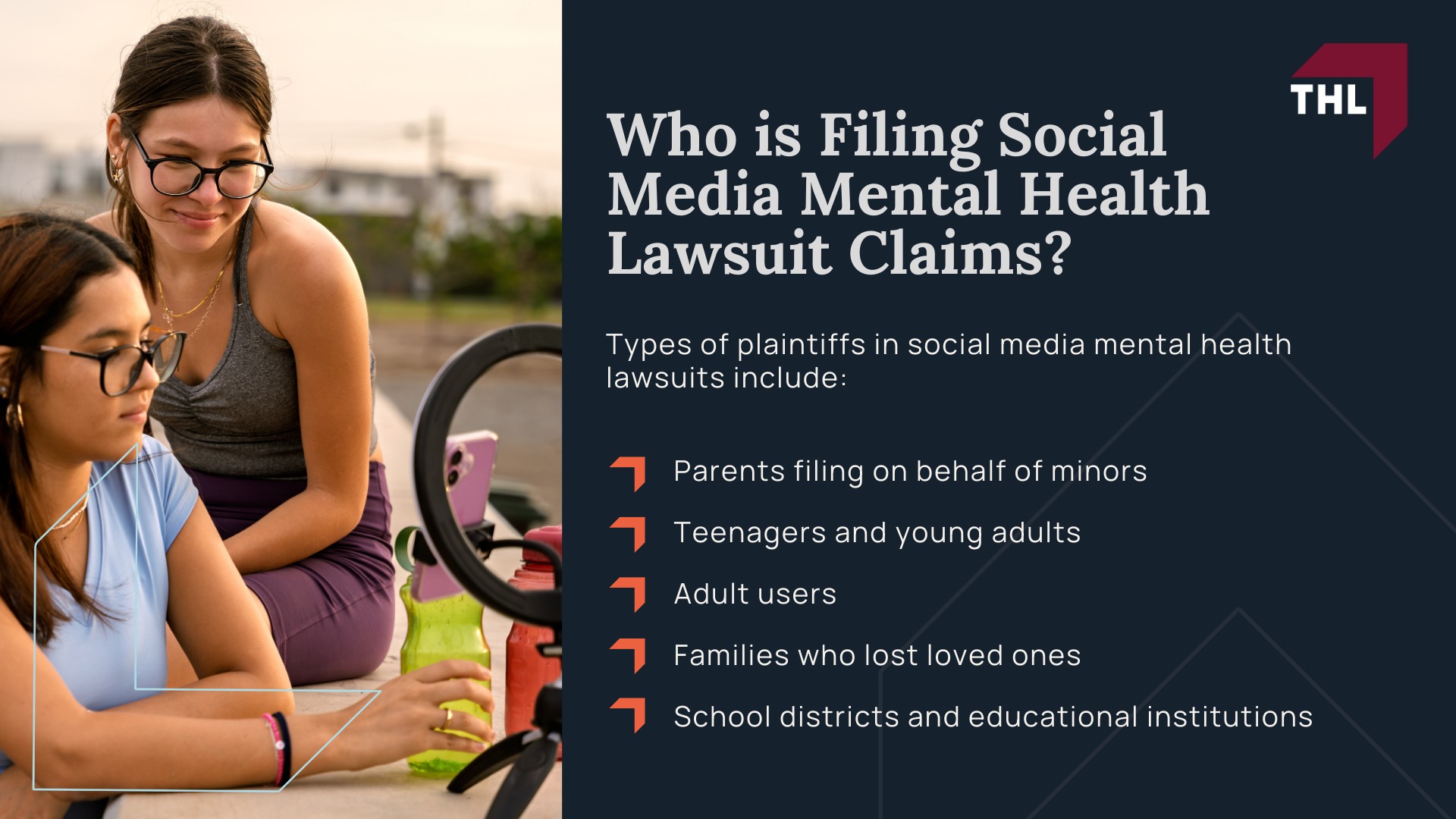
Social Media Mental Health Lawsuit - Overview of the Social Media Addiction Lawsuit - - torhoerman law; Social Media Mental Health Lawsuit - How Many Social Media Addiction Lawsuits Have Been Filed Current Status of the Social Media Harm MDL - torhoerman law; Who is Filing Social Media Mental Health Lawsuit Claims_ - torhoerman law

Types of plaintiffs in social media mental health lawsuits include:

  • Parents filing on behalf of minors who developed depression, anxiety, or self-harm behaviors after excessive use.
  • Teenagers and young adults suffering from eating disorders, body dysmorphia, or addiction-like dependency on multiple platforms.
  • Adult users who began using social media as children and now experience lasting mental health harm and reduced quality of life.
  • Families who lost loved ones to suicide or self-harm connected to social media-related mental health decline.
  • School districts and educational institutions facing increased costs for counseling, crisis intervention, and programs to combat the effects of social media use on students’ mental health outcomes.

What Social Media Companies are Named in the Lawsuit?

The Social Media Mental Health Lawsuit names several of the world’s largest technology and communication companies as defendants for their role in designing addictive and psychologically harmful platforms.

The primary defendant is Meta Platforms, the parent company of Facebook and Instagram, which plaintiffs claim knowingly developed algorithms that negatively influence social media’s impact on youth mental health.

Other social media companies named include ByteDance (TikTok), Snap Inc. (Snapchat), and Alphabet Inc. (YouTube), all accused of exploiting young users through design features that encourage compulsive use.

Together, the defendants represent nearly all major platforms used by children and teens in the United States.
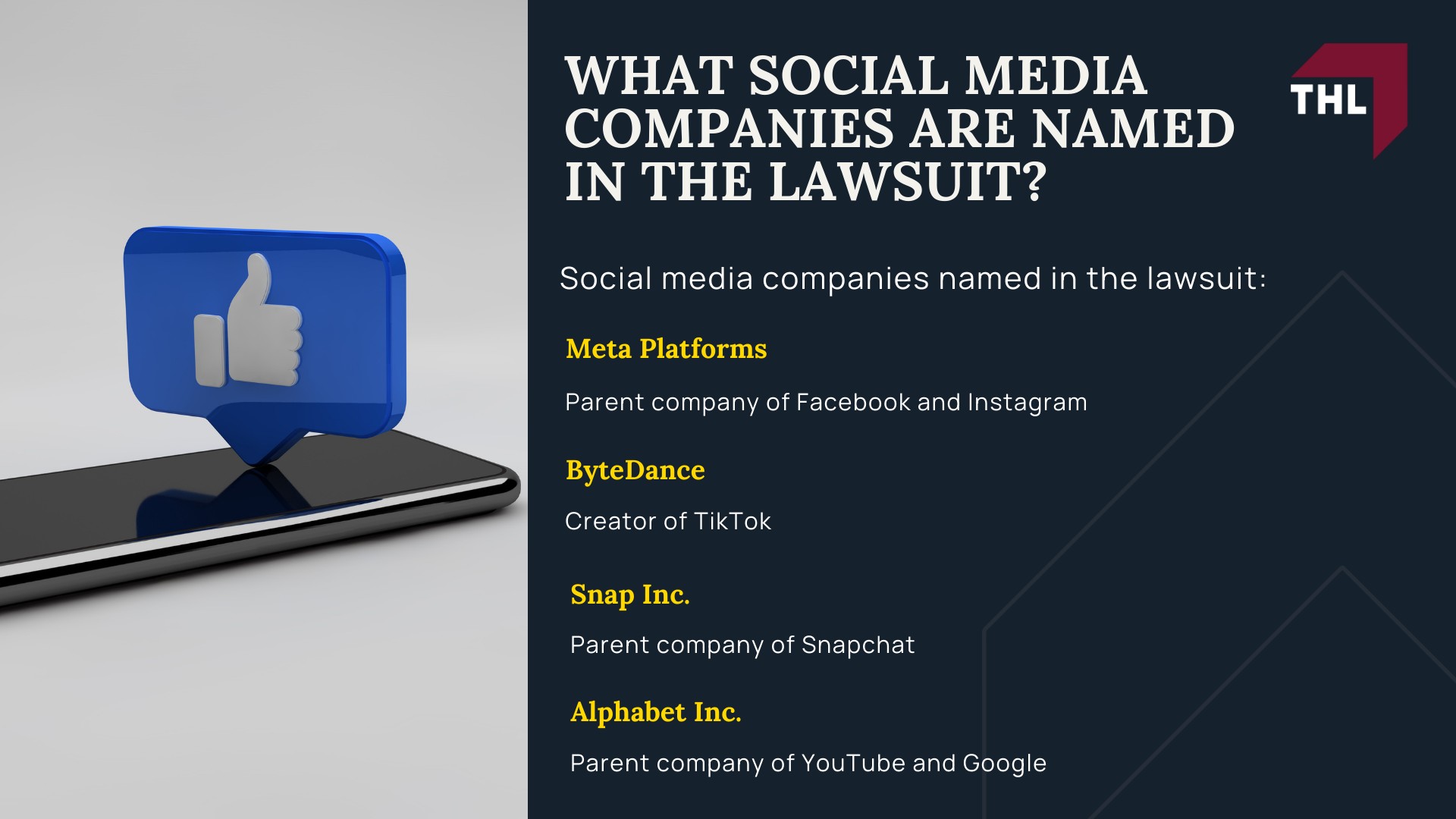
Social Media Mental Health Lawsuit - Overview of the Social Media Addiction Lawsuit - - torhoerman law; Social Media Mental Health Lawsuit - How Many Social Media Addiction Lawsuits Have Been Filed Current Status of the Social Media Harm MDL - torhoerman law; Who is Filing Social Media Mental Health Lawsuit Claims_ - torhoerman law; Social Media Mental Health Lawsuit - What Social Media Companies are Named in the Lawsuit_ - torhoerman law

Social media companies named in the lawsuit:

  • Meta Platforms: Parent company of Facebook and Instagram
  • ByteDance: Creator of TikTok
  • Snap Inc.: Parent company of Snapchat
  • Alphabet Inc.: Parent company of YouTube and Google
Mental Health and Physical Harms Linked to Social Media Use

Emerging research and public-health advisories increasingly link extensive social media use on addictive social media platforms to a wide array of severe mental health issues and physical effects among children, teens and young adults.

According to the World Health Organization (WHO), approximately 11% of adolescents surveyed across Europe, Central Asia and Canada in 2022 exhibited signs of “problematic social media behavior,” characterized by loss of control, withdrawal and neglect of other activities.

A U.S. advisory from the U.S. Surgeon General’s Office found that adolescents who spend more than three hours per day on social-media platforms face double the risk of depression and anxiety compared to their peers.

Whistleblower Frances Haugen revealed internal research from Meta Platforms showing the company’s own research acknowledged the negative effects of its platforms on teen mental-health, yet the documents indicate it chose to move ahead without sufficient protective safeguards.

These findings support claims in the current In re Social Media Adolescent Addiction/Personal Injury Products Liability Litigation (Social Media MDL) that major platforms neglected to act on known risks and therefore contributed to mental health consequences in young users.

Social Media Mental Health Lawsuit - Overview of the Social Media Addiction Lawsuit - - torhoerman law; Social Media Mental Health Lawsuit - How Many Social Media Addiction Lawsuits Have Been Filed Current Status of the Social Media Harm MDL - torhoerman law; Who is Filing Social Media Mental Health Lawsuit Claims_ - torhoerman law; Social Media Mental Health Lawsuit - What Social Media Companies are Named in the Lawsuit_ - torhoerman law; Social Media Mental Health Lawsuit - Mental Health and Physical Harms Linked to Social Media Use - torhoerman law

The body-of-evidence also highlights physical health harms tied to excessive screen time (such as disrupted sleep, poor posture and stress-related fatigue) that compound the psychological impact of young people’s mental health struggles.

In short, the alleged link between platform design, compulsive social media use and worsening mental health outcomes is foundational to the litigation and demands serious examination.

Mental Health Issues Linked to Excessive Social Media Use

Excessive social media use has been strongly associated with a rise in teen mental health issues and a broad range of psychological and emotional consequences.

Studies from health organizations warn that the mental health risks of these platforms extend beyond temporary stress.

They contribute to long-term psychological harm and behavioral changes.

Constant comparison, exposure to harmful content, and algorithm-driven engagement can lead to declining self-esteem, social withdrawal, and symptoms resembling addiction.

For many young users, these mental health impacts develop gradually, making them difficult to recognize until they have already affected mood, sleep, and functioning.

Social Media Mental Health Lawsuit - Overview of the Social Media Addiction Lawsuit - - torhoerman law; Social Media Mental Health Lawsuit - How Many Social Media Addiction Lawsuits Have Been Filed Current Status of the Social Media Harm MDL - torhoerman law; Who is Filing Social Media Mental Health Lawsuit Claims_ - torhoerman law; Social Media Mental Health Lawsuit - What Social Media Companies are Named in the Lawsuit_ - torhoerman law; Social Media Mental Health Lawsuit - Mental Health and Physical Harms Linked to Social Media Use - torhoerman law; Social Media Mental Health Lawsuit - Mental Health Issues Linked to Excessive Social Media Use - torhoerman law

Common mental health issues linked to social media use include:

  • Anxiety disorders and persistent worry related to online interactions or validation
  • Depression and social isolation tied to excessive scrolling or negative comparisons
  • Eating disorders, including anorexia and bulimia, fueled by exposure to idealized body images
  • Body dysmorphia and obsessive appearance-related behaviors
  • Sleep disruption and fatigue connected to late-night screen exposure and engagement loops
  • Addiction-like dependence on social media for mood regulation or self-worth
  • Self-harm behaviors and suicidal ideation driven by cyberbullying or social rejection
  • Low self-esteem, irritability, and emotional volatility among frequent users

Physical Harm Linked to Compulsive Social Media Use

Numerous scientific studies have now established that extensive social media use (especially on addictive platforms geared toward young people) can lead not only to emotional and psychological damage, but to observable physical health harms as well.

Researchers at the University at Buffalo found that college students with high levels of social media engagement showed elevated levels of C-reactive protein (CRP), a marker of chronic inflammation tied to serious conditions such as cardiovascular disease and diabetes.

A comprehensive review published in The BMJ analyzing over 1.4 million adolescents determined that frequent social media use was significantly associated with unhealthy dietary behaviors, increased substance use, and multiple physical-risk behaviors.

According to The Lancet, the ubiquitous nature of screen media in adolescence raises concerns about reduced physical activity, poor sleep hygiene, and detrimental developmental outcomes.

The mental health impacts of social media addiction do not occur in a vacuum.

Physical health consequences such as sedentary behavior, disrupted sleep, and musculoskeletal strain amplify the total burden of harm.

Because these cumulative harms occur during critical years of growth and brain development, young users face a combination of mental health risks and physical vulnerabilities that are central to the ongoing litigation.

Social Media Mental Health Lawsuit - Overview of the Social Media Addiction Lawsuit - - torhoerman law; Social Media Mental Health Lawsuit - How Many Social Media Addiction Lawsuits Have Been Filed Current Status of the Social Media Harm MDL - torhoerman law; Who is Filing Social Media Mental Health Lawsuit Claims_ - torhoerman law; Social Media Mental Health Lawsuit - What Social Media Companies are Named in the Lawsuit_ - torhoerman law; Social Media Mental Health Lawsuit - Mental Health and Physical Harms Linked to Social Media Use - torhoerman law; Social Media Mental Health Lawsuit - Mental Health Issues Linked to Excessive Social Media Use - torhoerman law; Social Media Mental Health Lawsuit - Physical Harm Linked to Compulsive Social Media Use - torhoerman law

Below is a list of the most noted physical and behavioral harms linked to excessive social media use:

  • Elevated inflammatory markers (e.g., higher C-reactive protein) among heavy social media users
  • Chronic sleep disturbance and reduced sleep duration linked to late-night screen exposure
  • Sedentary behavior and decreased physical activity associated with prolonged device use
  • Musculoskeletal complaints (neck/back pain, headaches) tied to device posture and screen gaze
  • Poor dietary behaviors such as disordered eating patterns triggered by social comparison and diet-culture content
  • Increased risk of obesity, metabolic syndrome or cardiovascular issues due to lifestyle disruption
  • Eye strain, headaches, and visual fatigue from extended screen time
  • Reduced engagement in outdoor/physical play, affecting physical development in children and adolescents
  • Compounded harm when psychological distress (e.g., anxiety or depression) co-occurs with physical inactivity
  • Substance use, unsafe behaviors or self-harm acts emerging as coping strategies for compounded mental and physical stress

Do You Qualify for the Social Media Mental Health Lawsuit?

Determining whether you qualify for the Social Media Mental Health Lawsuit depends on your history of platform use and any documented mental health impacts linked to that use.

Individuals who developed anxiety, depression, eating disorders, or self-harm behaviors due to excessive time spent on apps like Instagram, TikTok, Snapchat, or YouTube may be eligible to file social media addiction claims.

Parents and guardians can also pursue legal action on behalf of minors who suffered serious psychological or physical harm after years of compulsive use.

Many claimants report that social media use began in childhood and escalated into patterns consistent with behavioral addiction.

Social Media Mental Health Lawsuit - Overview of the Social Media Addiction Lawsuit - - torhoerman law; Social Media Mental Health Lawsuit - How Many Social Media Addiction Lawsuits Have Been Filed Current Status of the Social Media Harm MDL - torhoerman law; Who is Filing Social Media Mental Health Lawsuit Claims_ - torhoerman law; Social Media Mental Health Lawsuit - What Social Media Companies are Named in the Lawsuit_ - torhoerman law; Social Media Mental Health Lawsuit - Mental Health and Physical Harms Linked to Social Media Use - torhoerman law; Social Media Mental Health Lawsuit - Mental Health Issues Linked to Excessive Social Media Use - torhoerman law; Social Media Mental Health Lawsuit - Physical Harm Linked to Compulsive Social Media Use - torhoerman law; Social Media Mental Health Lawsuit - Do You Qualify for the Social Media Mental Health Lawsuit_ - torhoerman law

The social media multidistrict litigation consolidates these cases in federal court, allowing individuals from across the U.S. to file claims while maintaining their own representation and evidence.

A qualified attorney will review your medical records, therapy documentation, and app usage data to determine if your situation fits the established criteria.

Even if your child has not received a formal diagnosis, patterns of excessive social media use and measurable emotional changes can support eligibility.

TorHoerman Law is currently reviewing new cases for potential inclusion in the Social Media MDL and can help evaluate whether you or your child qualify to take legal action.

Gathering Evidence for a Social Media Mental Health Lawsuit

Evidence helps demonstrate how algorithms, notifications, and engagement loops contributed to addiction-like patterns and worsening mental health over time.

Attorneys use a combination of digital records, medical documentation, and expert evaluations to prove causation in these cases.

The more comprehensive the evidence, the stronger the foundation for your social media addiction claim.

Social Media Mental Health Lawsuit - Overview of the Social Media Addiction Lawsuit - - torhoerman law; Social Media Mental Health Lawsuit - How Many Social Media Addiction Lawsuits Have Been Filed Current Status of the Social Media Harm MDL - torhoerman law; Who is Filing Social Media Mental Health Lawsuit Claims_ - torhoerman law; Social Media Mental Health Lawsuit - What Social Media Companies are Named in the Lawsuit_ - torhoerman law; Social Media Mental Health Lawsuit - Mental Health and Physical Harms Linked to Social Media Use - torhoerman law; Social Media Mental Health Lawsuit - Mental Health Issues Linked to Excessive Social Media Use - torhoerman law; Social Media Mental Health Lawsuit - Physical Harm Linked to Compulsive Social Media Use - torhoerman law; Social Media Mental Health Lawsuit - Do You Qualify for the Social Media Mental Health Lawsuit_ - torhoerman law; Social Media Mental Health Lawsuit - Gathering Evidence for a Social Media Mental Health Lawsuit - torhoerman law

Evidence in a social media mental health lawsuit may include:

  • Social media account data showing daily or hourly usage patterns and screen time
  • Medical and therapy records documenting diagnoses of depression, anxiety, eating disorders, or self-harm
  • Expert evaluations linking excessive social media use to mental health decline
  • Screenshots or content logs showing exposure to harmful or triggering material
  • Witness statements from parents, teachers, or peers observing behavioral or emotional changes
  • School performance records reflecting academic or attendance issues tied to social media use
  • Device usage reports or app analytics verifying prolonged engagement across multiple platforms

Damages in a Social Media Addiction Case

In a social media addiction case, damages refer to the financial, emotional, and physical losses suffered as a result of compulsive platform use and related mental health harm.

These damages help quantify the impact that social media’s addictive design has had on a person’s life, from treatment expenses to long-term psychological effects.

Attorneys evaluate both economic and non-economic damages to pursue the full scope of compensation available under the social media multidistrict litigation.

The goal is to hold social media companies accountable for the widespread harm caused by their products and recover meaningful financial relief for victims and families.

Social Media Mental Health Lawsuit - Overview of the Social Media Addiction Lawsuit - - torhoerman law; Social Media Mental Health Lawsuit - How Many Social Media Addiction Lawsuits Have Been Filed Current Status of the Social Media Harm MDL - torhoerman law; Who is Filing Social Media Mental Health Lawsuit Claims_ - torhoerman law; Social Media Mental Health Lawsuit - What Social Media Companies are Named in the Lawsuit_ - torhoerman law; Social Media Mental Health Lawsuit - Mental Health and Physical Harms Linked to Social Media Use - torhoerman law; Social Media Mental Health Lawsuit - Mental Health Issues Linked to Excessive Social Media Use - torhoerman law; Social Media Mental Health Lawsuit - Physical Harm Linked to Compulsive Social Media Use - torhoerman law; Social Media Mental Health Lawsuit - Do You Qualify for the Social Media Mental Health Lawsuit_ - torhoerman law; Social Media Mental Health Lawsuit - Gathering Evidence for a Social Media Mental Health Lawsuit - torhoerman law; Social Media Mental Health Lawsuit - Damages in a Social Media Addiction Case - torhoerman law

Damages in a social media mental health lawsuit may include:

  • Medical expenses for therapy, psychiatric care, hospitalization, or medication
  • Future treatment costs for ongoing counseling or rehabilitation programs
  • Lost wages or earning capacity due to prolonged mental health struggles
  • Pain and suffering related to emotional distress, anxiety, or depression
  • Loss of enjoyment of life resulting from social withdrawal or psychological harm
  • Educational losses such as academic decline or withdrawal from school
  • Parental damages for emotional distress and financial strain caused by a child’s condition
  • Wrongful death damages in cases involving suicide or fatal self-harm
  • Physical health impacts including malnutrition, fatigue, or chronic sleep disruption

TorHoerman Law: Social Media Addiction Lawyers

TorHoerman Law is at the forefront of the nationwide effort to hold social media companies accountable for the harm their platforms have caused to children, teens, and young adults.

Our firm combines extensive experience in large-scale product liability and public health litigation with a compassionate, client-centered approach.

We understand how devastating the effects of social media addiction can be, from anxiety and depression to self-harm and long-term emotional trauma.

Every case we take is built with the goal of achieving justice, reform, and meaningful recovery for victims and their families.

Social Media Mental Health Lawsuit - Overview of the Social Media Addiction Lawsuit - - torhoerman law; Social Media Mental Health Lawsuit - How Many Social Media Addiction Lawsuits Have Been Filed Current Status of the Social Media Harm MDL - torhoerman law; Who is Filing Social Media Mental Health Lawsuit Claims_ - torhoerman law; Social Media Mental Health Lawsuit - What Social Media Companies are Named in the Lawsuit_ - torhoerman law; Social Media Mental Health Lawsuit - Mental Health and Physical Harms Linked to Social Media Use - torhoerman law; Social Media Mental Health Lawsuit - Mental Health Issues Linked to Excessive Social Media Use - torhoerman law; Social Media Mental Health Lawsuit - Physical Harm Linked to Compulsive Social Media Use - torhoerman law; Social Media Mental Health Lawsuit - Do You Qualify for the Social Media Mental Health Lawsuit_ - torhoerman law; Social Media Mental Health Lawsuit - Gathering Evidence for a Social Media Mental Health Lawsuit - torhoerman law; Social Media Mental Health Lawsuit - Damages in a Social Media Addiction Case - torhoerman law; Social Media Mental Health Lawsuit - TorHoerman Law_ National Product Liability Lawyers - torhoerman law

If you or your child developed mental health issues after prolonged or compulsive use of platforms like Instagram, TikTok, Snapchat, or YouTube, you may qualify to file a claim in the Social Media MDL.

Contact TorHoerman Law’s Social Media Addiction Lawyers today for a free and confidential consultation.

There are no upfront costs, and you pay nothing unless we win compensation on your behalf.

You can also use the chat feature on this page to find out if you’re eligible to file a social media addiction lawsuit.

Frequently Asked Questions

Published by:
Share
Picture of Tor Hoerman
Tor Hoerman

Tor Hoerman has represented injured individuals for more than 30 years, with experience spanning individual personal injury cases and nationwide mass tort litigation. His work includes car accidents, catastrophic injuries, product liability claims, and other serious injury cases. Tor has served in court-appointed leadership roles in national litigation and tried cases involving major corporate defendants.

TorHoerman Law’s legal content is researched and written by our editorial team and attorneys for legal accuracy, clarity, and relevance. We rely on statutes, court records, government publications, medical research, and other authoritative sources when applicable. This page provides general legal information and does not constitute legal advice.

TorHoerman Law reviews its legal content for factual accuracy, current information, and relevant legal context before publication and as material developments occur. This article is provided for general informational purposes and does not constitute legal advice. For guidance about a specific case, contact TorHoerman Law.

Additional Social Media Mental Health Lawsuit resources on our website:
All
FAQs
Injuries & Conditions
Legal Help
Other Resources
Settlements & Compensation
News

You can learn more about this topic by visiting any of our Social Media Mental Health Lawsuit pages listed below:

Do I Qualify for the Social Media Addiction Lawsuit?
Facebook Mental Health Lawsuit
How To File a Lawsuit Against Facebook for Social Media Addiction
How To File a Lawsuit Against Instagram for Social Media Addiction
How To File a Lawsuit Against Snapchat for Social Media Addiction
How To File a Lawsuit Against TikTok for Social Media Addiction
Instagram Mental Health Lawsuit
Meta Lawsuit for Addiction and Mental Health Effects
Potential Damages in Social Media Lawsuits
Snapchat Lawsuit
Social Media Addiction Lawsuits
Social Media Anorexia Lawsuit
Social Media Body Dysmorphia Lawsuit
Social Media Bulimia Lawsuit
Social Media Depression Lawsuit
Social Media Eating Disorders Lawsuit
Social Media Exploitation Lawsuit
Social Media Harm Lawsuit Injuries
Social Media Harm Lawsuit Settlement Amounts
Social Media Self Harm Lawsuit
Social Media Suicide Lawsuit
Social Media's Effects on Mental Health
TikTok Mental Health Lawsuit
Who Are the Defendants in the Social Media Lawsuit?
YouTube Addiction Lawsuit
Have you or a loved one been injured?

A serious injury can change your life.

Speak with an experienced personal injury lawyer about your rights, your case, and the legal options available to you.
Google
677 reviews
4.9
★★★★★
Recovered damages
$4 Billion+

Table of Contents

Guides & Resources
About TorHoerman Law

TorHoerman Law represents people whose lives have been disrupted by serious injuries, unsafe products, and negligence. Our attorneys handle individual personal injury cases as well as national mass tort lawsuits involving major corporations.

Founded in 2009, our legal team brings more than 100 years of combined experience handling serious injury and complex civil litigation.

Do you believe you’re entitled to compensation?

Use our Instant Case Evaluator to find out in as little as 60 seconds!

$495 Million
Baby Formula NEC Lawsuit

In this case, we obtained a verdict of $495 Million for our client’s child who was diagnosed with Necrotizing Enterocolitis after consuming baby formula manufactured by Abbott Laboratories.

$20 Million
Toxic Tort Injury

In this case, we were able to successfully recover $20 Million for our client after they suffered a Toxic Tort Injury due to chemical exposure.

$103.8 Million
COX-2 Inhibitors Injury

In this case, we were able to successfully recover $103.8 Million for our client after they suffered a COX-2 Inhibitors Injury.

$4 Million
Traumatic Brain Injury

In this case, we were able to successfully recover $4 Million for our client after they suffered a Traumatic Brain Injury while at daycare.

$2.8 Million
Defective Heart Device

In this case, we were able to successfully recover $2.8 Million for our client after they suffered an injury due to a Defective Heart Device.

Other Social Media Mental Health Lawsuit Resources

All
FAQs
Injuries & Conditions
Legal Help
Other Resources
Settlements & Compensation
News