(888) 508-6752

What Happens If the At-Fault Driver is Not Insured in a Car Wreck?

Published By:
Picture of Tor Hoerman
Tor Hoerman

Tor Hoerman has represented injured individuals for more than 30 years, with experience spanning individual personal injury cases and nationwide mass tort litigation. His work includes car accidents, catastrophic injuries, product liability claims, and other serious injury cases. Tor has served in court-appointed leadership roles in national litigation and tried cases involving major corporate defendants.

TorHoerman Law’s legal content is researched and written by our editorial team and attorneys for legal accuracy, clarity, and relevance. We rely on statutes, court records, government publications, medical research, and other authoritative sources when applicable. This page provides general legal information and does not constitute legal advice.

TorHoerman Law reviews its legal content for factual accuracy, current information, and relevant legal context before publication and as material developments occur. This article is provided for general informational purposes and does not constitute legal advice. For guidance about a specific case, contact TorHoerman Law.

Injured by an Uninsured or Underinsured Driver? You May Have Legal Options

If you are hit by an uninsured driver, you may still have options to recover compensation even though the at-fault driver does not have liability insurance.

Depending on your state’s laws and your auto insurance coverage, you may be able to file an uninsured motorist claim through your own insurance policy, use other available coverage, or pursue the at-fault driver directly if recovery is practical.

A motor vehicle accident involving an uninsured driver often creates additional challenges, but it does not automatically prevent you from recovering damages for medical expenses, lost wages, vehicle repairs, and other losses.

The best path forward depends on the insurance coverage available, the severity of your injuries, and whether any other parties share legal responsibility for the crash.

This guide explains who pays when the at-fault driver has no liability insurance, how uninsured motorist coverage works, when a lawsuit may be appropriate, and the steps you can take to protect your claim after the accident.

If you were injured in a crash with an uninsured driver, contact TorHoerman Law for a free, no-obligation consultation to discuss your legal options.

What Happens If the At-Fault Driver is Not Insured in a Car Wreck; What Happens If the At-Fault Driver Has No Insurance; Uninsured and Underinsured Motorist Coverage Explained; Important Rules That Can Affect an Uninsured Motorist Claim; What Happens in Different Uninsured Driver Scenarios; Common Injuries in Uninsured Driver Accidents; Evidence You Need to Support Your Claim; Common Mistakes to Avoid After an Uninsured Driver Accident; Who is Liable and What Compensation Can You Recover; Damages in an Uninsured Motorist Accident Claim; The Legal Process for an Uninsured Driver Accident Case; How a Car Accident Lawyer Can Help in a UM Claim; TorHoerman Law_ Car Accident Attorneys

Understanding Your Options After an Accident With an Uninsured Driver

Every state across the United States requires drivers to carry at least a minimum amount of car insurance, but not everyone follows those laws.

Even when states establish minimum requirements for liability insurance, some drivers carry no insurance at all, while others have liability limits that are too low to fully compensate an injured person after a serious crash.

If a negligent driver causes a motor vehicle accident and has no insurance, you cannot recover compensation from liability insurance that does not exist.

Even so, you may still have options.

Depending on your own policy and the circumstances of the collision, your auto insurance may provide coverage through uninsured motorist benefits, collision coverage, medical payments coverage, or other available protections.

In some cases, another party associated with the other vehicle may also be legally responsible for your damages.

Understanding which insurance policies apply is often one of the most important parts of an uninsured driver claim.

Questions about available coverage, liability limits, and state insurance laws can affect how much compensation you are able to recover and who ultimately pays for your injuries and other losses.

Being involved in a collision with an uninsured driver can create uncertainty about who will pay for your medical bills, lost wages, and other damages.

An experienced car accident lawyer can review your insurance policy, determine what coverage may be available, investigate whether another party shares responsibility for the crash, and handle negotiations with the insurance company on your behalf.

If you were injured because of a negligent driver who lacked adequate insurance, contact TorHoerman Law for a free, no-obligation consultation.

Table of Contents

What Happens If the At-Fault Driver Has No Insurance?

If the driver who caused your crash has no insurance, you cannot file a claim against their liability coverage because there is no policy available to pay for your injuries or other losses.

In some cases, the driver may have no coverage at all. In others, the driver may have only minimum coverage that is not enough to pay the full value of your claim.

Being hit by an uninsured driver does not automatically mean you have no way to recover compensation. Many injured people file an uninsured motorist claim through their own insurance company.

Uninsured motorist coverage is designed to apply when the at-fault driver lacks liability coverage, and the coverage limits often match your own liability limits.

What Happens If the At-Fault Driver Has No Insurance

Depending on your policy and the laws in your state, your options may include:

  • Filing an uninsured motorist claim: If you carry UM coverage, your own insurer may pay for damages the uninsured driver would have been responsible for.
  • Using other coverage on your policy: Collision coverage may help pay for vehicle repairs, while medical payments coverage may help with injury-related costs.
  • Pursuing the at-fault driver directly: You may be able to file a personal injury claim or lawsuit, although collecting compensation depends on whether the driver has income or assets.
  • Identifying other responsible parties: In limited cases, another party may share liability, such as an employer if the driver was working at the time of the crash.

The right path depends on your insurance policy, the available coverage, and the state where the crash occurred.

An experienced attorney can review your coverage, explain whether an uninsured motorist claim is available, and determine whether any other source of compensation may apply.

Uninsured and Underinsured Motorist Coverage Explained

Uninsured motorist (UM) and underinsured motorist (UIM) coverage are two of the most important protections available after a serious car accident.

Both are optional or required depending on state law, and both provide coverage through your own insurance policy when the at-fault driver cannot fully pay for your losses.

What Happens If the At-Fault Driver Has No Insurance; Uninsured and Underinsured Motorist Coverage Explained

Although the coverages are similar, they apply in different situations:

  • Uninsured motorist (UM) coverage: Applies when the at-fault driver has no auto insurance. In many states, UM coverage also applies to certain hit-and-run accidents involving an unidentified driver. Depending on your policy and state law, it may pay for medical expenses, lost wages, pain and suffering, and, in some states, property damage.
  • Underinsured motorist (UIM) coverage: Applies when the at-fault driver carries liability insurance, but the policy limits are too low to fully compensate you. UIM coverage helps pay the difference between the at-fault driver’s liability limits and the value of your damages, up to the limits of your own policy.

These coverages are increasingly important because uninsured and underinsured drivers remain common across the United States.

According to the Insurance Research Council, approximately 33.4% of drivers were either uninsured or underinsured in 2023.

Unlike a standard liability claim filed against another driver’s insurance company, UM and UIM claims are first-party insurance claims.

In other words, you seek compensation through your own insurance policy.

Even though you pay premiums for that coverage, your insurance company may still investigate the claim, dispute the value of your injuries, or challenge the amount it must pay.

You can find your uninsured and underinsured motorist coverage limits on your policy’s declarations page.

If you are unsure what coverage you purchased or how it applies to your accident, an experienced car accident lawyer can review your policy, identify available benefits, and explain your legal options.

For a broader overview of how these claims fit into a car accident case, you can also read our Ultimate Car Accident Lawsuit Guide.

Important Rules That Can Affect an Uninsured Motorist Claim

Even when you have uninsured motorist coverage, recovering compensation is not always straightforward.

What Happens If the At-Fault Driver Has No Insurance; Uninsured and Underinsured Motorist Coverage Explained; Important Rules That Can Affect an Uninsured Motorist Claim

State laws and insurance policies often contain rules that determine how much you can recover, when you can file a claim, and whether your insurer is required to pay.

Can You Stack Uninsured Motorist Coverage?

In some states, you may be able to “stack” uninsured motorist (UM) coverage to increase the amount of compensation available after a crash.

Stacking allows an injured person to combine the UM coverage limits from multiple vehicles on the same policy or from multiple insurance policies, potentially providing greater financial protection after a serious accident.

Whether stacking is allowed depends on state law and the language of your insurance policy.

Some states permit stacking unless it has been validly waived, while others enforce anti-stacking laws or policy provisions that limit you to the coverage available under a single vehicle or policy.

As a result, two drivers with similar insurance policies may have very different rights depending on where they live.

Because stacking rules vary significantly, it is important to review your policy carefully before assuming how much uninsured motorist coverage is available.

What Happens if Your Insurance Company Denies a UM Claim?

An insurance company does not have to approve every uninsured motorist (UM) claim simply because you have coverage.

Like any insurance claim, the insurer may investigate the accident, review your medical records, and determine whether your claim meets the terms of the policy.

Common reasons an insurance company may deny or dispute a UM claim include:

  • The insurer disputes who caused the accident. The insurance company may argue that the uninsured driver was not entirely at fault or that you share responsibility for the crash.
  • The claim was reported too late. Most insurance policies require prompt notice after an accident. Waiting too long to notify your insurer can jeopardize your claim.
  • There is insufficient evidence. Missing police reports, witness statements, photographs, or medical documentation can make it harder to prove liability or the extent of your damages.
  • The insurer questions your injuries. The insurance company may argue that your injuries are unrelated to the crash, pre-existing, or less severe than claimed.
  • The claim falls within a policy exclusion. Certain exclusions or policy conditions may prevent UM coverage from applying, depending on the circumstances of the accident and your insurance policy.

A denied claim does not necessarily mean you are no longer entitled to compensation.

An experienced attorney can review the insurer’s reasons for the denial, gather additional evidence, negotiate with the insurance company, and, when appropriate, pursue legal action to recover the benefits available under your policy.

What Is UM Arbitration?

Some uninsured motorist (UM) insurance policies require disputes to be resolved through arbitration instead of a lawsuit.

Arbitration is a legal process in which a neutral third party reviews the evidence and decides issues such as fault or the value of your damages.

Whether arbitration is required depends on the language of your insurance policy and the laws of your state.

The arbitration process is generally less formal than a court proceeding, but the decision may still determine how much compensation you recover.

Before agreeing to arbitration or signing any related documents, it is important to understand how the process may affect your rights under your policy.

Common UM Policy Exclusions

Uninsured motorist coverage is intended to protect you when an uninsured driver causes an accident, but it does not apply in every situation.

Every insurance policy contains terms, conditions, and exclusions that may limit or prevent coverage.

Common uninsured motorist policy exclusions include:

  • Excluded drivers: Coverage may not apply if the accident involved a driver specifically excluded from your insurance policy.
  • Intentional acts: Injuries caused by intentional or criminal conduct may not be covered under the policy.
  • Using a non-covered vehicle: Some policies limit UM benefits when the accident involves a vehicle that is not covered under your insurance policy.
  • Lapsed or canceled coverage: If your policy was not active because premiums were not paid, uninsured motorist benefits generally will not be available.
  • Failure to comply with policy requirements: Delaying notice of the accident, failing to cooperate with the insurer’s investigation, or otherwise violating policy conditions may affect coverage.

What Are Offsets in UM Coverage?

An offset is a reduction in the amount your insurance company pays under an uninsured motorist (UM) claim because you have already received compensation from another source.

Depending on your state’s laws and the terms of your policy, an insurer may reduce UM benefits by amounts paid through personal injury protection (PIP), medical payments (MedPay) coverage, workers’ compensation, or another applicable insurance policy.

Offsets are intended to prevent a person from recovering the same damages more than once, but the rules vary significantly from state to state.

Some states limit or prohibit certain offsets, while others allow insurers to reduce UM payments under specific circumstances.

What Happens in Different Uninsured Driver Scenarios?

The steps you should take after an accident with an uninsured driver depend on the circumstances of the crash.

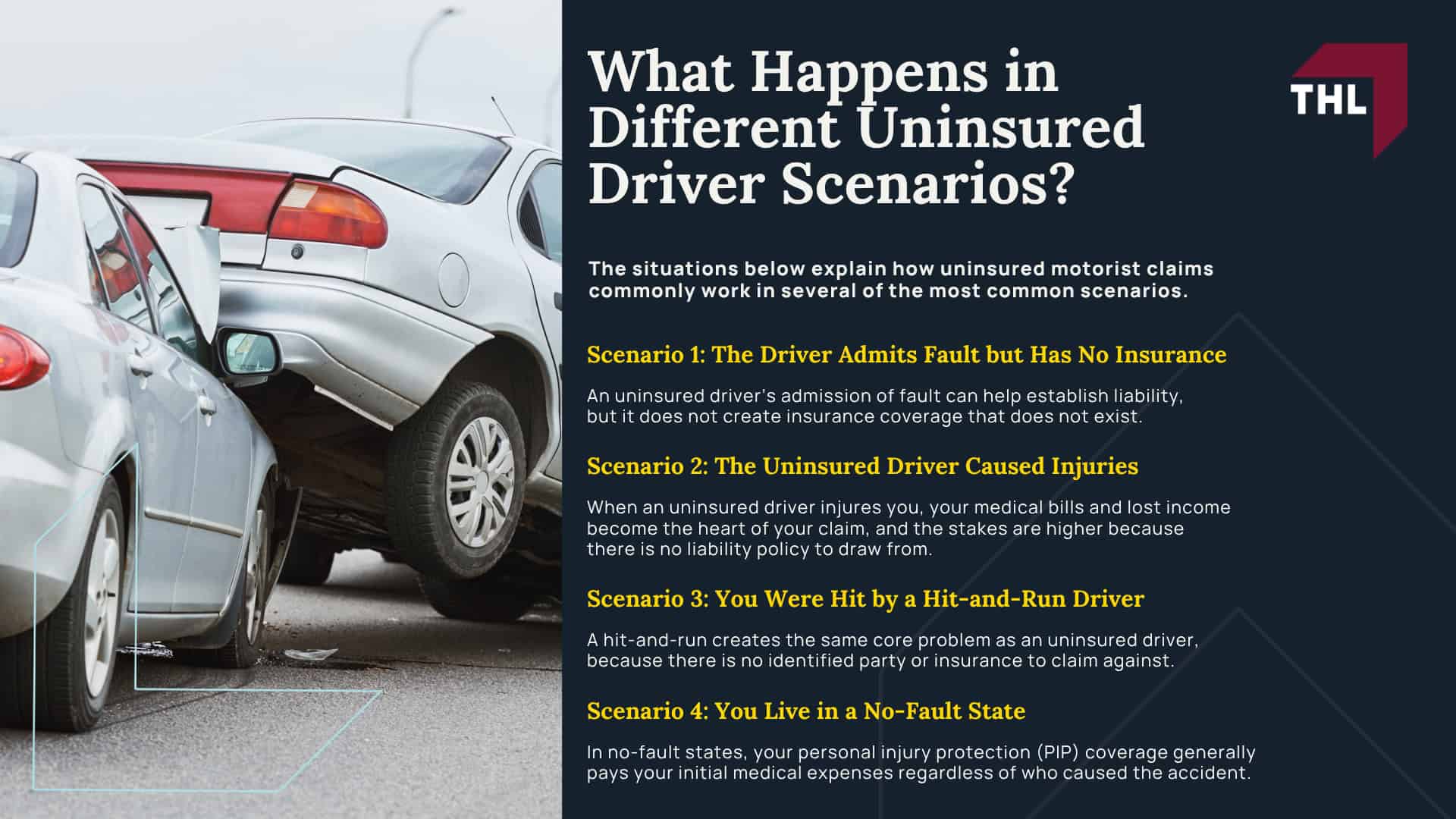
The situations below explain how uninsured motorist claims commonly work in several of the most common scenarios.
What Happens If the At-Fault Driver Has No Insurance; Uninsured and Underinsured Motorist Coverage Explained; Important Rules That Can Affect an Uninsured Motorist Claim; What Happens in Different Uninsured Driver Scenarios

Scenario 1: The Driver Admits Fault but Has No Insurance

An uninsured driver’s admission of fault can help establish liability, but it does not create insurance coverage that does not exist.

If you have uninsured motorist coverage, your claim will usually proceed through your own insurer.

If you do not, you may need to pursue the driver directly, although recovery often depends on whether the driver has assets or income available.

Scenario 2: The Uninsured Driver Caused Injuries

When an uninsured driver injures you, your medical bills and lost income become the heart of your claim, and the stakes are higher because there is no liability policy to draw from.

Uninsured motorist coverage is designed for exactly this situation and can compensate you for injuries when the at-fault driver cannot.

In a no-fault state, your own personal injury protection (PIP) coverage may also pay your initial medical bills regardless of who caused the crash.

Documenting your injuries thoroughly is critical here.

Thorough medical documentation helps establish both the extent of your injuries and their connection to the crash.

Prompt medical care, complete records, and a clear link between the crash and your injuries all strengthen your ability to recover.

Scenario 3: You Were Hit by a Hit-and-Run Driver

A hit-and-run creates the same core problem as an uninsured driver, because there is no identified party or insurance to claim against.

In many cases, uninsured motorist coverage applies to hit-and-run accidents just as it would to a known uninsured driver.

To protect this kind of claim, reporting the crash to police promptly is essential, and most insurers also require timely notice of a hit-and-run.

Try to gather whatever you can to support the claim, such as a partial license plate, vehicle description, photos, video footage, or witness contact information.

The stronger your documentation, the harder it is for an insurer to question whether the hit-and-run occurred as you described.

Some states and insurance policies impose additional requirements for hit-and-run claims, particularly when there was no physical contact between the vehicles.

Scenario 4: You Live in a No-Fault State

In no-fault states, your personal injury protection (PIP) coverage generally pays your initial medical expenses regardless of who caused the accident.

If your injuries exceed your PIP benefits or meet your state’s legal threshold, you may still pursue compensation through uninsured motorist coverage or another available claim.

The rules for stepping outside the no-fault system differ from state to state.

Common Injuries in Uninsured Driver Accidents

The injuries from a crash with an uninsured driver are no different from any other serious collision.

What changes is the financial stakes, because the at-fault driver cannot pay, so the value of your own claim becomes that much more important.

Documenting the full extent of your injuries is essential to recovering what you are owed.

What Happens If the At-Fault Driver Has No Insurance; Uninsured and Underinsured Motorist Coverage Explained; Important Rules That Can Affect an Uninsured Motorist Claim; What Happens in Different Uninsured Driver Scenarios; Common Injuries in Uninsured Driver Accidents

Common injuries in these accidents include:

  • Whiplash and other neck or back injuries, which are common in rear-end and side-impact crashes and can cause lasting pain.
  • Concussions and traumatic brain injuries, which may not show obvious symptoms right away but can have serious long-term effects.
  • Broken bones and fractures, which often require surgery, hardware and months of recovery.
  • Spinal cord injuries, which can lead to partial or permanent loss of function and lifelong care needs.
  • Soft tissue injuries, such as sprains, strains and torn ligaments.
  • Cuts, bruises and lacerations, which can leave scarring.
  • Internal injuries, which can be life-threatening and require emergency care.
  • Emotional and psychological injuries, such as anxiety or post-traumatic stress after a serious crash.

Some of these injuries appear immediately, while others take days to surface.

This is why prompt medical care matters, both for your health and for your claim, which leads directly to the kind of evidence you will need.

Evidence You Need to Support Your Claim

Evidence is the foundation of every uninsured motorist claim.

Whether you are filing a claim through your own insurance company or pursuing the at-fault driver directly, the documents below can help establish liability, prove your damages, and support the value of your claim.

What Happens If the At-Fault Driver Has No Insurance; Uninsured and Underinsured Motorist Coverage Explained; Important Rules That Can Affect an Uninsured Motorist Claim; What Happens in Different Uninsured Driver Scenarios; Common Injuries in Uninsured Driver Accidents; Evidence You Need to Support Your Claim

Evidence in an uninsured driver claim includes:

  • Medical records and bills. These connect your injuries to the crash and document the cost of your treatment, which forms the backbone of your claim.
  • The police or accident report. This provides an official record of the crash, often notes that the other driver was uninsured, and may identify who was at fault.
  • Photographs and video. Photographs of the vehicles, accident scene, road conditions, and visible injuries, along with dashcam, surveillance, or traffic camera footage, can help establish how the collision occurred and the severity of the impact.
  • Witness statements. Independent accounts from people who saw the crash can support your version of events, especially of the driver disputing fault.
  • Expert reports. In serious cases, accident reconstruction experts or medical experts can explain how the crash occurred and the long-term impact of your injuries.
  • Employment records. Pay stubs and employer letters document the income and time you lost while recovering, which supports a claim for lost wages.
  • Insurance documentation. Your own policy, declarations page, and any correspondence with insurers establish what coverage applies and what has been said about your claim.
  • Proof the at-fault driver was uninsured. The police report, correspondence from the other driver’s insurer, or other insurance records may help establish that no applicable liability coverage was available at the time of the crash.

Common Mistakes to Avoid After an Uninsured Driver Accident

Mistakes after an accident with an uninsured driver can make it harder to recover compensation.

What Happens If the At-Fault Driver Has No Insurance; Uninsured and Underinsured Motorist Coverage Explained; Important Rules That Can Affect an Uninsured Motorist Claim; What Happens in Different Uninsured Driver Scenarios; Common Injuries in Uninsured Driver Accidents; Evidence You Need to Support Your Claim; Common Mistakes to Avoid After an Uninsured Driver Accident

The following actions commonly weaken uninsured motorist claims or delay the claims process:

  • Not calling the police. Without an official accident report, it is harder to prove the crash happened and that the other driver was uninsured.
  • Failing to report a hit-and-run promptly. If the at-fault driver fled, delaying your report to police and your insurer can weaken or even void an uninsured motorist claim.
  • Failing to confirm the other driver’s insurance status. A police report, insurance information, or correspondence with the other driver’s insurer may help establish whether liability coverage was in effect at the time of the crash.
  • Skipping medical care. Declining treatment, or waiting too long to see a doctor, gives the insurer a reason to argue your injuries were minor or unrelated to the crash.
  • Failing to notify your insurance company promptly. Most insurance policies require timely notice after an accident. Waiting too long can complicate or jeopardize your uninsured motorist claim.
  • Giving a recorded statement without understanding your injuries. Statements made early in the claims process may later be used to dispute the nature or extent of your injuries.
  • Accepting a settlement before completing treatment. Settling too early may prevent you from recovering compensation for future medical expenses or complications that develop after the accident.
  • Posting about the accident on social media. Photos, check-ins, or comments can be taken out of context and used to dispute your injuries or your version of events.
  • Missing the filing deadline. Every state sets a statute of limitations, and letting that deadline pass can permanently end your claim, no matter how strong it is.
  • Overlooking available insurance coverage. Uninsured motorist, medical payments, collision, umbrella, or other policies may provide benefits that are easy to miss without reviewing the available coverage.

Who is Liable and What Compensation Can You Recover?

An uninsured driver is still legally responsible for the injuries and other damages caused by a motor vehicle accident.

The absence of insurance does not eliminate liability, but it can make recovering compensation more difficult because there is no liability insurance policy available to pay your claim.
What Happens If the At-Fault Driver Has No Insurance; Uninsured and Underinsured Motorist Coverage Explained; Important Rules That Can Affect an Uninsured Motorist Claim; What Happens in Different Uninsured Driver Scenarios; Common Injuries in Uninsured Driver Accidents; Evidence You Need to Support Your Claim; Common Mistakes to Avoid After an Uninsured Driver Accident; Who is Liable and What Compensation Can You Recover

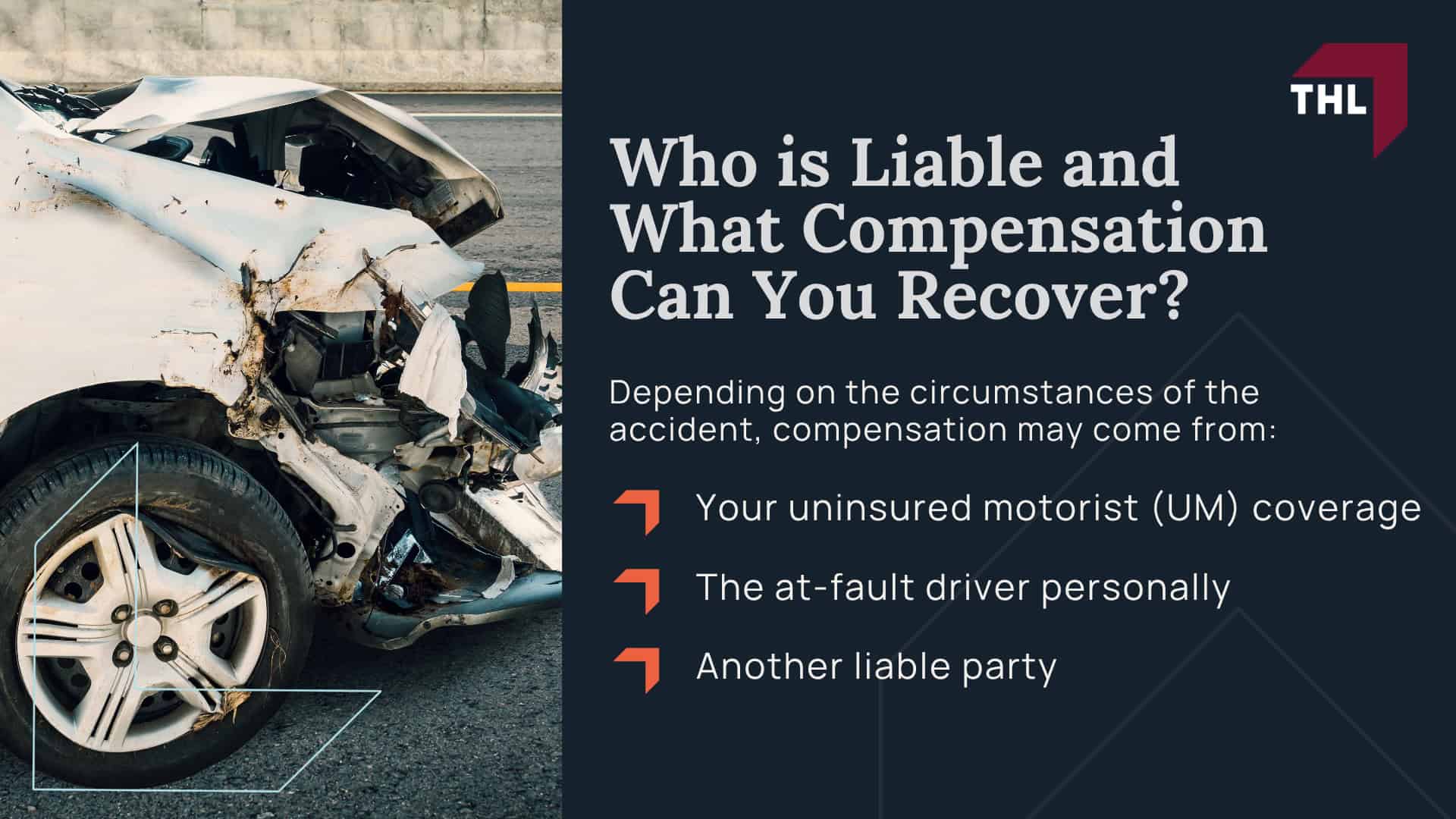
Depending on the circumstances of the accident, compensation may come from:

  • Your uninsured motorist (UM) coverage, if your policy includes it.
  • The at-fault driver personally, through a settlement or court judgment, although recovery depends on whether the driver has sufficient income or assets.
  • Another liable party, such as an employer if the driver was acting within the scope of employment or another person who shares legal responsibility for the crash.

Although you can file a lawsuit against an uninsured driver, obtaining a judgment does not guarantee payment.

Many uninsured drivers have limited financial resources, making uninsured motorist coverage the primary source of recovery in many cases.

If your damages exceed the available insurance coverage, additional legal or insurance options may be available depending on the facts of your case.

You can learn more in our guide to what happens when a car accident claim exceeds insurance limits.

Damages in an Uninsured Motorist Accident Claim

Damages are the financial and personal losses you suffer because of an accident caused by an uninsured driver.

The value of a claim depends on the severity of your injuries, the cost of your medical treatment, the income you lose while recovering, and the long-term impact the accident has on your life.

Lawyers calculate damages by reviewing medical records, employment information, expert opinions, and other evidence to determine the full extent of your losses.

The goal is to recover enough money to compensate you for both your financial losses and the harm the accident has caused.

What Happens If the At-Fault Driver Has No Insurance; Uninsured and Underinsured Motorist Coverage Explained; Important Rules That Can Affect an Uninsured Motorist Claim; What Happens in Different Uninsured Driver Scenarios; Common Injuries in Uninsured Driver Accidents; Evidence You Need to Support Your Claim; Common Mistakes to Avoid After an Uninsured Driver Accident; Who is Liable and What Compensation Can You Recover; Damages in an Uninsured Motorist Accident Claim

You may be able to recover compensation for:

  • Medical expenses, including emergency care, hospitalization, surgery, rehabilitation, medications, and future medical treatment.
  • Lost wages for income missed while recovering from your injuries.
  • Loss of future earning capacity if your injuries permanently affect your ability to work.
  • Property damage to repair or replace your vehicle and other damaged personal property.
  • Pain and suffering resulting from your physical injuries and recovery.
  • Emotional distress such as anxiety, depression, or post-traumatic stress related to the accident.
  • Loss of enjoyment of life if your injuries prevent you from participating in activities you previously enjoyed.
  • Permanent disability or disfigurement caused by the accident.

The Legal Process for an Uninsured Driver Accident Case

An uninsured driver accident claim typically follows many of the same steps as any other car accident claim, but recovering compensation often involves working with your own insurance company instead of the at-fault driver’s insurer.

Taking the right steps after the crash can strengthen your claim and protect your ability to recover compensation.

Acting promptly also helps preserve important evidence and ensures you receive the medical care you need.

If you have questions at any stage of the process, many car accident lawyers offer a free consultation to review your legal options.

What Happens If the At-Fault Driver Has No Insurance; Uninsured and Underinsured Motorist Coverage Explained; Important Rules That Can Affect an Uninsured Motorist Claim; What Happens in Different Uninsured Driver Scenarios; Common Injuries in Uninsured Driver Accidents; Evidence You Need to Support Your Claim; Common Mistakes to Avoid After an Uninsured Driver Accident; Who is Liable and What Compensation Can You Recover; Damages in an Uninsured Motorist Accident Claim; The Legal Process for an Uninsured Driver Accident Case

The claims process generally includes:

  • Call 911 immediately to report the accident and request emergency assistance if anyone is injured.
  • Seek medical treatment as soon as possible, even if your injuries do not seem serious at first.
  • Document the accident scene by taking photographs of the vehicles, roadway, and visible injuries, and collect contact information from any witnesses.
  • Exchange information with the other driver, but do not discuss fault or apologize for the accident.
  • Notify your insurance company and report the uninsured driver as soon as your policy requires.
  • Gather supporting evidence, including medical records, repair estimates, wage loss documentation, and the police report.
  • Review your available insurance coverage to determine whether uninsured motorist or other benefits apply.
  • Negotiate your claim with the insurance company based on the evidence and the value of your damages.
  • File a lawsuit if necessary when a fair settlement cannot be reached or another liable party must be pursued.

Every accident is different, and the claims process may vary depending on your insurance policy and the laws of your state.

Preserving evidence, following your doctor’s treatment recommendations, and meeting all applicable deadlines can improve your ability to recover compensation.

How a Car Accident Lawyer Can Help in a UM Claim

Uninsured motorist claims often involve more than determining who caused the accident.

Insurance coverage questions, disputes over the value of a claim, and negotiations with your own insurance company can make the process more complicated than a typical liability claim.

Legal representation can help ensure the claim is thoroughly investigated, properly documented, and supported by the available evidence.

What Happens If the At-Fault Driver Has No Insurance; Uninsured and Underinsured Motorist Coverage Explained; Important Rules That Can Affect an Uninsured Motorist Claim; What Happens in Different Uninsured Driver Scenarios; Common Injuries in Uninsured Driver Accidents; Evidence You Need to Support Your Claim; Common Mistakes to Avoid After an Uninsured Driver Accident; Who is Liable and What Compensation Can You Recover; Damages in an Uninsured Motorist Accident Claim; The Legal Process for an Uninsured Driver Accident Case; How a Car Accident Lawyer Can Help in a UM Claim

A car accident lawyer may assist by:

  • Investigating the accident to establish liability and identify every potential source of compensation.
  • Preserving evidence before photographs, video footage, vehicle damage, or witness information are lost.
  • Reviewing your insurance policy to determine whether uninsured motorist, underinsured motorist, medical payments, collision, or other coverage applies.
  • Calculating the full value of your damages, including future medical expenses, lost earning capacity, and non-economic losses.
  • Handling communications with the insurance company and responding to requests for statements, records, and additional documentation.
  • Negotiating a settlement supported by the evidence and the applicable insurance coverage.
  • Filing a lawsuit when necessary if negotiations are unsuccessful or another liable party must be pursued.
  • Managing legal deadlines and other procedural requirements throughout the claims process.

Many car accident lawyers, including the team at TorHoerman Law, work on a contingency fee basis, which means you typically pay no attorney fees unless they recover compensation for you.

That arrangement allows you to get experienced help without paying out of pocket while you are already dealing with the costs of the crash.

TorHoerman Law: Car Accident Attorneys

An accident involving an uninsured driver can leave you with serious injuries, mounting expenses, and uncertainty about where compensation will come from.

Even when the at-fault driver lacks insurance, you may still have options through uninsured motorist coverage, other available insurance policies, or claims against additional liable parties.

The attorneys at TorHoerman Law represent individuals injured in car accidents and can evaluate the insurance coverage available, investigate the circumstances of the crash, and pursue the compensation your case deserves.
What Happens If the At-Fault Driver Has No Insurance; Uninsured and Underinsured Motorist Coverage Explained; Important Rules That Can Affect an Uninsured Motorist Claim; What Happens in Different Uninsured Driver Scenarios; Common Injuries in Uninsured Driver Accidents; Evidence You Need to Support Your Claim; Common Mistakes to Avoid After an Uninsured Driver Accident; Who is Liable and What Compensation Can You Recover; Damages in an Uninsured Motorist Accident Claim; The Legal Process for an Uninsured Driver Accident Case; How a Car Accident Lawyer Can Help in a UM Claim; TorHoerman Law_ Car Accident Attorneys

We offer free consultations, and you pay no attorney fees unless we recover compensation on your behalf.

Contact TorHoerman Law today to discuss your uninsured driver accident claim and learn about the legal options available to you.

Frequently Asked Questions

Written By:
Picture of Tor Hoerman

Tor Hoerman

Owner & Attorney - TorHoerman Law

Do You
Have A Case?

Here, at TorHoerman Law, we’re committed to helping victims get the justice they deserve.

Since 2009, we have successfully collected over $4 Billion in verdicts and settlements on behalf of injured individuals.

Would you like our help?

About TorHoerman Law

TorHoerman Law represents people whose lives have been disrupted by serious injuries, unsafe products, and negligence. Our attorneys handle individual personal injury cases as well as national mass tort lawsuits involving major corporations.

Founded in 2009, our legal team brings more than 100 years of combined experience handling serious injury and complex civil litigation.

Do you believe you’re entitled to compensation?

Use our Instant Case Evaluator to find out in as little as 60 seconds!

$20 Million
Toxic Tort Injury

In this case, we were able to successfully recover $20 Million for our client after they suffered a Toxic Tort Injury due to chemical exposure.

$103.8 Million
COX-2 Inhibitors Injury

In this case, we were able to successfully recover $103.8 Million for our client after they suffered a COX-2 Inhibitors Injury.

$4 Million
Traumatic Brain Injury

In this case, we were able to successfully recover $4 Million for our client after they suffered a Traumatic Brain Injury while at daycare.

$2.8 Million
Defective Heart Device

In this case, we were able to successfully recover $2.8 Million for our client after they suffered an injury due to a Defective Heart Device.

Guides & Resources
Do You
Have A Case?

Here, at TorHoerman Law, we’re committed to helping victims get the justice they deserve.

Since 2009, we have successfully collected over $4 Billion in verdicts and settlements on behalf of injured individuals.

Would you like our help?

Share

Related Guides

What Our Clients Have To Say