Aqueous film-forming foam (AFFF) was known as a highly effective and efficient tool to extinguish flammable liquid fires.
Its innovative properties allowed it to quickly suppress fires and form a protective layer to prevent re-ignition.
In collaboration with 3M, the U.S. Military helped to develop aqueous film-forming foam (AFFF) in the 1960s.
After a fire broke out on the US Forrestal and killed 134 sailors in 1967, the US Navy began requiring all vessels to carry AFFF firefighting foam.
Since its development, various military bases have extensively used AFFF foams as a crucial tool in firefighting practices at their grounds, airports, airfields, aircraft carriers, vessels, and other facilities.
Role of AFFF in Addressing Flammable Liquid Fires on Military Installations
The highly flammable nature of aviation fuels and other hazardous liquids demanded a sophisticated firefighting solution.
AFFF’s effectiveness has made it indispensable for safeguarding military installations, from aircraft carriers to air force bases.
Training exercises, simulations, and real-life emergencies required using AFFF to prevent potential disasters and hazards.
Widespread Utilization of AFFF in the U.S. Air Force
Aqueous film-forming foam (AFFF) became ingrained in U.S. Air Force operations, utilized in diverse scenarios such as landing strip emergencies, aircraft carrier incidents, and daily base firefighting preparedness.
The Air Force implemented AFFF firefighting foams as an essential component of its approach to fire safety.
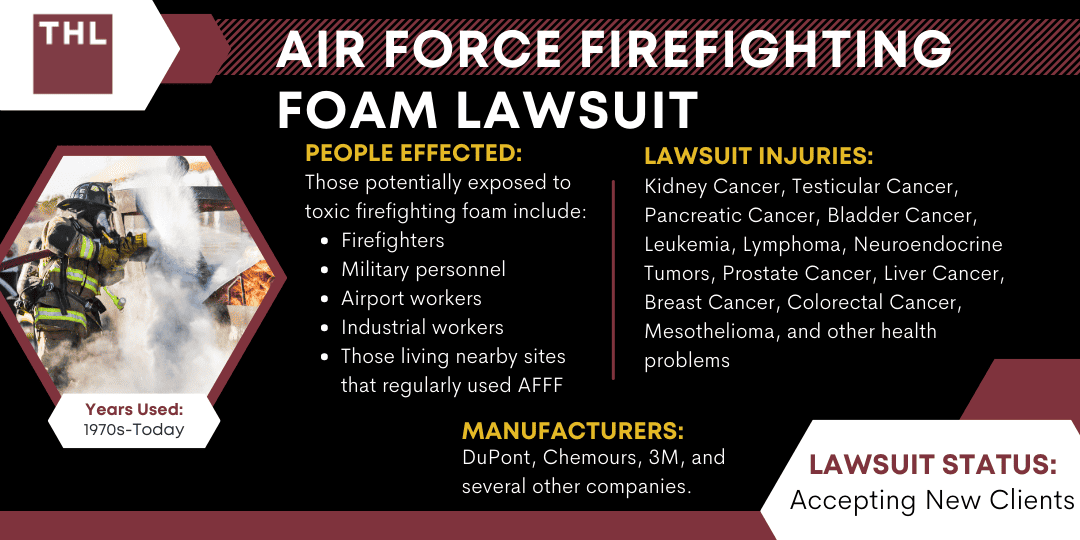
Firefighters and other military personnel on bases, airports, and airfields were routinely exposed to the foam during various drills and emergency responses.
However, the same properties that made AFFF effective also raised concerns about potential health risks associated with exposure.
From the regular use of AFFF, hazardous spills, and accidents to its daily transportation and disposal, the potential for toxic chemicals to impact personnel health was ever-present.